

Note: This article contains affiliate links. If you click on these links and make a purchase, I may earn a small commission at no extra cost to you. This helps support my research and content. Read my full affiliate disclosure here.
Choosing the right outdoor insecticide matters because it shapes how effectively you control pests, protect ornamental and edible plants, and preserve beneficial insects in the landscape. You want a solution that delivers reliable knockdown when pests are active, provides enough residual protection to reduce repeat treatments, and fits the scale of your yard, patio, or garden. This guide shortlists seven top outdoor insecticide options and explains the practical differences between them. We evaluate each product on coverage, longevity, application method, and safety considerations so you can pick the approach that matches your garden layout and pest pressures.
Top Picks at a Glance
| Best Overall The best all-around choice for most situations | Ortho Home Defense Insect Killer Refill, Indoor & Perimeter, 1.33 gal |  |
| Best Quality Built to a higher standard if you want something more solid | Talstar One Insecticide Concentrate, 1 Gallon |  |
| Best Value The sweet spot between price and what you get | Cutter Backyard Bug Control Spray Concentrate, 32 oz (2-Pack) |  |
| Best Budget The cheapest option that still gets the job done reliably | Spectracide Triazicide Insect Killer for Lawns & Landscapes, 32 oz |  |
| Highest Rated A top-rated pick with lots of positive feedback | Envu Tempo SC Ultra Insecticide Concentrate, 240 ml |  |
| Most Popular A crowd favorite that many people choose with confidence | Summit Mosquito Bits Granules, 30 oz |  |
| Best Seller A high-volume bestseller chosen again and again | Atticus Talak 7.9% Bifenthrin Indoor/Outdoor Insecticide Concentrate (32 oz) |  |
Ortho Home Defense Insect Killer Refill, Indoor & Perimeter, 1.33 gal

| Unit Count | 170.24 Fluid Ounces |
|---|---|
| Liquid Volume | 1.33 gallons |
| Item Form | Spray |
| Target Species | Insects |
Ortho Home Defense Insect Killer Refill is a 1.33 gallon concentrated spray intended to refill the Comfort Wand applicator and treat both indoor and perimeter problem areas. It is typically used to spray a band around doorways, windows, foundations and inside kitchens or bathrooms to form a residual barrier that controls ants, roaches, spiders and many other listed insects for up to 12 months on non‑porous indoor surfaces. The formula is described as fast‑drying and no‑fume with an Invisi‑Shield finish that dries clear, which makes treated areas unobtrusive once dry. Because this is a refill concentrate for the Comfort Wand system it is economical for regular perimeter maintenance and avoids repeatedly buying smaller ready‑to‑use cans. Important limitations are that the longest residual claims apply to specific pests and non‑porous surfaces, and the product requires the compatible applicator to get the comfort‑wand spray pattern rather than a built‑in sprayer in the container.
Best for: Homeowners who want a practical, cost‑effective solution for year‑round perimeter and indoor insect control and who plan scheduled maintenance rather than one‑off spot treatments.
Less Ideal for: People who need an all‑in‑one ready‑to‑spray container or who prefer non‑chemical control methods for pests.
- Provides up to 12 months of residual control against ants, roaches and spiders on treated non‑porous indoor surfaces
- Large 1.33 gallon refill is economical for regular perimeter and indoor maintenance
- Invisi‑Shield formula dries clear with no noticeable fumes, keeping treated areas unobtrusive
- Designed for use with the Comfort Wand for easy continuous spray application without bending or pumping
- Longest residual protection is limited to specific pests and non‑porous surfaces
- Requires a compatible Comfort Wand or applicator to achieve the advertised spray pattern
Verdict: Choose this refill if you want an economical, long‑lasting perimeter and indoor insect barrier that pairs with the Comfort Wand for easy, consistent application.
Talstar One Insecticide Concentrate, 1 Gallon

| Active ingredient | Bifenthrin 7.9% |
|---|---|
| Formulation | Water-based concentrate |
| Use sites | Indoor cracks and crevices, perimeter, lawns, ornamentals |
| Pest range | Over 75 pests |
Talstar One is a professional-strength bifenthrin concentrate designed to treat a wide range of household and perimeter pests. It mixes with water to create sprays for foundation perimeters, structural surfaces, lawn ornamentals, and spot treatments indoors in cracks and crevices. The product advertises control of more than 75 pests and provides a low-odor, water-based formula that dries clear, which helps when treating porches, patios, and visible exterior surfaces. Because it is a concentrate, a single gallon can cover large properties or multiple applications when mixed at label rates, making it cost-effective for seasonal maintenance. The main limitation is that it is a chemical insecticide requiring careful adherence to label directions and safety precautions for humans, pets, and desirable plants; it is not a ready-to-use spray and needs proper mixing and application equipment. For users seeking strong, residual perimeter protection rather than an off-the-shelf aerosol, Talstar One delivers professional-level performance.
Best for: Buyers who prioritize strong, professional-grade pest control and need a concentrate that delivers long-lasting perimeter protection across multiple structures and landscapes.
Less Ideal for: Casual users who want a ready-to-use spray or who prefer nonchemical, least-toxic pest control methods should consider alternatives.
- Broad-spectrum control effective against 75+ listed pests including ants, spiders, fleas, ticks, and mosquitoes
- Concentrate formula stretches a single gallon for large properties or repeated seasonal treatments
- Low-odor, water-based formula that dries clear for discreet perimeter and outdoor living area use
- Suitable for both indoor spot treatments and outdoor perimeter, lawn, and ornamental applications
- Concentrate requires mixing and appropriate application equipment
- Chemical insecticide that must be used exactly per label to protect people, pets, and non-target plants
Verdict: Choose Talstar One when you need a concentrated, professional-strength perimeter and structural insecticide with long-lasting residual control.
Cutter Backyard Bug Control Spray Concentrate, 32 oz (2-Pack)

| Unit Count | 64 Fluid Ounces |
|---|---|
| Item Form | Spray |
| Target Species | Insects |
| Active Ingredients | Lambda Cyhalothrin |
The Cutter Backyard Bug Control Spray Concentrate is a ready-to-use hose-end formulation for treating lawns, shrubs, trees and outdoor surfaces to reduce mosquitoes, ants, fleas and other listed insects. You attach the included QuickFlip hose-end sprayer, walk the area while spraying in an even sweeping motion and wet foliage to the dripping point for foliar treatments. Notable features include the hose-activated sprayer that mixes product with water on demand and label guidance for coverage up to 5,000 square feet per bottle. The practical benefit is fast knockdown plus extended residual control, which can reduce repeat treatments through the season. Important limitations are that it is a chemical insecticide with label restrictions on use near aquatic areas and around children or pets until the spray dries, and it requires careful application to avoid runoff or contact with non-target plants. For gardeners who follow label directions it simplifies broad outdoor pest control, but it is not a spot-only or organic option for sensitive plantings.
Best for: Gardeners and homeowners who want an efficient, whole-yard solution to reduce mosquitoes and common landscape insects and who prioritize seasonal control with minimal mixing or repeated mid-season applications.
Less Ideal for: People maintaining aquatic-edge plantings, organic gardens, or those who need selective spot treatments in sensitive landscapes should consider gentler or targeted alternatives.
- Works through a hose-end QuickFlip sprayer for fast, walk-and-spray application
- Label claims up to 12 weeks of control against many common lawn and landscape insects
- Covers up to 5,000 sq. ft. per bottle for whole-yard treatments
- Contains lambda-cyhalothrin, which delivers quick knockdown of listed pests
- Contains a synthetic pesticide with restrictions near water and until surfaces dry
- Not suitable for users seeking organic or spot-only treatments
Verdict: A practical, walk-and-spray concentrate that delivers fast knockdown and season-long yard coverage for homeowners who want straightforward, whole-lawn insect control.
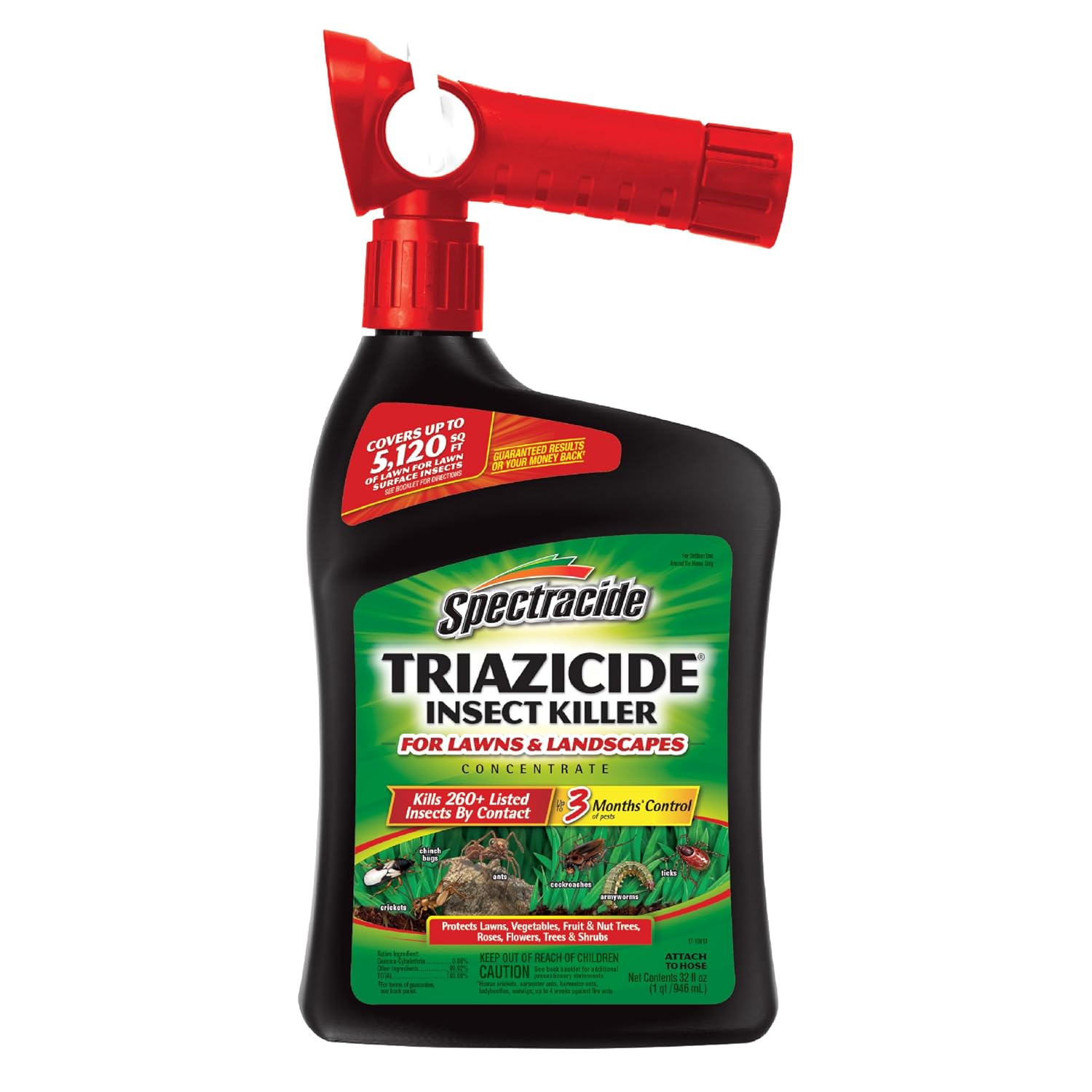
Spectracide Triazicide Insect Killer for Lawns & Landscapes, 32 oz
| Unit Count | 32 Ounce |
|---|---|
| Item Form | Spray |
| Target Species | Insects |
| Active Ingredients | Gamma-Cyhalothrin (0.08%) |
Spectracide Triazicide is a 32-ounce concentrate formulated to control more than 260 listed insects on lawns, flower beds, trees, shrubs and around vegetables. You mix the concentrate with water and apply it with a tank or hose-end sprayer; the ready-to-spray variant can attach to a garden hose for quicker application. The active ingredient, gamma-cyhalothrin, delivers fast contact kill for pests such as fleas, ticks, Japanese beetles and many surface insects, and the label claims protection for up to three months in some uses. It is non-staining when used as directed and can treat large areas, making it practical for whole-yard applications and targeted mound treatments like fire ants. Important limitations include toxicity to fish and bees, so it must not be applied near water or blooming plants, and the product requires careful handling and adherence to safety directions. Follow mixing rates and timing recommendations for best results and to minimize environmental risk.
Best for: Buyers who need an affordable, large-area solution to knock down common lawn and landscape pests and prefer a concentrate that stretches coverage when mixed.
Less Ideal for: People with small ornamental gardens near ponds, homeowners who prioritize pollinator-safe products, or those unwilling to follow pesticide safety precautions should consider gentler or targeted alternatives.
- Concentrate covers large areas so a single bottle treats many square feet when mixed correctly
- Fast-acting contact kill for a wide range of listed insects including fleas, ticks and Japanese beetles
- Versatile use on lawns, flower beds, trees, shrubs and around vegetables
- Non-staining when used as directed and available in hose-end ready-to-spray format for easier application
- Highly toxic to aquatic life and bees so it cannot be used near water or blooming plants
- Requires careful mixing and protective handling due to chemical toxicity
Verdict: A cost-effective, fast-acting concentrate for treating broad lawn and landscape pest problems when used with care and proper precautions.
Envu Tempo SC Ultra Insecticide Concentrate, 240 ml

| Item Volume | 240 ml |
|---|---|
| Item Form | Liquid |
| Target Species | Ants, flies, cockroaches, crawling pests, and ticks |
| Scent Name | Chalk-like |
Tempo SC Ultra is a suspension concentrate containing beta‑cyfluthrin designed as a versatile indoor/outdoor insecticide for perimeter and spot treatments. You dilute the liquid concentrate and apply it as surface, crack and crevice, or general perimeter spray around foundations, doorways, garages and other common harborage areas. Its demonstrated strengths are quick knockdown of ants, spiders, cockroaches and similar pests combined with residual activity so treated areas keep suppressing insects between applications. The formulation is low odor and nonstaining, which makes repeat use around entry points and basements less intrusive. As a concentrate a small bottle treats a large area, but correct mixing and label‑directed application are required for safety and effective coverage. This is a product aimed at routine perimeter maintenance and targeted treatments rather than casual spot‑spraying without PPE or professional guidance.
Best for: Buyers who prioritize dependable, long‑lasting perimeter control and prefer a concentrated product they can mix for routine maintenance around a home or outbuildings.
Less Ideal for: People who want a ready‑to‑use spray or who are uncomfortable handling concentrated insecticides should consider pre‑mixed or nonchemical alternatives.
- Broad‑spectrum control against ants, spiders, cockroaches and other crawling pests
- Fast knockdown plus residual activity for ongoing perimeter protection
- Concentrated liquid mixes easily to treat large areas from a small bottle
- Low odor and nonstaining formula suitable for use near entrances and living spaces
- Contains beta‑cyfluthrin so label precautions and protective equipment are required
- Requires correct dilution and application technique to be safe and effective
Verdict: Choose Tempo SC Ultra when you need a reliable, low‑odor concentrate that delivers fast knockdown and lasting perimeter protection for routine outdoor insect control.
Summit Mosquito Bits Granules, 30 oz

| Unit Count | 30 Ounce |
|---|---|
| Item Form | Granules |
| Target Species | Insects |
| Active Ingredients | Bacillus thuringiensis subsp. strain SUM-4218 |
These granular mosquito bits deliver a targeted larvicide that controls mosquito larvae where they breed. The product contains a Bacillus thuringiensis israelensis strain formulation in a 30 ounce container and is used by sprinkling or applying the granules to standing water, flowerpot saucers, birdbaths, gutters, and other small water-holding areas. Because the active ingredient is a BTI strain, it acts specifically on mosquito and certain fly larvae while having minimal impact on most other wildlife when used as directed. The EPA registration and long track record make it a dependable choice for reducing local mosquito populations before adults emerge. Limitations include the need to treat each water source directly and to reapply after heavy rain or when water is replaced; it does not repel or kill adult mosquitoes. For yards with many scattered breeding spots this product is practical and easy to apply, but users should plan routine inspections and reapplications during peak mosquito season.
Best for: Homeowners who prioritize proven, low‑impact larvicide methods to reduce mosquitoes around yards and outdoor living areas and who are willing to inspect and treat standing water regularly.
Less Ideal for: People seeking an all-in-one solution for adult mosquito control or those who want a one-time seasonal treatment without periodic reapplication.
- Contains BTI strain that targets mosquito larvae specifically
- EPA registered for use in all 50 states
- Granular form is easy to apply in small, scattered water sources
- 30 ounce container provides enough product for multiple treatments
- Only affects larvae and requires treating each water source directly
- Needs reapplication after heavy rain or when water is refreshed
Verdict: A dependable BTI granule for preventing mosquitoes by treating standing water before adults emerge.
Atticus Talak 7.9% Bifenthrin Indoor/Outdoor Insecticide Concentrate (32 oz)

| Liquid Volume | 32 fluid ounces |
|---|---|
| Item Form | Liquid |
| Active Ingredients | Bifenthrin |
| Specification Met | EPA |
Talak 7.9% is a concentrated bifenthrin suspension designed for homeowners who want a single product to treat lawns, landscapes and indoor perimeter areas. You mix the concentrate with water at label rates and apply with a pump or hose sprayer to create barrier treatments, drench fire ant mounds, or spot‑treat baseboards and eaves. The formula dries clear, leaves no residue and is odor‑free, so treated living spaces and plants are not visibly affected once the spray has dried. The label lists control for more than 75 pests including ants, ticks, mosquitoes and roaches and claims residual control up to three months. Practical advantages are the flexible dilution rates for lawns, landscapes and hardscape perimeter use and a pourable bottle with pre‑marked sections to reduce mess when measuring. Important limitations are that mixed solutions should be used the same day and the product is not approved for foggers, and state restrictions mean it is not available in a few states. Like other bifenthrin concentrates, careful handling and strict adherence to label directions are required to use it safely around people, pets and desirable plants.
Best for: Homeowners who prioritize a proven, go‑to product for routine perimeter, lawn and spot indoor treatments and who value clear, odor‑free results and predictable label instructions.
Less Ideal for: People seeking organic or non‑synthetic pest control solutions or users who need a ready‑to‑use aerosol or fogger application method.
- Broad spectrum control listed for 75+ common indoor and outdoor pests.
- Water‑based formula that dries clear, leaves no residue, and is odor‑free.
- Flexible dilution rates for lawns, landscapes and perimeter treatments.
- Residual control up to three months per labeled application.
- Easy‑pour bottle with pre‑marked measuring sections to reduce spills.
- Mixed spray cannot be stored and must be used same day.
- Not approved for fogger application and restricted in some states.
Verdict: Choose Talak 7.9% when you want a single, water‑based bifenthrin concentrate that delivers broad, long‑lasting perimeter and landscape control with minimal odor or visible residue.
Choosing the Right Outdoor Insecticide: Key Factors to Consider
Active Ingredient and Mode of Action
Different active ingredients work in different ways against insect pests. Knowing whether a product contains a contact insecticide, stomach poison, or repellent helps you match a product to the pest biology. Contact products give quick knockdown but often have shorter residual activity. Systemic or translaminar actives can protect new growth but are not available in all formats.
Understanding mode of action also helps reduce resistance risk when you rotate treatments across a season. For gardeners monitoring pollinators, ingredient choice affects non-target exposure and whether applications should be restricted to non-flowering periods or done in the evening.
Residual Duration and Reapplication Interval
Residual duration determines how long treated areas remain protected and how often you will need to reapply. Short-residual sprays can be effective for acute outbreaks but increase labor and product use. Long-residual options lower treatment frequency but may extend exposure to beneficial insects and pets.
Consider seasonal pest pressure and rainfall patterns. In rainy climates, labeled residual may be reduced, requiring more frequent treatments. Check the label for reapplication limits per season and re-entry intervals, especially around edible plants.
Application Method and Ease of Use
Gardeners have different tools and comfort levels: ready-to-use trigger bottles, hose-end applicators, concentrates for pump sprayers, and granular broadcast products each have tradeoffs. Hose-end and trigger bottles are convenient for small beds and near-plant use. Concentrates let you treat larger areas economically with backpack or handheld sprayers. Granules are useful for targeting soil-dwelling pests or perimeter treatments without spray drift.
Practical considerations include how easy the product is to measure and mix, whether it clogs sprayers, and how portable the application system is for stepped-out yards and scattered container plantings.
Target Pests and Labeled Uses
Match the product label to the insects you actually need to control. Some materials excel against chewing pests like caterpillars and beetles, while others are better for soft-bodied insects like aphids and whiteflies or for nuisance pests such as mosquitoes and ticks. Labels also indicate whether a product is safe to use on lawn, ornamentals, fruit trees, vegetables, or container plants.
Using a product outside its labeled targets reduces effectiveness and may create regulatory or safety issues. Look for clear lists of pests and site uses on the label before choosing.
Non-target Safety and Pollinator Protection
Outdoor insecticides can harm bees, butterflies, aquatic life, and beneficial predatory insects. Choose products whose labels include guidance on minimizing non-target exposure, such as avoiding bloom-time applications, using spot treatments, and applying during low pollinator activity times of day.
Consider how the product behaves in the environment: whether it binds to soil, moves with runoff, or persists on foliage. Those factors influence the risk to nearby water features, beneficial insects, and companion plantings.
Coverage Area and Cost Per Application
Coverage affects how much product you need and how quickly you can treat a yard. Labels typically state treated square footage or the dilution needed per gallon. For large yards, concentrates with high coverage per container are more efficient. For small patios or container gardens, ready-to-use sprays may be more economical when you factor in time and waste.
Also consider storage life and whether leftover mixed product can be kept for subsequent treatments. Products with long shelf life reduce the need to repurchase frequently.
When to Use Broadcast Treatments Versus Spot Applications
Broadcast treatments cover large areas such as lawns, foundation beds, or perimeter zones and are best when pests are widespread or when treating overwintering stages in mulch or turf. They reduce the number of missed patches that can act as reservoirs for reinfestation.
Spot applications focus product where pests are concentrated, such as on infested shrubs, potted plants, or around entry points. Spot treatment reduces non-target exposure and conserves product when pest pressure is localized. For many gardeners, a mixed approach is practical: spot-treat visible outbreaks and use occasional targeted broadcast applications when monitoring shows population increase.
- Reserve broadcast use for consistent, evenly distributed pest problems.
- Use spot treatments to protect flowering plants and pollinators.
- Combine visual scouting with thresholds to decide the scope of application.
Timing Applications to Protect Pollinators
Time applications to minimize contact with bees and other pollinators. Apply in the evening after blooms close and pollinator activity declines. Avoid spraying plants in flower unless the label specifically permits it and offers pollinator safety guidance.
For treatments near vegetable gardens, follow label re-entry and pre-harvest intervals. Where pollinators forage, prefer non-repellent or low-toxicity options and use targeted sprays rather than blanket coverage.
- Apply late in the day or early morning when pollinators are least active.
- Avoid spraying flowering plants and remove or cover open blooms if possible.
- Check label directions for pollinator safety statements.
Managing Resistance with Rotation and Integrated Tactics
Repeated use of the same active ingredient can select for resistant pest populations. Rotate products with different modes of action across a season when treating the same pest repeatedly. Incorporate non-chemical controls like hand removal, biological predators, and sanitation to reduce reliance on chemical inputs.
Maintain records of treatments and observe whether knockdown and control change over time. If you notice reduced effectiveness, shift tactics and consult extension guidance for regional resistance concerns.
- Rotate modes of action after consecutive applications.
- Use traps, beneficial insects, and cultural controls as part of a plan.
- Limit treatments to when pest thresholds are reached to slow resistance.
Application Equipment and Sprayer Tips
Choose a sprayer compatible with the formulation. Pump sprayers and backpack sprayers handle concentrates and larger volumes, while trigger bottles and hose-end applicators are fine for smaller tasks. Ensure nozzle selection fits the job: coarse droplets reduce drift, while fine mist improves coverage on undersides of leaves.
Calibrate sprayers so you apply the labeled rate. Overdosing wastes product and increases non-target risk; underdosing may fail to control pests and accelerate resistance. Clean equipment after use to prevent cross-contamination between products and to extend tool life.
- Match nozzle type to application target to minimize drift.
- Calibrate by marking a test area and measuring output per minute.
- Rinse sprayers thoroughly after each use to avoid residue buildup.
Protecting Water Features and Runoff-sensitive Areas
Many insecticides can harm aquatic life if they enter ponds, streams, or drainage ditches. Avoid applications right next to water and follow label setbacks and restrictions. Use buffer strips of vegetation to intercept runoff and prefer granular or targeted treatments near water to reduce drift.
In heavy rain, delay treatments until dry conditions return to allow product to bind and avoid immediate runoff. When treating slopes, apply smaller, more frequent doses rather than a single heavy application to limit movement downhill.
- Respect label aquatic use restrictions and setbacks.
- Avoid treating in windy or rainy conditions.
- Use buffer vegetation to reduce runoff into water features.
How We Chose the Best Outdoor Insecticide
We focused on practical, gardener-centered criteria that reflect how insect control performs in real outdoor settings. Selection emphasized the type of active ingredients and their known efficacy against common landscape and garden pests, the typical labeled coverage area and application rates for realistic yard sizes, and the variety of application methods gardeners use, such as hose-end sprays, ready-to-use bottles, concentrates, and granular formulations. We also assessed residual duration under typical outdoor conditions, because longevity affects how often you must reapply. Safety and non-target risk were weighed by looking at label precautions, re-entry intervals, and stated restrictions around edible plants or pollinator-attractive blooms. Ease of mixing, clarity of label instructions, and suitability for common garden surfaces were part of the decision frame. We excluded indoor-only insecticides, products labeled exclusively for structural treatments, and anything with restricted-use status that requires a licensed applicator. The list favors products whose labels match homeowner use and clearly state application rates, target pests, and environmental precautions.
FAQ
Can I use outdoor insecticide around vegetable gardens?
It depends on the product label. Some outdoor insecticides are labeled for use on vegetables with specified pre-harvest intervals and application limits. Always read the label for crop-specific instructions and observe re-entry and harvest waiting periods.
How soon after rain should I reapply an insecticide?
Rain can reduce residual activity, but reapplication timing varies by product. Many labels advise reapplying after heavy rain if runoff or wash-off occurred. Check the product directions for guidance on rainfastness and minimum reapplication intervals.
Are granular insecticides safer for pollinators than sprays?
Granules can reduce spray drift and limit direct contact with flower visitors, but they are not inherently safer. Granules that release active ingredients into soil can still affect non-targets. Follow label precautions to protect pollinators and avoid broadcasting granules on flowering plants.
How do I reduce exposure risk to pets and children?
Follow the label's re-entry intervals and keep pets and children off treated areas until surfaces are dry or the labeled waiting period has passed. Store products securely and use targeted applications rather than broad broadcasting to minimize exposure in play areas.
What is the best way to target soil-dwelling pests?
Granular formulations and soil drenches are practical for soil-dwelling insects because they place active ingredients where those pests live. Apply according to label rates, water in if instructed, and avoid overapplication which can harm soil organisms.
Can I mix different insecticides in the same tank?
Tank-mixing is sometimes possible but depends on compatibility and label allowances. Check both product labels for tank-mix instructions and perform a small jar test when in doubt. Avoid mixing products with conflicting precautions, especially those restricting use around edible plants or pollinators.
Final Verdict
Select an outdoor insecticide based on the pests you need to control, the scale of the area to treat, and the level of non-target protection you require. Prioritize a mode of action suited to the target pest, pairing longer residuals with careful pollinator-safe practices when needed. Balance application efficiency and safety by choosing the right formulation and timing. Ultimately, integrate chemical options with cultural and biological controls, use spot treatments when possible, and follow label directions closely to get reliable control while minimizing risks to beneficial insects, people, and water features.
