

Note: This article contains affiliate links. If you click on these links and make a purchase, I may earn a small commission at no extra cost to you. This helps support my research and content. Read my full affiliate disclosure here.
When infestations threaten plants, turf, or stored produce you need treatments that act fast and keep pests suppressed. High power insecticide choices differ widely in how quickly they reduce pest numbers, how long their effects last, and what safety steps are required for use around people, pets, and pollinators. This guide summarizes the top shortlisted options for aggressive pest pressure and explains the practical tradeoffs gardeners face. We evaluated speed of knockdown, residual activity, and user-facing safety to help you choose the right product for your situation. Read on for what matters in real garden use and how each shortlisted product performs against those needs.
Top Picks at a Glance
| Best Overall The best all-around choice for most situations | Demon Max Insecticide (16 fl oz) |  |
| Best Quality Built to a higher standard if you want something more solid | Talstar One Insecticide 1 Gallon Concentrate |  |
| Best Value The sweet spot between price and what you get | Hi-Yield Indoor/Outdoor Broad Use Insecticide, 32 oz |  |
| Best Budget The cheapest option that still gets the job done reliably | Spectracide One-Shot Home Insect Control with AccuShot Refill, 1 Gal |  |
| Highest Rated A top-rated pick with lots of positive feedback | Tempo SC Ultra Insecticide Concentrate (240 ml) |  |
| Most Popular A crowd favorite that many people choose with confidence | Ortho Home Defense Insect Killer for Indoor & Perimeter, 1.33 gal with Comfort Wand |  |
| Best Seller A high-volume bestseller chosen again and again | Atticus Talak 7.9% Bifenthrin Indoor/Outdoor Insecticide Concentrate (32 oz) |  |
Demon Max Insecticide (16 fl oz)
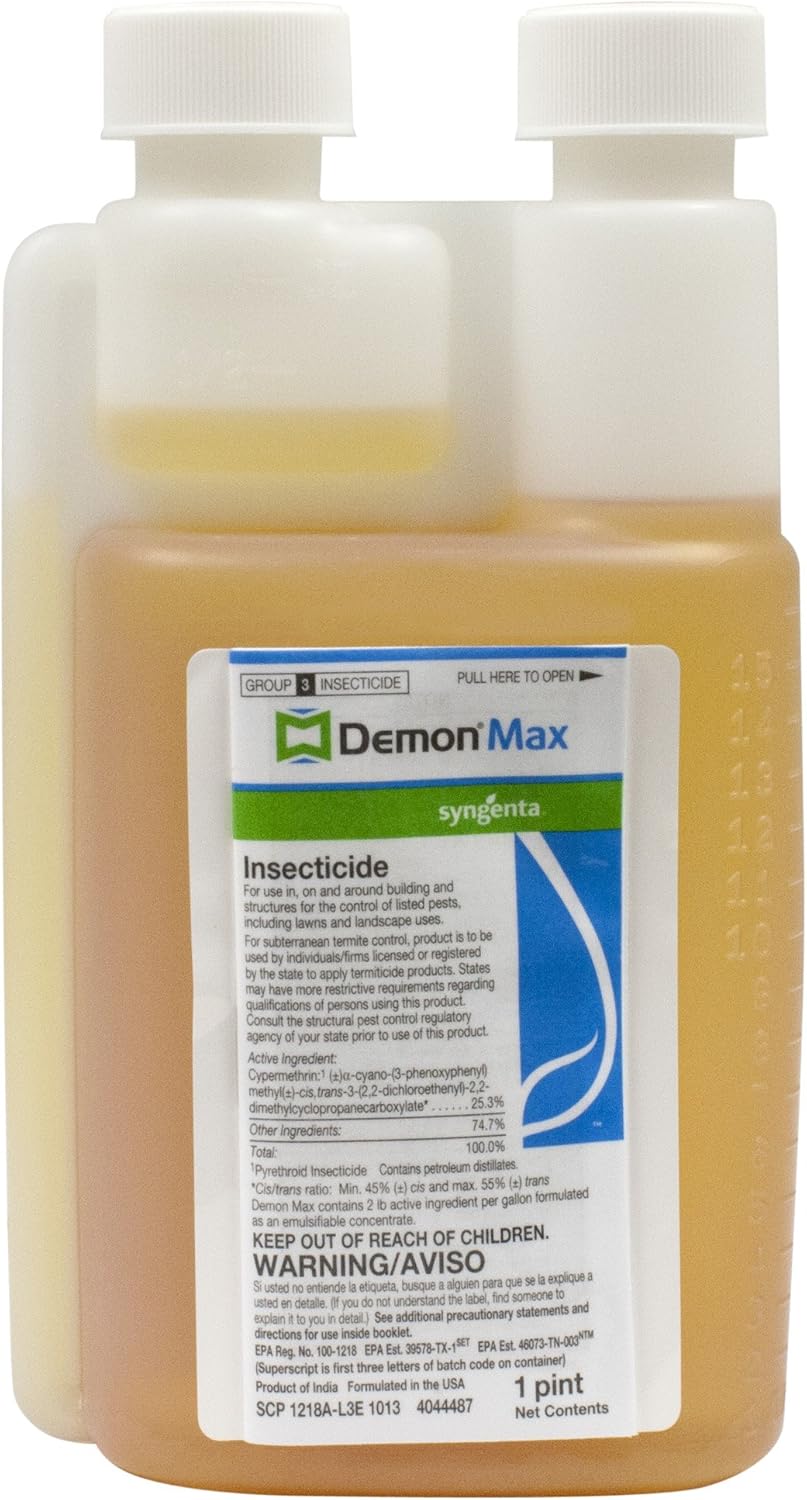
| Unit Count | 16 Ounce |
|---|---|
| Item Form | Liquid |
| Target Species | Insects |
| Liquid Volume | 16 fluid ounces |
| Active Ingredients | Cypermethrin |
Demon Max is a liquid insecticide designed for both spot and perimeter treatments where fast knockdown and lasting residual control are needed. It is typically mixed in a hand pump sprayer or similar applicator and applied to cracks, crevices, foundation perimeters, turf, and ornamentals. The active ingredient cypermethrin provides effective control of more than 30 insect pests, which makes this product useful for homeowners and maintenance pros dealing with a range of ants, spiders, roaches, and lawn pests. The label specifically allows use indoors for crack-and-crevice work and outdoors around structures, giving flexibility in where you can apply it. Practical benefits include concentrated formulation for treating measured square footage and a long residual so you do not need to reapply daily. Important limitations are that it is a chemical insecticide requiring careful handling, adherence to label directions, and keeping children and pets away from treated areas; it also requires proper mixing and application equipment to be used safely and effectively.
Best for: Buyers who want a powerful, versatile insecticide for tackling a wide range of household and yard pests and who are comfortable following label directions and using a sprayer.
Less Ideal for: Casual users seeking a ready-to-use, low-handling product or people unwilling to follow chemical safety precautions should consider milder or premixed alternatives.
- Broad-spectrum control of over 30 insect species thanks to cypermethrin
- Formulated for both crack-and-crevice indoor use and outdoor perimeter, turf, and vegetation applications
- Concentrated liquid suitable for measured mixing to cover specific square footage
- Long residual activity reduces frequency of reapplication
- Requires careful handling and strict adherence to label safety directions
- Not a ready-to-use spray — requires mixing and appropriate application equipment
Verdict: Choose Demon Max when you need a concentrated, high-power insecticide that delivers broad-spectrum knockdown and lasting residual control for home and perimeter pest problems.
Talstar One Insecticide 1 Gallon Concentrate

| Active ingredient | Bifenthrin 7.9% |
|---|---|
| Formulation | Concentrate, water-based |
| Target pests | Controls 75+ pests |
| Uses | Indoor and outdoor perimeter and structural applications |
Talstar One is a professional-strength bifenthrin concentrate formulated to control more than 75 pests across indoor and outdoor settings. Mixed with water, the gallon concentrate is intended for perimeter sprays around foundations, doors, and windows as well as spot treatments for cracks, crevices, lawns, ornamentals, shrubs, and trees. Its water-based, low-odor formula dries clear, so treated surfaces remain unobtrusive on porches and outdoor living areas. The product emphasizes long residual activity, which reduces how often you need to reapply when managing ongoing infestations. Notable features include a high active bifenthrin percentage and suitability for both structural and landscape use when applied per label directions. Important limitations are that it is a chemical insecticide requiring careful handling and strict adherence to label rates for safety and environmental reasons, and it is not a ready-to-use spray so you will need compatible mixing and application equipment for larger jobs.
Best for: Buyers who prioritize high-performance, long-residual pest control for homes, yards, and multi-structure properties and are comfortable using concentrated professional products with proper safety practices.
Less Ideal for: Casual users looking for ready-to-spray convenience or those unwilling to follow pesticide safety and application instructions should consider alternatives.
- Broad-spectrum control labeled for 75+ pests including ants, spiders, roaches, fleas, ticks, and mosquitoes
- Concentrated formulation stretches to treat large properties or multiple structures
- Water-based, low-odor formula dries clear for minimal impact on treated areas
- Effective for both perimeter barrier and targeted indoor crack-and-crevice applications
- Requires proper mixing and application equipment since it is a concentrate
- Contains a potent active ingredient that demands careful handling and strict adherence to label directions
Verdict: Choose Talstar One when you need a concentrated, professional-strength insecticide that delivers broad-spectrum, long-lasting control for perimeter and structural pest management.
Hi-Yield Indoor/Outdoor Broad Use Insecticide, 32 oz

| Item Form | Liquid |
|---|---|
| Target Species | Insects |
| Special Features | Low-Odor |
| Liquid Volume | 32 fluid ounces |
| Active Ingredients | Permethrin |
Hi-Yield Broad Use Insecticide is a 32-ounce, permethrin-based liquid designed for both indoor and outdoor pest control. It is intended for use on lawns, trees and around structures and can be diluted and applied with a tank or power sprayer to cover substantial areas. Notable features include low odor and broad-spectrum activity against ticks, mosquitoes, fleas, cockroaches and termites, and the label indicates concentration rates that allow treatment of large square-footage areas with small amounts of product. In practice this makes the bottle useful for periodic perimeter treatments, spot treatments around entry points and targeted applications on ornamental plants when label directions are followed. Limitations are that it contains permethrin so users must follow safety instructions, keep it away from children and avoid applying directly to flowering plants where pollinators are present. It is a professional-strength option that rewards careful measuring and proper protective equipment rather than a grab-and-spray convenience product.
Best for: Buyers who prioritize effective, concentrated pest control for yards and around structures and are comfortable measuring and applying professional-strength treatments safely.
Less Ideal for: Casual users who want a ready-to-spray aerosol or those who need a pollinator-safe product for flowering plants should consider alternatives.
- Broad-spectrum control covering ticks, mosquitoes, fleas, cockroaches and termites.
- Low-odor formula suitable for use around homes.
- Ready to mix with water and compatible with tank or power sprayers for larger jobs.
- Concentrated 32 oz bottle treats large areas when mixed at labeled rates.
- Contains permethrin which requires careful handling and adherence to label safety precautions.
- Not labeled for direct application to flowering plants where pollinators may be present.
Verdict: Choose this concentrated permethrin spray when you need a low-odor, broad‑spectrum liquid that treats large outdoor areas with measured professional-style applications.
Spectracide One-Shot Home Insect Control with AccuShot Refill, 1 Gal

| Unit Count | 128 Ounce |
|---|---|
| Item Form | Spray |
| Liquid Volume | 1 gallons |
This one-gallon Spectracide One-Shot refill is a high-capacity, ready-to-use contact insecticide designed for spot treatments and crack-and-crevice work around the home. You replace the cap with the reusable AccuShot sprayer to get a continuous-power wand with an extendable nozzle and a two-finger trigger, which reduces hand fatigue during larger jobs. The formula is fast-drying, clear, and non-staining with minimal lingering odor, and the manufacturer states it controls cockroaches, ants, spiders and many other pests for up to 12 months on non-porous surfaces. In practice this makes it well suited for perimeter treatments, garages, porches, and targeted indoor spots where you see activity. Important limitations are that it is for residential use only, it should not be applied to pets, and effectiveness claims apply to non-porous surfaces; porous areas may need repeat treatments. Also you must already have or purchase the AccuShot sprayer cap to use the continuous-wand feature as intended.
Best for: A practical buyer who wants a high-volume, ready-to-use insect control solution for routine perimeter and spot treatments and prefers lower ongoing cost per application.
Less Ideal for: People who need a pet-safe, multi-surface professional application or who require a treatment specifically labeled for porous surfaces should consider alternative formulations or professional services.
- Large 1 gallon refill reduces the need for frequent repurchases
- Works with AccuShot wand for continuous spray and reduced hand fatigue
- Fast-drying, clear formula that is non-staining and leaves little odor
- Label lists control of over 500 insects and up to 12 months residual on non-porous surfaces
- Requires the AccuShot sprayer cap (sold separately with some kits) to access the continuous wand functionality
- Residual claim applies mainly to non-porous surfaces so porous areas may need repeat applications
Verdict: Buy this refill if you want a cost-effective, large-volume contact spray that pairs with the AccuShot wand for fast, no-fuss home pest control.
Tempo SC Ultra Insecticide Concentrate (240 ml)

| Item Volume | 240 ml |
|---|---|
| Item Form | Liquid |
| Target Species | Ants, flies, cockroaches, crawling pests, and ticks |
| Scent Name | Chalk-like |
Tempo SC Ultra is a suspension-concentrate insecticide that mixes with water to produce a spray for spot, crack-and-crevice, and perimeter treatments. It uses beta-cyfluthrin for broad-spectrum, fast-acting knockdown and leaves a residual barrier that helps reduce re-infestation when applied to foundations, entry points, garages, basements, and patios. The liquid concentrate format treats large areas from a small bottle and is low odor and non-staining, which makes post-application cleanup easier in sensitive indoor spaces. Directions support both indoor and outdoor structural use, so it fits regular maintenance and targeted treatment routines. Important limitations are that it is a professional-strength pesticide so users must follow label dilution and safety directions carefully and it only targets listed crawling pests rather than flying insects alone; protective equipment and restricted-entry precautions may be needed during application.
Best for: Buyers who prioritize dependable, long-lasting perimeter and structural pest control and who are comfortable following dilution and safety instructions for a concentrated product.
Less Ideal for: Casual users who want a ready-to-use aerosol or those seeking a product solely for flying insect control should consider alternate formats.
- Broad-spectrum active ingredient (beta-cyfluthrin) for quick knockdown and residual control
- Concentrate format treats large areas from a small bottle, reducing trips to reapply
- Formulation is low odor and non-staining, suitable for use near living spaces
- Labeled for both indoor and outdoor structural and perimeter applications
- Requires proper dilution and handling; not a ready-to-use spray
- Designed for crawling pests listed on the label and not a standalone solution for all flying insects
Verdict: Choose Tempo SC Ultra when you need a reliable, low-odor concentrate that provides fast knockdown plus lasting residual control for perimeter and structural crawling-pest management.
Ortho Home Defense Insect Killer for Indoor & Perimeter, 1.33 gal with Comfort Wand

| Item Form | Spray |
|---|---|
| Target Species | Insects |
| Liquid Volume | 1.33 gallons |
| Active Ingredients | Bifenthrin 0.05%, Zeta-Cypermethrin 0.0125% |
This Ortho Home Defense Ready-to-Use spray is formulated to kill a wide range of household and perimeter insects and to create a lasting barrier when applied to appropriate surfaces. It is typically used as a band treatment around doors, windows and foundations and as a targeted indoor spray in kitchens, bathrooms and other non-porous areas. The included battery-powered Comfort Wand gives a continuous spray that reduces arm fatigue and makes treating foundations, patios and decks faster and more even. The formula claims up to 12 months of protection against ants, roaches and spiders on indoor non-porous surfaces and lists bifenthrin and zeta-cypermethrin as active ingredients, so it provides professional-grade knockdown and residual control. Important limitations are that it is a chemical pesticide that should be applied following safety directions, it is intended for non-porous indoor surfaces and perimeter use rather than direct plant or edible-area treatment, and re-entry is only safe after the spray has fully dried. For high-power perimeter control this delivers concentrated active ingredients in a convenient ready-to-use package, but users should follow label precautions and avoid using it in unintended areas.
Best for: Buyers who want a strong, proven perimeter and indoor insect barrier and prioritize an easy-to-use applicator and established effectiveness backed by many user experiences.
Less Ideal for: People seeking organic or plant-safe garden sprays, or those who need an insecticide specifically labeled for direct application to edible crops or delicate plants.
- Ready-to-use formula with no mixing required for quick treatments
- Comfort Wand continuous-spray applicator reduces bending and hand fatigue
- Active ingredients (bifenthrin and zeta-cypermethrin) provide fast knockdown and residual control
- Claims up to 12 months barrier protection on indoor non-porous surfaces
- Not labeled for direct use on edible plants or as a garden foliar treatment
- Contains synthetic pesticides that require following safety and re-entry instructions
Verdict: A convenient, ready-to-use insecticide with professional-strength active ingredients and a continuous-spray wand that makes fast, long-lasting perimeter and indoor treatments easy.
Atticus Talak 7.9% Bifenthrin Indoor/Outdoor Insecticide Concentrate (32 oz)

| Liquid Volume | 32 fluid ounces |
|---|---|
| Item Form | Liquid |
| Target Species | Insects |
| Active Ingredients | Bifenthrin |
| Specification Met | EPA |
Talak 7.9% is a liquid concentrate that uses bifenthrin to kill a wide range of indoor and outdoor pests on contact and provide residual control. You mix measured teaspoons into water for specific tasks — low rates for spot treatments and higher rates for mosquito or heavy‑infestation work — then apply with a pump sprayer to lawns, landscape plants, foundations, porches, and indoor perimeters such as baseboards. The formula is water‑based, dries clear, leaves no odor or residue, and the label indicates it will not cause phytotoxicity to plants when used as directed. Notable features include a high bifenthrin concentration for proven knockdown, clear drying for use around living spaces, and labeled dilution rates for lawns, landscapes, and surfaces. Important limitations are typical of concentrates: you must mix only the amount you need, follow label rates precisely, and use appropriate protective equipment because bifenthrin is a synthetic pyrethroid; it is also not approved for fogger use and cannot be stored once diluted. For buyers wanting a reliable, long‑lasting perimeter and landscape treatment, this performs as advertised when used with care and proper application tools.
Best for: A cautious homeowner who prioritizes proven, long‑lasting perimeter and landscape protection and is comfortable following label directions and using a sprayer for measured mixes.
Less Ideal for: Buyers who want a ready‑to‑use aerosol or fogger solution or who prefer nonchemical pest control methods should look elsewhere.
- High active bifenthrin concentration (7.9%) for broad‑spectrum knockdown and residual control
- Water‑based formula dries clear and is odor‑free, suitable for use near living areas and plants
- Labeled dilution rates for lawns, landscapes, and indoor/outdoor surface treatments simplify application
- Versatile use cases including lawns, trees, foundations, porches, and indoor perimeter treatments
- Dilute‑only concentrate requires measuring and a sprayer so it is not ready‑to‑use
- Diluted solutions cannot be stored and must be mixed fresh for each application
- Not approved for fogger use and not available for sale in some states
Verdict: Choose Talak 7.9% when you want a concentrated, water‑based bifenthrin solution for reliable, long‑lasting indoor and outdoor insect control.
Choosing the Right High Power Insecticide: Key Factors to Consider
Speed of Knockdown
How quickly an insecticide reduces visible pest numbers matters when you face heavy infestations or fast-acting pests. Fast knockdown delivers immediate relief and helps prevent further plant damage, but products that act very quickly are not always the best choice for long-term control.
Consider whether you need immediate suppression to save high-value plants or if a slower-acting product with longer residual protection would be acceptable. Also think about how fast-acting chemistries interact with beneficial insects and pollinators; rapid contact killers can eliminate non-targets if applied during bloom or when beneficials are active.
Residual Control Duration
Residual activity defines how long treated surfaces remain toxic to pests after application. Longer residuals reduce the need for repeat treatments and are valuable for persistent infestations or sites where continuous reinfestation is likely.
However, long-lasting residues may increase exposure risk to non-target organisms and require stricter reentry intervals. Match residual duration to the pest biology and the cropping or landscape context so you do not overapply powerful products in sensitive areas.
Spectrum of Pest Control
High power insecticides vary in the range of insects they control. Some chemistries work well against chewing pests, others are optimized for sap-suckers, and a few provide truly broad-spectrum control across multiple orders.
Understanding the pest or pests you need to manage helps narrow the choice. Broad-spectrum products simplify treatment when multiple pests are present but raise concerns about impacts on beneficial predators and pollinators. Where possible, target the product spectrum to the problem to limit collateral damage.
Application Versatility
Different formulations and delivery methods influence how you can use an insecticide. Spray concentrates, ready-to-use bottles, granular formulations, and systemic treatments each suit different tasks and sites.
Consider whether you need foliar contact action, root uptake through soil drench, or a residual barrier on structures. Versatile products that offer multiple compatible application methods can be used in several spots around the yard, but keep label directions in mind to avoid misapplication and environmental harm.
Safety Profile and Post-Application Restrictions
High power insecticides often require strict handling precautions and may carry reentry intervals or post-application restrictions for pets and edible crops. Read labels for required personal protective equipment, recommended buffer zones, and harvest intervals for edible plants.
Weigh the tradeoff between potency and the operational burden of safety measures. For small yards or areas with children and pets, choose products with manageable PPE requirements and clear guidance for safe use to minimize risk.
Environmental Persistence and Non-Target Impact
Persistence in soil, water, or on plant surfaces affects environmental exposure. Highly persistent chemistries can control pests through multiple life stages but may also accumulate and affect soil organisms, aquatic life, or pollinators.
Assess proximity to water, presence of pollinator-attractive blooms, and the role of beneficial insects in your site. Select products and timing that reduce runoff and drift, and follow label directions for buffer zones and disposal to limit broader ecological impacts.
Matching Product Type to the Infestation
First identify the pest biology and infestation scale. For fleeting outbreaks of soft-bodied pests, a quick-contact spray may be enough. For subterranean or systemic feeders, consider soil-applied or systemic options that reach the pest through plant tissues.
Think about where the infestation sits: on foliage, in stems, in the soil, or around structures. Each location changes which formulation and application method will be most effective and least disruptive to the garden ecosystem.
- Foliar outbreaks usually respond to contact sprays or foliar systemic treatments.
- Root or crown pests often need soil drenches or systemic chemistries.
- Structural infestations may be best treated with perimeter applications or residual barrier products.
Timing and Application Strategy
Timing can make as much difference as product choice. Apply treatments when pest stages are most vulnerable and beneficial activity is low. Early-morning or late-evening applications reduce exposure to pollinators and may improve contact with nocturnal pests.
Staggered treatments guided by monitoring often outperform blanket repeat spraying. Use threshold-based reapplications and inspect sites after the label-listed reentry interval to determine if another treatment is necessary.
- Monitor pest numbers and damage before applying high power options.
- Avoid applications during bloom unless the label specifically permits it and protective measures are used.
Safe Use Around Edibles and Pollinator Habitat
If you treat edible plants or areas with active pollinators, take extra precautions. Choose products with labeled uses on food crops and observe harvest intervals. Consider using targeted spot treatments rather than whole-plant sprays near blooms.
Create treated area buffers and keep flowering weeds mowed or removed before treating to lower pollinator exposure. When in doubt, use non-chemical controls or lower-toxicity alternatives in areas with heavy pollinator activity.
- Follow harvest interval guidance exactly on edible plants.
- Use spot treatments and avoid spraying open flowers.
Mixing, Calibration, and Application Equipment
Correct mixing rates and properly calibrated equipment ensure effective control and reduce waste or unintended harm. Overdiluting reduces effectiveness while overdosing increases risk to non-targets and the environment.
Choose sprayers that give you the right droplet size for the formulation and the target. Calibrate backpack or pump sprayers before treating to confirm delivery rates match label directions.
- Always measure concentrate and water precisely per label instructions.
- Inspect nozzles and hoses to maintain even coverage and prevent leaks.
Resistance Management
Repeated use of the same active ingredient can drive resistance in pest populations. Rotate chemistries with different modes of action and integrate nonchemical tactics such as sanitation, traps, and biological controls.
Document what you apply and when, and use integrated pest management principles to keep powerful insecticides effective as long as possible.
- Alternate modes of action between growing seasons or infestation cycles.
- Combine cultural controls with chemical tactics to reduce selection pressure.
How We Chose the Best High Power Insecticide
Our shortlist focused on products formulated for heavy pest pressure where rapid reduction and lasting suppression matter. We applied explicit filters: products had to be labeled for broad-spectrum control relevant to home gardens or small acreage, show measurable residual activity in typical outdoor conditions, and have clear user instructions and PPE guidance. Key evaluation dimensions were speed of knockdown, length of residual control, spectrum of pests covered, application method versatility, and safety profile during and after use. We excluded professional-only formulations that require commercial licensing and products labeled only for narrow, specialized pests. Performance information came from manufacturer labeling, independent extension resources, and aggregated usage guidance to determine practical effectiveness in backyard and small-farm settings.
FAQ
Can high power insecticides be used on edible plants?
Often they can, but only if the label explicitly lists the crop and provides a harvest interval. Follow label instructions for application rates, preharvest intervals, and any post-application washing recommendations to reduce residue risk.
How soon will I see results after applying a fast-acting product?
Many fast-acting chemistries reduce visible pest numbers within hours, but full control may take several days as residuals affect returning individuals or newly hatched stages. Monitor treated areas and follow up per label timing.
What safety gear is typically required for applying powerful insecticides?
Required gear often includes gloves, protective eyewear, and long sleeves, with respirators or chemical-resistant garments for certain formulations. Always check the product label for the exact personal protective equipment list and follow it closely.
Will using a high power insecticide harm beneficial insects?
Powerful, broad-spectrum products can harm beneficial predators and pollinators if applied indiscriminately. Targeted applications, off-bloom timing, and using spot treatments help reduce non-target impacts.
How should I dispose of leftover concentrate or rinse water?
Dispose of concentrates and rinse water according to local hazardous waste rules and label instructions. Never pour concentrated product or rinse water into storm drains or surface water. Triple-rinse empty containers if the label requires it and follow local disposal regulations.
What steps reduce drift and runoff during application?
Use low-drift nozzles, apply during low wind conditions, and avoid overwatering after application. Maintain buffer zones from water bodies and follow label guidance on precipitation and irrigation timing to minimize runoff.
Final Verdict
Choosing among high power insecticides is about balancing immediate pest suppression with safety and environmental responsibilities. Prioritize the pest spectrum and infestation location first, then match residual needs and application method to your site. Always follow label directions for PPE, timing, and post-application restrictions to protect people, pets, and beneficial organisms. If you need rapid knockdown with limited follow-up, favor products rated for quick action. If long-term suppression with fewer repeat visits matters more, select options with proven residual activity and incorporate resistance management and nonchemical tactics to extend effectiveness.
