

Note: This article contains affiliate links. If you click on these links and make a purchase, I may earn a small commission at no extra cost to you. This helps support my research and content. Read my full affiliate disclosure here.
A small gas chainsaw brings more cutting power than a cordless tool while staying compact enough for pruning, storm cleanup, and small firewood tasks. If you work on a small property, maintain mature trees, or rely on a chainsaw where outlet access is limited, choosing the right compact gas model matters for safety and efficiency. This guide shortlists the top small gas chainsaws currently available and explains the practical differences that matter in the yard. We evaluated ease of starting, cutting performance, bar and chain size, durability, and user safety features to help you pick the best tool for your gardening and property tasks. Read on to see which compact cutters made the final list and why they earned a spot.
Top Picks at a Glance
| Best Overall The best all-around choice for most situations | Husqvarna 120 Mark III 14" Gas Chainsaw |  |
| Best Quality Built to a higher standard if you want something more solid | Husqvarna T435 12 in. Top-Handle Gas Chainsaw |  |
| Best Value The sweet spot between price and what you get | WORKIT 25.4CC 12" Top-Handle Gas Chainsaw (WX112) |  |
| Best Budget The cheapest option that still gets the job done reliably | kunghei 12-inch Top-Handle Gas Chainsaw, 25.4cc 2-Stroke |  |
| Highest Rated A top-rated pick with lots of positive feedback | FARMMAC 12" Top-Handle Gas Chainsaw (1.36 HP) |  |
| Most Popular A crowd favorite that many people choose with confidence | VEVOR 25.4cc Top-Handle Gas Chainsaw, 12-Inch Bar |  |
| Best Seller A high-volume bestseller chosen again and again | Husqvarna 135 Mark II Gas Chainsaw, 16-inch, 38cc |  |
Husqvarna 120 Mark III 14" Gas Chainsaw

| Power Source | Gas Powered |
|---|---|
| Horsepower | 1.88 hp |
| Chain Length | 14 inches |
The Husqvarna 120 Mark III is a straightforward gas chainsaw that delivers solid cutting performance for pruning, limb work, and small tree felling. Powered by a 38-cc X-Torq two-cycle engine and a 14-inch bar, it provides enough torque and cleaner combustion for efficient cuts without complicated features. Notable design elements include Air Injection to keep debris away from the air filter, LowVib vibration damping for more comfortable handling during extended use, an inertia-activated chain brake for safety, and an automatic oiler for continuous chain lubrication. It is typically used by homeowners tackling yard cleanup, firewood prep, and occasional property maintenance where portability and raw power matter more than pro-level features. Limitations are its 14-inch bar which constrains maximum log diameter and the inherent maintenance needs of a gas engine compared with battery models. For buyers seeking a simple, durable gas saw that emphasizes cutting performance and fuel efficiency, this model is a practical choice under $300.
Best for: Buyers who prioritize cutting performance and dependable gas power for regular homeowner tasks like pruning, small tree work, and firewood prep.
Less Ideal for: If you need to cut large-diameter trees frequently or prefer low-maintenance, emissions-free operation, a larger gas saw or a battery/electric model would be a better fit.
- Efficient 38-cc X-Torq engine for good power and improved fuel economy
- Air Injection system reduces debris reaching the air filter to extend engine life
- LowVib technology reduces vibration for more comfortable handling
- Inertia-activated chain brake and automatic oiler add practical safety and convenience
- 14-inch bar limits cutting capacity for larger trees or thick logs
- Requires regular gas engine maintenance and fuel handling
Verdict: A capable, fuel-efficient 14-inch gas saw that delivers reliable cutting performance for homeowners who want straightforward, power-focused results.
Husqvarna T435 12 in. Top-Handle Gas Chainsaw

| Power Source | Gas Powered |
|---|---|
| Horsepower | 2.01 hp |
| Chain Length | 14 inches |
The Husqvarna T435 is a top-handle gas chainsaw designed for tree care professionals who need a light, maneuverable tool for pruning, limbing, and work in the canopy. It delivers 2.01 horsepower from a 35.2 cc X-Torq engine that maintains torque at low RPMs, making controlled cuts easier when working overhead. The unit is unusually light for its power, improving balance and reducing operator fatigue during long shifts. Practical user-focused features include Smart Start for easier pulls, LowVib anti-vibration isolation, an inertia-activated chain brake for safety, adjustable oil pump for different weather or cutting conditions, and simple maintenance with a quick-release air filter and side-mounted chain tensioning. The top-handle layout and heavy-duty rope attachment point make it straightforward to hoist and position in trees. Limitations are the inherent requirements of a gas saw: routine fuel and oil maintenance and higher noise and emissions than battery alternatives, plus a learning curve for safe top-handle operation in tight canopy situations.
Best for: Aimed at professional arborists or serious tree-care contractors who prioritize maneuverability, quick responsiveness, and minimal operator fatigue when working aloft.
Less Ideal for: Homeowners who want a low-maintenance, quiet saw or casual users uncomfortable with top-handle operation should consider simpler rear-handle or battery options.
- Excellent power-to-weight ratio for overhead and canopy work
- X-Torq engine for good low-RPM torque and improved fuel efficiency
- Smart Start and LowVib reduce startup effort and operator fatigue
- Adjustable oil pump and easy-access maintenance features speed field servicing
- Top-handle design with rope attachment simplifies hoisting into trees
- Requires regular gasoline maintenance and produces more noise and emissions than battery saws
- Top-handle layout is less forgiving for inexperienced users and demands careful handling
Verdict: Buy this if you need a lightweight, professional-grade top-handle saw that balances strong low-end power with excellent maneuverability for canopy and pruning work.
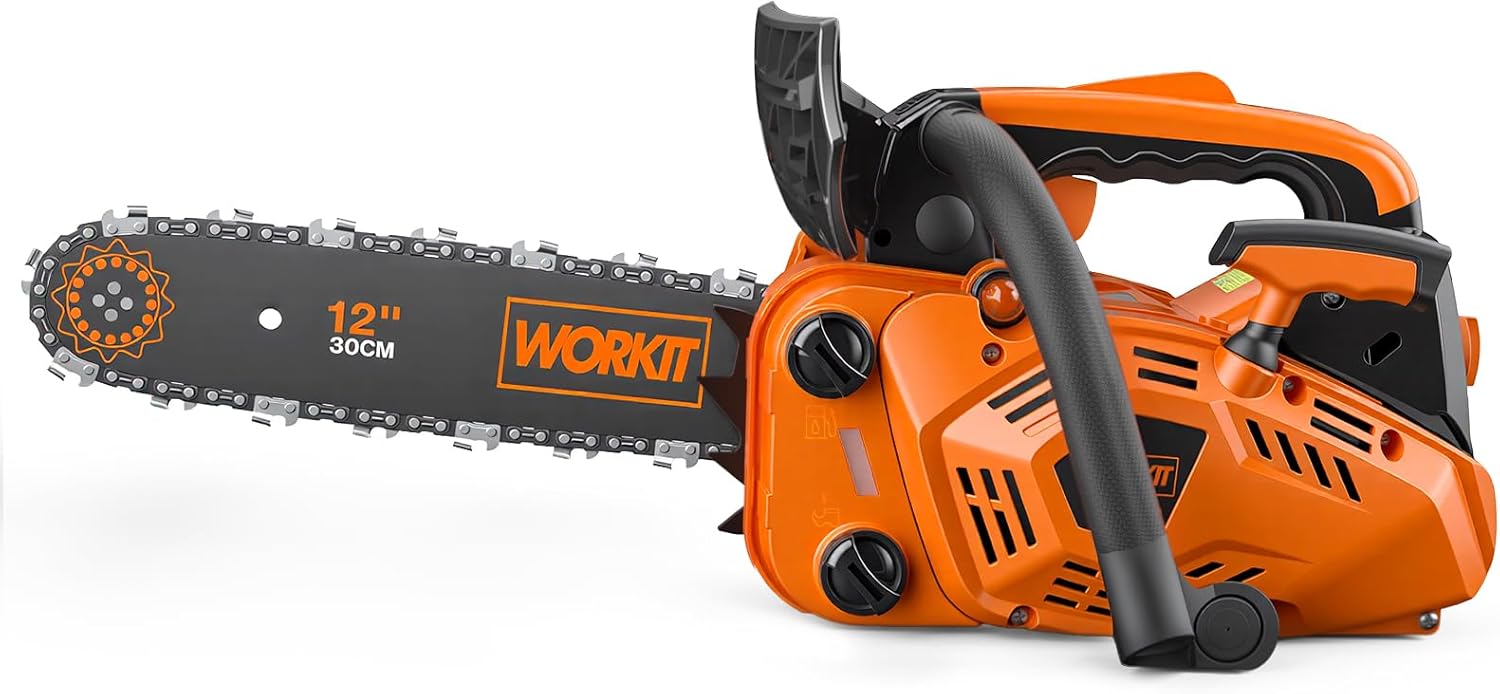
WORKIT 25.4CC 12" Top-Handle Gas Chainsaw (WX112)
| Power Source | Gas Powered |
|---|---|
| Horsepower | 1.2 hp |
| Chain Length | 12 inches |
The WORKIT WX112 is a lightweight top-handle gas chainsaw built for precision work in tight spaces. Its 25.4CC Xtreme two-cycle engine and 12-inch guide bar give it enough punch to cut hardwood, prune limbs, and handle routine storm cleanup while remaining nimble for high work or nursery tasks. Practical features include an OptiSpark ignition and an easy-start system to reduce pull-start frustration, an automatic stop switch to help avoid engine flooding, and an automatic oiler to keep the chain lubricated during extended runs. The reinforced body, heavy-duty bearings, and upgraded clutch aim to improve durability compared with entry-level units. Safety touches such as a chain brake, protective baffle, dual safety locks, and a one-stop engine switch make it suitable for pros who need a compact tool and for homeowners who value built-in protections. Expect some noise and the usual maintenance for a gas engine like fuel mixing and periodic spark plug/chain tuneups, and its 12-inch bar limits it to smaller-diameter cutting rather than full-size felling or large logs.
Best for: Buyers who need a compact, commercially styled top-handle saw for pruning, high work, and cleanup where maneuverability and dependable starts matter most.
Less Ideal for: Not a good choice for users who need a full-size felling saw or those who prefer low-maintenance electric or battery chainsaws for quiet, occasional yard chores.
- Compact, lightweight design for easy maneuvering in tight or overhead work
- 25.4CC Xtreme engine provides enough power for pruning, storm cleanup, and cutting hardwood up to small diameters
- Easy-start OptiSpark ignition and engine stop switch reduce starting problems and flooding
- Reinforced body, heavy-duty bearings, and improved clutch target better durability under heavier use
- Includes safety gear and protective features such as chain brake, dual safety locks, and protective baffle
- 12-inch bar restricts use to smaller limbs and logs rather than large-tree felling
- Being gas-powered requires routine maintenance, fuel mixing, and generates more noise and emissions than electric alternatives
Verdict: If you want a nimble, commercially oriented top-handle chainsaw for pruning and tight-space cutting, the WORKIT 25.4CC delivers dependable starts and durability in a compact package.
kunghei 12-inch Top-Handle Gas Chainsaw, 25.4cc 2-Stroke

| Power Source | Gas Powered |
|---|---|
| Horsepower | 1.22 hp |
This compact top-handle chainsaw pairs a 25.4cc 2-stroke motor (about 1.22 hp) with an 11.8-inch guide plate to deliver quick, precise cutting for pruning, small-diameter felling, and household firewood work. It is built with an aluminum alloy case and reinforced nylon shell for durability while staying light enough for handheld use and longer sessions. The engine claims up to 900W and a 9,000 rpm chain speed, which helps the quenched chain slice through branches cleanly. Practical touches include an ergonomic anti-slip handle, an easy pull-start system that typically fires up in a few pulls, simple chain tension adjustments, and basic safety features like a lock and protective baffle. Expect good value for occasional to moderate use, especially around the yard and orchard. Limitations are its small 12-inch bar, which restricts it to thinner trunks and limbing rather than large tree felling, and as a two-stroke gas unit it requires mixing fuel and routine engine maintenance.
Best for: Buyers who need an affordable, portable gas chainsaw for yard work, fruit-tree pruning, and cutting firewood where mobility and ease of use matter more than heavy-duty felling.
Less Ideal for: Do not choose this if you regularly fell large trees or need a long bar for processing big logs; look for a larger professional chainsaw instead.
- Compact, lightweight design makes it easy to handle for pruning and extended tasks
- Durable aluminum alloy body with reinforced nylon shell for outdoor use
- Quick-start pull cord and user-friendly chain tension adjustment reduce downtime
- High chain speed and quenched chain provide sharp, efficient cutting on small to medium wood
- 11.8-inch guide plate limits cutting to smaller diameter trunks and prevents efficient large-tree felling
- Two-stroke gas engine requires fuel mixing and regular maintenance
Verdict: A budget-friendly, lightweight gas chainsaw that is well suited for pruning and small tree work where portability and simple operation matter most.
FARMMAC 12" Top-Handle Gas Chainsaw (1.36 HP)

| Horsepower | 1.36 hp |
|---|---|
| Engine displacement | 25.0 CC |
| Max speed | 12000 rpm |
| Bar length | 12 inch |
| Chain | 3/8"LP pitch, 0.050" gauge, 44 drive links |
This FARMMAC 12-inch gas chainsaw is built for light-duty tree pruning, branch trimming, and general yard cleanup where maneuverability and dependable starting matter. The 1.36 hp engine and 12,008 rpm peak speed provide consistent cutting power for small-diameter wood, while the 12-inch bar and 3/8"LP 44DL chain make it easy to control in tight spots. Notable features include a spring-assisted starting system that reduces pull resistance, a wrap-around ergonomic top handle for one-handed access in pruning positions, and an automatic adjustable oiling system to keep the chain lubricated during use. The unit is very light, which cuts operator fatigue and helps with precision work up in trees or on ladders. Practical limitations are its small bar length and modest fuel tank, which mean it is not suited for large felling or long continuous jobs, and top-handle ergonomics favor occasional professional use or experienced homeowners comfortable with that style. For routine garden maintenance and periodic pruning this saw trades bulk for easier handling and reliable starting.
Best for: Buyers who prioritize reliable starting and easy handling for routine pruning and small yard jobs and who need a portable saw that is simple to operate and maneuver.
Less Ideal for: Users who need a saw for heavy-duty logging, frequent large-diameter felling, or long continuous cutting sessions should choose a larger rear-handle model with a longer bar and bigger fuel capacity.
- Lightweight top-handle design improves control and reduces operator fatigue
- Spring-assist starting system makes pull starts easier and more consistent
- Automatic adjustable oiling keeps the chain lubricated during use
- Compact 12-inch bar suited for pruning and working in tight spaces
- Small bar length and fuel tank limit suitability for large felling or extended cuts
- Top-handle configuration may feel awkward for users accustomed to rear-handle saws
Verdict: Choose this compact FARMMAC saw when you want a dependable, easy-starting, lightweight gas chainsaw for pruning and small yard tasks.
VEVOR 25.4cc Top-Handle Gas Chainsaw, 12-Inch Bar

| Power Source | Gas Powered |
|---|---|
| Horsepower | 1.2 hp |
| Chain Length | 12 inches |
| Model Number | CN-25 |
The VEVOR 25.4cc top-handle gas chainsaw is a compact, handheld saw built for pruning, light felling and general property maintenance. It uses a 2-cycle 25.4cc engine rated at about 1.2 hp and drives a 12-inch bar and high-strength steel chain that handles branches and small logs up to roughly 9.8 inches in diameter. Practical features include an easy-start system, a tool-free chain tension knob, a protective guard to reduce sawdust spray and onboard tanks for fuel and chain oil to limit downtime. At roughly 9 to 10 pounds the saw is relatively nimble for one-handed trimming and working in trees when combined with proper climbing gear. Important limitations are its modest power and short bar, which make it unsuitable for heavy felling or cutting large logs, and the usual maintenance needs of a 2-cycle gas engine such as mixing fuel and regular spark plug and carburetor care. For users who need a portable, serviceable saw for routine yard and tree work, it delivers sensible capability for its class.
Best for: Buyers who want a portable, serviceable gas saw for regular pruning, tree trimming and light felling and who value straightforward features and ease of use over maximum cutting power.
Less Ideal for: Not a good fit for landowners who need a saw for heavy timber work, milling logs, or frequent long-duration cutting where a larger bar and higher horsepower are required.
- Compact and lightweight for easier handling during pruning and above-ground work
- 12-inch steel bar and chain suited to trimming, limb work and small log cutting
- Tool-free chain tensioning for quick adjustments in the field
- Easy-start system and included maintenance kit simplify setup and upkeep
- 12-inch bar and 1.2 hp output limit use to light-duty cutting and small trees
- Requires routine 2-stroke engine maintenance and fuel mixing
Verdict: A lightweight, easy-to-use top-handle gas chainsaw that reliably handles pruning and light felling for homeowners and tree care hobbyists.
Husqvarna 135 Mark II Gas Chainsaw, 16-inch, 38cc

| Power Source | Gas Powered |
|---|---|
| Horsepower | 2 hp |
| Chain Length | 16 inches |
| Included Components | Powerhead, bar, chain, fuel mix, fuel cap, scrench, manual |
The Husqvarna 135 Mark II is a small, homeowner-focused gas chainsaw built for routine yard work such as pruning, branch trimming, and cutting firewood. It uses a 38-cc X-Torq two-stroke engine that delivers about 2.1 horsepower and supports 14 to 16-inch bars, so it handles medium backyard logs without feeling overbuilt. Practical features aimed at everyday users include Smart Start and combined choke/stop controls for easier starting, a side-mounted chain tensioner for tool-free adjustments, inertia-activated chain brake for added safety, and LowVib dampeners to reduce fatigue during longer jobs. The Air Injection centrifugal pre-cleaning helps keep the air filter cleaner between services. Because it is a gas model, expect regular fuel mixing, louder operation, and routine maintenance such as chain sharpening and air filter checks. Its compact size and user-oriented controls make it a dependable choice for homeowners who want a capable gas saw without the complexity of larger pro machines.
Best for: Homeowners and DIYers who want a compact, easy-to-start gas chainsaw for routine yard maintenance and occasional firewood cutting, preferring familiar gas power and user-oriented safety features.
Less Ideal for: Professional arborists or users who need high-hour commercial performance or who prefer quieter, low-maintenance battery models for frequent urban use.
- Smart Start and combined choke/stop control simplify cold starts and reduce engine flooding risk
- LowVib technology reduces vibration for more comfortable handling during extended use
- Side-mounted chain tensioner allows quick, on-tool adjustments without removing the bar
- Air Injection centrifugal system reduces debris reaching the air filter, lowering maintenance frequency
- Requires mixed gas and routine engine maintenance inherent to two-stroke gas models
- Smaller 16-inch maximum bar limits efficiency on very large logs or heavy-duty felling tasks
Verdict: A compact, easy-to-use gas chainsaw that gives risk-averse homeowners reliable cutting power with user-friendly safety and starting features.
Choosing the Right Small Gas Chainsaw: Key Factors to Consider
Bar and Chain Length
Bar and chain length determines what you can safely cut. Short bars around 10 to 14 inches are best for pruning, trimming, and light limb work because they are easier to control and reduce kickback risk. Bars in the 14 to 18 inch range expand capability to small-diameter firewood and light limbing while still remaining manageable for a single operator.
Picking the right bar length also affects chain speed and engine loading. Using a bar that is too long for the engine leads to bogging under load and increased wear. Consider the typical diameter of wood you will cut and choose the smallest bar that comfortably handles that size to maximize control and reduce fatigue.
Engine Size and Power Delivery
Engine displacement and how power is delivered matter more than peak horsepower numbers. For a small gas chainsaw, look for engines designed to provide steady torque at the low-to-mid rev range where cutting happens. A peaky engine that needs to be revved constantly will frustrate a homeowner doing pruning and can create unsafe handling moments.
Also consider how the saw behaves under load. Smooth throttle response and the ability to hold RPM when biting into wood make cuts faster and reduce the need to re-apply force. For intermittent homeowner use, a slightly underspun engine that is easy to start and throttle can be preferable to a higher-displacement motor that adds weight.
Ease of Starting
Starting reliability is crucial in field use. Recoil pull-start systems should be predictable and smooth; modern designs often add primer bulbs, decompression valves, or simplified choke setups to reduce hard pulls. An easy starter saves time and prevents the operator from needing awkward body positions that increase injury risk.
Consider whether the saw offers tools-free choke access, a decompression mechanism, or an ergonomic starter handle. These features are especially valuable for gardeners who use a chainsaw sporadically and may struggle with a stiff pull cord after long idle periods.
Weight, Balance, and Ergonomics
A small gas chainsaw should be light enough to hold comfortably for overhead or extended limb work while still feeling balanced. Weight alone is not the whole story. Center of gravity and handle placement determine how natural the saw feels in one hand or two. A saw with poor balance will tire your arms quickly even if its spec weight looks reasonable.
Look for wraparound front handles for varied grip positions, an anti-slip rear handle, and reachable controls that do not require hand position shifts to operate the throttle or chain brake. These ergonomics matter when you are working on ladders, on uneven ground, or when making repeated cuts.
Vibration Dampening
Vibration transfers directly to your hands and arms, increasing fatigue and reducing cut precision. Quality rubber-mount or spring-damped handle systems reduce transmitted vibration and make longer tasks comfortable. Reduced vibration also helps protect against numbness during repeated seasonal use.
Check whether the saw isolates the front and rear handles from the engine with visible dampers or a supported chassis. While small gas chainsaws will never be vibration-free, better damping improves control, cut quality, and safety during extended sessions.
Serviceability and Parts Access
Routine maintenance like air filter cleaning, spark plug access, and chain tension adjustments should be straightforward. Tools-free access to the air filter and a side-access chain tensioner simplify field service and reduce downtime. If you need to replace the chain or guide bar, compatibility with common sizes and availability of replacement parts matters for long-term ownership.
Consider how easy it is to adjust the carburetor or replace wear items without disassembling major components. For occasional users, simpler service routines reduce the chance that maintenance gets skipped, which improves life and reliability.
Best Small Gas Chainsaw Uses in the Yard
Small gas chainsaws fill a niche between lightweight electric trimmers and full-size felling saws. Typical uses include pruning mature limbs, cutting storm-damaged branches, and sectioning small logs for a wood stove. They are also useful for clearing fence lines and trimming branches that are out of reach of loppers.
Because they do not rely on a power cord or battery charge, these saws are handy for remote properties and winter cleanup. Match the bar length to the task to maintain control and safety while maximizing cutting efficiency.
- Pruning and trimming limbs up to about 12 inches diameter
- Cutting small rounds and seasoning firewood
- Storm cleanup and removing broken branches
- Light property maintenance like fence post shaping
Safe Operation Tips for Compact Gas Saws
Treat a small gas chainsaw like any other power saw. Wear eye protection, gloves, chaps or long pants, and ear protection. Ensure the chain brake works before each session and keep a firm two-handed grip when cutting.
Avoid cutting above shoulder height and never cut from a ladder when possible. Use pole pruners or have a second person support the branch if you must work from a height. Always let the chain stop before setting the saw down and follow proper refueling practices away from ignition sources.
- Check chain tension and sharpness before each use
- Inspect fuel and oil levels and top up in a ventilated area
- Let the engine cool before refueling
- Keep bystanders well away from the work area
Maintenance Checklist for Longevity
A short maintenance routine keeps a small gas chainsaw ready and extends its operating life. After each use clear sawdust from around the sprocket and bar groove, inspect and sharpen the chain as needed, and wipe up any oil or fuel residue. Weekly checks during heavy use should include air filter inspection and spark plug condition.
Seasonal maintenance should include a full tune, carburetor adjustment if necessary, and replacement of worn bars or chains. Store the saw with a light oil coating on the bar and chain and in a dry place to prevent corrosion.
- Daily: clean sawdust, check chain sharpness
- Weekly during busy season: inspect air filter and spark plug
- Seasonal: full service, replace worn consumables
Choosing Accessories That Matter
Good accessories improve safety and convenience. A sturdy scabbard protects the bar during storage and transport. A quality site saw file or sharpening kit keeps chains cutting efficiently. Consider a carrying harness if you expect long sessions; a harness shifts load from your arms to your torso and reduces fatigue.
Also think about spare chains sized to your bars, a fuel mix jug with clear measurements, and a compact tool kit with the right wrenches for chain tensioning and bar nuts. These small additions reduce downtime and make field repairs practical.
- Bar scabbard for safe transport
- Sharpening kit sized to your chain pitch
- Small tool kit for chain adjustments
- Carrying harness for extended cutting sessions
When a Small Gas Chainsaw Is Not the Right Choice
If you regularly cut large-diameter timber or perform professional felling, a small gas chainsaw will be underpowered and wear quickly. In those cases a larger bar and higher-displacement engine are more appropriate. Likewise, if you primarily trim small branches and value low vibration and near-zero maintenance, a battery-powered saw may be quieter and simpler to own.
Also avoid using a compact gas saw for tasks that require a two-person felling approach or prolonged heavy-duty bucking. Matching tool capability to task keeps you safer and extends tool life.
- Not ideal for frequent cutting above 18 inches diameter
- Consider alternative power sources for quieter, low-maintenance needs
- Avoid prolonged heavy-duty use beyond the saw's intended duty cycle
How We Chose the Best Small Gas Chainsaw
We prioritized features that directly affect daily use in home and small-property settings. We focused on compact engine designs that deliver adequate cutting torque for 10 to 18 inch bars while keeping weight low for one-person handling. Starting reliability was emphasized because hard-to-start units add frustration and unsafe situations in the field. We also examined chain and bar compatibility to ensure easy replacement and correct sizing for pruning versus limbing. Vibration control, ergonomic grip layout, and throttle response were included because they influence operator fatigue and control during extended tasks. Finally, cooling and serviceability matters for longevity when the saw sees seasonal heavy use. We excluded full-size professional saws with bars longer than 20 inches, purpose-built felling machines, and specialty two-person harvesters. We also filtered out models that prioritize maximum displacement over compact balance or that lack basic field-service access like easy spark plug and air filter replacement. The resulting shortlist emphasizes compact power, starting and handling, cutting capacity, vibration and safety features, and straightforward maintenance.
FAQ
What bar length is best for pruning and light backyard work?
For pruning and typical backyard tasks, bars between 10 and 14 inches offer the best balance of control and cutting capacity. They are easier to handle overhead and reduce the risk of kickback compared with longer bars.
How often should I sharpen the chain on a small gas chainsaw?
Sharpen the chain whenever cuts become slow, produce fine dust instead of chips, or you need to apply extra pressure. For regular seasonal use that might mean after several hours of cutting or every few jobs; heavy use requires more frequent attention.
Is a small gas chainsaw hard to start compared with electric models?
Gas starters require a pull-start motion, so they are typically more effort than flipping a switch on an electric unit. However, modern small gas models often include features like decompression valves, primer bulbs, or improved cord ergonomics to reduce starting effort.
Can I use a small gas chainsaw for firewood cutting?
Yes, for small rounds and splitting-seasoned logs a compact chainsaw with a 14 to 18 inch bar can be effective. For larger logs you will need a longer bar or a different tool; using a bar that is too short can make the job slow and increase wear on the engine.
What maintenance should I perform before storing a small gas chainsaw for the winter?
Run the tank dry or add a fuel stabilizer, change the bar oil if needed, clean the saw thoroughly, and fog internal parts with a light oil to prevent corrosion. Store it in a dry place with the bar covered.
Are vibration-reducing features important for occasional homeowners?
Yes, even occasional users benefit from reduced vibration because it lowers fatigue and improves control during intermittent jobs. Dampening systems also protect hands during repeated seasonal use and make tasks more comfortable.
Final Verdict
When choosing a small gas chainsaw, focus on the combination of bar length, starting reliability, and how the saw balances in your hands. Those factors have the biggest impact on everyday safety and efficiency in pruning, storm cleanup, and small firewood work. Expect tradeoffs between raw power and weight; prioritize the smallest bar and engine that can comfortably handle your typical cuts to reduce fatigue and maintenance needs. With the right balance of control, starting ease, and serviceability, a compact gas chainsaw becomes a dependable tool for most home and small-property tasks.
