

Note: This article contains affiliate links. If you click on these links and make a purchase, I may earn a small commission at no extra cost to you. This helps support my research and content. Read my full affiliate disclosure here.
Collards respond to steady, balanced nutrition more than flashy one-off treatments. If you want larger, tender leaves and consistent yields across the season, the fertilizer you choose will shape how quickly plants green up, how long leaves stay productive, and how well collards tolerate heat or light stress. This guide covers our seven shortlisted options for Collards and explains the practical tradeoffs between fast-acting feeds and longer-release formulas. We evaluated choices by how they deliver nitrogen for leaf growth, their ease of application, and how they fit into common garden systems like raised beds, in-ground rows, and containers. The next sections explain what matters and how to match a fertilizer to your garden style before the product summaries.
Top Picks at a Glance
| Best Overall The best all-around choice for most situations | YARDi Brassicas & Greens Liquid Plant Food 8-3-3, 32 oz |  |
| Best Quality Built to a higher standard if you want something more solid | BUILDASOIL Organic Vegetable Garden Fertilizer, Craft Blend (3 lb) |  |
| Best Value The sweet spot between price and what you get | Miracle-Gro Shake 'N Feed Tomato, Fruit & Vegetable Plant Food (1 lb) |  |
| Best Budget The cheapest option that still gets the job done reliably | Scotts All Purpose Flower & Vegetable Continuous Release Plant Food, 3 lb |  |
| Highest Rated A top-rated pick with lots of positive feedback | FoxFarm Grow Big Liquid Plant Food (16 fl oz) |  |
| Most Popular A crowd favorite that many people choose with confidence | Miracle-Gro Water Soluble All Purpose Plant Food, 1.5 lb |  |
| Best Seller A high-volume bestseller chosen again and again | Miracle-Gro Liquid All Purpose Plant Food Concentrate, 32 oz |  |
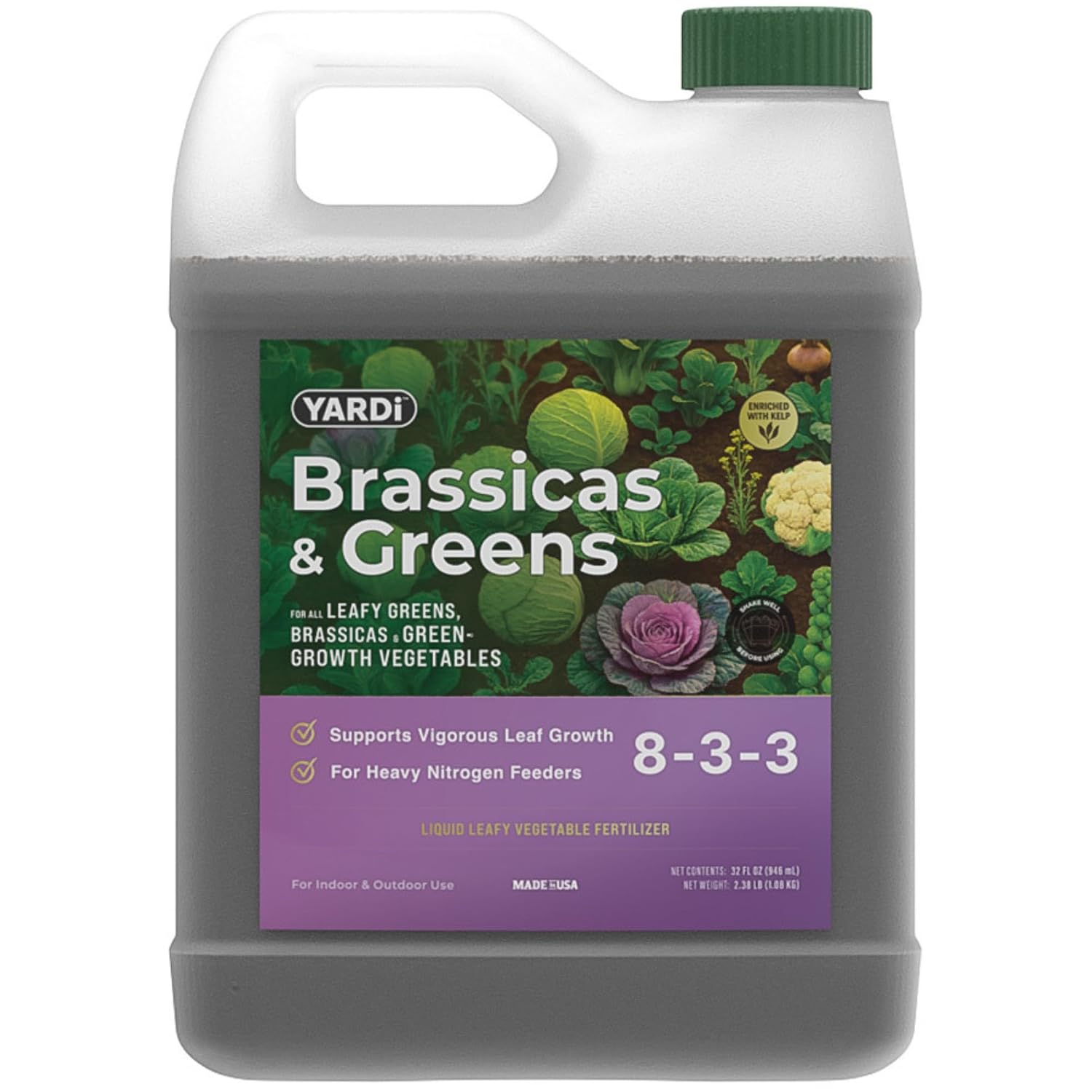
YARDi Brassicas & Greens Liquid Plant Food 8-3-3, 32 oz
| Item Form | Liquid |
|---|---|
| Specific Uses For Product | Leafy Greens |
| Target Species | Vegetables |
| Unit Count | 32 Fluid Ounces |
YARDi Brassicas & Greens is a concentrated liquid fertilizer with an 8-3-3 NPK designed specifically for brassicas and leafy vegetables like collards, kale, cabbage, and lettuce. It mixes 1 to 2 teaspoons per gallon of water and can be used as a soil drench, foliar spray, through drip irrigation, or with a hose-end applicator, which makes it easy to apply across beds and containers. The higher nitrogen content promotes fuller, faster leaf growth and stronger green color, useful when you want vigorous collard production. Micronutrients are included to support overall plant health during the growing season. Because it is a liquid concentrate, it offers rapid uptake compared with granular options but requires more frequent applications every 2 to 3 weeks. Also, users should follow dilution directions carefully to avoid overfeeding tender plants and to prevent nutrient runoff. In short, it is a practical, flexible choice for gardeners aiming for steady leafy growth in outdoor collard beds.
Best for: Gardeners who want steady, nitrogen-forward feeding to maximize leaf size and harvests from outdoor collards and other brassicas.
Less Ideal for: People who prefer low-maintenance, infrequent feeding or slow-release granular fertilizers for long-term nutrient delivery.
- High nitrogen 8-3-3 formula targets leafy growth in brassicas and greens.
- Liquid concentrate mixes easily for foliar, soil drench, drip, or hose-end application.
- Contains micronutrients to support overall plant health during the season.
- Simple dilution rate (1–2 tsp per gallon) and flexible application methods for beds and containers.
- Requires regular reapplication every 2–3 weeks compared with slow-release granular fertilizers.
- Concentrated liquid demands careful measuring to avoid overfeeding or runoff.
Verdict: A concentrated, easy-to-apply high-nitrogen liquid that quickly boosts leafy growth in collards and other brassicas.
BUILDASOIL Organic Vegetable Garden Fertilizer, Craft Blend (3 lb)

| Item Form | Granules |
|---|---|
| Specific Uses For Product | Plant Growth, Soil Conditioning |
| Coverage | Medium |
| Mixing Ratio | 1/4 to 1 cup per 5 gallons of water |
| Unit Count | 48 Ounce |
This BuildASoil Craft Blend is an all-purpose organic granular fertilizer aimed at improving vegetable garden performance and overall soil health. It is typically used as a top dressing, re-amendment, or brewed into a nutrient tea using the suggested ratio of 1/4 to 1 cup per 5 gallons of water. The formula lists a 2-4-2 NPK along with rock dust and calcium, which supports root development, flowering, and nutrient balance for faster visible plant response. Practical benefits include flexible application methods, suitability for both re-amending spent soil and regular feeding, and a composition intended to boost vigor and flower fragrance. The bag size and medium coverage make it convenient for home vegetable plots and raised beds. Important limitations are that specific nutrient analysis beyond NPK is not itemized on the label and the product requires regular application or tea brewing to see results rather than acting as a long-term one-time soil overhaul. Gardeners should also follow the recommended mixing rates to avoid overapplication when using concentrated brews.
Best for: Gardeners who prioritize measurable plant performance and want an organic fertilizer that promotes rapid growth and bloom response in vegetable beds and raised beds.
Less Ideal for: People seeking a single-application, long-term soil conditioner for large landscapes or those who need precise micronutrient analysis for corrective fertilization.
- Balanced 2-4-2 NPK formula suited to fruiting vegetables and flowering
- Contains mineral inputs like rock dust and calcium to support soil biology
- Versatile application: top dressing, soil re-amendment, or brewed nutrient tea
- Organic and GMO-free formulation appropriate for organic vegetable gardening
- Label does not provide a detailed ingredient breakdown or trace nutrient amounts
- Requires repeated applications or brewed teas rather than acting as a single long-term amendment
Verdict: Choose this handcrafted organic blend if you want a performance-focused, versatile fertilizer that boosts vegetable vigor and flowering with repeatable, measurable feeding methods.
Miracle-Gro Shake 'N Feed Tomato, Fruit & Vegetable Plant Food (1 lb)

| Item Form | Granules |
|---|---|
| Target Species | Tomato, Fruit & Vegetable Plant Food |
| Unit Count | 16 Ounce |
| Item Type Name | Continuous Release Plant Food Plus Calcium |
| Coverage | Full |
Miracle-Gro Shake 'N Feed Tomato, Fruit & Vegetable is a granular, continuous-release fertilizer aimed at vegetable gardens and container-grown edibles. You apply it dry to the soil surface or mix it into potting mix at planting, then water to activate feeding that lasts up to three months. The formula includes natural ingredients that feed soil microbes and added calcium to strengthen cell walls and reduce common calcium-related disorders in fruiting crops. For container cucumbers this product provides steady nutrition without weekly liquid feeding and is simple to dose at planting or between seasons. Limitations include the fixed N-P-K profile and that it is not water-soluble for immediate foliar feeding, so rapid correction of major nutrient deficiencies will require a soluble supplement. It also requires correct incorporation or surface application and watering to avoid uneven distribution in small pots. Overall it is a low-effort option to keep container cucumbers producing through a season when used alongside regular watering and good potting mix.
Best for: Gardeners who want a low-maintenance fertilizing routine for container-grown cucumbers and value steady month-to-month feeding over frequent liquid feeds.
Less Ideal for: Growers who need rapid correction of a diagnosed nutrient deficiency or who prefer precise, water-soluble dosing for each watering cycle.
- Continuous-release granules feed plants for up to three months reducing application frequency
- Contains calcium to help prevent blossom end rot and improve fruit quality
- Formulated for fruits and vegetables and suitable for both in-ground and container use
- Feeds soil microbes via natural ingredients which can improve root health and nutrient availability
- Not water-soluble so it will not correct acute nutrient deficiencies quickly
- Fixed formulation may not match specific soil test recommendations for containers
Verdict: A convenient, slow-release granular feed that keeps container cucumbers nourished for months with minimal fuss.
Scotts All Purpose Flower & Vegetable Continuous Release Plant Food, 3 lb

| Item Form | Granules |
|---|---|
| Application Method | Sprinkle on soil and rake into top 1-3 inches |
| Target Species | All Purpose Flower & Vegetable Continuous Release Plant Food |
| Unit Count | 48 Ounce |
Scotts All Purpose Flower & Vegetable Continuous Release Plant Food is a simple granular fertilizer intended for in-ground flower and vegetable gardens. You apply it by sprinkling the granules around plants, raking them into the top 1 to 3 inches of soil, and watering to start nutrient release. Formulated to feed for up to two months, it supplies steady nitrogen to support root growth and foliage and is recommended for common garden crops including peppers. The bag covers roughly 150 sq. ft., so a single 3 lb package is convenient for small beds or a few pepper plants. Key practical benefits are ease of use, predictable feeding intervals, and reduced need for frequent applications during the growing season. Limitations are that it is an all-purpose formula rather than a pepper-specific mix and its N-P-K profile is not listed on the label data here, so you may want to monitor fruiting and supplement with a bloom-boost fertilizer if you need higher phosphorus for heavy fruit set. Follow label rates to avoid overapplication near crowns.
Best for: Gardeners who want an inexpensive, low-effort fertilizer to maintain steady growth for a few jalapeno plants or a small vegetable bed without frequent feeding.
Less Ideal for: Growers who manage large vegetable plots or who need a nutrient program tailored specifically to maximize pepper fruit set and yield.
- Continuous-release granules feed plants for up to two months, reducing application frequency
- Easy application: sprinkle, rake into topsoil, and water
- Suitable for a wide range of garden plants including vegetables and peppers
- 3 lb bag covers about 150 sq. ft., practical for small gardens or container groups
- All-purpose formula may not provide the specific N-P-K balance jalapenos need for maximum fruiting
- Small bag size means frequent repurchases for larger gardens
Verdict: A budget-friendly, easy-to-use continuous-release fertilizer that keeps jalapeno plants fed for up to two months with minimal fuss.
FoxFarm Grow Big Liquid Plant Food (16 fl oz)

| NPK | 6-4-4 |
|---|---|
| Form | Liquid |
| Unit Count | 16 Fluid Ounces |
| Mixing Ratio | 2 teaspoons per 1 gallon |
FoxFarm Grow Big is a 6-4-4 liquid concentrate designed to boost vegetative size and structure for vegetables, roses and houseplants. Mix at the manufacturer recommendation (2 teaspoons per gallon) and apply as part of your watering or as an early-morning foliar spray; the low pH formula helps keep micronutrients stable for reliable uptake. For tomato growers it delivers a nitrogen-forward balance that supports leafy growth and strong vines during the pre-flowering and fruit-set stages, and the pint concentrate is easy to store and measure. Notable features include quick-soluble liquid delivery and clear feeding guidance so you can feed every other watering without extensive guesswork. Limits to consider are that this is a vegetative feed rather than a bloom/fruit-specific formula, so you will want to switch to a bloom or fruit-focused fertilizer at flowering to optimize fruit development, and a pint will require careful dilution for larger vegetable beds or multiple plants. Overall it is a dependable, easy-to-use vegetative booster when you want predictable growth before tomatoes set heavy fruit.
Best for: Gardeners who prioritize consistent, predictable vegetative growth for tomato plants and want a straightforward, low-fuss feeding routine. Ideal for growers who value reliable nutrient uptake and clear instructions over experimental blends.
Less Ideal for: Growers seeking an all-in-one bloom and fruit booster or those managing large-scale tomato plantings who need bulk quantities of fertilizer.
- Concentrated liquid formula for fast nutrient uptake and easy mixing.
- Low pH formulation that helps keep micronutrients stable and available.
- Clear mixing instructions and flexible application by watering or foliar spray.
- Nitrogen-focused NPK (6-4-4) that promotes robust vegetative growth and strong vines.
- Not formulated specifically for flowering or heavy fruiting stages so a bloom/fruit fertilizer is needed later.
- Pint size may be small for larger vegetable gardens and requires frequent repurchasing.
Verdict: A dependable, easy-to-use liquid concentrate that reliably promotes vigorous vegetative growth in tomatoes during the pre-flower stages.
Miracle-Gro Water Soluble All Purpose Plant Food, 1.5 lb

| Item Form | Powder |
|---|---|
| Application Method | Watering Can |
| Target Species | For all flowers, vegetables, trees, shrubs and houseplants |
| Mixing Ratio | 24-8-16 |
Miracle-Gro Water Soluble All Purpose Plant Food is a powder concentrate you mix with water to give a quick nutrient boost to flowers, vegetables, houseplants, shrubs and trees. It is typically dissolved in a watering can or used with a compatible garden feeder to soak soil at the base of plants, delivering nitrogen-heavy nutrition that shows effects faster than granular fertilizers. Notable features include an easy scooping method for indoor and outdoor dosing, compatibility with containers and in-ground planting, and clear directions for feeding every one to two weeks. In practice this makes the product a convenient option when you want visible growth and greener foliage quickly, and the 1.5 lb container covers roughly 600 sq. ft. Important limitations are that it is a fast-release, high-nitrogen formula best used as a regular quick feed rather than a long-term slow-release solution, and it requires careful measuring to avoid overfeeding. For routine maintenance combine with good watering and follow the label to avoid nutrient imbalance.
Best for: Buyers who prefer proven, easy-to-use feeding routines and want noticeable growth quickly for a variety of garden and houseplants, guided by established usage directions and broad user experience.
Less Ideal for: Gardeners seeking a single, long-term slow-release solution or those who prefer organic or low-nitrogen fertilizers for sensitive plantings should consider alternative products.
- Water-soluble powder starts working quickly at the roots when mixed and applied
- Clear, simple dosing for indoor and outdoor use with included scoop guidance
- Suitable for a wide range of plants including vegetables, flowers, shrubs and houseplants
- Covers a large area from a small container (about 600 sq. ft. per 1.5 lb)
- Fast-release formula means benefits are short-term compared with slow-release granular fertilizers
- Requires precise measuring and regular reapplication to avoid overfeeding
Verdict: A reliable, fast-acting water-soluble plant food for gardeners who want easy, repeatable feeding and quick visible results.
Miracle-Gro Liquid All Purpose Plant Food Concentrate, 32 oz

| Item Form | Liquid |
|---|---|
| Specific Uses For Product | Plant Growth, Root Development |
| Application Method | Mix with water in a watering can |
| Mixing Ratio | 1:10 (concentrate to water, estimate) |
Miracle-Gro Liquid All Purpose is a water-soluble concentrate you mix into a watering can and apply every 1 to 2 weeks to container and in-ground plants. It is formulated for general plant growth and root development and is marketed for flowers, vegetables, shrubs and houseplants, so it works as a straightforward feed for flowering bulbs like calla lilies. The bottle’s mixing guidance (cap measures for garden application and 1 teaspoon per gallon for containers) makes it easy to dose for pots or small beds. Practical benefits include fast uptake through the soil when applied as directed and compatibility with routine watering schedules. Limitations to note are that it is an all-purpose formula rather than a bloom-focused or calcium-rich fertilizer tailored specifically to calla lilies, so growers seeking targeted bloom enhancement or specialty nutrition may want a supplement. Also, frequent use at higher-than-recommended strength can risk fertilizer burn, so follow the mixing directions and schedule.
Best for: Buyers who want an affordable, easy-to-use liquid fertilizer to keep calla lilies and other flowering plants regularly fed without fuss.
Less Ideal for: Growers seeking a specialist bloom-boost or a fertilizer formulated for specific micronutrient needs should consider a targeted or bloom-specific product instead.
- Concentrated liquid mixes easily with water for quick application
- Clear dosing instructions for both garden beds and container plants
- Suitable for a wide range of plant types including flowering bulbs and houseplants
- General all-purpose formula not specifically formulated for enhancing blooms of calla lilies
Verdict: A budget-friendly, easy-to-use liquid concentrate that reliably feeds calla lilies and other common garden plants on a regular schedule.
Choosing the Right Fertilizer for Collards: Key Factors to Consider
Nitrogen Availability and Timing
Collards are a leafy green and rely heavily on available nitrogen throughout the growing season. A fertilizer that supplies a steady, usable form of nitrogen encourages larger, more tender leaves and reduces the chance of early bolting. Fast-release nitrogen can produce a quick green-up but may require more frequent applications and increases the risk of leaf burn if overapplied. Slow-release or controlled-release nitrogen reduces application frequency and gives more even growth, which is helpful if you cannot feed frequently.
Consider whether you want immediate results before a harvest or a low-maintenance schedule. Also factor in the soil's current nitrogen level; a soil test will tell you if supplemental nitrogen is needed and in what amounts.
Nutrient Balance Beyond Nitrogen
Leafy brassicas need more than nitrogen. Adequate calcium prevents tip burn and leaf edge crisping, magnesium supports chlorophyll production, and the right amount of phosphorus and potassium aids root development and stress tolerance. Fertilizers formulated for leafy vegetables will usually present a balance with higher nitrogen relative to phosphorus and potassium, but trace elements like boron, molybdenum, and iron are also useful in small amounts.
Too much phosphorus or potassium relative to nitrogen can reduce leafy vigor. Choose a feed whose label shows nutrient ratios appropriate for green-growth crops, or pair a nitrogen-focused feed with an occasional balanced amendment if the soil test indicates deficits.
Formulation Type and Application Method
Fertilizers come as dry granules, water-soluble powders, liquid concentrates, or coated slow-release granules. Granular feeds are easy to broadcast or side-dress and work well in larger beds. Water-soluble and liquid fertilizers deliver quick nutrients when applied as a drench or foliar spray, which can be useful when collards need rapid recovery from stress. Slow-release coated granules and some organic amendments release nutrients over weeks or months, lowering the risk of overfeeding and reducing labor.
Match the formulation to how you garden. Containers and small raised beds often benefit from frequent low-dose liquid feeding, while in-ground beds and larger plantings are good candidates for slow-release or granular applications.
Compatibility With Soil and Organic Practices
Soil texture, organic matter, and pH affect nutrient availability. In heavy clay, nutrients may bind differently than in sandy soils. Organic growers may prefer fertilizers derived from plant or animal sources that build soil biology as they feed plants, while conventional gardeners might choose synthetic formulas for fast correction of deficiencies.
If maintaining soil life is a priority, select products labeled compatible with organic systems or pair soluble feeds with compost and worm castings. Always consider how a fertilizer interacts with your long-term soil-building goals rather than viewing feeding as a one-time fix.
Application Safety and Environmental Impact
Because collards are often grown where children and pets play, choose fertilizers that present low acute risk when used as directed. Granular feeds can be easier to keep off walkways and away from non-target areas, while liquids require careful mixing and storage. Overapplication leads to nutrient runoff, which can harm nearby plants and water sources.
Read label safety instructions and pick handling formats that fit your storage options. Consider slow-release and organic options to minimize nutrient leaching and to encourage steadier uptake by plants.
Cost Per Season and Packaging Size
Think about how much product you need for your planting area and how long it will last. Concentrated liquids and water-soluble powders can stretch farther but require precise measuring. Bulk granular or slow-release bags may be more economical for larger beds but can be wasteful for small container gardens.
Also consider the shelf life and storage conditions. Some organic amendments decompose or attract pests if stored improperly. Buying a size suited to one or two seasons helps avoid stale or degraded fertilizer and reduces waste.
When to Feed Collards During the Season
Timing feeds around the crop's growth stages improves leaf production and keeps plants resilient. Start with a light application at transplanting or after seedlings are established to support initial root and leaf development. Feed again when plants have formed several true leaves and then apply maintenance feeds every few weeks if using fast-release formulations.
A slow-release or granular application at planting can provide steady nutrition without frequent refeeding. If you need a quick green-up after stress or a cold spell, a diluted liquid feed will top up available nitrogen promptly.
- Apply a starter feed at transplanting or after the first true leaves appear
- Use slow-release at planting for low-maintenance feeding
- Apply diluted liquid feed for fast recovery from stress
Soil Testing and Simple On-Farm Diagnostics
A basic soil test will identify nutrient deficits and pH issues that affect collard performance. Test in early spring or the season before planting. If tests are not available, watch plant color and leaf development: uniformly pale green leaves often indicate low nitrogen; rusty or spotted leaves can indicate micronutrient issues or disease.
Amend based on results. If pH adjustments are needed, address that before heavy feeding because pH strongly affects nutrient availability.
- Collect samples from several spots in the bed for representative results
- Test pH along with macro- and micronutrients
- Re-test every two to three years or when rotation changes
Feeding Collards in Containers Vs In-Ground
Containers hold limited soil and nutrients can be used up more quickly than in-ground beds. For container-grown collards, plan on more frequent, lower-dose liquid feedings or use a slow-release formula formulated for containers. In-ground collards have a larger soil reservoir and benefit from pre-plant amendments like compost plus an occasional granular top-dress.
Drainage and potting mix quality matter. Poor drainage concentrates salts and can damage roots if overfertilized. Use well-draining mixes and monitor plants for signs of salt build-up such as brown leaf margins.
- Containers: frequent low-dose liquids or container-specific slow-release
- In-ground: compost plus one or two granular applications per season
- Monitor for salt build-up in pots and leach if needed
Organic Options and Building Soil Biology
Organic fertilizers release nutrients more slowly and often feed soil organisms as well as plants. Materials like composted manures, fish emulsion, and kelp provide macronutrients and beneficial trace elements while improving soil structure and microbial activity. They are less likely to cause nutrient spikes but may require multiple applications to keep up with the demands of fast-growing collards.
Use organic feeds alongside regular additions of compost and green manures to maintain long-term fertility. If you rely exclusively on organic sources, plan feeding schedules to match the crop's peak nutrient demands.
- Pair organic feeds with regular compost top-dressing
- Expect slower release and plan repeated applications
- Use biological amendments to improve structure and nutrient cycling
Managing Overfertilization and Leaf Quality
Too much nitrogen can make collard leaves lush but weak, increasing susceptibility to pests and reducing shelf life. Excess salts from repeated liquid feeding can scorch roots and leaf margins. To avoid problems, follow label rates, measure doses carefully, and monitor plant response.
If you suspect overfertilization, leach the soil with fresh water and hold off on further feeding until plants recover. Adding organic matter can buffer nutrient spikes and help restore balanced growth.
- Follow label rates and measure carefully
- Leach with water if salts build up
- Add compost to buffer nutrient spikes
How We Chose the Best Fertilizer for Collards
We started by focusing on fertilizers suited to leafy brassicas and excluded formulas designed primarily for fruiting or bulb crops. Editorial selection prioritized product attributes that directly affect collard growth in home gardens. Key evaluation criteria included nutrient balance and nitrogen availability to support leaf development; formulation type and release profile to match gardeners who prefer granular, liquid, or slow-release feeding; ease and safety of application around children and pets; compatibility with soil types and common organic amendments; and packaging and concentration that influence measuring and storage. We filtered out feeds that lack clear nutrient labeling or that are formulated exclusively for lawns or trees. We also deprioritized blends with extremely high phosphorus or potassium when those ratios would not benefit leaf production. The remaining entries were scored on the practical dimensions listed above and on real-world usability in raised beds, containers, and in-ground patches.
FAQ
How often should I fertilize collards?
Frequency depends on formulation. Fast-release liquids are usually applied every one to three weeks in small doses. Slow-release and granular feeds often need only one or two applications per season. Monitor leaf color and growth to adjust timing.
Can I use a general vegetable fertilizer on collards?
Yes. General vegetable fertilizers with a higher nitrogen ratio work for collards because they promote leaf growth. Check that the nutrient ratio favors nitrogen over phosphorus and potassium compared with fruiting crop formulas.
Are foliar sprays useful for collards?
Foliar sprays deliver nutrients quickly and are useful for correcting short-term deficiencies or giving a fast green-up. They are not a substitute for good soil fertility and should be used as a supplemental measure.
What signs show my collards need more nitrogen?
Slow growth, pale or uniformly light green leaves, and reduced leaf size often indicate nitrogen deficiency. A soil test can confirm low nitrogen before intensive feeding.
Are organic fertilizers strong enough for heavy-feeding collards?
Organic fertilizers can support collards, but they release nutrients more slowly. For heavy-feeding needs, combine organic amendments with timed applications or choose concentrated organic feeds and plan multiple applications.
How do I avoid fertilizer burn on young collard seedlings?
Use diluted solutions for seedlings, avoid placing granular fertilizer in direct contact with roots, and start with light feeding after true leaves emerge. When in doubt, err on the side of underfeeding and increase gradually.
Final Verdict
Prioritize steady nitrogen availability, an appropriate formulation type, and compatibility with your garden system when choosing a fertilizer for collards. Fast-acting liquids give quick recovery and green-up but demand more frequent attention, while slow-release and organic options reduce labor and lower the risk of nutrient spikes. Balance nutrient ratios to favor leaf growth and watch for signs of overfertilization. With those tradeoffs in mind, select the feeding style that fits how you garden and the amount of maintenance you want to commit to each season.
