

Note: This article contains affiliate links. If you click on these links and make a purchase, I may earn a small commission at no extra cost to you. This helps support my research and content. Read my full affiliate disclosure here.
Picking the right topsoil for overseeding or starting a new lawn makes a big difference in how quickly grass takes and how well it survives the first season. The wrong soil can compact, shed water, or lack the fine texture seeds need to contact damp soil. This guide shortlists six topsoil options that work well for grass seed and explains the factors that matter for gardeners, including particle size, moisture retention, and nutrient buffering. We evaluated each option against practical lawn-start criteria like texture, drainage, and organic content to help you choose the best match for your yard. Read on for clear decision points before the product list.
Top Picks at a Glance
| Best Overall The best all-around choice for most situations | Garden Magic Organic Potting Top Soil Blend, 40 lb |  |
| Best Quality Built to a higher standard if you want something more solid | Front Porch Farms Fertigrow Top Soil Plus (1 cu ft) |  |
| Best Value The sweet spot between price and what you get | PlantBest Coco Lawn Soil Coconut Coir Block for Grass Seeding |  |
| Best Budget The cheapest option that still gets the job done reliably | Premium Topsoil 0.75 cu. ft. Lawn and Garden Top Soil with Peat Moss |  |
| Highest Rated A top-rated pick with lots of positive feedback | Coast of Maine Monhegan Blend Organic Topsoil (1 cu ft) |  |
| Best Seller A high-volume bestseller chosen again and again | Back to the Roots Organic Expanding Coco Coir Potting Soil Brick |  |
Garden Magic Organic Potting Top Soil Blend, 40 lb

| Volume | 40 liters |
|---|---|
| Included Components | Michigan Peat – 5540 – 40lb |
| Item Highlight | Dark Reed Sedge Peat and Sand – Moisture Retaining Mix |
Garden Magic Organic Potting Top Soil is a general-purpose 40 pound bagged topsoil designed for both indoor and outdoor planting and for use as a top dressing on lawns. The mix of dark reed sedge peat and sand makes it easy to use straight from the bag: it holds moisture to support seed germination and young roots while the sand component helps excess water drain. Typical uses include amending raised beds, filling holes in turf before overseeding, and loosening compacted clay when mixed into native soil. Practical benefits include improved moisture retention compared with straight sand, a looser texture that helps root penetration, and convenience because no mixing or conditioning is required for most garden tasks. Important limitations are that it is a basic topsoil rather than a nutrient-rich potting mix, so heavy feeders or long-term container plants may need added fertilizer, and the bag size means you may need multiple bags for larger lawn areas.
Best for: Home gardeners who want a convenient, all-purpose topsoil to improve seed germination, repair bare spots, and amend garden beds without special preparation.
Less Ideal for: Gardeners looking for a fertilizer-rich potting mix for long-term container plants or those who need bulk quantities for large lawn overhauls should consider other products.
- Ready-to-use bag that requires no pre-mixing for topdressing or planting
- Reed sedge peat and sand blend balances moisture retention with drainage
- Suitable for indoor and outdoor planting, raised beds, and lawn repairs
- Looser texture helps with root establishment and improves compacted soils
- Not formulated as a complete, nutrient-rich potting soil for long-term container growth
- Single 40 lb bag covers limited area, so larger lawn projects require many bags
Verdict: A handy, ready-to-use peat and sand topsoil that helps seed germination and quick lawn patching for everyday garden projects.
Front Porch Farms Fertigrow Top Soil Plus (1 cu ft)

| Brand Name | Front Porch Farms |
|---|---|
| Item Highlight | Sandy loam with composted steer manure, peat & pumice |
| Number of Packs | 1 |
| Volume | 1 cubic feet |
Fertigrow Top Soil Plus is a ready-to-use sandy loam topsoil blended with composted steer manure, composted forest products, peat, gro fiber and pumice to improve soil structure and support grass establishment. It is typically used for leveling low spots, filling holes, top dressing lawns with a thin 1/4 to 1/2 inch layer before light raking and watering, or as a 1 to 3 inch amendment worked into garden beds. The composted ingredients add organic matter to feed seedlings and retain moisture while the pumice and sandy loam keep the mix loose so seed-to-soil contact is easier. Because it comes in 1 cubic foot bags it is convenient for spot repairs and small lawns, and spreads cleanly for quick seeding jobs. The main limitation is bag size for larger projects since many bags are needed for full lawn renovations, and this product is a blended topsoil rather than a heavy fertilizer so additional seed-specific nutrients may be required for rapid green-up.
Best for: Gardeners and homeowners who need a performance-oriented topsoil for targeted lawn repairs, overseeding patches, or improving small garden beds and who value a balanced, ready-mixed product.
Less Ideal for: People tackling large-scale lawn renovations or commercial turf projects where bulk soil delivery or a specialized seed-start fertilizer would be more economical and efficient.
- Ready-to-spread sandy loam blend that improves seed-to-soil contact for overseeding and patching
- Contains composted steer manure and composted forest products to add organic matter
- Peat and pumice in the mix help retain moisture while keeping the soil friable
- Clear usage guidance for top dressing and for mixing into beds makes application straightforward
- Sold in 1 cubic foot bags which can be inefficient for large-area projects
Verdict: Choose this bagged sandy loam when you want a ready-mixed topsoil that improves seed contact and moisture retention for fast, reliable spot repairs and overseeding.
PlantBest Coco Lawn Soil Coconut Coir Block for Grass Seeding

| Material | 100% Coconut Coir |
|---|---|
| Volume (expanded) | 19.8 gallons |
| Coverage | Up to 125 sq. ft. at 1/4-inch depth |
| Unit count | 383 Ounce |
This compressed coconut coir block is intended as a lightweight, easy-to-handle alternative to traditional topsoil for lawn seeding and patch repairs. One compact block soaks up water and expands into roughly 19.8 gallons of planting medium that the manufacturer says can cover about 125 sq ft at a quarter-inch depth, making it convenient for overseeding, filling thin spots, and small new-lawn jobs. The coir retains moisture far better than ordinary soil, which helps keep grass seed consistently damp and encourages faster germination while also improving aeration and drainage to reduce compaction. Its compact packaging and low lifting weight mean less hassle moving material around the yard and simpler storage between uses. Important limitations are coverage depth and scale: the block is aimed at small areas rather than large lawn renovation, and you will still need to mix or topdress to match surrounding soil texture and fertility. For a practical homeowner who wants a cleaner, lower-effort option for seeding and patching, this product simplifies preparation and helps seeds establish reliably.
Best for: Homeowners who want a low-lift, low-mess solution for overseeding, patching bare spots, or establishing small lawns and who prioritize ease of handling and reliable seed moisture.
Less Ideal for: Those planning large-scale lawn renovation or needing a finished, nutrient-rich topsoil to match existing turf on broad areas should consider bulk topsoil or blended mixes instead.
- Expands with water to produce usable topsoil volume from a compact, easy-to-carry block
- Made from coconut coir that retains moisture longer than standard soil, supporting seed germination
- Improves aeration and drainage to reduce compaction around new grass roots
- Designed for small-area work and overseeding rather than large-scale lawn replacement
- Does not include nutrients or fertilizer information, so additional soil amendments may be needed
Verdict: A compact, easy-to-handle coconut coir block that expands into moisture-retentive topsoil ideal for overseeding and small lawn patching.
Premium Topsoil 0.75 cu. ft. Lawn and Garden Top Soil with Peat Moss

| Unit Count | 1 Ounce |
|---|---|
| Number of Packs | 1 |
| Brand Name | Generic |
| Manufacturer | Scotts |
This 0.75 cu. ft. bag of topsoil is a basic soil conditioner blended with peat moss for improving garden beds and small lawn patches. It is typically used to topdress bare spots before overseeding, to mix into planting beds to improve structure, or to level low areas. The peat moss content helps retain moisture and gives a loose texture that makes seed-to-soil contact easier for grass seed. Packaging is compact, so it is convenient for spot repairs or small yards but not suited to large turf projects without buying multiple bags. Practical benefits include improved moisture retention around new seed, a fine crumbly texture that helps germination, and simple handling for short jobs. Important limitations are the small volume per bag and the fact that details like soil pH and nutrient analysis are not provided, so users wanting a fertilized or lime-adjusted mix may need to amend the soil separately.
Best for: Homeowners fixing bare patches or overseeding small areas who want an affordable, ready-to-use topsoil that improves moisture retention and seed contact.
Less Ideal for: People preparing large lawns or full-scale turf renovations who need bulk topsoil or a fertilized, pH-specific seed starter mix.
- Contains peat moss to improve moisture retention and seed contact
- Compact 0.75 cu. ft. bag convenient for spot repairs and small lawns
- Loose, crumbly texture that aids grass seed germination
- Small bag volume makes it impractical for large areas without multiple purchases
- No nutrient analysis or pH information provided for precise soil adjustments
Verdict: A practical, small-batch topsoil blend with peat moss that is ideal for budget-friendly spot repairs and overseeding small lawn areas.
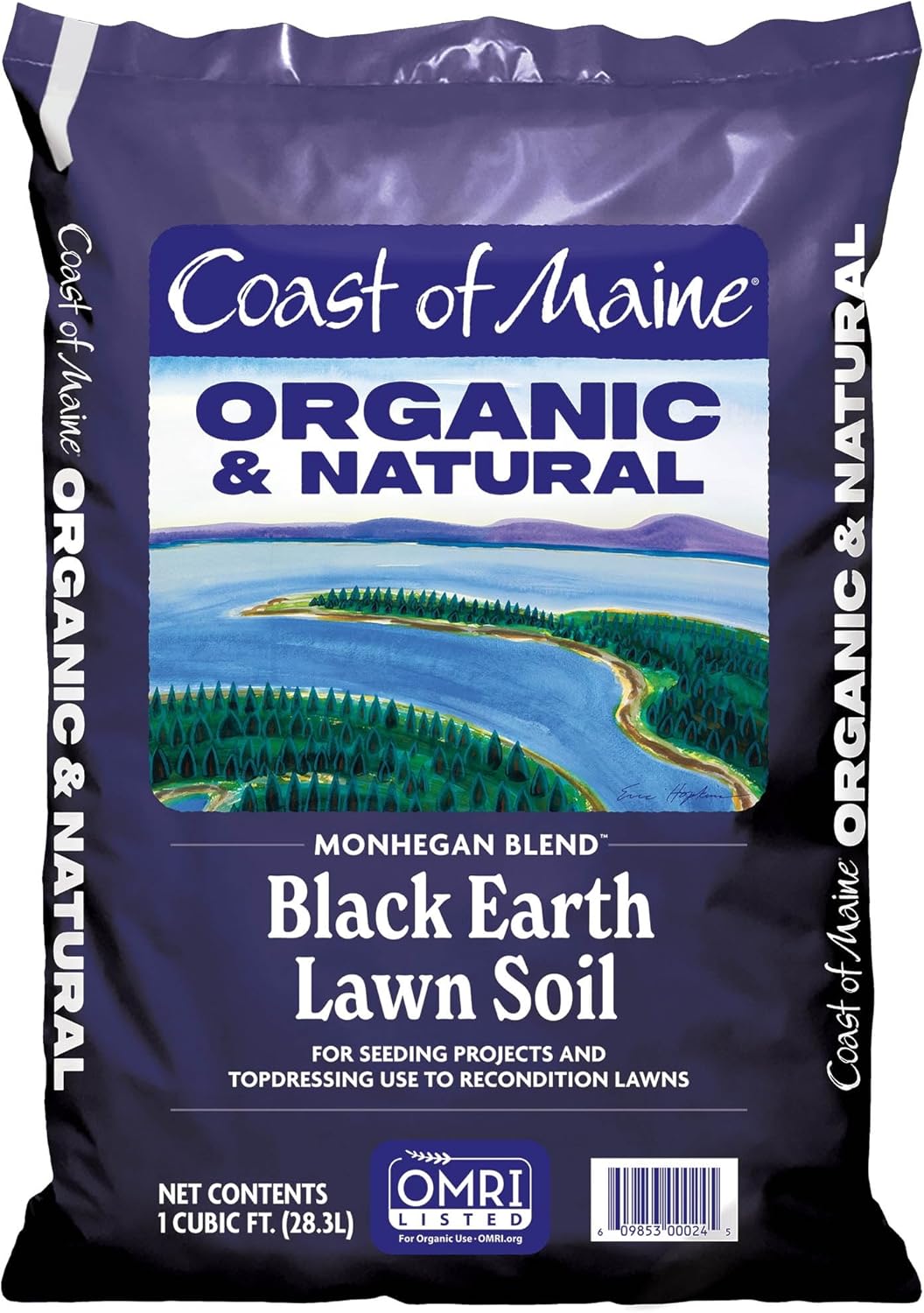
Coast of Maine Monhegan Blend Organic Topsoil (1 cu ft)
| Unit Count | 1 Count |
|---|---|
| Volume | 1 cubic feet |
| Ingredients | Composted farm manures, sphagnum peat moss, aged bark |
| Certified Organic | OMRI Listed |
Coast of Maine Monhegan Blend is an organic topsoil formulated for improving lawn and garden soils through topdressing, filling bare spots, and conditioning beds. The mix combines composted farm manures, sphagnum peat moss, and aged bark to boost moisture retention, aeration, and biological activity in the root zone. For seeding projects it is used as a thin top layer over grass seed or spread over thin turf and watered in; the brand recommends roughly one bag per 10 to 15 square feet for noticeable improvement. Notable features include OMRI listing for organic gardening, a fine texture that spreads easily, and a composition aimed at supporting beneficial microorganisms. Practical benefits are healthier seed germination conditions, improved soil structure, and reduced reliance on synthetic inputs. Limitations are the small 1 cubic foot bag size for larger lawns and the need to follow safety guidance to avoid inhaling fine particles during application. Expect modest, steady improvement in soil health rather than instant turf transformation.
Best for: Gardeners who prioritize reliable, organic soil amendments for overseeding, topdressing, or repairing small patches of lawn and who value building soil biology over time.
Less Ideal for: Homeowners needing to renovate or seed large lawns quickly who prefer bulk delivery or a single larger-volume product for faster coverage.
- OMRI-listed formulation suitable for organic lawn seeding and topdressing
- Blend of composted manures, peat moss, and aged bark improves moisture retention and aeration
- Fine texture spreads easily for even coverage over grass seed and thin turf
- Supports beneficial soil microorganisms to improve long-term soil health
- Small 1 cubic foot bag is inefficient for large lawn projects
- Contains fine particles that can irritate eyes or lungs if not handled carefully
Verdict: Choose this OMRI-listed topsoil when you want an organic, biology-driven product to reliably improve seed germination and soil structure for small-scale lawn repairs.
Back to the Roots Organic Expanding Coco Coir Potting Soil Brick

| Item Highlight | 10 lb compressed coco coir brick; peat-free; OMRI Listed |
|---|---|
| Item Type Name | Coconut Coir |
| Volume | 2 cubic feet |
| Ingredients | Coconut Coir |
This compressed coco coir block soaks up water and expands into a light, airy growing medium you can use alone or mixed with topsoil when overseeding lawn or starting grass seed in containers and beds. The brick is peat free and OMRI listed, so it suits organic gardens and reduces storage bulk compared with loose bags. In practice you hydrate the block, fluff it to break apart fibers, then blend with finish topsoil or compost to improve drainage, aeration, and water retention around delicate seed roots. It is pH balanced and fine enough for seed starting but contains no added nutrients, so you will need to add starter fertilizer or mix with nutrient-rich soil if seeding lawns that need fertility. The package volume is convenient for small to medium projects and works well for homeowners who prefer an easy, low-mess amendment; heavy clay or compacted soils may still require more aggressive conditioning or additional soil to create a proper seedbed.
Best for: Homeowners who prefer low-mess, organic soil amendments and want an easy-to-store medium to improve aeration and moisture for seed starting or small lawn repair projects.
Less Ideal for: Large lawn renovation projects where bulk topsoil, high nutrient content, or heavy soil conditioning is required; contractors and those needing a complete fertigated lawn mix should look elsewhere.
- Expands from a compact 10 lb brick to about 2 cubic feet, saving storage space
- Peat-free and OMRI listed for organic gardening applications
- Light, airy texture improves aeration and water retention when mixed with topsoil
- Works well as a seed-starting medium or amendment for containers and beds
- No built-in nutrients so requires fertilization or mixing with richer soil for seeding lawns
Verdict: A compact, peat-free coco coir brick that expands into an easy-to-use, organic-friendly amendment ideal for improving aeration and moisture when starting grass seed or repairing small lawn areas.
Choosing the Right Topsoil for Grass Seed: Key Factors to Consider
Seedbed Texture
Texture determines how closely seeds contact the soil and how consistently they sit at the right depth. Fine to medium-fine particles let small grass seeds settle without burying them too deep, while avoiding a muddy paste that impedes oxygen exchange.
When evaluating texture, look for soils described as loam or loamy topsoil with a balanced mix of sand, silt, and clay. Too much sand drains quickly and leaves seeds dry, while too much clay can crust and limit root penetration.
Moisture Retention and Drainage
Grass seed needs consistent moisture in the shallow seed zone; both rapid drying and standing water hurt germination. A good topsoil holds enough moisture to keep the seed bed damp between waterings while still allowing excess water to drain away.
Consider your local climate and irrigation frequency. In hot, dry areas prioritize mixes with higher water-holding capacity. In poorly drained yards lean toward lighter, faster-draining soils to prevent rot and crusting.
Organic Matter and Nutrient Buffering
Organic matter supports early seedling growth by improving moisture retention, structure, and microbial life. Soils with modest, well-decomposed organic content supply gentle nutrients and help buffer pH swings without causing fertilizer burn.
Avoid soils with fresh, undecomposed amendments that can immobilize nitrogen or generate heat. Look for descriptions indicating mature compost or stable organic matter suitable for seedlings.
Workability and Ease of Application
Topsoil that breaks apart easily and levels smoothly saves time and ensures even seed depth. Workability affects how well you can rake the soil into shallow grooves, fill divots, and create a uniform seedbed without large clods or stones.
For DIY lawn starts choose soils that spread with a rake or shovel and do not compact excessively under foot. Ease of application also matters if you are repairing patches by hand rather than using heavy equipment.
Cleanliness and Contaminant Safety
Seeds and young seedlings are vulnerable to competition and toxins. Clean topsoil should be free of persistent weeds, viable weed seeds, construction debris, large rocks, and chemical contaminants.
Prefer certified or tested soils when available, especially on sites with unknown history. Avoid soils that list unprocessed industrial byproducts or municipal biosolids without clear treatment claims.
pH Compatibility and Local Adaptation
Soil pH affects nutrient availability and seedling vigor. Most turf grasses prefer near-neutral pH, so topsoil that is neutral to slightly acidic usually works best. If your native soil is strongly alkaline or acidic, choose a topsoil that brings the seedbed closer to your grass species' preferences.
Local climate and native soil texture should influence your choice. A topsoil blend suited to your region reduces surprises and minimizes the need for corrective amendments after seeding.
Preparing the Existing Lawn or Bare Soil
Before adding new topsoil, prepare the surface by removing rocks, large roots, and dense thatch. For overseeding, mow low and dethatch or lightly scarify to expose bare mineral or existing topsoil where seed can contact damp soil.
When installing new topsoil over a compacted area, loosen the subsoil to at least a few inches to prevent perched water and to encourage root growth. A shallow rototill or fork-over followed by raking creates a firm but friable seedbed.
- Remove debris and break up clods to improve seed contact
- Ensure the surface is level to avoid pooling
- Lightly firm the seedbed so seeds do not sink too deep after application
Application Depth and Seeding Technique
Grass seed should be in direct contact with soil and no more than about 1/4 inch deep for most small-seeded turf species. Spread a light layer of topsoil to create a thin, even seedbed rather than piling deep mixes over the seed.
For patch repair, use enough topsoil to bring the patch flush with surrounding lawn but keep the seed at the proper shallow depth. For full renovation, a thicker topdressing can improve grading but still leave the top 1/4 inch composed of finer particles for seed.
- Broadcast seed and then drag a rake or use a leveling tool to incorporate seed into the top 1/8 to 1/4 inch
- Avoid burying seed under thick layers of mulch or heavy soil
- Use a thin final dusting of fine topsoil to improve seed contact if needed
Post-Seeding Watering and Early Care
Frequent, light waterings are essential during germination to keep the seed zone consistently moist without causing runoff. Adjust frequency to local conditions; in hot sun you may need multiple short waterings per day at first.
Once seedlings establish and can tolerate slightly deeper watering, transition to fewer, longer cycles to encourage deeper roots. Avoid heavy foot traffic until seedlings reach mowing height.
- Keep seedbed uniformly damp until most seeds sprout
- Gradually reduce watering frequency as roots deepen
- Protect newly seeded areas from pets and heavy use
Dealing with Problem Soils
If your yard has heavy clay, consider screening or amending topsoil with coarse sand and compost to improve structure, but avoid simply adding large quantities of sand to clay without proper proportions. For very sandy soils, add organic matter to increase water retention.
When underlying soil chemistry is problematic, a thicker layer of neutral, loamy topsoil can help buffer the seedbed. In severe cases a soil test will guide lime or sulfur adjustments before seeding.
- Amend clay with organic matter and gypsum where appropriate
- Add compost to sandy soils to help hold moisture
- Use a soil test to guide pH corrections before heavy seeding
When to Choose a Blend Versus Straight Topsoil
A blended topsoil that includes compost or moisture-retaining materials can give seedlings an early boost, especially in poor native soils. Straight screened topsoil is useful when you want to avoid extra nutrient load or when you will apply a custom amendment strategy.
Match the choice to your project: for small patch repairs a screened topsoil is often fine, while wholesale renovation of a lawn on depleted soil typically benefits from a balanced blend that improves structure and fertility.
- Choose blends for rebuilding soil structure and fertility
- Choose screened straight topsoil when you need neutral fill without extra nutrients
- Consider the long-term maintenance plan when selecting a product
How We Chose the Best Topsoil for Grass Seed
We assembled this list by applying lawn-focused editorial filters that reflect real seed-start conditions. Primary evaluation criteria included texture and particle size distribution, because fine, friable soil gives grass seed the close contact and capillary moisture it needs to germinate. Water retention and drainage were assessed next, favoring soils that hold moisture in the seed zone without staying waterlogged. Nutrient buffering and initial fertility were considered to ensure seedlings get a balanced start without needing excessive early fertilizer. We also checked organic matter content and maturity, preferring well-composted blends that support microbial activity while avoiding raw amendments that can rob nitrogen. Workability and ease of spreading were judged by how readily a soil crumbles and levels, important for even seed depth. Exclusions: blends with excessive sand or uncomposted biosolids, soils primarily designed for heavy clay remediation, and mixes aimed solely at potted plants were excluded. The final shortlist represents topsoils that meet seed-start needs across texture, moisture behavior, nutrient support, and application practicality.
FAQ
How deep should topsoil be for seeding a lawn?
A thin, even seedbed is best for most grass seed. Aim for enough topsoil to ensure the seed is no more than about 1/4 inch beneath the surface. For patching you may add more to match surrounding grade but keep the top layer fine and shallow for seed.
Can I seed directly on top of existing lawn without adding soil?
You can overseed an existing lawn if you prepare the surface by mowing, scarifying, and ensuring good seed-to-soil contact. Adding a light dusting of fine topsoil can improve germination, especially in thin or compacted areas.
Is compost-rich topsoil too strong for new grass seed?
Well-aged, mature compost in moderate amounts supports seedlings. Avoid fresh, hot compost that can generate heat or immobilize nitrogen. Look for soils listing stable organic matter rather than raw amendments.
How soon can I mow after seeding into topsoil?
Mow when the new grass reaches about 3 inches and you can remove only the top third of blade height. Early tiny mows can stress seedlings; wait until the turf has enough density and root development to tolerate cutting.
Should I test my soil before buying topsoil?
A basic soil test helps determine pH and major nutrient needs and informs whether you need a neutral topsoil or amendments. Testing is especially useful on sites with a history of construction or poor performance.
Final Verdict
For starting or repairing turf, prioritize a topsoil with a fine, loamy texture, reliable moisture behavior, and stable organic matter. Those characteristics help seeds stay in contact with moist soil, resist crusting, and access the nutrients they need during early growth. Balance your choice against local conditions and how much prep work you will do, and favor soils that are easy to spread and free of contaminants for the most predictable results. Choose based on the tradeoffs you can manage: higher water-holding capacity in dry climates, faster drainage in wet sites, and stable organic content for long-term soil health. Focus on seedbed texture and moisture behavior first, then match other traits to your yard.
