

Note: This article contains affiliate links. If you click on these links and make a purchase, I may earn a small commission at no extra cost to you. This helps support my research and content. Read my full affiliate disclosure here.
If ants are turning counters, pantry shelves, or indoor potted plants into traffic lanes, you need an approach that controls them without risking household occupants. Choosing a safe indoor ant killer matters because many homes have children, pets, or indoor plants that are vulnerable to harsh chemicals. This guide shortlists the six best safe indoor ant killers that balance effective control with reduced toxicity and safer placement options. We considered how quickly baiting or contact treatments stop trails, how long control lasts, and practical safety features like child-resistant packaging, clear application methods, and low-impact ingredients. Below are our top picks followed by guidance to help you pick the right option for your living situation.
Top Picks at a Glance
| Best Overall The best all-around choice for most situations | Wondercide Indoor Pest Control Spray, Lemongrass, 16 fl oz |  |
| Best Quality Built to a higher standard if you want something more solid | EcoVenger Ant & Crawling Insect Killer Spray, 16 oz (Plant-Based) |  |
| Best Value The sweet spot between price and what you get | STEM Plant-Based Bug Spray for Ants, Roaches and Flies, 12 fl oz |  |
| Best Budget The cheapest option that still gets the job done reliably | Raid Ant Killer Baits, 8 Count (Child-Resistant) |  |
| Highest Rated A top-rated pick with lots of positive feedback | NCSIFDD Ant Away Repellent Gel, Indoor and Outdoor Ant Control, 6-Pack |  |
| Most Popular A crowd favorite that many people choose with confidence | TERRO Liquid Ant Killer Bait Stations, 12-Pack (T300B) |  |
Wondercide Indoor Pest Control Spray, Lemongrass, 16 fl oz

| Unit Count | 16 Fluid Ounces |
|---|---|
| Item Form | Spray |
| Target Species | Ants, Roaches, Spiders, Flies, Fleas, Ticks, Mosquitoes, Silverfish, Moths, Gnats |
| Active Ingredients | 4.2% Cedar Oil; 1.5% Lemongrass Oil; 2.2% Sodium Lauryl Sulfate |
Wondercide Indoor Pest Control is a ready‑to‑use lemongrass‑scented spray designed to kill and repel flying and crawling household pests. You use it by spraying around windows, doors, baseboards, under sinks, in cabinets and directly on visible insects from about 8–12 inches; it is also marketed for treating carpets, furniture and pet areas for fleas. The formula relies on essential oils such as cedarwood and lemongrass plus plant‑derived surfactants, which makes it an option for people seeking a non‑synthetic alternative to conventional insecticides. Practical benefits include multi‑surface use, a familiar spray bottle applicator, and guidance for preventive use as part of regular cleaning. Important limitations are that the spray must contact flying insects to be effective, surfaces can be slippery when wet, and the natural lemongrass tint may temporarily discolor very light fabrics so spot testing is advised. Follow label directions for safe use around pets and to avoid eye or prolonged skin exposure.
Best for: Buyers who want an effective, plant‑based indoor pest spray they can use regularly around family and pets and who prefer a preventative plus treatment approach to common household bugs.
Less Ideal for: People seeking a fast‑acting aerosol knockdown for flying insects or those who need a product specifically labeled for use on plants or in aquatic areas should look for alternatives.
- Plant‑based active ingredients (cedarwood and lemongrass oils) for a less chemically harsh option
- Versatile ready‑to‑use spray for multiple indoor surfaces including carpets and furniture
- Safe for routine use around people and pets when directions are followed
- Targets a broad list of common indoor pests including ants, roaches, fleas and flies
- Requires direct contact with flying insects to kill them rather than acting as an aerosol knockdown
- May temporarily discolor very light fabrics due to natural lemongrass tint
- Surfaces can be slippery while wet after application
Verdict: A broad‑spectrum, plant‑powered indoor spray that balances effective pest control with routine safety around people and pets.
EcoVenger Ant & Crawling Insect Killer Spray, 16 oz (Plant-Based)

| Unit Count | 16 Fluid Ounces |
|---|---|
| Item Form | Spray |
| Target Species | Odorous House Ants, Fire Ants, Roaches, Fleas, Spiders |
| Active Ingredients | Citronella Oil, Geraniol, Cedarwood Oil, Sodium Lauryl Sulfate |
EcoVenger Ant Killer is a ready-to-use, botanical spray designed to kill ants on contact and leave a multi-week repellant residue. In use you spray visible ants, trails, entry points and mound tops for quick control; the formula claims to kill odorous house ants in about a minute and fire ants within several minutes while disrupting pheromone trails to deter re-infestation. The product lists plant-derived active ingredients such as geraniol, citronella and cedarwood oil, and is positioned for both indoor spot treatment around pantries, baseboards and carpets and outdoor mound or perimeter work. Practical benefits include a low-odor citrus/woody scent, non-staining finish suitable for fabrics, and safety testing that supports use in homes with children and pets when used as directed. Important limitations are that it is a spray for spot and perimeter treatments rather than a granular or bait solution for hidden colonies, and heavy infestations reaching deep nests may require repeat treatments or professional intervention to reach queens in complex tunnels.
Best for: Buyers who need a fast, low-toxicity spray to control visible ants and create a lasting perimeter barrier inside the home or around patios and entry points.
Less Ideal for: People who prefer baiting or dust-based colony eradication methods or who need a systemic soil treatment for nesting queens deep underground.
- Plant-based active ingredients reduce reliance on synthetic neurotoxins
- Kills on contact and claims residual repellency up to several weeks
- Safe for indoor use around children and pets when directions are followed
- Non-staining formula suitable for carpets, rugs and most fabrics
- Not a bait product so may not eliminate deeply hidden queens on its own
- Nozzle contains delicate parts that can be damaged if mishandled
Verdict: A fast-acting, plant-based spray that delivers immediate indoor ant knockdown and weeks of residual protection with a low-toxicity profile.
STEM Plant-Based Bug Spray for Ants, Roaches and Flies, 12 fl oz

| Active ingredients | Geraniol 6.2%, Lemongrass Oil 0.5% |
|---|---|
| Other ingredients | White Mineral Oil, Isopropyl Myristate, (+)-Ethyl Lactate 93.9% |
| Form | Trigger spray |
| Use | Indoor and outdoor spot treatments |
This STEM bug spray is a trigger-spray insecticide formulated with plant-derived actives such as geraniol and lemongrass oil to kill ants, roaches and flies on contact. It is intended for targeted indoor and outdoor spot treatments: shake, hold about a foot from the insect and spray directly on or where insects congregate. The product’s botanical formula and absence of added dyes or strong chemical fragrances make it a reasonable choice for homes where users prefer less synthetic-smelling options. The trigger bottle gives control for spot application and repeated short bursts, and the directions note it is oil-based so spills should be cleaned promptly. Important limitations are that it is not for spraying on people, pets or plants and requires direct hits for best effect rather than long-range fogging. For persistent infestations you may need supplemental measures because this is designed for surface and contact kills rather than residual baiting or area-wide control.
Best for: Buyers who want an affordable, low-odor botanical spray for quick spot control of common household pests and who prioritize a simple, easy-to-use trigger bottle for targeted treatments.
Less Ideal for: People facing large or hidden infestations who need long-lasting residual control or bait-style solutions should consider professional products or integrated pest control approaches.
- Plant-based active ingredients (geraniol and lemongrass oil) that reduce strong chemical odor
- Trigger-spray bottle for controlled, targeted application
- Labeled for both indoor and outdoor spot treatments when used as directed
- No added dye or fragrance listed, which minimizes residue and scent
- Oil-based formula can leave slippery residue if spilled
- Requires direct spraying of insects for effectiveness and offers limited residual control
- Not safe to spray on people, pets or plants
Verdict: A budget-friendly, low-odor plant-based trigger spray that provides quick, targeted kills of ants, roaches and flies for everyday spot treatments.
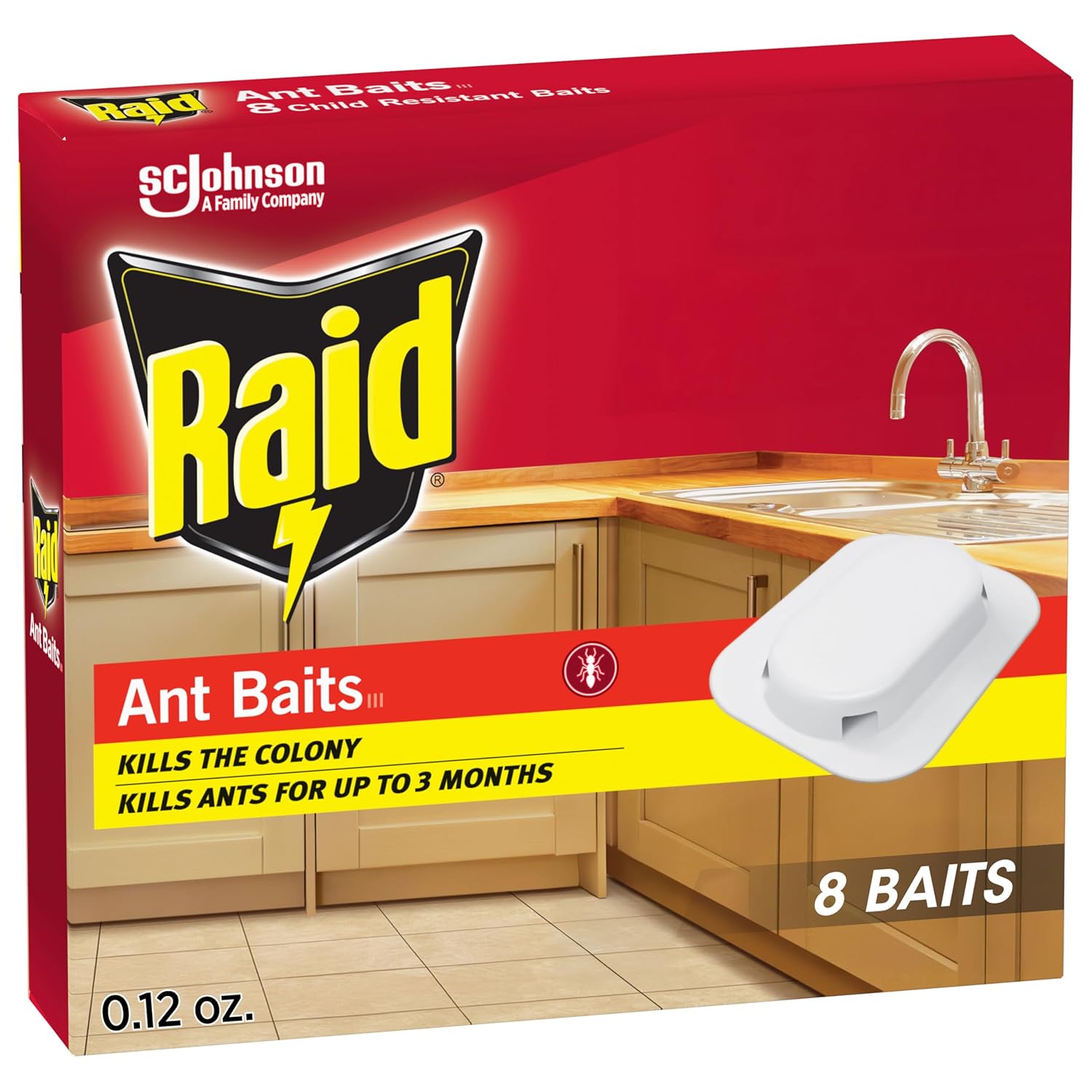
Raid Ant Killer Baits, 8 Count (Child-Resistant)
| Count | 8 Count |
|---|---|
| Indoor use | Yes |
| Child-resistant | Yes |
| Residency duration | Up to 3 months |
These Raid Ant Killer Baits are small, child-resistant bait stations designed for indoor use along walls, in corners, and near entry points. Workers feed on the bait and carry it back to the colony, which can kill the queen and reduce or eliminate infestations over time; the manufacturer states protection can last up to three months per placement. Typical use is to place a bait station where you see ant trails or near likely entryways and leave it undisturbed while ants transport the active ingredient. The child-resistant casing reduces accidental access in homes with children or pets but still allows ants to enter and exit. Practical benefits include discreet placement, low maintenance once set, and targeted control that avoids spraying. Limitations are that results are not instant and heavily infested or outdoor-sourced colonies may require multiple placements or complementary measures; it does not provide immediate contact kill of visible ants.
Best for: Homeowners who want a low-maintenance, indoor ant control option that focuses on eliminating colonies rather than quick surface kills and who prioritize safety around children.
Less Ideal for: People needing fast knockdown of visible ants or those dealing primarily with large outdoor colonies that continually reinvade indoor areas.
- Child-resistant bait stations suitable for indoor placement
- Works via transfer feeding to target entire colonies rather than just visible workers
- Compact and discreet, easy to place along walls and entry points
- Manufacturer claims up to three months of activity per placement
- Not an immediate contact killer so visible ants may persist for days while bait is carried back to the nest
- May be less effective against very large or outdoor nests without additional control steps
Verdict: A safe, low-maintenance indoor bait solution that targets entire ant colonies for buyers looking for cost-effective, child-resistant control.
NCSIFDD Ant Away Repellent Gel, Indoor and Outdoor Ant Control, 6-Pack

| Unit Count | 12 Count |
|---|---|
| Manufacturer | NCSIFDD |
| Number of Pieces | 1 |
This ant gel is a targeted repellent and bait-style treatment intended for application in narrow crevices, along baseboards, window frames, and known ant trails. You remove the cap, attach the precision applicator, and dispense pea-sized drops where ants travel; the manufacturer says to allow 3–5 days for activity to subside as the product works through the colony. The small applicator and gel form make it easy to place without bulky traps or sprays, so it is convenient for kitchens, cabinets, entry points, and patios. The pack is marketed for indoor and outdoor use and claims protection up to 60 days per pack, which suits routine preventive placement. Important limitations are that it is not an instant knockdown—expect increased visible activity initially—and it requires repeat monitoring and reapplication to maintain protection. Also effectiveness may vary by ant species and infestation size, so heavy infestations may need professional treatment or supplementary measures.
Best for: Homeowners who prioritize a reliable, low‑mess solution for recurring indoor ant activity and prefer placing discreet treatments in tight spaces rather than using sprays or bulky traps.
Less Ideal for: People facing large, severe infestations or those who need instant knockdown should consider professional services or additional fast-acting products.
- Precision applicator for accurate placement in narrow crevices and along baseboards
- Formulated for both indoor and outdoor use for flexible placement around the home
- Suitable for use around families and pets when directions are followed
- Small pea-sized drops reduce mess and visible product compared with traps
- Not an immediate kill; increased ant activity can appear for several days as it works through the colony
- May be less effective alone on large or well-established infestations
Verdict: A precise, low‑mess gel treatment designed for homeowners who want a dependable, family‑safe option to control routine indoor ant activity.
TERRO Liquid Ant Killer Bait Stations, 12-Pack (T300B)

| Unit Count | 12 Count |
|---|---|
| Item Form | Liquid |
| Active Ingredients | Sodium Tetraborate Decahydrate (Borax), 5.40% |
| Specification Met | EPA |
TERRO Liquid Ant Killer bait stations are pre-filled, no-mess stations designed for indoor use to reduce and eliminate common sugar-loving household ants. You place the small, self-contained stations along baseboards, in corners, under appliances, or on counters where you see ant activity. The liquid bait is formulated with borax so worker ants are attracted to the sweet feed, consume it, and carry it back to the nest to affect the colony. In practice the product is easy to deploy and requires minimal maintenance beyond occasional replacement when bait is depleted. It typically reduces visible activity within days and can take two to four weeks for more complete colony control depending on infestation size. Important limitations are that it targets sugar-attracted species and works slowly by design, so it is not an instant spray-style knockdown and will be less effective if competing food sources are available or if non-sugar-preferring ants are present.
Best for: Homeowners who want a low-effort, evidence-backed indoor solution to eliminate visible ant trails and suppress entire colonies using bait stations rather than sprays.
Less Ideal for: People who need immediate knockdown of large infestations or who are dealing primarily with ants that do not feed on sweet baits should consider alternative contact sprays or professional services.
- Ready to use stations that are simple to place with no mixing or measuring
- Borax-based liquid bait is carried back to the nest to target the entire colony
- Twelve stations provide coverage across multiple rooms for broader control
- Long-lasting placement that can continue to attract ants for weeks while bait remains
- Works slowly and may take 2–4 weeks for full colony elimination
- Formulation targets sugar-loving ants and may be less effective on protein- or grease-preferring species
Verdict: A simple, low-effort indoor bait system that uses borax-based liquid to attract worker ants and reduce whole colonies over time.
Choosing the Right Safe Indoor Ant Killer: Key Factors to Consider
Active Ingredient and Toxicity
Knowing the active ingredient is the first step to judging safety. Some indoor ant controls use low-toxicity baits that worker ants carry back to the nest, reducing the need for open-surface sprays. Other formulations rely on contact insecticides that can leave residues on floors and countertops.
Look for products with ingredients that have lower mammalian toxicity or that are formulated specifically for indoor use. Also check label warnings and precautionary statements. Even low-toxicity options require proper placement and handling to reduce accidental exposure to children, pets, and beneficial indoor organisms like potted-shelf plants.
Application Method and Placement
How a product is applied affects both safety and effectiveness. Bait stations and gels let you confine material in tamper-resistant housings or narrow bead applications, which is safer around kids and pets. Aerosol or pump sprays reach visible trails quickly but can spread residues that are harder to control in kitchens and play areas.
Think about where ants are active. Baits work best along trails and near entry points, while spot sprays can be useful for nests in wall voids or baseboards. Choose methods that let you keep the material out of reach and that match the ant behavior you observe.
Speed Versus Colony Elimination
Some products provide fast knockdown of visible ants, while others act slowly but target the colony. Fast-acting contact products reduce immediate nuisance but may not stop new worker ants if the nest remains intact. Slower-acting baits are designed to be carried back to the nest by foraging workers, producing longer-term control.
Decide whether you need rapid relief or deeper colony suppression. In many indoor settings, combining a quick spot treatment with strategic bait placement gives both immediate reduction and lasting control without heavy chemical loads.
Child and Pet Safety Features
Safety features are critical when treatments are applied inside occupied homes. Child-resistant bait stations, labeled non-toxic ingredient blends, and clear re-entry intervals reduce risk. Consider physical design too: sealed stations and rigid housings prevent pets from chewing or spilling materials.
Also account for household routines. If small children crawl or pets explore baseboards and counters, opt for products with secure placement options and minimal surface residue. Read label guidance on accidental exposure and first-aid steps so you know how to respond if contact occurs.
Compatibility with Indoor Plants and Food Areas
Indoor ant control often needs to be used near kitchens, pantries, and houseplants. Some products can be placed directly on kitchen baseboards or under sinks, while others should never be applied near food prep surfaces or exposed soil in pots.
If you keep edible herbs or many potted plants inside, choose options that minimize dust or liquid runoff into soil. Bait stations and gels generally reduce the chance of contamination. Always follow label directions for use around food and edible plants.
Residual Effect and Reapplication Frequency
Residual protection determines how often you must reapply or replace treatments. Long-lasting residual sprays or granules may keep ants away for weeks but increase the amount of active ingredient in the home. Shorter-duration baits or station-based systems require more frequent checks but limit ongoing chemical presence.
Balance the convenience of long residual control with your comfort level for continuous indoor exposure. If you have frequent guests, children, or sensitive pets, a regimen of frequent inspections with targeted baiting may be preferable to a long-lasting surface treatment.
Understanding Indoor Ant Behavior
Different ant species behave differently indoors. Some species forage widely and recruit teammates along scent trails, which makes baiting along trails especially effective. Others create small satellite nests inside walls or under flooring, which can produce intermittent indoor sightings rather than continuous trails.
Observing where ants appear and when they are most active helps guide product choice and placement. Track entry points, times of day, and the foods ants prefer. That field information shortens the time to control and reduces the amount of product you need to use.
- Follow fresh trails to find likely entry points and bait placement spots.
- Note whether ants are clustered around sweet foods, greasy residues, or damp areas.
- Check for tiny piles of soil or frass that can indicate nearby nests in structural voids.
Safe Application Practices for Living Areas
When treating living spaces, limit exposure by confining products to edges and out-of-reach locations. Use bait stations in corners, behind appliances, and along baseboards where children and pets are unlikely to contact them. Avoid broad-area sprays on counters or floors that touch food or bare skin.
Clean up crumbs and spills before applying bait so foragers find the bait first. Keep treated areas ventilated until any aerosols settle and follow label re-entry guidance. For liquid spot treatments, blot excess rather than wiping it across surfaces to minimize spread.
- Place baits along active trails rather than random spots.
- Secure stations so pets cannot overturn them.
- Isolate treated cabinetry or pantry shelves from food items during application.
Combining Nonchemical Methods with Safe Products
Physical and cultural controls reduce dependence on chemical treatments. Sealing entry cracks, repairing door sweeps, and storing food in sealed containers cut off forage incentives. Removing water sources like leaky pipes and drying damp plant saucers also reduces ant attraction.
When you combine these measures with a safe indoor ant killer, you often need smaller amounts and fewer reapplications. Nonchemical tactics are especially important in homes with infants, pets, or people with chemical sensitivities.
- Use caulk and weatherstripping to block obvious entry points.
- Keep indoor plants on saucers and avoid standing water.
- Store pet food and human snacks in airtight containers.
Maintenance and When to Reseat Baits
Bait stations and gels require periodic checks. If a station is untouched after several days, it might be in the wrong place or attractant type. Move it closer to active trails or try a different bait formulation. If a station is consumed quickly, replace it to sustain pressure on the colony.
For sprays and surface treatments, inspect treated edges weekly for new activity. Ants can reroute around treated areas or reinfest from adjacent structures, so maintenance matters even with effective initial control.
- Check bait stations every 3 to 7 days during active infestations.
- Relocate or replace baits that are ignored after a week.
- Keep a small log of locations to track progress and identify reinfestation patterns.
When to Contact a Professional
Some indoor infestations are structural or involve species that nest deep inside walls or insulation. If you see ants continuously despite careful baiting and sanitation, or if there are large numbers coming from inside structural voids, professional inspection can identify hidden nests and entry routes.
Professionals can also advise on treatment strategies that minimize indoor exposure while achieving control. Use professional services as an option when DIY measures fail or when infestations pose health concerns for sensitive occupants.
- Consider professional help when ants persist after repeated baiting and sealing.
- Ask about targeted interior treatments and exclusion methods to reduce chemical exposure.
- Request guidance on safe reentry intervals and precautionary steps for households with vulnerable people.
How We Chose the Best Safe Indoor Ant Killer
We screened candidate products for a mix of real-world safety features and pest-control performance that matter in occupied indoor spaces. Selection began with formulations designed for indoor use and labeled for kitchens, living rooms, and around houseplants. We prioritized low-toxicity active ingredients or bait systems that minimize broadcast spraying, plus clearly marked application instructions that reduce misuse. Evaluation focused on measurable dimensions: speed of colony reduction, safety profile for children and pets, ease of placement or application indoors, residual control duration, and suitability around food prep areas and plants. We excluded outdoor-only products, agricultural-graded chemicals, and items lacking clear indoor labeling or child-safety features. Products with ambiguous instructions or those requiring professional-only application were not considered. The final list contains indoor-appropriate options that scored well across these practical criteria.
FAQ
Are bait stations safe to use around children and pets?
Bait stations are generally safer than open sprays because they confine material inside a tamper-resistant housing. However, not all stations are equally secure. Choose stations designed to be child-resistant and place them where curious hands and paws cannot reach. Always follow label directions for lock mechanisms and replacement schedules.
How long does it take for baits to reduce an indoor ant population?
Baits often work over days to a few weeks because foragers must carry toxicant back to the nest. Visible reduction in worker numbers may appear within a few days, but full colony suppression can take longer depending on nest size and bait acceptance. Persistence and correct placement improve results.
Can I use outdoor ant treatments indoors if ants come from outside?
You should avoid using outdoor-only formulations inside. Outdoor products may have higher toxicity or different solvents not suited for enclosed spaces. Instead, use indoor-labeled baits or spot treatments and address entry points to stop reinfestation from outside.
Will sealing cracks and gaps stop ants completely?
Sealing helps but is rarely a complete solution on its own. It reduces entry points and foraging pathways, yet ants can still use tiny gaps or be transported in potted soil and grocery bags. Combine exclusion with baiting and sanitation for better control.
Is it safe to use ant control near indoor plants?
Many indoor-safe options minimize runoff into potting soil, especially enclosed baits and gels. Avoid applying sprays directly on exposed soil or plant foliage. If treating near plants, use contained stations or place barriers so treatments cannot wash into pots during watering.
How often should I inspect bait stations and treated areas?
Inspect bait stations every 3 to 7 days during active infestations and at least monthly afterward. Check treated edges once a week after application to confirm there is no new activity. Regular checks let you reposition or replace products promptly for continued control.
Final Verdict
Pick an indoor ant control strategy that matches the household risks and the infestation pattern. If children, pets, or edible plants are present, favor bait-based systems and tamper-resistant placements that reduce surface residues. For quick relief, combine a localized contact treatment with sustained baiting to target the colony while limiting exposure. Prioritize clear label guidance, secure placement, and regular monitoring. Balancing speed of control with low-toxicity approaches will give the best outcome for maintaining a safe, ant-free indoor space.
