

Note: This article contains affiliate links. If you click on these links and make a purchase, I may earn a small commission at no extra cost to you. This helps support my research and content. Read my full affiliate disclosure here.
If chinch bugs are browning patches of lawn, the right insecticide can stop active feeding and prevent new outbreaks. You need a product that acts quickly to relieve damage and has enough residual activity to protect roots while grass recovers. This guide looks at seven shortlisted insecticides for chinch bugs chosen for their real-garden performance across different turf types and infestation levels. Below we summarize how each option performs on speed of control, residual protection, application ease, and safety for common lawn situations so you can pick the right treatment for your yard.
Top Picks at a Glance
| Best Overall The best all-around choice for most situations | Talstar One Insecticide Concentrate, 1 Gallon |  |
| Best Quality Built to a higher standard if you want something more solid | Agrisel Bifenthrin Pro 7.9 Insecticide, 1 Gallon |  |
| Best Value The sweet spot between price and what you get | Compare-N-Save 7.9% Bifenthrin Concentrate, 8 fl oz |  |
| Best Budget The cheapest option that still gets the job done reliably | Spectracide Triazicide Insect Killer for Lawns & Landscapes, 32 oz |  |
| Highest Rated A top-rated pick with lots of positive feedback | Envu Tempo SC Ultra Insecticide Concentrate, 240 ml |  |
| Most Popular A crowd favorite that many people choose with confidence | Scotts GrubEx1 Season-Long Grub Killer (covers 5,000 sq. ft.) |  |
| Best Seller A high-volume bestseller chosen again and again | Atticus Talak 7.9% Bifenthrin Indoor/Outdoor Insecticide Concentrate (32 oz) |  |
Talstar One Insecticide Concentrate, 1 Gallon

| Active ingredient | Bifenthrin 7.9% |
|---|---|
| Formulation | Concentrate, water-based |
| Intended use areas | Indoor and outdoor, perimeter and structural surfaces |
| Pests controlled | Controls 75+ pests |
Talstar One is a concentrated bifenthrin insecticide designed to control a wide range of nuisance and structural pests both inside and around the home. You mix the concentrate with water and apply it as perimeter treatments, spot treatments in cracks and crevices, or to outdoor structural surfaces, lawns, ornamentals, shrubs, and trees following label directions. Notable features are its broad-spectrum efficacy against more than 75 pests, a water-based low-odor formula that dries clear, and long residual activity that reduces how often you need to reapply. For practical use this means one gallon of concentrate can treat large yards or multiple structures, making it suited to seasonal maintenance or professional-style applications. Important limitations are that it is a synthetic neurotoxic insecticide so care with mixing, application rates, and keeping people and pets off treated surfaces is required, and it must be used exactly as labeled for lawn pests. Also, it is a general-purpose product rather than a chinch-bug-specific formulation, so spot monitoring and targeted timing are still necessary for best chinch bug control.
Best for: Buyers who want a single, versatile insecticide to manage a range of turf and perimeter pests and who are comfortable following label directions for concentrated products.
Less Ideal for: Homeowners seeking an organic, non-synthetic chinch bug solution or those who prefer ready-to-use sprays rather than mixing a concentrate.
- Broad-spectrum control listed for over 75 pests including turf and perimeter pests
- Concentrate formulation stretches coverage for large lawns or multiple structures
- Water-based, low-odor formula that dries clear, suitable for outdoor living spaces
- Appropriate for both perimeter barriers and targeted crack-and-crevice indoor use
- Contains bifenthrin which requires careful handling and strict label adherence
- Not a product formulated specifically for chinch bugs so timing and monitoring are still needed
Verdict: Choose Talstar One when you need a versatile, long-lasting concentrate that stretches to cover large lawns and perimeter treatments for broad-spectrum pest control.
Agrisel Bifenthrin Pro 7.9 Insecticide, 1 Gallon

| Item Form | Liquid |
|---|---|
| Liquid Volume | 1 gallons |
Agrisel Bifenthrin Pro 7.9 is a concentrated liquid insecticide formulated for routine turf and perimeter treatments. Mixed at label rates into a hose or tank sprayer, it is intended to control a wide range of pests including ants, fleas, ticks, mole crickets and common lawn beetles and is appropriate for treating chinch bug infestations when applied to infested turf. The product emphasizes low use rates, which makes it economical for treating large areas; the manufacturer recommends rates based on vegetation density and repeat monthly for continued protection. Notable features include broad-spectrum activity and instructions for targeting nests and entry points, plus guidance on application volumes per 1,000 square feet. Important limitations are that it is a synthetic pyrethroid so users should follow label directions for timing and environmental precautions and allow treated areas to dry before pets return. It is not marketed for sale in all states so check local restrictions before purchasing.
Best for: Gardeners and turf managers who prioritize performance and economical treatments for persistent lawn pests and who are comfortable following label directions for concentrated insecticides.
Less Ideal for: Homeowners seeking organic or non‑synthetic solutions or those unwilling to follow state restrictions and safety precautions should consider alternative products.
- Broad-spectrum activity effective against a wide range of turf and perimeter pests
- Concentrated 1 gallon formula with low recommended usage rates for economical coverage of large areas
- Clear application guidance for lawns and targeted treatments such as nests and entry points
- Becomes safe for pets once treated surfaces are dry, per manufacturer directions
- Contains a synthetic pyrethroid which requires careful adherence to label restrictions and environmental precautions
- Cannot be sold in certain states which may limit availability
Verdict: Choose this concentrated bifenthrin formula when you need a performance‑oriented, economical insecticide for effective control of chinch bugs and other turf pests.
Compare-N-Save 7.9% Bifenthrin Concentrate, 8 fl oz

| Unit Count | 8 Fluid Ounces |
|---|---|
| Item Type Name | Insect Control |
| Item Form | Spray |
| Target Species | Insects |
| Active Ingredients | Bifenthrin |
This 8-ounce Compare-N-Save bifenthrin concentrate is a small, high-strength insecticide meant for dilution into ready-to-use spray for treating large areas. In practice you measure and mix the concentrate in a tank sprayer to cover lawns, ornamentals, trees, shrubs, and indoor problem areas; the listing states the bottle can make up to 44 gallons of spray, which makes it efficient for treating chinch bug infestations across a yard. Key features are the 7.9% bifenthrin active ingredient and compatibility with tank mixes including insect growth regulators, which gives flexibility when targeting multiple pests. The concentrate form keeps storage and transport compact but requires careful measuring, proper protective gear, and attention to label directions for safe application. It is effective for preventive and curative treatments on turf if applied at recommended rates, though it is a professional-strength product so users should be comfortable handling concentrated pesticides and following local regulations for outdoor pesticide use.
Best for: Buyers who want a cost-efficient, concentrated insecticide to treat chinch bugs and other turf pests across medium to large lawns and who are comfortable mixing and applying pesticides safely.
Less Ideal for: Casual gardeners who prefer pre-mixed sprays, small-plot users, or anyone unwilling to follow precise mixing and safety procedures should consider an easier-to-use product.
- High-concentration formula treats large areas from a small bottle up to 44,000 sq. ft. when mixed as directed
- 7.9% bifenthrin active ingredient provides broad-spectrum control against lawn and ornamental insects
- Can be tank mixed with other pesticides and insect growth regulators for flexible integrated treatments
- Concentrate form is compact for storage and reduces the number of ready-to-use containers needed
- Requires careful measuring, mixing, and protective equipment because it is a concentrated pesticide
- Not labeled as a ready-to-use product so it is less convenient for one-off spot treatments
Verdict: A compact, high-strength bifenthrin concentrate that stretches far for economical, large-area chinch bug control when mixed and applied correctly.
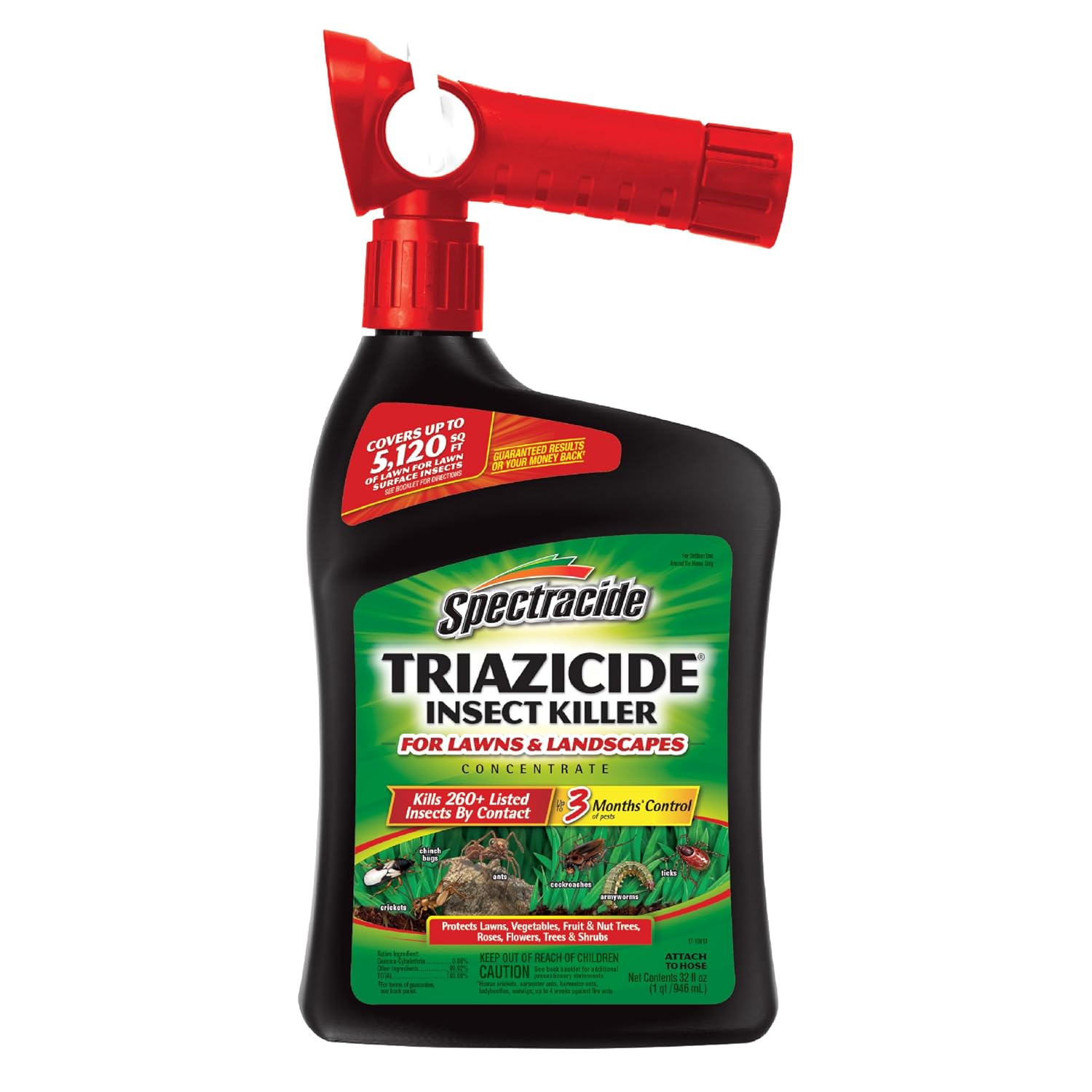
Spectracide Triazicide Insect Killer for Lawns & Landscapes, 32 oz
| Unit Count | 32 Ounce |
|---|---|
| Item Form | Spray |
| Target Species | Insects |
| Active Ingredients | Gamma-Cyhalothrin (0.08%) |
Spectracide Triazicide is a 32-ounce concentrate designed for treating lawns, gardens, trees and shrubs for surface and soil-dwelling insects. You mix the concentrate with water and apply it with a tank sprayer or the hose-end attachment to cover large areas; the manufacturer states coverage up to several thousand square feet depending on dilution. The active ingredient, gamma-cyhalothrin, delivers fast contact kill on many pests named on the label, including ants, fleas, deer ticks, Japanese beetles and grubs when used as directed. Practical benefits are broad-spectrum control, a nonstaining formula and flexible use around flower beds, roses and vegetable gardens when label directions are followed. Important limitations include toxicity to fish and bees so avoid applications near water or blooming plants and follow safety directions closely, and it requires mixing and sprayer equipment rather than a ready-to-spray bottle for all use cases. For chinch bug problems, it provides a conventional chemical option with quick knockdown when applied at recommended rates.
Best for: Homeowners managing chinch bugs and other common lawn pests who prioritize an affordable, broad-spectrum chemical control for medium to large turf areas and are comfortable following label safety and mixing instructions.
Less Ideal for: People with small ornamental gardens near water features, or gardeners who need a bee-safe or organic solution should choose a less toxic or nonchemical alternative.
- Concentrate covers large areas when mixed, making it cost-effective for big lawns
- Kills a wide list of above- and below-ground lawn insects by contact
- Non-staining formula when used as directed
- Works fast with knockdown reported within 24 hours
- Highly toxic to aquatic life and bees, requiring careful application timing and placement
- Requires mixing and a sprayer or hose-end applicator rather than a simple ready-to-spray bottle
Verdict: A budget-friendly concentrate that delivers fast, broad-spectrum knockdown for chinch bugs and other lawn pests across large areas when used responsibly.
Envu Tempo SC Ultra Insecticide Concentrate, 240 ml

| Item Volume | 240 ml |
|---|---|
| Item Form | Liquid |
| Target Species | Ants, flies, cockroaches, crawling pests, and ticks |
| Ingredients | Beta-Cyfluthrin |
Tempo SC Ultra is a liquid concentrate designed for treating crawling pests around the home and lawn perimeter. Mixes with water to create a spray for spot, crack-and-crevice, and general surface applications indoors and along foundations, doorways, garages, and patios. Its active ingredient, beta-cyfluthrin, provides quick knockdown and a measurable residual effect so treated areas remain protected between applications. The suspension concentrate formulation spreads evenly and is low odor and non-staining, which helps when using it near entryways or storage areas. Because it is a concentrate, a small bottle covers a large area when mixed per label directions, making it efficient for routine maintenance treatments. Important practical limits are that it is a pesticide so label directions and safety precautions must be followed, and it is intended for targeted and perimeter use rather than broadcast application over turf without following turf-specific instructions. Expect professional-strength performance when used correctly for dependable control of ants, spiders, cockroaches, ticks, and similar pests.
Best for: Homeowners and property stewards who prioritize a dependable, long-lasting perimeter treatment for crawling pests and want a concentrated product that treats large areas efficiently.
Less Ideal for: People seeking an organic or non-synthetic pest control option or those who need broadcast turf treatments without following specific turf labeling should consider alternatives.
- Broad-spectrum control of common crawling pests including ants, spiders, cockroaches, and ticks
- Fast knockdown plus residual activity for longer-lasting perimeter protection
- Concentrated liquid mixes easily to treat large areas efficiently
- Low odor and non-staining formula suitable for use near entry points and stored areas
- Contains a synthetic pyrethroid active ingredient so label safety precautions and application restrictions must be followed
Verdict: Choose Tempo SC Ultra when you want a professional-strength, low-odor concentrate that delivers fast knockdown and lasting perimeter control of crawling pests.
Scotts GrubEx1 Season-Long Grub Killer (covers 5,000 sq. ft.)

| Item Form | Granules |
|---|---|
| Target Species | Insects |
| Active Ingredients | Chlorantraniliprole |
| Unit Count | 229.6 Ounce |
Scotts GrubEx1 is a granular, season-long insecticide designed to prevent root-feeding grubs and reduce populations of other turf pests such as caterpillars, billbug larvae, and chinchbugs. You apply it to a dry lawn in spring or early summer using a broadcast or drop spreader (Scotts gives recommended spreader settings) and then water the lawn to move the active ingredient into the soil where pests feed. One 14.35 lb bag covers about 5,000 sq. ft. and the product is intended for a single application per year, providing up to four months of protection. In practice it is easy for a homeowner to use during routine lawn care and the instructions about watering and reentry times are straightforward. Limitations are that it is preventive rather than curative for heavy, established infestations and only one application per year is allowed, so timing matters. Also it targets soil-feeding pests specifically, so above-ground beetles or nonlisted insects may require other treatments.
Best for: Homeowners who want a low-effort, preventive approach to protect lawns from root-feeding pests and who follow application timing and watering instructions carefully.
Less Ideal for: People facing an active, heavy infestation that needs immediate knockdown or those who need multi-application seasonal control strategies.
- Season-long control from a single application covering up to 5,000 sq. ft.
- Granular formula for straightforward spreader application and easy integration into regular lawn maintenance.
- Targets grubs plus other turf pests including caterpillars and chinchbugs, broadening usefulness.
- Clear directions on activation (water-in) and safe reentry times after drying.
- Preventive product only and may be less effective at eliminating large, established infestations.
- Maximum of one application per year limits options if pests reappear outside the protection window.
Verdict: Choose Scotts GrubEx1 if you want a simple, single-application granular treatment to prevent grubs and reduce chinchbugs across a 5,000 sq. ft. lawn.
Atticus Talak 7.9% Bifenthrin Indoor/Outdoor Insecticide Concentrate (32 oz)

| Item Form | Liquid |
|---|---|
| Target Species | Insects |
| Liquid Volume | 32 fluid ounces |
| Active Ingredients | Bifenthrin |
| Specification Met | EPA |
Atticus Talak 7.9% is a versatile bifenthrin concentrate intended for both lawn and household perimeter treatments. You mix small measured amounts with water to spray lawns, landscapes, trees, patios, foundation perimeters, and indoor baseboards or cabinets. The product lists control for more than 75 pests including chinch bugs and claims residual control for up to three months. Its water-based formula dries clear, is odor-free, and is not phytotoxic to plants when used as directed, and the bottle has a pour-friendly design for easier measuring. Important limitations are that mixed solutions should be used the same day and it is not approved for fogger use, so you need a sprayer and must follow label rates carefully. Also this product is restricted from sale in a few states, and like all pesticides it requires reading the label for safety and reentry times. For routine perimeter and turf treatments where proven broad-spectrum control and established active ingredients matter, Talak is an effective, no-nonsense option.
Best for: Buyers who prioritize a proven, broad-spectrum insecticide for routine lawn and perimeter treatments and prefer familiar, well-established chemistry with clear label instructions.
Less Ideal for: People who want ready-to-use products, need fogger-compatible formulations, or live in states where this product is restricted should consider alternate solutions.
- Contains 7.9% bifenthrin, a long-used active ingredient with broad-spectrum control
- Water-based concentrate dilutes easily, dries clear, and is odor-free
- Label lists control of chinch bugs and more than 75 other pests with up to three months residual
- Can be used indoors and outdoors for perimeter, surface, and turf applications
- Bottle design permits measured pouring for accurate dilution
- Mixed spray must be used the same day and cannot be stored
- Not approved for fogger application, requiring a sprayer for proper coverage
- Not available for sale in Connecticut, New York, or Vermont
Verdict: Choose Talak 7.9% when you want a trusted bifenthrin concentrate that gives broad, long-lasting control of chinch bugs and other common turf pests.
Choosing the Right Insecticide for Chinch Bugs: Key Factors to Consider
Speed of Knockdown and Visible Control
How quickly an insecticide reduces active chinch bug feeding matters because prolonged feeding increases patch expansion and root stress. Fast knockdown typically means visible improvement in lawn color within days, which is important for homeowners trying to salvage small outbreaks before they spread.
Products that act quickly can also reduce the likelihood of predators being overwhelmed and make follow-up monitoring simpler. However, immediate knockdown sometimes comes with shorter residual protection, so weigh this factor against how long you need the lawn protected after treatment.
Residual Control Duration
Residual activity determines how long a treated area resists reinfestation. For chinch bugs, which can persist in thatch and move from neighboring turf, longer residual control reduces the need for repeat applications and lowers the chance of eggs hatching into a new damaging cohort.
Residual varies by active ingredient and application rate, and is influenced by irrigation, sunlight, and thatch depth. Expect shorter residual under heavy rainfall or frequent irrigation. Choose a product with a residual period that matches your infestation severity and lawn recovery timeline.
Turf Safety Across Grass Types
Not all insecticides are equally safe on every grass species or under stress conditions. Warm-season grasses and cool-season grasses respond differently to treatments, and recently overseeded or drought-stressed lawns are more prone to phytotoxic reactions.
Always match the product label to your grass type and avoid treatments during heat stress or immediately after core aeration unless the label permits it. Proper timing and following labeled rates protect grass while delivering effective chinch bug control.
Application Method and Ease
Ease of application affects how accurately you can cover the lawn and follow label directions. Granular products are often easier for homeowners because they broadcast evenly with a spreader, while liquids require mixing and a sprayer for uniform coverage.
Consider storage, mixing complexity, and cleanup. Products with simple application instructions reduce the chance of underdosing, overdosing, or missed strips. Choose a format that fits your equipment and comfort level to ensure consistent results.
Rainfastness and Environmental Persistence
Rain within a few hours of application can reduce effectiveness for some insecticides, washing them off turf blades and into soil where uptake or binding may change control characteristics. Rainfastness is therefore an important practical trait for maintaining efficacy after application.
At the same time, environmental persistence can be a double-edged sword. Higher persistence often means longer protection but also greater non-target exposure. Opt for products whose rainfast window and persistence match your scheduled irrigation and local weather patterns.
Label Restrictions and Safety Precautions
Labels include critical restrictions such as re-entry intervals, allowable application rates per season, and specific instructions for nearby edible plantings or water bodies. These instructions directly affect where and how you can treat for chinch bugs.
Personal protective equipment, restrictions on mowing and irrigation after application, and timing relative to pollinator activity should all be read and followed. Proper label adherence keeps the treatment safe for people, pets, and beneficial insects while ensuring legal and effective use.
When to Treat Chinch Bug Damage
Treat when you confirm chinch bug activity in expanding brown or yellow patches, not just when grass shows generic drought symptoms. A simple screwdriver or core sampler can expose insects in the thatch and soil surface where chinch bugs concentrate during daytime heat.
Early evening and morning inspections are most reliable because chinch bugs often shelter in thatch during midday. Treating promptly when you find active feeding limits the area that needs protection and reduces recovery time for the lawn.
- Look for stippling, dead grass blades, and active insects near the thatch layer
- Sample several locations to gauge infestation spread before treating
- Delay irrigation for the interval recommended on the label to improve uptake
Granular Versus Liquid Applications
Granular formulations are convenient for medium to large lawns because a broadcast spreader gives uniform coverage and requires less mixing. They can be easier to apply accurately for homeowners without sprayers.
Liquid applications often offer faster visible control and can be better for spot treatments or for reaching cracks and edges. Liquids require a sprayer and careful mixing to ensure correct rates and even coverage.
- Granules: simpler cleanup and storage, good for broad coverage
- Liquids: better for spot treatments and precise calibration
- Either format needs correct spreader or sprayer settings to avoid under- or over-application
Timing Treatments with Lawn Care Activities
Coordinate insecticide applications around mowing, aeration, and fertilization. Mow a day or two before treatment rather than immediately after, so turf stress is minimized and active surface coverage is maximized.
Avoid major cultural stress events like dethatching or heavy mechanical work at the same time as treatment unless the product label allows it. Proper timing helps grass recover and makes chemical control more effective.
- Mow short a couple of days before applying for better contact
- Wait to reseed or overseed according to label instructions to protect seedlings
- Schedule treatments when rain is unlikely for the product's rainfast window
Monitoring and Follow-up After Application
Check treated areas at regular intervals for remaining adults and nymphs. Continued activity after the expected knockdown window may indicate uneven coverage or a need for a different residual strategy.
Resist reapplying too quickly. Many products require waiting periods between treatments. Instead, focus on improving cultural practices to reduce future chinch bug pressure, such as watering deeply and infrequently and reducing thatch.
- Inspect edges and sunny areas first; chinch bugs favor hot, dry spots
- Record application dates and weather to inform future timing
- Combine chemical controls with cultural improvements for longer-term suppression
Safety Around Pollinators and Pets
While chinch bug treatments target turf pests, some active ingredients can be harmful to pollinators. Apply when pollinator activity is low, such as early morning or late evening, and avoid treating blooming plants.
Keep pets off treated areas for the re-entry interval specified on the label and follow washing instructions for pet bedding that contacts turf. Properly store and dispose of leftover product and containers following local guidelines.
- Avoid applications during peak bloom to reduce pollinator exposure
- Follow label re-entry times for people and pets
- Use minimal effective rates to reduce non-target impacts
How We Chose the Best Insecticide for Chinch Bugs
We evaluated products that are commonly used to control chinch bugs in lawns and applied practical, gardener-focused filters. Primary evaluation criteria included speed of knockdown, measured by how quickly visible feeding activity and adult populations decline after treatment, and residual control, meaning how long the product continues to protect grass from reinfestation. We also considered turf safety across warm- and cool-season grasses, coverage and application practicality for small and larger lawns, and labeled restrictions for watering and mowing. Ease of mixing and application method were weighed because amateurs do most residential treatments. Exclusions included products labeled only for ornamental beds or indoor use, options lacking clear lawn use on the label, and experimental formulations without established turf guidance. Our process prioritized products with clear, applicable instructions and a record of controlling chinch bugs while minimizing turf stress when used as directed. The scoring criteria below reflect these practical dimensions so gardeners can compare what matters in the yard.
FAQ
How soon should I expect visible lawn recovery after treating for chinch bugs?
Often you will see slowed damage progression within a few days and visible greening within one to three weeks depending on grass type and stress level. Recovery speed depends on root damage extent and whether irrigation and fertilizer support turf regrowth.
Can I use the same insecticide on all types of turfgrass?
Not always. Some formulations and labeled rates are specific to warm- or cool-season grasses or to certain varieties. Always check the label for approved turf types and any temperature or stress-related restrictions before applying.
Will watering after application reduce effectiveness?
It depends on the product. Some products require a dry window to be rainfast, while others need irrigation to move the active ingredient into the thatch or root zone. Follow the label instructions on post-application watering to maintain efficacy.
Is one application usually enough to control chinch bugs?
One application can be sufficient for light to moderate infestations when applied correctly, but heavy or persistent populations may need a follow-up timed according to label intervals. Combining chemical treatment with cultural care reduces the need for repeat sprays.
Are there non-chemical options that help reduce chinch bug pressure?
Cultural practices such as deep, infrequent watering, managing thatch, and overseeding with resilient grass varieties reduce chinch bug habitat and stress on turf. Biological controls and natural predators can contribute but are rarely enough alone in heavy infestations.
What precautions should I take when applying insecticide near gardens or water features?
Maintain buffer zones specified on the label, avoid drift by applying when wind is low, and do not apply directly into water. Choose products with label directions for adjacent plantings and follow disposal instructions to prevent contamination.
Final Verdict
Prioritize treatments that match the severity of the infestation and the needs of your turf. Fast-acting options are useful to stop active feeding, while products with longer residual control reduce the chance of reinfestation. Balance efficacy with turf safety, application practicality, and label restrictions. Ultimately, integrate chemical control with cultural practices like proper watering, mowing, and thatch management to lower future chinch bug risk and keep your lawn healthy.
