

Note: This article contains affiliate links. If you click on these links and make a purchase, I may earn a small commission at no extra cost to you. This helps support my research and content. Read my full affiliate disclosure here.
If you have rodents in an attic, choosing the right rodent poison for that space changes how you approach control and cleanup. Attics are enclosed, often insulated, and can hide carcasses and droppings in voids that make odors and secondary risks worse. This guide focuses on options suited for attic use and explains practical differences in toxicity, persistence, and bait formulation. We narrowed the list to the top five attic-appropriate rodent poisons that balance effectiveness with considerations important for overhead spaces. Below you will find short product summaries and our evaluation criteria so you can pick the solution that matches your attic access, non-target risk tolerance, and cleanup plan.
Top Picks at a Glance
| Best Value The sweet spot between price and what you get | J.T. Eaton 704-PN Peanut Butter Bait Blocks, 64 count pail |  |
| Best Budget The cheapest option that still gets the job done reliably | d-Con Refillable Corner-Fit Mouse Bait Station Refills, 10 Count |  |
| Highest Rated A top-rated pick with lots of positive feedback | JT Eaton 709-PN Peanut Butter Block Rodenticide, 2 Pails (288 count) |  |
| Most Popular A crowd favorite that many people choose with confidence | Tomcat Bromethalin Bait Chunx Pail, 4.25 lb |  |
| Best Seller A high-volume bestseller chosen again and again | Tomcat Mouse Killer Refillable Bait Station with 16 Baits |  |
J.T. Eaton 704-PN Peanut Butter Bait Blocks, 64 count pail
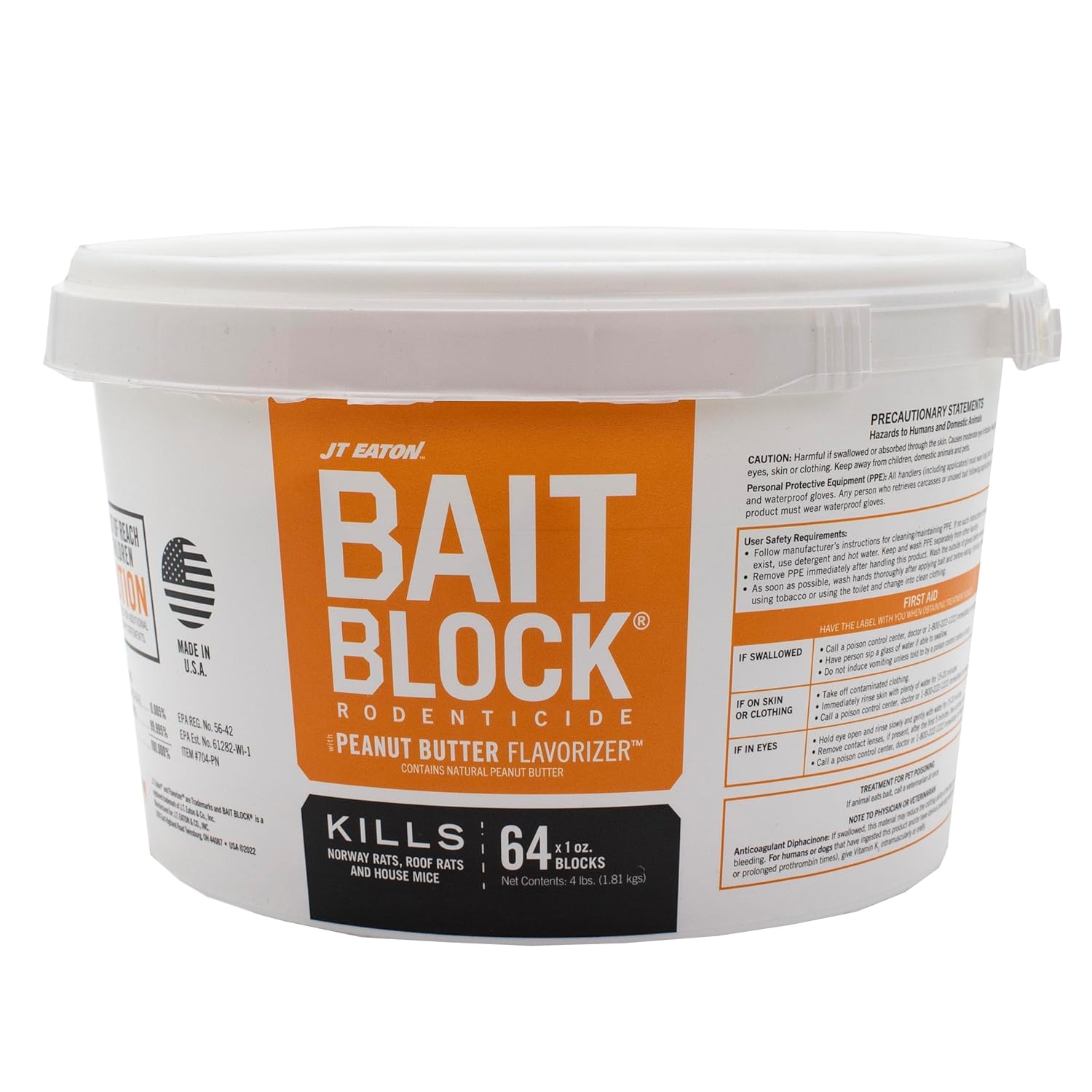
| Unit Count | 64 Count |
|---|---|
| Item Form | Block |
| Target Species | Rodents |
| Active Ingredients | Diphacinone |
The J.T. Eaton 704-PN bait blocks are solid 1-ounce peanut butter flavored rodenticide blocks sold in a resealable pail intended for routine rodent control in and around the home. You place individual blocks inside tamper-resistant bait stations or in tight attic spaces where rodents travel; the peanut butter flavor and rectangular shape make them easy to position and nab the attention of foraging mice and rats. The active ingredient diphacinone is a first-generation anticoagulant that typically affects rodents after repeated feedings, so expect results over several days rather than instant knockdown. The resealable pail and sturdy block form help the bait stay usable in storage and resist crumbling when positioned in drafty or dusty attics. Important limitations are the slower onset compared with single-feed rodenticides and the need to use the product only in secure bait stations to reduce accidental exposure to children, pets, or non-target wildlife.
Best for: Homeowners looking for a practical, long-term rodent control option for attics and outbuildings who prefer a durable, easy-to-deploy bait that stores well.
Less Ideal for: People needing immediate single-feed elimination or those who cannot guarantee secure bait placement around children, pets, or non-target animals should consider alternative solutions.
- Peanut butter flavoring increases attractiveness to mice and rats.
- Solid 1 oz blocks are easy to place inside bait stations and resist crumbling.
- Resealable pail keeps unused bait contained and protected during storage.
- Contains diphacinone, a commonly used anticoagulant effective with multiple feedings.
- First-generation anticoagulant requires multiple feedings and works more slowly than single-feed toxins.
- Must be used in tamper-resistant stations to avoid risk to children, pets, and wildlife.
Verdict: A practical, easy-to-store peanut butter bait block solution for homeowners who want reliable, long-term attic rodent control.
d-Con Refillable Corner-Fit Mouse Bait Station Refills, 10 Count

| Unit Count | 10 Count |
|---|---|
| Target Species | Mouse |
| Active Ingredients | Cholecalciferol |
These d-Con refills supply preformed bait pellets that fit into a corner-style refillable station to tackle house mice in attics and other tight spaces. The active ingredient is cholecalciferol, a non-anticoagulant formulation that the manufacturer positions as an alternative to traditional neurotoxins. In practice you set the refill inside the low-profile station in areas of mouse activity and monitor through the station window to see if mice are feeding. The package is small and convenient for multiple placements around an attic, behind appliances, and in basements or garages. Because the bait is made for a tamper-resistant corner station, it reduces accidental access by pets and children compared with loose bait. Limitations to note are that effectiveness depends on placement and bait acceptance by local mice and that a refill pack requires a compatible corner-fit station to be useful. For attic infestations you should pair these refills with multiple stations placed where droppings or gnawing are observed and follow label safety guidance.
Best for: Homeowners looking for an economical, safer-feeling bait option to control house mice in attics and other tight indoor spaces who plan to deploy multiple tamper-resistant stations.
Less Ideal for: People needing an immediate large-scale commercial solution or those without a compatible refillable corner bait station already in use.
- Preportioned bait made for easy loading into corner-fit refillable stations
- Uses cholecalciferol rather than anticoagulant or neurotoxin formulations
- Weather-resistant when housed in the station so units can be used in attics and sheltered outdoor areas
- Compact 10-count pack lets you place multiple stations around an attic or structure
- Requires a compatible corner-fit refillable station to use
- Success depends on mice accepting the bait and correct placement of stations
Verdict: A budget-friendly refill pack that supplies cholecalciferol bait for multiple corner-fit stations, ideal for controlling attic mice with tamper-resistant placement.
JT Eaton 709-PN Peanut Butter Block Rodenticide, 2 Pails (288 count)

| Brand | JT Eaton |
|---|---|
| Unit Count | 288 Count |
| Item Form | Bait |
| Target Species | Rodents |
This JT Eaton peanut butter block rodenticide is a ready-to-use anticoagulant bait packaged in two tamper-evident resealable pails that together contain 288 blocks. It is intended for placement in bait stations or other secure locations in attics and other rodent-prone areas where mice and rats forage. The peanut butter formulation is designed to be highly attractive to rodents and the block form reduces scattering compared with loose bait, while the resealable pails make storage and refill straightforward. Because it is an anticoagulant, it works over multiple feedings rather than providing instantaneous knockdown, so you should expect results over several days and plan for safe monitoring and disposal. The product is convenient for treating multiple activity points and bulk purchases reduce the need for frequent repurchasing, but it requires careful placement out of reach of children, pets, and non-target wildlife and should be used according to label directions.
Best for: Homeowners or property managers who prioritize reliable, long-term baiting in attic infestations and want a bulk, easy-to-store solution for treating multiple activity points.
Less Ideal for: People seeking instant knockdown or a single-use quick fix should consider alternatives; this product is also not appropriate for situations where secure, tamperproof bait placement cannot be ensured.
- Peanut butter flavoring that increases attractiveness to mice and rats
- Block form reduces scattering compared with loose bait
- Sold in resealable, tamper-evident pails for easy storage and refills
- Large unit count suitable for treating multiple bait stations or larger infestations
- Anticoagulant action requires multiple feedings and several days to control rodents
- Requires careful placement to avoid exposure of children, pets, and non-target wildlife
Verdict: Choose this product when you need a bulk, easy-to-store peanut butter block bait for reliable multi-point control of mice and rats in attics.
Tomcat Bromethalin Bait Chunx Pail, 4.25 lb

| Item Form | Bar |
|---|---|
| Target Species | Rodents |
| Net Weight | 4.25 lb |
Tomcat Bromethalin Bait Chunx is a bulk rodenticide supplied as 1 oz bait blocks in a 4.25 pound pail for tackling mice, Norway rats, roof rats, and meadow voles. It is designed for professional or agricultural use and is applied inside tamper-resistant bait stations around buildings, garages, basements, and other areas within 100 feet of man-made structures. The bromethalin formulation can kill rodents that are resistant to anticoagulants and a single block can deliver a lethal dose in one night, though rodents may take a day or two to die and continued baiting for at least 10 days is recommended. The pail format provides many pre-measured blocks for repeated placements and is convenient for refilling stations. Important limitations are that outdoor above-ground use requires a weather- and tamper-resistant station and the product must be kept away from children, pets, and non-target wildlife; label directions and local restrictions, including specific prohibitions in California, must be followed. This is not a do-it-yourself casual bait for open placement; it suits controlled station-based programs.
Best for: Homeowners, property managers, or professional applicators who need a potent, station-based solution for attic and structure infestations and who prioritize proven efficacy and documented product performance.
Less Ideal for: Casual users seeking a pet-safe, do-it-yourself open-placement option or people unwilling to follow strict bait-station and label safety requirements.
- Pre-measured 1 oz bait blocks simplify placement and station refills
- Bromethalin formulation effective against anticoagulant-resistant rodents
- Large 4.25 lb pail supplies many placements for ongoing control programs
- Labeled for indoor and outdoor use when used in tamper-resistant bait stations
- Requires tamper-resistant bait stations for safe outdoor or accessible placements
- Not suitable for unrestricted or open-area baiting due to toxicity and safety rules
Verdict: Choose this product when you need a professional-strength, station-only bait that reliably kills anticoagulant-resistant rodents in and around structures.
Tomcat Mouse Killer Refillable Bait Station with 16 Baits

| Unit Count | 16 Count |
|---|---|
| Target Species | Rodents |
| Power Source | manual |
| Material Type | Plastic |
The Tomcat Mouse Killer refillable bait station is a simple, low-effort solution for controlling mice in attics and around the home. The plastic station is weather resistant and designed to be tamper resistant to children and dogs, and it includes a clear lid so you can quickly check bait levels without opening the station. It ships with 16 ready-to-use bait blocks that are intended to be replaced as they are consumed, and the bait is formulated so a single block can kill multiple mice under laboratory conditions. Typical use is placing the station in attic corners, along runways, or near entry points and monitoring the clear lid until bait needs replacing. The practical benefits are easy setup, discreet placement, and reduced need to handle loose poison. Important limitations are that rodents usually leave the bait station to die elsewhere so you may not see carcasses, and effective control requires maintaining bait until activity stops. This product is a preventive or active-control tool but should be used as part of a broader attic rodent management plan.
Best for: Homeowners who prioritize safety and low-hassle rodent control in attics and want a tamper-resistant, easy-to-monitor baiting option that reduces direct contact with poison.
Less Ideal for: People who prefer non-toxic control methods or need immediate removal of carcasses at the bait site should consider traps or exclusion strategies instead.
- Child- and dog-resistant station reduces accidental access
- Clear lid allows quick visual monitoring of bait without opening
- Reusable, weather-resistant design for indoor or outdoor attic placement
- Includes 16 preformed bait blocks so you can maintain continuous baiting
- Rodents typically die away from the bait station so you may not recover carcasses
- Bait effectiveness is based on laboratory testing and field results can vary
Verdict: A practical, tamper-resistant bait station kit that lets you safely maintain continuous baiting for attic mouse control with minimal handling.
Choosing the Right Rodent Poison for Attic: Key Factors to Consider
Toxicity Level and Human/Non-target Safety
The active ingredient and its toxicity determine required precautions for attic use. Higher-toxicity compounds may knock down rodents quickly but raise the chance of secondary poisoning for pets or scavengers that gain attic access. In a home setting you must think about attic access points, whether children or pets ever enter attics, and how the product must be blocked or secured to avoid accidental contact.
Labels also specify PPE and how to handle spent bait and carcasses. Choose a toxicity level that you can safely manage given your ability to seal bait in tamper-resistant bait stations and your readiness to follow disposal and decontamination steps.
Bait Persistence and Environmental Conditions
Attics are typically warmer and drier than living spaces, which affects bait texture and palatability over time. Some baits harden, crumble, or dry out quickly in attic heat, reducing attractiveness and requiring more frequent replacement. Long-lasting formulations help reduce the need to reapply and lower the chance that rodents die in inaccessible voids after initial consumption.
Consider how long a bait remains palatable in heat and low humidity. If you cannot check the attic often, favor baits or carriers labeled for stability in dry, warm conditions or that are enclosed in dispensers that protect the bait from desiccation.
Delivery Method and Placement Options
How the poison is presented matters more in an attic than in open floor areas. Blocks, pellets, and paste baits each have pros and cons depending on where you can mount or set them. Tamper-resistant stations reduce non-target access and keep bait attached to a stable surface, while loose granular or pellet baits are harder to keep contained and can fall into insulation.
Think about available flat surfaces, beams, or rafters where you can secure a bait station. The delivery method should let you place bait out of sight from living areas and away from vents and ducts that could spread odor, yet still be accessible to rodents.
Likelihood of Carcass Detection and Recovery
One of the main attic-specific concerns is where a rodent will die after ingesting poison. Rapid-acting poisons can cause rodents to die near the bait, making recovery easier. Conversely, some anticoagulant baits can allow rodents to travel to hidden voids and die out of sight, creating lingering odors and secondary scavenger risks.
Assess how easy it would be to find and remove carcasses in your attic. If discovery is difficult, favor products with death-in-place tendencies or pair baiting with regular inspections so you can locate and remove remains before odor or pest birds and mammals become an issue.
Regulatory Guidance and Label Restrictions
All pesticide and rodenticide labels contain legally binding instructions and use-locations. Some formulations are not labeled for indoor attic use. Compliance with label directions is both a legal requirement and the best way to reduce non-target exposure and environmental contamination.
Review label language about where the bait can be applied, what kinds of bait stations are required, and any municipal or regional restrictions. Product suitability for attic use hinges on following these instructions, so label compatibility is a critical buying factor.
Cleanup and Disposal Requirements
After an infestation is controlled you may need to remove remaining bait, dispose of carcasses, and clean contaminated insulation or surfaces. Some active ingredients require specific disposal methods or limit how carcasses should be handled to avoid secondary exposure.
Consider whether you can access and replace insulation or remove contaminated material. If you cannot perform thorough cleanup, choose products and application methods that minimize the likelihood of hidden contamination and that come with clear, manageable disposal instructions.
Attic Access and Preparation
Before placing any bait, inspect and prepare the attic to reduce risks and increase effectiveness. Seal obvious entry points where rodents move between living areas and the attic to limit unintended exposures and make baiting more targeted. Clear loose insulation near bait locations so you can check and recover carcasses if needed, and identify safe surfaces for mounting bait stations away from vents and ducts.
- Close attic pull-down stairs or block attic access when not in use
- Identify rafters or joists where bait stations can be secured
- Note attic temperature extremes that may affect bait longevity
Strategies to Minimize Secondary Poisoning
Secondary poisoning occurs when predators or pets consume poisoned rodents. To reduce that risk in attic scenarios, choose enclosed bait stations that clamp to structural members and use baits with known carcass behavior. Pair baiting with exclusion work so scavengers cannot reach the attic, and check attic entry points such as soffits, gable vents, and ridge vents for wildlife access.
- Use tamper-resistant stations anchored to rafters
- Avoid loose baits that can fall into insulation
- Inspect attic openings for signs of larger wildlife
Dealing with Odor and Carcass Removal
If a rodent dies in a concealed space, odors can travel into living areas through ducts and gaps. Plan for regular inspections during the treatment window so you can recover carcasses quickly. If you detect a persistent odor, locate the area, remove the carcass using gloves, and ventilate the attic. In severe cases, contaminated insulation may need replacement to eliminate smells and contaminants.
- Perform visual checks every few days during treatment
- Wear gloves and a mask for carcass removal
- Replace contaminated insulation if odor persists
When to Choose Rapid-Kill Versus Delayed-Action Baits
Rapid-acting baits can reduce rodent populations quickly and make carcasses easier to find near bait points. Delayed-action anticoagulants reduce bait shyness and can be effective over multiple feedings but increase the chance that rodents will die in hidden voids. Your choice depends on how often you can access the attic and your tolerance for carcass recovery work.
- Rapid kill is better when regular access allows quick recovery
- Delayed-action can suit repeat-feeding strategies when access is limited
- Combine method choice with inspection frequency to manage odors
Legal and Environmental Considerations
Follow label instructions and local regulations about rodenticide use, storage, and disposal. Certain active ingredients have restrictions in various jurisdictions, and improper use may harm non-target wildlife. Keep records of what you use and when, and store unused product locked away and out of reach.
- Check label for indoor attic authorization
- Follow disposal instructions for leftover bait and carcasses
- Keep products in original containers and locked away
How We Chose the Best Rodent Poison for Attic
To assemble the list of top attic rodent poisons we applied practical filters that reflect real attic conditions and homeowner priorities. We prioritized formulations and delivery forms that are appropriate for overhead spaces, focusing on bait stability, low likelihood of off-target exposure, and detectability of carcasses. Efficacy against common commensal rodents was required, but we weighed long bait persistence differently from rapid knockdown depending on the risk of unnoticed carcasses in the attic. Evaluation criteria included toxicity profile and required precautions, bait longevity in dry, warm attic environments, delivery options and suitability for concealed placement, and how detectable or recoverable carcasses are after treatment. We excluded products intended only for outdoor perimeter use, repellents, and devices that rely solely on mechanical trapping. We also excluded products whose instructions prevent attic application or require continuous human access inside the living space. The final picks reflect solutions that work in attics while minimizing secondary risks and cleanup challenges.
FAQ
Can I use any rodent poison in an attic?
Not all rodenticides are labeled for indoor attic use. Labels specify permitted locations and required bait stations. Choose products whose directions allow attic or indoor structural applications and follow all safety instructions.
How often should I check baits in the attic?
Check bait stations at least every few days during active control when possible. Inaccessible attics can be checked weekly, but less frequent inspection increases the risk of undetected carcasses and odor issues.
Will poison bait attract other pests to the attic?
Bait can attract scavengers if carcasses are left in accessible areas. Properly secured bait stations and quick carcass recovery reduce the chance of attracting larger predators or scavenging birds.
What personal protection is recommended when handling rodent poison?
Wear gloves and a mask when handling bait or removing carcasses, and wash hands after. Follow label PPE instructions, and keep contaminated clothing separate until cleaned.
Can I place bait inside insulation or vents?
Avoid placing loose bait directly in insulation or inside ductwork. Use approved bait stations on structural members so bait stays contained and is not disturbed by air flow or settling insulation.
Final Verdict
Choosing the right rodent poison for an attic means balancing toxicity, bait durability, placement options, and your ability to inspect and recover carcasses. Prioritize products and delivery methods that are labeled for attic or indoor structural use and that let you mount bait in tamper-resistant stations. If you cannot access the attic frequently, favor baits and dispensers that remain palatable and reduce the chance of rodents dying in hidden voids. Follow label directions and local rules, plan for carcass recovery, and perform exclusion work to prevent reinfestation and reduce secondary risks.
