

Note: This article contains affiliate links. If you click on these links and make a purchase, I may earn a small commission at no extra cost to you. This helps support my research and content. Read my full affiliate disclosure here.
Starting vegetable seeds indoors gives you a head start on the season and greater control over early growth conditions. The right soil mix sets seedlings up for fast germination, sturdy stems, and minimal disease. Poor mixes can hold too much water, compact around roots, or lack the nursery nutrients young plants need. This guide covers seven shortlisted soil options built specifically for starting vegetable seeds indoors. We evaluated mixes on drainage, pathogen resistance, and feeding profile to help you pick the right medium for your space, light setup, and transplant timeline.
Top Picks at a Glance
| Best Overall The best all-around choice for most situations | Espoma Organic Seed Starter Premium Potting Mix (16 qt) |  |
| Best Quality Built to a higher standard if you want something more solid | Burpee Premium Organic Potting Mix with Coconut Coir (9 Quart) |  |
| Best Value The sweet spot between price and what you get | Miracle-Gro Organic Indoor Potting Mix (16 qt) |  |
| Best Budget The cheapest option that still gets the job done reliably | Back to the Roots 3-in-1 Seed Starting Mix, 6 Quart Organic Seed Starter |  |
| Highest Rated A top-rated pick with lots of positive feedback | sol soils Seedling & Propagation Mix (1 gal) |  |
| Most Popular A crowd favorite that many people choose with confidence | Miracle-Gro Indoor Potting Mix for Seed Starting, 8 qt. (2-Pack) |  |
| Best Seller A high-volume bestseller chosen again and again | ZeeDix 30mm Peat Pellets Seed Starter Pods (55 pcs) |  |
Espoma Organic Seed Starter Premium Potting Mix (16 qt)

| Brand Name | Espoma |
|---|---|
| Unit Count | 598.4 Ounce |
| Style Name | Peat Moss,Potting Soil Mix,Soil Mix |
| Volume | 16 quarts |
This Espoma seed starter is a lightweight, organic potting mix formulated for germinating seeds and rooting cuttings. It blends sphagnum peat moss and perlite with yucca extract and lime for balanced moisture retention and aeration, and includes a mycorrhizae mix to support early root establishment. Use it in seed trays, small pots, or for stem and leaf cuttings; the texture makes it easy to sow fine seeds and keeps medium moisture without compacting. The organic ingredient list means no synthetic fertilizers, so it is suitable for organic vegetable seedlings but will require a feed later once true leaves appear. The included mycorrhizae can help seedlings access nutrients when transplanted. Limitations: it does not contain starter fertilizer so expect to pot up or begin light feeding before long-term growth, and peat-based mixes may dry out faster than heavier blends in very warm indoor setups. Overall it is a reliable, plant-forward choice for starting vegetable seeds indoors when you want an organic, well-aerated medium.
Best for: Gardeners starting vegetable seeds indoors who prioritize organic ingredients and a light, well-aerated medium to promote healthy early root growth.
Less Ideal for: Growers who want a ready-to-feed plug mix that supplies nutrients for several weeks or those seeking a non-peat, completely peat-free starter medium.
- Formulated for seeds and cuttings with light, airy texture for fine seed sowing
- Includes endo and ecto mycorrhizae to support early root establishment
- Organic ingredients with no synthetic fertilizers for organic gardening compatibility
- Good moisture retention without compacting thanks to peat and perlite blend
- No added starter fertilizer so seedlings need feeding before extended growth
- Peat-based mix can dry out relatively quickly in warm, dry indoor conditions
Verdict: Choose this mix when you want an organic, airy starter medium that promotes quick root development for indoor vegetable seedlings.
Burpee Premium Organic Potting Mix with Coconut Coir (9 Quart)

| Item Form | Powder |
|---|---|
| Specific Uses For Product | Plant Growth, Root Development, Seed Development, Soil Conditioning |
| Coverage | 9 Qt Container |
| Liquid Volume | 9 quarts |
Burpee Premium Organic Potting Mix is a ready-to-use container medium that combines organic nutrients and coconut coir to support germination and root development for indoor seed starting and small container vegetables. In practice you fill trays or small pots, sow seeds or set seedlings, and water; the coir helps retain moisture without waterlogging while the built-in fertilizer feeds plants for up to three months. Notable features include an OMRI listing for organic production, a fine powdery texture suitable for small cells or starter pots, and a formulation aimed at plant growth and soil conditioning. For performance-focused growers it simplifies early-stage care by reducing watering frequency and providing immediate nutrition so seedlings establish quickly. Limitations are the small 9 quart coverage, which means multiple bags are needed for larger batches, and the fixed nutrient level that may require additional feeding after the initial few months or for heavy-feeding vegetable varieties.
Best for: Gardeners who prioritize reliable early growth for vegetable and herb seedlings and want a low-maintenance, organic starter medium for indoor trays and small containers.
Less Ideal for: Large-scale seed producers or growers who need bulk volumes or want to precisely control initial nutrient formulas should look for professional seed-starting mixes or bulk coir and amendments instead.
- OMRI listed organic mix suitable for certified organic growing
- Coconut coir improves moisture retention while promoting drainage and aeration
- Contains slow-release nutrients to feed seedlings for up to three months
- Fine-textured powder form works well in seed trays and small starter pots
- 9 quart bag provides limited coverage for larger seed-starting projects
- Contains pre-mixed fertilizer so exact nutrient ratios cannot be customized
Verdict: Choose this Burpee mix when you want an organic, coir-based potting medium that reliably supports fast, low-maintenance seedling establishment in trays and small containers.
Miracle-Gro Organic Indoor Potting Mix (16 qt)

| Unit Count | 1 Count |
|---|---|
| Item Highlight | Protects Against Over & Under Watering |
| Item Type Name | Miracle-Gro Organic Indoor Potting Mix |
| Manufacturer | Scotts Miracle Gro |
| Volume | 1 cubic feet |
Miracle-Gro Organic Indoor Potting Mix is a ready-to-use organic blend designed for houseplants and seed starting indoors. It combines coir for improved air space, sphagnum peat moss to hold and release water, and a quick-start natural fertilizer so seedlings get an early nutrient boost. Typical use is filling seed trays or small pots with a mix that stays evenly moist without becoming waterlogged, then sowing seeds or transplanting seedlings into containers with drainage. Practical benefits include consistent moisture regulation that helps reduce over- and under-watering, OMRI listing for organic growing, and a texture that supports root development in early stages. The 16 qt bag is roughly enough for one 12-inch pot or several small seed trays, making it convenient for small indoor vegetable seed projects. Limitations are the modest bag volume for larger batches of seeds and that peat-based mixes can compress over time, so you may need to refresh or lightly amend the medium for longer-term pots or heavy repotting projects.
Best for: Indoor gardeners who prioritize consistent moisture control and organic-approved inputs and who are starting small batches of vegetable seeds or maintaining houseplants.
Less Ideal for: Growers who need large-volume potting mix for many flats or commercial-scale seed starting should choose bulk seed-starting mixes or larger bags.
- OMRI listed so suitable for organic indoor seed starting
- Blend of coir and peat moss balances aeration and moisture retention
- Includes quick-start natural fertilizer to support early seedling growth
- Formulation specifically intended for indoor container plants and houseplants
- 16 qt bag is small for large seed-starting batches or multiple flats
- Contains peat moss which may compact over time and require refreshing
Verdict: A compact, OMRI-listed indoor potting mix that gives small-scale vegetable seed-starters reliable moisture balance and an early nutrient boost.
Back to the Roots 3-in-1 Seed Starting Mix, 6 Quart Organic Seed Starter

| Unit Count | 192 Fluid Ounces |
|---|---|
| Style Name | 3-in-1 Seed Starting Mix |
| Brand Name | Back to the Roots |
This 3-in-1 seed starting mix is designed to get vegetable seedlings off to a healthy start indoors. It combines coconut coir, nutrient-rich additions and moisture-controlling yucca to create a light, well-aerated medium that helps seeds germinate and roots establish. The formula includes mycorrhizae and dolomitic limestone to support nutrient uptake and pH balance, while worm castings and plant food give seedlings a gentle nutrient boost without needing heavy fertilization right away. It is packaged in a convenient 6-quart bag sized for small flats, windowsill trays, and starter pots, and the peat-free recipe is a plus for gardeners avoiding peat. Expect fast drainage and reduced risk of waterlogging, which is helpful for common vegetable seedlings that dislike soggy soil. The main limitations are the modest bag volume for multi-flat sowing and that the nutrient level is meant for starting rather than long-term potting, so transplants will need fresh potting mix or fertilization as they grow.
Best for: Home gardeners working on a tight budget who want an easy, eco-conscious seed starter that reliably germinates small batches of vegetable seeds and minimizes beginner mistakes.
Less Ideal for: Growers who start large numbers of flats at once or who need a long-term potting soil ready for mature container vegetables.
- Peat-free, organic blend with coconut coir and worm castings supporting sustainable seed starting
- Contains mycorrhizae and yucca extract to improve root development and water uptake
- Light, well-aerated texture that promotes drainage and reduces seedling damping-off risk
- Includes dolomitic limestone for pH balancing and gentle nutrient additions for early growth
- Only 6 quarts per bag, which may be insufficient for starting large numbers of vegetable seedlings
- Formulated for seed starting so plants will need richer potting mix or fertilizer after transplanting
Verdict: A compact, peat-free organic seed starter that makes indoor vegetable seed germination simple and low-risk for budget-minded gardeners.
sol soils Seedling & Propagation Mix (1 gal)

| Brand | sol soils |
|---|---|
| Style Name | Seedling & Propagation Mix |
| Unit Count | 128 Ounce |
| Volume | 1 gallons |
This seedling and propagation mix is formulated specifically for starting vegetable seeds and propagating cuttings indoors. The fine, moisture-retentive texture and coconut husk give consistent water holding without becoming soggy, while calcined clay improves aeration so roots get oxygen and are less prone to rot. Hardwood biochar and earthworm castings add structure and gentle nutrients that support early root development without risking fertilizer burn. The mix is peat-free and intended to stay stable longer than normal potting mixes, so you can use it for multiple sowing cycles before refreshing. Bags are hand-mixed in small batches, so texture can vary slightly from bag to bag. Also follow the safety guidance to avoid inhaling dust when handling dry mix. For indoor vegetable seed starting this mix covers the key needs: moisture control, drainage, and a low-risk nutrient boost for fragile seedlings.
Best for: Gardeners who prioritize reliable, low-risk seed starts and want a forgiving, moisture-balanced medium for indoor vegetable seedlings and cuttings.
Less Ideal for: Large-scale growers or those who need bulk quantities for many trays should consider larger volume blends or commercial propagation soils.
- Fine, moisture-retentive blend suited for seed starting and cuttings
- Calcined clay improves drainage and aeration to reduce root rot risk
- Biochar and earthworm castings add structure and gentle nutrients for healthy root development
- Peat-free formula and stable mix that resists rapid breakdown
- Small 1 gallon volume may require multiple bags for larger seed-starting projects
- Batch-to-batch texture variation means some bags may feel chunkier or finer
Verdict: A dependable, peat-free propagation mix that balances moisture retention and aeration to produce healthy indoor vegetable seedlings.
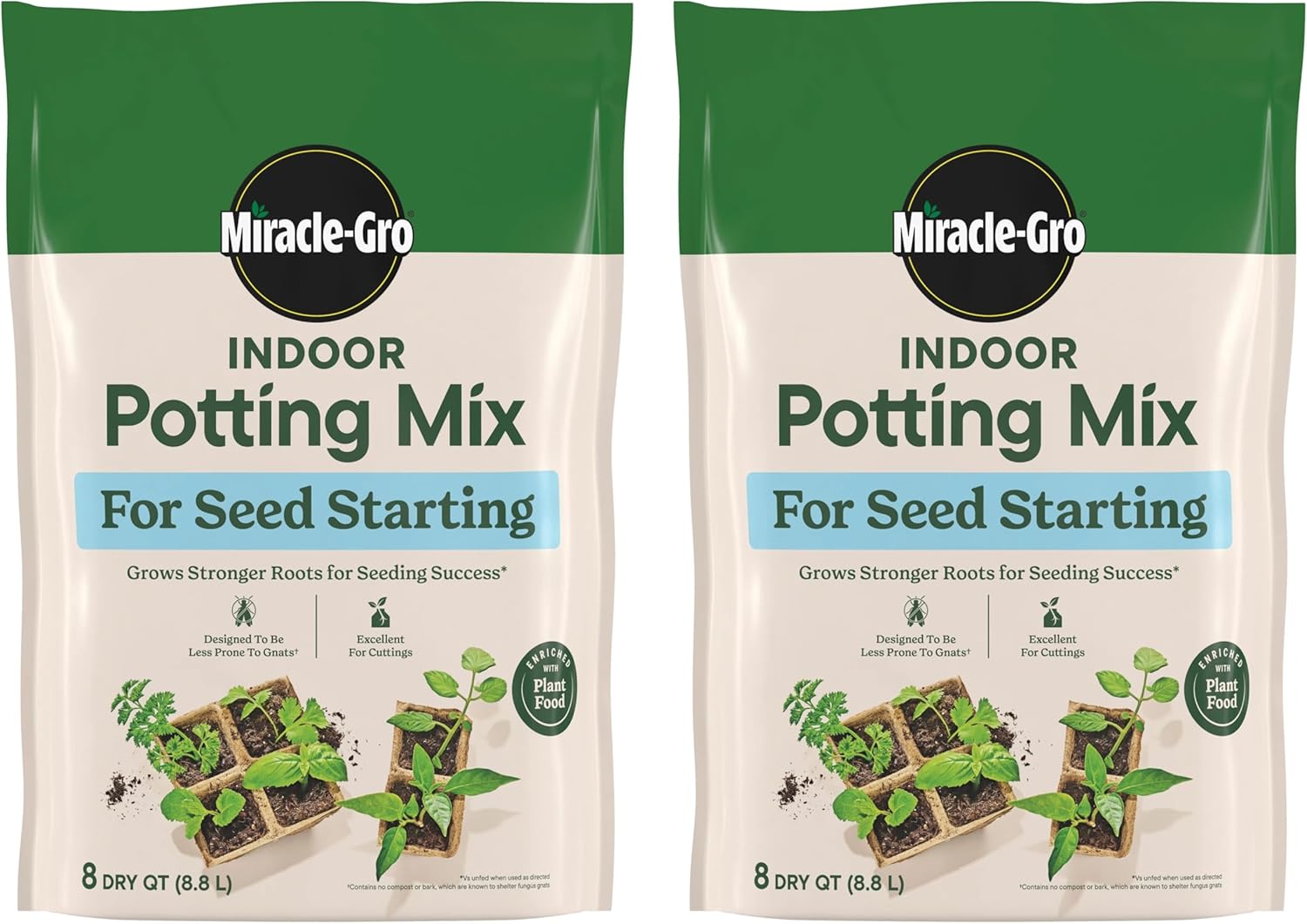
Miracle-Gro Indoor Potting Mix for Seed Starting, 8 qt. (2-Pack)
| Brand Name | Miracle-Gro |
|---|---|
| Item Type Name | Potting Mix |
| Number of Packs | 2 |
| Item Highlight | For Starting Vegetable, Flower, and Herb Seeds Indoors |
| Volume | 8 quarts |
This two-pack of Miracle-Gro seed starting mix is designed for germinating vegetable, flower, and herb seeds and for rooting leaf and stem cuttings. The mix is lightweight and precharged with plant food so seedlings get a nutrient boost right away, which helps establish stronger roots compared with unfed media when used as directed. Because it contains no compost or bark, it is less likely to harbor fungus gnats, a common issue with seed trays. In practice you fill cell trays or small pots, keep the mix moist and shaded until germination, and transplant once true leaves appear. The bags are sized to fill multiple 72-cell trays, so beginners can start several varieties at once. Limitations to note are the embedded fertilizer, which means you should follow seed packet and transplant guidance to avoid overfeeding, and the product is intended for starting and cuttings rather than as a long-term potting soil for mature plants. Safety precautions are advised because the mix contains fertilizer that can irritate if mishandled.
Best for: Gardeners who want a reliable, ready-to-use starting medium to germinate vegetable seeds and root cuttings with minimal fuss and lower fungus gnat risk.
Less Ideal for: Growers looking for a no-fertilizer sterile mix for specialized seeds or those who need a long-term potting soil for established houseplants.
- Lightweight texture promotes quick root development for seeds and cuttings
- Enriched with plant food to give seedlings an early nutrient boost
- Formulated without compost or bark to reduce habitat for fungus gnats
- Each 8 qt. bag fills multiple 72-cell seeding trays, suitable for starting many seedlings
- Contains fertilizer so it may not be ideal for plants that require unfed media or delicate seed types
- Intended for seed starting and propagation rather than long-term potting of mature plants
Verdict: Choose this mix when you want an easy, low-risk seed-starting medium that feeds seedlings and reduces fungus gnat issues so you can get vegetable starts off to a strong beginning.
ZeeDix 30mm Peat Pellets Seed Starter Pods (55 pcs)

| Unit Count | 50 Count |
|---|---|
| Material | Sphagnum peat moss |
| Style Name | Indoor & Outdoor Gardening |
| Item Weight | 0.28 kg |
These ZeeDix 30mm peat pellets are a simple seed-starting option for home gardeners who want an easy indoor workflow. Each compressed pellet expands when watered into a small peat plug wrapped in a non-woven net that holds the soil together and lets roots pass through, so you can sow seeds directly and transplant the whole pellet into pots or garden beds without disturbing roots. The product is made from sphagnum peat moss, which offers good water retention and a nutrient-friendly medium that helps seedling development for vegetables, herbs, and small ornamentals. The pellets are straightforward to use: hydrate, plant seeds, keep moist, then move seedlings outdoors or into larger containers once established. Practical benefits include reduced transplant shock and a tidy planting process thanks to the net covering. Limitations are that these are single-use peat pellets with no built-in fertilizer and peat is not a renewable material, so gardeners seeking reusable or fully sustainable alternatives may prefer coco coir or reusable seed trays.
Best for: Home gardeners who want a low-effort, reliable way to start vegetable and herb seeds indoors and prioritize straightforward transplant success over experimenting with custom mixes.
Less Ideal for: Growers who prefer reusable seed-starting systems or who prioritize peat-free, fully sustainable growing media should consider alternatives.
- Netted pellet design allows transplanting the whole plug with minimal root disturbance
- Made from sphagnum peat moss which provides good water absorption and retention for seedlings
- Easy single-step prep: hydrate pellets, sow seeds, and maintain moisture
- Compact, consistent plugs that keep seed-starting tidy and organized
- Peat-based medium is not renewable and may be a concern for sustainable gardeners
- No added fertilizer or nutrients included, so seedlings may need feeding after germination
Verdict: If you want a fuss-free indoor method to germinate vegetable and herb seeds and minimize transplant shock, these netted peat pellets make starting seedlings quick and reliable.
Choosing the Right Soil for Starting Vegetable Seeds Indoors: Key Factors to Consider
Water Retention Vs Drainage
This factor matters because seedling roots need steady moisture but cannot tolerate waterlogged conditions. A good seed-starting soil holds enough water to sustain germinating seeds between gentle waterings while allowing excess to drain quickly. Media that retain too much water cause oxygen depletion at the root zone and increase risk of damping-off disease.
When choosing a mix, look for lightweight ingredients such as peat alternatives or fine coir combined with perlite or vermiculite. Those components create a balance: capillary action supplies moisture to the seed, and coarse particles maintain pore space for air.
Pathogen Control and Sterility
Young seedlings are especially vulnerable to fungal pathogens and soil-borne organisms. Many gardeners prefer pre-sterilized or pasteurized seed-starting soils because they reduce the chance of damping-off and root rot in crowded trays under humid conditions.
If you use a non-sterile medium, consider surface sterilizing seeds, ensuring good airflow, and avoiding overwatering. Ingredients like sphagnum peat or properly processed compost can lower pathogen load, but the safest option for beginners is a clean, labeled seed-starting mix.
Nutrient Content and Starter Fertilizer
Seedlings do not need heavy fertilization immediately, but they do benefit from a gentle nutrient reserve once the cotyledons expand. Some seed-starting soils include a light, slow-release starter charge or low-strength fertilizer to support the first true leaves.
Too much fertilizer can burn tiny roots, so avoid mixes that advertise high nutrient loads meant for mature container plants. If you choose a nutrient-lean mix, plan a weak liquid feed once seedlings develop their first true leaves.
Particle Size and Workability
The mix texture affects sowing accuracy, root penetration, and transplanting ease. Fine, uniform particles make it easier to press small seeds into contact with the medium and to sow evenly in flats or cell trays. A very dusty or overly fine mix can crust when watered, whereas a mix with too many large chunks makes shallow seeding uneven.
Choose a medium that stays loose when moist and does not compact in pots. That ease of handling becomes more important if you start many seeds or use small cells.
pH Stability and Ingredient Consistency
Seedlings prefer a slightly acidic to neutral pH range for optimal nutrient uptake. Some components like peat or coir can shift pH over time, and inconsistent ingredient ratios from batch to batch create surprises for repeat sowings.
Look for mixes labeled for seed starting that indicate a stable pH or provide base amendments. Consistency matters when you compare germination rates across sowing dates or expect similar results season after season.
Ease of Transplanting and Root Development
A good seed-starting soil should encourage quick root growth without forming a dense root ball that resists transplanting. Fine, friable mixes allow roots to thread through and establish quickly after transplant. If the medium breaks apart easily and does not cling tightly to roots, you can transplant with less shock.
Consider how the mix performs when moving seedlings into larger pots or the garden. Some mixes are formulated to be left on the root ball, while others benefit from blending with a potting mix at transplant time.
When to Start Seeds Indoors
Timing seed starts depends on the vegetable and your local last frost date. Fast-maturing crops can be started closer to transplant time, while slow-developing vegetables need more lead time under lights. Planning a sowing calendar helps you avoid overly leggy seedlings from long indoor stretches.
Count backwards from your average last frost date by the seed packet's recommended indoor-start time, and add a week for erratic germination. If you will be using grow lights, shorter lead times are possible because light intensity is higher than window light.
- Check seed packet days to maturity and indoor start range
- Adjust for your available light and heat under lights
- Stagger sowings to ensure continuous harvest and reduce transplant shock
Tools and Containers That Work With Seed-Starting Soil
The soil you pick should pair with the containers and tools you use. Shallow seed flats, cell packs, and peat pots each interact differently with moisture and particle size. Cell trays need a mix that stays intact when watered from the bottom, while shallow flats do better with mixes that drain quickly.
Use gentle labels, a fine misting spray, and a small dibber or spoon for even sowing. Bottom-watering trays and humidity domes can speed germination but raise disease risk if ventilation is poor.
- Bottom-watering reduces surface disturbance
- Humidity domes help germination but require daily ventilation
- Fine tools improve sowing accuracy for tiny seeds
How to Prepare Soil for Sowings
Moisten the mix before filling trays until it is evenly damp but not dripping. Press lightly to create a firm, even surface for small seeds. For very small seeds, press the medium into the tray and sow on the surface without burying deeply.
If you suspect contamination, you can heat-treat small batches in an oven or microwave following safe, tested procedures. However, pre-sterilized seed mixes remove that step for most home gardeners.
- Pre-moisten to improve seed-to-soil contact
- Use a level press to ensure even depth
- Avoid overwatering after sowing to reduce fungal issues
Light, Heat, and Moisture Practices
After germination, provide bright, cool light and moderate temperatures to prevent legginess. Seedlings need more light than a sunny windowsill usually provides. Maintain consistent moisture with shallow, frequent checks rather than heavy soakings.
Use bottom heat for cold-loving crops or when germination is slow, but reduce heat as soon as true leaves form to promote strong stems.
- Aim for consistent surface moisture without saturation
- Use grow lights on an adjustable rack to keep stems compact
- Vent humidity domes daily to cut down on fungal problems
Transitioning Seedlings to Larger Pots or the Garden
Harden off seedlings gradually by exposing them to outdoor conditions over a week to ten days. The seed-starting soil left on the roots may be mixed gently with a potting mix or garden soil at transplant time to reduce shock and provide longer-term moisture retention.
Monitor root development. If roots circle densely, tease them gently before potting up to encourage outward growth. Proper transplant timing reduces the risk of transplant stress and slows shock-related stunting.
- Gradually increase outdoor time to build tolerance
- Mix seed-starting soil with potting mix for longer-term pots
- Inspect roots at potting up to prevent root-bound conditions
How We Chose the Best Soil for Starting Vegetable Seeds Indoors
We shortlisted soils that are specifically formulated or commonly used for indoor seed starting and evaluated them across several garden-relevant dimensions. Key evaluation criteria included drainage and aeration, because tiny roots need both oxygen and consistent moisture; pathogen management, with attention to sterilization or ingredients that lower damping-off risk; nutrient profile and starter feed, focusing on gentle, balanced nutrition suitable for seedlings; texture and consistency, so mixes are easy to seed, water, and transplant without compacting; and ease of use in common indoor setups such as flats, cell packs, and small pots. We excluded outdoor topsoils, garden soil with unknown origins, and mixes intended only for mature container vegetables. We also excluded media that require heavy amendments before use. Our process prioritized ready-to-use options and blends that perform reliably under grow lights and home propagating conditions.
FAQ
Can I use regular garden soil for starting seeds indoors?
Garden soil often compacts and can carry pathogens, making it a poor choice for indoor seed starting. It usually lacks the light texture and sterility that seedlings need. If you must use it, sift and sterilize small batches, but a purpose-made seed-starting mix is usually safer and more reliable.
How often should I water newly sown seeds in seed-starting soil?
Check surface moisture daily. Water lightly when the top of the mix begins to dry but before it cracks. Bottom-watering is a gentle method that keeps surface seeds undisturbed and helps maintain even moisture without overwatering.
Do seed-starting soils need fertilizer?
Many seed-starting mixes include a light starter nutrient, but heavy feeding is unnecessary and can harm tiny roots. If your chosen mix is nutrient-poor, begin a weak liquid feed after the first true leaves appear and increase strength gradually as plants grow.
What causes damping-off, and how can soil choice reduce it?
Damping-off is usually caused by fungal pathogens that thrive in cool, wet, crowded conditions. Using a clean, sterile seed-starting mix, providing good airflow, avoiding overwatering, and spacing seedlings appropriately all reduce the chance of disease.
Should I pre-moisten seed-starting soil before sowing?
Yes. Pre-moistening ensures even contact between seeds and the medium and reduces the need for heavy initial watering that can displace tiny seeds. The mix should be damp but not dripping when you sow.
Final Verdict
Choose a seed-starting soil that balances moisture retention with free drainage and has a low pathogen risk. Prioritize mixes with fine, consistent texture for accurate sowing and a gentle nutrient charge or plan to begin light feeding once true leaves appear. Match the mix to your containers and light setup, and be prepared to adjust watering and ventilation to reduce disease risk. With attention to those tradeoffs, you can pick a soil that helps seedlings germinate quickly and transplant with minimal shock.
