

Note: This article contains affiliate links. If you click on these links and make a purchase, I may earn a small commission at no extra cost to you. This helps support my research and content. Read my full affiliate disclosure here.
If you grow St. Augustine grass, choosing the right insecticide matters because this turf responds poorly to some active ingredients and to overapplication. You want a product that suppresses the insects causing visible damage while preserving turf color, root health, and the soil biology beneath the sod. This guide covers seven shortlisted insecticides for St. Augustine grass suited to common use situations. We explain how we evaluated knockdown speed, residual activity, and turf safety so you can match a product to your lawn's pest pressure and management routine. Read on for practical guidance to protect your turf without unintended damage.
Top Picks at a Glance
| Best Overall The best all-around choice for most situations | Ortho BugClear Lawn Insect Killer, 20 lb. |  |
| Best Quality Built to a higher standard if you want something more solid | The Andersons DuoCide Professional-Grade Lawn Insect Control (18 lb) |  |
| Best Value The sweet spot between price and what you get | Spectracide Immunox Fungus Plus Insect Control for Lawns, 32 oz |  |
| Best Budget The cheapest option that still gets the job done reliably | Spectracide Triazicide Insect Killer for Lawns & Landscapes, 32 oz |  |
| Highest Rated A top-rated pick with lots of positive feedback | Quali-Pro Bifenthrin I/T 7.9F Insecticide (1 Gallon) |  |
| Most Popular A crowd favorite that many people choose with confidence | Atticus Talak 7.9% Bifenthrin Insecticide Concentrate (32 oz) |  |
| Best Seller A high-volume bestseller chosen again and again | Scotts GrubEx1 Season-Long Grub Killer (covers 5,000 sq. ft.) |  |
Ortho BugClear Lawn Insect Killer, 20 lb.

| Item Form | Granules |
|---|---|
| Target Species | Insects |
| Unit Count | 1 Count |
| Manufacturer | The Scotts Company LLC |
Ortho BugClear Lawn Insect Killer is a 20 pound granular treatment intended for broad use across lawns, ornamental beds and perimeter areas. You apply it with a compatible broadcast spreader, then water it in to activate the product; the granules are formulated to work by contact and begin killing many pests within minutes. It targets ants, ticks, fleas, spiders, armyworms, grubs and other common lawn insects and advertises up to six months residual control against most ants and three months for other listed pests. The large bag covers very large yards, so it is convenient for homeowners with extensive St. Augustine turf. Practical benefits include easy broadcast application, multi-pest coverage, and a measurable residual that helps reduce repeat treatments during peak season. Limitations to keep in mind are the need to water in after application, exclusions for some ant species and fire ants, and that it is a non-selective insect control so care is required around pollinator-attractive plants and following label directions for use on listed vegetables.
Best for: Homeowners with medium to large St. Augustine lawns who want an easy-to-apply, multifunctional granular insecticide that reduces the need for frequent spot treatments during the growing season.
Less Ideal for: People with very small urban lawns or those seeking a pollinator-safe or organic option; those who prefer liquid hose-end products for spot treatment should consider alternatives.
- Broad-spectrum control for common lawn pests including ants, grubs, ticks and armyworms
- Long residual activity up to 6 months against many ant species and 3 months for other pests
- Large 20 lb. bag formulated to treat very large lawns up to the stated coverage
- Applies with standard broadcast spreaders for quick coverage of large turf areas
- Does not control certain ant species and is less effective against fire ants
- Requires watering in after application to activate and achieve full control
- Non-selective granules require caution around pollinator-attractive plants and edible crops
Verdict: A practical, large-coverage granular insecticide that gives balanced, long-lasting control of common lawn pests for homeowners with St. Augustine grass.
The Andersons DuoCide Professional-Grade Lawn Insect Control (18 lb)

| Item Form | Granule |
|---|---|
| Coverage | 9000 sq ft |
| Active Ingredients | bifenthrin |
| Unit Count | 288 Ounce |
DuoCide is a dual‑active granular insect control formulated to kill pests both on and below the turf surface. You spread the granules over the lawn and water them in so the DG granules disperse and move active ingredients into the soil, providing control of grubs, ticks, fire ants, mole crickets, fleas and many surface pests. The notable feature is the two active insecticides, which deliver a combination contact and soil activity that can reduce multiple pest populations from a single application. Its high coverage means one 18 lb bag treats up to about 9,000 sq ft, so it is practical for larger St. Augustine lawns where grub and subterranean insect pressure is common. Important limitations are standard pesticide safety and local restrictions: it is not labeled for sale in California and requires careful handling, protective gear, and adherence to reentry and watering instructions to avoid off‑target exposure. This product works best as part of a seasonal pest management plan rather than a frequent spot treatment.
Best for: Homeowners with larger St. Augustine lawns seeking a strong, professional‑grade solution to control both surface and soil pests in a single seasonal application.
Less Ideal for: Small‑lot or container gardeners who need spot treatments, or anyone who prefers organic or non‑chemical pest control strategies.
- Dual active ingredients provide both contact and soil activity for above‑ and below‑ground pests.
- DG granule format disperses quickly when watered to move actives into the root zone.
- Covers a large area with a single bag, suitable for big lawns.
- Broad pest spectrum includes grubs, ticks, fire ants, mole crickets and fleas.
- Not labeled for sale in California and requires strict adherence to safety and handling instructions.
Verdict: Choose DuoCide when you need a single, professional‑strength granular treatment to control both grub and surface pests across a large St. Augustine lawn.
Spectracide Immunox Fungus Plus Insect Control for Lawns, 32 oz

| Unit Count | 32 Fluid Ounces |
|---|---|
| Liquid Volume | 32 fluid ounces |
| Active Ingredients | Propiconazole, Lambda-cyhalothrin |
| Item Form | Spray |
| Coverage | Covers about 2,500 square feet |
Spectracide Immunox combines fungicide and insecticide in a single ready-to-spray hose-end bottle designed for routine lawn care. You attach the QuickFlip sprayer to a garden hose and apply until the lawn is wet; the formula is rainproof within hours so light rain shortly after application is less likely to wash it away. It targets common lawn diseases like brown patch, rust and powdery mildew while also killing listed pests such as ants, sod webworms, fleas and ticks. A 32 oz bottle treats about 2,500 square feet, which makes it economical for homeowners who want a simple, scheduled program — the label recommends treating every two weeks or when problems appear. Important limitations are that it only covers listed diseases and insects so identification and timing matter, and it is a chemical control that requires following safety directions and keeping people and pets off the treated area until dry. It is best used as part of an integrated lawn program rather than a one-off cure-all.
Best for: Homeowners who want a straightforward, time-saving lawn program that prevents and treats common diseases and pests on warm-season turf and prefer a hose-end product for easy repeat applications.
Less Ideal for: Organic gardeners or those seeking non-chemical approaches should avoid this product; it is not intended for precision spot-control of insects or diseases not listed on the label.
- Dual-action formula treats both listed lawn diseases and listed insects in one product
- Ready-to-spray hose-end applicator is easy to attach and activates with a flip
- Rainproof within hours so recent or short-term rain is less likely to reduce effectiveness
- 32 oz concentrate covers approximately 2,500 square feet, suitable for whole-yard maintenance
- Effective only against listed diseases and insect species on the label, so it may not control all turf pests
- Contains active chemical ingredients and requires keeping people and pets off treated areas until dry
Verdict: Choose this ready-to-spray dual-action control when you want an easy, single-product routine to prevent and treat common lawn diseases and insects on St. Augustine and other warm-season grasses.
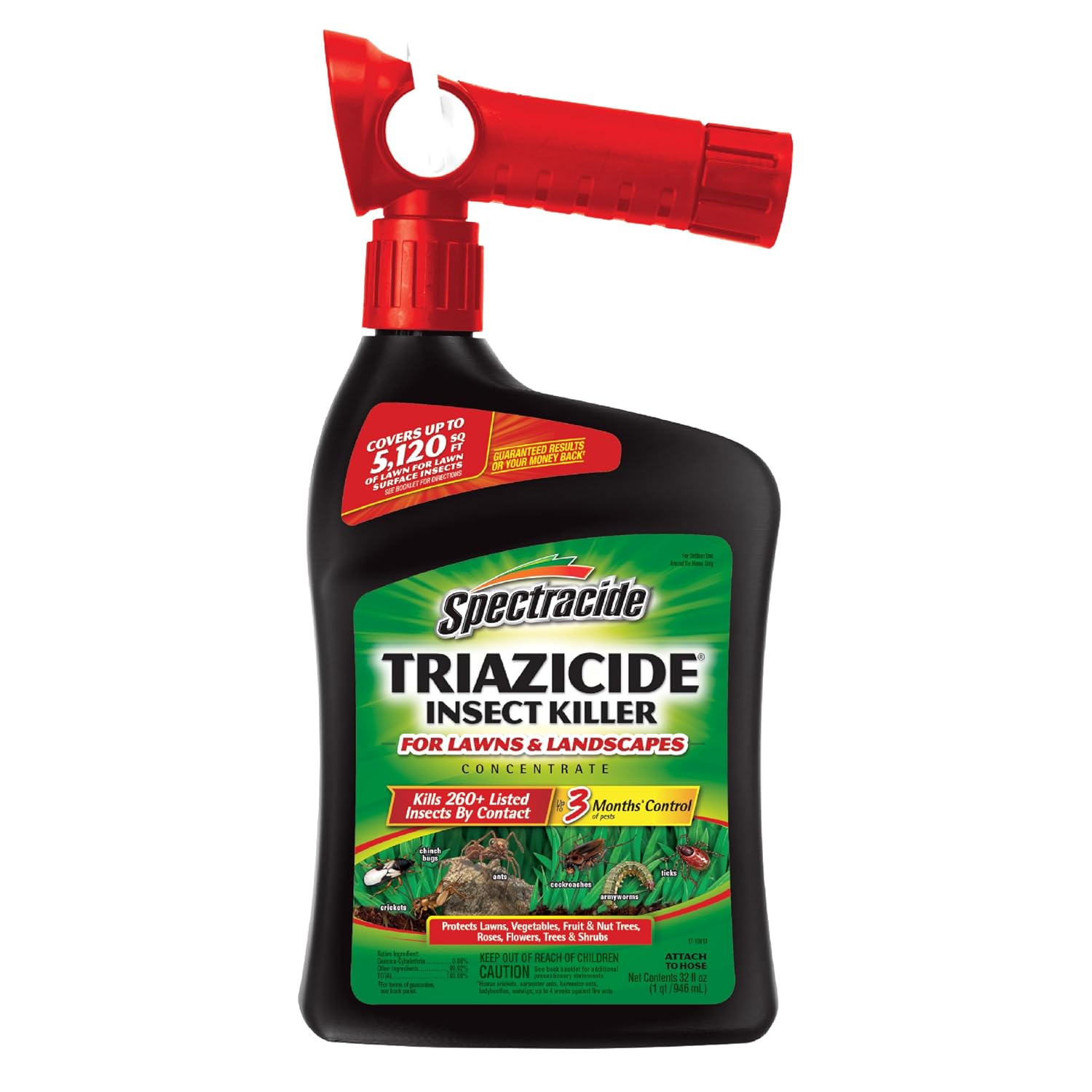
Spectracide Triazicide Insect Killer for Lawns & Landscapes, 32 oz
| Unit Count | 32 Ounce |
|---|---|
| Item Form | Spray concentrate |
| Target Species | Insects |
| Active Ingredients | Gamma-Cyhalothrin (0.08%) |
| Liquid Volume | 32 fluid ounces |
Spectracide Triazicide is a ready-to-dilute concentrate designed for broad insect control on lawns and surrounding landscapes. Mix the concentrate with water and apply with a tank or hose-end sprayer to treat surface and soil-dwelling pests such as ants, fleas, ticks, Japanese beetles and many grubs; the manufacturer claims protection lasting up to three months. It is useful for spot treatments, perimeter sprays, or whole-lawn applications on warm-season grasses like St. Augustine when applied before populations surge. The product works by contact and is fast acting, with some results reported within 24 hours, and the 32 oz bottle covers a substantial area when mixed correctly. Important limitations are safety and environmental risks: it is highly toxic to fish and bees and requires careful application to avoid runoff and drift, and the label lists specific timing and mixing rates that must be followed. Expect to use protective gear and to avoid treating blooming plants or nearby water features.
Best for: Gardeners who need an inexpensive, multipurpose insecticide for routine lawn and landscape pest control and who prioritize cost-effective coverage for larger St. Augustine lawns.
Less Ideal for: Those with ponds, heavy pollinator activity, organic gardening priorities, or small yards where spot products or nonchemical methods would be safer and more appropriate.
- Broad-spectrum control covering 260+ listed insects including ticks, fleas, ants and Japanese beetles
- Concentrate form lets you mix amounts to treat large areas, increasing per-bottle coverage
- Fast contact action with some results within 24 hours
- Non-staining when used as directed on most siding surfaces
- Highly toxic to aquatic life and bees so it must not reach water or blooming plants
- Requires careful mixing and application equipment; misuse risks non-target organisms and poor results
Verdict: A cost-conscious way to protect St. Augustine lawns from a wide range of insects with a single concentrate when used carefully and according to the label.
Quali-Pro Bifenthrin I/T 7.9F Insecticide (1 Gallon)

| Item Form | Spray |
|---|---|
| Target Species | Termites, Carpenter Ants |
| Liquid Volume | 1 gallons |
| Active Ingredients | Bifenthrin |
Quali-Pro Bifenthrin I/T 7.9F is a concentrated, flowable pyrethroid designed to provide long-lasting residual control of pests common in lawns, including termites, carpenter ants, fleas, mites, and ticks. It is typically diluted and applied to residential lawns, ornamentals, commercial turf and athletic fields to prevent infestations and reduce pest pressure over time. Notable features include a non‑irritating, low-odor formula that dries without visible residue and broad compatibility with many herbicides, fungicides and liquid fertilizers, which makes it easy to integrate into regular turf care programs. Practical benefits for St. Augustine grass include dependable residual activity that can reduce repeat treatments and a formulation reported to have no known phytotoxicity, which lowers the risk of plant damage when labeled rates are followed. Important limitations: this is a professional‑strength pesticide that requires careful handling, proper dilution and adherence to label directions for safety and effectiveness, and it targets a wide pest range rather than a single species so spot treatments for isolated pests may be unnecessary.
Best for: Homeowners and turf managers who prioritize dependable, long‑lasting pest control for St. Augustine grass and want a product that integrates into regular lawn treatment schedules.
Less Ideal for: Casual gardeners who prefer ready-to-use sprays or who need a targeted product for one specific pest should consider simpler, lower-strength alternatives.
- Long-lasting residual control effective against many turf and structural pests
- Low-odor, non-irritating formula that dries with no visible residue
- Compatible with herbicides, fungicides, insecticides and liquid fertilizers for tank mixes
- Suitable for use on residential lawns, ornamentals, commercial turf and athletic fields
- Requires careful handling and correct dilution because it is a concentrated professional product
- Not a targeted solution for a single pest species if you need spot treatment
Verdict: Choose this concentrated bifenthrin formula when you need reliable, long‑lasting residual control across a variety of turf pests on St. Augustine grass.
Atticus Talak 7.9% Bifenthrin Insecticide Concentrate (32 oz)

| Liquid Volume | 32 fluid ounces |
|---|---|
| Item Form | Liquid |
| Active Ingredients | Bifenthrin |
| Specification Met | EPA |
Talak 7.9% is a concentrated bifenthrin formulation designed for both lawn and structural perimeter use. You mix the liquid with water to treat turf, shrubs, trees, hardscapes, and indoor baseboards or cabinets; label rates give guidance for lawn, landscape and surface barrier applications. The concentrate targets more than 75 pest types and kills on contact while providing residual control for up to three months, which makes it useful for seasonal treatments on warm-season grasses like St. Augustine. Its water-based formula dries clear, leaves no odor or visible residue, and the bottle includes pre-marked pour areas to reduce mess when diluting. Important limitations are that solutions should be mixed only for same-day use, it is not labeled for fogger applications, and some states restrict sale. As with any professional-strength pyrethroid, follow label directions carefully to protect pollinators, aquatic areas, and non-target plants and animals when treating turf and perimeter zones.
Best for: Buyers who want a single, professional-strength product to manage seasonal insect pressure on St. Augustine grass and adjoining perimeter areas and who prioritize proven performance backed by many user reviews.
Less Ideal for: Homeowners who need an organic or non-pyrethroid option or who prefer ready-to-use formulations and minimal mixing should consider alternative products.
- Broad-spectrum control covering over 75 indoor and outdoor pests.
- Flexible use: labeled for lawns, landscapes, hardscapes and indoor perimeter treatments.
- Water-based formula dries clear, leaves no odor or visible residue.
- Long residual activity up to three months per application when applied at label rates.
- Mixed spray cannot be stored and must be used the same day.
- Not approved for use with foggers, limiting some application methods.
- Not available for sale in certain states.
Verdict: A single concentrated bifenthrin formula that delivers broad, long-lasting insect control for lawns and perimeter treatments when applied per label instructions.
Scotts GrubEx1 Season-Long Grub Killer (covers 5,000 sq. ft.)

| Item Form | Granules |
|---|---|
| Target Species | Insects |
| Active Ingredients | Chlorantraniliprole |
| Coverage | 5,000 sq. ft. per bag |
Scotts GrubEx1 is a granular lawn insecticide designed for one spring or early-summer application to protect turf from grubs and several other soil-feeding pests. You apply it to a dry lawn with a broadcast or drop spreader using the manufacturer spreader settings, then water it in to carry the active ingredient chlorantraniliprole into the soil where larvae feed. The formula claims up to four months of control against grubs and lists additional targets such as armyworms, billbug larvae, and suppression of chinchbugs, making it useful as a preventative for lawns at risk. It covers 5,000 sq. ft. per 14.35 lb. bag and is intended for DIY homeowners following label directions. The product is easy to store and considered safe for people and pets once the treated lawn has dried, but it must be watered after application to activate and only used once per year. If you need immediate curative action on an active heavy infestation or want multiple seasonal applications, this single-use seasonal product may not meet that need.
Best for: Homeowners who want a low-effort, preventive solution to protect St. Augustine and similar lawns from grub damage and other soil pests with a single seasonal treatment.
Less Ideal for: People dealing with an active, heavy infestation needing immediate knockdown or those who prefer products they can apply multiple times per season.
- Single application provides up to four months of grub prevention and control
- Targets a range of turf pests beyond grubs, including armyworms and billbug larvae
- Covers a large area (5,000 sq. ft.) from one bag, simplifying seasonal treatment
- Clear application instructions and recommended spreader settings for DIY use
- Active ingredient chlorantraniliprole is effective at soil-level control when watered in
- Only one application allowed per year so it is not suited for multiple-season treatments
- Requires watering after application to be effective, adding an extra step
Verdict: A one-and-done seasonal granular treatment that reliably prevents grubs and several other soil pests across a 5,000 sq. ft. lawn.
Choosing the Right Insecticide for St. Augustine Grass: Key Factors to Consider
Turf Safety and Labeled Use
Turf safety is the top concern because St. Augustine can be sensitive to certain chemistries and to overapplication. Check that the product explicitly lists St. Augustine or warm-season turf on the label and follow rate limits. Misapplied insecticide can cause leaf browning, slowed recovery after stress, or root damage that reduces density.
Pay attention to tank-mix restrictions and to cautions about heat or drought conditions. Some active ingredients are safe when used at recommended rates but cause phytotoxicity if applied during peak heat or when turf is water stressed. Using a product labeled for the turf type and the season reduces the risk of visible damage.
Target Pest and Mode of Action
Different insects require different approaches. Contact insecticide activity gives faster visible knockdown for chewing pests, while systemic actives or products with translaminar movement can control sap-feeding and root-feeding pests over time. Identify whether the main issues are surface feeders, soil-dwelling larvae, or sap-suckers before choosing a chemistry.
Mode of action matters for resistance management. Rotating between modes of action over seasons can slow resistance development in pest populations. If you have recurring problems, choose products that fit into an integrated plan rather than relying on a single chemistry repeatedly.
Residual Control and Reapplication Interval
Residual duration determines how often you need to reapply and how well the product covers multiple pest generations. Short-residual contact materials are useful for immediate knockdown but may need follow-up treatments. Longer-residual products reduce reapplication frequency but may have greater non-target impacts and need careful rate selection.
Consider lawn usage patterns when choosing residual length. High-traffic yards or properties with pets and children may favor shorter residuals applied more frequently during active pest windows to limit prolonged exposure. For persistent grub problems, products with longer soil activity provide season-long protection when applied at the right time.
Application Method and Equipment Compatibility
Insecticides for lawns come in granular, liquid concentrate, and ready-to-use formats. Granules are easier for many homeowners and reduce drift, but they must be watered in to reach soil-dwelling pests. Liquids can give more uniform coverage and are often better for targeting foliar pests, but they require a sprayer and careful calibration.
Think about what equipment you have and how precise you can be. Some formulations require specific nozzles or calibration to avoid streaking. If you plan spot-treatments, choose a formulation that handles small-area application without excessive waste.
Environmental and Non-target Considerations
Protecting pollinators, beneficial insects, and aquatic areas is important when treating turf. Many insecticides vary in toxicity to bees and natural predators. Avoid spraying flowering plants or applying products that have high runoff potential near water features.
Follow buffer zone recommendations and application timing to minimize impacts. If neighbors have vegetable gardens or pollinator plantings, communicate treatment plans and choose lower-risk options or spot treatments to reduce non-target exposure.
Timing Relative to Pest Life Cycle and Lawn Care
Effective control depends on timing applications to when pests are most vulnerable. For example, treating grubs is most effective when larvae are small in late summer to early fall, while foliar feeders may require treatment during active feeding windows in spring and summer.
Coordinate insecticide timing with mowing, irrigation, and fertilization. Mow a day or two before treatment for better contact, and avoid heavy irrigation immediately before or after certain applications unless the label specifies watering in. Integrating cultural controls like irrigation scheduling and proper fertility reduces pest pressure and improves outcomes from insecticide use.
Common Pests That Damage St. Augustine Grass
Several insects commonly injure St. Augustine turf and each requires a different control approach. Chinch bugs suck sap and cause yellowing patches that can expand quickly on hot, dry sites. Grubs feed on roots and cause spongy, thinning turf that can be pulled up like a rug when damage is extensive. Armyworms and cutworms chew leaves and can strip blades rapidly during outbreaks.
- Chinch bugs: sap feeders that create irregular dead patches in sunny areas.
- Grubs: soil-dwelling larvae that weaken roots and cause brown, spongy turf.
- Armyworms and cutworms: chewing larvae that defoliate turf quickly during warm months.
When to Treat and How to Scout
Scout routinely during the active season and treat only when thresholds are met to reduce unnecessary applications. For chinch bugs, inspect the edges of dead patches where live sod meets healthy turf. Grub thresholds are often based on the number per square foot sampled with a spade; small numbers may not justify treatment.
- Inspect turf margins and thatch layer for sap-feeding insects.
- Sample soil cores for root-feeding larvae to estimate grub density.
- Treat during peak vulnerability for the target life stage, not just when damage is visible.
Application Tips to Protect Turf Health
Calibrate sprayers and spreaders before application to ensure accurate rates across the lawn. Apply products when turf is actively growing and not under extreme heat or drought stress to reduce phytotoxic risk. For granular products, water in according to label timing to move the active ingredient into the root zone without causing runoff.
- Avoid applying during mid-day heat; choose early morning or late afternoon when possible.
- Mow a day or two before treatment to improve contact and spray uniformity.
- Keep children and pets off treated areas for the minimum interval stated on the label.
Integrating Insecticides With Cultural Controls
Chemical control is most effective when paired with good cultural practices. Maintain proper irrigation and fertility to promote dense turf that can tolerate some insect pressure. Aeration and dethatching where appropriate reduce thatch-harboring pest habitats and improve active ingredient movement into the root zone.
- Use targeted watering to reduce drought stress that attracts sap feeders.
- Adjust fertilization to avoid excessive top growth that can increase pest attractiveness.
- Monitor and repair thin areas promptly to prevent pest hotspots from expanding.
Safety, Storage, and Disposal Basics
Store insecticide concentrates in their original labeled containers in a cool, dry place out of reach of children and pets. Keep the label intact for reference to mixing rates, reentry intervals, and emergency instructions. Dispose of empty containers and any leftover product according to local regulations and label directions to avoid contamination.
- Wear label-recommended personal protective equipment during mixing and application.
- Never reuse pesticide containers for other purposes.
- Follow disposal instructions on the label and local hazardous waste rules for leftover concentrates.
How We Chose the Best Insecticide for St. Augustine Grass
We selected insecticides that are commonly used on warm-season turf and that list St. Augustine grass or general turfgrass on the label. Our filters prioritized active ingredients with documented efficacy against the insects that commonly damage St. Augustine, such as chinch bugs, grubs, and armyworms. We looked for products offering a range of residual control lengths and modes of action to help manage resistance. Evaluation emphasized four concrete dimensions: turf safety on St. Augustine, knockdown speed against target pests, residual duration in typical lawn conditions, and application flexibility for homeowners and pros. We excluded any products lacking clear turfgrass labeling or those whose primary risks to St. Augustine were flagged by extension resources. We also filtered out formulations incompatible with common lawn equipment or that require unusually restrictive handling for residential use. The result is a list of insecticides that balance efficacy with practical use considerations for St. Augustine lawns.
FAQ
Can I treat St. Augustine grass during hot, dry weather?
You can apply some products in warm weather, but many labels caution against treatment during extreme heat or drought because turf under stress is more prone to phytotoxicity. If the lawn is wilted, irrigate and allow recovery before treating or choose a product with a wider safety margin at lower rates.
How often should I reapply insecticide to maintain control?
Reapplication depends on the product's residual duration and the pest. Short-residual contact materials may need treatments every 7 to 21 days during heavy outbreaks, while longer-residual products can provide control for several weeks to months. Follow label reapplication intervals and factor in rainfall and irrigation.
Will treating for grubs prevent chinch bug problems?
No. Grubs are soil-dwelling larvae of beetles and require products that move into the root zone. Chinch bugs are surface sap feeders and need contact or translaminar activity. Use products labeled for the specific pest or combine timing and methods appropriate to each pest when both occur.
Are granular or liquid formulations better for a home lawn?
Both have pros and cons. Granules are easy to apply over large areas and reduce spray drift but must be watered in for soil pests. Liquids offer more uniform coverage and are better for foliar pests and spot treatments but require careful calibration of equipment. Choose based on equipment access and the target pest biology.
How can I reduce harm to pollinators when treating my lawn?
Avoid treating flowering plants and apply treatments during times when bees are least active, such as early morning or late evening. Use spot treatments where possible and select products with lower toxicity to pollinators when pollinator habitat is nearby. Always follow label precautions for pollinator protection.
Final Verdict
When choosing an insecticide for St. Augustine grass, prioritize turf safety and the specific pest biology you need to control. Balance the need for quick knockdown against residual protection and consider how applications fit with your irrigation, mowing, and safety practices. Select products that match the pest life stage and your equipment, and rotate modes of action seasonally to limit resistance. With the right timing and cultural support, insecticides can protect turf appearance and root health without unnecessary risk to the lawn or surrounding environment.
