

Note: This article contains affiliate links. If you click on these links and make a purchase, I may earn a small commission at no extra cost to you. This helps support my research and content. Read my full affiliate disclosure here.
Weed growth between paver joints is one of the most common maintenance headaches for patios and walkways. The right weed killer for patio pavers clears existing shoots, reduces regrowth from roots and seeds, and does not stain or damage stone, concrete, or polymeric sand. This guide covers seven shortlisted options that perform well in outdoor hardscape settings and explains the practical tradeoffs gardeners face when treating paver joints. You will find products chosen for real garden scenarios, plus decision criteria such as residual control, surface safety, and ease of application. Read on to understand which features matter most for your patio and how to use these treatments responsibly before the product list below.
Top Picks at a Glance
| Best Overall The best all-around choice for most situations | Roundup Dual Action Weed & Grass Killer Plus 4 Month Preventer with Sure Shot Wand, 1.33 gal |  |
| Best Quality Built to a higher standard if you want something more solid | Roundup Dual Action 365 Weed & Grass Killer Plus 12 Month Preventer with Pump 'N Go 2 Sprayer, 1.33 gal |  |
| Best Value The sweet spot between price and what you get | Ortho GroundClear Year-Long Vegetation Killer2 Concentrate, 32 fl. oz. |  |
| Best Budget The cheapest option that still gets the job done reliably | Spectracide Weed & Grass Killer Concentrate, 16 fl oz |  |
| Highest Rated A top-rated pick with lots of positive feedback | Roundup Weed & Grass Killer4 Refill, 1.25 gal. |  |
| Most Popular A crowd favorite that many people choose with confidence | Spectracide Weed & Grass Killer with AccuShot Power Sprayer, 1.33 gal |  |
| Best Seller A high-volume bestseller chosen again and again | Roundup Weed & Grass Killer with Comfort Wand, 1.33 gal. |  |
Roundup Dual Action Weed & Grass Killer Plus 4 Month Preventer with Sure Shot Wand, 1.33 gal

| Item Form | Liquid |
|---|---|
| Liquid Volume | 1.33 gallons |
| Coverage | 400 sq. ft. |
| Item Highlight | Sure Shot wand for targeted spray |
This Roundup Dual Action formula is designed for homeowners who want a single product to both remove weeds on hard surfaces and suppress regrowth for months. The ready-to-use 1.33 gallon jug supplies a Sure Shot wand that shields nearby plants and focuses spray on cracks in patio pavers, driveways, and sidewalks. It starts working quickly—visible wilting in hours and complete kill in one to two weeks—and becomes rainproof in about 30 minutes so light showers are less likely to interfere. The product claims up to 4 months of prevention when the entire application area is treated, which makes follow-up applications less frequent on high-use hardscapes. Limitations are that it must be applied carefully to avoid desirable planting areas and that replanting certain ornamentals or sod should wait four months after use. Coverage is about 400 sq. ft., so larger paved areas may require multiple containers.
Best for: Gardeners who want a straightforward, low-effort solution to clear weeds from patio pavers and prevent regrowth for months and who prioritize fast visible results and targeted spraying.
Less Ideal for: People who need to replant beds or turf within weeks or who want an organic or non-chemical weed control method should consider alternatives.
- Kills existing weeds and grasses down to the root for reliable removal
- Provides up to four months of prevention when applied to the whole treatment area
- Sure Shot wand focuses spray for targeted application on paver joints and cracks
- Becomes rainproof in as fast as 30 minutes so light rain rarely ruins an application
- Ready-to-use liquid requires no mixing or measuring for quick application
- Prevents planting of many ornamentals, sod, and seed for four months after application
- Needs full-area application to achieve the quoted preventive barrier rather than spot-spraying
Verdict: Use this ready-to-use weed killer when you want fast knockdown on patio pavers plus a multi-month preventive barrier with a targeting wand for precise application.
Roundup Dual Action 365 Weed & Grass Killer Plus 12 Month Preventer with Pump 'N Go 2 Sprayer, 1.33 gal

| Item Form | Liquid |
|---|---|
| Coverage | 400 sq.ft. |
| Unit Count | 170 Fluid Ounces |
| Rainproof Time | About 30 minutes |
This product combines an all-in-one contact and residual herbicide with an integrated Pump 'N Go 2 sprayer so you can kill visible weeds and create a year-long barrier in one application. It is formulated for non-lawn hardscape areas such as patio pavers, sidewalks, driveways, gravel and under decks. The liquid is rainproof in about 30 minutes and shows visible weed dieback in hours, and the extendable wand on the Pump 'N Go 2 gives targeted spraying without bending over and up to 10 minutes of continuous spray. A single 1.33 gallon container covers up to 400 sq ft when applied across the full area you want to protect. Because it must be sprayed across the entire area to prevent new growth, expect to spend more time treating larger surfaces compared with spot applications. Also this is for non-lawn areas only and requires safe handling per the label to avoid contact with desirable plants and people or pets while wet. For homeowners who want decisive, long-lasting control of weeds between pavers, it streamlines the job by combining application and residual protection.
Best for: Buyers who prioritize strong, long-lasting weed control on hardscape areas and want a simple, ready-to-use product that combines application and prevention in one step.
Less Ideal for: People who need a lawn-safe treatment or who prefer spot-only, low-chemical approaches; not suitable for gardeners protecting nearby desirable plants.
- Kills existing broadleaf and grassy weeds and grasses and provides up to 12 months of prevention in treated areas.
- Includes Pump 'N Go 2 sprayer with extendable wand for accurate application and up to 10 minutes of continuous spray.
- Rainproof in about 30 minutes with visible results in hours, allowing quicker re-use of paved areas.
- Ready-to-use liquid eliminates the need to measure or mix concentrated chemicals.
- Must be applied over the entire area to achieve prevention, which increases application time for large surfaces.
- Intended only for non-lawn hardscape areas so it cannot be used where desirable plants or turf are present.
Verdict: Choose this product when you want a one-step, ready-to-use solution that kills weeds now and prevents new growth on patio pavers for up to a year.
Ortho GroundClear Year-Long Vegetation Killer2 Concentrate, 32 fl. oz.

| Unit Count | 32 Fluid Ounces |
|---|---|
| Coverage | 300 square feet |
| Item Form | Liquid |
| Active Ingredients | Imazapyr; Isotropylamine Salt; Pelargonic Acid |
Ortho GroundClear Year-Long Vegetation Killer2 is a liquid concentrate made for clearing and keeping hardscape surfaces free of weeds and grasses. You mix 24 fl. oz. per gallon of water, apply with a tank sprayer, and the formula begins working immediately and becomes rainproof in about one hour. It is intended for places where no plant growth is wanted for a year, such as patios, paver joints, driveways, gravel and sidewalks. The product lists active ingredients including imazapyr and pelargonic acid which explain its prolonged control and fast burn-down. A 32 fl. oz. bottle treats roughly 300 to 400 sq. ft. when mixed as directed, so one container can handle most small to medium patio jobs. Important limitations are that it is nonselective so it will kill any desirable plants it contacts and it requires careful application and protective measures to avoid overspray or runoff. Follow label safety instructions and avoid treated areas you plan to plant in for at least a year.
Best for: For homeowners who want a low-maintenance, long-lasting solution to keep patio pavers and other hardscapes clear of weeds without frequent reapplication.
Less Ideal for: Not a good choice for gardeners who need selective control near planted beds or who plan to replant treated areas within the year.
- Long-lasting suppression up to one year on treated hardscape areas
- Fast-acting formula that is rainproof in about one hour
- Concentrated bottle mixes down to treat 300–400 sq. ft., useful for multiple applications
- Suitable for use on patios, paver joints, driveways, sidewalks and gravel areas
- Nonselective herbicide that will damage or kill desirable plants on contact
- Requires proper mixing and a sprayer for application
Verdict: Choose this concentrate if you need fast-acting, year-long weed control on patio pavers and other hardscape areas.
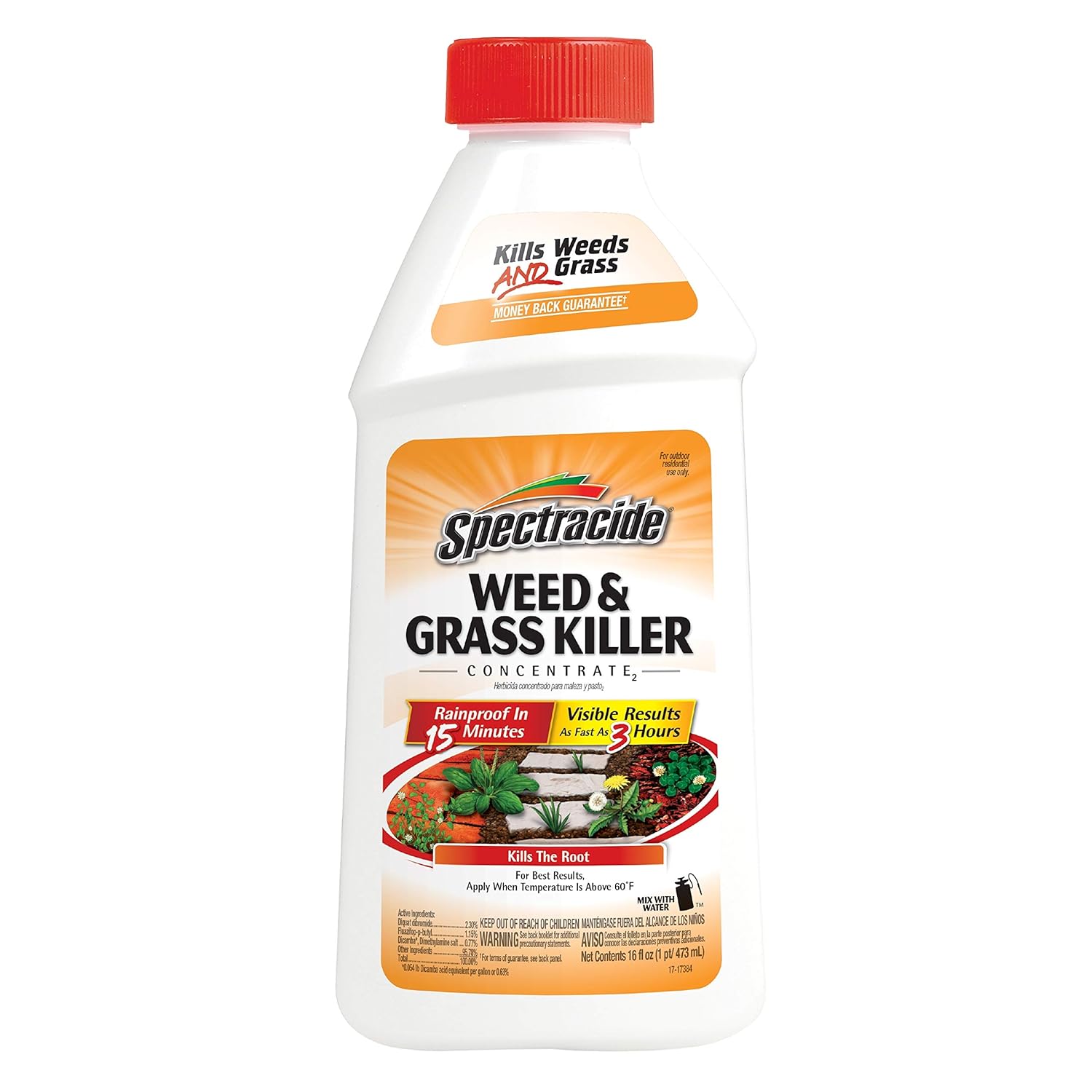
Spectracide Weed & Grass Killer Concentrate, 16 fl oz
| Unit Count | 16 Fluid Ounces |
|---|---|
| Item Form | Spray |
| Coverage | 7 fl oz per gallon covers up to 300 sq ft |
| Rainfast | 15 minutes |
Spectracide Weed & Grass Killer Concentrate is a mix-with-water herbicide designed to remove weeds and grasses from driveways, walkways, patios and along foundations. You mix the concentrate into a tank sprayer (label rates) and spray to thoroughly cover plant leaves; the formula is rainproof after 15 minutes and shows visible dieback in as fast as three hours. It kills down to the root so treated vegetation can be cleared and new plants installed within a day. Practical strengths are its quick action, rainfast formula and the ability to treat spot areas without needing premixed bottles. Important limitations are that it is nonselective so it will damage desirable plants if oversprayed and it requires a sprayer and careful mixing to get coverage rates right. Safety precautions and temperature recommendations (above 60°F) mean it is best used in suitable weather and with basic protective gear.
Best for: Homeowners who need an economical, fast-acting solution for clearing weeds from hard surfaces and prefer buying a concentrate to treat multiple small areas over time.
Less Ideal for: People who want a selective product that spares lawn or ornamental plants or those who prefer ready-to-use bottles without measuring and mixing.
- Concentrate formula lets you mix only what you need for spot treatments
- Rainproof in 15 minutes so light rain shortly after application does not reduce effectiveness
- Visible results in as fast as 3 hours and root-killing action allows replanting after one day
- Specifically labeled for use on driveways, walkways and patios
- Nonselective formula will damage any desirable plants if accidentally sprayed
- Requires a separate tank sprayer and correct mixing to apply safely and effectively
Verdict: A cost-effective concentrate that quickly and reliably clears weeds from patios and pavers when you need fast, rainproof control.
Roundup Weed & Grass Killer4 Refill, 1.25 gal.

| Unit Count | 160 Fluid Ounces |
|---|---|
| Coverage | 375 square feet |
| Item Form | Spray |
| Active Ingredients | Triclopyr; Fluazifop P-Butyl; Diquat Dibromide |
This Roundup refill is made to top up a compatible spray container and deliver fast, spot or area treatments for weeds on and around patio pavers. It contains a mix of active ingredients that attack broadleaf weeds and grasses at the root and is labeled as rainproof within about 30 minutes with visible dieback in hours, so treatments hold up well on paved surfaces. Typical use is pouring into an empty sprayer, applying when air is calm to avoid drift, and waiting for the spray to dry before allowing foot traffic. The refill covers roughly 375 square feet and is convenient for repeat maintenance around driveways, cracks between pavers, and edging where weeds recur. Important limitations are safety and replanting windows described on the label, and the need to avoid spraying desirable plants since it is nonselective; proper shielding and careful application are required. The product is best used as a targeted, reliable solution when you need quick, long-lasting control on hard surfaces rather than a selective lawn treatment.
Best for: Buyers who prioritize a dependable, fast-acting herbicide for recurring weeds on hardscapes and around planting beds and who prefer a refillable spray system for regular maintenance.
Less Ideal for: Gardeners who need a selective lawn-safe product or who want an organic, nonchemical method of weed control should consider alternatives.
- Targets broadleaf weeds and grasses to the root for longer control
- Rainproof in about 30 minutes so treatments withstand brief wet weather
- Visible results in hours for quick confirmation of effectiveness
- Designed as a refill so you can reuse an existing spray container and treat larger areas
- Nonselective formula will damage desirable plants if it drifts or contacts foliage
- Requires careful handling and adherence to label safety and replanting instructions
Verdict: A fast, rainproof refill solution that reliably kills weeds and grasses on and around patio pavers for routine maintenance.
Spectracide Weed & Grass Killer with AccuShot Power Sprayer, 1.33 gal

| Unit Count | 170 Fluid Ounces |
|---|---|
| Liquid Volume | 1.33 gallons |
| Item Form | Spray |
| Coverage | 1 gallon |
| Active Ingredients | Diquat Dibromide 0.12%, Fluazifop-p-butyl 0.06%, Dicamba DMA salt 0.04% |
This Spectracide kit combines a ready-to-use herbicide concentrate and a battery-powered AccuShot sprayer intended for spot-treating weeds on patios, driveways, and paver joints. The formula is non-selective and translocates from leaf to root, so treated vegetation typically browns quickly and is rainproof within 15 minutes, letting you replant or finish work the same weekend. The AccuShot wand gives continuous spray without pumping, an extendable wand for reach, and an adjustable nozzle for stream or spray patterns, which helps target narrow cracks and edges while reducing overspray. Practical benefits include fast visible results, decent per-gallon coverage, and a reusable sprayer for follow-up applications. Important limitations are that the product will kill any plants it contacts so careful aiming and protective clothing are required, and the sprayer needs four AA batteries and occasional maintenance to avoid leaks. Also avoid use where runoff could reach water bodies because the active ingredients are toxic to aquatic life.
Best for: Homeowners who want a fast, reliable way to clear weeds and grass from hard surfaces and paver joints while minimizing time spent reapplying or rinsing up. It suits buyers who prioritize visible, root-killing results and a built-in sprayer for targeted work.
Less Ideal for: People who need a selective lawn-safe product or who routinely treat areas adjacent to ponds, streams, or wetland habitat should choose a different solution. Those who prefer manual, pump-free gardening methods without batteries may also prefer alternatives.
- Includes AccuShot continuous-power sprayer with extendable wand for improved accuracy and reduced hand fatigue
- Non-selective formula that moves from leaves to roots for more complete weed control
- Rainproof in 15 minutes so treated areas are less likely to be washed out by light rain
- Reusable sprayer design lets you treat follow-up patches without additional equipment
- Non-selective herbicide will damage any desirable plants it contacts, requiring careful targeting
- Requires four AA batteries to operate the sprayer which adds ongoing cost and periodic maintenance
- Contains ingredients that are toxic to aquatic life so extra care is needed near water
Verdict: Use this kit when you need a fast, root-killing treatment for weeds on patios and pavers with the convenience of a powered, extendable sprayer.
Roundup Weed & Grass Killer with Comfort Wand, 1.33 gal.

| Item Form | Liquid |
|---|---|
| Liquid Volume | 1.33 gallons |
| Coverage | 400 sq. ft. |
| Unit Count | 170.24 Fluid Ounces |
This ready-to-use Roundup unit is aimed at homeowners who want a straightforward way to remove weeds from patios, paver joints, driveways, and other hardscapes. The 1.33 gallon jug includes a Comfort Wand with one-touch continuous spray, making spot treatment and edging easier without a separate sprayer. The formula claims fast visible results in hours and becomes rainproof in about 30 minutes, so you can treat on a morning and not worry about light showers shortly after. Coverage is listed at about 400 sq. ft., which fits small to medium patio areas. Practical benefits include the wand comfort for less hand fatigue, the ability to target tough broadleaf weeds and grasses to the root, and clear guidance about replanting windows. Important limitations are that treated areas must stay off-limits until the spray dries and that the product is a nonselective herbicide so it will damage desirable plants if drift or overspray occurs. For risk-averse users, careful application on calm, warm days and following label directions is essential.
Best for: Homeowners who want a simple, ready-to-use solution to remove weeds between patio pavers and along hardscape edges and who prioritize ease of application and quick visible results.
Less Ideal for: Those who need a selective product safe to use around delicate plants or who prefer organic or non-chemical weed control methods.
- Comfort Wand with one-touch continuous spray reduces hand fatigue during spot treatments
- Fast acting with visible results in hours and rainproof in as fast as 30 minutes
- Designed to kill both broadleaf weeds and grasses down to the root
- Ready-to-use liquid covers up to 400 sq. ft. without mixing
- Nonselective formula can damage desirable plants if it drifts or contacts foliage
- Requires keeping people and pets out of treated area until spray has fully dried
Verdict: A convenient ready-to-use weed killer with a comfort spray wand that makes fast, targeted control of weeds on patio pavers easy for homeowners.
Choosing the Right Weed Killer for Patio Pavers: Key Factors to Consider
Contact Versus Residual Action
Understanding whether a product acts as a contact desiccant or has residual activity changes how you plan treatments. Contact products kill exposed foliage quickly but often leave roots and seeds that can resprout, so they are best for visible top-growth and for areas where immediate results are needed.
Products with residual action leave an active zone in the joint or soil that suppresses new seedlings for a period after application. Residual control reduces the frequency of repeat treatments but can increase risk to nearby desirable seeds or seedlings and may have longer environmental persistence. Match the action type to whether you want spot clearance or longer-term suppression between pavers.
Surface Compatibility and Staining Risk
Patio pavers include a range of materials: poured concrete, natural stone, clay brick, and manufactured pavers with sealers. Some weed treatments can discolor, etch, or leave halos on certain surfaces, especially if allowed to dry on the stone. Check labels or product guidance for compatibility with common hardscape materials and always test a small hidden area first.
Application technique matters too. Using targeted applicators, shields, or wetting agents can limit overspray and reduce staining. For polymeric sand joints, some chemicals can break down or soften the binder, so prefer products tested for use with jointing materials if that is a concern.
Application Method and Precision
How a product is applied will influence both effectiveness and convenience. Ready-to-spray bottles and foam applicators allow precise placement in tight joints and minimize contact with surrounding patioscape. Concentrates need dilution and a sprayer, which can be efficient but increase the chance of over-application if you are not experienced with sprayer calibration.
Consider the typical access and layout of your patio. Narrow joints, paver patterns, or nearby plantings favor more precise delivery systems. Also evaluate whether the applicator produces fine mist, stream, or gel, since drift and run-off differ widely between these formats.
Safety for People, Pets, and Plants
Products differ in acute toxicity and labeled restrictions for use around pets, children, and edible plantings. For patios that border vegetable beds or herb planters, look for lower-risk formulations and follow re-entry interval instructions. Some products are non-selective and will damage any green plant they contact, while others offer selective control under specific conditions.
Personal protective equipment and drying times are important. Even with low-toxicity formulations, avoid contact with skin and eyes and keep pets off treated areas until the product has dried or the label allows re-entry. Consider alternative mechanical control where chemical restrictions are too limiting.
Environmental Persistence and Runoff
Residual herbicides vary in how long they remain active and how they move in the environment. On patios, runoff from heavy rain or irrigation can carry active ingredients into lawns, beds, or storm drains. Shorter persistence reduces downstream risk but may require more frequent treatments.
Choose products with appropriate persistence for your situation and apply when weather forecasts predict no heavy rain for the recommended window. Avoid applications near storm drains and consider containment techniques to limit runoff from hardscapes.
Effectiveness on Common Patio Weeds
Patio weeds include annual seedlings, perennial grasses, and tough species with deep rootstocks or rhizomes. Some products are more effective on broadleaf species while others control grassy weeds and moss. Knowing the dominant weed type on your patio will help you choose a product with the right spectrum.
If you have mixed infestations, plan for an integrated approach: a quick contact treatment to remove top-growth followed by targeted residual control in problem joints. Repeated mechanical removal and improved joint maintenance may be needed for species that regrow from root fragments.
Preparing Patio Joints Before Treatment
Good results start with preparation. Sweep or blow out loose debris and pull or scrape visible weeds so the herbicide contacts fresh tissue and joint material. Removing organic matter improves contact with the active ingredient and reduces the chance that mulch or dirt will absorb the product before it reaches the weed.
If possible, let the surviving foliage recover for a few days after mechanical clearing so leaves are turgid and actively growing; many products work better on actively growing plants. For dense moss or compacted joint material, consider light power washing once cured, but avoid disturbing polymeric sand that you intend to keep.
- Clear loose debris and decayed plant material
- Hand-pull larger weeds and remove root fragments
- Allow regrowth of small plants for better herbicide uptake
Timing Treatments for Best Results
Apply treatments when weeds are actively growing and temperatures are within the label-recommended range. Many herbicides work poorly when plants are dormant or stressed by drought. Early morning to late afternoon applications often deliver best uptake.
Avoid treating just before heavy rain. For residual products, follow the rainfast period to prevent wash-off. For patios used frequently, choose a time when furniture or foot traffic will not knock product onto adjacent beds.
- Target spring and early fall for annual seedlings
- Treat perennial regrowth when new shoots are present
- Check weather for at least 24-hour dry window
Mechanical Options and Integrated Control
Chemical control works best when combined with mechanical and cultural methods. Regularly scraping joints, re-sanding, and improving drainage reduce weed habitat and seed settling. Heat-based tools and steamers can be effective spot treatments without chemicals, especially on small patios or sensitive areas.
After treatment, reseal or refill joints where appropriate to prevent seed establishment. Good patio maintenance reduces reliance on repeated chemical applications and extends the life of any control product you choose.
- Consider joint resealing or re-sanding after clearing weeds
- Use mechanical removal for large perennial root systems
- Integrate non-chemical spot treatments when needed
Minimizing Non-target Damage and Runoff
Protect adjacent plantings by shielding them during application and by avoiding treatment on windy days. Use low-volume applicators or shields to limit drift onto desirable plants and hardscape surfaces. For patios that slope toward beds or drains, apply conservative amounts and consider spot treating rather than broad sprays.
Rinse any accidental overspray off porous stone immediately where the label permits, and follow disposal guidance for rinse water. Proper storage and containment during mixing reduce spill risks and environmental exposure.
- Shield nearby plants and features during application
- Avoid treatments before irrigation or heavy rain
- Contain and dispose of rinse water according to instructions
Maintaining Results Over Time
Treating once will not permanently prevent weeds; follow-up maintenance is essential. Inspect joints seasonally and reapply targeted treatments only where regrowth appears. Keeping joints tight, reducing seed sources, and controlling moss through shading reduction will lengthen intervals between treatments.
Record the product type and application date so you can track persistence and effectiveness. Rotate methods if a particular species shows reduced sensitivity to repeated use of the same control approach.
- Inspect and touch up problem areas seasonally
- Keep a simple maintenance log of treatments
- Address moisture and shading issues that favor weeds
How We Chose the Best Weed Killer for Patio Pavers
We prioritized choices that address the particular challenges of controlling weeds on patios and between paver joints. Primary evaluation centered on weed control spectrum and residual activity, because some gardeners need immediate contact kill while others need longer suppression to limit repeated weeding. Surface compatibility was a second key filter, looking for products formulated or documented as safe for common paving materials and joint sand. Application method and ease of use were evaluated to reflect real-world patio maintenance: liquids, concentrates, and foams behave differently around furniture and decorative plants. Speed of visible control mattered for gardeners who need quick cleanup before gatherings. Environmental persistence and non-target risk were checked to avoid options with excessive runoff risk near beds or lawn. Finally, packaging and sprayer quality were considered because patio application often requires precision to avoid staining adjacent surfaces. We excluded broad agricultural herbicides and products intended only for turf or forestry use. We also filtered out options with insufficient documentation on surface safety or those primarily marketed for indoor/household use. The metrics we used focus on practical performance in hardscape situations rather than lab-only claims.
FAQ
Will a weed killer damage my pavers or change their color?
It depends on the formulation and the paver material. Some products can stain or etch sensitive stone or sealers if left to dry on the surface. Test on a small hidden area first and use targeted application techniques to reduce contact with the paver face.
How long after treatment can I walk on the patio or allow pets back onto the surface?
Re-entry times vary by product. Many contact formulations are safe to walk on once fully dry, but labels may recommend keeping pets off treated areas for several hours to a day. Always follow the stated re-entry and pet protection guidance on the product label.
Are natural or non-chemical options effective on paver joints?
Non-chemical methods such as hand weeding, scraping, flame weeding, or steam can be effective for small areas or frequent maintenance. They often require more labor and may not provide the residual suppression that some chemical options offer, but they avoid risks to nearby plants and water.
Can I use a lawn herbicide on weeds growing between patio pavers?
Most lawn herbicides are formulated for turf and may not be suitable for hardscape joints. They can be too broad or risk runoff into beds. Choose products labeled for hardscape or spot treatment and follow instructions for surface use.
How often will I need to reapply a residual weed killer on paver joints?
Reapplication frequency depends on the active ingredient, environmental conditions, and seed pressure. Many residual products provide suppression for several weeks to a few months, but high seed loads or heavy runoff may shorten that window. Inspect and reapply only where regrowth appears.
Is it safe to apply weed killer near edible planters or vegetable containers next to a patio?
Caution is advised. Choose lower-risk products and avoid drift or runoff into edible beds. Leave a buffer zone and rinse any accidental overspray from container surfaces. If in doubt, use mechanical control where edible plants are very close.
Final Verdict
For patio pavers, prioritize treatments that balance effective weed control with surface safety and minimal runoff. Choose between quick contact products for immediate cleanup and residual formulas when longer suppression is needed, while matching the application method to narrow joints and surrounding plantings. Regular joint maintenance and targeted spot treatments will reduce the need for frequent chemical use and protect adjacent beds. Make decisions based on the dominant weed types, the material of your pavers, and your tolerance for reapplications versus environmental persistence. With the right approach you can keep patios tidy while safeguarding hardscape finishes and nearby plants.
