

Note: This article contains affiliate links. If you click on these links and make a purchase, I may earn a small commission at no extra cost to you. This helps support my research and content. Read my full affiliate disclosure here.
If you need to remove unwanted grass from beds, driveways, or an area before replanting, selecting the right weed killer matters. Products formulated to kill grass behave differently than broadleaf-only options: they vary in how quickly grasses brown, how long treated areas stay bare, and how they interact with nearby plants. This guide covers seven top-rated weed killers that kill grass, shortlisted for their predictable results in typical garden and hardscape situations. We evaluate each pick using speed of action, residual control, application ease, and safety considerations so you can choose the best approach for clearing grass without surprises.
Top Picks at a Glance
| Best Overall The best all-around choice for most situations | Spectracide Weed & Grass Killer Concentrate, 16 fl oz |  |
| Best Quality Built to a higher standard if you want something more solid | Roundup Dual Action 365 Weed & Grass Killer Plus 12 Month Preventer, 1 gal |  |
| Best Value The sweet spot between price and what you get | Compare-N-Save 75324 Glyphosate Herbicide, 1 Gallon |  |
| Best Budget The cheapest option that still gets the job done reliably | Spectracide One-Shot Weed & Grass Killer, 32 oz Ready-to-Use Spray |  |
| Highest Rated A top-rated pick with lots of positive feedback | RM43 43% Glyphosate Plus Weed Preventer Total Vegetation Control, 1 Gallon |  |
| Most Popular A crowd favorite that many people choose with confidence | Spectracide Weed & Grass Killer with AccuShot Power Sprayer, 1.33 gal |  |
| Best Seller A high-volume bestseller chosen again and again | Roundup Weed & Grass Killer4 with Pump 'N Go 2 Sprayer, 1.33 gal. |  |
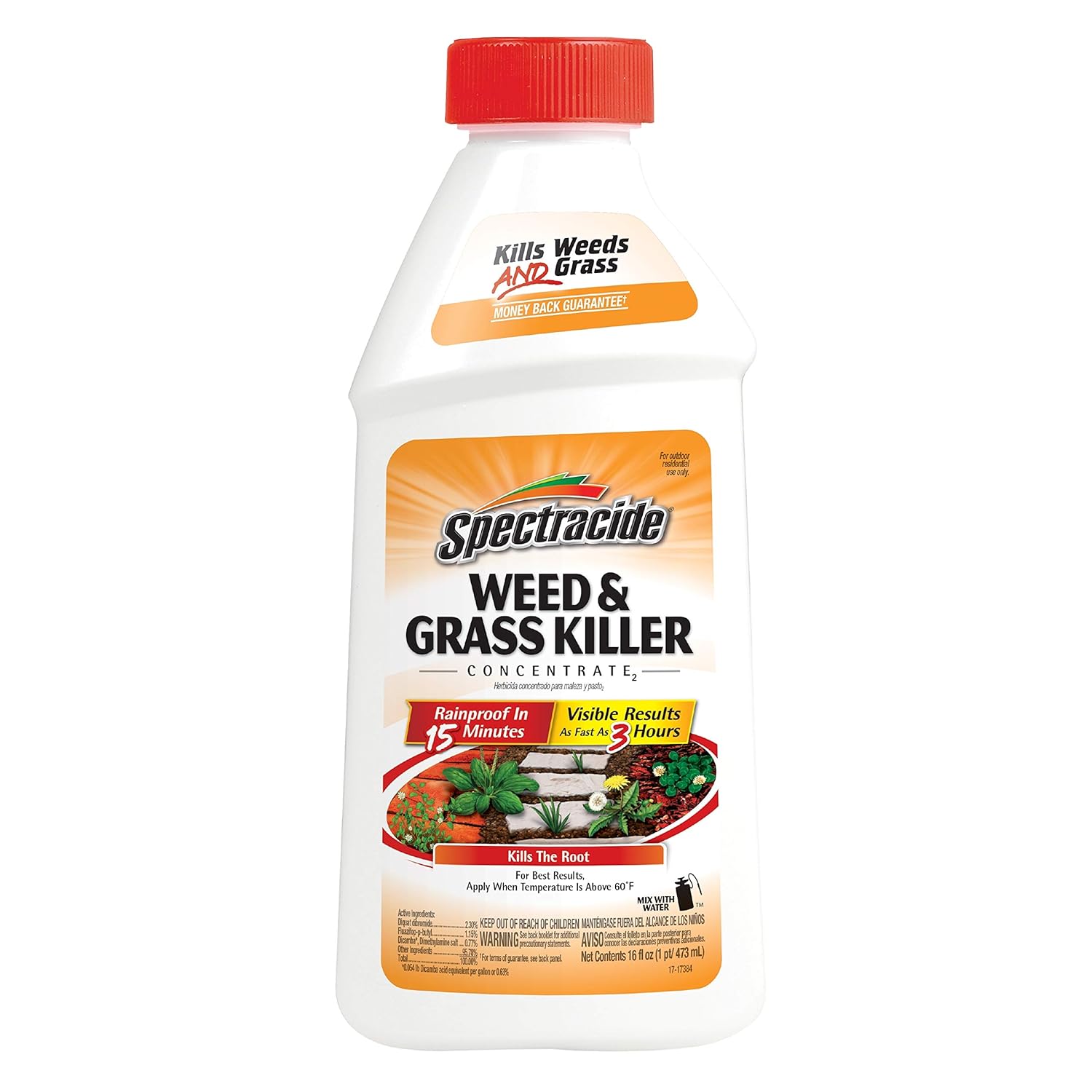
Spectracide Weed & Grass Killer Concentrate, 16 fl oz
| Unit Count | 16 Fluid Ounces |
|---|---|
| Item Form | Spray |
| Coverage | 7 fl oz per gallon covers up to 300 sq ft (as directed) |
| Rainfast | 15 minutes |
| Visible Results | As fast as 3 hours |
This Spectracide concentrate is a fast-acting, nonselective herbicide designed for spot treatment where you need to clear weeds and grass quickly. Mix the concentrate with water and apply with a tank sprayer to fully coat leaves; the formula is rainproof after 15 minutes and can show visible results in as fast as three hours. It is intended for use on hard surfaces such as driveways and walkways and around foundations, fences and garden beds where you want to remove unwanted vegetation before replanting. Practical benefits include root-killing effectiveness, the ability to replant in treated areas after one day, and a coverage rate given on the label for easy planning. Important limitations are that it will damage any desirable plants it contacts, requires careful application and protective measures, and should only be used when temperatures are above about 60°F; it is also not suitable for edible crops. Follow safety directions to keep people and pets away during application.
Best for: Gardeners who need a reliable spot-treatment herbicide to clear weeds and grass from hard surfaces and planting edges and who are comfortable using concentrated chemicals with a sprayer.
Less Ideal for: People who need a selective lawn treatment, want an organic solution, or who primarily need weed control for edible food gardens.
- Nonselective formula that kills weeds and grasses down to the root for longer control
- Rainproof in 15 minutes so treatment is not easily washed away by brief showers
- Visible results in as fast as 3 hours and treated areas can be replanted after one day
- Concentrate mixes with water for tank sprayer use and includes a labeled coverage rate for planning
- Requires careful shielding of desirable plants because it will kill any vegetation it contacts
- Effectiveness depends on applying under recommended temperature conditions and good leaf coverage
Verdict: Choose this concentrate when you want a fast, root-killing spot treatment to quickly clear weeds and grasses from driveways, walkways and planting edges.
Roundup Dual Action 365 Weed & Grass Killer Plus 12 Month Preventer, 1 gal

| Unit Count | 128 Fluid Ounces |
|---|---|
| Coverage | 300 square feet |
| Item Form | Spray |
| Active Ingredients | Triclopyr; Fluazifop-P-butyl; Imazapic; Diquat Dibromide |
This one-gallon Roundup Dual Action 365 combines quick knockdown with up-to-12-month prevention for non-lawn surfaces. It is applied with the included Comfort Wand for one-touch continuous spray, which makes treating cracks, patios, driveways, and gravel areas straightforward without tiring your hands. The formula contains multiple active ingredients targeted at broadleaf weeds, grassy weeds and brush, and the label promises visible results in hours and rainproofing in about 30 minutes. For performance-focused users the key benefit is the dual action: immediate weed control plus an invisible soil barrier when you spray the entire area rather than spot-treating. Practical limits to expect are that it is meant for non-lawn areas only and must be applied across the whole target area to prevent regrowth, which increases product needed for larger surfaces; repeat applications are restricted by label timing. Also observe safety instructions closely to avoid drift onto desirable plants and to keep people and pets away until the spray dries.
Best for: Buyers who prioritize fast, long-lasting weed control for hardscape, gravel, and other non-lawn areas and want a product that combines immediate kill with season-long prevention.
Less Ideal for: Homeowners looking to treat turf, ornamental beds, or spot-treat small isolated weeds should choose a lawn-safe product or a targeted spot treatment instead.
- Kills existing broadleaf and grassy weeds and shows visible results in hours.
- Provides up to 12 months of prevention when the entire area is treated.
- Comfort Wand with one-touch continuous spray reduces hand fatigue during application.
- Rainproof in as fast as 30 minutes so light rain soon after application is less likely to wash it away.
- Designed for non-lawn areas only and will damage desirable turf or plants if contacted.
- Requires treating the entire area (not spot spraying) to establish the preventive barrier, which uses more product.
Verdict: Choose this product when you need fast knockdown plus up-to-12-month prevention for weeds and grasses on driveways, patios, and other non-lawn surfaces.
Compare-N-Save 75324 Glyphosate Herbicide, 1 Gallon

| Active Ingredients | glyphosate |
|---|---|
| Liquid Volume | 1 gallons |
| Item Form | Spray |
| Coverage | 25000 square_feet |
This 1-gallon Compare-N-Save concentrate uses glyphosate to kill most annual and perennial weeds plus grasses by being absorbed through foliage and translocated to the root. You mix a measured amount with water to make ready-to-use spray: the label recommends 1.5 ounces per gallon for general weeds and 2.5 ounces per gallon for tougher perennials or brush, and a single gallon of concentrate can treat a large area when diluted. It is rainproof in about two hours and shows visible results in 2 to 4 days, which makes it useful for clearing driveways, walkways, fence lines, garden renovation, and stump or brush treatment. Practical benefits include long coverage per bottle and the ability to replant ornamentals quickly because it has no residual soil activity. Important limitations are that it will kill any green plant it contacts, so careful spot application and protective gear are required, and it does not provide pre-emergent control so new weeds can return without follow-up management.
Best for: Buyers who want a cost-effective, high-coverage herbicide to remove existing weeds and grass and who plan treatments carefully to avoid non-target plants.
Less Ideal for: People seeking a product that prevents future weed emergence or a selective herbicide safe to use in lawns and mixed planting beds.
- Concentrated formula stretches into many gallons of ready-to-use spray for large-area coverage
- Glyphosate active ingredient effectively kills both weeds and grasses to the root when foliage is thoroughly covered
- Rainproof in about two hours with visible results in 2 to 4 days for predictable timing
- No residual soil activity allows replanting in ornamentals soon after treatment
- Non-selective and will kill any green plant it touches, requiring careful application
- Contains glyphosate so protective equipment and adherence to safety directions are necessary
Verdict: A highly concentrated, economical glyphosate concentrate for efficiently killing established weeds and grass across large areas.
Spectracide One-Shot Weed & Grass Killer, 32 oz Ready-to-Use Spray

| Unit Count | 32 Fluid Ounces |
|---|---|
| Coverage | 500 Square Feet |
| Item Form | Spray |
| Active Ingredients | Imazapyr; Diquat Dibromide; Dicamba |
This Spectracide One-Shot Ready-to-Use Spray is designed to quickly clear unwanted weeds and grass from hard surfaces and areas where you do not want vegetation. You simply aim and spray without mixing; the formula acts on leaves and translocates to roots to deliver visible dieback the same day and longer control up to five months. It is rainproof within an hour and labeled for use on driveways, walkways and patios, which makes it convenient for spot treatments and clearing paving cracks. Important limitations: it is not selective so avoid desirable lawns, garden beds and nearby plants because the active ingredients persist in soil and can prevent planting for up to a year in some soils. The label also restricts application near water and requires keeping people and pets away during spraying and until treated areas dry. For someone wanting a no-fuss, fast-acting solution to permanently remove grass and weeds from hardscapes, this product is effective, but it requires careful application and planning to avoid unintended damage.
Best for: Homeowners who need a low-effort, fast solution to remove weeds and grass from hard surfaces or unwanted patches and who prioritize getting results without mixing concentrates.
Less Ideal for: Gardeners who want to preserve surrounding plants, maintain lawns, or plan to replant treated soil within a year should choose a more selective or short-lived control method.
- Ready-to-use spray requires no mixing and is simple to apply
- Kills foliage and roots with visible results the same day
- Prevents regrowth for up to five months on treated areas
- Rainproof within one hour which reduces reapplication risk
- Not selective and will damage desirable plants and lawns if contacted
- Residue can persist in soil and prevent planting in treated areas for up to a year
- Restricted use near water and on slopes requires careful application
Verdict: If you want an easy, ready-to-use product that kills grass and weeds quickly and prevents regrowth on driveways and patios, this delivers powerful, long-lasting control.
RM43 43% Glyphosate Plus Weed Preventer Total Vegetation Control, 1 Gallon

| Unit Count | 128 Fluid Ounces |
|---|---|
| Item Form | Spray |
| Coverage | 17297 square feet |
| Active Ingredients | glyphosate |
RM43 is a concentrated herbicide designed to kill existing grass and broadleaf weeds and to prevent regrowth for up to a year when applied to non-crop areas. It mixes with water and is applied with a sprayer for spot treatments or larger surface coverage; one gallon treats thousands of square feet when diluted according to directions. The formulation contains glyphosate and a second herbicide plus surfactant, which makes it effective at translocating to roots and reducing regrowth. It becomes rainfast in about two hours and does not restrict entry to treated areas once the spray has dried, which helps with scheduling treatments. Important practical limits are its nonselective nature so it will damage desirable plants and the need to follow safety and disposal guidance carefully. Also it is intended for use on non-crop, non-landscape areas rather than where you want to preserve turf or ornamental plants.
Best for: Buyers who need a dependable, long-lasting solution for killing grass and weeds on non-crop areas and prioritize effectiveness and reduced retreatment frequency.
Less Ideal for: Homeowners wanting to preserve lawns, ornamental beds, or treat areas with desirable plants nearby should choose a selective or lower-strength product instead.
- Concentrated formula covers a large area when diluted, reducing the number of containers needed
- Combination of glyphosate and a second herbicide with surfactant improves root kill and long-term control
- Rainfast in two hours so treated areas are less affected by short-term weather
- Suitable for total vegetation control on non-crop surfaces and prevents regrowth for up to 12 months
- Nonselective and will kill or damage desirable plants if contacted
- Contains strong active ingredients that require careful handling, PPE, and disposal
Verdict: Choose RM43 when you need a reliable, concentrated, long-lasting herbicide to permanently remove grass and weeds from non-crop areas.
Spectracide Weed & Grass Killer with AccuShot Power Sprayer, 1.33 gal

| Unit Count | 170 Fluid Ounces |
|---|---|
| Coverage | 1 gallon |
| Item Form | Spray |
| Active Ingredients | Diquat Dibromide 0.12%, Fluazifop-p-butyl 0.06%, Dicamba (dimethylamine salt) 0.04% |
Spectracide Weed & Grass Killer pairs a ready-to-use 1.33 gallon herbicide with an AccuShot continuous-power sprayer that makes treating driveways, patios, walkways and beds faster and more precise than a manual pump bottle. The formula is non-selective and moves through foliage to the root, which produces visible browning in about three hours and allows replanting the same weekend when used as directed. The sprayer wand is extendable and battery-powered so you can reach tight spots and spray without pumping, and the unit is rainproof within 15 minutes. Practical benefits include a large volume for treating multiple areas without frequent refills and an easy-to-use wand for targeted applications around ornamentals and hardscapes. Important limitations are that the product will kill any plant it contacts so careful aiming and PPE are required, the sprayer requires four AA batteries and occasional priming and maintenance, and the formula is not suitable for selective lawn spot treatments. Follow label precautions to avoid drift, protect desirable plants and prevent contamination of water.
Best for: Buyers who want a fast-acting, whole-plant solution to clear weeds and grass on hard surfaces and around beds, and who prefer a ready-to-use product with a powered wand for accurate application.
Less Ideal for: Gardeners who need selective lawn spot treatments or who must avoid using non-selective herbicides near sensitive plants or water features.
- Non-selective formula that translocates to roots for fast visible results in about three hours
- Includes AccuShot battery-powered sprayer with extendable wand for accurate, low-fatigue application
- Rainproof 15 minutes after application so treatments are less likely to be washed away
- Large 1.33 gallon unit covers multiple areas without frequent refills
- Will kill any vegetation it contacts, requiring careful application around desirable plants
- Sprayer depends on four AA batteries and needs occasional priming and maintenance
Verdict: Choose this product if you need a powerful, ready-to-use herbicide with a battery-powered wand to quickly and accurately kill weeds and grasses to the root.
Roundup Weed & Grass Killer4 with Pump 'N Go 2 Sprayer, 1.33 gal.

| Unit Count | 170 Fluid Ounces |
|---|---|
| Item Form | Spray |
| Coverage | 300 Square_Feet |
| Active Ingredients | Triclopyr; Fluazifop-P-Butyl; Diquat Dibromide |
This Roundup Weed & Grass Killer4 kit combines a 1.33 gallon ready-to-use formula with a Pump 'N Go 2 sprayer so you can treat patches of weeds and grassy growth without mixing chemicals. The product is intended for in and around flower beds, along driveways, patios, gravel and mulch where unwanted grass or broadleaf weeds are growing. The extendable wand and up to 10 minutes of continuous spray let you apply precisely without bending over, and the label promises visible dieback in hours plus rainproofing in about 30 minutes for predictable results. It also notes you can replant in 1 to 30 days depending on the situation. Important limitations are safety and site restrictions: wear protective clothing, keep people and pets away until the spray dries, and follow the directions to avoid damage to desirable plants since the formula will kill grasses and many broadleaf species to the root. For small-to-medium spot treatments this is convenient and effective, but it is a chemical herbicide that requires careful handling and precise application to avoid collateral damage.
Best for: Buyers who want a dependable chemical solution to remove unwanted grass and broadleaf weeds quickly and with precise application control, and who are comfortable following label safety directions.
Less Ideal for: People seeking organic, nonchemical weed control or those unwilling to use a product that requires protective clothing and exclusion of people and pets until drying.
- Ready-to-use formula with no mixing required for faster treatment
- Pump 'N Go 2 sprayer with extendable wand enables accurate, continuous spray up to 10 minutes
- Produces visible weed and grass dieback in hours and becomes rainproof in about 30 minutes
- Designed for use around beds, walkways, driveways, gravel and mulch for versatile spot treatment
- Contains strong active ingredients that require protective gear and careful application
- Will damage any desirable plants it contacts and must be kept away from lawns and ornamentals
- Not suitable for users who prefer nonchemical or organic weed control methods
Verdict: A convenient ready-to-use chemical kit with a built-in Pump 'N Go sprayer for fast, targeted killing of grasses and broadleaf weeds when you need reliable, predictable results.
Choosing the Right Weed Killer That Kills Grass: Key Factors to Consider
Mode Of Action And What It Kills
Understanding how a weed killer works helps predict which grasses it will eliminate and how quickly. Some herbicides disrupt photosynthesis and cause rapid browning over days, while others interfere with root growth and take longer to show results. Knowing the mode of action also helps avoid accidental damage to nearby desirable turf or ornamentals when treating borders or patches.
Read label language about spectrum of activity. A product labeled for nonselective grass control will act on most common lawn species, but the time to kill and residual behavior differ. Choosing a herbicide with a clear mode of action reduces surprises during cleanup and replanting.
Residual Persistence And Replanting Wait Times
Residual persistence determines how long treated soil will inhibit regrowth or prevent planting. Some formulations leave minimal soil activity and allow rapid replanting, while others have residual activity that can affect seed germination or sensitive seedlings for weeks to months.
If you plan to reseed or install new plants soon after removal, select a product with short residual persistence or follow label instructions for safe replanting intervals. For permanent hardscape preparation, longer persistence can be an advantage, keeping areas bare while you work.
Formulation Type And Application Method
Weed killers come as ready-to-use sprays, concentrates for dilution, granular products, and foam or brush-on gel for spot work. Concentrates can be more economical for large areas but require careful mixing. Ready-to-use options are convenient for small patches. Granules can be easier to apply on windy days but may be slower to act.
Think about the area size, access to water for mixing, and whether you need spot treatment or broadcast coverage. Application method affects drift risk, coverage uniformity, and how quickly symptoms appear on grasses.
Coverage And Spray Technique
Effective control depends on uniform coverage of foliage. Sparse spray or missed patches allow grasses to regrow from untreated crowns and rhizomes. For perennial or creeping grasses, thorough wetting of aboveground growth is critical because roots and rhizomes can resprout from surviving tissue.
Use appropriate nozzle settings, avoid spraying in high winds, and follow label directions on droplet size and spray pressure. For targeted edge work, low-volume spot applications reduce off-target exposure while ensuring contact with all green tissue.
Non-Target Plant Safety And Buffering
Nonselective grass-killing herbicides can damage any green plant they contact. When treating near flower beds, shrubs, or desirable lawn strips, plan for physical barriers, careful spray angles, or selective spot treatment methods. Some formulations adhere to foliage to reduce drift, while others may volatilize and risk off-target injury under heat.
Observe recommended buffer distances and rinse equipment before switching treatment areas. Consider the placement of desirable plants relative to treated zones and timing treatments when environmental conditions lower drift risk.
Environmental Conditions And Timing
Temperature, moisture, and plant growth stage all affect herbicide uptake and effectiveness. Active, actively growing grass in warm, non-drought-stressed conditions usually absorbs systemic herbicides better, producing more reliable kill. Very hot or very cold weather can slow activity or increase volatility risks.
Apply when grasses are actively growing and when rain is not expected for the label-specified rainfast period. Avoid applications during extended drought or immediately after heavy rain, as stress and runoff reduce herbicide performance and increase the chance of environmental movement.
Preparing The Area For Treatment
Clear debris, mow the area low if necessary, and mark nearby desirable plants before applying a grass-killing product. Removing loose thatch and large clippings improves herbicide contact with green tissue and reduces the chance that blades will shelter grass crowns from spray.
- Cut grass shorter for better foliar contact but do not over-stress the plants before treatment.
- Cover nearby plants or use cardboard barriers to prevent drift and accidental contact.
- Plan for a rain-free window based on the product's rainfast label guidance.
Spot Treatment Versus Broadcast Application
Decide whether you need targeted spot control or whole-area treatment. Spot applications limit off-target risk and conserve product when only patches of grass need removal. Broadcast application is more efficient for large areas but requires careful setup to avoid overspray onto ornamentals or neighboring turf zones.
- Use brush-on or gel products for single stubborn clumps to reduce drift.
- Choose a soluble concentrate and a labeled sprayer for larger areas to ensure even coverage.
- When doing broadcast treatments, maintain consistent walking speed and nozzle pattern to avoid streaks.
Post-Treatment Cleanup And Disposal
Follow label instructions for rinsing sprayers and disposing of leftover solution. Rinse water can contain active ingredients and should be handled according to disposal guidance to prevent contamination of soil or waterways. Clean tools away from garden beds and avoid runoff into storm drains.
- Triple-rinse sprayers and dispose of rinse water as directed.
- Collect and bag any visible dead plant material if required by the label before composting or disposing.
- Store leftover concentrate in its original container with the label intact and away from children and pets.
Managing Regrowth And Follow-Up Work
Some grasses regenerate from rhizomes or seed banks after initial treatment. Monitor treated areas for regrowth and apply follow-up spot treatments when fresh green shoots are visible to maximize effectiveness. For renovation projects, allow the labeled replanting interval before installing new turf or sensitive plants.
- Repeat spot treatments at the first sign of green regrowth for persistent species.
- For permanent removal, remove large dead thatch and root masses mechanically after herbicide action has ceased.
- Wait the label-recommended interval before seeding or transplanting to avoid injury to new plants.
Safety Practices For Gardeners And Pets
Wear appropriate personal protective equipment such as gloves and eye protection when mixing and applying concentrated herbicides. Keep people and pets off treated areas until the spray has dried and the product label allows reentry. Store products securely and out of reach of children and animals.
- Follow label PPE requirements exactly during mixing and application.
- Keep pets off treated areas for the specified reentry period.
- Avoid applying on windy days to reduce drift to play areas or vegetable gardens.
How We Chose the Best Weed Killer That Kills Grass
We focused editorial selection on attributes gardeners actually experience when using grass-killing herbicides. Primary filters included proven efficacy on common lawn grasses, clarity of application instructions, and availability in formulations suited to the described scope. We prioritized products that delivered reliable visual kill across a range of cool- and warm-season grasses and that provided guidance for spot treatment versus area-wide use. Evaluation criteria emphasized speed of visible control, how long treated areas remained free of regrowth, formulation type and application flexibility, and safety guidelines for nearby desirable plants and soil. We also considered label guidance for follow-up planting intervals and whether the product required special equipment for effective coverage. We excluded any options that were limited to broadleaf-only control, lacked clear usage directions, or had inadequate information on turf persistence. The result is a shortlist of products that meet practical gardener needs for clearing grass before renovation, edging, or hardscape work.
FAQ
Will a grass-killing weed killer damage nearby flowers and shrubs?
Yes, many grass-killing herbicides are nonselective and will injure any green plant they contact. Use physical barriers, spot treatments, or low-drift formulations when treating close to desirable plants and follow buffer recommendations on the label.
How long after treatment can I reseed or plant?
Replanting intervals vary by product and formulation. Some have minimal soil persistence and allow planting within days, while others recommend waiting several weeks to months. Check the product label for the specific replanting timeframe and follow that guidance.
Can I use a weed killer that kills grass to clear turf for hardscaping?
Yes, these products are commonly used to clear turf before installing patios, paths, or beds. For hardscape prep, longer-residual options can keep an area free of regrowth during construction, but be mindful of runoff and avoid treating in conditions that increase movement.
Is spot treatment effective on creeping grasses with rhizomes?
Spot treatment can work, but creeping grasses with extensive rhizomes may resprout from untreated sections. Thorough foliar coverage and follow-up treatments on new shoots improve control; mechanical removal of large root masses after herbicide activity can help for total eradication.
What weather conditions give the best results?
Apply when grasses are actively growing, not drought-stressed, and when temperatures are within the product's recommended range. Avoid imminent rain during the rainfast period and windy conditions that increase drift risk.
Final Verdict
Prioritize the attributes that match your project when choosing a weed killer that kills grass. Speed of kill matters when you need quick clearance, while residual persistence matters for long-term suppression or when wait times for replanting are acceptable. Application method and safety considerations will determine how practical a product is for small patches versus large-area renovation. Balance required coverage and buffer needs against replanting goals to select an approach that fits your timeline and site constraints. When in doubt, follow label directions closely and plan for follow-up treatments or mechanical removal for persistent grasses to achieve predictable, lasting results.
