

Note: This article contains affiliate links. If you click on these links and make a purchase, I may earn a small commission at no extra cost to you. This helps support my research and content. Read my full affiliate disclosure here.
You need an insect spray that works inside your living spaces without leaving heavy smells or lingering hazards. Choosing the right bug spray for around the house affects how comfortable and safe your home feels after application, whether you treat baseboards, window frames, or the porch entryway. This guide shortlists seven top options selected for indoor use and real-home performance. We highlight how each product handles common indoor pests, how long protection lasts, and what to expect for smell and surface compatibility. Read on for practical notes on application, safety, and maintenance before the product list.
Top Picks at a Glance
| Best Overall The best all-around choice for most situations | Ortho Home Defense Insect Killer Refill, 1.33 gal (Indoor & Perimeter) |  |
| Best Quality Built to a higher standard if you want something more solid | Ortho Home Defense Insect Killer Concentrate, 32 oz |  |
| Best Value The sweet spot between price and what you get | Spectracide Bug Stop Home Barrier Ready-to-Use Spray, 32 oz (3 pack) |  |
| Best Budget The cheapest option that still gets the job done reliably | Raid Ant & Roach Killer Spray, Outdoor Fresh Scent, 17.5 oz |  |
| Highest Rated A top-rated pick with lots of positive feedback | Envu Tempo SC Ultra Insecticide Concentrate, 240 ml |  |
| Most Popular A crowd favorite that many people choose with confidence | Mighty Mint Peppermint Oil Insect Repellent Spray, 16 oz |  |
| Best Seller A high-volume bestseller chosen again and again | Ortho Home Defense Insect Killer for Indoor & Perimeter, 1.1 gal (2-Pack) with Comfort Wand |  |
Ortho Home Defense Insect Killer Refill, 1.33 gal (Indoor & Perimeter)

| Unit Count | 170.24 Fluid Ounces |
|---|---|
| Manufacturer | The Scotts Company LLC |
| Item Form | Spray |
| Target Species | Insects |
| Liquid Volume | 1.33 gallons |
This Ortho Home Defense refill is meant for homeowners who already own the Comfort Wand applicator and want an economical way to treat both indoor hotspots and the home perimeter. The formula targets many common pests including ants, roaches, spiders, fleas, ticks and mosquitoes and creates a residual barrier that the manufacturer says lasts up to 12 months against ants, roaches and spiders on nonporous indoor surfaces. It is sold as a refill so typical use is pouring into a reusable sprayer or mixing per the original product instructions, then applying a narrow band indoors (kitchens, bathrooms, entryways) and a wider band around foundations, patios and decks. Notable features are the long residual control, the large 1.33-gallon volume for multiple treatments, and an Invisi-Shield formula that dries clear with no noticeable fumes. Limitations to consider are that the 12-month claim applies only to certain pests and nonporous surfaces, it requires the original applicator or a compatible sprayer, and it is a chemical control so care is needed around children, pets, and planted areas when applying outdoors.
Best for: Homeowners seeking a cost-effective, long-lasting chemical option to reduce recurring indoor bugs and to establish a treated perimeter around the house.
Less Ideal for: People who prefer non-chemical, organic pest control methods or who need an immediate ready-to-spray product without a separate applicator.
- Broad-spectrum control covering indoor pests and common perimeter invaders
- Long residual barrier for certain pests, reducing reapplication frequency
- Large 1.33 gallon refill supports multiple treatments or whole-house perimeter coverage
- 12-month protection claim is limited to ants, roaches and spiders on nonporous indoor surfaces rather than all pests or surfaces
- Requires a compatible applicator or transfer into a sprayer before use
Verdict: Buy this refill if you want a single, economical product to establish a long-lasting indoor and perimeter insect barrier for common household pests.
Ortho Home Defense Insect Killer Concentrate, 32 oz

| Liquid Volume | 32 fluid ounces |
|---|---|
| Included Components | Ortho Home Defense Insect Killer for Indoor |
| Active Ingredients | Bifenthrin, Zeta Cypermethrin |
| Item Form | Wipe |
| Target Species | Insects |
Ortho Home Defense Insect Killer Concentrate is a liquid concentrate you mix with water and apply with a tank sprayer to create a chemical barrier around a home's perimeter and on indoor non-porous surfaces. It targets ants, roaches, spiders and many other crawling and some flying insects, and the bottle claims up to 12 months of residual control for ants, roaches, and spiders when applied indoors on non-porous surfaces. Typical use is diluting the 32 oz. bottle to make up to four gallons, treating foundation perimeters, patios, garages, and spot-treating indoor areas like kitchens or basements. Notable features include bifenthrin and zeta cypermethrin active ingredients, a non-staining and low-odor formula, and compatibility with common tank sprayers. Practical benefits are broad-spectrum control, economical coverage from the concentrate, and a long residual that reduces retreatment frequency. Important limitations are that it must be diluted and applied with a sprayer, it is a chemical solution that requires following label safety directions, and the long residual applies only to certain pests and surfaces as specified on the label.
Best for: Buyers who prioritize strong, long-lasting perimeter and indoor protection and are comfortable using concentrated insecticide with a sprayer for preventative or corrective treatments.
Less Ideal for: People who want a ready-to-use product or who prefer non-chemical, organic pest control methods should consider alternatives.
- Concentrate makes up to 4 gallons for economical coverage
- Contains bifenthrin and zeta cypermethrin for broad-spectrum control
- Non-staining and low-odor formula suitable for indoor use on non-porous surfaces
- Provides up to 12 months residual control for ants, roaches, and spiders per label
- Requires dilution and a separate tank sprayer for application
- Long-lasting chemical residue means you must follow safety and reentry instructions on the label
Verdict: Choose this concentrate if you want a powerful, economical perimeter and indoor insect control solution that delivers long residual protection for common household pests.
Spectracide Bug Stop Home Barrier Ready-to-Use Spray, 32 oz (3 pack)

| Unit Count | 96 Fluid Ounces |
|---|---|
| Included Components | 32 Fl Oz (3 Pack) |
| Item Form | Spray |
| Target Species | Ants, Roaches, Spiders, Fleas, Ticks & More |
| Active Ingredients | Gamma-Cyhalothrin |
Spectracide Bug Stop Home Barrier is a ready-to-use insect spray formulated for indoor and outdoor perimeter treatments. You spray it into cracks and crevices, along baseboards, and around doors, windows and foundation gaps, or apply to outer surfaces of screens and porches to stop insects at entry points. The clear, water-based formula contains gamma-cyhalothrin and claims contact kill plus up to 12 months of control for cockroaches on non-porous surfaces. Practical benefits include no-mix convenience, minimal odor, and a non-staining finish that leaves little residue on treated surfaces. Because it is labeled for many common pests it simplifies routine home maintenance and reduces the need for multiple specialized products. Important limitations are that it contains a synthetic insecticide so users must follow label precautions and avoid treating porous indoor surfaces where long residual claims do not apply; repeated applications may be needed for heavily infested areas. The 3-pack format suits multi-entry homes or seasonal re-treatment schedules.
Best for: Homeowners who want a convenient, all-purpose perimeter spray to reduce routine indoor and outdoor insect incursions and prefer a low-odor, ready-to-use product for regular maintenance.
Less Ideal for: People seeking organic or non-chemical pest control methods or those who need targeted solutions for infestations that require professional-grade treatments.
- Ready-to-use spray requires no mixing and is simple to apply around windows, doors and baseboards
- Water-based clear formula with minimal odor that does not leave an oily residue
- Label covers a broad range of common household pests including ants, roaches, spiders, fleas and ticks
- Long residual claim for cockroaches on non-porous surfaces reduces frequency of re-treatment in those locations
- Contains a synthetic pyrethroid active ingredient so protective measures are required during application
- Residual efficacy varies by surface type and may be much shorter on porous materials
Verdict: A simple, ready-to-use perimeter spray that gives low-odor, broad-spectrum control for routine home pest prevention.
Raid Ant & Roach Killer Spray, Outdoor Fresh Scent, 17.5 oz

| Item Form | Aerosol |
|---|---|
| Target Species | Insects |
| Liquid Volume | 17.5 |
Raid Ant & Roach Killer is a straightforward aerosol insecticide for treating visible infestations and common hiding spots around the home. You use it by shaking and spraying surfaces such as baseboards, under sinks, garbage cans and garages from about 18 inches away until wet. The formula lists active ingredients imiprothrin and cypermethrin and claims contact kill plus residual action that can help keep treated areas pest-free for up to 13 weeks. Practical benefits include broad-spectrum effectiveness against roaches, ants, silverfish, crickets and spiders, simple application with the aerosol actuator, and no lingering chemical odor noted in the listing. Important limitations are typical of pressurized aerosols: it is flammable, must not be used near open food or flames, and requires careful handling around children and pets; it also treats surfaces rather than eliminating nest sources, so repeat or combined tactics may be needed for heavy infestations. For routine spot treatments and perimeter maintenance it is an easy, familiar option for household use.
Best for: Homeowners or renters who want a low-effort, familiar spray for quick spot treatments and perimeter maintenance to reduce common indoor pests on a modest budget.
Less Ideal for: People dealing with large or hidden infestations that need targeted baits, professional-grade treatments, or non-chemical integrated pest management approaches.
- Kills on contact and has residual action to reduce reappearing insects for weeks
- Broad spectrum labeled for ants, roaches, spiders, silverfish, crickets and other common household pests
- Easy aerosol application for spot treatment on floors, baseboards and garbage areas
- Aerosol is flammable and pressurized, requiring careful storage and safe use
- Treats surfaces only and may not eliminate nests or colony sources without additional methods
Verdict: A simple, budget-friendly aerosol for quick spot control and ongoing surface protection against a wide range of household insects.
Envu Tempo SC Ultra Insecticide Concentrate, 240 ml

| Item Volume | 240 ml |
|---|---|
| Size | 8.1 Fl Oz (Pack of 1) |
| Item Form | Liquid |
| Target Species | Ants, flies, cockroaches, crawling pests, and ticks |
| Active Ingredient | Beta-Cyfluthrin |
Tempo SC Ultra is a liquid concentrate insecticide intended for perimeter and spot treatments around homes. Mix per the label and apply as a general surface, crack-and-crevice, or mist treatment on foundations, doorways, garages, basements, patios, and other common harborage areas. The product uses beta-cyfluthrin as the active ingredient and is formulated for fast knockdown plus residual activity so treated surfaces continue to repel or kill crawling pests after application. As a concentrate it stretches to cover large areas and the suspension formulation helps even coverage when diluted. It is low odor and labeled as non-staining, which makes it more suitable for use around living spaces than some stronger-smelling options. Important limitations are that it is a professional-grade pesticide requiring careful mixing and strict adherence to label directions and safety precautions, and it targets crawling insects rather than flying pests specifically. Expect to reapply according to label intervals for ongoing perimeter protection.
Best for: Homeowners who prioritize dependable, long-lasting perimeter control and are comfortable following label mixing and safety instructions for an effective concentrated treatment.
Less Ideal for: People who want a ready-to-use spray without mixing or those focused primarily on flying insects should consider alternative or additional products.
- Broad-spectrum control targeting ants, cockroaches, spiders, ticks and other crawling pests
- Concentrated liquid mixes with water so a small amount treats large areas
- Fast knockdown with residual effectiveness for ongoing perimeter protection
- Low odor and formulated to be non-staining for safer indoor/outdoor use
- Contains a synthetic pyrethroid (beta-cyfluthrin) that requires careful handling and strict label compliance
- Not formulated specifically for flying insects so may need a complementary product for full home coverage
Verdict: Buy this concentrate if you want a low-odor, residual perimeter insecticide that delivers reliable, long-lasting control of crawling pests when mixed and applied correctly.
Mighty Mint Peppermint Oil Insect Repellent Spray, 16 oz
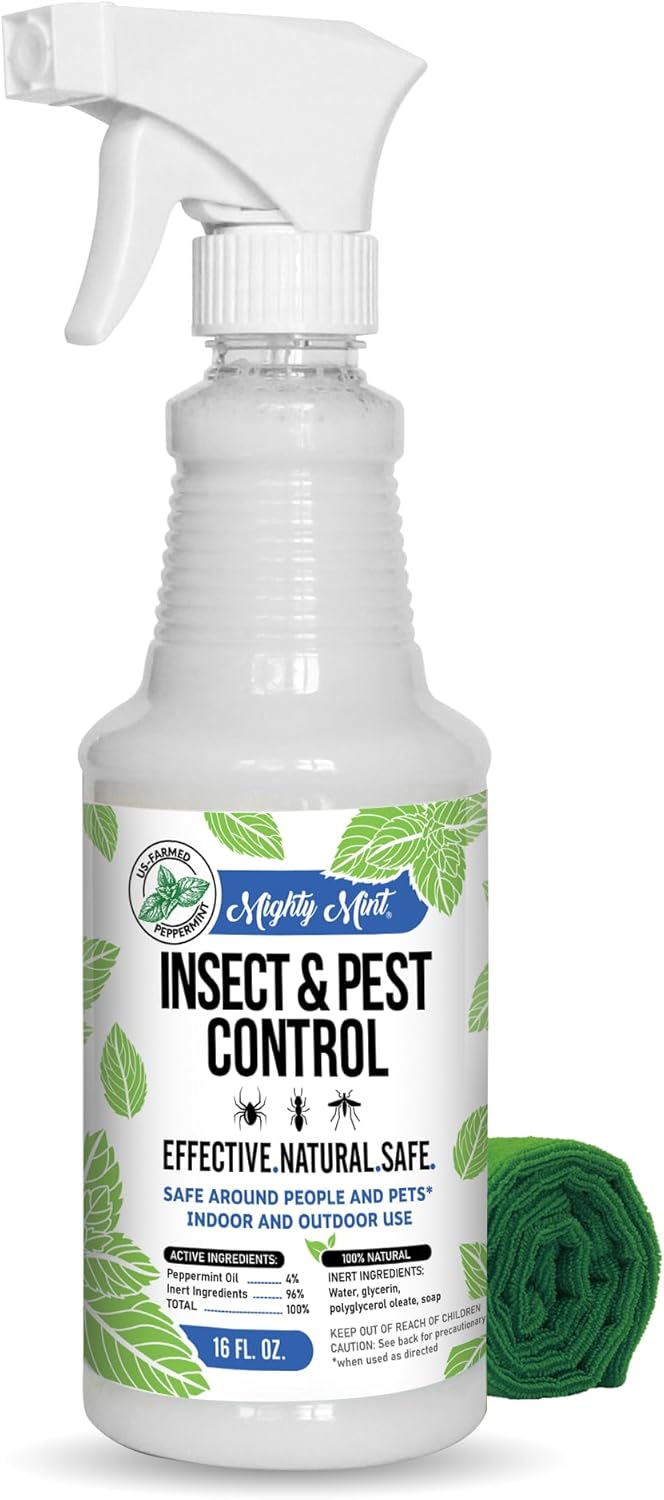
| Volume | 16 oz |
|---|---|
| Ingredients | Water, Glycerine, Polyglycerol oleate, Soap, Peppermint oil |
| Use | Indoor / Outdoor |
| Pests targeted | Spiders, ants, roaches and other common insects |
Mighty Mint is a plant-based peppermint oil spray intended for targeted indoor and outdoor pest control. You use it as a spot treatment on baseboards, entryways, patios, vehicle engine compartments, and other entry points to discourage spiders, ants, roaches and some other insects. The ready-to-use 16 ounce bottle sprays a fine mist so you can coat surfaces quickly; the manufacturer recommends reapplying a couple times per week in problem areas. Notable features include an extra-concentrated peppermint oil formula, simple water-based ingredients, and directions that warn against applying when pollinators are present and against direct skin contact. In practice the spray offers a low-toxicity alternative to synthetic pesticides and leaves a minty scent rather than harsh chemical odors, which is useful in living spaces. Important limitations are that it is a repellent not a killer so results vary by infestation level and frequency of reapplication, and the strong peppermint concentration can irritate sensitive people or pets until the product dries.
Best for: Buyers who prioritize safer, plant-based options and want a spray they can use around living spaces for frequent, visible spot treatments backed by broad user experience.
Less Ideal for: People facing large or entrenched infestations who need a fast-acting insecticide or users who require an unscented or zero-fragrance solution.
- Plant-based peppermint formula provides a low-toxicity alternative to synthetic insecticides
- Ready-to-use 16 oz spray is convenient for spot treatments around doors, baseboards, garages and patios
- Works indoors and outdoors on multiple pests including spiders, ants and roaches
- Leaves a pleasant mint scent instead of strong chemical odors
- Acts primarily as a repellent rather than an insecticide so it may not eliminate established infestations
- Contains a high concentration of peppermint oil that can irritate sensitive people, pets, or eyes if contacted before drying
Verdict: Choose this spray if you want an easy, plant-based peppermint repellent for regular spot treatments around the home that avoids harsh chemical smells.
Ortho Home Defense Insect Killer for Indoor & Perimeter, 1.1 gal (2-Pack) with Comfort Wand

| Unit Count | 281.6 Fluid Ounces |
|---|---|
| Item Form | Spray |
| Target Species | Insects |
| Liquid Volume | 8.32 liters |
| Active Ingredients | Bifenthrin, Zeta-Cypermethrin |
This two-pack of Ortho Home Defense is a straightforward ready-to-use spray designed for treating indoor areas and the foundation perimeter to control ants, roaches, spiders and many other common pests. Each 1.1 gallon bottle pairs with a battery-powered Comfort Wand that delivers a continuous spray, making it easy to apply without bending or pumping. The formula contains bifenthrin and zeta-cypermethrin and advertises up to 12 months of protection on non-porous indoor surfaces against ants, roaches and spiders when applied as directed. Typical use is spraying a 4-inch band indoors near entry points and a 12-inch band outdoors around foundations, patios and garages until slightly wet. Practical benefits include simple application, broad insect coverage and a clear, low-odor formula that dries fast. Important limitations are that active ingredients are synthetic insecticides, so users should follow label safety instructions and avoid treating porous surfaces or areas where children and pets could contact wet residues. This product is best used as part of a prevention routine rather than a one-time fix for heavy infestations.
Best for: Homeowners who prefer a low-effort, preventive approach to common indoor and perimeter pests and want a product that is simple to apply with minimal odor.
Less Ideal for: People seeking organic or non-chemical pest control methods or those needing a fast eradication plan for heavy infestations should consider alternative solutions.
- Ready-to-use with included battery-powered Comfort Wands for continuous, low-effort spraying
- Advertised up to 12 months barrier protection indoors on non-porous surfaces against ants, roaches and spiders
- Works for both indoor spot treatments and outdoor perimeter applications
- Formula dries clear and gives off no noticeable fumes during application
- Contains synthetic insecticides that require careful handling and adherence to safety directions
- Not intended for porous indoor surfaces where long-term protection is claimed
- May not eliminate large, established infestations without complementary targeted treatments
Verdict: A convenient, ready-to-use indoor and perimeter spray with included comfort wands that offers long-lasting, broad-spectrum protection for routine home pest prevention.
Choosing the Right Bug Spray for Around the House: Key Factors to Consider
Active Ingredient and Toxicity
Knowing the active ingredient helps predict what pests the spray will control and what precautions to take. Some actives are designed for low indoor toxicity and short reentry times, while others are more potent and meant for spot treatments with longer ventilation. Consider whether the product lists common household pests on the label and whether it mentions special handling around children, seniors, or pets.
Toxicity information also determines whether you need to remove household items, cover food, or rinse treated surfaces. In many cases a lower-toxicity formulation used correctly provides effective control for typical indoor infestations without extra risk.
Residual Effectiveness and How It's Measured
Residual effectiveness is how long treated surfaces remain active against insects. Longer residuals reduce reapplication frequency but can increase occupant precautions. Look for label language about hours or weeks of protection and whether effectiveness holds on porous versus nonporous surfaces.
Understand that residual performance can vary with cleaning, sunlight exposure, and the type of surface. If you need long-term perimeter control inside, choose a formula with a proven residual claim; for quick knockdown of an occasional pest, a shorter-acting spray might suffice.
Odor, Volatility, and Reentry Time
Odor matters a lot indoors because strong fumes can irritate occupants. Volatile formulations can smell strong initially but dissipate; others use low-odor solvents for immediate comfort. Check label directions for recommended ventilation and reentry times after application.
Rooms with limited airflow, sensitive occupants, or open food prep areas may need particularly low-odor options. In many cases opening windows and running fans for a short period reduces smell quickly.
Surface Safety and Staining Risk
Indoor sprays come into contact with many finishes: painted trim, upholstery, rugs, and countertops. A product that leaves stains or dulls finishes will create additional chores or damage. Look for labels indicating suitability for fabrics and painted surfaces and read application guidance about spot-testing.
If you plan to spray along baseboards or near textiles, choose a formula that is nonstaining and safe for common household materials. When in doubt, test a hidden patch and follow label cleanup instructions.
Application Method and Coverage
Different delivery formats-trigger sprays, pump mists, aerosol cans, or concentrates to mix-affect control and convenience. Trigger sprays and pump mists give good control for spot treatment and are easy to direct into cracks and crevices. Aerosols provide quick knockdown for flying insects. Concentrates can be more economical and allow custom dilution but require careful measuring.
Consider how much surface area you need to treat and whether you prefer targeted bursts or sweeping coverage. Ease of application influences how often you will realistically treat problem areas.
Pets, Children, and Occupant Considerations
Homes with pets, infants, or people with respiratory sensitivities need extra caution. Look for products with clear label directions about keeping occupants out during application and specified reentry intervals. Some formulations allow short reentry times and recommend wiping treated surfaces that come into direct contact with people or pets.
Planning timing around when occupants can vacate the treated area and following ventilation guidance minimizes exposure. Also consider whether treated rooms require additional cleaning before regular use resumes.
Common Indoor Pests and How Sprays Work
Different sprays target different pests. Some formulations focus on crawling insects such as ants, roaches, and spiders, while others add flying insect knockdown for mosquitoes and flies. Understanding which pests you encounter most often helps you select a formula with the right active ingredient and residual claim.
Sprays typically work by direct contact knockdown and residual transfer when insects cross treated surfaces. For perimeter treatments it is important to place product where pests travel, such as along baseboards, entry thresholds, and behind appliances.
- Crawling insects respond well to directed surface treatments on travel paths.
- Flying insects are best handled with quick knockdown aerosols or traps used in tandem.
- Persistent infestations may need integrated approaches including sanitation and exclusion.
Safe Application Practices Indoors
Always read and follow label directions for ventilation and reentry. Open windows and run fans when possible to reduce fumes quickly after treatment. Remove or cover food, dishes, and pet bowls before applying sprays near kitchens.
Use targeted applications rather than sweeping sprays in living areas. Treat cracks, crevices, and baseboards where insects hide. After the specified reentry time, wipe high-contact surfaces if the label recommends doing so.
- Keep children and pets out of treated rooms until the label allows reentry.
- Avoid spraying directly on bedding, stuffed toys, or food-contact surfaces.
- Spot-test on an inconspicuous area before treating fabrics or finished wood.
When to Choose a Low-Odor Formula
Choose a low-odor product when treating living rooms, bedrooms, or kitchens, or when occupants are sensitive to smells. Low-odor sprays often use less volatile solvents and can make reentry faster and more comfortable.
If you need to treat while someone remains at home briefly, plan to ventilate thoroughly and apply in short, localized bursts rather than whole-room fogging.
- Low-odor is preferable for frequent maintenance treatments.
- High-odor products may offer stronger knockdown but require longer ventilation.
- Consider occupant sensitivity when scheduling treatments.
Integrating Bug Spray With Other Home Pest Methods
Sprays work best as one part of an integrated pest plan. Combine targeted sprays with good sanitation, sealing entry points, and mechanical traps or baits for more persistent problems.
Regular cleaning and removing food and water sources reduce reliance on chemicals and can extend the time between spray applications.
- Seal gaps and screen vents to reduce insect entry.
- Use glue traps or baits for monitoring and reducing populations.
- Maintain consistent cleaning habits to limit attractants.
Mixing and Dilution Considerations
Concentrated products require careful measuring and appropriate dilution ratios. Always use the recommended water type and mixing container, and label the mixed solution with date and active concentration.
Do not mix different active ingredients together. Combining products can increase toxicity or reduce effectiveness and is not recommended unless the labels explicitly permit it.
- Follow label dilution instructions exactly.
- Prepare only the amount you need for the immediate job.
- Store concentrates safely and out of reach of children.
How We Chose the Best Bug Spray for Around the House
We prioritized products that are formulated and labeled for indoor use and proven household pest control tasks. Core evaluation criteria included indoor safety profile, residual effectiveness, odor level, and surface compatibility. Indoor safety profile covered active ingredients and stated precautions for occupied spaces and around children or pets. Residual effectiveness measured how long a product keeps working on common house pests after application, based on label claims and typical formulation classes. Odor level assessed how quickly fumes dissipate and whether lingering smells bother household members. Surface compatibility looked at staining, finishes, and whether the spray is suitable for fabrics, painted wood, and countertops. We excluded outdoor-only formulas, foggers, and aerosols intended exclusively for structural or commercial pest control. Products that required specialized equipment or professional application were not considered. Our shortlist favors options with clear indoor instructions, reasonable reentry times, and versatility for treating baseboards, entry points, and small localized infestations. Each finalist met multiple criteria above and offered documented label directions for residential indoor use.
FAQ
Can I use bug spray around food preparation areas?
You can use sprays near food prep areas if the label allows it, but you must remove or cover food, dishes, and utensils first. After the required ventilation or reentry period, wipe down counters according to label directions before handling food again.
How soon can pets reenter a room after application?
Reentry times vary by product and formulation. Many indoor-labeled sprays specify short reentry windows if the area is ventilated, but you should always follow the exact label instructions and keep pets out until it is safe to return.
Will indoor sprays stain furniture or flooring?
Some formulas can stain or affect finishes, especially on delicate fabrics or untreated wood. Spot-test an inconspicuous area and follow label guidance about compatible surfaces. If staining is a concern, choose products labeled safe for use on household materials.
Is it safe to spray baseboards if I have young children?
It can be safe when you use a product labeled for indoor household use and follow precautions such as removing children during application and ventilation. Choose the lowest-toxicity option that lists children and family safety steps on the label.
How often should I reapply indoor bug spray?
Reapplication frequency depends on the product's residual claim and the level of pest activity. Some indoor sprays provide weeks of residual control while others are meant for quick knockdown and may need repeat treatments. Follow label instructions for reapplication intervals.
Can I use an outdoor formula indoors for a severe infestation?
Outdoor-only formulas are generally not labeled for indoor use and often require different precautions. For severe indoor infestations consult a label or professional guidance rather than using outdoor products inside.
Final Verdict
Prioritize indoor safety, odor level, and surface compatibility when selecting a bug spray for around the house. Balance the need for residual control against occupant sensitivity and the surfaces you will treat. For routine maintenance choose low-odor, surface-safe formulas applied in targeted spots; for persistent infestations look for longer residuals and follow stricter ventilation and reentry guidance. With these tradeoffs in mind you can pick an option that reduces pests while keeping your home comfortable and safe.
