

Note: This article contains affiliate links. If you click on these links and make a purchase, I may earn a small commission at no extra cost to you. This helps support my research and content. Read my full affiliate disclosure here.
Picking the right fertilizer for blooming plants changes how a garden looks through the flowering season. The right formula encourages more flower buds, supports healthy stems and foliage, and helps blooms last longer under real garden stresses like heat and irregular watering. This guide focuses on the top shortlisted fertilizers that suit container gardens, beds, and borders where flowering is the main goal. We evaluated each option for nutrient profile, ease of application, and how it behaves in typical garden conditions. Below you will find our top picks plus practical buying guidance to match feeding habits and bloom goals.
Top Picks at a Glance
| Best Overall The best all-around choice for most situations | FoxFarm Soil Liquid Trio Pack (Tiger Bloom, Grow Big, Big Bloom) – 48 fl oz |  |
| Best Quality Built to a higher standard if you want something more solid | FoxFarm Big Bloom Liquid Plant Food, 1 Pint |  |
| Best Value The sweet spot between price and what you get | Miracle-Gro Shake 'N Feed Rose & Bloom Granular Plant Food, 4.5 lb |  |
| Best Budget The cheapest option that still gets the job done reliably | Miracle-Gro Water Soluble Bloom Booster Flower Food, 10-52-10, 1 lb |  |
| Highest Rated A top-rated pick with lots of positive feedback | FoxFarm Tiger Bloom Liquid Plant Food (16 fl oz) |  |
| Most Popular A crowd favorite that many people choose with confidence | Miracle-Gro Water Soluble Bloom Booster Flower Food, 4 lb |  |
| Best Seller A high-volume bestseller chosen again and again | TPS Nutrients Orchid Fertilizer Bloom Boost Liquid Plant Food, 8 fl oz |  |
FoxFarm Soil Liquid Trio Pack (Tiger Bloom, Grow Big, Big Bloom) – 48 fl oz

| Item Form | Liquid |
|---|---|
| Specific Uses For Product | Plant Food |
| Coverage | Organic |
| Unit Count | 48 Fluid Ounces |
The FoxFarm Soil Liquid Trio Pack combines three complementary liquid concentrates—Grow Big for vegetative growth, Big Bloom for general feeding, and Tiger Bloom for flowering and fruit set—so you can run a simple, stage-specific feeding program. Use Grow Big during the vegetative phase to push leafy growth, apply Big Bloom throughout to support overall vigor and root health, and switch to Tiger Bloom when buds set to encourage bigger flowers and fruit. The formulas are greenhouse-tested and supplied as concentrates, so you control dilution and feeding frequency for containers, raised beds, or garden rows. Practical benefits include a complete, coordinated nutrient progression and easy integration into regular watering schedules. Limitations are that these are concentrates requiring proper dilution and handling, and directions recommend protective measures; they are not granular or slow-release options for low-maintenance gardeners. If you need organic-certified or time-release feeding, consider other formats.
Best for: Gardeners who want a single, coordinated feeding system to support robust growth and bigger blooms throughout the season and who are comfortable mixing and applying liquid concentrates.
Less Ideal for: People who prefer hands-off, slow-release granular fertilizers or who need certified organic products for strict organic gardening programs.
- Complete three-part program covering vegetative growth and flowering
- Concentrated liquids allow flexible dilution and feeding schedules
- Formulas greenhouse-tested for consistency
- Suitable for a wide range of plants including roses, tomatoes, houseplants and vegetables
- Requires careful dilution and handling as a concentrated liquid
- Not a slow-release or organic-certified granular option
Verdict: Buy this kit if you want a straightforward, stage-specific liquid feeding system that helps produce bigger blooms and fruit.
FoxFarm Big Bloom Liquid Plant Food, 1 Pint

| Item Form | Liquid |
|---|---|
| Specific Uses For Product | Organic |
| Application Method | watering can, sprayer, or drip system |
| Liquid Volume | 16 fluid ounces |
| Mixing Ratio | 4 |
FoxFarm Big Bloom is a concentrated liquid plant food designed to boost flowers and fruit by supplying readily available organic nutrients. It is mixed at about 4 tablespoons per gallon and can be applied with a watering can, sprayer, or through drip systems, which makes it easy to integrate into regular watering routines. The formula relies on natural inputs such as bat guano and earthworm castings, and is OMRI listed for organic gardening, so you get fast-acting nutrition without synthetic salts. In practice it helps perk up struggling plants, extend flowering and fruiting periods, and is suitable for use throughout growth stages rather than only at bloom time. Important limitations are its small 16 fl oz size for larger gardens and the presence of phosphorus, which can be regulated in some areas and requires mindful use to avoid runoff. Expect noticeable bloom improvement on container plants, raised beds, and small plots when used consistently as directed.
Best for: Gardeners focused on maximizing blooms and fruit who prefer an organic, performance-oriented feed they can apply regularly to containers, raised beds, or small plots.
Less Ideal for: People managing large acreage or extensive landscapes who need bulk fertilizer or those under local restrictions on phosphorus use.
- Organic, OMRI-listed formula suitable for certified organic gardens
- Versatile application options: watering can, sprayer, or drip system
- Contains nutrient-rich inputs (earthworm castings and bat guano) that promote blooms and fruiting
- Concentrated liquid mixes quickly for immediate nutrient uptake
- Small 16 fl oz bottle may require frequent repurchase for larger plantings
- Contains phosphorus so local restrictions and runoff risk should be checked
Verdict: Choose Big Bloom when you want a concentrated, organic liquid fertilizer that reliably boosts flowering and fruiting in small-scale gardens.
Miracle-Gro Shake 'N Feed Rose & Bloom Granular Plant Food, 4.5 lb

| Item Form | Granules |
|---|---|
| Specific Uses For Product | Plant Food |
| Target Species | roses and flowering plants |
| Unit Count | 72 Ounce |
| Item Highlight | Long-Lasting Granular Fertilizer for Flowering Plants, Feeds Up to 3 Months |
Miracle‑Gro Shake 'N Feed Rose & Bloom is a slow‑release granular fertilizer designed to boost flowering in roses, annuals, perennials, and container blooms. You apply it by shaking the granules onto dry soil, working them in, and watering to start the feed; one application lasts up to three months so maintenance is minimal. The formula includes natural ingredients such as kelp, feather meal, bone meal, and earthworm castings intended to feed soil microbes and support root development and water efficiency. In practice it gives an easy, no‑fuss way to keep beds and pots flowering through the season without frequent feedings. Because it is granular and continuous‑release, it is forgiving of occasional watering variations and is labeled not to burn when used as directed. Limitations: it is a general bloom booster rather than a specialty recipe for every flower type, and results depend on starting soil health and proper application; heavy feeders or specialty show roses may still need targeted supplements or foliar feeds for peak performance.
Best for: Gardeners who want a low‑effort, season‑long way to keep roses and flowering beds or containers producing more blooms without frequent feedings.
Less Ideal for: Growers seeking a precision or high‑nitrogen bloom booster for competitive showing or those who prefer liquid/foliar feeding routines.
- Feeds continuously up to three months from a single application
- Formulated specifically for roses and flowering plants to encourage bigger, more frequent blooms
- Contains natural ingredients to support soil microbes and root health
- Easy application: shake onto soil, work in, and water to start feeding
- Not tailored to specialty nutrient recipes for specific flowering varieties
- Granular form requires manual application and soil incorporation
Verdict: A simple, low‑maintenance granular feed that reliably boosts blooms for roses and flowering plants with just one application every three months.
Miracle-Gro Water Soluble Bloom Booster Flower Food, 10-52-10, 1 lb

| Item Form | Liquid |
|---|---|
| Application Method | Water Soluble |
| Coverage | 500 square feet |
| Target Species | all blooming plants |
| Mixing Ratio | 1 tablespoon/gallon (indoor 1.5 teaspoons/gallon) |
This Miracle‑Gro bloom booster is a water‑soluble plant food designed to encourage bigger, more abundant blooms in flowering annuals and perennials. You mix it with water (1 tablespoon per gallon for outdoor use, a reduced rate for indoor plants) and apply every 7 to 14 days during bud set and bloom. The high middle number in the N‑P‑K analysis signals extra phosphorus to support flower formation, and it feeds both through the roots and the foliage for quicker visible results. It is easy to use with a watering can or the brand’s garden feeder and the product coverage notes make it simple to plan applications across beds or containers. The formula is intended to be safe when used as directed, but like all concentrated fertilizers it requires careful measuring to avoid overfeeding. This one‑pound pack is a straightforward, no‑frills option that delivers targeted bloom support without specialty additives or slow‑release chemistry.
Best for: Practical gardeners who want an inexpensive, easy‑to‑apply fertilizer that reliably boosts flower production in beds and containers during the blooming season.
Less Ideal for: Gardeners seeking an all‑season or slow‑release fertilizer for low‑maintenance feeding or those managing very large landscapes where bulk or lower‑frequency products are preferred.
- High phosphorus formula specifically formulated to increase bloom production
- Water soluble for fast feeding and usable with a watering can or garden feeder
- Clear mixing rates and application schedule make dosing straightforward
- Works on both in‑ground and container flowering plants
- Requires frequent applications every 7 to 14 days during bloom vs slow‑release alternatives
- One‑pound pack may require frequent repurchasing for larger gardens
Verdict: A budget‑friendly, easy to use water‑soluble booster that delivers quick, visible improvement in flower production.
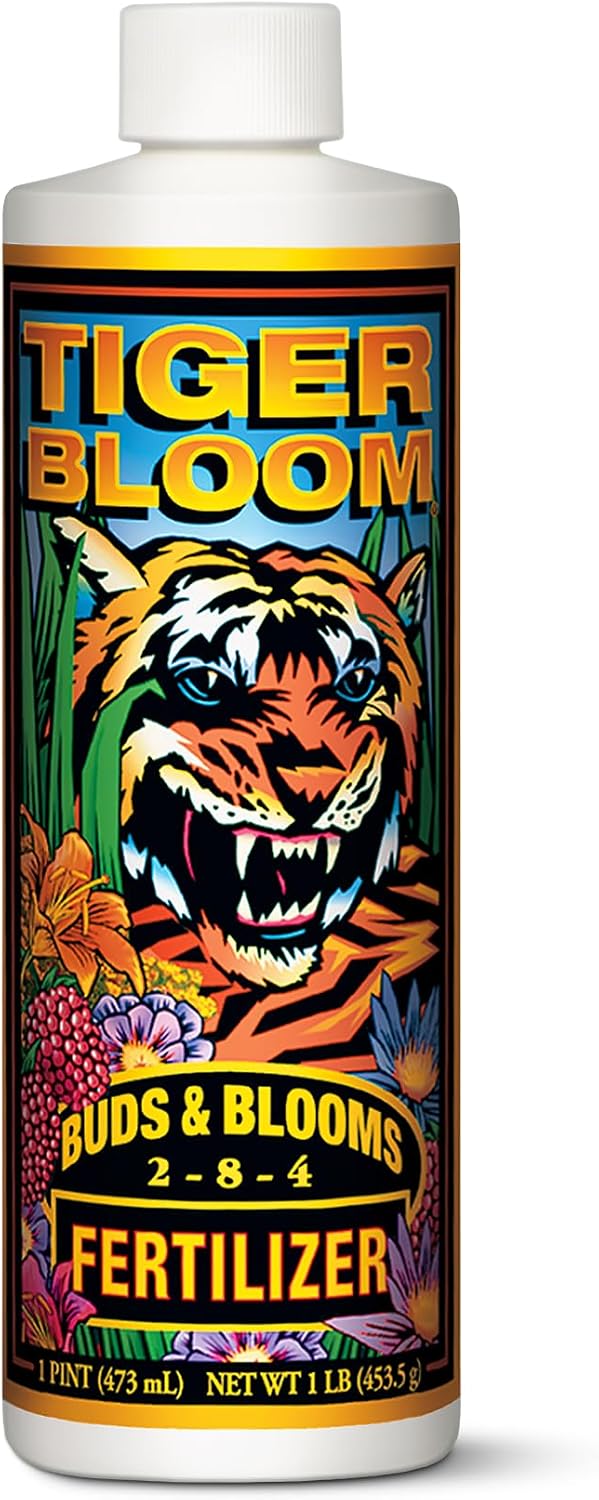
FoxFarm Tiger Bloom Liquid Plant Food (16 fl oz)
| Item Form | Liquid |
|---|---|
| Specific Uses For Product | Hydroponic |
| Application Method | Watering; Foliar spraying |
| Target Species | Flowering Plants |
| Mixing Ratio | 1:200 or 1:300 (1 part to 200 or 300 parts water) |
FoxFarm Tiger Bloom is a concentrated liquid fertilizer aimed at the flowering stage, with a 2-8-4 N-P-K ratio designed to push bud and bloom development. You use it diluted in water — the label recommends roughly 2 to 3 teaspoons per gallon for regular feedings and up to 4 teaspoons per gallon for heavier feeding — and it can be applied through regular watering or as a foliar spray. Its formulation is compatible with both soil and hydroponic setups and is intended for quick nutrient uptake and steady micronutrient availability thanks to a low pH. The practical benefits are clear: stronger blooms and fruiting when applied during the first signs of flowering and through harvest, and flexibility to feed by irrigation or spray. Important limitations are that it is phosphorus-rich, so runoff and local restrictions may apply in some regions, and small 16-ounce bottles mean you will need to repurchase more frequently for larger gardens or commercial use.
Best for: Gardeners who prioritize reliable, bloom-focused feeding and want a proven liquid formula to support flowering plants in either soil or hydroponic setups.
Less Ideal for: People managing large landscapes or municipal turf where phosphorus restrictions apply, or those seeking an all-in-one daily feed for non-flowering plants.
- Bloom-focused 2-8-4 N-P-K formula that supports buds, flowers, and fruit development
- Suitable for both soil and hydroponic systems for flexible use
- Quick nutrient absorption and low pH help maintain micronutrient availability
- Can be applied by watering or foliar spraying for targeted feeding
- Contains phosphorus which may be restricted in some areas and can contribute to runoff issues
- Small 16 fl oz size may require frequent repurchasing for larger gardens
Verdict: Choose Tiger Bloom when you need a dependable, bloom-focused liquid fertilizer that reliably promotes stronger flowers and fruit in both soil and hydroponic gardens.
Miracle-Gro Water Soluble Bloom Booster Flower Food, 4 lb

| Item Form | Powder |
|---|---|
| Application Method | Water Soluble |
| Target Species | flowers |
| Mixing Ratio | 1 tablespoon per gallon |
Miracle-Gro Water Soluble Bloom Booster is a powder fertilizer designed to be mixed with water and applied every 7 to 14 days to flowering annuals, perennials and container plants. It contains a high phosphorus analysis (10-52-10) intended to stimulate bud set and more abundant blooms, and it dissolves for use with a watering can or the Miracle-Gro Garden Feeder. In practice it is easy to use: stir the recommended tablespoon-per-gallon ratio into water for outdoor plants and soak the soil at the plant base. The instant solubility delivers visible results faster than slow‑release granular products, which is helpful if you want quicker color and bloom response. Important limitations are that it is a targeted bloom booster rather than an all‑purpose nutrient program and it requires regular repeat applications during the growing season. Also, because it is concentrated in phosphorus, it should be used as directed to avoid overfeeding and to keep fertilization balanced with regular all‑purpose feeds when needed.
Best for: Buyers who prioritize proven, widely used products and want a fertilizer that delivers faster visible bloom improvements for containers and garden flowers.
Less Ideal for: Gardeners seeking a low-maintenance, long‑term feeding plan or those who prefer a single all‑purpose granular fertilizer that does not require regular mixing.
- High phosphorus formula (10-52-10) aimed at increasing bloom number and color
- Water‑soluble powder mixes quickly for use with a watering can or garden feeder
- Works quickly so you can see bloom response faster than many slow‑release fertilizers
- Clear mixing directions support accurate dosing for outdoor and indoor use
- Requires frequent reapplication every 7 to 14 days compared with slow‑release options
- Focused on flowering boost rather than providing balanced long‑term nutrition
Verdict: Use this water‑soluble, high‑phosphorus formula when you want a trusted, fast‑acting fertilizer to boost blooms and color in flowering plants.
TPS Nutrients Orchid Fertilizer Bloom Boost Liquid Plant Food, 8 fl oz

| Item Form | Liquid |
|---|---|
| Application Method | foliar spray |
| Coverage | Medium |
| Target Species | orchids |
| Unit Count | 8 Fluid Ounces |
TPS Nutrients Orchid Fertilizer is a ready-to-mix liquid plant food formulated specifically for orchids and intended for foliar application. In practice you dilute according to the label and spray leaves and crowns to deliver nutrients directly where orchids absorb them quickly. The formula highlights kelp and an NPK geared toward supporting bloom spikes and root vigor, so you can expect improved flower production and overall plant tone when used regularly during the growing season. The 8 fluid ounce bottle is compact and easy to handle for indoor growers and the foliar method helps correct deficiencies faster than slow-release granules. Limitations to note are that this product is a targeted orchid feed rather than an all-purpose fertilizer and small bottles mean more frequent repurchasing for larger collections. Users should follow the mixing ratio and avoid overapplication to prevent leaf burn.
Best for: Buyers who want a straightforward, low-risk orchid feed that supports flowering and root health and prefer foliar applications for faster results.
Less Ideal for: Gardeners looking for a single fertilizer to cover large outdoor beds or many different plant types should choose a broader-purpose product or larger-volume feed.
- Formulated for orchids to support bloom spike production and healthier roots.
- Liquid, foliar-spray format delivers nutrients quickly to leaves and crowns.
- Kelp-enriched formula adds natural growth stimulants alongside nutrients.
- Compact 8 fl oz bottle is easy to store and handle for indoor use.
- Small unit size requires more frequent replacement for gardeners with many plants.
- Designed specifically for orchids so may not match nutrient needs of all flowering houseplants.
Verdict: A simple, kelp-enriched liquid feed that reliably promotes orchid blooms and root health for indoor growers who favor foliar applications.
Choosing the Right Fertilizer for Blooming Plants: Key Factors to Consider
Nutrient Ratio and Secondary Elements
Flowering plants respond to more than just the N-P-K numbers on a bag. A bloom-focused fertilizer typically leans toward higher phosphorus relative to nitrogen during bud set, but available micronutrients and calcium or magnesium can influence flower quality and longevity.
Check the guaranteed analysis and note secondary and micronutrient listings. Iron and magnesium help keep foliage healthy so leaves do not yellow and reduce the plant's ability to support blooms. Calcium can strengthen cell walls for better stem support. Choosing a formula with transparent secondary nutrients reduces the risk of hidden deficiencies that blunt flowering.
Form and Application Method
Fertilizers come as water-soluble powders, granular mixes, slow-release prills, or liquid concentrates. Each behaves differently in soil and containers and suits different gardener routines.
Water-soluble feeds deliver nutrients quickly and are useful for triggering a flush of blooms, but they require more frequent applications and careful measuring. Slow-release granules provide a low-maintenance steady supply and reduce the chance of overfeeding, which is helpful for planted beds or mixed borders. Liquid concentrates or foliar feeds give rapid uptake for quick color gains but need appropriate dilution and timing to avoid leaf burn.
Soil Type and Drainage
The same fertilizer will act differently in heavy clay, sandy soils, and potting mixes. Well-draining soils reduce residue buildup and salt accumulation from repeated feedings, while compact or poorly draining soils increase the risk that fertilizer salts will concentrate around roots.
If you garden in containers, choose formulations and application frequencies that account for limited substrate volume and faster nutrient loss. In-ground beds with rich organic matter often need less frequent feeding because organic breakdown releases nutrients over time.
Timing and Feeding Schedule
Flowers develop on a schedule that responds to seasonal cues and plant maturity. The timing of fertilizer applications affects whether plants set buds, maintain blooms, or produce excessive foliage at the expense of flowers.
Follow recommended schedules for pre-bloom boosts, mid-season maintenance, and tapering approaches late in the season. Overfeeding during bud-set can encourage leaf growth instead of flowers, while too little at key times results in fewer or smaller blooms. Clear feeding intervals help plan garden chores and prevent mistakes.
Salt Index and Residual Effects
Some concentrated or fast-release fertilizers carry a higher salt index, which can build up in soil or potting mix and stress roots. Salt buildup is especially problematic in containers and can cause leaf scorch, reduced water uptake, and fewer blooms.
Consider product labels for salt warnings and choose lower-salt or slow-release options for sensitive plants. Periodic flushing of containers and adding organic matter in beds reduces residual salt risks and protects flower production.
Compatibility With Plant Type
Different flowering plants have different nutrient preferences and tolerances. Annual bedding plants, bulbs, and spring-flowering perennials often benefit from a different feeding rhythm and ratio than woody shrubs or tropical bloomers.
Match fertilizer form and strength to the plant group. For example, heavy-feeding annuals tolerate frequent soluble feeds, while shrubs may do better with slower release products that avoid repeated disturbance. Knowing your plants' habits prevents mismatched feedings that can suppress blooms.
When to Boost for Bud Set Versus Maintenance
Timing a stronger feeding for bud formation yields a noticeable difference in flower counts. A moderate, bloom-oriented feed given a few weeks before expected bud set supplies phosphorus and supportive elements when plants are developing flower primordia.
Once plants are in full bloom, switch to lighter maintenance feeds to sustain color without forcing excessive vegetative growth. For long-season bloomers, alternate between lighter and moderate feeds rather than continuous high-strength applications to avoid stress.
- Give a slightly higher-phosphorus feed 2-4 weeks before the main bloom period
- Use lighter, balanced feeds during heavy flowering to maintain vigor
- Reduce feeding as growth slows or when plants enter dormancy
Feeding Strategies for Containers Versus In-Ground Beds
Containers have limited substrate and dry out faster, so they require more frequent but lower-strength feedings. Water-soluble fertilizers or weak weekly liquid feeds work well for seasonal container displays.
In-ground beds with good organic matter can rely more on slow-release products or amended compost for steady nutrition. Applying granular slow-release products once in spring often covers the season in these situations.
- Containers: low-strength, frequent applications and periodic leaching to prevent salt buildup
- Beds: consider one spring application of slow-release plus midseason side-dressing
- Adjust timing after heavy rain or irrigation events
Using Foliar Feeding to Rescue Fading Blooms
Foliar feeding delivers nutrients directly to leaves and can give a quick lift to struggling bloomers when root uptake is limited by cold, compacted soil, or root damage. Use diluted solutions and apply in the cool part of the day to improve uptake and avoid leaf burn.
Foliar feeds are best as a supplemental tactic rather than the main feeding program. They help with acute deficiencies and can revive color quickly, but they do not replace good root-zone nutrition for sustained flowering.
- Apply foliar feeds early morning or late afternoon
- Use formulations labeled for foliar use or very dilute soluble fertilizers
- Avoid foliar feeding in hot, sunny conditions to prevent scorch
Organic Options and How They Support Blooming
Organic fertilizers supply nutrients more slowly as microbes break them down, which reduces the risk of sudden nutrient spikes and salt damage. Materials like bone meal, composted manures, and fish-based feeds can enhance soil biology and support steady bloom production over time.
Because organic options release nutrients over weeks to months, they are often paired with a short-term soluble feed at critical bloom stages to combine steady background nutrition with quick-acting support.
- Use organic amendments for long-term soil health and steady blooms
- Pair with light soluble feeds at bud-set for immediate nutrient needs
- Monitor soil moisture and microbial activity for best performance
Common Mistakes That Reduce Flowering
Overfertilizing with high-nitrogen products is a frequent error that promotes lush foliage at the expense of flower production. Excess salts from repeated strong feeds cause root stress and blossom drop.
Applying fertilizer at the wrong time, such as heavy feeding late in the season, can push plants into vegetative growth and reduce the next bloom cycle. Careful attention to nutrient balance and timing prevents these setbacks.
- Avoid using turf or general high-nitrogen formulations on bloom-focused plantings
- Do not apply concentrated feeds in hot weather to prevent burn
- Follow label rates closely and err on the side of weaker mixes for containers
How We Chose the Best Fertilizer for Blooming Plants
We selected products that demonstrably support abundant flowering by focusing on concrete, gardener-relevant specifications. Primary filters included guaranteed analysis and nutrient ratios that favor bloom development, followed by delivery method and ease of use for common garden situations. We prioritized formulas with clear N-P-K and secondary nutrient information so you can match feedings to plant needs. Application flexibility was a second filter: granular, water-soluble, and slow-release formats were considered so different gardeners and plant types are accommodated. We also checked for user-oriented labels about timing and frequency because correct scheduling is essential for continuous blooms. Material safety and environmental guidance were considered to avoid choices that require aggressive handling or impractical precautions for home gardeners. We excluded products without transparent nutrient labels or those designed only for turf or non-flowering crops. In short, selections had to combine bloom-biased nutrient ratios, practical application methods, clear labeling, and reasonable environmental guidance.
FAQ
How often should I feed flowering annuals?
Often weekly or every two weeks with a diluted soluble feed during active growth, depending on the product strength. Containers usually need more frequent, lower-strength applications than in-ground plantings.
Can I use a vegetable fertilizer on flowering ornamentals?
It depends on the nutrient ratio. Many vegetable fertilizers are balanced for fruit and vegetable production and can work if they do not push excessive nitrogen. Check the N-P-K and adjust timing to favor bloom-set when needed.
Will foliar feeding replace soil fertilization?
No. Foliar feeding can quickly correct micronutrient deficiencies or provide an immediate lift, but it does not supply a sustained root-zone reserve. Use foliar sprays as a supplement to proper soil feeding.
How can I tell if my soil has too much fertilizer salt?
Symptoms include leaf scorch, wilting despite adequate moisture, and poor root growth. In containers, white crust on the soil surface or pot rim also indicates salt buildup. Leaching containers and reducing feed strength usually helps.
Are slow-release fertilizers better for perennials and shrubs?
Slow-release products provide steady nutrition with less frequent applications, which suits perennials and shrubs that do not tolerate frequent disturbance. They reduce the risk of overfeeding but may be best paired with targeted feeds at key bloom times.
Final Verdict
Prioritize a fertilizer that matches your plants and growing situation. Choose a bloom-focused nutrient ratio with transparent secondary nutrients, and pick a form that fits how often you can realistically feed. Balance quick-acting soluble options for short-term boosts with slow-release or organic background nutrition for steady, long-lasting blooms. Recognize the tradeoffs between speed of uptake and salt risk, and adjust timing to support bud set and maintenance rather than forcing foliage growth. With the right approach to ratio, form, and schedule, you can reliably increase flower counts and extend bloom periods across containers and beds.
