

Note: This article contains affiliate links. If you click on these links and make a purchase, I may earn a small commission at no extra cost to you. This helps support my research and content. Read my full affiliate disclosure here.
Getting fertilizer right in the first seasons after planting sets the stage for years of productive fruiting. New fruit trees have different needs than established specimens: they need gentle nutrition that supports root development, encourages steady shoot growth, and avoids salts or high nitrogen spikes that can stress young roots. This guide covers seven shortlisted fertilizers suited for new fruit trees, chosen for their nutrient profiles, ease of application, and suitability for common planting scenarios. Below we explain what to consider, how the products were evaluated, and practical tips for applying fertilizer in the early life of a fruit tree so you can pick an option that matches your soil and planting goals.
Top Picks at a Glance
| Best Overall The best all-around choice for most situations | Espoma Citrus-Tone Organic Fertilizer (4 lb) |  |
| Best Quality Built to a higher standard if you want something more solid | Down To Earth Organic Fruit Tree Fertilizer, 6-2-4, 25 lb |  |
| Best Value The sweet spot between price and what you get | Farmer's Secret Fruit Tree Booster Liquid Fertilizer (8 fl oz) |  |
| Best Budget The cheapest option that still gets the job done reliably | Jobe's Organics Granular Fruit & Citrus Fertilizer, 4 lb |  |
| Highest Rated A top-rated pick with lots of positive feedback | Espoma Organic Bio-Tone Starter Plus 4-3-3 Organic Starter Plant Food, 8 lb |  |
| Most Popular A crowd favorite that many people choose with confidence | Miracle-Gro Fruit & Citrus Plant Food Spikes (12 count) |  |
| Best Seller A high-volume bestseller chosen again and again | TPS NUTRIENTS Lemon Tree Liquid Fertilizer, 8 oz |  |
Espoma Citrus-Tone Organic Fertilizer (4 lb)

| Item Form | Granules |
|---|---|
| Specific Uses For Product | Agriculture,Gardening,Plant Growth |
| Application Method | Spread evenly over the entire tree or plant area |
| Target Species | Citrus, Fruit Trees, Nut Trees, Avocado |
| Mixing Ratio | No Mixing Required |
Espoma Citrus-Tone is an organic granular fertilizer designed specifically for citrus and other fruit and nut trees. It is applied by spreading around the tree drip line and watering in, with a recommended application of 4 pounds per use; no mixing is required. The 5-2-6 NPK analysis with added calcium and Espoma’s Bio-tone formula supplies steady, balanced nutrition that supports leafy growth, flower set and fruit development while meeting organic production standards. Typical use is seasonal: late winter pre-bloom, spring post-bloom and fall, which makes it easy to fit into a new tree care schedule. Because it is granular and ready to use, it is simple to measure and apply for homeowners establishing young fruit trees. Limitations are its single bag size and moderate nutrient concentration, so very large or nutrient-depleted sites may need multiple applications or a complementary soil amendment plan; results are gradual rather than instant since it is organic feed rather than a quick-release synthetic formula.
Best for: Home gardeners planting or caring for new fruit or citrus trees who want a straightforward organic fertilizer program and prefer seasonal, low-maintenance feeding.
Less Ideal for: Gardeners needing a high-analysis or fast-acting synthetic fertilizer for rapid correction of severe nutrient deficiencies or for very large established orchards.
- Formulated specifically for citrus and similar fruit and nut trees
- Organic formula approved for organic gardening
- Ready-to-use granular form requires no mixing and is easy to apply
- Includes calcium and Bio-tone formula to support bloom and fruit set
- Modest nutrient concentration may require repeated applications for larger trees or poor soils
Verdict: A simple, organic granular fertilizer tailored to citrus and fruit trees that delivers balanced seasonal nutrition for new and young trees.
Down To Earth Organic Fruit Tree Fertilizer, 6-2-4, 25 lb

| Item Form | Powder |
|---|---|
| Specific Uses For Product | Plant Growth |
| Target Species | Trees |
| Mixing Ratio | 6-2-4 (N-P-K) |
This is a purpose-built organic fertilizer for backyard and young orchard trees that supplies steady, soil-focused nutrition rather than a quick soluble feed. The powder blend (6-2-4 N-P-K) combines feather meal, fish bone meal, kelp, alfalfa and mineral ingredients including calcium carbonate and langbeinite so it feeds soil life and supports flower and fruit set. It is applied by broadcasting or hand-applying around the root zone and worked in lightly or covered with mulch, then watered in; it is not water soluble so you are feeding the soil rather than relying on foliar uptake. Practical benefits include long-lasting nutrient release, added calcium to reduce blossom-end problems, and OMRI listing for organic use. Important limitations are that results take time compared with soluble synthetics and that handling requires care because it is dusty and intended for soil application only. For new fruit trees this product helps establish a nutrient-rich root zone but you should follow label rates and plan for repeat seasonal applications rather than one-time quick fixes.
Best for: Gardeners building productive backyard orchards who want an organic, performance-oriented fertilizer that establishes long-term soil fertility for new fruit trees.
Less Ideal for: People who need immediate, soluble nutrient responses for quick greening or who prefer liquid or foliar feeds for fast corrective treatments.
- OMRI-listed organic formula that supports certified organic practices
- 6-2-4 N-P-K blend with added calcium to promote fruit development
- Slow-release, soil-applied ingredients that feed microorganisms for sustained nutrition
- Large 25 lb bag suitable for treating multiple young trees or a small orchard
- Dry powder is dusty and requires protective gear during handling
- Not water soluble, so it takes longer to affect visible growth compared with soluble fertilizers
Verdict: Choose this OMRI-listed 6-2-4 powder if you want an organic, soil-feeding fertilizer that builds lasting fertility and supports fruit development in new trees.
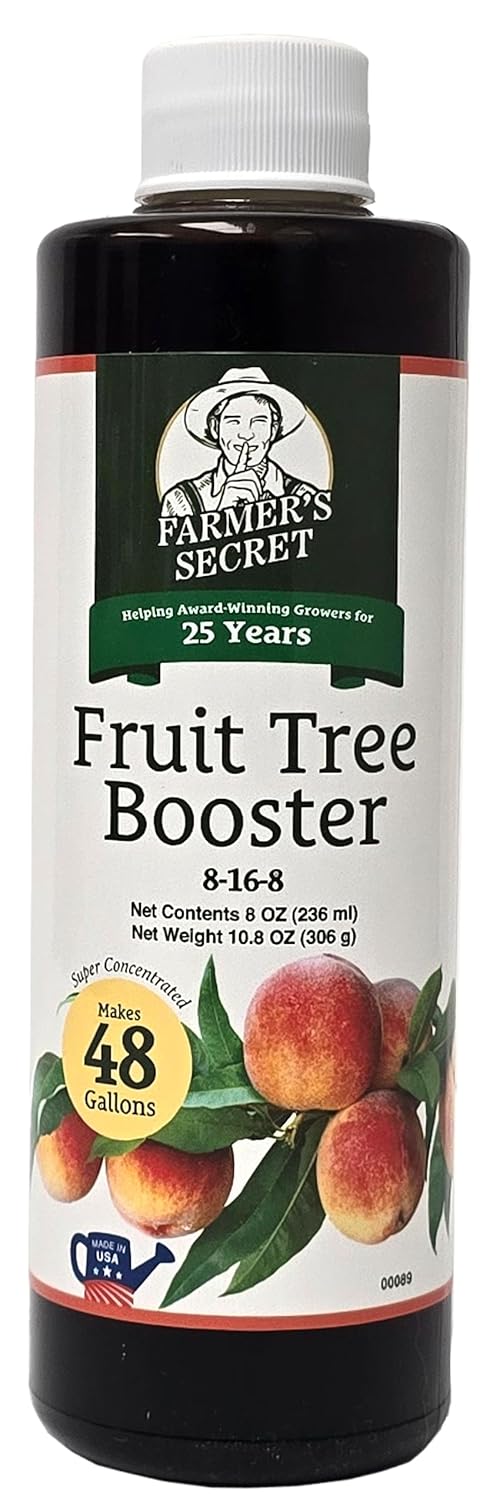
Farmer's Secret Fruit Tree Booster Liquid Fertilizer (8 fl oz)
| Item Form | Liquid |
|---|---|
| Specific Uses For Product | Plant Growth, Fruit Production |
| Coverage | Full |
| Target Species | Apple, Banana, Peach |
| Mixing Ratio | 1 teaspoon per gallon |
Farmer's Secret Fruit Tree Booster is a concentrated liquid fertilizer designed for early-season feeding of fruit trees. You dilute one teaspoon per gallon and apply weekly at the drip line or as a foliar spray; the bottle is meant to deliver multiple feedings despite its small size because the formula is highly concentrated. The blend emphasizes phosphorus and includes NPK plus trace minerals like zinc and iron to support root expansion, bloom set, and disease resilience. In practice it is easy to use with a watering can, sprayer, or hooked to irrigation, and the quick-acting liquid form makes nutrients available to young trees faster than most granulars. Important limitations are the small 8 ounce bottle which may require multiple bottles for several new trees or a season of heavy feedings, and the directions require careful dilution to avoid overfeeding. Safety notes advise keeping concentrate away from skin and eyes and out of reach of children and pets.
Best for: Gardeners planting or tending new fruit trees who want a ready-to-use, concentrated feed that promotes root development and early fruiting while optimizing product usage.
Less Ideal for: Large-scale plantings or owners who prefer low-frequency granular fertilization or want a single-application slow-release product.
- Super-concentrated formula lets a little product cover multiple feedings
- Phosphorus-rich blend and added micronutrients support root growth and fruit production
- Liquid form provides fast nutrient availability and works for soil or foliar application
- Easy to mix and apply with a watering can, sprayer, or irrigation system
- 8 ounce bottle may not be sufficient for multiple new trees or for an entire season without repurchasing
- Requires precise dilution and weekly application to avoid over- or under-feeding
Verdict: A concentrated, phosphorus-forward liquid feed that accelerates root and fruit development in new fruit trees while minimizing product waste.
Jobe's Organics Granular Fruit & Citrus Fertilizer, 4 lb

| NPK | 3-5-5 |
|---|---|
| Form | Granules |
| OMRI Listed | Yes |
| Unit Count | 64 Ounce |
Jobe's Organics Granular Fruit & Citrus Fertilizer is a slow-release, granular feed designed to support fruit and citrus trees and shrubs. It is meant to be spread evenly around the base of young or established trees and watered in, with reapplication recommended every 4 to 8 weeks during the growing season. The 3-5-5 NPK blend emphasizes phosphorus and potassium to encourage root development, flowering, and fruit set while supplying nitrogen for foliage. Ingredients such as feather meal, bone meal, and processed poultry manure provide organic nutrient sources and the product is OMRI listed for organic gardening. Practical benefits include ease of measurement, lower runoff risk compared with liquids, and suitability for use around children and pets when applied per directions. Limitations are that granular, organic sources release nutrients more slowly than soluble synthetic options so results may take longer to appear, and precise nutrient delivery depends on regular application and correct dosing for tree size.
Best for: Buyers looking for an inexpensive, organic granular fertilizer to establish and feed new fruit trees who prioritize safety and long-term soil health over immediate greening.
Less Ideal for: Gardeners who need rapid correction of nutrient deficiencies or who prefer single-application, high-solubility feeds for instant results.
- OMRI listed and made from organic inputs suitable for certified organic gardens
- Balanced 3-5-5 formula targets root development and fruiting
- Slow-release granules reduce risk of burn and runoff compared with soluble feeds
- Easy to apply and measure with simple spread-and-water instructions
- Slower visible results compared with fast-release synthetic fertilizers
- Requires regular reapplication every 4–8 weeks during the growing season
Verdict: An affordable organic granular fertilizer that steadily feeds new fruit trees while supporting root development and fruiting.
Espoma Organic Bio-Tone Starter Plus 4-3-3 Organic Starter Plant Food, 8 lb

| Item Form | Granules |
|---|---|
| Application Method | Mix with soil |
| Coverage | Medium |
| Specific Uses For Product | Gardening |
| Target Species | For everything you plant |
Espoma Bio-Tone Starter Plus is a granular, organic starter fertilizer designed to be mixed into planting soil to encourage rapid root development and improved transplant success. You use it at planting time by incorporating the granules into the backfill or planting mix so the nutrients and mycorrhizae are immediately available to the root zone. Notable features include a 4-3-3 NPK analysis, added beneficial bacteria, humates, and both endo and ecto mycorrhizae to support root colonization and soil structure. In practice it helps new plantings, including young fruit trees, establish deeper roots and better withstand transplant stress without synthetic salts. The product is approved for organic gardening and comes in an 8 pound bag that covers medium planting areas. Limitations are that it is a starter formula rather than an ongoing feed so you will need a regular maintenance fertilizer plan later and quantities must be measured into the planting hole for best results.
Best for: Home gardeners and small-scale orchardists who prioritize reliable, organic support for new plantings and want a product that promotes strong root establishment at planting time.
Less Ideal for: Growers who need an ongoing complete feeding program or who prefer a high-analysis synthetic fertilizer for fast foliar growth should consider a complementary maintenance product.
- Contains both endo and ecto mycorrhizae to promote root colonization
- Organic formula with beneficial bacteria and humates that improve soil structure
- Designed for use at planting so it supports rapid establishment and reduces transplant shock
- Approved for organic gardening which fits certified or organic orchards
- Formulated as a starter feed so it is not intended to replace routine maintenance fertilization
Verdict: Use this organic, mycorrhizae-enhanced starter fertilizer at planting to help new fruit trees establish deeper roots and minimize transplant stress.
Miracle-Gro Fruit & Citrus Plant Food Spikes (12 count)

| Item Form | Sticks |
|---|---|
| Specific Uses For Product | Fruit & Citrus Tree Care |
| Application Method | Insert spikes into the ground |
| Mixing Ratio | 10:15:15 |
| Number of Items | 12 |
These Miracle-Gro spikes are a no-fuss way to feed newly planted and established fruit or citrus trees. Each rigid spike contains a 10-15-15 NPK mix that you push into softened soil around a tree's dripline; nutrients are released directly into the root zone so you do not need to measure or mix liquid fertilizer. Typical use is simple: water the root zone to soften the soil, space spikes around the dripline per the label chart, and drive them below the surface once in early spring and again in mid-fall. Benefits include targeted feeding that helps encourage foliage and fruit set and the convenience of twice-yearly application. Limitations are that spikes are seasonal rather than continuous delivery during the growing season and they are formulated specifically for fruit, citrus and palms so they are not a one-stop fertilizer for every plant type. Very compact root systems or rocky, compacted soils may make inserting spikes difficult and you should follow label directions to avoid overapplication on young transplants.
Best for: Home gardeners planting or maintaining fruit and citrus trees who want an easy, low-maintenance fertilizing routine that focuses on improving fruit yield and foliage without regular mixing or measuring.
Less Ideal for: Gardeners who need continuous or fast-acting feeding during the growing season, or those managing a diverse planting of non-fruit-species that require different nutrient ratios.
- Simple, no-mixing application that feeds directly at the root zone
- 10-15-15 NPK formulation targeted for fruit and citrus production
- Twice-yearly schedule reduces maintenance compared with monthly feeding
- Includes 12 spikes suitable for feeding multiple small trees or repeat applications
- Provides discrete seasonal dosing rather than continuous feeding through the growing season
- Inserting spikes can be difficult in very compacted or rocky soils
Verdict: Use these spikes when you want an easy twice-yearly, root-targeted fertilizer to boost fruit production and foliage on citrus and other fruit trees.
TPS NUTRIENTS Lemon Tree Liquid Fertilizer, 8 oz

| Item Form | Liquid |
|---|---|
| Application Method | Watering can, hose end sprayer, or leaf misting |
| Target Species | Lemon Trees |
| Mixing Ratio | 1:200 |
| Liquid Volume | 8 fluid ounces |
This liquid fertilizer is formulated specifically for lemon and citrus trees and is meant to be diluted at 1:200 for regular applications. You can apply it with a watering can, hose-end sprayer, or as a foliar mist, which makes it easy to use on in-ground and container trees. The formula targets fruit production, leaf health, and root development so new fruit trees get nutrients that encourage shoot growth and stronger roots during establishment. Because it is a concentrated liquid in a small 8 oz bottle, one purchase treats a modest number of trees at typical dilution rates, and you will need to measure carefully to avoid over-application. The product’s practical strengths are its citrus-specific formulation and flexible application methods, while its small volume and need for accurate mixing are the main limitations to plan for when using it on multiple new trees.
Best for: Buyers who want a ready-to-use citrus-specific fertilizer that is simple to apply and focused on establishing healthy fruit trees. This suits gardeners who prefer straightforward, targeted care for new lemon trees rather than general-purpose fertilizers.
Less Ideal for: Large-scale plantings or growers who need bulk fertilizer or a detailed nutrient profile for customized feeding programs should consider other options.
- Formulated specifically for lemon and citrus to support fruit set and foliage health.
- Multiple application methods: watering can, hose-end sprayer, or foliar misting for versatility.
- Concentrated liquid with clear mixing ratio (1:200) for controlled dosing.
- Suitable for both in-ground and container lemon trees.
- Small 8 oz volume may require frequent repurchasing or multiple bottles for several trees.
- No N-P-K breakdown or detailed nutrient analysis provided to guide precise feeding schedules.
Verdict: A small, citrus-focused liquid fertilizer that makes targeted feeding of new lemon trees easy and adaptable to several application methods.
Choosing the Right Fertilizer for New Fruit Trees: Key Factors to Consider
Nutrient Ratio and Timing
The ratio of nitrogen, phosphorus, and potassium shapes early tree behavior. Young trees need phosphorus and potassium to support root growth and stress tolerance while moderate nitrogen encourages steady shoot development without overly vigorous top growth that strains roots. Understand the N-P-K on the label and how that aligns with the planting stage.
Timing matters as much as ratio. Apply starter nutrition at planting if recommended, then follow a schedule that avoids heavy nitrogen applications late in the season. Split, light applications through the first two growing seasons are usually safer than a single heavy feed.
Formulation Type
Fertilizers come as granules, slow-release pellets, liquid concentrates, or water-soluble powders. Granular and slow-release forms are low-maintenance and reduce burn risk when properly placed, making them useful for backyard plantings. Liquids and water-soluble products allow quicker correction of deficiencies and easier foliar or root drench applications but require more frequent dosing.
Consider available equipment and how precise you need to be. If you want minimal repeat applications, a quality slow-release formulation may suit you. If you need to correct a deficiency or work in containers, a soluble or liquid product gives faster results.
Salt Index and Burn Risk
New roots are sensitive to soluble salts and concentrated feeds. High salt fertilizers or improper placement can dehydrate fine roots and worsen transplant shock. Look for products with a low salt index or those marketed as safe for transplants, and follow label dilution instructions closely.
Placement also affects risk. Avoid piling granular fertilizer against the trunk or into the planting hole where concentrated salts meet tender roots. Instead, apply according to recommended banding or surface placement practices to reduce burn potential.
Root Growth and Microbial Support
Products that support root architecture and soil biology help trees establish faster. Some fertilizers include phosphorus forms or organic amendments that encourage root branching. Others may contain beneficial microbes, mycorrhizal inoculants, or humic substances that improve nutrient uptake.
While not always essential, these additives can be especially helpful in poor or disturbed soils where natural microbial communities were reduced during planting. Evaluate whether your planting site would benefit from a formulation that emphasizes root and microbial support.
Application Practicalities and Dosing Clarity
Clear instructions and flexible dosing are valuable for home gardeners. Products that provide precise, tree-size-based rates, clear timing guidance, and simple mixing directions reduce application errors. Ease of measuring and applying affects real-world outcomes because under- or over-application is common with vague directions.
Also consider how the fertilizer integrates with other routine tasks like mulching and watering. If you rely on drip irrigation, check compatibility for fertigation. If you prefer top-dressing, choose a product designed for surface application.
Preparing Soil Before the First Feed
A soil test is the most useful first step before applying any fertilizer. Knowing pH, available phosphorus, potassium, and organic matter levels helps you choose a formulation that fills specific gaps rather than adding unnecessary nutrients.
Amending planting holes with large amounts of rich compost or high-phosphorus mixes can create a nutrient pocket that encourages root circling. Instead, mix modest organic matter into backfill and reserve most amendments for top-dressing once the roots begin to spread into native soil.
- Collect a soil sample from the tree planting area to at least 6 inches deep.
- Correct pH issues before planting when possible; many fruit trees prefer slightly acidic to neutral soil.
- Avoid concentrated fertilizer in the planting hole; place starter nutrients around, not against, the root ball.
How to Apply Fertilizer to New Trees
For most new trees, light banding around the root zone and regular shallow applications are effective. Apply granular or slow-release material in a ring outside the root ball where new feeder roots will grow rather than next to the trunk.
Liquid feeds can be applied as root drenches immediately after planting or during the first season for a gentle nutrient boost. Follow label rates and reduce concentration for young specimens to avoid shock. When using slow-release pellets, keep them evenly distributed and at the recommended distance from the trunk.
- Measure the root zone radius and apply fertilizer in a wider ring as the root system expands.
- Water thoroughly after application to move nutrients into the root zone and reduce surface salt concentration.
- Reapply in shorter intervals with lower doses rather than a heavy one-time application.
Adjusting Feed by Soil Type and Climate
Sandy soils leach nutrients faster and may need more frequent, smaller doses or slow-release formulations that provide steady supply. Clay soils hold nutrients but can tie up phosphorus; starter applications should focus on root stimulation and not rely solely on high phosphorus bursts.
In cool climates, root growth can be slow for the first season, so reduce nitrogen to avoid pushing late-season growth that will not harden off. In warmer climates with fast root growth, a slightly more generous early feed can support rapid establishment, but still avoid salt-heavy formulations.
- Use slow-release or organic options in sandy soil to prevent nutrient loss.
- In clay soils, prioritize aeration and microbial activity in addition to modest fertilization.
- Match application timing to local frost-free and growth windows to prevent late flushes.
Organic Versus Synthetic Choices
Organic fertilizers release nutrients more slowly and tend to improve soil structure over time. They can be kinder to new roots and to soil life, but their nutrient concentrations are often lower and less predictable than synthetic options.
Synthetic fertilizers deliver predictable, measurable nutrients and can correct deficiencies quickly. For new trees, choose lower-strength synthetic applications or use them as supplements to organic soil-building practices to balance immediacy with long-term soil health.
- Pairing small amounts of synthetic fertilizer with organic matter can give both quick uptake and long-term benefit.
- Consider the availability of compost, manure, or well-formulated organic starters if long-term soil improvement is a priority.
- Always follow label instructions for dilution and timing, especially with synthetic products.
Common Application Mistakes to Avoid
Avoid concentrating fertilizer in the planting hole or against the trunk. This creates hot spots that can burn fine roots and cause poor establishment. Also avoid over-fertilizing in the first season, which can produce leggy growth and weak root systems.
Do not ignore watering after application. Dry surface-applied fertilizer increases burn risk and reduces effectiveness. Regular, moderate watering helps move nutrients into the active root zone and supports microbial activity that makes nutrients available.
- Never apply more than the recommended rate for young trees.
- Do not incorporate fresh high-nitrogen amendments heavily at planting time.
- Avoid late-season high-nitrogen feeds that delay dormancy.
How We Chose the Best Fertilizer for New Fruit Trees
We focused on products and formulations that help newly planted fruit trees establish a strong root system while promoting balanced aboveground growth. Editorial filters favored nutrient ratios that avoid excessive early-season nitrogen, formulation forms compatible with common backyard soils, and options that are easy and safe for amateur gardeners to apply. We evaluated each option on measurable factors: nutrient balance and formulation type, effect on root development and transplant stress, application convenience and dosing clarity, and salt index or potential to burn young roots. Practical considerations like suitability for container starts, compatibility with common soil amendments, and season-specific timing were included. We excluded products designed only for mature or fruiting-stage trees, lawn or turf fertilizers not formulated for woody plants, and specialty agricultural blends that require commercial equipment. The resulting shortlist represents fertilizers appropriate for home gardeners establishing new fruit trees in yards, small orchards, or patio containers.
FAQ
When should I first fertilize a newly planted fruit tree?
Often a small starter feed at planting helps, but it depends on soil test results and the planting mix. If the backfill already contains balanced compost or starter amendments, wait a few weeks until you see new root activity before adding more fertilizer.
Can I use a general-purpose lawn fertilizer on a new fruit tree?
Usually not recommended because lawn fertilizers are formulated for turf and may be too high in soluble nitrogen or salts. Choose a fertilizer labeled for woody plants or fruit trees and follow reduced-rate guidance for young specimens.
How much fertilizer does a young fruit tree need?
It depends on tree size, soil fertility, and formulation. Many home-garden recommendations favor small, repeated applications based on trunk diameter or root zone area rather than large single doses. Refer to label rates and err on the side of underfeeding for the first season.
Are organic fertilizers better for new trees?
Organic options can be gentler and improve soil biology, which supports root establishment. They often release nutrients slowly, so they may need pairing with targeted feeds if a rapid correction is required. Choice depends on soil condition and gardener goals.
Should I adjust feeding if my tree is in a container?
Yes. Containers have limited soil volume and nutrients are used or leached faster, so you will need more frequent, lighter feeds and careful attention to salt buildup. Use container-appropriate formulations and flush the pot periodically to avoid salt accumulation.
Can fertilizing too early harm root development?
Yes. High-strength or improperly placed fertilizers can burn new roots and exacerbate transplant stress. Use gentle, correctly dosed applications and avoid concentrated placement near the root ball.
Final Verdict
For new fruit trees, prioritize products and practices that support root establishment over forcing rapid shoot growth. Focus on balanced nutrient ratios, low salt risk, and application methods that place nutrients where emerging feeder roots will find them. Consider soil type, climate, and whether you prefer organic soil-building approaches or the predictability of synthetic fertilizers. Choose a fertilizer that matches the planting context and follow modest, staged feeding rather than heavy early applications. That approach minimizes transplant stress and lays the groundwork for a healthier, more productive tree in coming seasons.
