

Note: This article contains affiliate links. If you click on these links and make a purchase, I may earn a small commission at no extra cost to you. This helps support my research and content. Read my full affiliate disclosure here.
Growing tomatoes and peppers relies heavily on consistent, balanced nutrition tailored to fruiting crops. The right organic fertilizer corrects common soil shortfalls, supports steady flowering and fruit set, and avoids the leaf-heavy growth that can reduce yields. Whether you garden in raised beds, containers, or in-ground rows, choosing a product formulated for tomatoes and peppers makes a noticeable difference in harvest reliability. This guide covers seven top organic fertilizers shortlisted for fruiting vegetables and evaluates them across practical gardener-focused criteria like nutrient profile, application ease, and suitability for containers versus beds. Read on to understand how each option behaves in real garden conditions and which product features matter most for your situation.
Top Picks at a Glance
| Best Overall The best all-around choice for most situations | Neptune's Harvest Fish & Seaweed Liquid Fertilizer (2-3-1), 36 oz |  |
| Best Quality Built to a higher standard if you want something more solid | Espoma Organic Tomato-tone 3-4-6 Organic Fertilizer with 8% Calcium, 4 lb |  |
| Best Value The sweet spot between price and what you get | Jobe's Organics Granular Tomato & Vegetable Fertilizer, 4 lb |  |
| Best Budget The cheapest option that still gets the job done reliably | Down To Earth Organic Vegetable Garden Fertilizer 4-4-4, 1 lb |  |
| Highest Rated A top-rated pick with lots of positive feedback | FoxFarm Happy Frog Tomato & Vegetable Fertilizer (5-7-3), 4 lb |  |
| Most Popular A crowd favorite that many people choose with confidence | Dr. Earth Organic Tomato, Vegetable & Herb Fertilizer (4 lb) |  |
| Best Seller A high-volume bestseller chosen again and again | Burpee Organic Tomato & Vegetable Granular Plant Food, 4 lb |  |
Neptune's Harvest Fish & Seaweed Liquid Fertilizer (2-3-1), 36 oz

| Item Form | Liquid |
|---|---|
| Specific Uses For Product | Plant Growth |
| Application Method | Dilute and water |
| Mixing Ratio | 2:3 |
| Unit Count | 36 Fluid Ounces |
Neptune's Harvest Fish & Seaweed liquid fertilizer is an all-purpose organic concentrate that supplies nitrogen, phosphorous, and potassium in a 2-3-1 ratio using hydrolyzed fish and seaweed. You dilute the concentrate (manufacturer mixing guidance provided) and apply as a soil drench or foliar feed every 1 to 3 weeks, which makes it suitable for transplants and established vegetables, flowering plants, shrubs, and houseplants. Notable features include the fish-plus-seaweed blend that delivers both quick-release nutrients and trace compounds from seaweed, plus guidance for indoor and outdoor mixes. In practice it helps boost green growth, supports flowering and fruit set, and can improve soil biology over time when used regularly. Limitations are the relatively low NPK numbers for heavy-feeding situations where higher synthetic formulas are needed, and the product has an odor typical of fish-based fertilizers which some users may find strong when mixing or foliar feeding indoors. Follow dilution and feeding intervals to avoid overapplication.
Best for: Gardeners who want a reliable, organic all-purpose fertilizer for tomatoes, peppers and mixed beds and who prioritize steady plant health and improved soil biology over time.
Less Ideal for: Growers seeking rapid, high-release nitrogen boosts for very large or nutrient-demanding crops or those who need an odor-free indoor feeding option.
- Organic concentrate with a fish and seaweed blend that provides balanced nutrients and trace elements
- Can be used as both soil drench and foliar feed for vegetables, flowers, trees and houseplants
- Clear dilution guidance for indoor and outdoor use makes regular feeding straightforward
- Lower NPK values compared with high-nitrogen synthetic fertilizers for very heavy feeders
- Has a noticeable fish odor during mixing and application
Verdict: A dependable organic liquid feed that steadily supports tomatoes, peppers and mixed garden plantings while improving soil biology.
Espoma Organic Tomato-tone 3-4-6 Organic Fertilizer with 8% Calcium, 4 lb
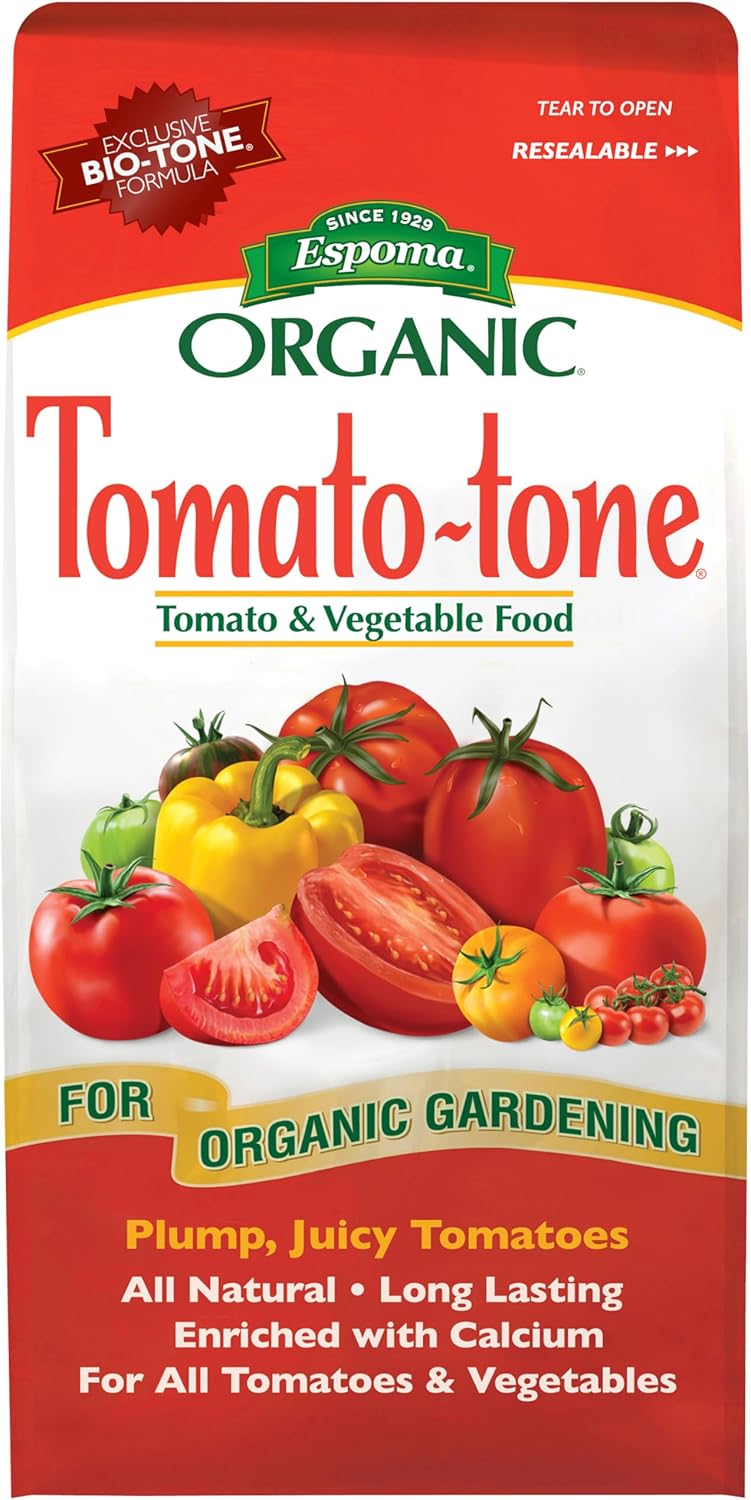
| Unit Count | 64 Ounce |
|---|---|
| Mixing Ratio | 3:4:6 |
| Item Form | Granules or Pellets |
| Target Species | tomatoes and vegetables |
Espoma Tomato-tone is a ready-to-use granular organic fertilizer designed specifically for tomatoes and other vegetables. You apply it to the soil around the plant drip line every two weeks during the growing season and water in; the 3-4-6 NPK ratio provides a steady supply of nitrogen, phosphorus, and potassium while the 8% calcium targets blossom end rot prevention. The product is made from organic ingredients and carries an organic input approval, so it fits certified organic growing systems and backyard organic gardens alike. In practice it encourages flower and fruit production without promoting excessive leafy growth, and the granular form makes application simple and measured. Limitations include the need for regular reapplication during the season and that it is not a quick-soluble chemical feed for instant greening. For growers focused on consistent fruit set and organic certification, Tomato-tone is a practical, low-maintenance choice that supports healthier, more productive tomato and pepper harvests.
Best for: Growers who prioritize reliable fruit production from tomatoes and peppers and want an organically approved fertilizer that supports consistent set and fruit quality without synthetic inputs.
Less Ideal for: Gardeners who need rapid, corrective nutrient boosts or who prefer liquid concentrates and single-application fertigation systems should consider other options.
- Formulated specifically for tomatoes and vegetables with a balanced 3-4-6 NPK
- Contains 8% calcium to help prevent blossom end rot
- Approved organic input suitable for certified organic and organic home gardens
- Granular form is easy to apply around the drip line and does not require mixing
- Requires repeat application every two weeks for continual feeding
- Not a fast-acting soluble fertilizer for instant corrective feeding
Verdict: A reliable organic granular fertilizer that delivers balanced nutrients plus calcium to support productive, blossom-end-rot-resistant tomato and pepper crops.
Jobe's Organics Granular Tomato & Vegetable Fertilizer, 4 lb

| NPK | 2-5-3 |
|---|---|
| Item Form | Granules |
| Target Species | Vegetable and tomato |
| Coverage | Medium |
| Unit Count | 64 Ounce |
Jobe's Organics Granular Tomato & Vegetable Fertilizer is an OMRI-listed, slow-release granular fertilizer designed for tomato and vegetable beds. You apply it around established plants or when planting and reapply every 4 to 6 weeks during the growing season. The 2-5-3 NPK formula emphasizes phosphorus to support flowering and fruit set while supplying modest nitrogen and potassium for foliage and overall plant health. The product is made from natural inputs such as bone meal and processed poultry manure and includes beneficial microbes to support soil biology. Practical benefits include easy measuring and application, reduced risk of quick nutrient burn compared with soluble feeds, and suitability for certified organic production. Limitations are its relatively low nitrogen content for heavy-feeding leafy crops and the slower release profile, which means results appear over weeks rather than days and occasional supplementation with a higher-nitrogen organic feed may be needed for hungrier plants.
Best for: Gardeners who prioritize organic, low-fuss feeding for fruiting vegetables and want a reliable granular fertilizer that supports blooms and yields with minimal weekly effort.
Less Ideal for: Growers who need rapid, high-nitrogen feeding for fast leafy growth or who prefer water-soluble fertilizers for immediate uptake should consider alternatives.
- OMRI listed for organic gardening and safe for use around children and pets
- Balanced 2-5-3 formula that supports flowering and fruit development in tomatoes and other vegetables
- Granular slow-release form is easy to measure and reduces risk of overfertilizing
- Contains calcium, magnesium, and beneficial microbes to support soil health
- Lower nitrogen percentage may not satisfy very leafy or heavy-feeding vegetable varieties
- Slow-release action produces gradual results rather than immediate nutrient boosts
Verdict: A convenient OMRI-listed granular fertilizer that delivers steady, flower-and-fruit-focused nutrition for organic tomato and vegetable gardens.
Down To Earth Organic Vegetable Garden Fertilizer 4-4-4, 1 lb

| Item Form | Granules |
|---|---|
| Specific Uses For Product | Organic Gardening, Transplanting, Vegetable Gardens |
| Target Species | vegetable gardens |
| Mixing Ratio | 4-4-4 |
This 1 lb Down To Earth organic vegetable fertilizer supplies a balanced 4-4-4 blend of nutrients in a slow-release granular form designed for vegetables, herbs and raised beds. You apply it by broadcasting or mixing into planting holes according to the mixing ratio, and it feeds plants gradually to support steady leafy growth, root development and fruit set without shocking seedlings. The formula is made from natural ingredients such as fish bone meal, alfalfa and seaweed meal and is OMRI-friendly for organic use, so it suits gardens where chemical inputs are avoided and pollinator safety matters. Its small 1 lb size is convenient for trying on a few tomato or pepper plants and reduces storage hassle. The main limitation is the small package size and moderate NPK numbers, which means frequent reapplication or larger quantities are needed for bigger beds or heavy feeders, and it is not a high-nitrogen boost for rapid leafy growth.
Best for: Gardeners growing a few tomato and pepper plants who want an organic, easy-to-use fertilizer that feeds steadily and fits a modest budget.
Less Ideal for: Growers with large vegetable beds or commercial production who need concentrated, high-volume fertilizer solutions.
- Balanced 4-4-4 NPK suited to vegetables, supporting both foliage and fruit development
- Made from natural ingredients like fish bone meal and seaweed, appropriate for organic gardens
- Slow-release granular form reduces risk of nutrient burn and promotes steady feeding
- Compact 1 lb package is easy to store and practical for small plots or trial use
- Small unit size requires buying multiple packages or larger sizes for bigger gardens
- Moderate nutrient levels may need supplemental feeding for heavy-feeding tomato varieties
Verdict: A small, organic slow-release 4-4-4 fertilizer that is ideal for budget-minded gardeners feeding a few tomato and pepper plants.
FoxFarm Happy Frog Tomato & Vegetable Fertilizer (5-7-3), 4 lb

| Item Form | Granules |
|---|---|
| Specific Uses For Product | Vegetables, Tomatoes, Soft Fruits, and Berries |
| Mixing Ratio | 5:7:3 |
| Unit Count | 64 Ounce |
FoxFarm Happy Frog Tomato & Vegetable Fertilizer is a granular organic blend designed to support vigorous feeders through vegetative growth and fruit set. Typical use is top-dressing or side-dressing in containers, rows, and in-ground beds following the package mixing directions; the 5-7-3 ratio supplies a higher middle number to encourage bloom and fruit development while added calcium helps reduce blossom end rot. The formula includes mycorrhizal fungi to improve root efficiency and micronutrients to support overall plant health. Practical benefits include straightforward application for home gardeners, versatility across peppers and tomatoes, and an OMRI listing for organic gardeners wanting a certified product. Limitations are that it is a dry granular product so it needs incorporation or watering in to be effective and it does not replace a targeted soil test or tailored nutrient program for specific deficiencies. For gardeners seeking reliable, organic support for fruiting veggies this fertilizer covers general feeding needs well.
Best for: Gardeners who prioritize consistent, organic feeding for tomatoes and peppers and want a simple, multi-use product that supports fruit set and root health.
Less Ideal for: Growers who need quick foliar feeding or precise, test-driven nutrient adjustments should look for liquid feeds or targeted supplements instead.
- OMRI-listed organic formula suitable for certified organic gardens
- Contains calcium to help prevent blossom end rot in fruiting vegetables
- Includes mycorrhizal fungi to support root nutrient and water uptake
- Granular form works for containers, in-ground beds, and row plantings with simple application
- Granules require watering in or mixing and are not a ready-to-use liquid feed
- Not a substitute for soil testing when addressing specific nutrient deficiencies
Verdict: A dependable OMRI-listed granular fertilizer that delivers balanced organic nutrition and calcium support for healthier, more productive tomato and pepper plants.
Dr. Earth Organic Tomato, Vegetable & Herb Fertilizer (4 lb)

| Item Form | Granules |
|---|---|
| Specific Uses For Product | Organic |
| Coverage | Medium |
| Target Species | Herb |
| Unit Count | 64 Ounce |
Dr. Earth Organic Tomato, Vegetable & Herb Fertilizer is a granular, 100 percent organic formula intended to boost vegetable and herb production. It is typically worked into soil at planting, used for transplanting, applied mid‑season, or added to containers every six weeks to feed plants. The formula supplies primary nutrients and claims quick nutrient release while continuing to feed for several months, and includes multiple strains of beneficial microbes plus ecto and endo mycorrhizae to help nutrient uptake and drought tolerance. Practically, this means healthier root development and potentially larger, tastier fruit when paired with good cultural care. Because it is organic and free of GMOs, chicken manure and chemical additives, it fits an organic garden plan and can also be brewed into compost tea. Limitations are that it is a medium coverage granular product so larger beds may need several bags and users should follow local phosphorus rules to avoid runoff; pH attention (around 6.5) and regular reapplication are recommended for container use and continuous feeding.
Best for: Gardeners who prioritize organic inputs and want a microbe‑rich fertilizer to support tomatoes, peppers and other vegetables in raised beds or containers.
Less Ideal for: Those managing very large vegetable plots who need high‑coverage, low‑frequency bulk fertilizer or gardeners restricted by local limits on phosphorus application.
- 100% organic formula with no GMOs or chemical additives
- Contains multiple strains of beneficial microbes and mycorrhizae to improve nutrient uptake and drought tolerance
- Quick release plus extended feeding that supports growth over several months
- Medium coverage requires multiple bags for larger gardens
Verdict: Choose this if you want a trusted organic granular fertilizer that pairs beneficial microbes with steady nutrient release to improve tomato and pepper performance.
Burpee Organic Tomato & Vegetable Granular Plant Food, 4 lb

| Item Form | Granules |
|---|---|
| Specific Uses For Product | Gardening,Plant Growth,Root Development |
| Application Method | Sprinkle |
| Coverage | 160 Square Feet |
| Mixing Ratio | 3-6-4 |
This Burpee organic granular plant food is a general-purpose fertilizer aimed at home vegetable gardeners, especially those growing tomatoes and other edible crops. You apply it by sprinkling granules around the plant base and watering in; the formulation releases nutrients right away and continues feeding for up to three months, which reduces how often you need to reapply. It is OMRI-listed for organic use and lists a 3-6-4 mixing ratio, making it suitable for seed starting, in-ground beds, and containers. The granular form is easy to store and measure, and the stated 160 sq ft coverage on a 4 lb bag makes it practical for small to medium plots. Limitations to note are that a single 4 lb bag only covers modest area, so larger gardens will require multiple bags, and granular application is less precise than targeted liquid feeds if you need rapid corrective feeding. Also the listing does not include a full nutrient analysis beyond the mixing ratio, so users wanting exact N-P-K percentages should check the package label.
Best for: Gardeners who prioritize organic certification and simple, low-maintenance feeding for home tomato and pepper beds or container plants and prefer a dependable, infrequent-application fertilizer.
Less Ideal for: Large-scale growers or those who need fast, highly precise corrective feedings should consider bulk organic fertilizers or water-soluble alternatives instead.
- OMRI-listed for organic use and formulated specifically for tomatoes and vegetables
- Feeds immediately and provides up to three months of nutrient release to reduce application frequency
- Granular form is easy to apply by sprinkling and works in beds, containers, and seed starting
- Designed coverage metric (160 sq ft) helps plan use for small to medium gardens
- 4 lb bag provides limited coverage for larger or multi-row vegetable gardens
- Product listing gives a mixing ratio but not a detailed N-P-K percentage breakdown in the provided data
Verdict: A reliable OMRI-listed granular fertilizer that simplifies seasonal feeding for home tomato and pepper growers by providing immediate and up-to-three-month continuous nutrition.
Choosing the Right Organic Fertilizer for Tomatoes and Peppers: Key Factors to Consider
Nutrient Balance and Secondary Elements
Tomatoes and peppers need a balanced supply of nitrogen, phosphorus, and potassium, but the ideal ratio shifts through the season. Early growth needs steady but moderate nitrogen to build foliage without excessive leafiness. As plants begin to flower and set fruit, higher phosphorus and potassium help with bloom production and fruit development. A product that lists both primary macronutrients and secondary elements such as calcium, magnesium, and sulfur will reduce common problems like blossom end rot and poor fruit set.
Micronutrients such as boron, zinc, and manganese are often needed in small amounts but can influence pollination, fruit quality, and overall vigor. Choosing an organic fertilizer that includes these trace elements or is used alongside a soil amendment that supplies them will save time diagnosing deficiencies later in the season.
Release Pattern and Reapplication Frequency
Organic fertilizers vary from fast-release liquid feeds to slow-release granules and pelletized formulations. Fast-release options give an immediate nutrient boost and are handy when plants show signs of deficiency or during transplant establishment. Slow-release and granular products feed steadily over weeks, reducing the risk of nutrient spikes that encourage foliage over fruit.
Consider how often you want to feed. Container growers often need more frequent, measured feeds because pots dry and leach nutrients faster. In-ground beds amended with compost or slow-release pellets usually need fewer interventions. Match the product's release pattern to your maintenance routine and crop stage so you do not overapply nitrogen late in the season.
Application Method and Practical Ease
Application practicality matters for backyard gardeners. Powders and granular fertilizers require even spreading and correct incorporation into the soil or top-dressing, while concentrated liquids need dilution and measured foliar or soil drench applications. Pre-measured spikes or stakes are low-effort but may not deliver balanced nutrition through the full season.
Also consider tools and time. If you are feeding a few container plants, a liquid concentrate can be efficient. For larger raised beds, a spreadable granule or compost blend that you mix into the planting row saves repeated labor. Clear dosage instructions and packaging that stores well between seasons reduce the chance of over- or under-feeding.
Soil Health and Microbial Support
Beyond immediate nutrient supply, the best organic fertilizers also build long-term soil health. Ingredients such as composted organics, humic substances, mycorrhizal fungi, and beneficial bacteria help improve structure, water retention, and nutrient availability. This is especially important for tomatoes and peppers, which respond well to healthy root environments.
Products that actively support soil biology reduce dependence on frequent feeding and can mitigate common stresses like variable moisture or marginal soils. If your garden soil is depleted, prioritize amendments that combine plant-available nutrients with materials that encourage microbial activity and organic matter accumulation.
Suitability for Containers Versus In-Ground Beds
Container-grown tomatoes and peppers experience faster nutrient depletion and salt build-up, so fertilizers formulated for pots or that specify container dosing are preferable. Look for soluble formulas and clear guidance on leaching and flushes to avoid salt stress. Slow-release granules can work in containers but require careful sizing and monitoring.
In-ground beds with good organic matter can rely more on compost and less frequent fertilization, but concentrated feeding at blossom time can boost yields. Consider whether you move plants season to season, grow in raised beds, or use large patio pots, and pick a fertilizer whose application method and concentration match that system.
Safety and Residue Concerns
When growing crops for the table, gardeners often worry about residues and the impact of fertilizers on flavor and soil ecology. Organic-labeled products generally use plant or mineral-based sources and avoid synthetic salts, but composition still varies. Check for high-salt inputs, manures that are not fully composted, or products that recommend heavy late-season use.
Safety also includes ease of handling and odor. Some organic fertilizers are quite strong-smelling or require gloves and careful storage. If you garden close to living spaces or use small, shared outdoor areas, select products with manageable handling characteristics and clear storage instructions.
Timing Fertilization Through the Season
Tomatoes and peppers benefit from phased feeding that matches plant development. Start with a gentle, balanced feed at transplanting to support root establishment. Move to a bloom-focused or higher phosphorus feed as flowers form, then maintain potassium support during heavy fruit set to improve size and flavor.
- Use a mild starter feed at planting to avoid shocking transplants.
- Switch to a bloom or fruiting formula once the first flowers appear.
- Reduce high-nitrogen applications after heavy fruit set to prioritize fruit development.
Container Feeding Tips
Containers demand closer attention to watering and feeding because nutrients leach quickly with frequent watering. Choose soluble or low-salt formulations and follow a regular schedule based on the product's concentration. Periodically flush pots with plain water to prevent salt build-up and consider repotting into fresh mix between seasons.
- Follow manufacturer dilution rates and measure rather than estimating.
- Apply feeds after watering so nutrients reach roots instead of burning dry soil.
- Monitor foliage for tip burn or yellowing as signs of over- or under-feeding.
Using Compost and Organic Amendments Alongside Fertilizer
Combining a targeted organic fertilizer with compost or well-rotted manure gives both immediate plant-available nutrients and long-term soil improvement. Work compost into planting holes or top-dress beds in early spring to improve structure and water retention. For heavy feeders, a side-dressing of organic granules midseason can complement compost's slower release.
- Top-dress beds with compost in spring before planting.
- Avoid fresh manure directly against roots; use only fully composted materials.
- Layer slow-release fertilizers with compost to balance quick and long-term nutrient supply.
Signs Your Plants Need Correction
Nutrient deficiencies present in recognizable ways: pale or yellowing leaves often signal nitrogen shortage, while blossom end rot points to calcium availability or inconsistent moisture. Poor flowering or small fruits can indicate low phosphorus or potassium. Before treating aggressively, test the soil if possible to confirm what is lacking.
- Yellowing lower leaves usually mean low nitrogen.
- Blossom end rot can be due to inconsistent moisture or low calcium.
- Weak flowering with abundant leaves suggests an imbalance toward nitrogen.
Environmental and Sustainability Considerations
Organic fertilizers vary in their carbon footprint and sourcing. Look for responsibly sourced ingredients and minimal processing when sustainability is a priority. Using local composts and reducing packaging waste are simple ways to lower environmental impact. Also weigh the benefits of building soil health against quick fixes that require repeated applications.
- Favor compost-based or minimally processed inputs for lower embodied energy.
- Consider bulk or refillable packaging to reduce plastic waste.
- Balance immediate yield goals with long-term soil improvement strategies.
How We Chose the Best Organic Fertilizer for Tomatoes and Peppers
We shortlisted products that specifically address the needs of fruiting solanaceous crops and excluded general-purpose feeds that lack clear N-P-K balance for tomatoes and peppers. Selection began with formulas labeled organic or derived from recognizable organic sources, then filtered for transparent nutrient listings and application instructions aimed at fruit development. Evaluation focused on concrete, garden-relevant dimensions: the primary macronutrient balance and secondary micronutrient content, whether the product supports bloom and fruit set; the delivery form and how easily a gardener can apply it in beds or containers; release pattern and reapplication frequency to avoid late-season nitrogen flushes; and the presence of soil-building ingredients such as composted organics or beneficial microbes. We also considered packaging sizes and clarity of dosing for small-scale gardeners. We excluded products with vague ingredient lists, unspecified nutrient analyses, or formulations intended only for lawns or non-fruiting ornamentals. The result is a set of options that perform reliably for tomatoes and peppers under typical backyard and container conditions.
FAQ
How often should I feed tomatoes and peppers with organic fertilizer?
It depends on the formula. Liquid feeds are often applied every one to two weeks, while slow-release granules might only need reapplication every four to eight weeks. Containers typically require more frequent feeding than in-ground plants.
Can I use vegetable fertilizer on peppers and tomatoes interchangeably?
Often yes, because both are fruiting vegetables with similar nutrient needs. Look for formulas that emphasize bloom and fruiting support rather than high nitrogen for leafy growth.
Will organic fertilizer prevent blossom end rot?
Organic fertilizer that supplies balanced calcium and promotes consistent soil moisture can reduce blossom end rot, but the condition also depends heavily on watering consistency and soil pH. Address moisture and calcium availability together for best results.
Is it safe to use manure-based organic fertilizers in containers?
Only if the manure is fully composted and applied at recommended rates. Fresh manure can be too strong, may contain pathogens, and can burn roots. Use composted sources or products labeled safe for container use.
How can I tell if a product is too high in salts for potted plants?
Signs include leaf tip burn, stunted growth, or poor water uptake. Products that list soluble salt levels or recommend frequent leaching are clues. When in doubt, use lower-concentration mixes and flush pots periodically with plain water.
Final Verdict
Prioritize a fertilizer that matches where and how you grow tomatoes and peppers. Balance immediate fruiting needs with long-term soil health by choosing formulas that provide the right N-P-K ratios, include useful micronutrients, and support soil biology. Containers demand soluble, lower-salt options and more frequent feeding, while in-ground systems can rely more on compost plus targeted side-dressing. Weigh the tradeoffs between quick-release boosts and slow-release soil builders, and pick the feeding cadence you can maintain. That pragmatic approach will deliver steady blooms, healthier fruit, and fewer midseason surprises.
