

Note: This article contains affiliate links. If you click on these links and make a purchase, I may earn a small commission at no extra cost to you. This helps support my research and content. Read my full affiliate disclosure here.
If you grow irises you want big, well-formed blooms and vigorous fan growth without wasting effort on the wrong feed. Choosing the right fertilizer for irises matters because these rhizome-forming perennials respond to specific nutrient balances and application timing more than many other garden plants. This guide shortlists seven top options suited for iris beds and containers and explains how we evaluated nutrient ratios, ease of use, and effect on flowering. Below you will find practical notes on feeding schedules, soil compatibility, and application methods so you can pick a fertilizer that matches your soil and seasonal routine.
Top Picks at a Glance
| Best Overall The best all-around choice for most situations | TPS Nutrients Liquid Iris Fertilizer, 32 oz |  |
| Best Quality Built to a higher standard if you want something more solid | 6-10-10 Controlled-Release Iris Food (4 lb) |  |
| Best Value The sweet spot between price and what you get | Espoma Organic Bone Meal Fertilizer, 4 lb |  |
| Best Budget The cheapest option that still gets the job done reliably | Espoma Organic Bulb-Tone 3-5-3 Organic Fertilizer for Bulbs, 4 lb |  |
| Highest Rated A top-rated pick with lots of positive feedback | Cz Garden Supply Bulb & Bloom Fertilizer 4-10-10 (64 oz) |  |
| Most Popular A crowd favorite that many people choose with confidence | Lilly Miller Bulb & Bloom Food 4-10-10 (4 lb) |  |
| Best Seller A high-volume bestseller chosen again and again | Schreiner's Iris Gardens 6-10-10 Controlled-Release Iris Food (1 lb) |  |
TPS Nutrients Liquid Iris Fertilizer, 32 oz

| Item Form | Liquid |
|---|---|
| Application Method | watering can or sprayer |
| Target Species | Irises |
| Unit Count | 32 Fluid Ounces |
This liquid iris fertilizer is designed for regular monthly feeding of bearded, Siberian, Dutch, and other iris varieties to strengthen roots, support bulb development, and promote more consistent blooming. It is applied with a watering can or sprayer, allowing quick nutrient uptake into the soil and foliage, which makes it convenient for gardeners who feed during routine watering. The product highlights targeted benefits for rhizomes and flowering, so you can expect fuller blooms and healthier plants when used as directed. As a liquid formula it is easier to mix and distribute evenly than granular fertilizers, but you will need to measure and apply it more often than slow-release options. It is best used on garden beds and landscape plantings where monthly feeding fits your maintenance schedule. For gardeners wanting a simple, bloom-focused supplement for established irises, this offers a straightforward, effective option, though those preferring one-application season-long solutions may find liquid feeding more hands-on.
Best for: Gardeners who want a practical, bloom-focused fertilizer to feed established iris beds on a regular schedule and who prefer the control of a liquid product.
Less Ideal for: People who prefer low-maintenance, single-application fertilizers or who need a granular product for slow-release feeding in large perennial borders.
- Liquid formula for fast absorption and even application with a watering can or sprayer
- Specifically formulated for irises to support rhizomes, bulbs, and bloom production
- Suitable for a range of iris types including bearded, Siberian, and Dutch varieties
- Convenient 32 oz unit size for multiple monthly feedings across a season
- Requires regular monthly application rather than a single season-long treatment
- No nutrient analysis or N-P-K ratio listed on the provided product details
Verdict: Choose this liquid iris fertilizer if you want a targeted, easy-to-apply feed that promotes stronger roots and fuller blooms with monthly treatments.
6-10-10 Controlled-Release Iris Food (4 lb)

| Item Form | Granules |
|---|---|
| Specific Uses For Product | Iris Plant Care |
| Coverage | Full |
| Mixing Ratio | 6:10:10 |
This 6-10-10 controlled-release iris food is a granular fertilizer designed to support flowering and establish healthy iris beds. It is typically applied one month before and one month after bloom and can be worked into soil when planting or dividing rhizomes to give new plants a nutritive boost. The lower nitrogen and higher phosphorus and potassium balance favors stronger blooms and root development rather than excessive leaf growth. In practice the 4 lb bag is convenient for small to medium beds and the directions indicate it will cover roughly 100 newly planted irises when used as directed. Because it is a controlled-release formula, feeding is less frequent and it reduces the risk of fertilizer burn when applied properly. Limitations are the modest bag size for larger gardens and the product provides no detailed application rates for every planting size on the label, so gardeners should measure carefully or consult guidance for heavier feeding needs.
Best for: Gardeners focused on maximizing iris bloom and plant health who want a targeted, low-nitrogen fertilizer that is simple to apply during planting and bloom cycles.
Less Ideal for: Large-scale growers or gardeners who need bulk quantities or very specific per-plant application charts should consider larger or more technical fertilizer options.
- Formulated specifically for irises with a 6-10-10 NPK that encourages bloom development
- Controlled-release granules reduce the need for frequent applications
- Clear timing guidance to apply before and after bloom and when planting or dividing
- 4 lb bag is easy to handle and suitable for small to medium iris beds
- Bag size may be too small for large plantings or commercial use
- Application rates are general rather than specific for all planting sizes
Verdict: Choose this controlled-release 6-10-10 formula when you want a simple, bloom-focused fertilizer made specifically to improve iris flowering.
Espoma Organic Bone Meal Fertilizer, 4 lb

| Item Form | Powder |
|---|---|
| Specific Uses For Product | Gardening, Organic, Plant Food |
| Application Method | Mix into soil at time of planting |
| Target Species | Bulbs, flowers |
| Unit Count | 64 Ounce |
Espoma Organic Bone Meal is a straightforward, single‑ingredient powdered fertilizer intended to be mixed into planting soil for bulbs and flowering plants like irises. You use it at planting time by working the powder into the root zone where it releases phosphorus and calcium slowly to support root development and bloom formation. The product is 100 percent natural bone meal with no fillers and is approved for organic gardening, so it fits chemical‑free beds and perennial borders. Practical benefits include a simple application method, long‑lasting nutrient release that reduces the need for frequent feeding, and suitability for spring and fall bulb planting. Limitations are that it is a single‑nutrient amendment so it will not meet complete N‑P‑K needs alone, and its slow release means results are gradual rather than immediate. Also, as with all bone meal, effectiveness depends on soil biology and pH; in very low‑activity soils or acidic conditions its nutrients may be less available to plants.
Best for: Gardeners who prioritize organic, low‑maintenance amendments for bulbs and perennial flowers and who want a simple, at‑planting boost to roots and blooms.
Less Ideal for: Growers who need a complete, fast‑acting fertilizer program or who want a single product to meet all seasonal nutrient needs.
- 100% natural bone meal with no fillers, suitable for organic gardening
- Simple application: mix into soil at planting for bulbs and flowers
- Provides slow‑release phosphorus and calcium to support root growth and flowering
- Single‑ingredient product that does not supply a balanced N‑P‑K fertilizer
- Slow release means it will not correct immediate nutrient deficiencies
Verdict: Choose this bone meal when you want an organic, at‑planting phosphorus and calcium boost to improve iris root development and flowering.
Espoma Organic Bulb-Tone 3-5-3 Organic Fertilizer for Bulbs, 4 lb

| Item Form | Granules |
|---|---|
| Specific Uses For Product | Gardening,Organic,Plant Food |
| Coverage | Medium |
| Target Species | bulbs |
| Mixing Ratio | 3:5:3 |
Espoma Bulb-Tone is a ready-to-use granular organic fertilizer designed for bulbs and similar flowering plants. You can place it directly in the planting hole for new bulbs or sprinkle it on the soil surface around established bulbs and water it in. Its 3-5-3 analysis with added calcium and organic ingredients aims to support root development and promote stronger blooms, and the product is approved for organic gardening. Practical benefits include easy application with no mixing required and a formulation that is gentle enough for use at planting and for post-bloom feeding. Because it is a medium-coverage 4 lb bag, it fits small beds, clumps of irises, or modest perennial borders. Limitations to consider are the modest bag size and medium coverage if you have large iris beds, and the granular format means you must apply evenly by hand or with a spreader for consistent results.
Best for: Home gardeners planting or maintaining small to medium clumps of irises who prioritize organic products and simple, no-mix feeding routines.
Less Ideal for: Gardeners managing large iris beds or commercial plantings who need higher coverage or large-volume fertilizer solutions.
- Organic formula approved for organic gardening
- Ready-to-use granules that require no mixing
- 3-5-3 N-P-K with added calcium to support blooms and root health
- Simple application for planting holes or surface feeding
- 4 lb bag provides only medium coverage for larger beds
- Granular form requires careful spreading for even distribution
Verdict: A compact, certified-organic granular fertilizer that makes planting and feeding irises simple for small home gardens.
Cz Garden Supply Bulb & Bloom Fertilizer 4-10-10 (64 oz)

| Item Form | Granules |
|---|---|
| Coverage | Vegetable gardens, lawns, flower gardens, and indoor/outdoor plants |
| Target Species | Flowers |
| Unit Count | 64 Ounce |
| Mixing Ratio | 4:10:10 |
This granular 4-10-10 fertilizer is designed to boost flowering and bulb development for plants like irises by supplying a higher middle number phosphorus content alongside balanced nitrogen and potassium. It is typically used at planting or as a bloom booster by mixing to the recommended 4:10:10 ratio and applying to the root zone of bulbs and established flowers. The product comes in a heavy-duty resealable pouch that makes measuring and storage straightforward and keeps granules dry between uses. Made in the USA and formulated with micronutrients and 2 percent iron, it supports stronger blooms and improved bulb health when used as directed. Practical limitations are that it is a general-purpose bulb formula rather than an iris-specific specialty mix and as a granular feed it requires correct application and occasional rewatering to release nutrients. For gardeners seeking a reliable, easy-to-store bloom fertilizer, this offers predictable performance for spring bulb care and repeat seasonal use.
Best for: Gardeners who prioritize a dependable, storeable bloom fertilizer to support healthy bulbs and repeat spring flowering in beds and borders.
Less Ideal for: Growers looking for a specialized iris formula or an all-organic granular option should consider alternatives tailored to those priorities.
- Higher phosphorus ratio (4:10:10) to encourage flower and bulb development
- Resealable 64 oz pouch for easy pouring and dry storage
- Includes micronutrients and 2% iron to support healthy foliage and bloom color
- Granular form allows targeted application at the root zone
- Not formulated specifically for irises so lacks iris-tailored amendments
- Requires correct mixing and watering to avoid uneven nutrient release
Verdict: A reliable, resealable granular 4-10-10 bloom fertilizer that supplies extra phosphorus to help bulbs and flowers produce stronger blooms.
Lilly Miller Bulb & Bloom Food 4-10-10 (4 lb)

| Item Form | Powder |
|---|---|
| Specific Uses For Product | plant care |
| Coverage | Medium |
| Target Species | bulbs |
| Mixing Ratio | 4:10:10 |
Lilly Miller Bulb & Bloom Food is a powder, slow-release fertilizer intended for flowering bulbs and similar spring-flowering plants. With a 4-10-10 N-P-K mix the formula emphasizes phosphorus and potassium to encourage strong bloom set and vigorous flowers, and it is applied by mixing into the soil around the plant at the start of the growing season. The product includes natural ingredients and bone meal and is labeled for medium coverage, so it suits small beds and individual clumps rather than large landscape applications. Practical benefits include reduced need for frequent feeding thanks to the slow-release formulation and a simple mixing ratio (4:10:10) for gardeners who follow label instructions. Important limitations are that it contains phosphorus, which may be restricted in some areas, and the 4 lb unit size is best for hobby beds rather than extensive plantings. Users should also follow safety guidance to avoid inhalation and keep it away from children and pets.
Best for: Gardeners growing irises and other flowering bulbs who prioritize bloom performance and want an easy-to-apply, slow-release feed for small to medium beds.
Less Ideal for: Large-scale landscapers or gardeners with many beds who need high-coverage or bulk fertilizer options; those in regions that restrict phosphorus use should consider phosphorus-free alternatives.
- Flower-focused N-P-K (4-10-10) that supports bloom development.
- Slow-release formulation reduces how often you need to reapply.
- Powder form mixes into soil and bone meal addition provides organic phosphorus source.
- Contains phosphorus which may be restricted by local regulations.
- Medium coverage and 4 lb unit is not optimal for large gardens or widespread use.
Verdict: Choose this product if you want a bloom-focused, slow-release fertilizer that simplifies feeding for irises and other flowering bulbs.
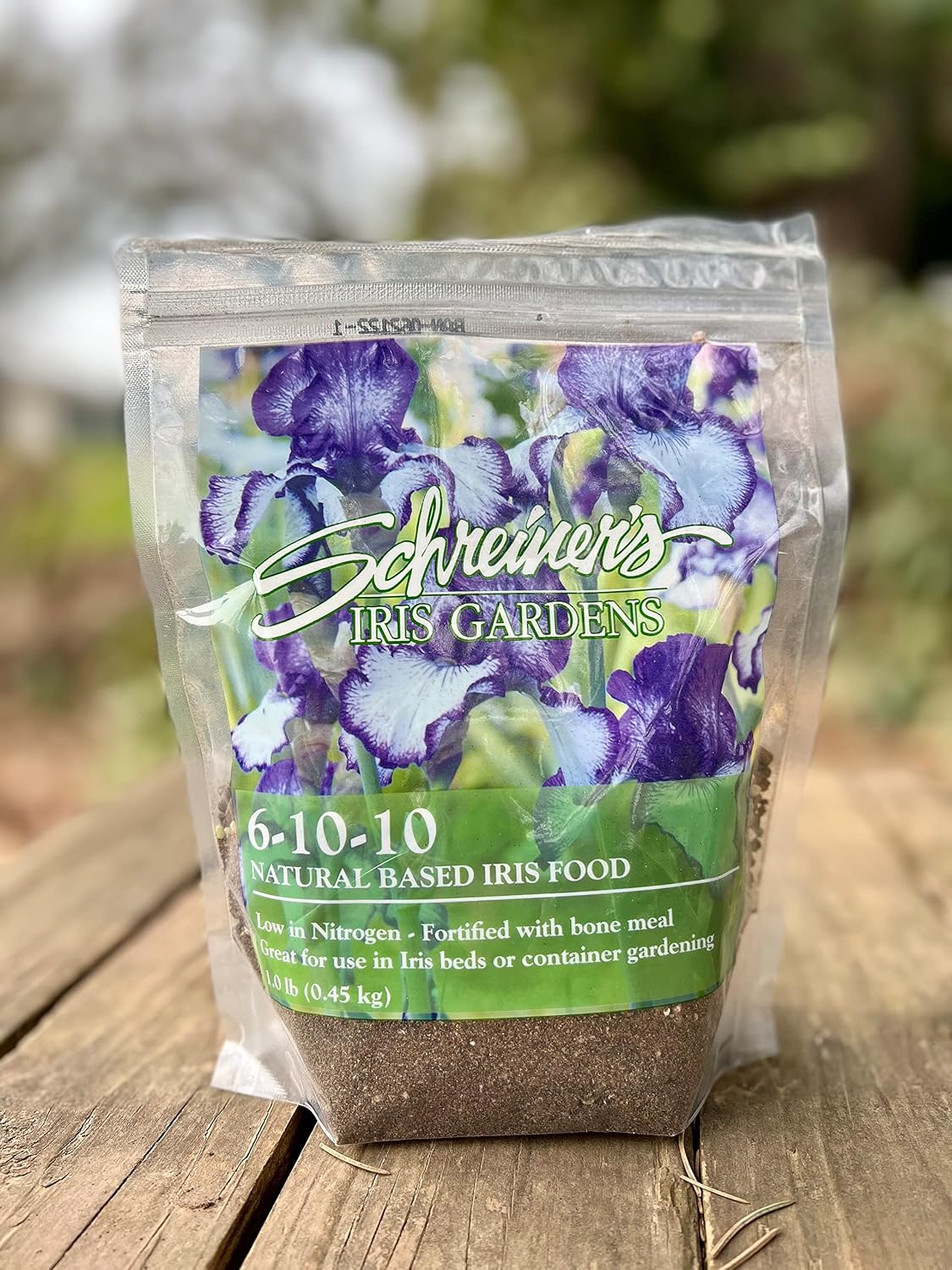
Schreiner's Iris Gardens 6-10-10 Controlled-Release Iris Food (1 lb)
| Item Form | Granules |
|---|---|
| Specific Uses For Product | Plant Growth, Iris Bloom Improvement |
| Target Species | Iris |
| Mixing Ratio | 6:10:10 |
| Unit Count | 16 Ounce |
This 6-10-10 iris food is a granular, controlled-release fertilizer designed for use one month before and one month after bloom and on newly planted or divided rhizomes. It supplies higher phosphorus and potassium relative to nitrogen, which helps encourage stronger blooms and healthier plants without excessive leafy growth. Typical use is sprinkling the measured amount around established rhizomes or applying to new plantings as directed; the 1 lb bag is sized for small beds and provides enough product for roughly 25 newly planted irises when used per instructions. Practical benefits include a formula tailored to irises, predictable release that reduces the need for frequent feeding, and clear timing guidance for pre- and post-bloom applications. Limitations are that the small 1 lb size is best for hobby beds rather than larger plantings and you must follow safety guidance when handling and storing granules. For gardeners who prefer a purpose-built iris fertilizer and straightforward application, this is a conservative, low-risk choice.
Best for: Gardeners who want a simple, low-risk fertilizer tuned for iris bloom and prefer a controlled-release granular product for small to medium beds.
Less Ideal for: Growers managing large-scale plantings or those who prefer liquid or bulk granular fertilizers for repeated, high-volume applications should consider other options.
- Iris-specific 6-10-10 formulation promotes bloom development rather than excessive foliage
- Controlled-release granules reduce frequency of applications
- Clear directions for use around bloom times and newly planted rhizomes
- Small 1 lb package suits trial use or small beds
- 1 lb bag may be insufficient for larger iris gardens
- Contains granular fertilizer that requires protective handling and safe storage
Verdict: A conservative, iris-focused 6-10-10 controlled-release fertilizer that simplifies feeding for small iris beds and encourages better blooms.
Choosing the Right Fertilizer for Irises: Key Factors to Consider
Nutrient Ratio and Timing
Irises perform best with a fertilizer that emphasizes phosphorus and potassium relative to nitrogen at certain times. Phosphorus supports root and rhizome development and helps set larger blooms, while excess nitrogen can encourage leafy growth at the expense of flowers. Look for products with clear N-P-K ratios and instructions that tell you when to feed-typically a light feed at early spring growth and a post-bloom application. Proper timing matters because feeding at the wrong time can disrupt bulb dormancy or interfere with natural seasonal cycles.
Formulation and Release Type
Granular, slow-release, and liquid fertilizers behave differently in an iris bed. Granular slow-release formulas provide a steady supply of nutrients and reduce the risk of overfeeding, which is useful for established beds. Water-soluble or liquid feeds give a faster nutrient boost and are handy for correcting a visible deficiency or promoting bloom production just before flowering. Organic sources release nutrients more slowly as they break down and also add to soil organic matter. Choose a formulation that matches how often you want to feed and how quickly you need the nutrients to be available.
Application Method and Ease
How you apply fertilizer affects both results and labor. Top-dressing granular fertilizer around rhizomes is common, but avoid piling material directly on rhizomes to prevent burn or rot. Liquid feeding requires dilution and more frequent applications but offers precise control. Some products include spreading or measuring tools, while others require separate application equipment. Consider how much time you will spend on feeding, whether you need a product that works well in containers as well as beds, and whether instructions are clear enough for safe use near rhizomes and newly divided plants.
Soil Type and pH Considerations
Irises prefer well-draining soil and can struggle in heavy, compacted soils. Soil pH affects nutrient availability; for example, phosphorus becomes less available in very acidic or very alkaline soils. Before choosing a fertilizer, test soil texture and pH. Some fertilizers include soil amendments or are formulated to work in a range of pH levels. Matching fertilizer choice to soil will reduce wasted nutrients and improve bloom response, and in poor soils you may want a product that also adds organic matter to improve drainage and root environment.
Safety for Rhizomes and Dividing
Irises are commonly divided, and newly divided rhizomes are vulnerable to fertilizer burn and disease. A safe fertilizer for irises should provide guidance on how long to wait after dividing before applying concentrated feeds and whether the product should be watered in or kept away from direct contact with rhizomes. Some gardeners prefer mild or organic starters after dividing to reduce stress. Consider products with specific instructions for use around freshly divided plants to protect delicate tissue and promote reestablishment.
Long-Term Soil Health
Repeated use of quick-release, high-salt fertilizers can degrade soil structure and microbial life over time, which ultimately reduces bloom quality and plant vigor. Fertilizers that contribute organic matter or are compatible with compost and mulching practices help maintain a healthy bed over multiple seasons. Think about whether you want a single feeding plan or a program that integrates with soil-building practices like annual top-dressing, compost incorporation, or cover cropping. Sustainable choices often reduce the need for corrective treatments later.
When to Feed Irises
Timing is an outsized factor in how a fertilizer affects irises. The most common schedule is a light application as new foliage emerges in spring and an optional low-dose feed after bloom to help rhizomes store energy without forcing late vegetative growth. Avoid heavy feeding late in the season when plants are entering dormancy.
If you divide irises, hold off on concentrated fertilizer for several weeks to allow wounds to callus and roots to reestablish. In regions with a long growing season apply lower doses more frequently rather than a single heavy feeding.
- Early spring: light feed when shoots are 2-3 inches tall
- After bloom: small dose to support rhizome recovery
- Avoid high-nitrogen feeding late summer or fall
Soil Testing and Adjustments
A simple soil test is one of the best investments before selecting a fertilizer for irises. Tests reveal pH and available phosphorus and potassium, allowing you to match a product to actual deficiencies rather than guessing.
If soil is compacted or heavy, address drainage and structure first because fertilizers will not compensate for poor rooting conditions. Amending with organic matter and ensuring planting depth and spacing often improves fertilizer response more than switching formulas.
- Test pH and nutrient levels every 2 to 3 years
- Amend heavy soils to improve drainage before feeding
Organic Versus Synthetic Options
Organic fertilizers release nutrients as microbes break down material and also add organic matter to the bed. They are forgiving and support long-term soil health, but the nutrient release rate depends on temperature and microbial activity.
Synthetic and water-soluble fertilizers give predictable, measurable nutrient delivery and are useful when you need a quick bloom boost or corrective feed. Many gardeners use a hybrid approach: organic base amendments in fall and targeted synthetic or liquid feeds in spring.
- Organic: slower release, improves soil structure
- Synthetic: faster response, precise dosing
Applying Fertilizer Around Rhizomes
When feeding iris beds, distribute granular fertilizer evenly in the soil around plants rather than placing it on top of rhizomes. Work light amounts into the topsoil and water to move nutrients into the root zone. For liquid feeds, dilute according to instructions and avoid pouring concentrated solutions directly on exposed rhizomes.
Mulch can help conserve moisture but keep it away from sitting directly over rhizomes to prevent rot. A narrow ring of mulch between fans is usually sufficient.
- Do not pile granular fertilizer on rhizomes
- Water in granular feeds to reduce burn risk
Feeding Irises in Containers
Container-grown irises experience faster nutrient depletion and may need more frequent but smaller doses. Choose a fertilizer that is appropriate for containers and follow a lighter schedule than landscape beds to avoid salt buildup.
Ensure potting mix drains well and consider monthly liquid feeds during active growth if using an inert mix with limited organic matter.
- Prefer water-soluble or liquid feeds for containers
- Refresh potting mix periodically to maintain structure
How We Chose the Best Fertilizer for Irises
We focused on fertilizers that fit the particular needs of iris plants: encouraging strong rhizomes, supporting spring bloom, and avoiding excess foliage at the expense of flowers. Our evaluation used concrete, garden-relevant criteria: nutrient ratio and bioavailability, suitability for use on rhizomes and beds, application method and ease, effect on bloom set, and suitability for common iris soil types. We prioritized options with clear directions for timing and safe use around dividing and transplanting. We excluded general-purpose products that lack specific guidance for irises, high-nitrogen lawn formulas, and specialty feeds intended only for non-rhizomatous bulbs. Products that made the shortlist were those that score well across the measurable dimensions above and that offer straightforward instructions for amateur and experienced gardeners alike.
FAQ
How often should I fertilize irises during the growing season?
Typically apply a light feed in early spring and an optional low-dose application after bloom. In poorly drained or nutrient-rich soils you may need no more than these two feedings; in very depleted soils split the spring dose into two lighter applications.
Can I use general-purpose garden fertilizer on irises?
General-purpose fertilizers can work but may contain higher nitrogen than ideal. If you use a general feed, choose a balanced formula and avoid high-nitrogen mixes that encourage foliage over flowers.
Are organic fertilizers effective for irises?
Yes. Organic fertilizers release nutrients slowly and improve soil structure, which benefits iris rhizomes over time. They are best used as a baseline soil improvement combined with targeted feeds for bloom if needed.
Will fertilizer prevent iris disease or rot?
Fertilizer does not prevent disease or rot. Good cultural practices-proper planting depth, drainage, spacing, and avoiding mulch piled on rhizomes-are the primary defenses. Appropriate feeding can improve vigor but will not substitute for disease management.
How should I feed newly divided irises?
Wait several weeks after dividing before applying concentrated fertilizer to allow wounds to callus. Use a mild starter or a light organic top-dress if you want to provide nutrients sooner, and focus on keeping soil moist but not waterlogged.
Final Verdict
Choosing the right fertilizer for irises comes down to matching nutrient balance, timing, and application method to your soil and bed conditions. Prioritize products that support rhizome health and bloom promotion while avoiding high late-season nitrogen that stimulates excessive foliage. Consider soil tests, feeding frequency, and whether you prefer organic soil-building approaches or quick-acting liquid feeds. With those tradeoffs in mind you can pick a feeding plan that keeps iris beds vigorous and floriferous for many seasons.
