

Note: This article contains affiliate links. If you click on these links and make a purchase, I may earn a small commission at no extra cost to you. This helps support my research and content. Read my full affiliate disclosure here.
Choosing the right fertilizer for a mango tree makes a real difference in bloom timing, fruit set, and long-term tree health. Whether you are growing a single patio tree or managing several trees in a backyard orchard, feeding strategy affects flowering, fruit size, pest resilience, and root development. This guide covers seven top fertilizer options shortlisted for feeding mango trees and explains how each approach addresses nutrient needs, timing, and ease of use. Read on to understand the feeding goals we prioritized and which product traits matter most when you pick fertilizer for mango tree care.
Top Picks at a Glance
| Best Overall The best all-around choice for most situations | Espoma Citrus-Tone Organic Fertilizer for Citrus, Fruit, Nut & Avocado Trees, 4 lb |  |
| Best Quality Built to a higher standard if you want something more solid | Down To Earth Organic Fruit Tree Fertilizer, 6-2-4 (5 lb) |  |
| Best Value The sweet spot between price and what you get | Farmer's Secret Fruit Tree Booster Liquid Fertilizer (8 oz) |  |
| Best Budget The cheapest option that still gets the job done reliably | Jobe's Organics Granular Fruit & Citrus Fertilizer, 4 lb |  |
| Highest Rated A top-rated pick with lots of positive feedback | Gardenera Organic Liquid Kelp Fertilizer Concentrate for Mango Trees, 8 oz |  |
| Most Popular A crowd favorite that many people choose with confidence | Miracle-Gro Shake 'N Feed Citrus, Avocado, Mango Plant Food (4.5 lb) |  |
| Best Seller A high-volume bestseller chosen again and again | TPS Nutrients Mango Tree Fertilizer, Liquid Plant Food, 8 oz |  |
Espoma Citrus-Tone Organic Fertilizer for Citrus, Fruit, Nut & Avocado Trees, 4 lb

| Item Form | Granules |
|---|---|
| Specific Uses For Product | Gardening, Organic, Plant Food |
| Coverage | Medium |
| Target Species | Citrus, avocado, fruit and nut trees |
Espoma Citrus-Tone is an organic granular fertilizer designed for fruit trees, including citrus and avocado, and works well as a steady-feeding option for similar tropical fruit trees such as mango. You apply it around the tree base at the drip line and water it in; the manufacturer recommends applications in late winter pre-bloom, spring post-bloom and fall. The 5-2-6 N-P-K ratio and 5% calcium support balanced vegetative growth and fruit development without synthetic inputs, and the product is certified for organic gardening. Because it is ready to use granules, no mixing is required and coverage is described as medium, making it simple to spread by hand or with a broadcast spreader on small to medium trees. Limitations are that the bag is a modest 4 pound unit so frequent repurchase may be necessary for larger or multiple trees, and specific mixing or feeding rates are not provided on the available listing so buyers should consult the label for exact application amounts per tree size. Overall it is a practical, organic choice for gardeners seeking steady, low-effort nutrition for fruiting trees.
Best for: Gardeners who want an organic, easy-to-apply fertilizer to support fruit production and overall tree health and who prefer straightforward seasonal feeding over custom nutrient programs.
Less Ideal for: Large-scale growers or owners of mature mango trees who need bulk fertilizer or precise, high-volume nutrient dosing should consider larger or more concentrated products.
- Organic formulation approved for organic gardening
- Balanced 5-2-6 N-P-K with 5% calcium to support fruit set and healthy growth
- Ready-to-use granules that require no mixing
- Simple seasonal application schedule for pre-bloom, post-bloom and fall
- Small 4 lb bag may not be economical for larger mango trees or multiple trees
- Product listing does not include detailed application rates on the provided data
Verdict: A simple, certified organic granular fertilizer that delivers balanced nutrition ideal for home growers wanting low-effort feeding for fruiting trees.
Down To Earth Organic Fruit Tree Fertilizer, 6-2-4 (5 lb)

| Item Form | Powder |
|---|---|
| Specific Uses For Product | Plant Growth,Potting |
| Target Species | fruit trees |
| Mixing Ratio | 6:2:4 |
This Down To Earth 6-2-4 fruit tree fertilizer is a dry, soil-applied blend of organic ingredients designed to feed fruit trees through the root zone rather than acting as a quick soluble feed. Typical use is broadcasting or hand-applying the powder around the tree dripline, lightly working it into the topsoil or covering with compost or mulch, and watering it in; the manufacturer notes it is shelf stable and does not dissolve like water-soluble formulas. The mix contains bone meal, blood meal, kelp, alfalfa and rock phosphate plus langbeinite for potassium and added calcium to support fruit set and development. For a performance-focused grower of mango trees, the higher nitrogen and available potassium sources help support vegetative growth and fruiting when applied at recommended rates. Limitations: it is not water soluble so effects are slower and rely on soil biology, and application rates must be followed to avoid excess nitrogen during flowering or fruit set. Overall it is a solid organic option for building long-term soil fertility in a backyard orchard setting.
Best for: Gardeners focused on producing healthy, well-fruiting backyard mango trees who prefer building soil fertility with organic, slow-release inputs and predictable N-P-K balance.
Less Ideal for: Growers who need rapid, soluble nutrient correction for acute deficiencies or who prefer foliar or liquid feeding for quick results should consider alternatives.
- OMRI-listed organic-friendly ingredient mix suitable for organic production
- Includes calcium and slow-release nutrient sources that support fruit development
- Shelf-stable dry formula that can be broadcast and incorporated into soil or covered with mulch
- Blend contains diverse nutrient sources (bone, blood, kelp, alfalfa, rock phosphate) to feed soil biology
- Not water soluble so plant response is slower than soluble fertilizers
- Requires correct application timing and incorporation to reach roots effectively
Verdict: Choose this product when you want a reliable organic, slow-release fertilizer that builds soil fertility and supports strong fruit set in mango trees.
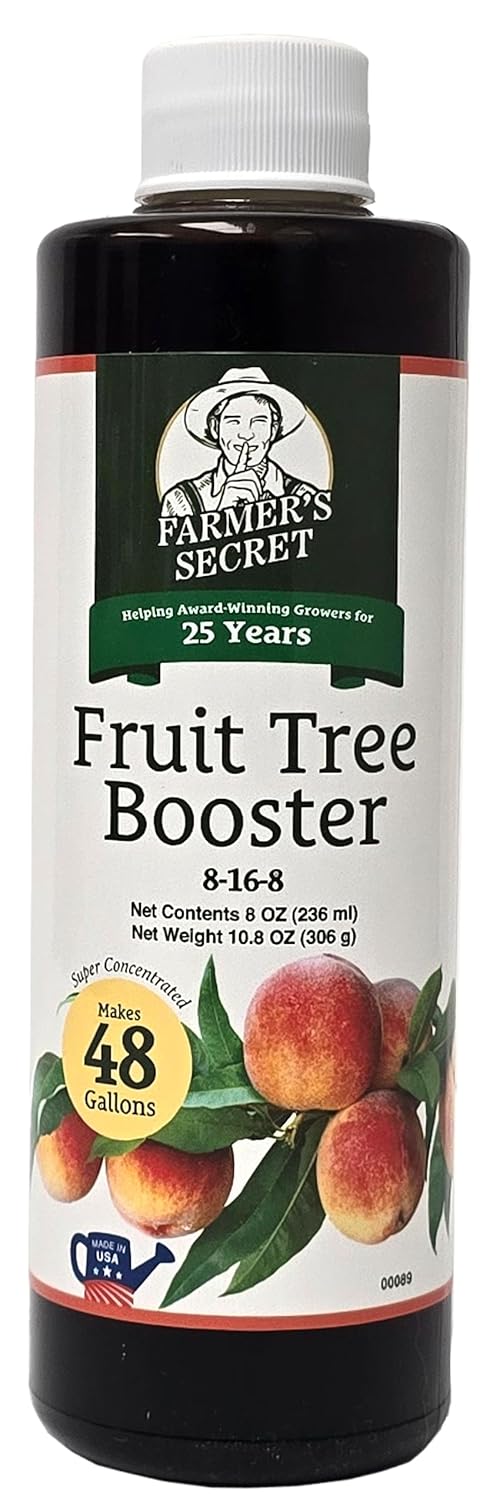
Farmer's Secret Fruit Tree Booster Liquid Fertilizer (8 oz)
| Item Form | Liquid |
|---|---|
| Specific Uses For Product | Plant Growth, Fruit Production |
| Coverage | Full |
| Target Species | Apple, Banana, Peach |
| Liquid Volume | 8 fluid ounces |
This concentrated liquid from Farmer's Secret is designed to encourage stronger roots and increased fruit set by delivering a phosphorus-rich, balanced mix of NPK and trace minerals. You dilute one teaspoon per gallon for regular feeding and apply weekly around the drip line or as a foliar spray, with higher doses recommended for young or mature trees. The small 8 ounce bottle is super concentrated so a single bottle covers multiple feedings, and the liquid form means nutrients are immediately available to the tree rather than waiting to break down in soil. Practical users will appreciate simple directions, compatibility with irrigation or sprayers, and the ability to target applications during the early growth cycle after dormancy. Limitations to consider are the small bottle size if you have many trees and the need to follow dilution guidance closely to avoid overfeeding; also the product description is focused on general fruit trees rather than mango specifically, so regional or species-specific nutrient plans might still be necessary.
Best for: Home gardeners who want a straightforward, concentrated feed to encourage fruiting and stronger roots and who prefer easy weekly liquid applications over granular programs.
Less Ideal for: Large-scale growers or anyone managing many trees who need bulk quantities or a product with detailed species-specific feeding schedules.
- Highly concentrated formula extends the number of feedings per bottle
- Liquid form provides nutrients that are immediately available to trees
- Balanced NPK with trace minerals supports root development and fruit production
- Can be applied to soil, as foliar spray, or through irrigation for flexible use
- Small 8 oz volume can be inefficient for larger plantings
- Label guidance is general and not tailored specifically to mango nutrient schedules
Verdict: A compact, highly concentrated liquid fertilizer that gives home fruit trees an easy weekly boost to roots and fruit production.
Jobe's Organics Granular Fruit & Citrus Fertilizer, 4 lb

| NPK | 3-5-5 |
|---|---|
| Form | Granules |
| Unit Count | 64 Ounce |
| Application Method | Spread evenly around base |
| OMRI Listed | Yes |
Jobe's Organics Fruit & Citrus Granular Fertilizer is a slow-release, USDA OMRI-listed granular designed to feed fruiting trees and plants through the roots. You apply measured amounts around the base of the tree and water in, repeating every 4 to 8 weeks during the growing season. The 3-5-5 NPK blend plus added calcium and magnesium supports root development, flowering and fruit set rather than rapid leafy growth. Practical benefits include easy application from a resealable bag, organic ingredients like bone and feather meal that reduce synthetic inputs, and a formula that is safe to use around children and pets. For a budget-minded gardener growing mango trees, it provides steady nutrient release appropriate for maintaining blooms and fruit without aggressive nitrogen spikes. Limitations are the modest NPK ratio for heavy-feeding trees and the need for regular reapplication during the season; very large or nutrient-depleted mango trees may require larger quantities or supplemental feeding with a higher-potassium formula for bigger fruiting results.
Best for: Home gardeners growing a single mango tree who prioritize organic inputs and straightforward, low-fuss feeding on a budget.
Less Ideal for: Commercial growers or those with large, nutrient-depleted mango trees who need high-rate, high-potassium fertilization or less frequent heavy-feed solutions.
- OMRI listed for organic gardening, suitable for certified organic production
- Slow-release granular formula that feeds roots over time
- Resealable bag for easy storage and measured application
- Includes calcium and magnesium alongside NPK for balanced nutrition
- Lower overall NPK levels may be insufficient for very large or heavily fruiting trees
- Requires repeat application every 4–8 weeks during the growing season
Verdict: A budget-friendly organic granular that delivers steady, root-focused nutrition ideal for home mango trees needing simple, low-risk feeding.
Gardenera Organic Liquid Kelp Fertilizer Concentrate for Mango Trees, 8 oz

| Item Form | Liquid |
|---|---|
| Application Method | foliar spray or soil drench |
| Target Species | Mango Trees |
| Mixing Ratio | 1:575 (8 oz: 45 gallons) |
This 8 oz Gardenera kelp concentrate is a seaweed-based supplement designed specifically for mango trees and mixes to a large volume, making it easy to use across multiple trees or containers. It is applied as a foliar spray or soil drench at a recommended mixing ratio that yields about 45 gallons, so a small bottle stretches a long way for routine feeding every 2 to 4 weeks. The formula highlights Ascophyllum nodosum seaweed, which supplies natural growth hormones, trace minerals, and compounds that promote root development, better leaf color, and improved flowering and fruit set. Because it is organic and described as non-toxic and gentle, it is suitable for regular use without risk of burning. Practical limits are that coverage is listed as low, so heavy-feeding situations or large orchards will require frequent mixing and more product, and a single 8 oz bottle is best for hobbyists or small plantings rather than large commercial plots. For growers seeking a steady, plant-friendly kelp feed that supports mango vigor and fruiting, this is a convenient concentrated option.
Best for: Home fruit growers and container mango owners who want a reliable, gentle organic feed to encourage steady growth, flowering, and fruit set in small to medium plantings.
Less Ideal for: Large-scale orchards or growers who need high-coverage, heavy-feeding fertilizer programs should consider bulk or higher-concentration commercial products instead.
- Concentrated formula mixes to about 45 gallons so an 8 oz bottle treats many applications
- Suitable for foliar spray or soil drench, giving flexible feeding options
- Made from Ascophyllum nodosum kelp to deliver natural hormones and trace minerals for flowering and root strength
- Small 8 oz size limits how many large trees or orchards one bottle can support
- Coverage described as low so frequent reapplication or multiple bottles may be needed for larger plantings
Verdict: A concentrated, plant-safe kelp concentrate that reliably supports mango tree vigor and fruiting for home and container growers.
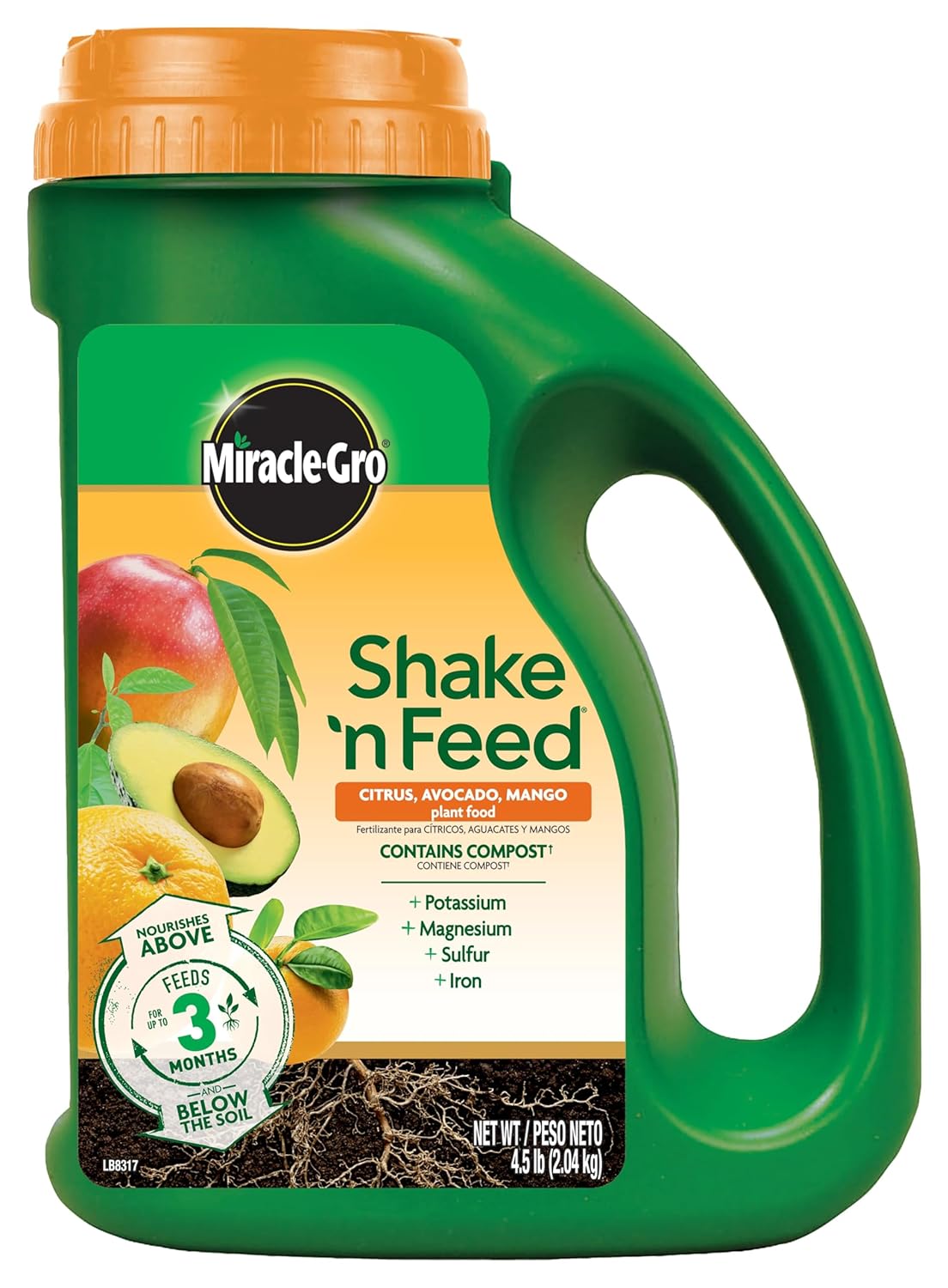
Miracle-Gro Shake 'N Feed Citrus, Avocado, Mango Plant Food (4.5 lb)
| Item Form | Granules |
|---|---|
| Application Method | Shake evenly onto soil |
| Target Species | citrus, avocado, mango |
| Mixing Ratio | 8-2-10 |
Miracle-Gro Shake 'N Feed Citrus, Avocado, Mango is a granular, slow-release plant food intended for in-ground and container fruit trees. You apply it by shaking or sprinkling onto the soil within the branch spread, lightly working it into the top inch or two of soil for established plants or mixing it into potting mix at planting. Its 8-2-10 NPK ratio and added micronutrients such as potassium, magnesium, sulfur, and iron aim to correct common deficiencies and support root development through microbes that help break down compostable ingredients. The key practical benefit is low maintenance feeding that covers roughly three months per application, so it suits seasonal care schedules. It is straightforward to use and works for both outdoor beds and containers, but like any granular feed it must be applied correctly to avoid trunk contact and uneven distribution. It also offers medium coverage per unit, so larger trees or multiple specimens will need more frequent reapplication or larger quantities. For gardeners who expect quick foliar feeding, a water-soluble formula will act faster than this slow-release option.
Best for: Gardeners who want an easy, low-maintenance fertilizer tailored to mango and similar fruit trees and prefer scheduled slow-release feeding over frequent liquid feeds.
Less Ideal for: Growers seeking fast corrective feeding or immediate foliar response, or those managing many large trees who need higher coverage per bag.
- Slow-release formula feeds up to three months reducing application frequency
- Formulated specifically for citrus, avocado, and mango with added micronutrients
- Works for both in-ground and container plants with simple shake-on application
- Medium coverage means multiple packages or more product needed for large trees
- Granular slow-release acts more slowly than liquid or soluble fertilizers
Verdict: Use this if you want a simple, slow-release granular fertilizer made specifically to support mango and other citrus-family trees with quarterly applications.
TPS Nutrients Mango Tree Fertilizer, Liquid Plant Food, 8 oz

| Item Form | Liquid |
|---|---|
| Specific Uses For Product | Mango Tree Fertilizer |
| Coverage | Full |
| Target Species | Mangoes |
| Mixing Ratio | 1:100 |
This 8 oz liquid formula is designed for mango and other tropical fruit trees and is used diluted at the manufacturer-recommended 1:100 mixing ratio. It supplies balanced, kelp-enriched minerals plus added calcium and magnesium to support shoot and root growth, stronger fruit set, and reduced fruit drop. In practice you mix small amounts into water and apply to the root zone or as a foliar feed according to directions, making it convenient for backyard trees and patio specimens. The liquid form allows quick uptake compared with granular fertilizers and is useful during active growth and just before fruiting. The small bottle is easy to store and works well for a few trees or for trialing on young specimens, but you will need to repurchase for larger plantings. Follow safety guidance to avoid skin or eye contact and keep away from children and pets. For gardeners seeking a mango-specific, easy-to-use liquid feed to encourage healthier growth and better harvests, this product is a practical option.
Best for: Home gardeners and backyard mango owners who want a purpose-made, easy-to-apply liquid feed to support fruiting and reduce fruit drop without complex mixing or timing schedules.
Less Ideal for: Large-scale orchard growers or anyone needing a bulk, long-lasting fertilizer solution should consider concentrated or granular options better suited to high-volume use.
- Formulated specifically for mango trees with kelp-enriched minerals plus added calcium and magnesium
- Liquid concentrate mixes 1:100 for quick uptake and easy foliar or soil application
- Compact 8 oz bottle is easy to store and suitable for backyard or patio trees
- Helps support root and shoot development and can reduce fruit drop when used properly
- Small 8 oz volume means frequent repurchasing for multiple or mature trees
Verdict: A convenient, mango-specific liquid feed that helps strengthen trees and encourage better fruit set for home gardeners.
Choosing the Right Fertilizer for Mango Tree: Key Factors to Consider
Nutrient Ratio and Stage-Specific Needs
Young mango trees need higher nitrogen to encourage leafy growth and a strong canopy, while mature, fruiting trees benefit from reduced nitrogen and relatively higher phosphorus and potassium to support flowering and fruit development. Understanding N-P-K ratios helps match fertilizer choice to the tree's age and current growth stage.
Overapplying nitrogen during the flowering window can suppress blooms and reduce fruit set. Conversely, inadequate potassium can lead to poor fruit quality and weaker stress tolerance. Look for clear formulation guidance so you can switch feeding plans as the tree moves from establishment to production.
Release Profile and Frequency
Slow-release or controlled-release fertilizers provide steady nutrition with fewer applications, which is useful for busy gardeners and reduces the risk of nutrient spikes that burn roots. Water-soluble or quick-release feeds offer rapid correction for visible deficiencies or to stimulate a late-season push, but they require more frequent application.
Consider how often you want to feed and whether you can reliably apply fertilizer at the recommended intervals. The local climate and rainfall pattern also affect how fast nutrients are leached or made available to roots.
Application Method and Practicality
Fertilizers come in granular, pellet, liquid concentrate, and foliar spray forms. Granular products are easy to apply around the dripline and can be incorporated into mulches. Liquid feeds are useful for spot-corrections and for foliar feeding during bloom, but they need mixing and timely application. Foliar sprays can quickly deliver micronutrients but are less effective for macronutrient needs.
Choose a format that fits your watering routine and garden layout. For potted or patio mango trees, measured liquid feeds or slow-release capsules may be easier; for in-ground trees, broadcastable granules can cover a large root zone efficiently.
Micronutrients and Soil Conditions
Mango trees benefit from micronutrients such as zinc, magnesium, iron, and boron when soils are deficient. Soil pH and existing nutrient levels influence availability, so a soil test is valuable before committing to a feeding program. Micronutrient deficiencies can show as leaf yellowing, poor fruit set, or delayed growth.
When soil tests reveal specific shortfalls, choose fertilizers or supplements that supply the lacking elements without overloading other nutrients. Avoid blanket, high-salt remedies that can harm root bacteria and mycorrhizal relationships.
Timing Around Flowering and Fruit Set
The timing of applications matters more than the total annual quantity. Applying the right nutrients just before or during bud formation encourages a healthy bloom and improves fruit set. Excessive feeding during heavy flowering can push vegetative growth at the expense of fruit.
Plan a feeding schedule that matches local flowering windows and fruit development stages. Many gardeners use a lower-nitrogen formula at bud break and a maintenance feeding after fruit drop to support fruit fill and tree recovery.
Environmental Impact and Salt Load
Some fertilizers contain high levels of soluble salts that can accumulate in soil or runoff into nearby water. Excessive salt can damage roots, reduce microbial activity, and harm nearby plants. Choosing products with lower salt index or using slow-release formulations reduces leaching risk.
Also consider how frequently rain or irrigation will move nutrients. In sandy or highly drained soils, split applications and controlled-release products help limit nutrient loss and reduce environmental impact.
Feeding Schedule by Tree Age
Match feeding frequency and rate to the tree's age. Young trees typically need more frequent, lower-rate applications to build canopy and roots without forcing stress. Mature trees need fewer, targeted feedings focused on bloom and fruit development.
A simple approach is to use a balanced, slightly nitrogen-lean formula at bud formation, then a maintenance feed during fruit development. For new plantings, follow an establishment schedule with higher nitrogen until the root system is well established.
- Seedlings and newly planted trees: smaller, more frequent feeds to encourage root growth
- Immature trees not yet fruiting: moderate nitrogen for structure and leaf area
- Mature, fruiting trees: reduced nitrogen, higher phosphorus and potassium for bloom and fruit set
Using Soil Tests to Tailor Feeding
A basic soil test gives pH and macronutrient levels, which helps avoid unnecessary applications. Mango trees perform best in slightly acidic to neutral soils where key elements remain available. If tests show specific micronutrient deficiencies, add targeted supplements rather than broad high-N fertilizers.
Interpret results in the context of your local climate. In high-rainfall areas, split applications or slow-release products reduce leaching. In heavier soils, nutrients may stay available longer, allowing for less frequent feeding.
- Test before the first major feed of the season
- Adjust pH and add micronutrients as indicated
- Re-test every 2 to 3 years or after major amendments
Practical Application Tips
Apply granular fertilizers evenly around the dripline rather than at the trunk to target the active root zone. Lightly work granules into the top layer of soil or cover with mulch to reduce runoff. For liquid feeds, moisten the root zone first, then apply to maximize uptake.
Avoid applying concentrated fertilizer to dry soil or near the trunk. Use a measured spreader or scoop to keep rates accurate, and record application dates so you can avoid overfeeding.
- Keep feed applications away from the trunk flare
- Combine feeding with deep watering to move nutrients into the root zone
- Use mulch to conserve moisture and moderate nutrient release
Managing Deficiencies and Common Issues
Leaf yellowing, poor bloom, or small fruits often indicate specific nutrient issues rather than a need for more nitrogen. Zinc deficiency is common in some regions and appears as distorted or chlorotic leaves. Correcting deficiencies with foliar sprays or soil-applied micronutrients can quickly restore vigor.
Be cautious with corrective measures. Overcompensating can create imbalances. When in doubt, test and apply targeted solutions rather than blanket high-dose feeds.
- Use foliar sprays for quick correction of micronutrient shortages
- Address soil pH if several nutrients are unavailable
- Monitor new growth to confirm recovery after treatment
Organic Versus Synthetic Options
Organic fertilizers release nutrients more slowly as soil biology breaks them down and often supply a broader range of micronutrients and organic matter. They support soil structure and microbial life but can require higher application rates or more time to correct deficiencies.
Synthetic fertilizers deliver precise nutrient ratios quickly and are useful for targeted corrections or timed feeding. Consider alternating or combining approaches to balance fast correction with long-term soil health.
- Organic: steadier supply, improves soil organic matter
- Synthetic: precise ratios and rapid uptake
- Combine methods when you need both quick fixes and long-term soil improvement
How We Chose the Best Fertilizer for Mango Tree
We selected fertilizers based on factors that directly influence flowering, fruit development, and root health in mango trees. Priority went to nutrient balance that supports flowering and fruiting, such as adequate phosphorus and potassium relative to nitrogen for mature trees, plus formulas appropriate for young trees. We evaluated nutrient release profile, distinguishing slow-release and controlled-release options from quick-acting soluble fertilizers. Application method and ease were weighed, including granular broadcasting, soil drench, and foliar feeding compatibility. Packaging and measured feeding rates were considered for backyard gardeners who need clear instructions. We excluded fertilizer types that are unsuitable for mango trees, such as mixes designed exclusively for lawns or high-chloride salts, and products lacking transparent nutrient analysis. Editorial filters removed any items without clear N-P-K labeling or without guidance for timing around bloom and fruit set. The final shortlist emphasizes practical garden performance over marketing claims, favoring fertilizers that give predictable nutrient delivery, workable application schedules, and guidance for adjusting feeding by tree age and season.
FAQ
How often should I fertilize a mango tree?
It depends on tree age and fertilizer type. Young trees usually benefit from smaller, more frequent feeds, while mature trees do well with two to three targeted applications timed around bud set and fruit development. Slow-release products may only need one or two applications per year.
What N-P-K ratio is best for a fruiting mango tree?
Mature fruiting trees often perform best with reduced nitrogen and relatively higher phosphorus and potassium to promote flowering and fruit fill. Exact ratios vary by region, but avoid high-nitrogen mixes during the bloom period.
Can I use a general-purpose garden fertilizer for my mango tree?
General-purpose fertilizers can work if their nutrient profile matches the tree's needs and you adjust timing. However, formulas tailored for fruit trees or that include needed micronutrients are often more effective for consistent fruiting and tree health.
Should I use foliar feeding for mango trees?
Foliar feeding is useful for quickly correcting micronutrient deficiencies and supporting bloom, but it does not replace soil-applied macronutrients. Use foliar applications as a supplement when symptoms appear or for targeted short-term boosts.
How does soil type affect fertilizer choice?
Sandy soils leach nutrients faster and often need split or slow-release applications. Heavy clay holds nutrients longer but can lock them up if pH is off. Adjust frequency and product form based on drainage and local conditions.
When should I stop fertilizing before harvest?
Many gardeners reduce or stop high-nitrogen feeding a few weeks before major harvest to avoid forcing late vegetative growth. Continue maintenance feeds that support fruit fill and tree recovery, but avoid aggressive nitrogen applications close to harvest.
Final Verdict
Prioritize matching nutrient ratios and release profile to the tree's age and the local growing conditions. Focus feeding around bud formation and fruit development, and use soil tests to correct specific deficiencies. Balance practicality with long-term soil health by choosing an application method you can maintain consistently. With a feeding plan that fits your schedule and soil, you can improve bloom, fruit set, and tree vigor while avoiding common overfeeding mistakes.
