

Note: This article contains affiliate links. If you click on these links and make a purchase, I may earn a small commission at no extra cost to you. This helps support my research and content. Read my full affiliate disclosure here.
Scale insects are persistent sap feeders that weaken shrubs, container plants, and trees if left unchecked. Choosing the right insecticide for scale insects matters because some products only smother or slow infestations while others provide systemic or residual control that reduces reapplication time. This guide covers the top shortlisted insecticide options for scale insects across common garden situations and plant types. We evaluate each option for effectiveness against different scale life stages, safety on ornamentals and edibles, and how easy it is to apply in a backyard or patio setting. Read on to see the evaluation criteria and what to expect from each type of treatment.
Top Picks at a Glance
| Best Overall The best all-around choice for most situations | Bonide Systemic Insect Control Granules, 4 lb |  |
| Best Quality Built to a higher standard if you want something more solid | Bonide Systemic Insect Control Concentrate, 16 oz |  |
| Best Value The sweet spot between price and what you get | BioAdvanced Fruit & Citrus Tree Insect Control Concentrate, 32 oz |  |
| Best Budget The cheapest option that still gets the job done reliably | Bonide Systemic Insect Control Granules, Ready-to-Use, 1 lb |  |
| Highest Rated A top-rated pick with lots of positive feedback | ferti-lome Tree & Shrub Drench Systemic Insecticide, 32 oz |  |
| Most Popular A crowd favorite that many people choose with confidence | Garden Safe Insecticidal Soap Insect Killer Spray, 32 oz |  |
Bonide Systemic Insect Control Granules, 4 lb

| Unit Count | 64 Ounce |
|---|---|
| Item Form | Granules |
| Target Species | Insects |
| Special Features | Ready-to-Use |
| Active Ingredients | Imidacloprid |
Bonide Systemic Insect Control Granules are a low-odor, ready-to-use granular treatment that you apply to the soil around outdoor ornamental plants to protect them from sap-feeding pests such as scale, aphids, mealybugs, and whiteflies. The granules are absorbed by roots and move through the plant, so insects are controlled when they feed rather than by contact. It is simple to use: sprinkle the product on the soil, mix in lightly, water to activate, and reapply about every eight weeks if needed. The systemic action means protection is not removed by watering and gives multi-week control without frequent spraying. Important limitations are that it contains imidacloprid and is not labeled for edible plants, and it can affect insects that feed on treated plants so care is needed around pollinator-friendly plantings. For gardeners managing recurring scale infestations on ornamentals, this product offers straightforward, long-lasting control, but it should be used according to label directions to minimize non-target impacts.
Best for: Gardeners who want an easy, low-maintenance way to protect ornamental shrubs and potted plants from recurring sap-feeding insects and prioritize multi-week control with minimal repeat applications.
Less Ideal for: People who need insect control for vegetables, herbs, or fruit-bearing plants or who must avoid neonicotinoid insecticides for pollinator-sensitive plantings.
- Systemic action provides plant-wide protection for up to eight weeks after application
- Ready-to-use granules are low odor and simple to apply to soil around ornamentals
- Effective against common sap-feeding pests including scale, aphids, mealybugs, and whiteflies
- Contains imidacloprid and is not for use on edible plants
- Will not control pests that do not feed on plant sap or pests on non-treated surfaces
Verdict: A convenient, long-lasting granular systemic treatment for controlling scale and other sap-feeding insects on ornamental plants.
Bonide Systemic Insect Control Concentrate, 16 oz

| Unit Count | 1 Count |
|---|---|
| Included Components | 16 oz Concentrate |
| Item Form | Spray |
| Target Species | Spider |
| Specification Met | EPA |
Bonide Systemic Insect Control is a 16 oz concentrate that mixes with water for spray applications on outdoor ornamental plants. It combines contact activity with systemic uptake so treated plants both receive immediate knockdown and prolonged protection as the active ingredient moves through plant tissues. Typical use is on roses, shrubs, flowers and trees for pests such as scale, spider mites, whiteflies, thrips, mealybugs and other listed insects; the label warns against use on edible fruit or vegetable crops. It can be combined with some fungicides or fertilizers to streamline applications and is intended for repeat sprays every 7 to 10 days while infestations persist. Practical benefits include broad pest coverage for ornamentals and the convenience of systemic control that helps reach concealed feeders. Limitations are that it is not for use on edibles, requires careful mixing and adherence to label directions for safety, and repeat applications may be needed for heavy or persistent scale infestations.
Best for: Gardeners who prioritize fast, reliable control of ornamental pests and want a product that delivers systemic protection for trees, shrubs and flowering plants.
Less Ideal for: Homeowners growing edible vegetables or fruit or those seeking an organic-certified option should choose a product labeled for food crops or organic use.
- Systemic action plus contact kill reaches concealed feeding insects
- Labeled for use on a wide range of ornamental plants including roses and shrubs
- Compatible for tank-mixing with certain fungicides or fertilizers to reduce application steps
- Not labeled for use on vegetables or fruit plants
- Requires careful dilution and adherence to label safety instructions
Verdict: Choose this concentrate when you need a performance-oriented systemic spray that provides both immediate knockdown and ongoing control of scale and other ornamentals pests.
BioAdvanced Fruit & Citrus Tree Insect Control Concentrate, 32 oz

| Unit Count | 32 Fluid Ounces |
|---|---|
| Item Form | Liquid |
| Target Species | Insects |
| Active Ingredient | Imidacloprid 0.235% |
This BioAdvanced concentrate is designed for gardeners who want a low‑effort, season‑long defense against sap‑sucking and chewing pests on fruit and citrus trees. You mix the liquid and pour it at the base of trunks or plants; the active ingredient is taken up through the roots and provides internal protection so rain will not wash it off. The label lists control for aphids, whiteflies, leafhoppers, scales and other common pests and claims protection for up to two months from a single annual application. It treats multiple trees or several hundred square feet of vegetables, which makes it economical for small orchards or mixed edible beds. Important limitations are state restrictions in certain states and that it is a systemic insecticide containing imidacloprid, so users should follow label directions to avoid harming pollinators and non target insects and observe harvest intervals on edible crops. For those wanting a non‑spray, root‑applied option to reduce repeated foliar applications, this concentrate is a practical choice.
Best for: Practical gardeners who want a low‑maintenance, pour‑in‑the‑soil solution to protect fruit and citrus trees and nearby edible plants without repeated foliar spraying.
Less Ideal for: Gardeners who prioritize organic or pollinator‑safe treatments or who need a foliar contact spray for immediate knockdown should consider alternatives.
- Systemic root uptake provides internal protection that is not washed off by rain
- One annual application protects for up to two months, reducing repeat treatments
- Treats up to nine fruit trees or about 640 sq ft of vegetables from a single 32 oz bottle
- Controls a broad list of pests including aphids, whiteflies, leafhoppers and scale insects
- Contains imidacloprid which can harm pollinators if label precautions are not followed
- Restricted for sale in several states, limiting availability in those regions
Verdict: A convenient, root‑applied concentrate that gives season‑long, systemic protection for fruit and citrus trees with minimal effort.
Bonide Systemic Insect Control Granules, Ready-to-Use, 1 lb

| Formulation | Ready-to-use granules |
|---|---|
| Coverage duration | Up to 8 weeks |
| Intended use | Outdoor ornamental plants only |
This ready-to-use granular systemic from Bonide controls sap-feeding pests like scale, aphids, mealybugs, and scale by being absorbed into the plant through the roots and moving through the vascular system so insects ingest the active ingredient when they feed. You apply the granules to the top of the soil, mix them in, and water to activate the systemic action; protection lasts up to eight weeks and is not washed away by normal watering. The low odor, granular format is easy to spread around shrubs, ornamentals, and container plants and avoids mixing concentrates or spraying. Important limitations are that it is labeled for non-edible ornamentals only and will not affect insects that do not feed on plant sap, so it is not a broad-contact option for all garden pests. For routine, economical control of scale and similar pests on landscape ornamentals this product offers simple application and multi-week residual activity, but you will need to reapply on a schedule for season-long control.
Best for: Budget-minded gardeners who need a low-effort, multi-week solution for scale and other sap-feeding pests on ornamental shrubs and container plants.
Less Ideal for: Gardeners who need treatments for edible crops or who require immediate knockdown of non-sucking insects should choose a product formulated for those uses.
- Systemic action provides up to eight weeks of protection after application
- Ready-to-use granules are low odor and simple to apply without mixing
- Targets sap-feeding insects such as scale, aphids, and mealybugs through ingestion
- Not labeled for use on edible plants so unsuitable for vegetables and fruit
- Will not control insects that do not feed on plant sap
Verdict: An inexpensive, hassle-free granular systemic that delivers convenient multi-week control of scale and other sap-feeding insects on ornamental plants.
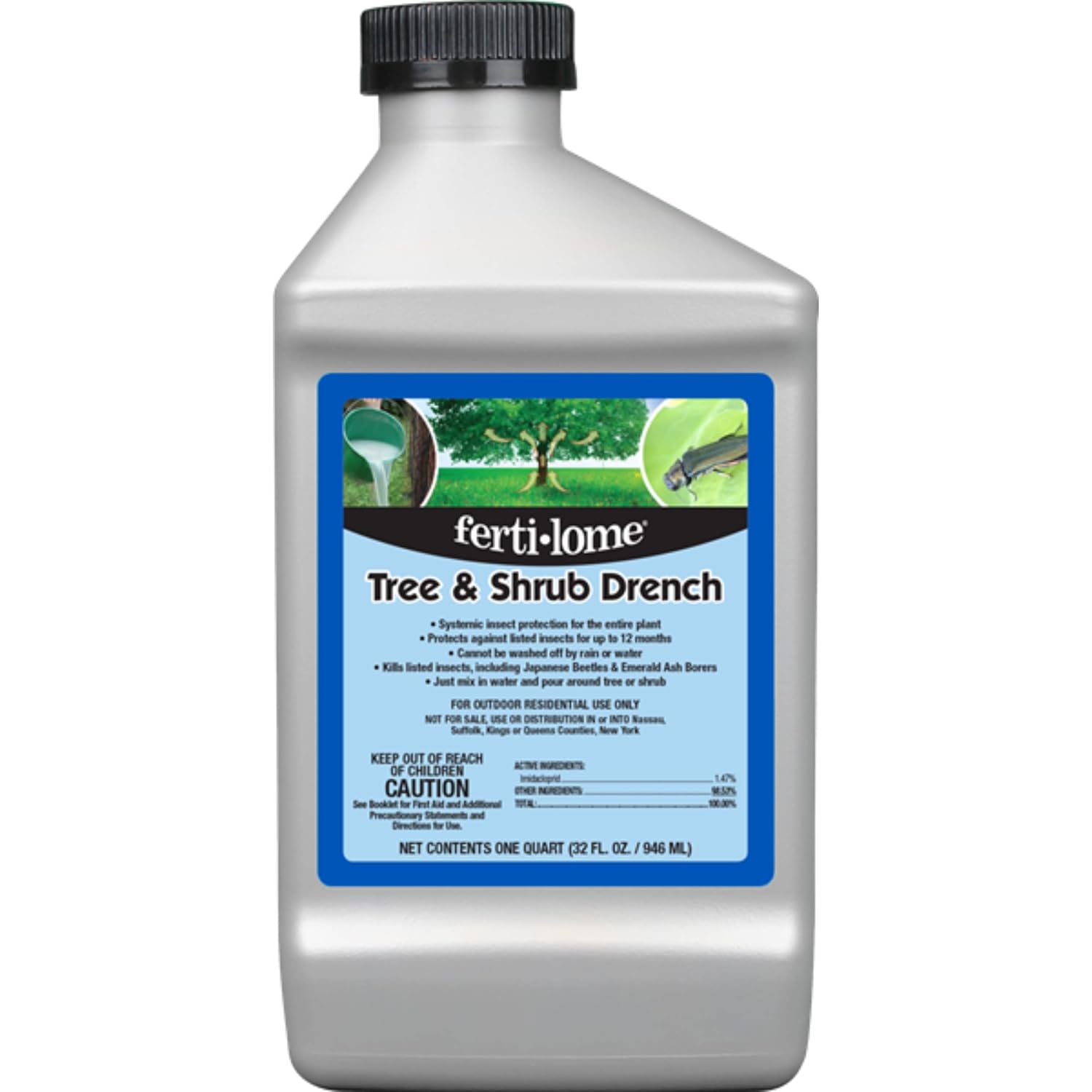
ferti-lome Tree & Shrub Drench Systemic Insecticide, 32 oz
| Unit Count | 32 Ounce |
|---|---|
| Item Form | Liquid |
| Target Species | Fungus |
| Special Features | Long-Lasting, Weather-Resistant |
| Active Ingredients | Imidacloprid |
The ferti-lome Tree & Shrub Drench is a soil-applied systemic insecticide designed to protect ornamental trees and shrubs from sap-feeding pests. Mix the 32 oz concentrate with water and pour the solution around the root zone; the active ingredient is taken up by the plant and provides long-lasting, weather-resistant control for up to 12 months. It is typically used in early spring or early fall and labeled for pests such as aphids and psyllids plus other listed species, which makes it a low-effort option for season-long protection. Notable features include an OMRI specification and an imidacloprid active ingredient that delivers reliable systemic activity. Practical benefits are ease of application, single annual treatment timing, and durable protection that reduces the need for repeated foliar sprays. Important limitations are that it targets sap-feeding insects and fungal pests per the label rather than broad-spectrum contact control, and it must be applied according to safety directions because of the systemic insecticide chemistry.
Best for: Gardeners and property owners who prioritize dependable, low-maintenance control of sap-feeding insects on trees and shrubs and prefer a once-a-year treatment strategy.
Less Ideal for: People needing fast contact knockdown of a wide range of pests or those who avoid systemic neonicotinoid products should consider alternative contact or non-systemic options.
- Systemic mode of action provides season-long protection from sap-feeding insects with a single annual application
- Simple soil drench application that is easy for homeowners to mix and apply
- Long-lasting and weather-resistant formula reduces repeat treatments during the growing season
- OMRI specification noted in product details
- Contains imidacloprid so users must follow safety directions and label restrictions for pollinator protection and application timing
- Not a broad-contact insecticide so it will not quickly knock down all pest types on foliage
Verdict: Choose this drench when you want a reliable, once-a-year systemic treatment to protect trees and shrubs from sap-feeding insects with minimal repeat applications.
Garden Safe Insecticidal Soap Insect Killer Spray, 32 oz

| Item Form | Spray |
|---|---|
| Target Species | Insects |
| Liquid Volume | 32 fluid ounces |
| Active Ingredients | Potassium Salts Of Fatty Acids |
Garden Safe Insecticidal Soap is a ready-to-use contact spray formulated with potassium salts of fatty acids to control soft-bodied pests such as aphids, mealybugs, mites, thrips, whiteflies and scale insects. You apply it by thoroughly wetting all plant parts, including leaf undersides, and it works when sprayed directly onto the pests. It is versatile for use on vegetables, fruit trees, ornamentals, shrubs, flowers and in greenhouses and can be used up to the day of harvest for edible crops. Notable practical benefits are that no mixing is required, the soap-based active ingredient is appropriate for organic-minded gardeners, and repeated applications are straightforward because it is gentle on many plants when used as directed. Important limitations are that it is a contact-only product so it will not control hidden or crawling stages you cannot reach, and treatments can be washed off by rain or moved by wind so timing and coverage matter for effectiveness.
Best for: Gardeners who prioritize proven, lower-toxicity options and want a ready-made spray for routine control of soft-bodied pests on ornamentals and edible plants.
Less Ideal for: Those needing systemic or residual control for deep infestations or pests hidden under bark or in crevices should consider a different mode of action.
- Ready-to-use formula requires no mixing for quick application
- Label permits use on edibles up to the day of harvest
- Soap-based active (potassium salts of fatty acids) suitable for organic-style gardens
- Effective against a broad list of soft-bodied pests including scale when contacted
- Contact-only action requires thorough coverage and will not affect pests out of reach or in protected stages
- Susceptible to wash-off by rain and drift in windy conditions
Verdict: Choose this ready-to-use insecticidal soap when you want a low-toxicity, contact spray that is safe for use on food crops and effective against scale when you can achieve full coverage.
Choosing the Right Insecticide for Scale Insects: Key Factors to Consider
Mode of Action and How It Targets Scale
Different insecticide modes of action determine which life stages of scale insects you will control. Contact insecticides need to physically reach crawler stages to be effective, while systemic products move through plant tissues and can control feeding nymphs and adults that are hard to spray.
Understanding mode of action also helps avoid resistance buildup. Rotating between products with different biochemical targets or combining a contact treatment timed for crawler emergence with a systemic application can improve long-term control without relying on a single chemistry.
Plant Safety and Labeled Uses
Label directions specify which ornamental and edible plants a product can be applied to and at what rates. Some insecticides have broad labels that cover trees, shrubs, houseplants, and vegetables; others are restricted to nonfood ornamentals. Always follow label constraints for application timing and maximum seasonal rates.
Plant sensitivity varies by species and by formulation. Concentrated sprays, oils, or systemic drenches can cause leaf burn or transplant stress in tender plants. Test sprays on a small area and observe for phytotoxicity before treating an entire specimen.
Timing and Life-Stage Targeting
Scale control is easiest during the crawler stage when young nymphs are mobile and exposed. Monitoring for crawler emergence and timing applications accordingly will greatly increase control without repeated blanket spraying.
For established infestations where many stages are present, combine treatments: a contact spray for crawlers plus a systemic or long-residual product to suppress hiding adults. Repeated treatments timed to the pest life cycle yield better suppression than a single broad application.
Application Method and Ease for Gardeners
Application options include foliar sprays, soil drenches, trunk or soil injections, and oil-based smothering treatments. Foliar sprays and horticultural oils are straightforward for small gardens and containers, while soil drenches or trunk injections may be preferred for large trees or when systemic movement is needed.
Consider equipment you already own. Hose-end sprayers and backpack sprayers cover large areas quickly but can be less precise. Hand sprayers and syringe-style applicators are useful for spot treatments on prized specimens or houseplants.
Residual Control and Reapplication Schedule
Residual activity affects how often you must reapply. Short-residual contact products often require multiple treatments spaced to match crawler emergence, while systemic treatments can offer weeks to months of protection depending on product and plant uptake.
Balance the convenience of longer residual control with concerns about non-target exposure. Longer persistence can reduce gardener labor but may increase impacts on beneficial insects if not applied carefully.
Environmental and Non-Target Considerations
Consider impacts on pollinators, predatory insects, and aquatic systems. Some insecticides are toxic to beneficial insects on contact, so avoid spraying open flowers and apply treatments during low activity periods for pollinators.
Follow buffer recommendations near water and choose lower-risk formulations where possible. Horticultural oils and insecticidal soaps tend to have lower non-target toxicity when applied properly, but they are not effective against all life stages and may require more frequent applications.
Recognizing Scale Damage and Infestation Signs
Scale insects often show up as small bumps on stems, leaves, or fruit; heavy infestations cause yellowing, sticky honeydew, sooty mold, and branch dieback. Different scale types look distinct: armored scales form a hard shell that is difficult to penetrate, while soft scales often exude honeydew and attract ants.
- Look for crawlers in spring by tapping branches over white paper or using sticky traps near infested plants.
- Check undersides of leaves and along branch junctions where crawlers settle and begin feeding.
- Monitor plant vigor and new growth; slow or deformed shoots suggest ongoing sap-sucking damage.
Monitoring and Timing Applications
Set a monitoring schedule in spring and early summer when many species produce crawlers. Sticky tape, double-sided tape, or simple branch tapping can reveal crawler activity so you can apply contact treatments at the most vulnerable stage.
If monitoring shows staggered crawler emergence, plan a follow-up treatment 7 to 14 days after the initial spray. For systemic options, apply when plants are actively taking up water for best distribution within tissues.
- Record dates of first crawler detection and follow up in the lifecycle window noted on the product label.
- Avoid blanket calendar-based spraying; use monitoring data to reduce unnecessary applications.
Using Horticultural Oils and Soaps Safely
Horticultural oils and insecticidal soaps work by smothering or disrupting the insect's cuticle and are effective against many crawler and soft scale infestations when coverage is thorough. They have low residual toxicity and are a good first line for many ornamentals and houseplants.
Apply oils at recommended concentrations and avoid use during extreme heat to reduce phytotoxic risk. Thorough coverage is essential because these products must contact the pests directly.
- Test on a small area before treating sensitive species.
- Cover all surfaces including leaf undersides and branch collars for best effect.
When to Use Systemic Treatments
Systemic insecticides can provide control of nymphs and adults that are hidden under scale coverings or in tight crevices. They are helpful for large shrubs or trees where thorough spray coverage is impractical, or when crawlers are not easily detected.
Use systemic products in accordance with label timing and application method to ensure uptake. They can reduce the need for repeated foliar sprays but may take days to weeks to fully impact populations.
- Avoid systemic use on blooming plants to reduce exposure to pollinators until label guidance allows.
- Combine systemic applications with targeted contact sprays during heavy infestations for faster knockdown.
Spot Treatment and Mechanical Removal
For small specimens or limited infestations, physical removal can be an effective part of control. Scraping off scales with a soft brush or using cotton swabs dipped in alcohol can remove overwintering adults and reduce population pressure.
Mechanical removal is especially useful on slow-growing or valuable specimens where chemical use is limited or undesirable. Follow up with monitoring and targeted treatments to address remaining crawlers.
- Prune heavily infested branches to reduce overall pest load and improve spray access.
- Sanitize tools and dispose of removed material to avoid spreading crawlers.
How We Chose the Best Insecticide for Scale Insects
We shortlisted products that are proven to address scale insects across typical garden settings and on a range of host plants. Selection focused on control strategy, spectrum of activity against armored and soft scales, and safety for commonly treated ornamentals and edible crops. We prioritized options with clear application instructions and realistic reapplication intervals so home gardeners can plan treatments without guesswork. Concrete evaluation criteria included mode of action and life-stage control, plant safety and labeled uses, residual control and reapplication frequency, ease of application for hobby gardeners, and environmental considerations such as non-target impacts. We excluded products labeled only for greenhouse or commercial use and any formulations lacking clear homeowner directions. Products lacking labeling for common ornamental plants or edible crops were not considered. This approach favors practical, safe, and effective treatments that amateur gardeners can use with predictable results.
FAQ
How do I tell armored scale from soft scale?
Armored scales have a separate hard covering and do not excrete honeydew, while soft scales are more blob-like and often produce sticky honeydew. Visual inspection of exudates and the scale covering helps you choose control tactics because armored scales are harder to penetrate with contact sprays.
Can I treat edible plants with these insecticides?
It depends on the product label. Some insecticides are labeled for use on vegetables and fruit trees with specified preharvest intervals, while others are restricted to ornamentals. Always follow label directions for edible crops and observe withholding periods before harvest.
Will horticultural oil harm bees and beneficial insects?
Horticultural oils have low residual toxicity and are generally less harmful, but they can kill beneficial insects on contact. Apply oils when pollinators are not active and avoid spraying open flowers to reduce risk to bees.
How often should I reapply treatment during an outbreak?
Reapplication frequency depends on the product and life stage targeted. Contact products often require treatments timed with crawler emergence every 7 to 14 days, while systemic products may provide several weeks of control. Follow label guidance and use monitoring to schedule follow-ups.
Are trunk injections necessary for scale control on trees?
Trunk injections can deliver systemic active ingredients directly into the sap stream for large trees where foliar coverage is impractical. They are a useful option for high-value trees but require proper technique and adherence to label instructions.
What non-chemical options can help reduce scale pressure?
Cultural measures such as pruning infested wood, promoting plant vigor with proper irrigation and fertilization, and encouraging natural predators can lower scale populations. Sticky barriers and ant control can also reduce honeydew-mediated protection of soft scales.
Final Verdict
Focus on timing and compatibility when choosing an insecticide for scale insects. Match the product mode of action to the life stages present, and prioritize plant safety and labeled uses for the host species you are treating. For small or early infestations, contact sprays, oils, and mechanical removal often work well when timed to crawler emergence. For larger plants or persistent problems, systemics provide longer protection but require careful label adherence and attention to non-target impacts. Prioritize methods that fit your garden scale, monitor results, and rotate approaches to maintain long-term control.
