

Note: This article contains affiliate links. If you click on these links and make a purchase, I may earn a small commission at no extra cost to you. This helps support my research and content. Read my full affiliate disclosure here.
If spider mites are stressing your plants, choosing the right insecticide can stop damage and reduce repeat outbreaks. You need a solution that reliably controls mites while minimizing harm to foliage, beneficial insects, and the environment. This guide covers the top shortlisted insecticides for spider mites and explains how each option performs on effectiveness, plant safety, and ease of use. We evaluated candidates for speed of control, residual activity, and compatibility with common garden plants and integrated pest management. Read on to see the practical strengths gardeners should weigh before applying treatments.
Top Picks at a Glance
| Best Overall The best all-around choice for most situations | Trifecta Crop Control Ready-to-Use Maximum Strength Plant Spray (32 fl oz) |  |
| Best Quality Built to a higher standard if you want something more solid | Atticus Fervid Abamectin Insecticide/Miticide (32 oz) |  |
| Best Value The sweet spot between price and what you get | BioAdvanced 3-in-1 Insect, Disease & Mite Control Concentrate, 32 oz |  |
| Best Budget The cheapest option that still gets the job done reliably | Bonide Captain Jack's Mite-X Houseplant Spray, 12 oz |  |
| Highest Rated A top-rated pick with lots of positive feedback | Monterey Mite & Insect Control, 16 fl oz (with measuring spoon) |  |
| Most Popular A crowd favorite that many people choose with confidence | Bonide Captain Jack's Deadbug Brew Ready-to-Use Spray, 32 oz |  |
| Best Seller A high-volume bestseller chosen again and again | Bonide Captain Jack's Ready-to-Use Neem Oil Spray, 32 oz |  |
Trifecta Crop Control Ready-to-Use Maximum Strength Plant Spray (32 fl oz)

| Unit Count | 32 Fluid Ounces |
|---|---|
| Item Form | Spray |
| Recommended Use | Indoor, Outdoor, Greenhouses |
| Strength | Maximum Strength (20:1) |
Trifecta Crop Control Ready-to-Use is a plant-based spray designed to knock down spider mites, aphids, whiteflies, fungus gnats and powdery mildew on vegetables, ornamentals and houseplants. It is applied with a trigger sprayer or mister to thoroughly wet foliage, including undersides, and can be used every other day during active infestations until control is achieved, then weekly for maintenance. The formula is fast drying and formulated to leave no long-term residue, which makes it practical for edible crops when stopped two weeks before harvest. Notable features include an all-natural, biodegradable formula and instructions that recommend treating at dusk to avoid foliage damage. Important limitations are that it requires thorough coverage to work well and repeated applications for heavy infestations, and users should wear eye protection and gloves during handling. It is not a single-application cure for large outbreaks but is useful as part of an integrated pest management routine.
Best for: Buyers who want a natural, easy-to-use product to manage spider mites and other soft-bodied pests on both garden and houseplants and who prefer to avoid synthetic pesticides.
Less Ideal for: Commercial growers or users seeking a single systemic fix for severe, widespread infestations should consider concentrated or professional treatments instead.
- Plant-based, biodegradable formula safe for edible crops when used as directed
- Effective against a broad range of soft-bodied pests and common plant fungi including powdery mildew
- Ready-to-use with a trigger sprayer for easy application on indoor and outdoor plants
- Fast-drying, low-residue formula so treated plants do not retain detectable buildup
- Requires thorough, repeated coverage for best results on severe infestations
- Not a systemic treatment so it only affects pests contacted by spray
Verdict: A versatile, plant-based ready-to-use spray that reliably controls spider mites and common fungal problems for gardeners who prefer natural, low-residue solutions.
Atticus Fervid Abamectin Insecticide/Miticide (32 oz)

| Unit Count | 32 Fluid Ounces |
|---|---|
| Active Ingredients | abamectin |
| Formulation | Emulsifiable Concentrate |
| Target Species | Aphids, thrips, whiteflies, leafminers, mites |
| Specification Met | EPA |
Fervid is a professional-style miticide/insecticide that uses 2.0% abamectin to stop feeding pests on ornamental plants, greenhouses and nurseries within hours after ingestion. It is applied as a foliar spray and is designed to move from the leaf surface to the underside, which helps reach mites and leafminers hiding on the lower leaf surface. Notable features include a rainfast formulation that dries with low odor and minimal residue and a Tip N’ Measure bottle that simplifies mixing. Practical benefits for performance-focused users are quick knockdown of spider mites and suppression of aphids, thrips and whiteflies, predictable systemic activity for hard-to-reach infestations, and suitability for landscape ornamentals, shadehouses and greenhouse use. Important limitations are that it is not labeled for turf, requires careful adherence to the label for safe use, and it targets primarily feeding/sucking pests rather than broad-spectrum chewing insect control. As with any abamectin product, follow retreatment interval and application restrictions to avoid resistance and protect beneficials.
Best for: Gardeners and greenhouse managers who prioritize fast, reliable control of spider mites and other sap-feeding ornamental pests and who are comfortable following professional-use label directions.
Less Ideal for: Homeowners seeking a multipurpose insecticide for turf or broad-spectrum chewing pests or those who prefer non-chemical or organic controls should consider alternatives.
- Contains 2.0% abamectin for fast systemic control of mites and leafminers
- Formulation moves into the leaf so undersurface pests are reached with standard spray coverage
- Rainfast once dry for protection against short showers
- Low odor and minimal visible residue after drying
- Tip N’ Measure bottle design simplifies measuring and pouring
- Not labeled for turf use and limited to ornamental and greenhouse applications
- Requires strict label-following for safe and effective use, including retreatment intervals
Verdict: If you need fast, professional-strength control of spider mites and other sap-feeding ornamental pests, Fervid delivers rapid systemic knockdown and reliable residual performance.
BioAdvanced 3-in-1 Insect, Disease & Mite Control Concentrate, 32 oz
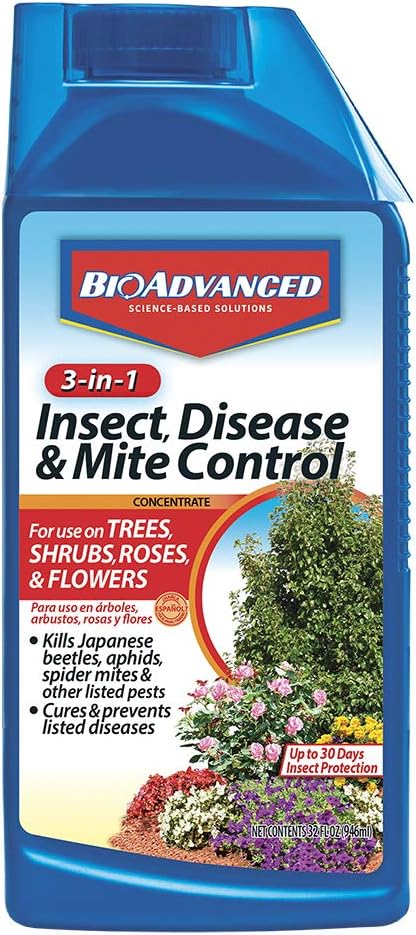
| Unit Count | 32 Fluid Ounces |
|---|---|
| Item Type Name | Concentrate |
| Active Ingredients | Imidacloprid, Tau-fluvalinate, Tebuconazole |
| Specification Met | EPA |
This BioAdvanced concentrate mixes with water to make up to 12 gallons of spray and delivers combined insect, disease, and mite control in one product. In practice you dilute it into a handheld or pump sprayer and treat roses, flowers, shrubs, trees, ground covers, and ornamentals to kill aphids, spider mites, Japanese beetles, caterpillars, and other listed pests while also helping prevent common fungal diseases such as powdery mildew and black spot. Key active ingredients include imidacloprid, tau-fluvalinate, and tebuconazole, which provide contact and systemic action and claim rainproof protection lasting up to 30 days. The main benefits are convenience and broad coverage from a single concentrate and useful residual control that reduces treatment frequency. Important limitations are regulatory restrictions in several states and that it is a concentrated pesticide that requires careful measuring, proper protective equipment, and adherence to label directions for safe use around desirable plants and pollinators.
Best for: Gardeners who want a single, efficient product to manage pest and fungal problems across roses and ornamental beds and who prioritize reducing repeat treatments.
Less Ideal for: People looking for an organic or strictly low-toxicity solution or gardeners who prefer spot treatments rather than broadcast spraying should consider alternatives.
- Combines insecticide, fungicide, and miticide so one application addresses multiple problems
- Systemic formula with up to 30 days of residual protection reduces reapplication frequency
- Concentrate mixes to make up to 12 gallons of spray, making it economical for larger yards
- Effective against a wide list of pests including spider mites and aphids
- Not sold in several states, which limits availability depending on location
- Requires careful dilution and personal protective equipment because it contains multiple active chemicals
Verdict: If you want one product to simultaneously kill spider mites, control insects, and prevent common fungal diseases with multiweek residual protection, this concentrate is a practical all-in-one choice.
Bonide Captain Jack's Mite-X Houseplant Spray, 12 oz
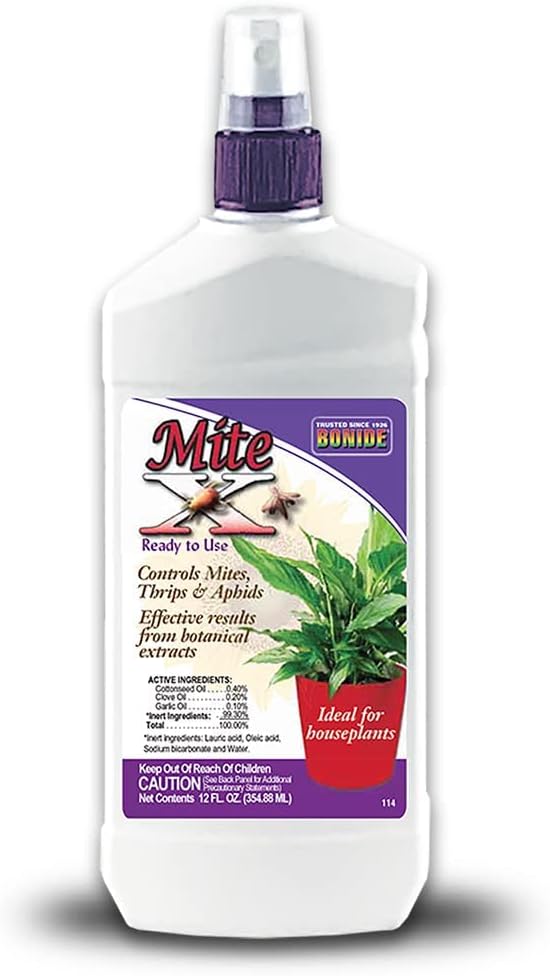
| Unit Count | 12 Ounce |
|---|---|
| Item Form | Spray |
| Target Species | Insects |
| Liquid Volume | 12 fluid ounces |
| Specification Met | USDA |
Bonide Captain Jack's Mite-X is a ready-to-use contact spray formulated from botanical extracts to control mites, aphids and thrips on herbs, ornamentals and houseplants. You use it like any spray bottle product: target infested foliage and wet insects directly since it requires contact to kill pests. The product is convenient for spot treatments and can be applied up to the day before harvest, making it suitable for edible container herbs. Notable features include a trigger sprayer for easy application and a formula based on cottonseed, clove and garlic extracts rather than synthetic chemicals. For budget-minded gardeners this bottle provides a simple, low-effort way to suppress outbreaks without mixing concentrates. Limitations are that it is a contact spray so it will not control hidden or egg-stage pests and repeated applications are often necessary for full control; heavy infestations may need a more systemic or residual product. Follow safety guidance on the label when using around people and pets.
Best for: Gardeners who want a low-cost, easy-to-use spray to quickly knock down visible spider mites and other small insects on houseplants and container herbs.
Less Ideal for: Growers facing large-scale or chronic mite infestations who need systemic or long‑lasting control should consider stronger or professional options.
- Ready-to-use trigger spray requires no mixing
- Botanical active ingredients suitable for use up to day before harvest
- Effective on contact against mites, aphids and thrips
- Designed for both indoor and outdoor houseplants
- No residual or systemic activity so eggs and hidden pests may survive
Verdict: A convenient, budget-friendly botanical contact spray that quickly knocks down visible spider mites and other small pests on houseplants.
Monterey Mite & Insect Control, 16 fl oz (with measuring spoon)

| Active ingredient | Bifenthrin |
|---|---|
| Volume | 16 fl oz |
| Indoor residual | Up to 4 months |
| Outdoor residual | Up to 6 weeks |
| Application method | Tank sprayer |
Monterey Mite & Insect Control is a ready-to-use foliar and surface treatment formulated with bifenthrin to kill and repel a broad range of pests, including spider mites, ants, roaches, fleas, and ticks. It is designed for use on lawns, roses, shrubs, trees, flowers and vegetable gardens as well as indoor problem areas. The product is applied with a tank sprayer for treating larger areas and provides extended residual control—up to four months indoors and about six weeks outdoors for listed pests—so you do not need to reapply frequently. The label includes safety directions such as wearing eye protection and gloves when handling the concentrate. Because it contains bifenthrin, it offers fast knockdown and long-lasting control, but users should follow label precautions and avoid unnecessary contact with beneficial insects and pollinator-attractive blooms. This product is best when used as part of an integrated approach to mite management rather than the only tactic for severe infestations.
Best for: Gardeners and homeowners who prioritize dependable, long-lasting pest suppression for ornamental plants, lawns and indoor problem spots and who follow label safety practices.
Less Ideal for: Those seeking an organic or pollinator-safe miticide or people unwilling to use a synthetic pyrethroid should consider alternative, selective products.
- Broad-spectrum control that covers spider mites and many common garden and household pests
- Ready-to-use formulation with measuring spoon for straightforward tank-sprayer application
- Long residual protection indoors (up to 4 months) and several weeks outdoors reduces reapplication frequency
- Contains bifenthrin which can harm beneficial insects and requires careful safety precautions when handling and applying
- Not a selective miticide so repeated use may impact pollinators if applied to flowering plants
Verdict: Choose this product when you need reliable, long-lasting control of spider mites and other pests across indoor and garden areas.
Bonide Captain Jack's Deadbug Brew Ready-to-Use Spray, 32 oz

| Item Form | Spray |
|---|---|
| Target Species | Insects |
| Liquid Volume | 32 fluid ounces |
| Active Ingredients | Spinosad (spinosyn A and D) – 0.5% |
Bonide Captain Jack's Deadbug Brew is a ready-to-use insecticide containing 0.5% spinosad that targets caterpillars, beetles, thrips and many other chewing and some soft-bodied pests while being approved for organic gardening. You use it like a typical foliar spray: shake, then thoroughly coat tops and undersides of leaves with the trigger nozzle to reach feeding sites. Its main practical benefit for ornamental and edible gardens is selective activity against target pests with minimal disruption to many predatory insects when applied as directed, which helps preserve natural biological control. The RTU format and 32 oz bottle make it convenient for spot treatments and regular applications during an outbreak. Important limitations are that spinosad is most effective on contact or shortly after ingestion so complete coverage is necessary, and it does not control every pest species equally so identification matters before treatment. Also follow label safety instructions and avoid spraying when pollinators are active to reduce non target exposure.
Best for: Gardeners who want an organic-approved, easy-to-use foliar spray to manage outbreaks on vegetables, fruits and ornamentals while preserving beneficial insects as much as possible.
Less Ideal for: Users who need systemic or long residual control, or who prefer a single product to cover a wide range of nonlisted pests should consider other options.
- Approved for organic gardening and contains spinosad, a naturally derived active ingredient
- Ready-to-use spray with a trigger nozzle for immediate application
- Effective against a broad list of chewing pests and some soft-bodied insects
- Formulation is reported to have lower impact on many predatory beneficial insects when used correctly
- Requires thorough leaf coverage for good control because activity is mainly by contact or ingestion
- Not equally effective against all pest types so correct pest ID is necessary
Verdict: Choose this ready-to-use spinosad spray when you want an organic-approved, low-impact foliar treatment to quickly knock down many common chewing pests while preserving beneficials.
Bonide Captain Jack's Ready-to-Use Neem Oil Spray, 32 oz

| Liquid Volume | 32 fluid ounces |
|---|---|
| Item Form | Liquid |
| Target Species | Insects |
| Active Ingredients | Clarified Hydrophobic Extract of Neem Oil |
Bonide Captain Jack's 32 oz Ready-to-Use Neem Oil spray is a convenient spray-on solution for controlling common garden pests and fungal problems. In practice you shake the bottle and spray plant surfaces including leaf undersides at the first sign of infestation or disease, then reapply every 7 to 14 days as needed. The active clarified hydrophobic extract of neem oil acts on insects at multiple life stages and is explicitly labeled to control spider mites, aphids, whiteflies and similar pests while also helping prevent powdery mildew and other fungal issues. Because it is approved for organic gardening and comes ready to use in a trigger bottle, it is easy for hobby gardeners or busy homeowners to add to routine plant care without mixing concentrates. Limitations are that it is a contact and residual product so thorough coverage is essential and severe infestations may need repeat treatments or complementary controls. Also follow safety directions to keep children and pets away and avoid spraying in peak sun to reduce plant stress.
Best for: Gardeners who prefer a low-effort, organic-approved spray to manage early signs of mites, aphids, and common fungal problems without mixing concentrates.
Less Ideal for: Those needing a one-time, systemic cure for severe infestations or professional users who require concentrated, high-volume treatments.
- Ready-to-use trigger bottle requires no mixing for immediate application
- Controls insects at all life stages and is labeled effective against spider mites
- Also functions as a fungicide to help prevent powdery mildew and other diseases
- Approved for organic gardening so suitable for edible plants up to harvest
- Requires thorough coverage to be effective since it is primarily a contact treatment
- May need multiple applications for heavy infestations rather than a single cure
Verdict: A ready-to-use, organic-approved neem spray that is an easy, low-risk choice for preventing and controlling spider mites and other common garden pests.
Choosing the Right Insecticide for Spider Mites: Key Factors to Consider
Mode of Action and Resistance Management
Spider mites reproduce quickly and can develop resistance when the same mode of action is used repeatedly. Rotating insecticides with different biochemical modes of action reduces selection pressure on mite populations and preserves control options. When planning treatments, alternate between contact miticides, systemic options where labeled, and non-chemical controls such as horticultural oils or biological predators.
Understanding the active ingredient group matters for long-term control. Choosing products with clear mode-of-action labeling helps you create a rotation schedule and avoid unintentionally applying similar chemistries back-to-back, which is a common cause of control failure.
Phytotoxicity and Plant Sensitivity
Some insecticides can burn or discolor foliage, especially on tender new growth, shade-grown plants, or when applied under hot, sunny conditions. Always check label guidance for temperature restrictions, dilution rates, and plant tolerance notes. A product that is gentle on tomatoes or ornamentals may still harm succulents or azaleas.
Spray tests on a small section of plants and observing for 48 to 72 hours reduces the risk of widespread damage. Consider contact options with low phytotoxic potential or use lower-concentration applications followed by observation before treating entire beds or greenhouse benches.
Coverage and Application Method
Spider mites hide on the undersides of leaves and inside dense growth, so thorough coverage is essential. Liquid sprays, drenches, and foliar concentrates vary in how well they reach mites. Spray equipment that produces fine, even droplets and allows you to coat leaf undersides improves efficacy. Systemic treatments applied as soil drenches can reach feeding mites indirectly through plant tissues, but they may act slower.
Think about the size of the area you manage and the equipment you already own. Handheld sprayers are fine for potted plants and small beds, while larger landscapes may need backpack sprayers or specialized nozzles to ensure adequate coverage.
Residual Action Versus Contact Control
Contact insecticides kill mites on contact and can provide rapid knockdown but often lack lasting protection. Residual products or systemic options may continue to suppress mite populations after application and can reduce the need for repeat sprays. Balance the immediacy of contact control with the convenience of residual activity depending on infestation severity and your tolerance for repeated applications.
Keep in mind that longer residual control can increase exposure to non-target species. Use residual products thoughtfully in flowering crops or areas where beneficial insects are active.
Compatibility with Beneficial Organisms
Many gardeners rely on predatory mites, lacewings, ladybugs, and other beneficials to keep pest populations manageable. Some insecticides are broad-spectrum and will harm or kill these helpful organisms, undermining integrated pest management. Look for products labeled as compatible with biological control agents or that have reduced impact on beneficial predators.
When introducing natural enemies, coordinate the timing of chemical applications to avoid wiping out released or resident beneficials. If you plan regular biological control, prioritize selective miticides and cultural tactics that support predator populations.
Safety, Handling, and Environmental Considerations
Consider human and pet safety when selecting an insecticide formulation. Labels provide mixing instructions, personal protective equipment requirements, and reentry intervals. Choose formulations and application practices that fit your comfort level with mixing concentrates and disposing of leftover material.
Also weigh environmental fate. Some active ingredients bind to soil or break down quickly, while others persist. For containers, rooftop gardens, and areas near pollinator habitat, favor products with lower environmental mobility and clear guidance on protecting non-target plants and insects.
When to Treat Versus When to Scout
Not every sighting of spider mites requires immediate spray action. Low-level infestations can sometimes be suppressed with increased watering, improved humidity, or by introducing predators. Use regular scouting to monitor egg presence, webbing, and damage progression before committing to a chemical control.
Treat when you find active feeding across multiple leaves, visible webbing that shelters colonies, or when vulnerable plants show rapid decline. Early intervention with targeted treatments is often more effective than broad emergency sprays.
- Focus scouting on the undersides of leaves and the newest growth
- Record infestation hotspots rather than treating an entire garden at once
- Combine cultural changes with targeted applications to reduce repeat outbreaks
Non-Chemical and Cultural Controls That Complement Treatments
Simple cultural changes reduce mite pressure. Increasing humidity around susceptible plants, spacing to improve airflow, removing heavily infested leaves, and maintaining plant vigor through balanced fertilization lower the risk of severe outbreaks.
Mechanical options such as strong water sprays can dislodge mites on many ornamentals and edibles. Integrate these practices with selective insecticides to reduce the number of chemical applications needed and to preserve beneficials.
- Use focused water sprays for light infestations
- Adjust irrigation and shading to reduce plant stress
- Introduce or conserve predatory mites where practical
Application Tips to Reduce Plant Damage
Avoid applying treatments during midday heat or when plants are drought stressed. Early morning or late evening applications reduce the risk of phytotoxicity and improve spray retention on leaves. Always follow label dilution rates and avoid doubling concentrations in hopes of better control.
Target leaf undersides and dense canopy pockets. For foliar sprays, use enough volume to wet the leaf surface but not to cause runoff. When testing on sensitive species, treat a single plant and wait two to three days to watch for adverse reactions before broader use.
- Test sprays on a small area before whole-plant application
- Rinse sprayers thoroughly between different chemistries
- Wear recommended protective gear and keep people and pets away until reentry times have passed
Integrating Treatments Into an IPM Plan
Treatments are most effective when combined with monitoring, cultural controls, and biologicals. Use thresholds to guide action rather than spraying on a schedule. After applying a contact treatment, continue scouting and consider follow-up with a different mode of action if counts remain high.
Record dates, products used, and observed results to refine your rotation plan. This record-keeping protects control options and helps identify patterns such as seasonal spikes or treatment failures that need alternative approaches.
- Rotate modes of action to delay resistance
- Time applications to target vulnerable mite life stages
- Keep treatment records for future decision making
Safe Disposal and Post-Treatment Care
Dispose of leftover spray mix and rinsate according to label instructions to avoid contaminating soil or water. Clean equipment outside of areas where sensitive plants are grown to prevent accidental contamination.
After treatment, monitor treated plants for recovery signs and for any unintended effects on beneficial insects. If non-target harm occurs, adjust future choices toward more selective options and increase reliance on cultural controls.
- Follow label guidance for triple-rinsing containers
- Avoid disposing of sprayer rinse water in flower beds or near water bodies
- Observe treated plants for a week to confirm recovery
How We Chose the Best Insecticide for Spider Mites
We prioritized treatments that deliver consistent control of spider mites across common garden and container plants. Selection focused on demonstrated mite knockdown and reproductive suppression without relying on unsupported claims. We excluded products intended only for other pests or that lack clear usage directions for ornamental and edible plants. Evaluation criteria included speed of activity against all life stages of spider mites, phytotoxicity risk on a range of plant types, application flexibility for foliar and soil uses, and compatibility with biological controls and IPM strategies. We also considered residual protection and safety for people handling treated plants. Products were filtered for clear labeling, realistic application rates, and availability in formulations appropriate for home gardeners and small-scale growers.
FAQ
How soon will I see results after applying an insecticide for spider mites?
Results often appear within 24 to 72 hours for contact treatments that knock down active mites. Population suppression may take longer because eggs are not always affected, so follow-up monitoring and repeated applications timed to hatch cycles are usually necessary.
Can I use the same insecticide repeatedly without problems?
Repeated use of the same chemistry increases the risk of resistance. Rotate between products with different modes of action and integrate non-chemical methods to maintain long-term control.
Will insecticides harm beneficial insects and pollinators?
Some products are broad-spectrum and can harm beneficials. Apply treatments when pollinators are not active, avoid spraying blooms, and select options labeled as reduced-risk to natural enemies where possible.
Are systemic treatments effective against spider mites on ornamentals and edibles?
Systemic treatments can reduce mite feeding by making plant tissue less suitable, but they may act slower than contact options. Their usefulness depends on label allowances for the specific plant and whether rapid knockdown is needed.
How should I apply sprays to reach mites hiding under leaves?
Use a sprayer that produces fine, even coverage and aim to spray leaf undersides and inner canopy pockets. Increasing spray volume and working methodically is more important than higher concentration for improving coverage.
Can water sprays alone control light infestations?
Strong water sprays can reduce mite numbers on many plants and are a good first step for light infestations. Combine mechanical removal with cultural changes to reduce the need for chemical interventions.
Final Verdict
Focus on the balance between fast mite knockdown and protecting plants and beneficials when choosing an insecticide for spider mites. Prioritize products that fit into a rotation plan, have clear label directions for the plants you grow, and match your application equipment and tolerance for repeat sprays. Use scouting and cultural controls to reduce reliance on chemicals, and choose selective options when biological control is part of your strategy. With thoughtful selection and proper application, you can bring mite populations under control while preserving plant health.
