

Note: This article contains affiliate links. If you click on these links and make a purchase, I may earn a small commission at no extra cost to you. This helps support my research and content. Read my full affiliate disclosure here.
Dealing with black ant infestations requires products that stop foraging trails, remove nests, and minimize harm to people, pets, and garden plants. Choosing the right black ant killer matters because some formulations work quickly but offer only temporary suppression, while others eliminate colonies over time. This guide covers the seven top-rated options for indoor and outdoor use, each shortlisted for real-world effectiveness and manageable safety profiles. We evaluate how well each approach controls trails, targets nests, and fits different application sites so you can pick the option that suits your situation. Read on to see the practical strengths and limitations of each shortlisted solution before the product list.
Top Picks at a Glance
| Best Overall The best all-around choice for most situations | Raid Ant Killer Baits, 8 Count (Child-Resistant) |  |
| Best Quality Built to a higher standard if you want something more solid | Syngenta Advion Ant Gel (4 Tubes, 30 g each) |  |
| Best Value The sweet spot between price and what you get | TERRO Liquid Ant Killer 3-Pack (T200-3SR) |  |
| Best Budget The cheapest option that still gets the job done reliably | Combat Max Ant Killing Gel, 27 g Syringe |  |
| Most Popular A crowd favorite that many people choose with confidence | TERRO Liquid Ant Killer Bait Stations, 12-Pack (T300B) |  |
| Best Seller A high-volume bestseller chosen again and again | Ortho Home Defense Insect Killer for Indoor & Perimeter, 1.33 gal. with Comfort Wand |  |
Raid Ant Killer Baits, 8 Count (Child-Resistant)
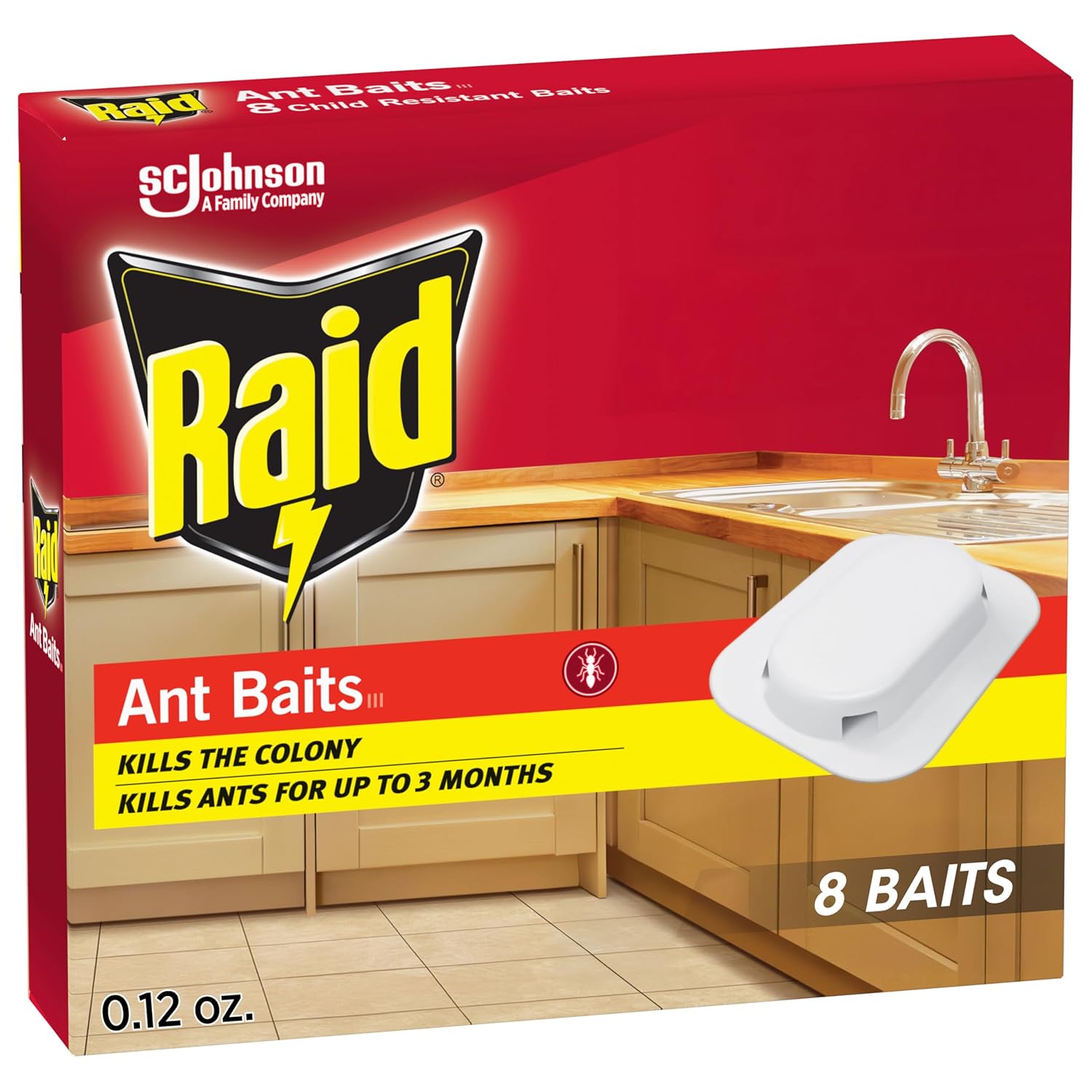
| Package quantity | 8 Count |
|---|---|
| Child safety | Child-resistant |
| Intended use | Indoor |
| Effect duration | Up to 3 months |
These Raid Ant Killer Baits are small, ready-to-use indoor stations that dispense an attractive liquid bait ants carry back to the colony, which can eliminate the nest over time. You place the bait along walls, in corners, and near entry points where small ants forage; after ants feed, the active ingredient is shared with other colony members, including the queen, and protection can last for weeks. The child-resistant design reduces accidental access in homes with children while the compact stations are low-profile and easy to position. Because they are prefilled and disposable, there is no mixing or measuring, which makes them convenient for quick treatment in kitchens, pantries, and baseboards. Limitations are that the product is for indoor use only and may be less effective if competing food sources are left available or if multiple heavy infestations require broader perimeter treatment. For someone looking for a simple, no-fuss bait to try first, these are a practical option.
Best for: Budget-minded homeowners or renters who want an easy, low-effort indoor solution to control small ant trails and try baiting before calling for broader treatments.
Less Ideal for: People needing immediate knockdown for very large or outdoor ant colonies or those who prefer non-chemical mechanical control methods.
- Ready-to-use prefilled bait stations that require no setup
- Child-resistant design reduces accidental access
- Bait formula is transferred through the colony to target the queen
- Compact, low-profile stations are easy to place along walls and entry points
- Intended for indoor use only, not suited for outdoor colony control
- May be less effective if other food sources are available or in very large infestations
Verdict: A low-cost, no-fuss indoor bait station that effectively targets small ant colonies by having foragers carry bait back to the nest.
Syngenta Advion Ant Gel (4 Tubes, 30 g each)

| Unit Count | 4.23 Ounce |
|---|---|
| Included Components | 4 Tubes x 30-Grams, 1 Plunger and 2 Tips |
| Item Form | Gel |
| Active Ingredients | 0.05% indoxacarb |
| Target Species | Insects |
Advion Ant Gel is a user-friendly gel bait intended to control common household and structural ant species by exploiting worker foraging behavior. You apply small spots or short lines of the odorless gel along active trails, in cracks and crevices, and near entry points; foraging workers consume the bait and carry it back to the nest where it is shared, helping to eliminate the queen and other nestmates. The kit ships with four 30 g tubes plus an applicator plunger and tips for precise placement, which makes targeting tight spaces straightforward. Its non-repellent formula with 0.05% indoxacarb is formulated to be attractive to a range of species including Argentine and carpenter ants, and it is labeled for both indoor and outdoor use. Limitations to note are that it is a chemical bait so safety precautions are needed around children and pets and efficacy depends on ants accepting the bait matrix versus other available food sources.
Best for: Homeowners and renters who want a targeted, easy-to-apply solution to eliminate established ant infestations and prefer a bait that works via worker-mediated transfer to treat whole colonies.
Less Ideal for: People seeking non-chemical or immediate-contact kill methods or those who need a one-time spray rather than ongoing baiting strategies should consider other options.
- Non-repellent gel formulation designed for worker ants to feed and transfer bait to the colony
- Includes four 30 g tubes plus a plunger and application tips for precise placement
- Labelled for both indoor and outdoor use, suitable for common pest species
- Odorless formula that is easy to place along trails, cracks, and crevices
- Contains a chemical active ingredient so it must be kept away from children and pets
- Effectiveness depends on ants preferring the bait over other available food sources
Verdict: Choose Advion Ant Gel when you want a precise, bait-based solution that encourages workers to carry poison back to the nest for colony-level control.
TERRO Liquid Ant Killer 3-Pack (T200-3SR)

| Item Form | Liquid |
|---|---|
| Active Ingredients | Sodium Tetraborate Decahydrate (Borax) 5.40% |
| Target Species | Insects |
| Specification Met | EPA |
TERRO Liquid Ant Killer is a straightforward indoor bait system designed to eliminate common household ants by having workers feed on a borax-based liquid and transfer it to the colony. You apply drops of the bait onto the included cardboard tiles and place them along ant trails, baseboards, counters, and other activity hotspots. The 3-pack gives multiple bait stations for treating several rooms or repeated placements. The active ingredient, sodium tetraborate decahydrate, works slowly enough to be shared among nestmates so the queen and hidden workers are affected, which can produce visible reductions in a few days. Because the formulation is liquid and comes in drip bottles, placement and reapplication are simple and low-mess compared with granular or spray options. Limitations are that the product is intended for indoor use only and requires ants to find and feed on the bait, so heavily contaminated or outdoor nests may need additional measures. When used as directed it is a practical, low-effort solution for routine household infestations.
Best for: Homeowners wanting a low-effort, indoor-focused solution to eliminate sugar ants and other household species who prefer baiting over sprays.
Less Ideal for: People who need immediate knockdown of visible ants outdoors or who require a product for large external infestations should look at targeted outdoor nest treatments.
- Borax-based liquid attracts worker ants and allows transfer to the colony for more complete elimination
- Three 2 oz bottles provide multiple placements for whole-house coverage
- Simple drop application on included cardboard tiles makes setup and reapplication low-mess
- EPA specification met and formulated for common household ant species including sugar and ghost ants
- Only effective if ants discover and consume the bait, so results depend on placement and ant behavior
- Designed for indoor use and may not address outdoor nests feeding into the house
Verdict: A simple, effective indoor bait that uses borax to knock out sugar ant colonies by relying on worker-to-colony transfer.
Combat Max Ant Killing Gel, 27 g Syringe

| Active ingredient | Fipronil 0.001% |
|---|---|
| Net weight | 27 gram (0.95 oz) |
| Application | Indoor and outdoor use |
| Form | Ready-to-use gel in syringe |
Combat Max Ant Killing Gel is a syringe-applied bait that targets foraging ants and carries a fipronil-based formulation back to the nest to eliminate the queen, larvae, and workers. It is used by placing small dots of gel where ants travel or enter structures—along trails, in cracks, and near suspected nests—so foragers feed and transfer the bait to the colony. Notable features include a precise syringe applicator for tight spaces, an odorless, vapor-free gel suitable for kitchens and living areas, and a high water-content formula that encourages quick feeding and colony impact within three to five days. The product is effective on a range of common species including little black ants and odorous house ants. Important limitations are the small 27 gram syringe size, which may require reapplication or multiple tubes for larger infestations, and the need to avoid placement on areas that are routinely washed or where food contact can occur. Follow label directions to prevent contamination and do not use on electrical equipment.
Best for: Buyers who want a targeted, low-odor solution to control small black ants and other common household species by placing bait directly on trails and entry points and who prefer precise, spot treatments over broad sprays.
Less Ideal for: People facing large outdoor mound infestations or who need long-lasting perimeter protection should consider larger-capacity baits or complementary control methods.
- Syringe applicator allows precise placement in cracks, crevices, and other hard-to-reach ant pathways
- Fipronil-based formula begins working within hours and is designed to eliminate entire colonies via forager transfer
- Odorless and vapor-free gel suitable for use in kitchens, bedrooms, and living areas
- High water content encourages faster feeding by ants, speeding colony control
- Small 27 gram (0.95 oz) syringe may be insufficient for large or widespread infestations
- Must avoid areas that are routinely washed or where food is prepared, limiting placement options
Verdict: A precise, low-odor gel bait that quickly attracts and kills foraging small black ants and their colonies when applied directly to trails and entry points.
TERRO Liquid Ant Killer Bait Stations, 12-Pack (T300B)

| Unit Count | 12 Count |
|---|---|
| Item Form | Liquid |
| Target Species | Insects |
| Active Ingredients | Sodium Tetraborate Decahydrate (Borax), 5.40% |
Terro Liquid Ant Killer bait stations are prefilled, single-use traps designed for indoor control of common sugar-loving ants. You place the small stations along baseboards, in corners, under appliances, or on countertops where you see ant activity. Worker ants are drawn to the sweet liquid, feed on it, and take it back to the nest so the borax-based active ingredient can eliminate the colony over days to weeks. The product is easy to use with no mixing or setup and the 12-pack gives coverage for several rooms. Because the bait is contained inside a low-profile plastic station, it reduces incidental contact risk compared with loose sprays or powders and lasts for weeks while ants continue to visit. Limitations are that the formula targets sugar-preferring species so very protein- or grease-attracted ants may ignore it, and control can take 2 to 4 weeks for larger infestations. Also stations should be placed away from pets and children despite the contained design since the bait contains borax.
Best for: Homeowners who prioritize an easy, low-hassle indoor solution and want a bait that works at the colony level with minimal hands-on pest handling.
Less Ideal for: People who need immediate knockdown of ants or who have pets or children that frequently access treated areas and cannot reliably keep them away from placed stations.
- Ready-to-use stations require no mixing or setup
- Designed to be carried back to the nest for colony-level control
- Low-profile enclosed bait reduces messy exposure compared with loose liquids or sprays
- 12 stations provide coverage for multiple rooms or hotspots
- Formulation is sugar-based so less effective on ants that prefer protein or grease
- Control can take 2–4 weeks for large or established colonies
Verdict: A simple, low-contact indoor bait system that reliably reduces sugar-loving ant infestations by getting worker ants to carry borax back to the colony.
Ortho Home Defense Insect Killer for Indoor & Perimeter, 1.33 gal. with Comfort Wand

| Item Form | Spray |
|---|---|
| Target Species | Insects |
| Liquid Volume | 1.33 gallons |
| Active Ingredients | Bifenthrin 0.05%, Zeta-Cypermethrin 0.0125% |
This 1.33 gallon Ortho Home Defense spray is designed to treat both indoor problem spots and the outdoor perimeter of a home to reduce ants, roaches, spiders and many other crawling and flying insects. It comes with a battery-powered Comfort Wand that delivers a continuous spray so you can apply a uniform band around foundations, patios and entry points without bending or pumping. The formula with bifenthrin and zeta-cypermethrin is intended to kill on contact and establish a barrier that the manufacturer says lasts up to 12 months for ants, roaches and spiders on non-porous indoor surfaces. In real-world use that means fewer repeat treatments in busy yard perimeters and around doors and windows. The spray dries clear with minimal fumes which helps for indoor use near kitchens and living areas. Limitations are that this is a chemical insecticide so users should follow safety directions around children, pets and plants and it is not a specific solution for pests not listed on the label. For homeowners focused on strong, perimeter-level protection this product simplifies application and covers a large area per container.
Best for: Homeowners who want a performance-focused perimeter treatment to reduce recurring yard and entry-point insect problems and prefer a ready-to-use product that is easy to apply.
Less Ideal for: People seeking organic or non-chemical control methods or those who need a targeted solution for pests not listed on the label should consider alternative products.
- Includes battery-powered Comfort Wand for continuous, fatigue-free application
- Ready-to-use 1.33 gallon container covers large perimeters without mixing
- Formula creates a barrier claimed to provide up to 12 months protection against ants, roaches and spiders on non-porous indoor surfaces
- Dries clear and gives off minimal fumes, making indoor use more practical
- Contains synthetic insecticides so precautions are required around children, pets and ornamentals
- Protection claims are specific to certain species and surfaces so results vary by pest and conditions
Verdict: A powerful, ready-to-use perimeter and indoor spray for homeowners who want long-lasting, performance-oriented protection against common yard and household insects.
Choosing the Right Black Ant Killer: Key Factors to Consider
Mode of Action and How It Reaches the Nest
Different black ant killers rely on distinct modes of action, and understanding these determines whether you will see a quick drop in visible ants or a slow collapse of the colony. Contact killers act quickly where ants walk but often leave the queen unaffected, so trails can return. Baits use attractive food sources laced with slower-acting active ingredients that worker ants carry back and feed to nestmates and the queen. Biological or growth-regulator approaches interrupt reproduction and can reduce populations over several weeks.
When deciding, think about whether you need immediate suppression for indoor foragers or a longer-term colony-level solution. The mode of action also affects where and how you place treatments; baits work best where foragers will discover them repeatedly, while perimeter contact applications protect entry points.
Attractiveness to Local Ant Diets
Black ants vary in foraging preferences by season and food availability, so bait attractiveness matters. Sweet-based baits work well when ants forage for carbohydrates, while protein- or grease-based baits are better when ants are collecting protein for growing brood. Weather and nearby food sources in your home or garden influence what type of bait will get the highest uptake.
If you place a bait that does not match local preferences, workers may ignore it and the colony will remain active. Rotating bait types or observing what ants are carrying can help you choose the most attractive formulation for faster colony impact.
Safety Around People, Pets, and Plants
Ant control products range from enclosed bait stations designed to reduce non-target exposure to broadcast sprays that may contact soil, plants, or surfaces. For households with children, pets, or edible gardens, select options with clear label restrictions and low-risk formulations or enclosed placements. Also consider the time until reentry for indoor applications and any required washing of harvested produce if treatments are used near edible plants.
Following label directions reduces accidental exposure. If you plan to use treatments around raised beds or container plants, choose products formulated or registered for garden-adjacent use and follow buffer and waiting-time instructions.
Residual Activity and Weather Durability
Residual activity determines how long an applied treatment continues to affect ants after application. Some products leave a lasting barrier on soil or along foundations, reducing re-infestation risk for weeks. Others degrade rapidly in sunlight, rain, or irrigation and provide only short-term suppression.
For outdoor use, pick products with a residual profile compatible with your climate and irrigation schedule. For indoor use, consider whether residue on floors or baseboards is acceptable and how often repeat applications will be needed to maintain control.
Application Method and Practicality
How you apply an ant control product affects both safety and success. Bait stations and granular baits require placement in the path of foragers and occasional inspection. Ready-to-use sprays and dusts can be faster but need careful targeting to avoid non-target exposure. Some granular formulas can be broadcast, while others perform better when concentrated near nests or entry points.
Consider the time you can commit to placement and follow-up. If you prefer low-maintenance control, choose long-lasting bait stations or slow-acting baits that workers distribute. For immediate indoor problems, a localized spray may be the more practical choice, but expect to supplement with baits for lasting control.
Impact on Non-Target Insects and Soil Life
Ants play roles in soil aeration and pest suppression, so heavy-handed treatments can affect beneficial insects and soil organisms. Products that are highly toxic to a broad range of insects may reduce non-target populations when used outdoors. Enclosed baits and targeted nest treatments reduce collateral impact compared with wide-area broadcasts.
If you manage a vegetable patch, pollinator-friendly garden, or native plant area, weigh the tradeoff between quick eradication and preserving beneficial invertebrates. Use spot treatments and place baits away from flowering plants to minimize unintended effects.
When to Use Baits Versus Contact Treatments
Baits are the best option when your goal is colony reduction because workers pick up and carry the active ingredient back to nestmates. They are slower to produce visible results but can lead to longer-term control, especially for established outdoor colonies. Use baits along known foraging trails, near entry points, and in sheltered spots where rain or sun will not degrade them too quickly.
- Place baits where ants are already active and not in open, wet locations.
- Avoid using contact sprays immediately next to baits; contact sprays can repel workers and reduce bait uptake.
Protecting Indoor Spaces and Kitchens
For indoor infestations, prioritize contained baits and tight spot treatments rather than broad sprays. Clean up food residues and seal obvious entry points before applying treatments. In kitchens and food-prep areas, choose tamper-resistant bait stations and follow label instructions about placement and sanitation.
- Keep bait stations out of reach of children and pets and away from food prep surfaces.
- Use caulking and door sweeps to reduce future entry after ant activity subsides.
Managing Outdoor and Garden-Adjacent Infestations
Outdoor ant activity often centers around nesting sites in soil, mulch, or under pavers. For garden-adjacent infestations, use targeted placements that avoid contact with flowering plants and vegetable beds. Granular baits or targeted nest powders can be effective when placed at nest entrances or along foraging corridors.
- Observe ant activity at different times of day to find active trails and optimal bait placement.
- Avoid broadcasting insecticides over flowering plants to protect pollinators.
Seasonal Timing and Ant Behavior
Ant activity and diet preferences shift with temperature and moisture. In warm months ants forage more and may be easier to bait, while during cooler periods they forage less and may not take baits readily. Rain can wash away or dilute surface treatments, so plan applications for dry periods whenever possible.
- Target baits when ants are actively foraging and weather forecasts predict dry days.
- Reassess treatment placement after heavy irrigation or rain.
Non-Chemical Steps That Support Control
Sanitation, exclusion, and habitat modification reduce ant pressure and make chemical or bait strategies more effective. Remove open food sources, store pet food in sealed containers, and keep compost and mulch a short distance from foundations. Sealing cracks and gaps reduces easy access into buildings, making treatments more focused and successful.
- Trim vegetation away from house foundations and move woodpiles and debris off the ground.
- Store ripe fruit and fallen produce promptly to remove attractive food sources.
How We Chose the Best Black Ant Killer
We focused on real-world control of black ant infestations across indoor, outdoor, and garden-adjacent situations. Selection began with products and formulations commonly used by gardeners and homeowners for managing foraging trails and reducing colony size. We prioritized options that offer clear application methods for kitchens, patios, lawns, and planting beds. Key evaluation criteria included residual effectiveness against foragers and nest decline over time; bait attractiveness and transferability to reach the queen; safety profile and label directions for use near people, pets, and edible plants; and ease of application including placement, cleanup, and user error tolerance. We also considered the adaptability of the treatment to different infestation sizes and access points, from single trails to multiple satellite nests. We excluded treatments intended only for professional pest-control licensees, and we did not consider general household cleaners or repellents that do not reduce colony numbers. Final picks are those meeting the above filters and showing consistent effectiveness across the criteria listed.
FAQ
How long does it take to see results from ant baits?
Results often appear in a few days to a few weeks. Slow-acting baits need time for workers to feed nestmates and the queen, so visible trail reduction can be gradual but more lasting.
Can I use ant treatments near vegetable beds?
You can if the product label permits garden-adjacent use and you follow buffer and reentry instructions. Prefer enclosed baits and avoid applying broadcast sprays directly on edible plants.
Will spraying visible ants solve the colony problem?
Spraying reduces visible foragers quickly but often leaves the colony intact. For lasting control, pair spot sprays with baits or nest-targeted treatments that reach the queen.
Are bait stations safe around pets and children?
Tamper-resistant bait stations reduce exposure risk, but they are not risk-free. Place stations where pets and young children cannot access them and follow label precautions.
How often should I reapply outdoor ant treatments?
Reapplication depends on the product residual and weather. Some residual products protect for weeks, while baits may need replenishing until activity stops. Check treatments after rain and reapply if the material has been washed away.
Do non-chemical methods work for large infestations?
Non-chemical steps like sanitation and exclusion help reduce pressure but are rarely sufficient alone for large or well-established colonies. They are most effective when combined with targeted baits or nest treatments.
Final Verdict
Choose a black ant control strategy by balancing the need for immediate suppression with the goal of colony elimination. Baits that workers carry to the nest are typically the best route to long-term control, while contact treatments provide fast but short-lived relief. Prioritize approaches with appropriate safety profiles for your home and garden, and apply treatments where ants are active while protecting non-target insects. Focus on correct placement, patience with slow-acting baits, and sensible sanitation and exclusion to prevent reinfestation. With the right tactic matched to your situation, you can reduce black ant activity effectively while limiting collateral impact.
