

Note: This article contains affiliate links. If you click on these links and make a purchase, I may earn a small commission at no extra cost to you. This helps support my research and content. Read my full affiliate disclosure here.
A steady supply of nitrogen helps plants grow without the surge-and-crash cycles that stress roots and invite pests. Slow release nitrogen fertilizer delivers nutrients over weeks to months, reducing the need for frequent feeding and lowering the chance of runoff in beds, containers, and lawns. This guide shortlists seven top options gardeners commonly choose and walks through the practical tradeoffs that matter in the garden. You'll get clear criteria we used to evaluate longevity, ease of application, and suitability for different planting situations. Read on to learn which type of slow release nitrogen fertilizer fits your growing style and maintenance schedule.
Top Picks at a Glance
| Best Overall The best all-around choice for most situations | Milorganite 6-4-0 Slow-Release Fertilizer, 32 lb (with Feeding Tips Brochure) |  |
| Best Quality Built to a higher standard if you want something more solid | The Andersons Deep Green Professional-Grade Lawn Fertilizer 24-0-11 (40 lb) |  |
| Best Value The sweet spot between price and what you get | GreenView Fairway Formula Lawn Fertilizer, 33 lb (covers 10,000 sq. ft.) |  |
| Best Budget The cheapest option that still gets the job done reliably | Milorganite Slow-Release Organic Fertilizer, 5 lb |  |
| Highest Rated A top-rated pick with lots of positive feedback | Ferti-lome Slow Release Nitrogen Lawn Fertilizer 15-0-15 with Iron (2 Pack, 16 lb each) |  |
| Most Popular A crowd favorite that many people choose with confidence | Scotts Turf Builder WinterGuard Fall Lawn Food, 10 lb. |  |
| Best Seller A high-volume bestseller chosen again and again | Scotts Green Max Lawn Food (16.67 lb) |  |
Milorganite 6-4-0 Slow-Release Fertilizer, 32 lb (with Feeding Tips Brochure)

| Item Form | Pelletized |
|---|---|
| Application Method | Broadcast, Rotary or Manual |
| Coverage | 2,500 Square Feet |
| Specific Uses For Product | Lawns, Flowers and Gardens, Education |
Milorganite 6-4-0 is an organic, pelletized slow-release fertilizer intended for routine lawn and garden feeding. It is typically broadcast with a rotary or manual spreader and provides nitrogen slowly over 8 to 10 weeks, which reduces the need for frequent applications and lowers burn risk. The product contains organically complex iron for greening without the strong staining associated with iron salts and is low in soluble salts, so it performs well in warm or drier conditions. The 32 lb bag covers roughly 2,500 square feet and comes with a printed feeding and spreader tips brochure to simplify seasonal timing and application rates. Because it is made from heat-dried microbes, it also adds organic matter to improve soil structure in heavy clay or sandy soils. Limitations are that nutrient release is gradual so it is not suited to quick color fixes or rapid turf recovery, and users seeking tightly controlled N-P-K ratios or fast-acting synthetic performance may prefer a different product.
Best for: Buyers who want a low-maintenance, environmentally minded fertilizer that steadily feeds established lawns and mixed garden beds with minimal risk of burn and fewer repeat applications.
Less Ideal for: If you need rapid turf recovery, immediate color correction, or precise synthetic nutrient control for athletic fields or newly sodded lawns, choose a fast-release or specialty fertilizer instead.
- Slow-release nitrogen feeds lawns and plants for 8–10 weeks, reducing application frequency
- Low-salt formulation minimizes fertilizer burn and streaking in hot or dry conditions
- Organically complex iron promotes deep greening without heavy staining of concrete
- Pelletized form works with broadcast, rotary, or manual spreaders for easy application
- Adds organic matter that can improve drainage and soil structure in clay or sandy soils
- Not fast-acting, so it will not deliver an immediate green-up after application
- Contains biosolids which some buyers may prefer to avoid for personal or local reasons
Verdict: Pick this if you want a reliable, low-salt slow-release fertilizer that feeds lawns and gardens for weeks with minimal maintenance.
The Andersons Deep Green Professional-Grade Lawn Fertilizer 24-0-11 (40 lb)

| Unit Count | 640 Ounce |
|---|---|
| Item Form | Granules |
| Specific Uses For Product | Lawn Fertilizer |
| Mixing Ratio | 24:0:11 |
| Coverage | 40 |
This granular fertilizer is designed to strengthen turf color and provide steady nutrition through summer with a 24-0-11 analysis and 2 percent iron and manganese to boost greening. You apply it evenly across the lawn (manufacturer guidance suggests about 4 pounds per 1,000 sq ft) and water to move nutrients into the root zone; the blend of quick- and slow-release nitrogen supports an immediate green-up followed by up to eight weeks of feeding. It is safe for all turf types and intended for routine seasonal use rather than specialty treatments. The 40 pound bag covers roughly 4,000 to 10,000 square feet depending on rate, so it suits homeowners who want a single-season supply. Expect stronger color and reduced summer yellowing when used as directed, though you will need a broadcast or drop spreader for even application and careful measurement to avoid overapplication. This product is straightforward, effective for general summer maintenance, and built for users who prefer a balanced, low-maintenance feeding program.
Best for: Homeowners seeking an easy-to-use, season-long fertilizer to improve lawn color and maintain steady growth during summer without specialty nutrient management.
Less Ideal for: Those needing a phosphorus-containing starter fertilizer for new lawns or gardeners who want organic or liquid feeding methods should consider alternatives.
- Contains 2% iron and manganese to intensify green color and reduce yellowing
- Blend of quick- and slow-release nitrogen provides immediate green-up and up to eight weeks of feeding
- Formulated for safe use on all turf types and suitable for summer applications
- Large 40 lb bag provides enough product to cover multiple applications or a single-season lawn
- Requires a spreader and careful application to ensure even coverage
- No phosphorus in the formula, so not suitable where root development fertilizer is specifically needed
Verdict: A no-fuss, professional-grade granular formula that delivers stronger summer color and steady feeding for general lawn maintenance.
GreenView Fairway Formula Lawn Fertilizer, 33 lb (covers 10,000 sq. ft.)

| Coverage | 10,000 sq. ft. |
|---|---|
| Item Form | Granules |
| Specific Uses For Product | Root Development, Seed Development, Soil Conditioning |
| Mixing Ratio | 27-0-5 |
GreenView Fairway Formula is a granular lawn fertilizer formulated to deliver steady nitrogen feeding without causing surge growth. It combines an immediate-release portion with a high proportion of slow-release nitrogen to feed turf for up to 12 weeks, making it suitable for routine spring or in-season applications when grass is actively growing. Typical use is broadcast application with a spreader for established lawns or raked into the seedbed for new lawns, and one bag claims coverage for about 10,000 sq ft. Notable features include a phosphate-free mix to reduce runoff concerns, a 27-0-5 N-P-K profile, and safety guidance to avoid hand spreading or applying before heavy rain. Practical benefits are longer intervals between applications, reduced risk of burning from controlled-release nutrients, and stronger, thicker turf and color. Limitations are that it is a straight nitrogen-focused formula (no weed control or broad-spectrum nutrient balance) and it requires careful spreading and watering to avoid off-target loss near hard surfaces or waterways.
Best for: Homeowners who want a practical, lower-maintenance fertilizing plan that prioritizes steady nitrogen feeding and fewer seasonal applications for medium to large lawns.
Less Ideal for: If you need simultaneous weed or crabgrass control, a combined fertilizer-plus-herbicide product would be a better choice; not for those who prefer a multi-nutrient or custom lawn program.
- Long-lasting feeding with up to 12 weeks of controlled-release nitrogen
- Covers up to 10,000 sq ft from a single 33 lb bag for fewer applications
- Phosphate-free formula reduces potential impact on waterways
- Suitable for all grass types and usable anytime turf is actively growing
- Does not include weed or crabgrass control
- Requires a spreader for even application and careful sweeping from hard surfaces
Verdict: Choose this fertilizer if you want a phosphate-free, high slow-release nitrogen formula that feeds lawns steadily for up to 12 weeks and reduces how often you need to apply.
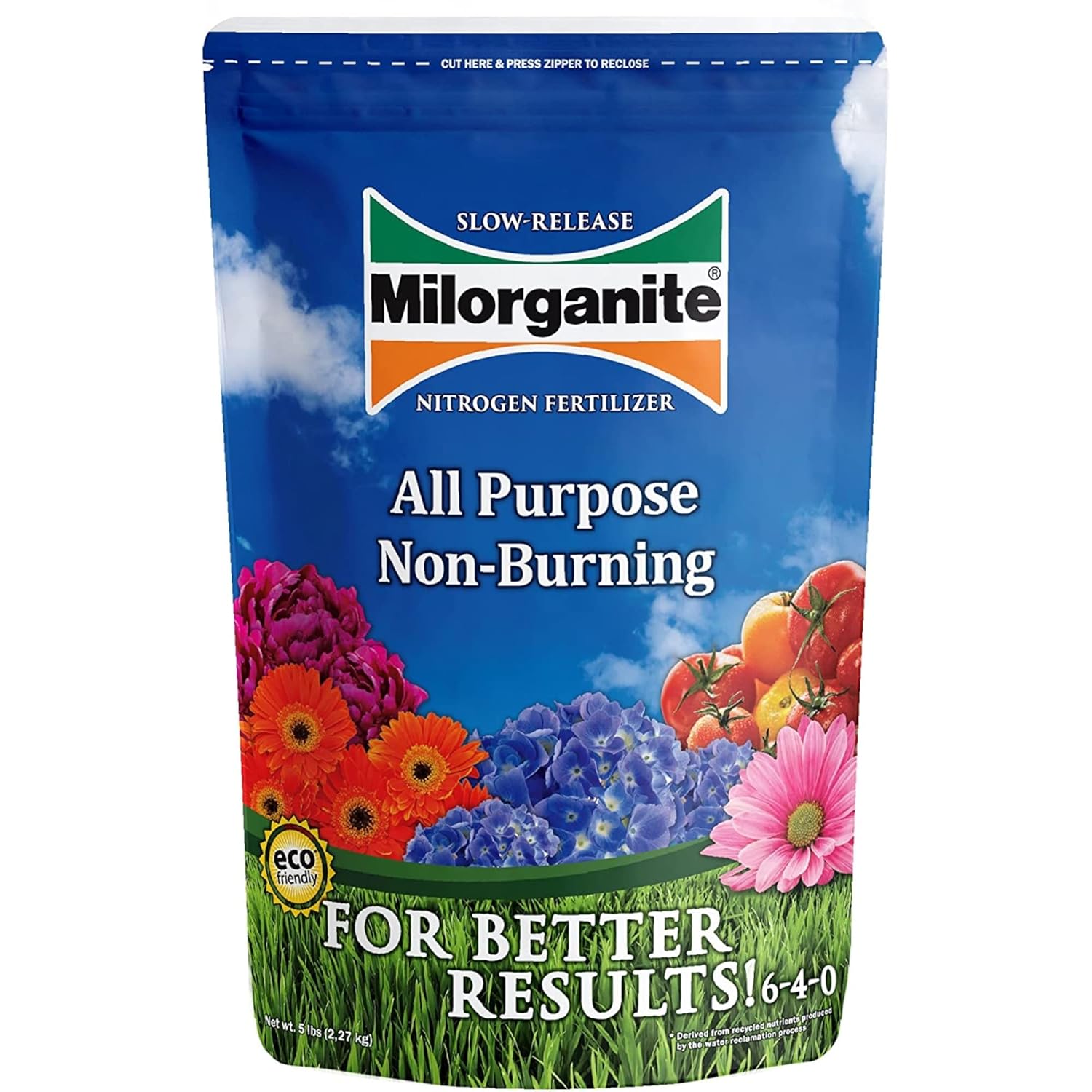
Milorganite Slow-Release Organic Fertilizer, 5 lb
| Item Form | Granules |
|---|---|
| Specific Uses For Product | Lawns, Flowers and Gardens |
| Coverage | 390 Square Feet |
| Ingredients | Nitrogen |
Milorganite is a granular, slow-release organic fertilizer formulated to feed lawns and garden plants for about 8 to 10 weeks per application. It is typically broadcast by hand or with a spreader and does not require immediate watering in, making it easy to fit into routine maintenance. Notable features include a low-salt formula that greatly reduces the risk of burning turf, organically complex iron that greens grass without staining hard surfaces, and about 85% organic matter that helps improve soil structure over time. The product covers roughly 390 square feet from a 5 pound bag and is positioned as safe for use on lawns, shrubs, flowers, trees, and edible gardens. Limitations are that nutrient release is gradual, so it is not a quick fix for severe nitrogen deficiency, and the bag has an earthy odor at first that some pets may find attractive until it dissipates or is watered in. For someone managing Empire Zoysia, use on the recommended schedule and expect steady, low-risk green-up rather than instant color change.
Best for: Gardeners who prioritize steady, low-risk nutrient delivery and soil health and who prefer a hands-off feeding schedule for fine-textured lawns like Empire Zoysia.
Less Ideal for: Homeowners wanting rapid color correction or fast-acting synthetic nitrogen boosts should choose a quick-release fertilizer instead.
- Slow-release nitrogen feeds lawns for 8–10 weeks reducing application frequency
- Low salt formulation minimizes risk of burning sensitive turf like Zoysia
- Provides organically complex iron that greens grass without staining concrete
- High organic matter improves soil structure and water retention over time
- Slow-release action means it will not correct severe yellowing immediately
- Initial earthy odor that may attract some pets until it is watered in or dissipates
Verdict: Choose Milorganite for Empire Zoysia when you want a safe, slow-release organic feed that greens turf steadily without burning or staining.
Ferti-lome Slow Release Nitrogen Lawn Fertilizer 15-0-15 with Iron (2 Pack, 16 lb each)

| N‑P‑K | 15-0-15 |
|---|---|
| Item Form | Granules |
| Target Uses | Lawn Care |
| Included Components | Lawn Fertilizer |
This two‑bag pack of Ferti-lome 15-0-15 delivers slow‑release nitrogen with added iron to maintain color and steady growth on warm and cool season lawns. Each 16 lb bag is intended to cover up to 4,000 sq ft, so the bundle is convenient for larger yards or for having a spare for the next application. Typical use is a spring and fall feeding at the recommended rate, applied with a broadcast or drop spreader; the slow‑release formulation reduces the need for frequent reapplication and helps avoid quick flushes of growth. The inclusion of iron and micronutrients improves leaf color without extra liquid treatments, and compatibility with many grasses makes this usable on Empire Zoysia. Limitations are that the blend has no phosphorus and is focused on nitrogen and potassium balance, so soils needing phosphorus will require a separate product, and precise coverage depends on correct spreader settings and uniform application. For homeowners prioritizing predictable, low‑maintenance feeding and improved lawn color, this pack is a practical choice.
Best for: Homeowners who want a dependable, low‑maintenance fertilizer regimen and need steady feeding and color improvement across a sizable Empire Zoysia lawn.
Less Ideal for: Gardeners whose soil tests show a phosphorus deficiency or who need a specialized nutrient program focused on establishing new turf should consider a different formula.
- Slow‑release nitrogen provides extended feeding and fewer applications
- Contains iron and micronutrients to enhance leaf color
- Two 16 lb bags cover large areas or allow for a follow-up application
- Suitable for a wide range of grass types including warm‑season Zoysia
- No phosphorus in the 15-0-15 formula so it will not correct phosphorus deficiencies
- Effective, even coverage requires correct spreader calibration and application technique
Verdict: Choose this two‑pack slow‑release 15-0-15 fertilizer when you want predictable, low‑frequency feeding and improved color for an established Empire Zoysia lawn.
Scotts Turf Builder WinterGuard Fall Lawn Food, 10 lb.

| Item Form | Granules |
|---|---|
| Specific Uses For Product | Lawn Fertilizer |
| Application Method | spread |
| Coverage | 4000 |
| Target Species | lawn grasses |
Scotts Turf Builder WinterGuard is a granular fall lawn food designed to build strong, deep roots and help turf recover from summer heat, drought, and regular wear. It is applied with a broadcast or drop spreader over a lawn in autumn and can be used on any grass type. The bag covers about 4,000 sq. ft., and the package directions include recommended spreader settings and note that watering-in is optional for fast results. In practice this product provides a straightforward, DIY-friendly way to add nutrients before winter; the granules are easy to spread and work with standard spreaders. Notable features are its all-grass compatibility and clear application guidance. Limitations are that it is a single-season bag sized for small to medium yards and it does not include weed or insect control functions found in some other Scotts formulas, so you may need additional products if those issues are a concern. For homeowners wanting a simple autumn boost to root strength, this is an effective, no-frills option.
Best for: Homeowners who want a simple, reliable fall fertilizer to strengthen roots and help lawns recover from summer stress without complicated application steps.
Less Ideal for: People managing large lawns who need wide-coverage bulk fertilizer or those who want combined weed or insect control in the same product.
- Formulated specifically for fall to build deep, winter-ready roots
- Works on all grass types so it fits mixed lawns
- Clear application instructions and spreader settings for easy DIY use
- Covers 4,000 sq. ft. from a single 10 lb. bag for small to medium yards
- No built-in weed or insect control so additional products may be needed
- Single 10 lb. bag may be small for larger properties
Verdict: Choose this bag if you want an easy-to-apply fall fertilizer that strengthens roots and helps your lawn recover before winter.
Scotts Green Max Lawn Food (16.67 lb)

| Item Form | Granules |
|---|---|
| Coverage | 5000 square feet |
| Specific Uses For Product | Lawn |
| Target Species | lawn grass |
Scotts Green Max Lawn Food is a granular, all-purpose lawn fertilizer formulated to deliver fast greening with a 2-in-1 feed plus 5% iron supplement. It is applied with a broadcast or drop spreader to any grass type and is recommended for routine spring, summer, or fall applications. Notable features include a guaranteed nonstaining formula when used as directed and settings provided for Scotts spreaders to help get an even application across the advertised 5,000 sq ft coverage. The iron content speeds visible greening in as little as three days and the granules are ready to water in for faster uptake. For a risk-averse homeowner growing fescue in spring, the product is straightforward to use and safe to re-enter the lawn immediately after application. Limitations are that proper spreader settings and sweeping up excess product are important to avoid runoff and that it is a general lawn food rather than a specialized product for nutrient-deficient soils, so a soil test is still useful for targeted corrections.
Best for: Homeowners who want a low-risk, easy-to-apply lawn food that produces quick green results on fescue lawns in spring and prefer established brand guidance for application.
Less Ideal for: Gardeners seeking a product to correct a specific nutrient imbalance or those who prefer liquid or organic-only fertilizing approaches.
- Includes 5% iron for faster, deeper greening visible in about three days
- Premeasured granular form covers up to 5,000 sq ft from one bag
- Manufacturer provides spreader settings to simplify even application
- Formulated not to stain concrete or driveways when used as directed
- Not a tailored corrective fertilizer for specific soil deficiencies
- Requires correct spreader settings and cleanup to prevent runoff
Verdict: A simple, fast-acting granular lawn food with added iron that reliably greens fescue lawns when applied with a spreader.
Choosing the Right Slow Release Nitrogen Fertilizer: Key Factors to Consider
Nitrogen Release Mechanism
Different slow release fertilizers deliver nitrogen through distinct mechanisms such as coated granules, polymer-controlled release, or organic mineralization. Coated granules shed nutrients based on temperature and moisture, producing a more predictable schedule in stable climates. Organic sources rely on microbial breakdown, which can vary with soil temperature, moisture, and microbial activity.
Understanding the mechanism helps set expectations for how fast plants will respond and how weather affects feeding. If you need steady winter feeding or predictable summer schedules, choose a formulation with a release profile suited to those conditions.
Longevity Versus Immediate Need
Longer-lasting products reduce application frequency but may delay visible growth responses when plants are deficient. Shorter-duration slow release options give a balance of some immediate availability with extended feeding. Consider the timing of planting and the crop's growth stage. For established lawns or perennial beds, longer release seasons often reduce maintenance. For new transplants or heavy-feeding vegetables, a product that offers a small soluble fraction plus a longer residual can support early growth while maintaining steady supply.
Match the fertilizer longevity to your maintenance rhythm and crop demands to avoid both underfeeding and excessive early flushes.
Form and Application Method
Slow release nitrogen fertilizer comes as granules, prills, spikes, or blended powders. Granules are generally easiest to broadcast or mix into potting media. Spikes or stakes deliver localized feeding for individual shrubs or trees. Powder or blend formats can be hand-mixed into soil for planting holes.
Think about the tasks you will perform: broadcasting on a lawn, topdressing containers, or working into raised beds. The physical form affects application equipment, dust generation, and how evenly the nitrogen distributes across the root zone.
Soil and Climate Interaction
Soil texture, organic matter, and temperature all influence how slow release products behave. Sandy soils with low organic matter are more prone to leaching, so choosing a product with stronger release control helps retain nitrogen. Cold soils slow microbial activity, reducing mineralization of organic nitrogen sources until temperatures rise. Warm, wet conditions accelerate some controlled-release technologies and microbial breakdown, shortening effective longevity.
Account for your local climate and soil type when selecting a formulation so the release schedule aligns with plant uptake rather than environmental loss.
Environmental Impact and Runoff Risk
One reason gardeners pick slow release nitrogen is to reduce nitrogen losses to runoff and groundwater. Products that limit soluble nitrogen at any one time lower the risk of leaching after heavy rain. Also consider whether the formulation reduces ammonia volatilization or nitrate spikes that can harm nearby waterways.
Choose products with measured slow release properties and follow application rates to minimize environmental impact, especially near water features, storm drains, or sensitive ecosystems.
Label Information and Compatibility
Clear labels that state total nitrogen, the form of nitrogen present, and expected release duration make it easier to compare products. Compatibility notes for mixing with other fertilizers, soil amendments, or herbicides are also helpful for integrated garden programs. Look for guidance on application rates for lawns, containers, and landscape beds.
A transparent label reduces guesswork and helps you match the product to crop needs and seasonal timing while avoiding incompatible tank mixes or application errors.
How Slow Release Nitrogen Helps Different Garden Uses
Slow release nitrogen works differently depending on use. In lawns it moderates green-up so you avoid tall flushes that require frequent mowing. In containers it reduces the risk of salt buildup from frequent soluble feeds, because smaller amounts of nitrogen are available over time. For vegetable beds, using a slow release product can support sustained growth across a season while cutting down on midseason topdressings.
When choosing a product, consider the planting context and how maintenance routines will change. Containers and newly established plants often need closer attention early on, while mature perennials and turf benefit most from longer, steady feeding.
- Lawns: choose even broadcast granules for uniform coverage
- Containers: prefer mixes with low salt index or products formulated for potting media
- Vegetable beds: look for a balance of early availability and season-long release
Timing Applications to Match Plant Demand
Plan applications around growth cycles. Apply a slow release product when soil temperatures support root uptake so the nitrogen release aligns with plant needs. For spring green-up, apply earlier in cool regions when the chosen product still releases at lower temperatures. In warm climates you can schedule fewer applications because release rates accelerate.
Avoid applying large amounts shortly before heavy rains. Even slow release products can have soluble fractions; timing applications to avoid forecasted storms lowers runoff risk.
- Early spring: supports active growth without overstimulating weak roots
- Midseason: a single long‑acting application can sustain growth for weeks
- Late season: check label guidance to avoid promoting late soft growth in perennials
Using Slow Release Nitrogen in Container Mixes and Potting Soil
Containers have limited soil volume and a high risk of salt accumulation from fertilizers. Slow release nitrogen reduces the frequency of liquid feeds and provides a gentler nutrient supply. When using in potting mixes, incorporate granules at planting according to label rates and avoid placing undiluted granules directly against roots.
Monitor plant response and flush containers periodically to prevent salt buildup. Combining a slow release product with occasional light liquid feeds can balance steady nutrition with corrective measures for deficiencies.
- Incorporate evenly into potting mix at planting
- Avoid concentrated placement near roots
- Flush containers annually if buildup is suspected
Environmental Best Practices for Application
To minimize runoff and groundwater contamination, follow label rates and avoid applying before heavy rain. Use a spreader or calibrated scoop to ensure even application and reduce hotspots. For slopes or near water bodies, reduce rates or choose products with proven low leaching potential.
Remove clumps and sweep granules off hard surfaces to prevent wash-off. Store unused fertilizer in a dry place and keep it covered to avoid spills during storms.
- Calibrate spreaders for even distribution
- Decrease rates near water features
- Clean up stray granules on pavements
Combining Slow Release Nitrogen with Other Amendments
Slow release nitrogen can be part of a balanced fertility program. Pair it with phosphorus and potassium adjustments based on soil test results. Organic matter additions such as compost improve soil buffering and support microbial breakdown of organic slow release sources.
Be cautious mixing with ammonium-heavy inputs or other nitrogen sources without recalculating total seasonal nitrogen to avoid overapplication. Staggering different nutrient inputs can help maintain steady availability while preventing spikes.
- Base additional nutrient decisions on a soil test
- Use compost to improve nutrient retention
- Recalculate total seasonal nitrogen when adding soluble feeds
How We Chose the Best Slow Release Nitrogen Fertilizer
We prioritized characteristics that make slow release nitrogen fertilizers genuinely useful for everyday gardeners. Longevity of nitrogen release was a primary filter because predictable feeding schedules reduce overfertilizing and labor. Application flexibility was assessed next: how easily the product spreads in lawns, mixes into potting media, or topdresses beds. Nutrient predictability and label clarity mattered, since clear analysis of nitrogen forms and release mechanisms helps gardeners match fertilizer to plants. Environmental impact and leaching potential were considered by looking at nitrogen forms and known slow release technologies. Practical handling factors such as dust control, odor, and compatibility with common garden equipment were also weighed. We excluded fast-release soluble fertilizers and specialty formulations intended only for agricultural or industrial use. Products had to be appropriate for home garden use across containers, beds, or turf and provide real slow-release behavior rather than simple coated quick-release blends.
FAQ
How long does slow release nitrogen typically last in the garden?
Duration depends on the formulation and local conditions. Many products release over 8 to 12 weeks, while some polymer‑coated or highly stabilized formulas extend to several months. Temperature, moisture, and soil biology influence actual longevity.
Can I use slow release nitrogen for vegetables and container plants?
Yes. Slow release nitrogen is suitable for vegetables and containers when used at recommended rates. For fast‑growing vegetables, choose a product with a modest initial soluble fraction or supplement with occasional light liquid feeds early in the season.
Will slow release nitrogen prevent runoff completely?
Slow release products reduce runoff risk compared with large single applications of soluble fertilizer, but they do not eliminate it. Following label rates, timing applications away from heavy rain, and using products with good release control further lower environmental risk.
Do slow release fertilizers build up salts in soil over time?
They generally produce less salt stress than repeated soluble feeds, but buildup can still occur if rates are excessive or containers are not leached periodically. Monitoring plant health and occasional flushing of containers can prevent salt accumulation.
How should I adjust application on sandy versus clay soils?
On sandy soils use formulations with stronger release control and consider slightly reduced rates to minimize leaching. On clay soils nutrient retention is higher, so standard rates are usually appropriate, but avoid overapplication because clay holds nutrients tightly and can cause local concentration spikes.
Can I mix slow release nitrogen with other fertilizers when applying?
Mixing is often possible but depends on product labels. Avoid combining multiple nitrogen sources without recalculating total seasonal nitrogen and check compatibility notes to prevent chemical interactions or uneven release.
Final Verdict
Choose a slow release nitrogen fertilizer by matching release duration and form to how you garden. Prioritize clear label information, release mechanism, and a physical form that fits your application method. Account for soil type and climate so the product's release schedule aligns with plant uptake rather than weather-driven loss. A thoughtful choice trades frequent feeding for predictability. Focus on longevity, application ease, and environmental risk to pick the product that best reduces work while supporting steady growth in your beds, containers, or lawn.
