

Note: This article contains affiliate links. If you click on these links and make a purchase, I may earn a small commission at no extra cost to you. This helps support my research and content. Read my full affiliate disclosure here.
Picking the right hose garden sprinkler for your lawn affects how evenly your grass grows, how much water you waste, and how often you need to move equipment. Whether you have a small patch of turf near a patio or a full front yard, sprinkler design changes spray reach, overlap, and runoff risk. This guide covers six top hose sprinklers shortlisted for lawn use. We focus on coverage patterns, adjustable range, and durability so you can match a sprinkler to your yard shape and watering schedule. Read on for what mattered in our picks and the decision points to weigh when choosing a lawn sprinkler.
Top Picks at a Glance
| Best Overall The best all-around choice for most situations | Aqua Joe Indestructible Metal Base Oscillating Sprinkler with 16 Clog-Resistant Nozzles |  |
| Best Quality Built to a higher standard if you want something more solid | Melnor XT Turbo Oscillating Sprinkler (4,500 sq ft) |  |
| Best Value The sweet spot between price and what you get | Melnor Turbo Oscillating Sprinkler — 2,800 sq. ft., 16 Precision Nozzles |  |
| Best Budget The cheapest option that still gets the job done reliably | SYOOY 360° Metal Spot Sprinkler (Circular) |  |
| Highest Rated A top-rated pick with lots of positive feedback | QWORK 2-Pack 360° Metal Spot Sprinkler |  |
| Most Popular A crowd favorite that many people choose with confidence | Eden Weighted Essential Oscillating Sprinkler with Quick Connect Starter Set |  |
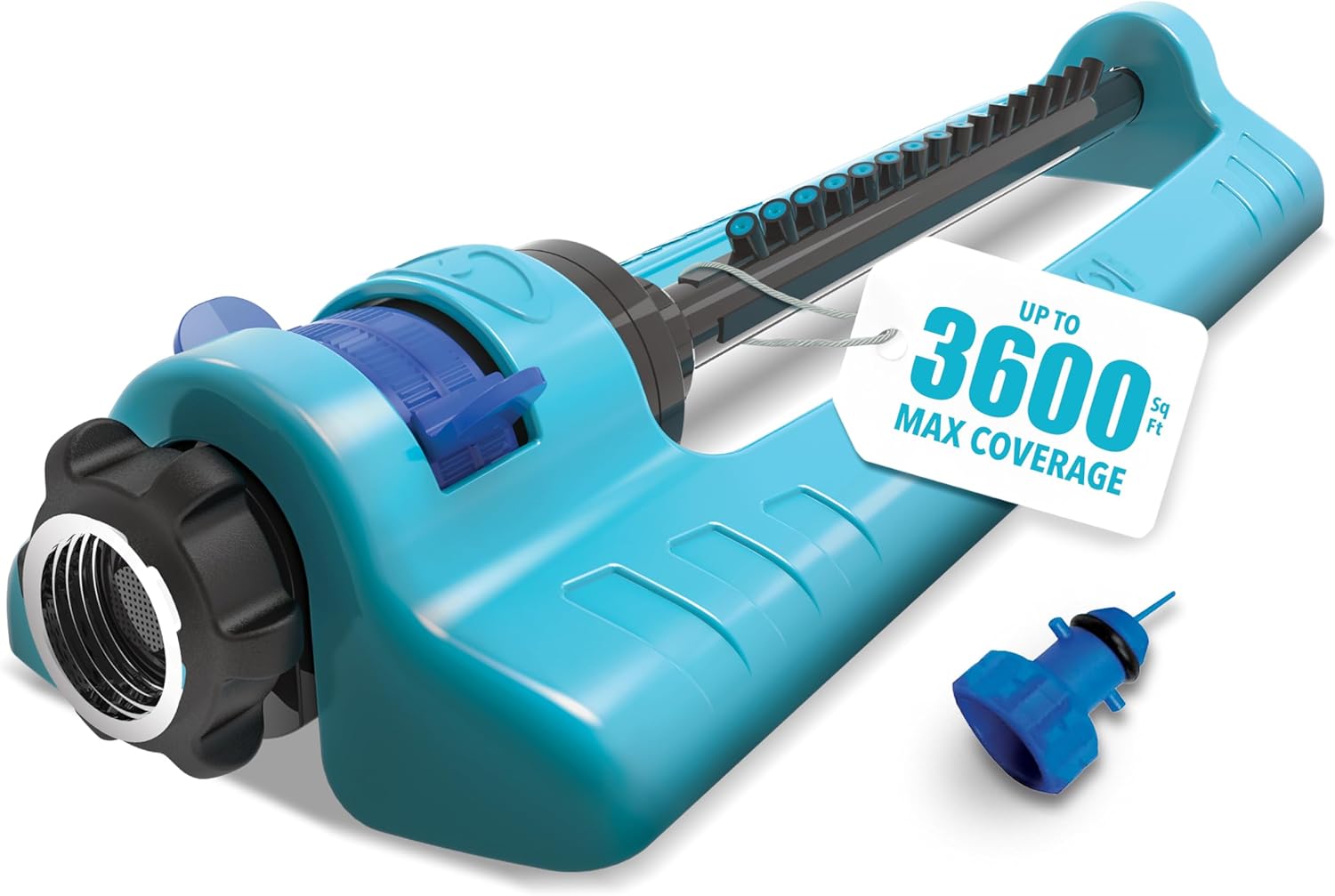
Aqua Joe Indestructible Metal Base Oscillating Sprinkler with 16 Clog-Resistant Nozzles
| Material Type | Metal |
|---|---|
| Maximum Pressure | 120 psi |
| Maximum Flow Rate | 6.65 gpm |
| Number of Nozzles | 16 |
| Coverage | Up to 3,600 sq ft |
This Aqua Joe oscillating sprinkler is a straightforward, durable option for watering medium to large lawns. It connects to a standard garden hose and the sealed turbo gear-driven unit powers a 16-nozzle bar that you can adjust for width and range, making it easy to target flower beds or sweep a broad lawn. The extra-large solid metal base gives the unit good stability on uneven ground and the built-in clean-out tool helps clear nozzle clogs without disassembly. Practical benefits include predictable, even coverage across up to roughly 3,600 square feet and a design meant to stand up to regular seasonal use. Limitations to note are that it is a manual, stationary sprinkler so it does not rotate or move on its own beyond the oscillation, and setup requires positioning and occasional adjustment to avoid overspray near sidewalks or flowerbeds. For most homeowners wanting a reliable, no-frills portable sprinkler, this model strikes a sensible balance of durability and performance.
Best for: Homeowners who want a dependable, no-fuss portable sprinkler that balances durability and flexible coverage for medium to large yards.
Less Ideal for: People seeking automated moving sprinklers, programmable timers, or very small container gardens where a compact rotary or drip system would be more appropriate.
- Solid metal base provides strong stability and durability in the yard
- 16 clog-resistant nozzles with built-in clean-out tool for consistent spray
- Sealed turbo gear-driven unit offers reliable performance season after season
- Adjustable width and range allow targeted coverage up to 3,600 sq ft
- Oscillating motion is fixed and does not self-translate to cover irregular shapes
- Requires manual positioning and adjustments to avoid overspray
Verdict: A durable, easy-to-use oscillating sprinkler that delivers reliable, adjustable coverage for most medium to large lawns.
Melnor XT Turbo Oscillating Sprinkler (4,500 sq ft)

| Coverage | 4,500 sq. ft. |
|---|---|
| Nozzles | 20 precision nozzles |
| Maximum Pressure | 90 psi |
| Material Type | Plastic |
The Melnor XT Turbo Oscillating Sprinkler is a user-friendly lawn sprinkler designed to water medium to large yards up to about 4,500 square feet. It uses 20 precision nozzles and TwinTouch width and range controls so you can set left, right or both-side coverage and change the length of the spray pattern. The Zoom Flow Control lets you reduce output for newly seeded areas or increase it to reach farther sections of lawn. A durable InfinityDrive Turbo Motor and dirt-resistant drive are built to keep the oscillation smooth even if your water contains grit. Practical benefits include clear watering-width indicators for repeatable settings and a QuickConnect starter set for fast hookup to hoses and accessories. Limitations are that the unit is plastic so it is best stored indoors through winter, and like most oscillating sprinklers it delivers a broad, gentle spray rather than a narrow high-pressure jet for very long reach or targeted irrigation.
Best for: Homeowners who want a reliable, easy-to-adjust sprinkler for broad, repeatable coverage of medium to large lawns and prefer straightforward controls over complex programming.
Less Ideal for: Gardeners who need a sprinkler for very long, targeted spray distances or a permanently installed, heavy-duty metal irrigation head should consider other options.
- Covers up to 4,500 sq ft with 20 precision nozzles for even distribution
- Three-way adjustment (width, range, flow) for flexible watering patterns
- Dirt-resistant drive and InfinityDrive motor for reliable operation with sedimented water
- Watering width indicators make it easy to reproduce preferred settings
- Includes QuickConnect starter set for fast hose and accessory changes
- Plastic construction requires winter storage to avoid cracking in freezing conditions
- Not suitable if you need a very narrow high-pressure stream for long, targeted reach
Verdict: Choose this sprinkler if you want dependable, easy-to-adjust long-range coverage for up to 4,500 sq ft with clear controls and sediment-tolerant operation.
Melnor Turbo Oscillating Sprinkler — 2,800 sq. ft., 16 Precision Nozzles

| Maximum Pressure | 80 psi |
|---|---|
| Maximum Flow Rate | 30 gpm |
| Inlet Connection Size | 0.75 inches |
| Material Type | ABS Plastic |
The Melnor Turbo Oscillating Sprinkler is designed to give even, controllable watering across medium lawns and garden beds up to about 2,800 square feet. It uses 16 precision nozzles and a geared InfinityDrive turbo motor to produce a steady oscillating pattern, while sliding range adjusters let you limit spray to specific zones to reduce overspray onto paths and driveways. The included quick connect starter set makes attaching and detaching hose accessories faster when you swap tools. In use the sprinkler produces consistent coverage at typical household water pressures and the plastic ABS body keeps it lightweight and easy to move. Important limitations are that it requires a compatible 3/4 inch inlet and performance depends on your water pressure and flow rate; very low-pressure systems will reduce coverage. The plastic construction is fine for seasonal use but may not match the longevity of heavier metal models in harsh climates. For routine lawn watering this sprinkler balances adjustability, coverage, and convenience.
Best for: Gardeners who want a reliable, adjustable sprinkler to optimize water delivery across a medium lawn while minimizing wasted spray and time spent adjusting coverage.
Less Ideal for: Homeowners with very low water pressure or who need an ultra-heavy-duty, long-lasting metal sprinkler for commercial or extreme outdoor use.
- Covers up to 2,800 sq. ft. with 16 precision nozzles for consistent watering
- Sliding range adjusters allow targeted watering to reduce overspray
- InfinityDrive turbo motor provides smooth oscillation for even coverage
- Quick Connect starter set speeds attachment and removal of hose accessories
- ABS plastic body is lighter but less durable than metal alternatives
- Requires adequate household water pressure and a 0.75 inch inlet for full coverage
Verdict: A practical, adjustable oscillating sprinkler that delivers even coverage and simple setup for medium-sized lawns.
SYOOY 360° Metal Spot Sprinkler (Circular)

| Material Type | Metal |
|---|---|
| Maximum Pressure | 71.12 psi |
| Inlet Connection Size | 0.75 inches |
| Coverage | Up to 30ft diameter |
The SYOOY 360° metal spot sprinkler is a compact, all‑metal sprinkler head that converts a standard garden hose into a fountain‑style 360‑degree emitter for spot watering. You set it in the lawn or garden and control coverage by water pressure and placement rather than fiddly adjustments. Built from zinc alloy, it is more durable than plastic heads and intended for outdoor exposure. It produces an even, circular spray that is well suited to patchy turf, new seed, flower beds, and patios where you need gentle, water‑saving coverage. Installation is straightforward: attach the 0.75‑inch inlet to a standard hose and vary pressure to change radius. Limitations include no sector adjustment or pattern control and reliance on water pressure to set range, so it is not ideal for irregularly shaped beds or precision irrigation. Also it is a single head best used for small to medium areas rather than replacing a multi‑zone sprinkler system.
Best for: Buyers who want a low‑cost, durable, easy‑to‑use sprinkler for spot watering small lawns, seed patches, patios, or garden beds and prefer simple setup over adjustable features.
Less Ideal for: People needing precision watering for irregularly shaped beds, multi‑zone irrigation, or long‑distance coverage should consider adjustable or pop‑up sprinkler options.
- Heavy‑duty metal construction for better outdoor durability than plastic heads
- 360° circular spray provides even, fountain‑like watering for small patches
- Simple hose connection and no complex adjustments make setup fast
- Water‑saving gentle spray suitable for new seed and sensitive plants
- No adjustable spray sector or pattern control for irregular areas
- Range depends entirely on water pressure so coverage can vary
Verdict: A rugged, budget‑friendly metal spot sprinkler that delivers simple, even 360° watering for small lawns and garden patches.
QWORK 2-Pack 360° Metal Spot Sprinkler

| Material Type | Metal |
|---|---|
| Number of Packs | 2 |
| Maximum Pressure | 80 psi |
| Coverage Area | Up to 30 feet diameter |
These QWORK metal spot sprinklers are straightforward, durable watering heads built for routine lawn and garden irrigation. Each unit screws onto a standard garden hose and delivers a 360-degree circular spray that can reach up to about 30 feet in diameter depending on water pressure. The heavy-duty metal construction and polished finish make them more resistant to damage and wear than typical plastic sprinkler heads, so they suit regular seasonal use. Flow is adjustable by water pressure and positioning, producing a gentle spray that is good for established lawns, flower beds, and small landscape zones. Because they are simple mechanical devices there is little to set up or program, and the two-pack covers multiple zones or provides a spare. Limitations are that true coverage and spray radius depend heavily on your available water pressure and they lack built-in oscillation or programmable timing, so you will still need a timer or controller for automated schedules and may need to experiment with placement for even coverage.
Best for: Homeowners who prioritize a durable, no-frills sprinkler for reliable regular watering of lawns and garden beds and who prefer robust metal hardware over plastic options.
Less Ideal for: People who need fine-tuned, programmable irrigation, highly uniform coverage for large lawns, or integrated sprinkler systems should consider more advanced heads or timed systems.
- Heavy-duty metal construction for improved durability over plastic heads
- 360-degree circular pattern can cover up to about 30 feet in diameter under sufficient pressure
- Simple screw-on setup fits standard garden hose threads for quick installation
- Comes as a 2-pack so you can water two zones or keep a backup
- Spray distance and uniformity depend strongly on available water pressure
- No built-in timer or oscillation features so automation requires an external timer or controller
Verdict: Choose these metal 360-degree sprinklers if you want simple, durable hose-end watering that reliably covers small to medium lawn zones.
Eden Weighted Essential Oscillating Sprinkler with Quick Connect Starter Set

| Maximum Pressure | 60 psi |
|---|---|
| Maximum Flow Rate | 30 gpm |
| Nozzle Count | 16 precision nozzles |
| Coverage | Up to 3,600 sq. ft. |
The Eden Weighted Essential Oscillating Sprinkler delivers steady, even watering across mid‑to‑large lawns and garden beds up to about 3,600 square feet. It mounts on a weighted base so it stays put while a sealed turbo drive motor oscillates a bar with 16 precision nozzles for consistent spray distribution. Sliding range tabs let you limit how wide the spray is, and a built‑in nozzle cleaning tool helps clear clogs without disassembly. The included quick connect starter set and stainless steel filter washers simplify hookups and let you swap tools without shutting off the water. In practice this model is quiet, simple to position, and keeps water patterns uniform on level turf. Expect best results on relatively flat lawns where the coverage matches the stated footprint; very large properties will need multiple units or a different sprinkler type to avoid gaps. The unit is plastic, so durability under heavy seasonal use may lag behind metal alternatives, but the design and filters reduce maintenance and leaks for routine garden watering needs.
Best for: Buyers who want a reliable, easy‑to‑use sprinkler that produces uniform coverage for medium to large lawns and value social proof and low maintenance features when choosing a dependable product.
Less Ideal for: Not a great choice for very large estates or professional irrigation needs where metal, higher‑capacity, or multi‑zone systems are preferred.
- Even coverage from 16 precision nozzles for consistent watering patterns
- Weighted base provides stability during operation
- Adjustable range tabs allow precise area control to target lawns or beds
- Quick connect starter set and stainless steel filters simplify hookups and reduce leaks
- Built‑in nozzle cleaning tool makes maintenance fast and simple
- Plastic construction may wear faster than metal sprinklers under heavy seasonal use
- Coverage limited to about 3,600 sq. ft., so large properties may need multiple units
Verdict: A user‑friendly oscillating sprinkler that combines even coverage, a stable weighted base, and quick‑connect hookups for dependable mid‑sized lawn watering.
Choosing the Right Hose Garden Sprinkler for Lawns: Key Factors to Consider
Spray Pattern and Coverage Radius
How a sprinkler distributes water across the lawn determines how many placements you need and whether your turf gets uniform moisture. Circular, oscillating, and impact-style patterns each create different wetting shapes: circular heads work well for round or irregular patches, oscillating units create rectangular swaths for strips of turf, and rotating impact-style heads reach farther for larger lawns.
Consider the maximum radius listed and whether the pattern is adjustable. Adjustable nozzles or multiple pattern settings let you tailor coverage so adjacent sprinkler placements overlap slightly. Proper overlap reduces dry rings and helps the grass establish evenly. For narrow or oddly shaped lawns, pick a sprinkler that lets you limit spray width or switch to a directional mode.
Water Flow Requirements and Efficiency
A sprinkler's performance depends on flow rate and how it uses available water pressure. Low-flow options are better for small yards or when multiple watering points share the same supply, while high-flow heads reach farther but need stronger pressure. Look for sprinklers that list recommended flow or have adjustable flow control to match your hose pressure.
Efficient spray patterns reduce misting and fine droplets that evaporate before wetting turf. Some designs apply larger droplets that penetrate soil better and cut down on runoff. If you have water restrictions or a municipal limit, choose a sprinkler you can throttle or pair with a timer to control total inches applied per session.
Durability and Materials
Lawn sprinklers spend long days outdoors and need to resist sun, impact from lawn mowers, and corrosion. Metal components at hose fittings or moving parts often last longer than low-grade plastics, but good plastics with UV stabilizers can be durable and lighter to move. Check whether seals and moving parts are replaceable and how well the base resists cracking on hard surfaces.
Durability also matters for winter storage. Sprinklers that tolerate disassembly without breaking are easier to winterize and store, reducing the chance of freeze damage. Consider components that resist mineral buildup if you have hard water, because clogged nozzles reduce coverage and require more maintenance.
Ease of Setup and Adjustment
A sprinkler should be quick to hook to a hose, stable on turf, and simple to adjust for range and pattern. Gardeners often move sprinklers frequently, so lightweight units with easy connectors and clear adjustment knobs reduce hassle. Tools-free assembly and visible indicators for spray width or distance save time when laying out multiple heads.
Also think about how intuitive the controls are outdoors. Dial-based or lever adjustments are easier to tweak with wet or muddy hands. If you plan to change coverage frequently, choose a model with clearly indexed settings so you can repeat placements reliably across the lawn.
Stability and Anchoring
A sprinkler that tips, slides, or shifts will create puddles and dry patches. Bases should distribute weight and have low ground pressure to sit securely on turf without tearing the grass. Some designs include stakes, weighted bases, or broad footprints to resist movement from water force or wind.
For sloped lawns, anchoring ability is especially important to maintain direction and overlap. Also consider whether the unit rattles or walks when running at high flow; excessive vibration can shorten component life and change spray alignment. A sprinkler that stays put reduces the time you spend readjusting during a watering cycle.
Matching Sprinkler Shape to Lawn Layout
Think of your lawn in basic geometric zones before choosing a sprinkler. Narrow strips like borders and front-yard strips benefit from oscillating or rectangular spray patterns that cover a long, thin area in one pass. Open, round patches are easiest with circular or rotary designs that place water evenly from a single point.
For mixed layouts, use a combination approach: a rotary head for the large central area and a short oscillating unit for edges and near fences. Planning placements to achieve slight overlap at the edges prevents thin or brown rings along the perimeter.
- Use rotary or impact-style heads for larger, unobstructed lawns.
- Choose oscillating models for rectangular or narrow lawns.
- Combine different shapes if the yard includes put-ins or irregular beds.
Timers, Controllers, and Watering Rhythm
Pairing a simple mechanical or battery timer with your hose sprinkler controls watering duration and frequency without manual attention. Timing is important: early morning runs reduce evaporation, while short, frequent cycles can help new seed establish without oversaturation.
If your sprinkler has an adjustable flow, set a shorter run time at higher flow to avoid puddling. On slopes, use shorter bursts spaced an hour apart to allow water to soak in rather than run off.
- Schedule runs in the cool part of the day to minimize evaporation.
- Use cycle-and-soak on slopes to improve infiltration.
- Match timer runtime to sprinkler flow and lawn water needs.
Maintenance Tips for Long-Lasting Performance
Regular maintenance extends sprinkler life and keeps coverage consistent. Flush the hose and run the sprinkler briefly before storage to clear particles, and inspect nozzles for mineral buildup. Soaking removable nozzles in vinegar can dissolve scale and restore spray patterns.
Check hose fittings and seals each season and replace O-rings if leaks develop. Store the sprinkler indoors over winter or drain and disassemble any parts that trap water to avoid freeze-related damage.
- Rinse and inspect nozzles monthly during heavy use.
- Replace worn gaskets to prevent leaks that alter flow.
- Lubricate moving parts sparingly if they begin to stick.
Reducing Waste and Preventing Runoff
Preventing runoff is a combination of correct sprinkler choice and watering technique. Choose sprinklers that produce larger droplets for faster infiltration, and set run times to allow water to soak into the soil. For compacted or clay soils, shorter cycles with more repeats reduce surface puddling.
Adjust spray angle away from paved surfaces and beds to avoid wasted water. Where possible, use overlapping placements to get even soil moisture rather than blasting one area for a long time.
- Avoid high-misting sprays on windy days.
- Use cycle-and-soak to increase infiltration on heavy soils.
- Angle heads to keep spray on turf and off hardscape.
Seasonal Considerations and Storage
In active growing seasons, inspect and adjust sprinklers regularly as turf density and shade change. Reduce run times in cooler weather and raise frequency during heatwaves. Toward the end of the season, drain and clean units to prevent freeze damage if you live where temperatures drop below freezing.
Store sprinklers in a dry place away from sunlight to avoid UV degradation of plastic parts. Keep spare gaskets and a small repair kit on hand so simple fixes do not interrupt your watering routine.
- Winterize by draining and storing indoors.
- Check seals before spring startup.
- Rotate placements seasonally to avoid wear patterns on turf.
How We Chose the Best Hose Garden Sprinkler for Lawns
We shortlisted hose garden sprinklers that perform well for lawn care based on practical, garden-focused criteria. Primary evaluation points were spray pattern versatility and effective coverage, because uniform overlap limits dry spots and reduces waste. Water efficiency and flow control were examined to see how well a sprinkler adapts to common home water pressures and conserves water while keeping turf hydrated. Durability and build quality matter for season-to-season use and resistance to sun, abrasion, and freezing conditions in off-season storage. Ease of setup and adjustment was judged for quick placement, simple range changes, and straightforward angle or pattern tweaks. Stability and anchoring were considered to prevent tipping or wandering streams that cause puddles. We excluded any product that only suits specialty uses like garden-bed drip irrigation, or items that require complex plumbing changes. Our selections focus on readily hose-connected sprinklers designed for lawns. The criteria above align with the scoring labels used on each product card: Spray Pattern & Coverage, Water Flow & Efficiency, Durability & Materials, Setup & Adjustment, and Stability in Use.
FAQ
What spray pattern is best for a small rectangular lawn?
Oscillating or rectangular-pattern sprinklers usually cover narrow lawns most efficiently. They create even swaths that match strip shapes and reduce the need for multiple placements.
How do I match sprinkler flow to my household water pressure?
Check your water pressure and choose a sprinkler that lists recommended flow or has adjustable flow settings. Using a flow control or a timer to shorten run time can help if pressure is limited.
Can I leave a hose sprinkler running unattended for hours?
Leaving a sprinkler running for long periods risks overwatering, runoff, and potential lawn disease. Use a timer and check for even coverage and puddling rather than relying on open-ended runs.
How often should I move the sprinkler during a single watering session?
Move sprinklers only after completing a full cycle and when you can achieve slight overlap with the next placement. Frequent small moves can be efficient but plan placements to avoid under- or over-lapping zones.
Will a sprinkler ruin my lawn if I use it on a slope?
Using sprinklers on slopes requires cycle-and-soak techniques to minimize runoff. Shorter watering intervals with repeats allow water to infiltrate rather than run downhill, reducing erosion and puddling.
Final Verdict
Choose a hose garden sprinkler based on how your lawn is shaped, how much water your supply can deliver, and how often you want to move equipment. Prioritize spray pattern and adjustability for coverage, then weigh flow requirements and durability against your local conditions. Remember that proper setup, cycle-and-soak watering, and routine maintenance matter as much as the sprinkler style itself. With those tradeoffs in mind, pick the configuration that minimizes overlap gaps and runoff while matching your watering routine.
