

Note: This article contains affiliate links. If you click on these links and make a purchase, I may earn a small commission at no extra cost to you. This helps support my research and content. Read my full affiliate disclosure here.
Queen palms respond to regular, targeted feeding more than many other landscape palms. Choosing the right fertilizer for queen palms helps prevent nutrient deficiencies that show up as yellowing fronds, thin canopy, or reduced growth. This guide covers seven top fertilizer options suited for queen palms and explains the practical differences between formulation types, application methods, and feeding schedules. The shortlist focuses on products that deliver the nutrients queen palms need, including the right NPK ratio and essential micronutrients. Below you will find our evaluation criteria and clear guidance to match fertilizer style to your yard, soil, and maintenance routine.
Top Picks at a Glance
| Best Overall The best all-around choice for most situations | Miracle-Gro Palm Tree Food, 20 lb |  |
| Best Quality Built to a higher standard if you want something more solid | PERFECT PALM Dual Action Palm Tree Fertilizer, 7 lb Pail with Measuring Scoop |  |
| Best Value The sweet spot between price and what you get | PERFECT PALM Dual Action Palm Tree Fertilizer — 40 lb Refill Bag |  |
| Best Budget The cheapest option that still gets the job done reliably | Jobe's Organics Granular Palm Tree Fertilizer, 4 lb |  |
| Highest Rated A top-rated pick with lots of positive feedback | MicroLife Palms & Tropical Granular Organic Fertilizer (4-2-4), 7 lb |  |
| Most Popular A crowd favorite that many people choose with confidence | Miracle-Gro Shake 'N Feed Palm Plant Food, 4.5 lb |  |
| Best Seller A high-volume bestseller chosen again and again | Carl Pool Palm Food 12-4-12, 4 lb |  |
Miracle-Gro Palm Tree Food, 20 lb

| Item Form | Granules |
|---|---|
| Target Species | palm trees |
| Mixing Ratio | 8-4-8 |
| Unit Count | 320 Ounce |
| Coverage | 20 |
Miracle-Gro Palm Tree Food is a granular, slow-release fertilizer designed specifically for palm trees and other tree plantings. You spread the granules around the root zone, work them into the top inch or two of soil or mulch, and water them in; directions call for roughly 1/2 cup per 4 sq. ft., which the manufacturer says provides up to six weeks of feeding and about 15 feedings per bag for a 10 ft. canopy. Notable features include an 8-4-8 NPK ratio with added magnesium, iron and manganese to help reduce yellowing and curling of fronds, and the slow-release nitrogen reduces the chance of burning when used as directed. Practically, this makes it a low-maintenance option for routine seasonal feeding and for maintaining deeper green foliage. Limitations are that it is a general palm formula rather than a tailored program for nutrient-deficient soils, and it needs correct placement and watering to avoid trunk contact and ensure even distribution of nutrients.
Best for: Buyers who want a dependable, low-maintenance palm feed to keep established palms green without frequent applications; best for homeowners who prefer straightforward seasonal care.
Less Ideal for: Gardeners looking for a soil-specific or corrective fertilizer program for known severe nutrient deficiencies or for those who need a liquid fertilizer for quick correction.
- Formulated specifically for palms with added magnesium, iron and manganese to combat yellowing
- Slow-release nitrogen lowers risk of fertilizer burn when applied as directed
- Granular form is easy to apply around existing trees and mixes into soil or mulch
- Feeds for up to six weeks per application, reducing maintenance frequency
- Not a diagnostic treatment for specific nutrient deficiencies beyond the included micronutrients
- Requires correct application rate and placement to avoid contact with the trunk
Verdict: A simple, slow-release palm fertilizer that reliably maintains deep green foliage with minimal fuss.
PERFECT PALM Dual Action Palm Tree Fertilizer, 7 lb Pail with Measuring Scoop

| Item Form | Granules |
|---|---|
| Application Method | Sprinkle |
| Specific Uses For Product | Palm Tree Health and Growth |
| Mixing Ratio | 7:14:40 |
Perfect Palm 7 lb is a granular, dual-action fertilizer designed specifically for palms and built around a spoon-feed application that is easy to use. You simply fill the included scoop, sprinkle the granules evenly within the root zone around the trunk and irrigate as normal; the mix contains quick-release and slow-release granules so some nutrients take effect immediately while others feed the tree over about six weeks. Notable features include a free measuring scoop and a resealable pail for tidy storage, a 7-14-40 NPK ratio that prioritizes potassium for stress resistance, and micronutrients such as iron and magnesium to support greening. The product is intended for repeated applications every six weeks and is sized to feed multiple small to medium palms per container. Limitations are that it is a palm-specific formula so it is not a balanced all-purpose fertilizer for non-palm ornamentals and the granular surface application requires even distribution and routine irrigation to dissolve evenly.
Best for: Buyers who prioritize measurable performance for Majesty palms and want a palm-specific program that delivers steady feeding and improved frond color with minimal mixing or calibration.
Less Ideal for: Gardeners seeking a multi-purpose fertilizer for lawns or non-palm ornamentals or those who prefer liquid or foliar feeding methods.
- Formulated specifically for palms with a 7-14-40 NPK that boosts potassium for improved stress tolerance
- Includes a measuring scoop and resealable pail for precise, tidy application
- Dual-action granules combine immediate and sustained nutrient release over roughly six weeks
- Contains micronutrients (iron, magnesium, manganese, zinc) to help correct deficiencies and improve frond color
- Designed for palms rather than as a general-purpose fertilizer for mixed plantings
- Requires even surface distribution and consistent irrigation to activate slow-release granules
Verdict: A purpose-built granular program for Majesty palms that delivers predictable, spoon-fed nutrition and improved frond color with minimal fuss.
PERFECT PALM Dual Action Palm Tree Fertilizer — 40 lb Refill Bag

| Item Form | Granules |
|---|---|
| Specific Uses For Product | Palm Tree Fertilizer |
| Application Method | Sprinkle |
| Target Species | ['palm trees'] |
| Unit Count | 640 Ounce |
This 40 lb Perfect Palm refill bag is a granular, spoon-feed fertilizer made specifically for palms and intended to be sprinkled on the soil surface and watered in every six weeks. It contains a dual-action formula with coated and soluble granules so some nutrients release quickly while others feed over about six weeks, which reduces the need for frequent reapplication. The bulk bag is sized to refill pails or treat many trees — the manufacturer lists counts for small, medium, and large trunks so you can plan coverage. Key practical benefits are simple application with no mixing, included application guidance for scoop measurements, and nutrients targeted to palms including higher potassium and multiple magnesium and iron sources to help maintain green fronds and stress tolerance. Limitations are that this is a refill bag only — pails and scoops are sold separately — and the directions assume regular irrigation to move granules into the root zone, so it is less convenient for very dry sites without reliable water. Also ingredient detail shows synthetic carriers and salts that some organic gardeners may prefer to avoid.
Best for: Best for homeowners or property managers who want an efficient, low-fuss program to keep multiple foxtail or other palms green and who prioritize clear application guidance and cost-per-tree efficiency.
Less Ideal for: Not a good fit for gardeners seeking certified organic palm fertilizers or for people without reliable irrigation who cannot water granules into the root zone.
- Formulated specifically for palm trees with higher potassium and multiple micronutrients
- Dual-action granules provide immediate and controlled release feeding for up to six weeks
- Bulk 40 lb bag covers many palms, useful for larger yards or refilling pails
- Simple scoop-and-sprinkle application with clear guidance reduces measuring errors
- Designed by palm growers and includes directions for matching palm trunk size to application rates
- Bag is a refill product and does not include the easy-carry pail or scoop
- Requires regular watering or irrigation to activate controlled-release granules
- Contains synthetic coated granules and common fertilizer salts that some organic users avoid
Verdict: If you need a straightforward, cost-effective bulk fertilizer to regularly feed many foxtail palms, this 40 lb Perfect Palm refill bag delivers targeted nutrients with easy surface application.
Jobe's Organics Granular Palm Tree Fertilizer, 4 lb

| NPK | 4-2-4 |
|---|---|
| Item Form | Granules |
| Unit Count | 64 Ounce |
| Target Species | palm trees and plants |
This granular palm fertilizer is designed to feed palms and similar house or landscape plants on a slow-release schedule. It is OMRI listed and made from organic sources such as feather meal and bone meal, so you can apply it around ornamentals, indoor palms, and planted containers without synthetic chemicals. Typical use is straightforward: broadcast or sprinkle the granules around the root zone every 2 to 3 months during the growing season and water in. The 4-2-4 NPK plus added calcium and magnesium supplies steady nitrogen and potash for leaf development while supporting root health. Practical benefits include low risk of burn when used as directed, easy measuring, and longer-lasting effects compared with quick-release feeds. Limitations are that a 4 lb bag covers a moderate area only, so larger landscapes will need multiple bags, and nutrient release is slower so you will not see immediate greening after a single application.
Best for: Gardeners looking for an affordable, organic palm fertilizer they can apply infrequently and safely around ornamental palms and potted specimens.
Less Ideal for: People who need rapid greening or who manage large acreages of palms and want a high-volume commercial option.
- OMRI listed organic formula safe for use around ornamentals, children, and pets when used as directed
- Balanced 4-2-4 NPK with added calcium and magnesium supports foliage and root development
- Slow-release granular form provides longer-lasting feeding and lower burn risk
- Simple application schedule of every 2 to 3 months makes maintenance easy
- 4 lb bag provides only medium coverage so multiple purchases may be needed for larger plantings
- Slow-release formula delays visible results compared with fast-release fertilizers
Verdict: A budget-friendly organic granular fertilizer that gives steady, low-risk nutrition to palms with easy, infrequent applications.
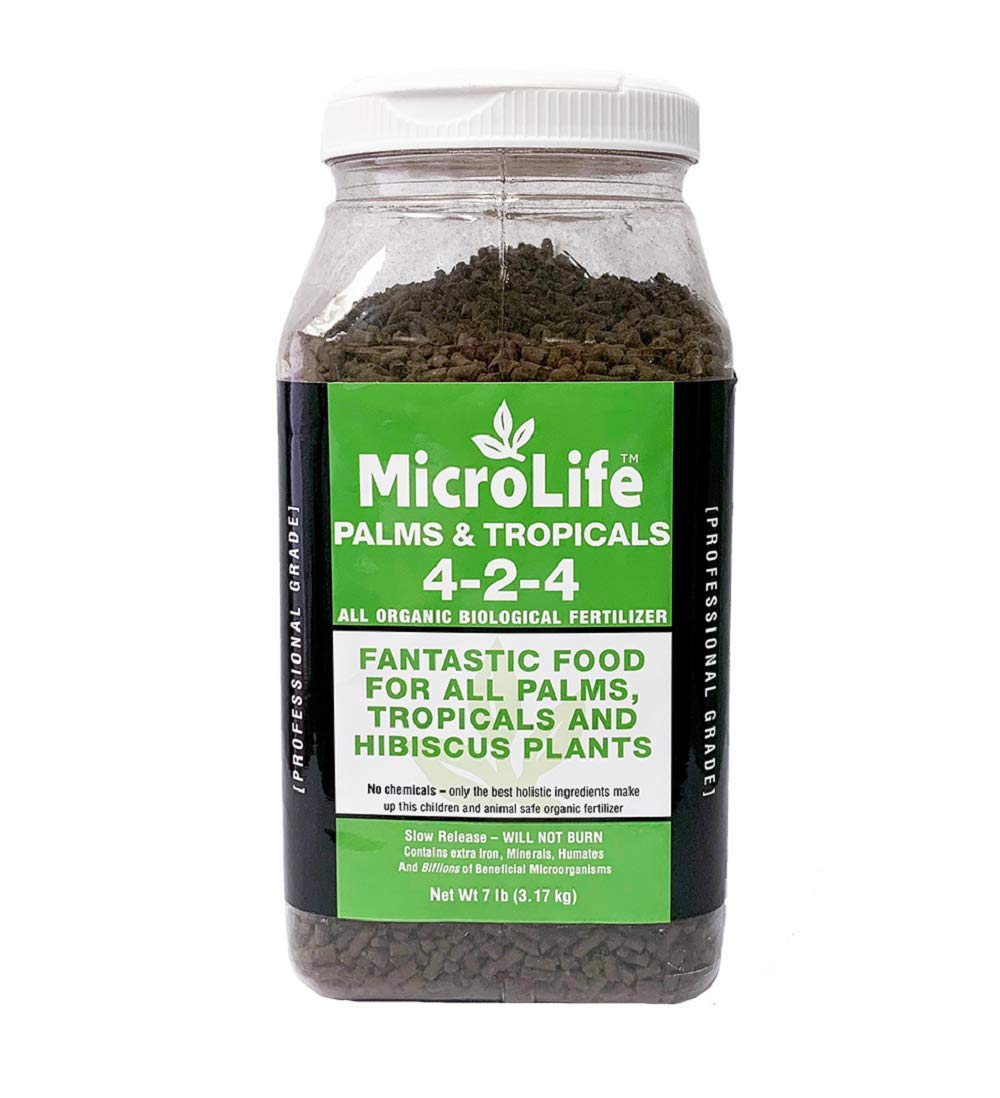
MicroLife Palms & Tropical Granular Organic Fertilizer (4-2-4), 7 lb
| Item Form | Granules |
|---|---|
| Specific Uses For Product | Organic |
| Target Species | Palms, tropicals & hibiscus |
| Mixing Ratio | 1:1:1 |
This granular formula delivers steady nutrition with a 100 percent slow-release profile designed to avoid burning sensitive tropical plants. You apply it to soil around the base of new plantings and as part of annual maintenance; the slow-release granules feed over time so you do not need frequent reapplication. The product includes extra potassium, magnesium, manganese, and iron, which support strong foliage color and stress tolerance in nutrient-hungry tropicals. Its professional-grade concentration means you can expect robust, gradual growth and improved plant resilience rather than a short burst of lush but weak growth. On the downside it is a specialty palm/tropical blend so it is not tailored for every fruiting crop and directions must be followed to get the intended slow-release benefit. Also the granular form requires spreading or incorporation into soil, so it is less convenient than a liquid feed for foliar applications. For gardeners focused on steady, dependable nutrition this fertilizer simplifies seasonal feeding for tropical and hibiscus plantings.
Best for: Buyers who prioritize dependable, low-maintenance nutrition for tropical plants and want a slow, steady feeding program rather than frequent dosing.
Less Ideal for: Growers seeking a fertilizer optimized specifically for pineapple fruit production or those who prefer liquid or foliar feeds for quick correction.
- 100% slow-release granules reduce risk of fertilizer burn and provide sustained feeding
- Includes added potassium, magnesium, manganese and iron to support foliage health and stress tolerance
- Professional-strength formula suited for new plantings and annual maintenance
- Formulated specifically for palms and tropicals so nutrient balance may not match all fruiting crops
- Granular form requires soil application and is not suitable for quick foliar feeding
Verdict: Choose this slow-release tropical fertilizer when you want reliable, low-risk seasonal feeding to maintain healthy foliage and steady growth.
Miracle-Gro Shake 'N Feed Palm Plant Food, 4.5 lb

| Item Form | Powder |
|---|---|
| Application Method | shake onto soil |
| Target Species | Palm plants |
| Unit Count | 72 Ounce |
| Mixing Ratio | 8:2:12 |
Miracle-Gro Shake 'N Feed Palm Plant Food is a shake-on granular fertilizer designed to supply steady nutrition to palms, cycads, and other tropical plants for up to three months per application. You apply it by shaking the powder evenly onto soil beneath the fronds, working it into the top 1–3 inches of soil, then watering to activate the feed; it can also be mixed into new potting soil at planting. The formulation includes nitrogen, phosphorus and potassium plus magnesium, iron and manganese to help reduce yellowing and promote greener fronds, and the product contains compost to support root health. The main practical benefits are simple application without measuring equipment, slow-release feeding that reduces application frequency, and targeted nutrients for palm health. Limitations are that it is a general palm formula rather than tailored to specific palm species and you must avoid contact with trunks and foliage to prevent damage; correct application rates are important to avoid overfeeding. This is a straightforward option if you want low-effort, periodic feeding for established palms in containers or in-ground beds.
Best for: Gardeners who want a low-effort, reliable palm fertilizer that requires infrequent applications and straightforward shake-on use for established container or in-ground palms.
Less Ideal for: Growers needing a species-specific nutrient program or precise, frequent feeding schedules for high-value or finicky palms.
- Continuous-release formula that feeds up to three months reducing application frequency
- Includes micronutrients (magnesium, iron, manganese) to help prevent yellowing of fronds
- Easy shake-on application for in-ground and container palms without mixing equipment
- Contains compost to support root health and improve water efficiency
- Not species-specific so it may not address unique nutrient needs of all palm varieties
Verdict: A no-fuss, slow-release palm fertilizer that delivers targeted micronutrients and three months of feeding with simple shake-on application.
Carl Pool Palm Food 12-4-12, 4 lb

| N-P-K | 12-4-12 |
|---|---|
| Net weight | 4 lb |
| Nitrogen release | 3-4 month |
| Formulation focus | Extra magnesium and manganese |
This 4 lb Carl Pool Palm Food is a granular, slow-release fertilizer designed specifically for palms and formulated to deliver balanced nutrition over several months. It combines three nitrogen sources, including a water-insoluble fraction that reduces leaching and provides both immediate and longer-term feeding, while extra magnesium and manganese address common palm micronutrient needs. Typical use is seasonal top-dressing under the palm canopy, watered in after application and repeated every 3 to 4 months for established trees. Practical benefits include targeted micronutrient support for frond color and growth, reduced frequency of applications thanks to the controlled-release nitrogen, and a straightforward spread-and-water application that suits homeowners and pros. Important limitations are that it is intended only for established palms and should not be used on new plantings, and the 4 lb size may be small for properties with multiple or large Robellini palms, requiring multiple bags to cover larger root zones.
Best for: Homeowners and small-scale gardeners who want a palm-specific, low-maintenance fertilizer that corrects micronutrient needs and reduces reapplication frequency for established Robellini palms.
Less Ideal for: People planting new palms or restoring seriously deficient soil should choose starter fertilizers or soil amendments tailored for transplants and heavy remediation.
- Formulated specifically for palms with added magnesium and manganese to correct common micronutrient deficiencies
- Three nitrogen sources including water-insoluble nitrogen for both immediate and sustained feeding
- Controlled 3–4 month nitrogen release cuts down on how often you need to reapply
- Easy granular application that is spread under the canopy and watered in
- Labeled for established palms only and not suitable for new transplants
- Small 4 lb bag may be insufficient for multiple or mature Robellini palms
Verdict: A palm-specific slow-release fertilizer that simplifies feeding established Robellini palms by delivering balanced nutrition and targeted micronutrients with fewer applications.
Choosing the Right Fertilizer for Queen Palms: Key Factors to Consider
Nutrient Ratio and Micronutrient Content
Queen palms need a balanced supply of macronutrients and certain micronutrients to maintain green, vigorous fronds. A fertilizer's NPK ratio tells you the proportion of nitrogen, phosphorus, and potassium, but palm health often depends on added magnesium, manganese, and iron. Those trace elements prevent common symptoms like yellowing between leaf veins or older frond decline.
When choosing, look for formulas that list guaranteed levels of micronutrients. Slow-release formulations with micronutrient blends supply steady doses that match the palm's uptake pattern better than one-off soluble feeds. A product that only lists NPK without trace elements can work for short-term growth but may miss chronic deficiencies seen in tropical soils.
Release Type and Feeding Frequency
Fertilizers come in quick-release, water-soluble, and slow- or controlled-release forms. Quick-release mixes show fast greening but can require frequent reapplication and raise the risk of salt buildup in the root zone. Water-soluble feeds are useful for targeted correction of deficiencies since they deliver nutrients immediately through irrigation.
Slow-release or coated granular fertilizers provide steady nutrition over months and reduce application frequency, which is helpful for large specimens or low-maintenance landscapes. Match release type to your irrigation schedule and how often you can apply fertilizer. Inconsistent irrigation can reduce the effectiveness of slow-release coatings or concentrate salts with soluble feeds.
Application Method and Practicality
Consider whether you prefer broadcast granules, soil drench, or foliar applications. Broadcast granules and slow-release tablets are easy to apply around a mature palm's root zone, while soluble packets and liquid concentrates require mixing and careful watering-in for even distribution. Foliar sprays can correct leaf-level deficiencies quickly but do not replace soil feeding for long-term vigor.
Practical labels, clear spreader settings, and guidance for root spread and timing make some products much easier to use correctly. If you have several palms or large specimens, products that allow batch mixing or that cover large areas per bag reduce labor.
Salt Index and Root Safety
High-salt fertilizers can stress palm roots, especially in compacted or poorly draining soils and in coastal yards where salts already accumulate. Look for formulations described as low-salt or with a moderate salt index, and favor slow-release options that avoid sudden spikes in soluble salts after application.
If your site has poor drainage or regular irrigation with hard or brackish water, choose fertilizers that minimize sodium and chloride content. Proper application rates and thorough watering-in after applying soluble feeds also reduce the chance of root burn.
Label Clarity, Directions, and Palm-Specific Guidance
A good fertilizer label explains how much to apply based on trunk diameter or canopy spread and gives a feeding schedule tailored to palms. Clear instructions on how to distribute product, whether to remove fallen fronds before application, and whether to incorporate into soil are important for consistent results.
Products that include troubleshooting tips for common palm issues, safe reapplication intervals, and compatibility with mulches or soil amendments make successful feeding easier for home gardeners. Avoid mixes with vague instructions or missing guidance for established trees.
Environmental Considerations and Soil Health
Consider how a fertilizer affects the broader garden ecosystem. Formulations that release nutrients slowly reduce runoff risk and maintain steady soil biology. Excessive phosphorus or misuse of high-salt products can harm nearby plants and water bodies.
Think about combining fertilization with organic matter additions to build soil structure and support microbial life. Using fertilizers as part of a larger fertility plan that includes mulch, compost, and periodic soil testing yields more resilient palms over the long term.
When to Start Feeding Queen Palms
Young and newly planted queen palms need a gentler schedule than mature specimens. Begin a tailored feeding program after initial establishment, once roots have begun to spread into surrounding soil. In warm climates, active growth periods drive nutrient uptake, so align major applications with spring and early summer growth bursts.
Mature trees benefit from a routine that avoids heavy late-season feeds which can encourage tender growth before cooler weather. Seasonal timing should follow local climate patterns and irrigation availability rather than a fixed calendar.
- Start light feeding after the first full growing season for new plantings.
- Time heavier applications during active growth periods in spring and early summer.
- Avoid late-season high-nitrogen feeding that promotes vulnerable new growth.
Soil Testing and Adjusting Your Program
A simple soil test is the most direct way to learn which nutrients are lacking. Tests can indicate pH and levels of magnesium, manganese, iron, and other elements that affect palm health. Armed with results, you can pick a fertilizer that corrects measured deficiencies rather than guessing.
Follow-up testing every few years helps you avoid unnecessary applications and prevents the buildup of unwanted salts or excess phosphorus. Tests also help you decide when to add amendments like magnesium sulfate or elemental sulfur to adjust pH.
- Test before starting a long-term feeding plan or if palms show persistent deficiency symptoms.
- Use test results to choose between granular slow-release and targeted soluble corrections.
How Irrigation Affects Fertilizer Choice
Irrigation frequency and quality influence how fertilizers behave in the soil. Regular, even watering helps distribute soluble nutrients and activates coated granules. Infrequent watering can leave soluble salts concentrated near feeder roots, while heavy irrigation can leach nutrients from sandy soils before palms absorb them.
Match fertilizer release type to your irrigation: slow-release granules pair well with consistent schedules, and water-soluble feeds are better when you can water immediately after application for even distribution.
- Ensure thorough watering-in after applying soluble fertilizers to avoid salt hotspots.
- Consider split applications for sandy soils to reduce leaching and improve uptake.
Combining Fertilizers with Soil Amendments and Mulch
Mulch conserves moisture and moderates soil temperature around the root zone, which complements a steady fertilizer program. Organic mulches also slowly add nutrients and improve structure, helping palms use applied fertilizers more efficiently. Avoid piling mulch against the trunk; apply it in a broad, shallow layer over the root zone.
If soils are compacted or depleted, incorporate organic matter or compost to rebuild structure before relying solely on fertilizers. Improved soil biology increases nutrient retention and reduces the need for aggressive feeding.
- Apply mulch in a donut shape, keeping material away from the trunk base.
- Topdress with compost annually to enhance long-term fertility and structure.
Recognizing Nutrient Deficiencies in Queen Palms
Deficiency signs are the quickest clue that your fertilizer program needs adjustment. Yellowing between leaf veins often indicates micronutrient shortages, while older fronds turning yellow first can point to overall nutrient limitations. A magnesium or manganese shortfall produces characteristic patterns you can learn to spot.
Correct diagnosis matters because applying the wrong nutrient in excess can mask or worsen other problems. If you are unsure, pair visual diagnosis with a soil test or targeted soluble correction rather than blanket high-nitrogen feeding.
- Look for interveinal chlorosis and note whether new or old fronds show symptoms first.
- Use spot treatments of micronutrients when tests or clear symptoms point to a specific deficiency.
How We Chose the Best Fertilizer for Queen Palms
We prioritized fertilizers that address the specific nutritional needs and common deficiencies of queen palms. Key evaluation criteria included nutrient ratio and micronutrient profile to ensure adequate nitrogen, potassium, and essential trace elements. We also rated formulation type and release profile, since slow-release granules, coated formulations, and water-soluble mixes perform differently in sandy tropical soils and under varying irrigation. Application practicality was a major filter: we favored products that are straightforward to apply around established root zones and that have clear, palms-specific directions. Longevity of feeding effect and frequency of reapplication were assessed so gardeners can match labor and seasonality. Environmental impact and salt load were considered, with preference toward options that limit salt buildup and protect roots. Exclusions: we excluded generic houseplant mixes that lack palm-focused micronutrients and any formulations intended exclusively for turf or vegetables without palm guidance. We also did not include products with unclear nutrient labeling or lacking standard application instructions.
FAQ
How often should I fertilize established queen palms?
It depends on the product. Slow-release formulas are often applied two to four times per year. Water-soluble feeds may be used more frequently for quick correction, but avoid overfeeding by following label intervals and monitoring frond response.
What NPK ratio is best for queen palms?
Queen palms typically do well with a balanced ratio that leans toward adequate potassium and nitrogen while including micronutrients. A palm-specific label will list trace elements like magnesium and manganese, which are as important as the NPK numbers.
Can I use lawn fertilizer on queen palms?
Some lawn fertilizers work in a pinch, but many lack the micronutrient mix palms need. Turf products may also have different release rates and salt contents, so choose products labeled for palms or supplement lawn feeds with palm-focused micronutrients.
Will foliar feeding fix yellowing fronds quickly?
Foliar sprays can correct certain micronutrient deficiencies faster than soil applications because leaves absorb nutrients directly. However, foliar feeding is usually a short-term fix and should be combined with soil feeding for lasting health.
Is it safe to fertilize queen palms during drought?
Fertilizing during severe drought is risky because high-salt feeds can stress roots when soil moisture is low. If irrigation is limited, postpone feeding until adequate watering is available or use very low-dose, slow-release options sparingly.
Final Verdict
Select a fertilizer for queen palms that matches both your soil conditions and your maintenance routine. Prioritize formulas with the right balance of macronutrients and palm-specific micronutrients, and pick a release profile that fits your irrigation and labor patterns. Regular soil testing and attention to salt management reduce risk and make feeding more effective. A sensible feeding plan focuses on preventing deficiencies rather than chasing rapid growth. With the right product type, clear label guidance, and proper timing, you can maintain a healthy canopy and reduce common nutrition-related problems in queen palms.
