

Note: This article contains affiliate links. If you click on these links and make a purchase, I may earn a small commission at no extra cost to you. This helps support my research and content. Read my full affiliate disclosure here.
Picking the right soil mix for herbs shapes how well they establish, set flavor, and produce over the season. Herbs vary from thirsty basil to drought-tolerant rosemary, but they share a need for a mix that drains reliably while holding enough nutrients and moisture for even growth. This guide reviews seven carefully shortlisted soil mixes for herbs suited to pots, raised beds, and in-ground patches. We focus on practical gardener concerns like drainage, nutrient retention, particle size, and disease resistance so you can match a mix to your planting method and local conditions. Below are our top picks followed by clear buying guidance and care tips.
Top Picks at a Glance
| Best Overall The best all-around choice for most situations | Rosy Soil Herb Mix Organic Potting Soil, 4 Quarts |  |
| Best Quality Built to a higher standard if you want something more solid | Burpee Premium Organic Potting Mix with Coconut Coir (9 Quart) |  |
| Best Value The sweet spot between price and what you get | Back to the Roots All-Purpose Peat-Free Potting Mix, 12 Quart (2-Pack) |  |
| Best Budget The cheapest option that still gets the job done reliably | Miracle-Gro Indoor Potting Mix for Seed Starting (2-Pack, 8 qt. each) |  |
| Highest Rated A top-rated pick with lots of positive feedback | KXUPOIAV Organic Vegetable & Herb Mix, Compressed 2 cu ft Bale |  |
| Most Popular A crowd favorite that many people choose with confidence | Miracle-Gro Indoor Potting Mix for All Plants, 6 qt. (2-Pack) |  |
| Best Seller A high-volume bestseller chosen again and again | Back to the Roots Organic Indoor Potting Mix, 6 Quart |  |
Rosy Soil Herb Mix Organic Potting Soil, 4 Quarts

| Unit Count | 64 Ounce |
|---|---|
| Volume | 4 quarts |
| Item Highlight | Biochar, Worm Castings, Mycorrhizae Blend, Peat-Free, Fast Draining |
This Rosy Soil Herb Mix is a ready-to-use potting medium designed specifically for growing culinary and ornamental herbs indoors or in containers outdoors. It combines biochar, worm castings, compost, bark fines and beneficial mycorrhizae to create a light, airy mix that drains quickly while holding nutrients where roots can access them. Typical use is straight from the resealable 4-quart bag to fill two to three 6-inch pots or top up larger planters; no blending required. The organic inputs and mycorrhizal fungi support stronger root development and improved nutrient uptake, which can lead to fuller, more flavorful herb growth. Being peat-free and built from upcycled materials is a plus for gardeners wanting a more sustainable option. Limitations are the small bag size if you are planting many containers or a larger outdoor bed and the product is tailored to container-grown herbs rather than heavy garden soil amendment for large vegetable plots.
Best for: Gardeners who want an easy, ready-made organic mix for growing herbs in pots, windowsills or balcony planters and prioritize plant health and sustainability.
Less Ideal for: People needing large quantities of soil for in-ground beds or landscapers who require bulk amendments for big plots.
- Formulated for herbs with biochar, worm castings and mycorrhizae to support root health and nutrient uptake
- Peat-free and made from upcycled organic ingredients for a more sustainable choice
- Fast-draining, airy texture suitable for seedlings and container-grown herbs
- Resealable 4-quart bag ready to use without additional mixing
- Small 4-quart volume may require multiple bags for larger collections or bigger planters
- Not intended as a bulk garden soil amendment for large in-ground beds
Verdict: A compact, peat-free herb potting mix that gives container-grown herbs healthier roots and better nutrient access with no mixing required.
Burpee Premium Organic Potting Mix with Coconut Coir (9 Quart)

| Item Form | Powder |
|---|---|
| Specific Uses For Product | Plant Growth, Root Development, Seed Development, Soil Conditioning |
| Coverage | 9 Qt Container |
| Included Components | Fertilizer |
Burpee Premium Organic Potting Mix is a 9 quart, coco coir–enhanced soil blend aimed at container gardening and seed starting. It is OMRI listed and formulated to encourage germination and strong root development while holding moisture without waterlogging, which makes it useful for herbs grown in pots or small raised beds. The mix includes slow-release nutrients that the manufacturer says can feed plants for up to three months, so it reduces the need for frequent fertilizing during the early growth stage. Practical benefits for herb growers include improved aeration from the coir, consistent moisture retention that cuts down watering frequency, and a lightweight bag size that is easy to handle for tabletop or balcony gardens. Limitations are the small 9 quart volume, which means you will likely need multiple bags for several pots or larger containers, and the product is sold as a finished potting mix so it may not suit gardeners who prefer to custom-blend amendments or control exact nutrient levels for mature, heavy-feeding herbs.
Best for: Herb growers who want a ready-made organic potting mix that promotes quick germination and steady early growth in containers and limited-space gardens.
Less Ideal for: Gardeners who need large volumes for in-ground beds or who prefer to create custom soil blends with precise nutrient or texture control.
- OMRI listed organic blend suitable for organic herb production
- Coco coir improves aeration while retaining moisture to reduce watering frequency
- Contains slow-release nutrients to feed plants for up to three months
- Formulated for seed starting and strong root development in containers
- Small 9 quart bag may not be cost-effective for larger herb gardens
Verdict: Choose this organic, coco coir–enhanced potting mix when you want a ready-to-use bag that jumpstarts seed germination and supports steady root growth for container herbs.
Back to the Roots All-Purpose Peat-Free Potting Mix, 12 Quart (2-Pack)

| Number of Packs | 2 |
|---|---|
| Unit Count | 384 Ounce |
| Item Type Name | Natural & Organic All-Purpose Peat-Free Potting Mix |
| Style Name | Specialty Potting Mix |
This Back to the Roots All-Purpose Potting Mix is a peat-free, organic blend intended for container and herb gardening. It combines coconut coir for moisture retention, mycorrhizae to support root health, yucca extract to aid water and nutrient transport, and dolomitic limestone to help balance pH. Typical use is filling pots, planters, or raised beds for herbs, vegetables, and flowers where steady moisture and consistent nutrient availability help young roots establish. The peat-free formula is a practical choice for gardeners wanting sustainable alternatives without sacrificing performance, and the included biological additives reduce the need for frequent fertilizer in early growth. Limits to expect are package volume versus ongoing needs for large collections of pots and that heavier-feeding plants may need supplemental fertilizer over time. Overall the mix simplifies starting and maintaining potted herbs by focusing on moisture control, root support, and a balanced starting nutrient profile.
Best for: Ideal for gardeners who want an easy, sustainable potting mix that helps herb seedlings and container herbs establish quickly with minimal fuss and fewer early fertilizer interventions.
Less Ideal for: Not the best choice for gardeners managing large vegetable plots or for those who prefer to custom-blend soils for specific high-demand crops.
- Peat-free organic blend supports sustainable gardening
- Contains mycorrhizae to enhance root growth and nutrient uptake
- Coconut coir and yucca extract improve moisture retention and distribution
- Includes dolomitic limestone to help balance soil pH for many herbs
- Sold in modest 12 quart total volume which may require multiple bags for larger herb collections
- May require supplemental feeding for heavy-feeding or mature plants
Verdict: A sustainable, ready-to-use peat-free potting mix that makes starting and maintaining potted herbs easier by supporting roots, moisture control, and balanced pH.
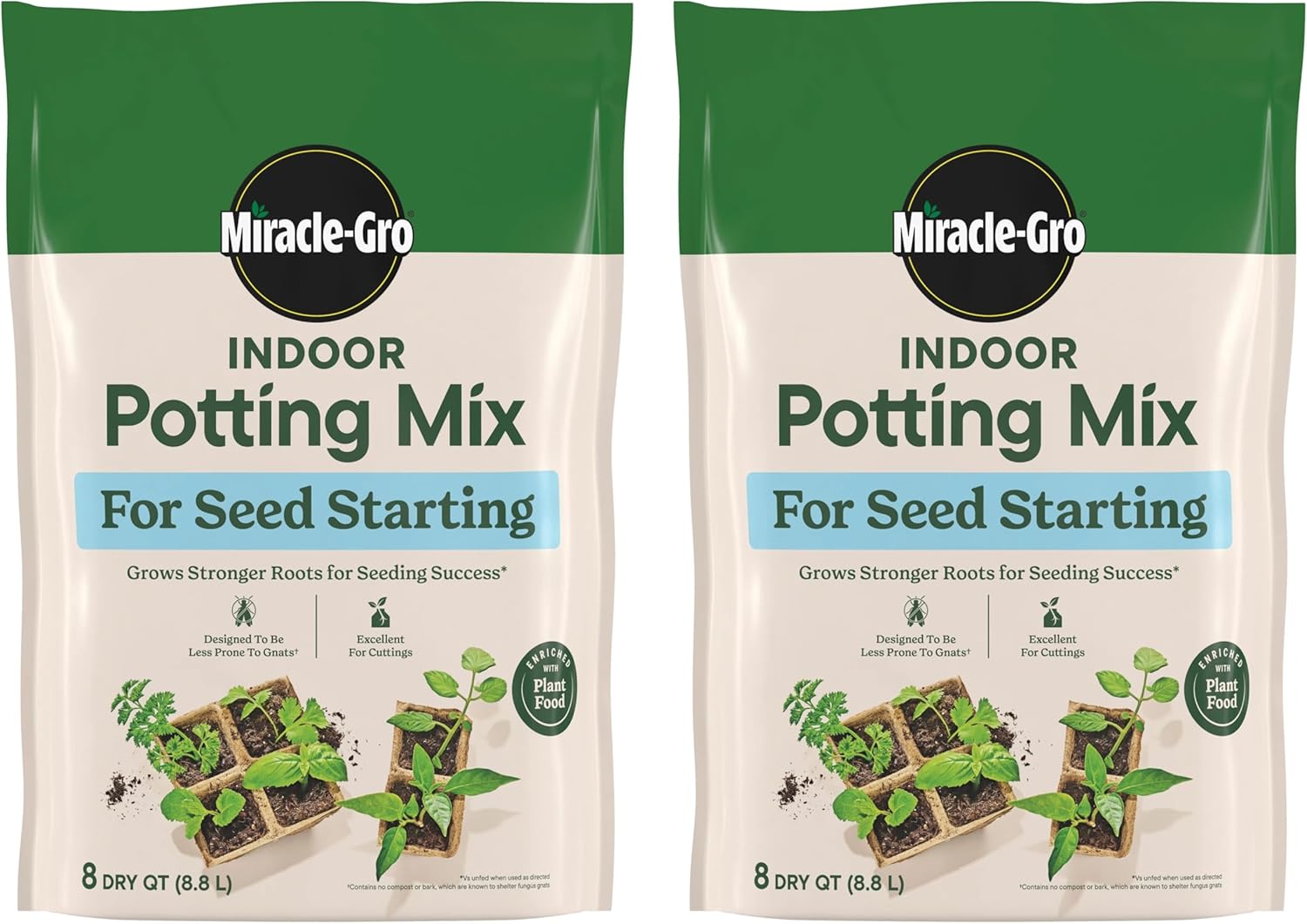
Miracle-Gro Indoor Potting Mix for Seed Starting (2-Pack, 8 qt. each)
| Brand Name | Miracle-Gro |
|---|---|
| Item Type Name | Potting Mix |
| Number of Packs | 2 |
| Volume | 8 quarts |
Miracle-Gro Indoor Potting Mix for Seed Starting is a lightweight, ready-to-use soil blend designed to give young seedlings and cuttings an easier start. It is typically used to fill cell trays or small containers for germinating vegetable, flower, and herb seeds and for rooting leaf or stem cuttings. The mix is enriched with plant food to promote stronger root development compared with unfed media and is formulated without compost or bark to reduce shelter for fungus gnats. Practical benefits include consistent moisture retention for delicate seedlings, enough mix in an 8 qt. bag to fill multiple 72-cell trays, and a familiar brand formulation that many growers trust. Because it is a prepared seed-starting mix, users do not need to blend ingredients or add fertilizer during the initial weeks. Important limitations are that it is intended for indoor seed starting and cuttings rather than long-term potting or in-ground use, and the included plant food means you should follow directions on subsequent fertilizing to avoid overfeeding once plants are established.
Best for: Ideal for gardeners starting herbs from seed or propagating cuttings who want a simple, no-mix solution to get many seedlings off to a healthy start on a modest budget.
Less Ideal for: Not the best choice for growers looking for a long-term container mix or an outdoor garden amendment for mature herb plants.
- Lightweight, consistent texture suited to seed trays and small containers
- Pre-enriched with plant food to support early root growth
- Formulated without compost or bark to lower risk of fungus gnat habitat
- Each 8 qt. bag fills multiple 72-cell trays, and this listing includes two bags
- Not formulated for long-term potting or in-ground use once seedlings are established
Verdict: A convenient, budget-friendly seed-starting mix that simplifies indoor herb propagation by supplying a lightweight, fed medium that reduces fungus gnat risk.
KXUPOIAV Organic Vegetable & Herb Mix, Compressed 2 cu ft Bale

| Unit Count | 1536 Ounce |
|---|---|
| Style Name | Compressed Bale |
| Volume | 4 cubic feet |
This compressed bale is designed for growing vegetables, fruits, and especially herbs in beds or containers; the 2 cu ft compressed bag expands to about 4 cu ft of ready-to-use soil. It is peat-based, OMRI-listed for organic use, and contains mycorrhizae plus an organic fertilizer that feeds gradually for up to three months, which helps establish seedlings and supports steady growth without frequent feeding. The compressed format saves storage space and is easy to expand by loosening and hydrating the bale before use. Practical benefits include a sterile, uniform medium suited to transplanting and container herb production and a built-in nutrient boost for the early season. Important limitations are that peat-based mixes can dry out faster than heavier soils and will require more frequent watering in warm conditions, and the three-month fertilizer means later-season feeding or side-dressing may be necessary for long-season herbs. Also users with peat-free preferences should note this is peat-based.
Best for: Herb growers who want a dependable, ready-to-use organic potting/bed mix that establishes plants quickly and reduces early-season feeding and prep time.
Less Ideal for: People strictly avoiding peat or those who prefer a heavier, moisture-retentive loam for perennial herb beds should consider alternatives.
- OMRI-listed organic blend suitable for vegetable and herb production
- Includes mycorrhizae to support root development
- Contains slow-release organic fertilizer providing nutrients for up to three months
- Compressed bale expands to usable volume for easier storage and transport
- Peat-based formula can dry out more quickly than heavier mixes
- Nutrient supply is time-limited so additional fertilization is needed for long-season crops
Verdict: Choose this compressed OMRI-listed mix when you want a reliable, ready-to-use organic soil that jump-starts herbs with built-in mycorrhizae and slow-release nutrients.
Miracle-Gro Indoor Potting Mix for All Plants, 6 qt. (2-Pack)

| Number of Packs | 2 |
|---|---|
| Item Highlight | Feeds for up to 6 Months |
| Ingredients | Sphagnum Peat Moss, Coir, Perlite, Fertilizer, Wetting Agent |
| Unit Count | 400.58 Ounce |
This two-pack of Miracle-Gro Indoor Potting Mix is a lightweight, ready-to-use soil aimed at indoor container plants. It combines sphagnum peat moss, coconut coir, and perlite with a built-in fertilizer and wetting agent so new or repotted herbs and houseplants get moisture retention and aeration without extra blending. Typical use is straightforward: fill a drained pot, set the plant, backfill and water; one 6 qt. bag is said to fill about four 6-inch pots. Practical benefits for herbs include improved water retention without compaction and fewer hiding places for fungus gnats because the mix is bark- and compost-free. The included fertilizer feeds up to six months, reducing the need for immediate feeding. Limitations are that the bagged nutrient level is finite so repotting or supplemental feeding will be needed after the initial period, and the general-purpose formula is not specialized for high-drain or succulents that need extra drainage. For herb growers who prefer a simple, proven potting medium, this reduces prep time and uncertainty, but serious growers should plan a feeding schedule after the first few months.
Best for: Buyers who want a low-effort, reliable potting mix for indoor herbs and common houseplants and prefer a product with wide user acceptance and clear usage guidance.
Less Ideal for: Growers seeking a specialty herb soil with tailored nutrient ratios or those who need an ultra-fast-draining mix for succulents or cacti.
- Ready-to-use blend of peat moss, coir, and perlite for good water retention and aeration
- Contains starter fertilizer that feeds plants for up to six months
- Bark- and compost-free formula helps reduce fungus gnat habitat
- Lightweight mix that is easy to handle and repot with
- Fertilizer is temporary so nutrients will need replenishing after about six months
- Not formulated specifically for herbs with unusual drainage needs or for succulents
Verdict: A proven, ready-to-use indoor potting mix that makes repotting and growing herbs simple by combining moisture-holding materials with six months of starter nutrition.
Back to the Roots Organic Indoor Potting Mix, 6 Quart

| Volume | 6 quarts |
|---|---|
| Ingredients | Coconut Coir, Yucca, Mycorrhizae, Perlite, Horticultural Sand |
| Peat-free | Yes |
| Made in | USA |
This 6‑quart Back to the Roots Indoor Potting Mix is designed for indoor plants and herbs, offering an organic, peat-free blend that emphasizes moisture retention and root health. It contains coconut coir, yucca extract to help the mix hold water, mycorrhizae to support root development and nutrient uptake, perlite and horticultural sand for drainage, and dolomitic limestone to balance pH. In practice it is easy to use for repotting small herb pots, seedling transplants, or refreshing the topsoil of basil, parsley and other countertop herbs. The peat-free formula and lack of bark or compost reduce the chance of indoor gnats and make it a cleaner option for kitchens. The 6‑qt size is convenient for single pots or a few small containers but will require buying multiple bags for a larger herb collection. For buyers who prefer organic, ready‑to‑use mixes with built‑in root support, this provides straightforward, low‑risk performance; larger scale growers should plan for more volume or a bulk product.
Best for: Buyers who want a low-risk, ready-to-use organic potting mix for countertop herbs and a few small containers and who prioritize clean, pest-resistant indoor soil.
Less Ideal for: Not ideal for gardeners needing large volumes for raised beds or many containers who should consider bulk mixes or larger bags.
- 100% organic and peat-free formula suitable for eco-conscious indoor gardening
- Includes yucca extract to improve moisture retention between waterings
- Contains mycorrhizae to promote stronger root development and nutrient uptake
- Perlite and horticultural sand provide drainage to prevent waterlogging
- Only 6 quarts per bag so multiple bags are needed for several pots or larger herb setups
Verdict: A compact, organic peat-free potting mix with moisture retention and mycorrhizae that makes repotting and growing countertop herbs simple and low risk.
Choosing the Right Soil Mix for Herbs: Key Factors to Consider
Drainage and Aeration
Herbs generally dislike waterlogged roots, so a soil mix that drains well is essential. Good drainage comes from coarse particles like perlite, coarse sand, or chunky bark that create pore space and prevent compaction. Aeration keeps oxygen available to roots and encourages fibrous root growth that supports flavor and essential oil production.
If you are planting in containers, drainage is even more critical because pots retain water differently than in-ground beds. In raised beds or garden soil, a mix that improves structure without holding excessive water will reduce root rot risk and keep herb foliage vigorous.
Moisture Retention Vs Fast Drying
Herbs span a moisture spectrum; some prefer evenly moist conditions while others tolerate drier cycles. A good herb mix balances water-holding components like peat, coconut coir, or compost with draining ingredients so the medium does not dry out overnight nor stay saturated for days.
Think about how often you can water. If you travel frequently or are growing in small pots that dry fast, choose a mix with slightly higher moisture retention. For sun-exposed containers or Mediterranean herbs, lean to a faster-draining blend.
Nutrient Content and Slow-Release Amendments
Herbs do not require heavy fertilization, but they do benefit from steady, moderate nutrient availability during the growing season. Soil mixes that include modest amounts of compost, aged manure, or low-level slow-release fertilizer provide an initial feeding that supports establishment.
Avoid mixes overloaded with high-nitrogen amendments that push leaf growth at the expense of flavor. For long-season containers, plan on supplemental feeding; for in-ground herbs, a slightly richer mix at planting helps young plants compete and root quickly.
Particle Texture and Structure
Texture affects how roots spread, how the mix compacts over time, and how easy it is to transplant. A blend of fine particles for contact with roots and coarser particles for structure makes a stable medium that resists compaction but still allows close root-to-soil contact.
Fine silt or too much powdery peat can compact and reduce aeration. Conversely, an overly coarse mix may not retain enough moisture for small-rooted herbs. Look for mixes that state a balance of particle sizes or combine peat/coir with perlite, pumice, or coarse sand.
pH and Salt Levels
Most culinary herbs prefer a near-neutral to slightly alkaline pH, though many tolerate a broad range. A soil mix should not be highly acidic or salt-loaded. High salts from certain composts or recycled potting materials can stress herbs, especially young transplants.
If you grow herbs for consumption, choose mixes with tested pH ranges and low soluble salt ratings when available. You can adjust pH gradually with lime for acidic mixes or use fresh water flushes to reduce soluble salts in containers.
Cleanliness and Disease Control
Starter mixes that have been pasteurized or are produced under clean conditions reduce early damping-off, fungal disease, and weed seed introduction. For edible herbs, minimizing pathogens and weed seeds helps reduce the need for reactive interventions.
Avoid garden soil mixed in unsterilized containers unless it has been aged and screened. Clean mixes mean fewer surprises during establishment and a lower risk of transplant losses from soilborne pathogens.
Best Mix Types By Growing Situation
Different herb setups call for different mix priorities. Containers benefit from mixes that hold enough moisture but still drain quickly, so blends with coir or peat plus perlite work well. Raised beds often tolerate richer mixes with more compost because the bed drains into surrounding soil. In-ground planting calls for mixes that amend native soil structure without creating a perched water table.
Match the mix to pot size and exposure. Shallow containers need lighter, moisture-retentive media to support roots without frequent watering. Large tubs can use chunkier mixes because greater volume moderates drying.
- Small pots: finer texture with some water-holding components
- Large containers: chunkier structure with added aeration
- Raised beds: more compost for nutrient-holding capacity
- In-ground: amendments to correct drainage and structure only
Adjusting Mixes Seasonally and By Herb Type
Consider tweaking mixes seasonally. In hot summer conditions, increase moisture retention slightly to prevent daily drying stress. For wintering herbs or cold-season growth, reduce organic-rich components that retain too much water which can freeze and damage roots.
Also consider herb type. Mediterranean herbs usually need lean, very well-draining mixes, while tender culinary herbs prefer slightly richer, more moisture-holding blends. Adjust amendments rather than swapping entire mixes when possible.
- Summer tweaks: add more moisture-holding material
- Winter tweaks: increase drainage and reduce fresh compost
- Mediterranean herbs: lean, rocky mixes
- Tender herbs: richer, moister blends
How To Test and Improve Your Existing Mix
You can test drainage by watering a sample pot and timing how long water runs through. If water sits on the surface or drains extremely slowly, add coarse materials. If water runs through almost instantly and the medium dries in a day, add compost or coir to increase retention.
To improve structure over time, top-dress containers with a small amount of compost each season and gently fluff compacted surface layers. For in-ground beds, work in coarse sand or grit to open heavy clay soils and add organic matter to sandy soil to increase water-holding capacity.
- Drainage test: saturate and measure percolation time
- Fix slow drainage: add perlite, pumice, or coarse sand
- Fix fast drying: incorporate compost or coconut coir
- Seasonal top-dressing prolongs mix life
Watering and Feeding Practices That Match Good Mixes
Even the best mix requires compatible watering and feeding. Water deeply and allow a brief dry period for herbs that prefer it, rather than frequent shallow watering. For moisture-loving herbs, keep the medium evenly moist but never waterlogged.
Fertilize according to the mix's initial nutrient content. A modest liquid feed every few weeks or a low-dose slow-release product can keep herbs productive in containers. In raised beds and garden soil, side-dress with compost or diluted organic fertilizer during the growing season.
- Deep watering encourages stronger roots
- Match feeding schedule to mix nutrient level
- Flush containers occasionally to prevent salt build-up
- Adjust volume and frequency for pot size and exposure
Sourcing and Storage Tips for Soil Mixes
Buy or blend only as much mix as you can use in a growing season to avoid nutrient decline and compaction in stored mixes. Keep unopened bags dry and out of direct sun. For bulk purchases, store in a sheltered, ventilated area on pallets to avoid ground moisture.
When blending components, use clean containers and screen compost to remove large undecomposed pieces. Label any custom blends so you can reproduce successful mixes in future seasons.
- Store bags off the ground and in dry shade
- Use clean tools and containers when blending
- Screen compost for fine texture
- Label custom blends with date and proportions
How We Chose the Best Soil Mix for Herbs
We selected surface soil mixes that reflect real garden use for herbs in pots, raised beds, and garden rows. Only mixes formulated for edible herbs or versatile all-purpose mixes suitable for culinary plants were considered. We excluded mixes designed solely for succulents, orchids, or heavy-feeding vegetable transplants because their formulations do not match most herb needs. Evaluation prioritized drainage characteristics and moisture retention because herbs need a balance between wet feet and drought stress. Particle size and texture were assessed to predict aeration, root penetration, and compaction over time. Nutrient content and the presence of slow-release amendments were reviewed to estimate how often gardeners must supplement feeding. Disease and weed seed screening was considered to reduce early losses and contamination risk. Finally, suitability for container use, raised bed placement, and direct garden incorporation was evaluated so recommendations fit common herb-growing setups.
FAQ
Can I use regular garden soil for potted herbs?
Regular garden soil is often too heavy for containers and can compact, restricting roots and drainage. It can work if amended heavily with coarse materials and compost, but most gardeners prefer a purpose-formulated mix for containers.
How often should I repot herbs grown in containers?
Repotting is usually needed every 12 to 24 months depending on growth and pot size. Refresh the top few inches annually and fully repot when roots become dense or the mix has compacted and drains poorly.
Do herbs need fertilizer if the mix includes compost?
A mix with compost provides an initial nutrient boost, but many herbs benefit from light, periodic feeding during the growing season. Use a low-strength liquid feed or a gentle slow-release option if growth slows or leaves pale.
What is the best mix for drought-tolerant Mediterranean herbs?
Mediterranean herbs do best in lean, free-draining mixes with higher proportions of coarse sand, gravel, or grit and less moisture-retaining organic matter. Good aeration and low fertility help mimic their native conditions.
How can I reduce diseases introduced in potting mix?
Choose mixes that are sterilized or pasteurized and avoid untreated garden soil in containers. Use clean pots and tools, and replace mix between crops if you notice persistent damping-off or root issues.
Final Verdict
Choosing the right soil mix for herbs is about balancing drainage, moisture retention, and moderate fertility to match your specific growing setup and the herb types you grow. Prioritize a texture that resists compaction, a nutrient level that supports steady growth without excessive leafiness, and cleanliness to reduce disease risk. Match tweaks to container size, exposure, and seasonal needs so you can maintain productive, flavorful herbs with less stress and fewer interventions. Focus on the tradeoffs that matter for your garden: more drainage for Mediterranean herbs, more retention for tender types, and modest nutrient boosts for containers. With those priorities in mind you can confidently pick a mix that keeps herbs healthy and flavorful all season.
