

Note: This article contains affiliate links. If you click on these links and make a purchase, I may earn a small commission at no extra cost to you. This helps support my research and content. Read my full affiliate disclosure here.
If clover is spreading through your lawn, the right weed and feed can remove broadleaf competition while feeding turf for recovery. You need a product that balances a clover-effective herbicide with a fertilizer formulation that supports grass regrowth and avoids injury. This guide shortlists five top choices for clover control and evaluates them for how well they kill clover, how safe they are for common lawn grasses, and how easy they are to apply. Below we cover practical performance factors gardeners care about, including application timing, turf tolerance, and follow-up care. Use these criteria to pick the Weed and Feed that matches your lawn type and maintenance plan.
Top Picks at a Glance
| Best Overall The best all-around choice for most situations | Scotts Turf Builder Bonus S Southern Weed & Feed2, 13.79 lb |  |
| Best Quality Built to a higher standard if you want something more solid | The Andersons Premium Weed and Feed 24-0-16 (18 lb) |  |
| Best Value The sweet spot between price and what you get | Scotts Turf Builder Weed & Feed (42.87 lb) |  |
| Highest Rated A top-rated pick with lots of positive feedback | Scotts Turf Builder WinterGuard Fall Weed & Feed, 11.43 lb |  |
| Most Popular A crowd favorite that many people choose with confidence | Scotts Turf Builder Weed & Feed (14.29 lb) |  |
Scotts Turf Builder Bonus S Southern Weed & Feed2, 13.79 lb

| Item Form | Granule |
|---|---|
| Coverage | 4000 square feet |
| Unit Count | 220.64 Ounce |
This Scotts Turf Builder Bonus S Southern Weed & Feed2 combines a broadleaf weed killer with a slow-release fertilizer made specifically for southern lawns. It is designed for spot-to-whole-lawn applications with a broadcast or drop spreader and must be applied to a dry, actively growing lawn and watered in immediately. Notable features include a formula that targets more than 25 southern weed species, including clover, and guidance for spreader settings to ensure even coverage. Practical benefits are twofold: it reduces existing broadleaf weeds while providing nutrients that encourage grass to fill in and compete with future weeds, helping create a denser turf. Important limitations are that it is labeled only for St. Augustine, Centipede, Zoysia, and Carpetgrass and should not be used during winter dormancy or on other grass types, and timing matters—apply after the third mowing when soil temperatures reach the recommended range. Coverage per 13.79 lb bag is 4,000 square feet, so larger yards will need multiple bags or a larger size option.
Best for: Homeowners with southern-style lawns who want a single product to control clover and other broadleaf weeds while feeding the turf, and who follow label timing and application guidance.
Less Ideal for: Those with cool-season lawns, mixed-grass yards, or users who prefer spot-treating weeds with herbicide-only products should look elsewhere.
- Kills a wide range of southern broadleaf weeds including clover
- Feeds grass while killing weeds to encourage thicker turf
- Formulated for common southern grasses so label directions are targeted
- Includes recommended spreader settings for even application
- Restricted to specific southern grass types and not safe for all lawns
- Must be applied when grass is actively growing and watered in immediately which requires correct timing
Verdict: Choose this if you have a southern grass lawn and want one granular product that kills clover and other broadleaf weeds while feeding the turf to promote a denser lawn.
The Andersons Premium Weed and Feed 24-0-16 (18 lb)

| Item Form | Granule |
|---|---|
| Coverage | 5,000 sq ft |
| Active Ingredients | Herbicide, Iron, Nitrogen, Sulfur |
| Unit Count | 288 Ounce |
The Andersons Premium Weed and Feed mixes a broadleaf herbicide with both quick- and slow-release nitrogen and added iron, so it aims to kill common broadleaf weeds while giving the lawn a fast green-up and sustained feeding. It is applied with a rotary or drop spreader to a dry lawn, with the label recommending a split application (half rate first, the remainder 4–6 weeks later) and post-application watering to activate weed control. Notable features are the dual-release fertilizer for immediate and extended nutrition, iron for deeper greening, and coverage rated for up to 5,000 square feet per bag. Practical benefits include combining fertilization and weed control in one step and predictable timing when following the two-application schedule. Limitations are that it is not labeled for use on carpet grass or dichondra and is restricted from sale in several states, and like all weed-and-feed products it targets broadleaf weeds rather than selective clover-only control, so clover results may vary depending on timing and clover resistance.
Best for: Homeowners who want a performance-focused single-product solution to reduce weeds and build turf vigor across a medium lawn and who are comfortable following a two-application schedule for best results.
Less Ideal for: Gardeners who need a clover-specific, spot-only treatment or who manage lawns made of carpet grass or dichondra should look for more targeted products.
- Combines herbicide and fertilizer to reduce separate applications
- Quick- and slow-release nitrogen gives both immediate green-up and extended feeding
- Contains iron for improved turf color
- Covers up to 5,000 sq ft per bag for medium-sized lawns
- Clear application directions for spreader use and a two-step program
- Not labeled for use on carpet grass or dichondra and not available in some states
- Formulation targets a broad range of broadleaf weeds rather than guaranteeing complete clover control
Verdict: Choose this if you want a single granular treatment that combines broadleaf weed control with fast and sustained feeding to improve lawn performance across a medium-sized yard.
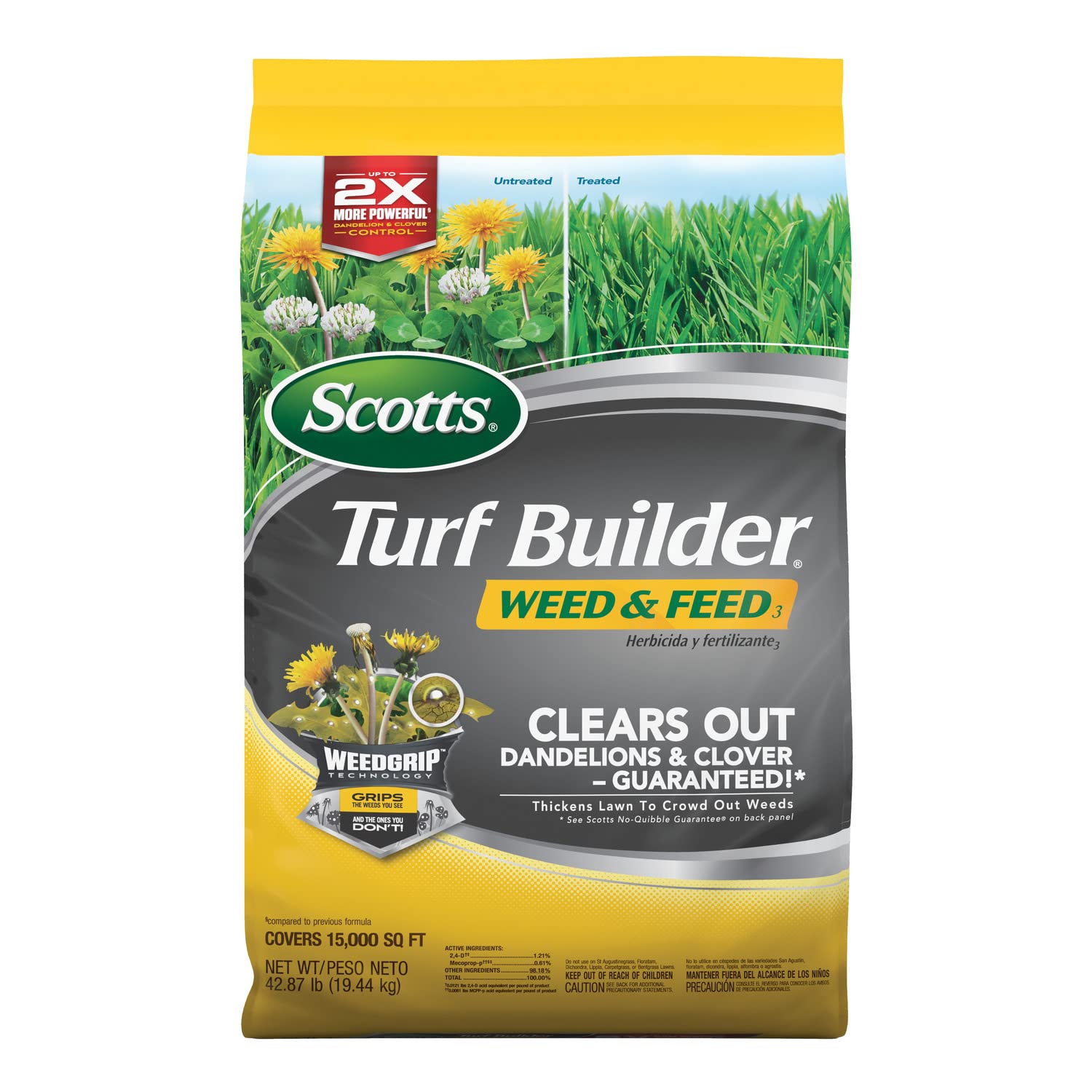
Scotts Turf Builder Weed & Feed (42.87 lb)
| Item Form | Granule |
|---|---|
| Coverage | 15000 square_feet |
| Active Ingredients | 24-D Mecoprop-p |
Scotts Turf Builder Weed & Feed is a granular lawn treatment that kills many broadleaf weeds while feeding grass to encourage thicker turf that can crowd out future weeds. It is typically applied in late spring when clover and dandelions are actively growing and temperatures are between 60°F and 90°F; the label recommends applying to a wet lawn and using a broadcast or drop spreader for even coverage. The formula uses WeedGrip technology and lists active ingredients including 2,4-D and Mecoprop-p, which are effective against clover and other common broadleaf weeds. Practical benefits include large coverage from a single bag and instructions tuned for common spreaders, so one application can treat a whole suburban lawn. Important limitations are the grass type restrictions and application timing: do not use on certain grasses such as St. Augustine or bentgrass, avoid watering for 24 hours after application, and do not apply if rain is expected. As with any herbicide, follow safety directions to keep children and pets away until dust settles.
Best for: Homeowners who want a single-season, no-fuss product to kill clover and feed their lawn across a mid-to-large yard and who plan applications around label timing and instructions.
Less Ideal for: People with St. Augustine, bentgrass, carpetgrass, dichondra, or other excluded grass types, or those who need a year-round integrated weed management plan.
- Controls a wide range of broadleaf weeds including clover and dandelions
- Feeds lawn while treating weeds to promote thicker turf
- Large coverage per bag suitable for mid to large lawns
- Designed for use with common spreaders for uniform application
- Not safe for use on several grass types such as St. Augustine and bentgrass
- Requires specific weather and watering conditions for best results
Verdict: A single large bag that reliably kills clover while feeding and thickening a compatible lawn, making it a practical one-step choice for homeowners.
Scotts Turf Builder WinterGuard Fall Weed & Feed, 11.43 lb

| Item Form | Granule |
|---|---|
| Coverage | 4000 square feet |
Scotts Turf Builder WinterGuard is a fall granular weed-and-feed formulated to kill common broadleaf weeds such as clover and dandelion while feeding cool- and warm-season grasses. It is applied with a broadcast or drop spreader to a moist lawn on a calm day when temperatures are between 60°F and 90°F. Notable features include WeedGrip Technology to improve granule adhesion to weed leaves, instructions tuned for Scotts spreaders, and coverage sized for about 4,000 square feet per 11.43 lb bag. In practice it simplifies a seasonal task by combining weed control and fertilization in one application, which helps build root strength and recover summer stress heading into winter. Important limitations are that it is labeled for specific grass types only and must not be used on St. Augustinegrass, bentgrass, or several groundcover species, and you must avoid watering for 24 hours after application for best effect. For homeowners who want a dependable, single-step fall treatment for typical lawn weeds, this performs as advertised; those with unsupported grass types or very large lawns will need a different product or multiple bags.
Best for: Homeowners who prioritize a reliable, low-effort fall solution to eliminate clover and other broadleaf weeds while feeding their lawn for winter hardiness.
Less Ideal for: Properties planted with unsupported turf species or buyers who need coverage for very large lawns without buying multiple bags.
- Kills over 50 listed lawn weeds including clover and dandelion
- Combined fertilizer and weed control saves an extra application
- WeedGrip Technology helps granules stick to moist weed leaves for better uptake
- Clear application guidance for use with Scotts spreaders and recommended timing
- Labeled for specific grass types only and should not be used on St. Augustinegrass, bentgrass, or certain groundcovers
Verdict: Choose this product if you want a dependable one-step fall treatment that both kills clover and feeds your lawn to build stronger roots for spring.
Scotts Turf Builder Weed & Feed (14.29 lb)

| Item Form | Granule |
|---|---|
| Coverage | 5000 square_feet |
| Active Ingredients | 2,4-D 1.220%, Mecoprop 0.081% |
Scotts Turf Builder Weed & Feed is a granular lawn treatment designed to kill common broadleaf weeds such as clover and dandelions while delivering fertilizer to thicken grass. You apply it with a broadcast or drop spreader when weeds are actively growing and temperatures are between 60°F and 90°F, ideally onto a wet lawn so granules stick to weed leaves. Notable features include WeedGrip Technology and an NPK-style lawn food that helps crowd out future weeds as the turf fills in. Practical benefits are straightforward: targeted weed control plus feeding in a single step, coverage for a typical small-to-medium yard, and clear directions for timing and spreader settings. Important limitations are that it must not be used on several grass types including St. Augustine and bentgrass, you must keep people and pets off the lawn until dust settles, and you need to avoid watering or rain for 24 hours after application for best effect. It is best used as part of a seasonal lawn program rather than a one-off cure for entrenched weed problems.
Best for: Homeowners who want a combined weed control and feeding step to remove clover and dandelions while improving lawn density, and who follow label safety and timing instructions.
Less Ideal for: People with St. Augustine or bentgrass lawns, or gardeners who need an organic or pet-safe alternative should consider other products or methods.
- Controls common broadleaf weeds including clover and dandelions using WeedGrip Technology
- Feeds turf while treating weeds to help thicken lawn and reduce future weed establishment
- Clear application guidance and recommended spreader settings make correct coverage straightforward
- Single-bag coverage suitable for up to 5,000 sq ft—convenient for small to medium lawns
- Contains active herbicide ingredients and must be kept away from certain grass species and non-target plants
- Requires dry window after application and restriction of access for people and pets until granules settle
Verdict: A reliable one-step weed-and-feed that effectively targets clover and dandelions while feeding turf, ideal for homeowners following label timing and safety directions.
Choosing the Right Weed and Feed for Clover: Key Factors to Consider
Herbicide Active Ingredients
Different active ingredients work differently on clover. Some herbicides provide systemic control that translocates through the plant to kill roots, while others only scorch foliage and require repeat applications. Knowing which active ingredient targets clover effectively helps you set expectations for how long control takes and whether retreatment will be needed.
Active chemistry also affects when you can apply relative to temperature and grass growth stage. Read label directions about ideal application windows so the herbicide can be absorbed rather than being stressed off by heat or dormant turf.
Turf Type Compatibility
Not all lawn grasses tolerate the same herbicide or fertilizer blends. Cool-season grasses and warm-season grasses have different sensitivities, and some formulations can injure particular varieties during active growth or dormancy. Confirm that a product's label lists your grass type to reduce risk of scorch or discoloration.
Application timing matters with turf tolerance as well. Applying when grass is actively growing and not under heat or drought stress improves recovery and lowers the chance of visible damage.
Fertilizer Formulation and Release Pattern
Weed and Feed products pair herbicide with nutrients, so the fertilizer component should support lawn recovery after weed control. Look at the N-P-K ratio and whether nitrogen is provided as quick-release, slow-release, or a mix. Quick-release nitrogen green-ups are noticeable but can stress grass if followed by drought; slow-release feeds provide steady growth and lower mowing demands.
Consider your seasonal needs: early spring often benefits from higher nitrogen for recovery, while late-season applications should favor balanced or slow-release formulas to avoid pushing tender fall growth.
Application Method and Coverage
Weed and Feed products come as granules or liquids for broadcast spreader or hose-end/sprayer application. Granular spreaders give even distribution but require calibration to avoid streaks. Liquid applications can deliver more uniform coverage but need careful mixing and spray technique to prevent overlap and over-application.
Choose a format that suits the size and layout of your lawn and the equipment you already own. Consider whether you need a product formulated for broadcast spreaders, drop spreaders, or for conversion to spray.
Timing, Weather, and Follow-Up Care
Weather around application day affects performance. Rain too soon after application can wash off active ingredients, while extended dry spells can limit herbicide uptake by clover. The label will specify re-entry, irrigation, and mowing intervals; following those directions directly improves safety and effectiveness.
Plan follow-up mowing and routine fertilization around the product's recommended windows. Some formulations require additional spot treatments for persistent clover or overseeding restrictions for a period after use.
Environmental and Safety Considerations
Herbicide runoff and non-target exposure matter in yards with nearby gardens, water features, or pollinator habitat. Look for instructions that minimize drift and protect desirable plants. Read the label for personal protective equipment recommendations and for guidance on pet and child safety after application.
Responsible application practices include avoiding windy days, not applying before heavy rain, and storing product securely. These measures reduce unintended damage and environmental impact.
When to Treat Clover in Your Lawn
Timing the application for active clover growth gives the best results. Apply when clover is in its vegetative stage and the grass is actively growing so the herbicide is translocated into the clover plant rather than being trapped in dormant tissue.
Avoid applying during peak summer heat or during drought stress. Early spring and early fall windows are often ideal because clover is growing and temperatures are moderate.
- Treat when soil temperatures support active growth, not during dormancy
- Avoid applications before forecast heavy rain or strong winds
- Mow a few days before treatment but do not bag clippings immediately after application
Preparing Your Lawn Before Application
Improve contact and uptake by watering lightly several days before application if the lawn is stressed or very dry. This helps clover and grass be in active metabolic state at treatment time.
Clear debris, rake if necessary, and ensure even canopy height so granules or spray droplets reach leaves. Calibrate your spreader or check your sprayer settings to avoid streaks and overlaps.
- Water to relieve drought stress 48 to 72 hours before application
- Set spreader rate according to product label and lawn size
- Mark irrigation zones and nearby beds to prevent drift or runoff
Managing Expectations After Treatment
Clover response is not always immediate. Some products cause browning within a week while systemic control that kills roots can take several weeks. Expect gradual dieback rather than instant disappearance, and plan any cosmetic fixes like overseeding after the plant has died back fully.
Follow label instructions for irrigation and mowing intervals post-application. Premature mowing or heavy watering can impede herbicide uptake and reduce effectiveness.
- Wait the recommended days before watering or mowing
- Assess treated areas after two to four weeks before spot retreatment
- Reseed bare patches once herbicide restrictions allow
Spot Treatments and Combination Strategies
For lawns with patchy clover infestations, combine a broadcast Weed and Feed with targeted spot treatments. That reduces overall chemical use and lets you apply a stronger spot herbicide where clover is dense.
Use cultural practices such as improving fertility balance, addressing compaction, and overseeding with competitive grasses to reduce clover reinfestation over time.
- Use spot sprays on dense clover patches after assessing general lawn health
- Cultural improvements often reduce the need for repeat chemical control
- Alternate control methods seasonally to avoid overreliance on one chemistry
Protecting Pollinators and Non-Target Plants
Clover blooms can attract pollinators, so avoid applying during bloom periods if pollinator protection is a priority. If treatment during bloom is necessary, minimize exposure by applying in the early morning or late evening when pollinator activity is lower.
Keep spray or granule drift away from flower beds and vegetable gardens. Use physical barriers or careful spray technique to protect nearby plantings and water sources.
- Do not treat during peak bloom if you want to protect pollinators
- Use shielded nozzles or low-wind conditions to limit drift
- Follow label guidance for buffer zones near water and sensitive plants
How We Chose the Best Weed and Feed for Clover
We shortlisted products that specifically list clover or broadleaf weeds on their label and that pair herbicide activity with a turf-feeding fertilizer. Our evaluation focused on several concrete, garden-relevant dimensions: herbicide effectiveness on clover, turf safety for cool- and warm-season grasses, fertilizer nutrient balance and slow-release options, and application ease including spreader and spray compatibility. We also considered re-entry and watering restrictions that affect when you can resume mowing or irrigating. We excluded anything labeled only for spot treatment or only for wildflower control, and we did not include standalone fertilizers or separate herbicide-only products. Preference was given to formulations with clear label instructions for established lawns and to products whose active ingredients are commonly recommended for clover control. Safety directions and realistic gardener use constraints were part of the selection filters.
FAQ
Will a Weed and Feed kill clover immediately?
Often you will not see immediate results. Some products show browning within days, but systemic control that kills roots can take several weeks. Follow label timelines before considering a repeat treatment.
Can I use Weed and Feed on any lawn grass?
It depends. Many formulas list compatible grass species on the label. Some warm-season and cool-season grasses have different tolerances, so check compatibility and apply during a recommended growth window to reduce risk of damage.
How long should I wait to overseed after using a Weed and Feed?
Overseeding windows vary by formulation. Some products restrict seeding for several weeks to months. Always consult the product label for the specified waiting period before overseeding.
Is a granular or liquid Weed and Feed better for clover?
Both can be effective. Granular products are convenient for broadcast spreaders and provide fertilizer benefits, while liquid applications can give more uniform herbicide coverage. Choose based on lawn size, equipment, and personal comfort with application technique.
Can I apply Weed and Feed when it is about to rain?
You should avoid applying just before heavy rain. Some rain shortly after application can reduce efficacy by washing away active ingredients, while labels often specify a safe window for irrigation or light rain.
Final Verdict
For effective clover control choose a Weed and Feed that pairs a clover-active herbicide with a fertilizer suited to your seasonal needs and turf type. Prioritize products with clear label instructions for your grass species and that balance nutrient release to support recovery without overstimulating tender growth. Match application timing to active clover growth, follow post-application care, and combine chemical control with cultural practices for longer-term suppression. Focusing on herbicide effectiveness, turf safety, and proper application method will help you resolve clover problems while keeping your lawn healthy and resilient.
