

Note: This article contains affiliate links. If you click on these links and make a purchase, I may earn a small commission at no extra cost to you. This helps support my research and content. Read my full affiliate disclosure here.
Ants inside a house can escalate quickly from a single trail to a visible infestation that contaminates food and stresses household members. Picking the right indoor ant killer matters because products behave differently on various ant species, leave different residues on surfaces, and vary in safety around children and pets. This guide covers seven shortlisted options that represent the best choices across common use cases, from quick baiting to barrier sprays and non-chemical traps. We evaluated ease of use, residual effectiveness, and household safety to help you match a solution to the size of the problem and your living situation. Read on to see which types of indoor ant control fit your needs.
Top Picks at a Glance
| Best Overall The best all-around choice for most situations | TERRO Liquid Ant Killer 3-Pack with Cardboard Tiles |  |
| Best Quality Built to a higher standard if you want something more solid | Syngenta Advion Ant Gel Bait, 4 Tubes (30 g each) |  |
| Best Value The sweet spot between price and what you get | Combat Max Ant Killing Bait Stations, 6 Count |  |
| Best Budget The cheapest option that still gets the job done reliably | Raid Ant Killer Baits, 8 Count |  |
| Highest Rated A top-rated pick with lots of positive feedback | NCSIFDD Ant Away Repellent Gel, Indoor and Outdoor Ant Control, 6-Pack |  |
| Most Popular A crowd favorite that many people choose with confidence | TERRO Liquid Ant Bait Stations, 12-Pack (T300B) |  |
| Best Seller A high-volume bestseller chosen again and again | Ortho Home Defense Insect Killer for Indoor & Perimeter, 1.33 gal. with Comfort Wand |  |
TERRO Liquid Ant Killer 3-Pack with Cardboard Tiles

| Item Form | Liquid |
|---|---|
| Target Species | Insects |
| Active Ingredients | Sodium Tetraborate Decahydrate (Borax) 5.40% |
| Specification Met | EPA |
TERRO Liquid Ant Killer is a straightforward indoor ant bait system intended to remove entire colonies rather than only killing visible workers. Each 2 oz bottle contains a sweet borax-based liquid that worker ants feed on and then transport back to nestmates and the queen. Use is simple: apply drops onto the included cardboard tiles and place them along ant trails, baseboards, under sinks, and on countertops where you see activity. The practical benefit is comprehensive control across multiple rooms thanks to three bottles and multiple tiles, and you can expect visible reduction in a few days when ants actively feed. Because the active ingredient is borax, the product works indirectly through the colony which is more effective for long-term elimination than contact sprays. Limitations include the need to keep baits undisturbed while ants are feeding and the slower kill compared with contact killers, so it requires monitoring and patience to place and replenish baits. It is formulated for indoor use and should be used according to label directions to keep children and pets safe.
Best for: Buyers who want a reliable, low-effort indoor solution that eliminates ant colonies at the source and are willing to set and monitor multiple bait stations around the home.
Less Ideal for: People who need fast, immediate knockdown of visible ants or who cannot leave bait placements undisturbed in areas accessible to children or pets.
- Targets the entire colony by having worker ants carry bait back to the nest
- Three 2 oz bottles provide multiple bait stations for whole-house coverage
- Simple application using included cardboard tiles requires no tools
- Borax-based formula is EPA-specified and effective against common household ants
- Requires undisturbed feeding and monitoring so results are not instantaneous
- Not a contact spray so it will not provide immediate knockdown of visible ants
Verdict: Use TERRO Liquid Ant Killer when you want a proven indoor bait that eliminates entire ant colonies through worker-carried borax bait placements.
Syngenta Advion Ant Gel Bait, 4 Tubes (30 g each)

| Item Form | Gel |
|---|---|
| Target Species | Insects |
| Active Ingredients | 0.05% indoxacarb |
| Included Components | 4 Tubes x 30-Grams, 1 Plunger and 2 Tips |
Advion Ant Gel is a concentrated ant bait designed to eliminate entire colonies rather than just individual workers. The odorless gel is dispensed from syringe tubes with included plunger and tips so you can place small spots or lines in cracks, crevices, along trails, and under appliances where ants forage. Its non-repellent formulation encourages worker ants to feed and carry the bait back to nestmates and the queen, which helps collapse colonies rather than just shifting activity. The product targets common species such as Argentine and carpenter ants and is usable both indoors and outdoors, giving flexible placement options. Practical benefits include the highly attractive bait matrix that speeds uptake and the compact tubes that are easy to store and apply discreetly. Important limitations are that safe handling is required around children and pets and that a small quantity per tube means multiple applications or tubes may be needed for very large or multiple nests.
Best for: Buyers who prioritize fast, professional-level elimination of indoor ant colonies and want a product that encourages worker transfer to the nest for long-term control.
Less Ideal for: People who need a non-chemical or pet-safe exclusion method or who prefer all-in-one traps and monitors rather than a bait application approach.
- Non-repellent formula with 0.05% indoxacarb promotes worker transfer to the nest for colony control
- Syringe tubes with plunger and tips allow precise placement in cracks and along trails
- Odorless, highly attractive bait matrix encourages rapid feeding by sugar-seeking ants
- Suitable for both indoor and outdoor use for flexible treatment locations
- Contains an active insecticide so careful placement is required to keep it away from children and pets
- Small tube size may require multiple tubes or repeat applications for large infestations
Verdict: Choose Advion Ant Gel when you want a professional, non-repellent bait that targets entire indoor ant colonies rather than only killing visible workers.
Combat Max Ant Killing Bait Stations, 6 Count

| Active ingredient | Fipronil 0.01% |
|---|---|
| Quantity | 6 bait stations |
| Usage | Indoor and outdoor |
Combat Max Ant Killing Bait Stations are compact, ready-to-use units that lure foraging ants into a sealed plastic station where a fipronil-based bait is consumed and taken back to the nest. Typically you place stations along ant trails, near entry points, and in tight spaces such as under sinks or behind appliances; each station is designed to remain effective for up to three months. Notable features include a child-resistant housing, odorless and fume-free formulation, and suitability for multiple common ant species. In practice the product offers mess-free placement and low maintenance since no mixing or activation is required, and the colony-level action addresses ants you see plus hidden nest members. Important limitations are that results vary with species and bait acceptance and that outdoor placement in wet locations may reduce longevity. For those who want a discreet, low-effort indoor solution, these stations do the job but should be used as part of a broader prevention plan for best long-term control.
Best for: Buyers who want a low-effort, indoor-focused ant control that tackles colonies rather than just visible workers and prefer a discreet, mess-free option to place along trails and in tight spaces.
Less Ideal for: People needing immediate knockdown of visible ants only or those who require a liquid spray or trap solution for very large outdoor infestations.
- Ready-to-use stations require no mixing or setup
- Child-resistant plastic housing reduces access risk
- Odorless and vapor-free formula suitable for kitchens and living areas
- Designed to eliminate whole colonies by ants carrying bait back to the nest
- Effectiveness depends on ants accepting the bait and can vary by species and season
- Outdoor exposure to moisture can shorten station lifespan
Verdict: A simple, child-resistant, ready-to-use bait station set that targets entire ant colonies for low-effort indoor ant control.
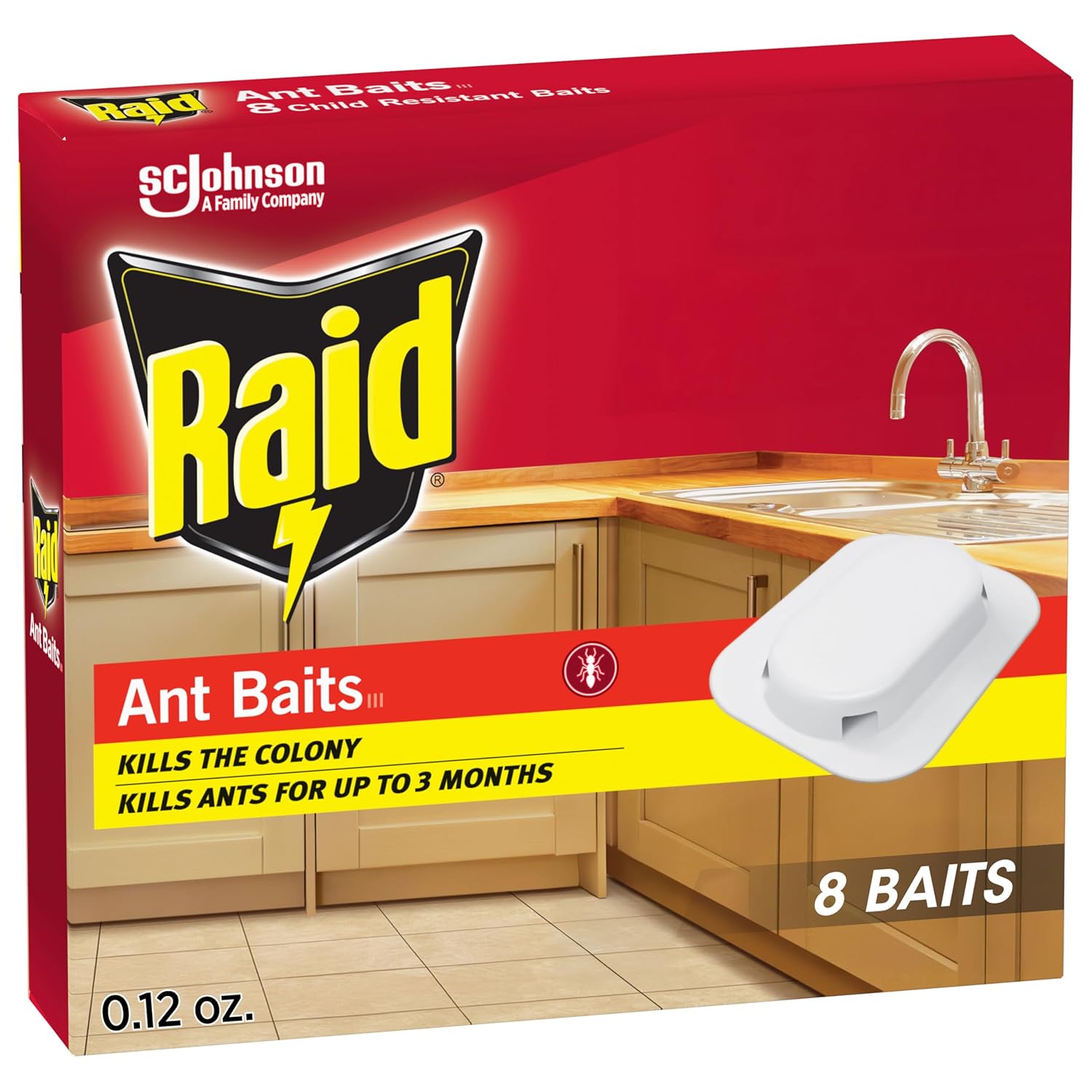
Raid Ant Killer Baits, 8 Count
| Count | 8 |
|---|---|
| Intended use | Indoor |
| Child-resistant | Yes |
| Residual control | Up to 3 months |
These Raid Ant Killer Baits are small, child-resistant bait stations preloaded with ant bait for indoor use. You place them along walls, in corners, or near entry points where ants are active; worker ants consume the bait and carry it back to the colony, which helps reduce the entire nest rather than just the ants you see. The product is simple to use and low-maintenance since each bait station remains effective for up to three months, making it convenient for ongoing prevention in kitchens, pantries, and baseboards. The child-resistant packaging reduces accidental access in homes with kids, and the compact stations are unobtrusive. Limitations are that baits take time to eliminate a colony so you should expect a gradual decline rather than immediate results, and like all baits they work best when competing food sources are controlled. For buyers looking for an easy, budget-friendly indoor ant solution, these deliver reliable, hands-off control for common household ant problems.
Best for: Homeowners wanting an inexpensive, low-effort indoor solution to reduce ant colonies by placing discreet bait stations in kitchens, pantries, and along baseboards.
Less Ideal for: People needing immediate visible knockdown of heavy infestations or those who prefer non-chemical control methods should consider alternatives.
- Ready-to-use bait stations placed along walls and entry points
- Formulation transfers poison through the colony for broader control
- Effective residual activity for up to three months per station
- Child-resistant design reduces accidental access
- Works gradually rather than providing immediate knockdown
- Effectiveness can be reduced if competing food sources are available
Verdict: A simple, low-cost indoor bait solution that provides hands-off colony control for common household ants.
NCSIFDD Ant Away Repellent Gel, Indoor and Outdoor Ant Control, 6-Pack

| Unit Count | 12 Count |
|---|---|
| Number of Pieces | 1 |
| Manufacturer | NCSIFDD |
This ant gel delivers a simple, targeted way to tackle indoor ant activity by placing pea-sized drops along baseboards, entry points, and known trails. The product is supplied as small tubes with a precision applicator that fits into narrow crevices, so application is quick and mess-light compared with sprays or traps. According to the instructions, you may see increased activity at first as the formula works through the colony, with results typically appearing over 3 to 5 days. The manufacturer states one pack helps keep ants away for up to 60 days when applied to key areas like cabinets, windows, and storage. It is described as family and pet safe when used as directed, making it suitable for kitchens and homes with children or pets. Limitations are that it requires repeated, deliberate placement along trails and will not provide instant surface cleaning or broad-area spray coverage, so it is best used as a targeted treatment rather than a mass broadcast solution.
Best for: Homeowners who prioritize a reliable, targeted approach to indoor ant control and want a pet- and family-friendly option for treating trails, cabinets, and entry points.
Less Ideal for: People who need immediate, whole-room or outdoor perimeter knockdown should consider a spray or professional service instead.
- Precision applicator allows targeted placement in tight crevices and along ant trails
- Formulation works through the colony with visible effects in 3–5 days
- Suitable for indoor and outdoor use around entry points and baseboards
- Marketed as family and pet safe when used according to directions
- Not an instant kill solution since it relies on colony-level control and can take several days
- Requires repeated, manual placement rather than a one-time broadcast treatment
Verdict: Use this precision gel when you want a dependable, family-safe way to eliminate indoor ant trails by treating the colony at its source.
TERRO Liquid Ant Bait Stations, 12-Pack (T300B)

| Unit Count | 12 Count |
|---|---|
| Item Form | Liquid |
| Target Species | Insects |
| Active Ingredients | Sodium Tetraborate Decahydrate (Borax), 5.40% |
TERRO Liquid Ant Bait Stations are compact, ready-to-use traps designed for indoor ant control by using a sweet borax-based liquid that worker ants take back to their colony. Typically you peel the tab and place stations along baseboards, in corners, near counters, or under appliances where ants are active. The formula is slow-acting so ants feed and transport it, which can reduce visible activity within days and can eliminate the queen and colony over 2 to 4 weeks. The small stations are discreet and long-lasting while ants continue to visit them, and the 12-pack gives coverage for multiple rooms or repeated placements. Because the product relies on ant foraging behavior, it works best against sugar-loving household species and in situations where competing food sources are removed. It is not an instant spray knockdown, so expectation management and monitoring are important for larger or outdoor infestations. Appropriate placement and keeping other food sources away improves effectiveness.
Best for: Buyers who want a low-effort indoor solution that targets entire ant colonies rather than quick surface kills, and who prefer products backed by widespread consumer use and proven baiting behavior.
Less Ideal for: People needing immediate knockdown of visible ants or solutions for outdoor/structural nest treatments should consider alternative methods or professional services.
- Ready-to-use stations are simple to place with no mixing or setup
- Borax-based liquid attracts worker ants and can be transferred to the nest for colony-level control
- 12-pack provides good coverage for multiple rooms or follow-up placements
- Compact, discreet design lets you place bait in corners, along baseboards, and under appliances
- Slow-acting by design so control can take 2 to 4 weeks for full colony elimination
- Formulation targets sugar-preferring species and may be less effective on protein-preferring ants
Verdict: A convenient, widely used indoor bait system that quietly eliminates sugar-seeking household ant colonies by letting workers carry borax-based liquid back to the nest.
Ortho Home Defense Insect Killer for Indoor & Perimeter, 1.33 gal. with Comfort Wand

| Unit Count | 170.24 Fluid Ounces |
|---|---|
| Item Form | Spray |
| Target Species | Insects |
| Active Ingredients | Bifenthrin 0.05%, Zeta-Cypermethrin 0.0125% |
Ortho Home Defense is a large ready-to-use spray formulated to kill ants, roaches, spiders and many other common household insects and to create a protective barrier around your home. It is designed for indoor use on non-porous surfaces and for perimeter treatment around foundations, doors and windows, patios, decks and garages. The included battery-powered Comfort Wand delivers continuous spray for easier application without bending or pumping, and the formula dries clear with no noticeable fumes. The product claims up to 12 months of indoor protection against ants, roaches and spiders when applied as directed, and lists active ingredients bifenthrin and zeta-cypermethrin that are commonly used for residual control. Important limitations: it is a chemical contact and residual spray so care is needed around pets, children, and planted areas, and it should only be used on appropriate surfaces per label directions. For someone seeking straightforward indoor ant control and a perimeter barrier, this offers a practical, long-lasting option; those wanting non-chemical methods or spot-only treatments will want alternatives.
Best for: Buyers who want reliable, long-lasting indoor ant control and a perimeter barrier delivered in an easy-to-use spray so they can treat whole rooms and foundation perimeters without specialized equipment.
Less Ideal for: People who prefer non-chemical, organic or spot-only ant solutions or those who need a product safe for frequent use directly on soil, edible plants, or porous indoor surfaces.
- Ready-to-use formula with battery-powered Comfort Wand for easy, continuous application
- Creates a residual indoor barrier that the label says can protect against ants, roaches and spiders for up to 12 months on non-porous surfaces
- Dries clear and is formulated to give off no noticeable fumes during use
- Kills a wide range of common household insects including ants, cockroaches, spiders and fleas
- Contains synthetic pyrethroid active ingredients that require careful use around children, pets and sensitive plants
- Not intended for use on porous surfaces and requires following label directions for safe application
Verdict: A practical ready-to-use spray for homeowners who want an easy-to-apply, long-lasting indoor and perimeter solution to control ants and other common household insects.
Choosing the Right Indoor Ant Killer: Key Factors to Consider
Ant Species and Behavior
Different ant species behave differently and respond to control methods in distinct ways. Sugar-feeding house ants will typically accept sweet baits, while protein- or grease-preferring species ignore them. Carpenter ants nest in wood and often require locating and treating the gallery or using longer-lasting baits to reach the colony. Understanding the likely species based on size, color, and visible trails helps you choose a bait matrix and placement strategy that the ants will take back to the nest.
Activity patterns matter too. Ants that forage primarily at night may not pick up a daytime-placed bait as readily, and some species recruit rapidly, meaning fast-acting contact sprays can scatter workers and make baiting harder. Identifying behavior will shorten the time to control and reduce wasted treatments.
Formulation Type and Placement
Indoor ant control comes in baits, gels, residual sprays, and non-chemical traps. Baits deliver a delayed toxicant that forager ants carry back to the nest, offering colony-level control when picked up. Gels behave similarly but allow precise placement along trails or inside cracks. Residual sprays give quick knockdown on contact and leave a barrier that deters future foragers, but they may not eliminate hidden nest sites.
Placement is crucial. Use baits and gels directly on trails, near entry points, and close to nest openings for best uptake. Avoid placing sprays where food is prepared or on surfaces that children frequently touch. The chosen formulation should match where you can safely and effectively place it indoors.
Household Safety and Non-Target Exposure
When treating indoor spaces, minimizing exposure to children, pets, and food surfaces is a top priority. Some formulations are designed to be low-toxicity to mammals yet effective for ants; others rely on volatile actives or residual chemicals that increase exposure risk if misused. Look for options that allow targeted placement and labeled guidance for use near food prep areas. Consider whether you need to remove pets or cover aquariums during application and whether ventilation is required after using a spray.
The physical form also affects safety. Enclosed bait stations and gel syringes reduce accidental contact, while loose granules or broad-spray applications raise the chance of non-target contact. Read labels for re-entry intervals and cleanup instructions.
Speed Versus Long-Term Control
Fast knockdown is satisfying but not always the most effective long-term strategy. Contact sprays can remove visible workers quickly but may leave the colony intact, leading to a return of activity. Baits take longer to show results because the active ingredient must be transported to the nest, but they are typically better at reducing overall colony numbers.
Evaluate how quickly you need visible relief versus how important it is to suppress the nest. In many household scenarios the most effective plan combines a targeted contact option for immediate reduction with baiting for sustained control.
Surface Compatibility and Residue
Indoor treatments come into contact with countertops, cabinet interiors, floors, and baseboards. Some sprays can stain or leave an oily residue, and some formulations are not recommended on porous surfaces such as unfinished wood. Consider how easily residues can be wiped away and whether surfaces will need to be cleaned after treatment.
Choosing products labeled safe for use around food storage or that come in enclosed bait formats reduces the need for post-treatment cleaning. Also think about whether you have children who put hands or toys on treated surfaces; low-residue or enclosed application methods reduce ongoing exposure.
Ease of Use and Ongoing Maintenance
Practicality matters in a home setting. Gel syringes and pre-baited stations are easy to place and require minimal maintenance, while sprays may require more setup and follow-up. Consider whether you prefer a set-and-forget approach or are willing to check and refill bait stations periodically.
Accessibility of common infestation points is important too. If ants are inside tight voids, you may need tools or probes to place gel bait effectively. Also account for how intrusive the treatment is: some methods require temporary relocation of food items or appliances, while others are nearly invisible once set.
Identifying Where Ants Are Coming From
Find the source before treating broadly. Watch ant trails at different times of day, and track them back to entry points such as gaps under doors, utility penetrations, window frames, or cracks in baseboards. Look for localized clustering that suggests a nearby nest rather than random foraging.
Sealing small entry sites and cleaning up food residues can reduce reinfestation even when using chemical controls. Use caulk, door sweeps, and weatherstripping to limit future access after you treat.
- Inspect under sinks, behind appliances, and inside cabinets
- Follow trails during peak activity times
- Note whether ants carry food particles back to a visible nest
Safe Placement of Baits and Stations
Place baits and stations directly on obvious trails, near but not on food prep surfaces, and out of reach of children and pets. Enclosed stations are preferable in kitchens where accidental access is a concern.
Avoid disturbance. If ants find and feed on an undisturbed bait, they are more likely to carry it back to the colony. Replacing bait too quickly can interrupt transfer and slow control.
- Use small dots of gel along the trail rather than large piles
- Place stations along baseboards and inside lower cabinet corners
- Keep bait away from busy household activity areas
Non-Chemical Steps That Support Control
Simple sanitation and exclusion measures amplify any chemical or bait-based approach. Clean up sugary spills immediately, store pantry items in sealed containers, and remove outdoor attractants like pet food left near doorways. Trim vegetation that contacts the house, because ants use branches as bridges.
Moisture control matters too. Fix leaky pipes and reduce damp areas where some ant species nest. Combining physical prevention with targeted treatments reduces the number of follow-up interventions needed.
- Store dried food in airtight containers
- Fix plumbing leaks and improve ventilation
- Keep outdoor mulch and wood debris away from foundation
When to Call a Professional
Most small indoor ant problems can be handled with baiting and targeted sprays, but large or persistent colonies that extend into structural voids may need professional attention. If you repeatedly treat and ants persist or if there is evidence of nesting inside walls, professional inspection can locate and treat the source safely.
Professionals can access nests in structural areas and may use different formulations not available to consumers. Consider professional help if you have vulnerable household members or if repeated DIY attempts have not reduced activity.
- Persistent trails despite multiple treatments
- Visible nesting in structural components
- Infestations near vulnerable people or animals
Seasonal Timing and Long-Term Prevention
Ant activity often peaks in warmer months when foragers search for food and moisture. Use baiting early in the season when colonies are active but still manageable, and reinforce perimeter exclusion work before winter if needed. Long-term prevention focuses on reducing food and moisture cues and maintaining sealed entry points.
Regular inspections, especially in spring and summer, catch small incursions before they grow. Keep a few bait stations stocked as a precaution if you experience seasonal recurrences.
- Inspect annually in spring for early signs
- Top up or replace bait stations seasonally
- Maintain exterior gaps and trim vegetation regularly
How We Chose the Best Indoor Ant Killer
We focused on practical, indoor-ready control methods that work in homes, apartments, and other living spaces. Selection began by excluding outdoor-only treatments, structural fumigation products, and anything labeled strictly for commercial pest control. We prioritized products and formulations that are intended for use on indoor surfaces, inside cabinets, along baseboards, and near food-prep areas when manufacturer directions allow. Evaluation centered on measurable dimensions relevant to household use: bait efficacy against common indoor ant species, speed of colony reduction, residual control duration on indoor surfaces, ease of targeted placement, and safety profile for people and pets. We also considered formulation type (bait, spray, gel, or trap) because that affects precision and exposure risk. Products that required professional application or that are unsuitable for occupied living spaces were excluded. The final list balances quick knockdown with sustained control and minimizes unnecessary household exposure while keeping typical homeowner application in mind.
FAQ
How long does it take baits to control an indoor ant problem?
Baits often take several days to a few weeks to noticeably reduce activity because foragers must carry the bait back to the nest and it needs to spread through the colony. Expect slower visible results than with contact sprays, but baits can provide deeper, colony-level control.
Are indoor ant control sprays safe around pets and children?
Safety depends on the formulation and how it is used. Many indoor products are labeled for use in occupied homes when directions are followed, but you should keep children and pets away until treated surfaces dry and use enclosed bait stations where possible. Read and follow label precautions carefully.
Will cleaning trails remove the attraction and stop ants permanently?
Cleaning trails removes scent markers and can disrupt foraging temporarily, but it does not eliminate the colony. Cleaning combined with baiting or targeted treatments is more effective than cleaning alone because it reduces attraction while control measures remove the source.
Can I use outdoor ant products inside the house?
Many outdoor formulations are not appropriate for indoor use because they can emit stronger odors, leave residues, or be labeled for outdoor surfaces only. Use products specifically labeled for indoor use to ensure safety and effectiveness.
How should I choose between gel baits and pre-baited stations?
Gels allow precise placement along trails and in cracks, which is useful for focused infestations, while pre-baited stations offer enclosed protection that reduces accidental contact in kitchens or homes with pets. The site of activity and safety concerns usually determine the best choice.
Do non-chemical traps work for indoor ants?
Non-chemical traps may capture some foragers and help monitor activity, but they rarely eliminate a colony on their own. They are best used as part of an integrated plan that includes sanitation, exclusion, and targeted baits for sustained control.
Final Verdict
For indoor ant problems, prioritize methods that balance colony-level control with minimal household exposure. Baits and gels are usually the best choice for long-term reduction because foragers carry the active ingredient back to the nest, while contact sprays can provide immediate relief when used carefully. Match the formulation to the infestation site, species behavior, and the presence of children or pets. Focus first on identifying trails and entry points, then place enclosed baits or targeted gel along those routes. Combine treatment with exclusion and sanitation to reduce recurrence. With that approach, you can confidently reduce ant populations while managing safety and cleanup tradeoffs.
