

Note: This article contains affiliate links. If you click on these links and make a purchase, I may earn a small commission at no extra cost to you. This helps support my research and content. Read my full affiliate disclosure here.
If you want showy spring blooms and a long-lived canopy, the right fertilizer for cherry blossom trees makes a real difference. These trees respond to balanced nutrition and proper timing more than heavy feeding. Too little nitrogen and leaves look weak; too much can reduce flowering or push excessive vegetative growth. This guide shortlists seven top-rated fertilizers suited for cherry blossom trees in home landscapes and small orchards. We explain how each option handles nutrient balance, application method, and timing so you can pick the one that fits your soil, maintenance style, and bloom goals. Read on for the evaluation criteria used and practical tips on feeding and care.
Top Picks at a Glance
| Best Overall The best all-around choice for most situations | Jobe's Organics Granular Fruit & Citrus Fertilizer, 4 lb |  |
| Best Quality Built to a higher standard if you want something more solid | Down To Earth Organic Fruit Tree Fertilizer, 6-2-4, 5 lb |  |
| Best Value The sweet spot between price and what you get | Farmer's Secret Fruit Tree Booster Liquid Fertilizer (8 oz) |  |
| Best Budget The cheapest option that still gets the job done reliably | Miracle-Gro Liquid All Purpose Plant Food Concentrate, 32 oz |  |
| Highest Rated A top-rated pick with lots of positive feedback | Wellspring Gardens Mulberry Fuel Slow-Release Fertilizer (1 lb) |  |
| Most Popular A crowd favorite that many people choose with confidence | Miracle-Gro Tree & Shrub Plant Food Spikes (12-pack) |  |
| Best Seller A high-volume bestseller chosen again and again | Jobe's Slow Release Tree and Shrub Fertilizer Spikes, 15 Count (16-4-4) |  |
Jobe's Organics Granular Fruit & Citrus Fertilizer, 4 lb

| NPK | 3-5-5 |
|---|---|
| Form | Granules |
| OMRI listed | Yes |
| Application | Spread around base and water in |
| Reapply | Every 4-8 weeks |
Jobe’s Organics Granular Fruit & Citrus Fertilizer is a slow-release granular designed to feed plants at the root zone with a balanced 3-5-5 NPK and organic nutrient sources such as feather meal and bone meal. It is intended to be spread evenly around the base of trees and plants and watered in, with reapplication every 4 to 8 weeks during the growing season. The OMRI listing and absence of synthetic chemicals make it suitable for organic gardens, and the resealable packaging helps limit mess and preserve the product between uses. Practical benefits include steady nutrient release that reduces the risk of burning and a formula with added calcium and sulfur to support fruit development and foliage. Limitations are that the NPK is formulated specifically for fruit and citrus so it may not precisely match the feeding needs of ornamental flowering trees, and granular application requires measuring and physical spreading rather than simple spike or liquid feeds. For cherry blossom trees, it can provide general nourishment but monitoring bloom-specific nutrient needs may be necessary.
Best for: Buyers who want an organic, slow-release granular fertilizer to provide steady, root-focused nutrition for trees and larger shrubs and who value USDA OMRI certification and reduced risk of overfeeding.
Less Ideal for: Gardeners seeking a fertilizer specifically tuned to maximize ornamental flower production or those who prefer liquid feeds or pre-measured spike systems for fully hands-off applications.
- OMRI listed and made from organic inputs suitable for organic gardening
- Slow-release granular formula delivers steady feeding to roots and lowers burn risk
- Resealable bag reduces waste and keeps product fresh between applications
- Contains secondary nutrients like calcium and sulfur that support fruit set and overall plant health
- Formulated specifically for fruit and citrus so nutrient ratios may not be ideal for ornamental cherry blossom bloom optimization
- Requires manual spreading and measuring rather than a ready-to-use spike or liquid application
Verdict: Choose this if you want an OMRI-listed, slow-release organic granular to give trees steady, root-focused nutrition throughout the growing season.
Down To Earth Organic Fruit Tree Fertilizer, 6-2-4, 5 lb

| Item Form | Powder |
|---|---|
| Specific Uses For Product | Plant Growth,Potting |
| Target Species | fruit trees |
| Mixing Ratio | 6:2:4 |
This Down To Earth fruit tree fertilizer is a powdered organic blend designed to feed fruiting trees through soil applications. It is typically broadcast or hand applied around the tree drip line, lightly scratched into the top inch of soil and watered in; the manufacturer states it is not water soluble and is intended to feed soil biology rather than act as a quick foliar feed. The 6-2-4 N-P-K mix with calcium sources and materials like fish bone meal, blood meal, langbeinite and kelp provides a balance that supports vegetative growth, flowering and fruit development in backyard orchards. Practical benefits include OMRI‑listed organic inputs, shelf stability and a formula aimed at productive fruiting rather than simply green growth. Important limitations are that it is a slow soil amendment rather than an immediate soluble feed and application rates require attention to avoid overapplication; it also requires regular reapplication per label and good watering to move nutrients into the root zone. For growers focused on steady, organic fruit production this is a solid soil feeder to pair with good orchard care.
Best for: Home orchardists and gardeners seeking a performance-oriented organic soil fertilizer to support consistent flowering and fruit development in fruit trees.
Less Ideal for: Growers who need fast, soluble nutrient boosts for acute deficiencies or who prefer liquid/foliar feeds for rapid results.
- Organic, OMRI‑listed ingredients support soil biology and organic production
- Balanced 6-2-4 N‑P‑K with added calcium aimed at supporting flowering and fruit set
- Shelf stable powdered blend that can be broadcast and incorporated into soil
- Contains diverse nutrient sources (fish bone meal, blood meal, kelp) for slow-release feeding
- Not water soluble so it will not provide immediate nutrient uptake
- Requires correct application and watering to move nutrients into the root zone
Verdict: Choose this product if you want a performance-focused organic soil fertilizer that supports steady flowering and fruit development in cherry and other fruit trees.
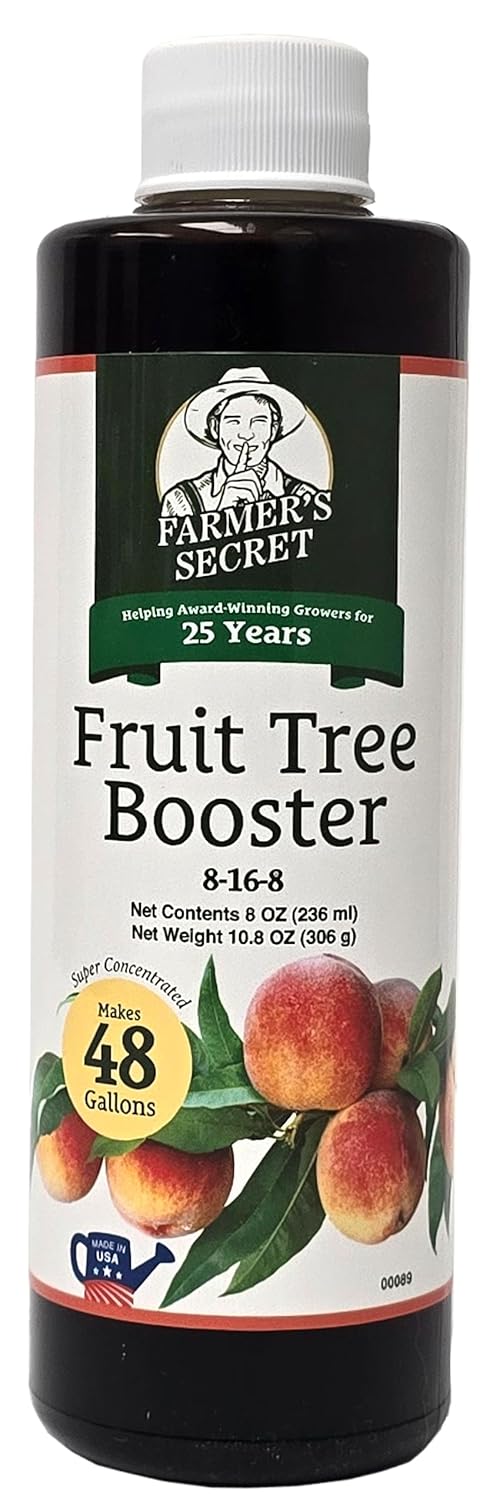
Farmer's Secret Fruit Tree Booster Liquid Fertilizer (8 oz)
| Item Form | Liquid |
|---|---|
| Specific Uses For Product | Plant Growth, Fruit Production |
| Coverage | Full |
| Target Species | Apple, Banana, Peach |
| Mixing Ratio | 1 teaspoon per gallon |
This concentrated liquid fertilizer is designed to give trees a nutrient boost during active growth, supplying nitrogen, phosphorus, potassium and trace minerals in an immediately available form. It is typically mixed at one teaspoon per gallon and applied weekly around the tree drip line or as a foliar spray, making it easy to incorporate into a routine feeding schedule. Notable features include a high phosphorus concentration to encourage root development and flowering, compatibility with watering cans, sprayers and irrigation systems, and a formulation developed by agronomists for crop yield. For cherry blossom trees, the emphasis on phosphorus and trace minerals can help strengthen roots and support abundant blooms in the season after dormancy. Practical benefits are rapid uptake compared with granular fertilizers and a concentrated bottle that stretches across multiple feedings. Limitations are that it requires regular weekly applications for best results and careful dilution to avoid overapplication, and the 8 ounce bottle will require refills for larger yards or many trees.
Best for: Gardeners who want a practical, science-backed liquid feed to encourage stronger roots and better bloom production on ornamental trees and small fruit trees and who prefer a repeatable weekly feeding routine.
Less Ideal for: People seeking a one-time slow-release solution or those who want a single large bottle to feed many mature trees without frequent replenishment.
- High phosphorus formula that supports root growth and flowering
- Super-concentrated liquid for immediate nutrient availability and economical use
- Works as soil drench or foliar feed and is compatible with sprayers and irrigation
- Formulated by agronomists and tested in field conditions
- Requires consistent weekly applications to maintain results
- Small 8 oz bottle may not cover multiple mature trees for a full season
Verdict: A concentrated, phosphorus-forward liquid feed that practical gardeners can use weekly to strengthen roots and boost flowering on cherry blossom trees.
Miracle-Gro Liquid All Purpose Plant Food Concentrate, 32 oz

| Item Form | Liquid |
|---|---|
| Specific Uses For Product | Plant Growth, Root Development |
| Application Method | Mix with water in a watering can |
| Unit Count | 32 Fluid Ounces |
| Mixing Ratio | 1:10 (concentrate to water, estimate) |
Miracle-Gro Liquid All Purpose Plant Food is a water-soluble concentrate you dilute in a watering can to feed container and in-ground plants every 1 to 2 weeks. It is used by filling the cap to the indicated line for garden applications or measuring 1 teaspoon per gallon for houseplants, then applying the mixed solution to soil around the plant. The formula is intended to promote plant growth and root development and is suitable for flowers, vegetables, shrubs, trees and houseplants. Practical benefits include fast uptake through irrigation, simple mixing instructions, and broad compatibility so you can use the same bottle across your landscape. As a general-purpose product it is convenient for routine maintenance of ornamental trees like cherry blossoms, especially during the growing season when regular feeding supports blooms. Limitations are that it is an all-purpose feed rather than a tree-specific formula, so it lacks tailored NPK ratios for flowering trees and requires consistent reapplication on a schedule rather than providing slow-release nutrition.
Best for: Gardeners who want an inexpensive, easy-to-use fertilizer they can use across beds, containers and small trees and who prefer quick, noticeable feeding results.
Less Ideal for: Growers seeking a specialized bloom-boosting or slow-release fertilizer tailored specifically for mature cherry blossom trees should consider tree-specific or timed-release products instead.
- Easy to mix and apply with clear cap and teaspoon dosing guidance.
- Works on a wide range of plants so one product covers multiple garden needs.
- Liquid form provides nutrients that are quickly available to plants through watering.
- Not formulated specifically for flowering trees so it may not optimize bloom-specific nutrient balance.
- Requires frequent reapplication rather than providing slow-release feeding.
Verdict: A budget-friendly, versatile liquid fertilizer that delivers quick, general-purpose nutrition for ornamental trees and surrounding plantings.
Wellspring Gardens Mulberry Fuel Slow-Release Fertilizer (1 lb)

| Item Form | Granules |
|---|---|
| Application Method | Spread around the base of plants |
| Target Species | Mulberries, berries, cherries, nuts |
| Mixing Ratio | 20:6:9 |
| Unit Count | 16 Fluid Ounces |
Wellspring Gardens Mulberry Fuel is a slow-release granular fertilizer designed to feed mulberry trees, berries, cherries and other small fruit trees on a steady 90-day cycle. You apply it by spreading the granules around the base of the plant, where the formula gradually supplies nitrogen, phosphorus and potassium to support vegetative growth and fruit development. The resealable 1-pound pouch is convenient for multiple small applications and storage. Notable features are its 20-6-9 N-P-K mix and the granule form that avoids frequent liquid mixing or immediate nutrient spikes. In practice this product suits spring and early summer maintenance when trees are active and benefit from a sustained nutrient supply. Important limitations are that it is a general-purpose, slow-release feed rather than a targeted bloom booster, and exact application rates matter because the product is concentrated; follow label guidance to avoid overfeeding. You will also need to pair it with good soil and irrigation for best fruiting results.
Best for: Gardeners and homeowners who prioritize consistent, low-maintenance feeding for small fruit trees and shrubs and want a reliable, easy-to-apply product that reduces the need for frequent applications.
Less Ideal for: Growers seeking an aggressive bloom-boosting or high-phosphorus fertilizer specifically to maximize ornamental blossoms should consider a product formulated for flowering rather than this general fruit-tree feed.
- Slow-release granular formula provides steady nutrition over a 90-day period
- Nutrient ratio (20-6-9) supports leafy growth and fruit development
- Resealable pouch makes storage and repeated small applications easy
- Granules are simple to apply around the root zone without mixing
- Not formulated specifically as a bloom or flower booster for peak blossom enhancement
- Concentrated formula requires careful measurement to avoid overapplication
Verdict: Choose this slow-release granular if you want a dependable, low-maintenance feed that steadily supports growth and fruiting in mulberries and similar small fruit trees.
Miracle-Gro Tree & Shrub Plant Food Spikes (12-pack)

| NPK Ratio | 15-5-10 |
|---|---|
| Coverage | 12 spikes per season |
| Application Method | Place around tree drip line |
| Target Species | Trees, shrubs, evergreens, acid-loving plants |
Miracle-Gro Tree & Shrub Plant Food Spikes are premeasured, slow-release sticks designed to deliver nutrients directly to the root zone of trees and shrubs. You use them by watering the soil around the drip line, spacing spikes around the drip line about 3 feet apart, then driving each spike below the soil surface. The spikes contain a 15-5-10 NPK formula intended to promote foliage color and general vigor and are applied once in early spring and again in mid-fall. In practice these are very low-effort compared with granular or liquid feeds since they avoid measuring and frequent applications and they target roots rather than surface soil. They are best for established in-ground trees and larger shrubs where the drip line is accessible. Limitations are that they are seasonal only and not formulated for frequent summer feeding or for small container trees, and you must follow the placement chart to avoid under- or over-applying around trees with unusual root patterns.
Best for: Home gardeners who want an easy, low-maintenance seasonal feeding option for in-ground ornamental trees and shrubs and prefer products with many user reviews to confirm consistent performance.
Less Ideal for: Gardeners needing fast corrective feeding, year-round monthly programs, or solutions for containerized cherry trees should consider water-soluble or granular alternatives instead.
- Direct root delivery reduces nutrient loss to surface runoff
- Premeasured spikes remove guesswork and simplify seasonal feeding
- Slow-release formula supports longer-lasting nutrient availability
- Suitable for a range of trees, shrubs and acid-loving plants
- Not intended for frequent summer feeding or quick corrective treatments
- Unsuitable for small potted trees or container-grown specimens
Verdict: If you want a simple, low-effort seasonal feed for established in-ground cherry blossom trees, these premeasured slow-release spikes make fertilizing easy and reliable.
Jobe's Slow Release Tree and Shrub Fertilizer Spikes, 15 Count (16-4-4)

| NPK | 16-4-4 |
|---|---|
| Application Method | Insert spikes into soil |
| Coverage | 15 fertilizer spikes |
| Target Species | Tree and Shrub |
Jobe's Slow Release Tree and Shrub Fertilizer Spikes are premeasured sticks designed to feed trees and shrubs at the root zone without mixing or spreading granular fertilizer. You insert the spikes around the dripline twice a year, and the slow‑release formula provides a steady supply of nitrogen, phosphate, and potash (16-4-4) through the growing season. That makes them well suited for established ornamental trees where you want to support leaf growth and root development while avoiding surface runoff. The package contains 15 spikes and the manufacturer recommends spacing them in a circle at the dripline and driving them just below the soil surface. The main practical benefits are convenience, minimal mess, and a reduced risk of overfertilizing compared with broadcast applications. Limitations are that spikes cover limited area per stick so multiple spikes are needed for larger trees and the fixed NPK ratio cannot be adjusted for specific deficiencies; they are best as a routine maintenance feed rather than a corrective soil treatment.
Best for: Buyers who prioritize low‑risk, low‑effort tree care and want a safe, measured way to feed ornamental trees like cherry blossoms with minimal chance of overapplication.
Less Ideal for: Gardeners needing targeted soil remediation, precise nutrient correction, or fast corrective feeding after deficiency diagnosis should choose a different product or a soil test–guided program.
- Premeasured slow‑release formula reduces risk of overfertilizing
- Direct root zone application minimizes runoff and surface mess
- Easy twice‑a‑year installation with no mixing required
- Fixed 16-4-4 NPK ratio cannot be customized for specific nutrient deficiencies
- Each spike covers a small root area so several spikes are required for larger trees
Verdict: A simple, low‑risk way to maintain nutrient levels for ornamental trees by delivering a season‑long 16-4-4 feed directly to the roots.
Choosing the Right Fertilizer for Cherry Blossom Trees: Key Factors to Consider
Nutrient Ratio and Timing
The relative amounts of nitrogen, phosphorus, and potassium determine how a cherry blossom tree allocates resources. Moderate nitrogen encourages healthy foliage and stem growth, phosphorus supports bud set and flowering, and potassium aids overall stress tolerance and winter hardiness.
Timing is as important as ratio. Apply a bloom-support feed with higher phosphorus in late winter or very early spring before buds swell to encourage flower development. Follow with a light balanced feeding after flowering to support leaf and root recovery rather than a high-nitrogen treatment that could trigger late-season flushes vulnerable to frost.
Application Method and Ease
Granular, slow-release, and water-soluble fertilizers each fit different gardener workflows. Granular slow-release products are low-maintenance and reduce burn risk, making them a good match for established trees and busy gardeners. Water-soluble formulas allow targeted feeding and faster uptake, which can help correct short-term deficiencies but require more frequent applications.
Also consider whether the product is suited for broadcast around the drip line, as a soil drench, or for foliar feeding. Ease of measurement, clear label instructions, and compatibility with common spreading or watering tools matter for consistent, safe applications.
Soil Interaction and Salt Sensitivity
Cherry blossom trees have relatively shallow, fibrous roots that can be damaged by high salt fertilizers or concentrated applications. A low salt index and even nutrient release reduce the risk of root burn. Organic or coated slow-release formulations often have gentler soil interactions and can improve long-term soil structure.
Soil pH also affects nutrient availability. If your soil is acidic or alkaline, some micronutrients may be locked up; choosing a fertilizer that includes chelated iron, magnesium, or trace elements can help. Always test soil before major feeding changes to avoid compounding existing issues.
Tree Age and Size
Young cherry trees establish roots and need a different feeding strategy than mature specimens. Newly planted trees benefit from lower, more frequent feedings that support root development rather than vigorous top growth. Mature trees tolerate a broader range of formulations but may need periodic boosts to support heavy bloom years.
Adjust amounts by trunk diameter or canopy spread rather than treating all trees the same. Over-fertilizing small or young trees can harm root establishment and reduce long-term vigor.
Bloom Goals Versus Vegetative Growth
If your priority is spectacular spring flowers, choose a formula that emphasizes phosphorus and balanced micronutrients while avoiding excessive nitrogen that promotes leaf growth at the expense of blooms. For trees grown primarily for shade or canopy density, a slightly higher nitrogen balance may be acceptable.
Consider seasonal tradeoffs: a fertilizer that enhances blooming may not deliver the lush green growth some gardeners prefer. Decide whether bloom intensity or foliage vigor is the primary goal and select a product that aligns with that outcome.
Environmental and Safety Considerations
Some fertilizers release nutrients quickly and can leach into groundwater or run off into waterways. Slow-release and controlled-release products reduce environmental impact by delivering nutrients over time. Organic fertilizers can improve soil biology but may require higher application rates to match synthetic nutrient levels.
Also consider safety around pets and children. Choose formulations with clear handling instructions and avoid concentrated treatments that increase the risk of accidental exposure. Read labels for any restrictions on use near water features or drainage pathways.
When to Feed Cherry Blossom Trees
Timing feeds to the tree's growth cycle gives the biggest return. Apply a bloom-focused feed in late winter or very early spring so nutrients are available as buds form and open. Avoid heavy nitrogen applications after mid-summer, which can stimulate tender growth susceptible to frost.
A light maintenance feeding after petals fall helps replenish reserves used during flowering. For established trees, a single managed application schedule usually suffices; for younger trees, split feedings spaced several weeks apart support steady root and canopy development.
- Late winter or early spring: bloom-support feeding
- After flowering: light maintenance feeding
- Avoid high-nitrogen late summer feeds
Organic Versus Synthetic Options
Organic fertilizers release nutrients more slowly and add organic matter to the root zone, improving soil structure and microbial life. They are forgiving for shallow-rooted ornamentals and reduce the risk of rapid nutrient swings, but they may supply nutrients more slowly and require a season-long perspective.
Synthetic and controlled-release synthetics offer predictable nutrient ratios and faster correction of deficiencies. They are useful when you need a clear N-P-K balance for bloom support, but they require careful application to avoid salt build-up in the root zone.
- Organics: soil health benefits, gentler release, slower action
- Synthetics: precise ratios, faster uptake, potential salt concerns
Applying Fertilizer Without Damaging Roots
For trees with shallow root systems, avoid piling concentrated fertilizer against the trunk. Spread granular applications evenly beneath the canopy and lightly work them into the topsoil or mulch layer. If using water-soluble feeds, dilute according to label directions and water in thoroughly to move nutrients into the root zone.
If you suspect compacted or poor soils, incorporate organic matter and consider using root-friendly application methods such as slow-release rings or soil injections only when recommended by a local arboricultural source.
- Distribute granules across the drip line rather than at the trunk base
- Water in soluble feeds to prevent surface burn
- Improve soil structure to support better nutrient uptake
Micronutrients and Blossom Color
Micronutrients such as magnesium, iron, and boron contribute to healthy chlorophyll production and bud formation. Deficiencies can lead to chlorosis, poor bud set, or weak blooms. Some fertilizers include chelated micronutrients that remain available across a wider pH range.
While fertilization has limited direct control over blossom color, providing a full suite of nutrients ensures flowers develop at their genetic best. Address any visible deficiency signs early to avoid reduced bloom quality.
- Check for leaf yellowing or poor bud set as deficiency signs
- Choose formulations with targeted micronutrients if soil tests show gaps
Feeding Container-Grown Cherry Trees
Potted cherry trees have restricted soil volume and a higher risk of nutrient depletion and salt build-up. Use a balanced, water-soluble fertilizer on a regular but dilute schedule, or choose a slow-release granule formulated for containers.
Monitor container moisture and flush pots occasionally to prevent salt accumulation. Adjust feeding frequency seasonally, reducing applications in cooler months when growth slows.
- Containers: favor lower-dose, more frequent feeding
- Flush containers annually to reduce salt build-up
How We Chose the Best Fertilizer for Cherry Blossom Trees
We prioritized fertilizers that address the needs of ornamental cherry trees: bloom promotion, balanced seasonal nutrition, root health support, and ease of application for home gardeners. Formulation matters, so we focused on products with clear N-P-K ratios and inclusion of secondary nutrients such as magnesium and iron when relevant. Application method was another filter; we favored granular options that integrate with spring and fall feeding schedules and water-soluble or slow-release formulas that reduce burn risk. We evaluated whether the fertilizer supplies phosphorus and potassium levels that support flowering without forcing excessive leafy growth. We also considered soil safety and salt index to avoid damage to shallow roots, plus whether the product is suitable for container-grown specimens as well as in-ground trees. Exclusions: products intended exclusively for fruit production targets rather than ornamental bloom, high-salt chemical mixes unsuitable for established trees, and niche specialty blends with unusable labeling. The remaining selections scored well across nutrient profile, root- and foliar-safety, application convenience, and season-long performance.
FAQ
How often should I fertilize a mature cherry blossom tree?
Mature trees typically need one main feeding in late winter or very early spring and an optional light maintenance feed after flowering. Frequency can increase for young or container-grown trees that deplete soil nutrients faster.
Can too much fertilizer reduce flowering?
Yes. Excessive nitrogen encourages leafy growth at the expense of blooms. Use a bloom-support formula timed before bud break and avoid high-nitrogen feeds during the flowering period.
Should I test my soil before choosing a fertilizer?
Often testing is helpful because soil pH and nutrient levels determine what the tree actually needs. A simple soil test can reveal pH imbalances or micronutrient deficiencies that affect bloom quality and guide fertilizer selection.
Are organic fertilizers effective for ornamental cherry trees?
Organic fertilizers can be very effective and improve long-term soil health. They release nutrients more slowly, which reduces burn risk, but may require more time or slightly higher application rates to match immediate nutrient demands.
What signs show my cherry tree needs feeding?
Look for pale or yellowing leaves, poor bud set, reduced bloom count, or generally weak spring growth. These symptoms can indicate nutrient shortfalls, though pests and disease can cause similar signs, so inspect thoroughly before changing feeding practices.
Can I use lawn fertilizer around my cherry trees?
Lawn fertilizers are formulated for turf and often have higher nitrogen ratios that can promote leaf growth rather than blooms. If using them, choose a balanced formula and apply carefully around the root zone to avoid overfeeding.
Final Verdict
Choose a fertilizer that matches your bloom goals, tree age, and soil conditions. Prioritize formulas with an appropriate N-P-K balance for flower promotion, a low salt index to protect shallow roots, and an application method you will follow consistently. Manage timing carefully: a bloom-focused feed before bud break and a light maintenance application after flowering usually produce the best ornamental results. With the right feeding plan and attention to soil health, you can enjoy fuller spring displays and healthier cherry blossom trees for years to come.
