

Note: This article contains affiliate links. If you click on these links and make a purchase, I may earn a small commission at no extra cost to you. This helps support my research and content. Read my full affiliate disclosure here.
Ant infestations inside an RV are more than a nuisance. Tight quarters, stored food, and limited ventilation mean a typical home product can feel overpowering or leave residues where you cook and sleep. Picking the right ant killer for an RV calls for options that act quickly, keep fumes low, and leave a safe residual to stop returning foragers. This guide shortlists five top ant control options suitable for RV use and explains the practical tradeoffs you will face. We evaluate products across safety, speed of effect, and how long they prevent re-infestation so you can choose a solution that fits your travel and living patterns.
Top Picks at a Glance
| Best Overall The best all-around choice for most situations | EcoVenger Ant & Crawling Insect Killer Spray, 16 oz (Plant-Based) |  |
| Best Quality Built to a higher standard if you want something more solid | Syngenta Advion Ant Gel Bait, 30 g |  |
| Best Budget The cheapest option that still gets the job done reliably | Combat Max Ant Killing Gel, 27 g Syringe |  |
| Highest Rated A top-rated pick with lots of positive feedback | NCSIFDD Ant Away Ant Repellent Gel, 6-Pack |  |
| Most Popular A crowd favorite that many people choose with confidence | TERRO Liquid Ant Killer Bait Stations, 12-Pack (T300B) |  |
EcoVenger Ant & Crawling Insect Killer Spray, 16 oz (Plant-Based)

| Unit Count | 16 Fluid Ounces |
|---|---|
| Item Form | Spray |
| Target Species | Odorous House Ants, Fire Ants, Roaches, Fleas, Spiders |
| Active Ingredients | Citronella Oil, Geraniol, Cedarwood Oil, Sodium Lauryl Sulfate |
| Liquid Volume | 480 ml |
EcoVenger Ant & Crawling Insect Killer is a ready-to-use, botanical spray designed to eliminate ants and other crawling pests quickly while leaving a light citrus/woody scent. In practice you spray active ants and their trails for immediate knockdown and treat entry points, baseboards, and mounds to create a residual barrier that the manufacturer says lasts up to four weeks. The formula lists plant-derived actives such as geraniol, citronella and cedarwood oils rather than traditional neurotoxic insecticides, which makes it suitable for use around homes with pets when directions are followed. Notable features include fast kill times (claims of house ants in about a minute and fire ants in minutes), a non-staining finish safe for carpets and fabrics, and a fine spray nozzle for targeted treatment. Limitations: botanical products can require thorough application to reach nests and deep queen chambers, so severe infestations may need repeat or professional intervention; effectiveness versus every species and in every environment will vary compared with conventional synthetics. For pet-safe indoor control and perimeter work this provides a practical, lower-toxicity option with measurable residual effects.
Best for: Buyers who prioritize effective, lower-toxicity pest control for indoor use around pets and family and want a product that acts fast and leaves a short-lived pleasant scent.
Less Ideal for: People facing very large or established colonies who need a single heavy-duty chemical solution or those who prefer synthetic pesticides for guaranteed uniform efficacy across all pest species.
- Plant-based active ingredients suitable for homes with children and pets when used as directed
- Fast on-contact knockdown of ants and other crawling pests according to product claims
- Leaves no oily residue and is labelled non-staining for use on carpets and fabrics
- Provides residual repellency for up to four weeks when applied to trails and entry points
- May require thorough application into nest chambers for complete colony elimination, which can be labor-intensive
- Performance can vary by species and infestation severity compared with conventional chemical pesticides
Verdict: A fast-acting, plant-based spray that delivers pet-friendly indoor ant control with several weeks of residual protection.
Syngenta Advion Ant Gel Bait, 30 g
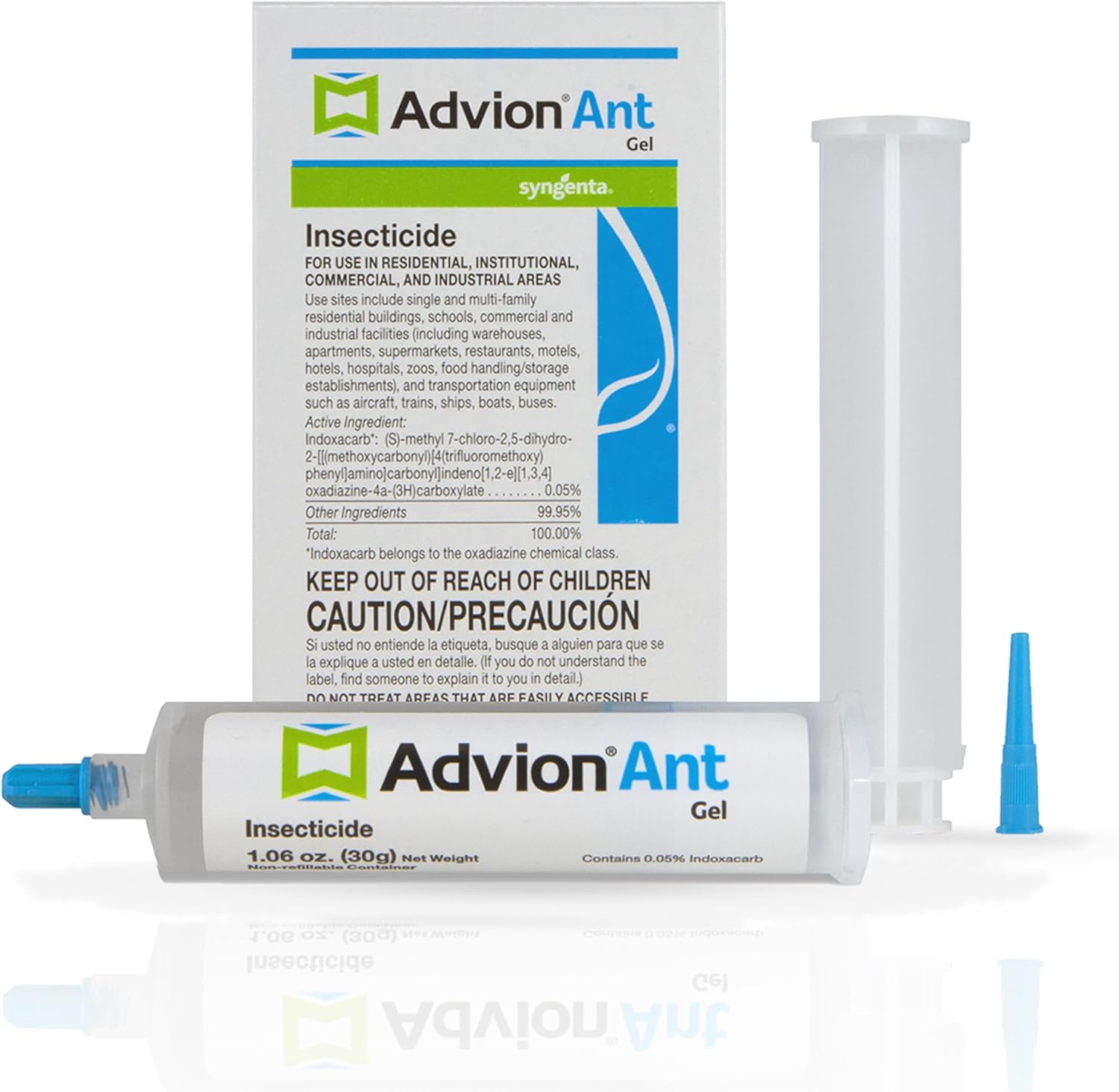
| Item Form | Gel |
|---|---|
| Target Species | Insects |
| Active Ingredients | Indoxacarb |
Advion Ant Gel is a concentrated, professional-style ant bait formulated around indoxacarb and a highly palatable gel matrix to lure foraging ants and carry toxicant back to the colony. You apply small dabs of the translucent, nonstaining gel in ant trails, near nesting sites, or in voids where ants forage; workers feed on the gel and transfer it through trophallaxis, which helps suppress entire colonies rather than just worker ants. The formulation is touted for lasting integrity with low odor and high attractiveness to sweet-feeding species, so you do not need frequent reapplication in protected spots. Because it is a targeted bait rather than a broadcast insecticide, it is practical for spot treatments in kitchens, pantries, and around baseboards as well as sheltered outdoor locations. Important limits are that it is a bait product requiring worker-mediated distribution so results are not instant and indoor use requires keeping it away from children and pets.
Best for: Buyers who prioritize effective colony-level control and want a concentrated, professional-style bait for spot treatments inside homes or in sheltered outdoor locations.
Less Ideal for: People needing immediate knockdown of visible ants or those who require a product for widespread outdoor perimeter treatments should consider different control methods.
- Contains indoxacarb, a potent active ingredient with a unique mode of action
- Highly palatable, translucent gel that attracts sweet-feeding ants
- Maintains formulation integrity for extended periods in sheltered application sites
- Suitable for indoor and sheltered outdoor spot treatments
- Relies on worker feeding and transfer so colony elimination can take several days to weeks
- Not intended for broad outdoor broadcast use or exposed wet areas
Verdict: Choose Advion Ant Gel when you want a high-performance, worker-transferred bait that targets colonies rather than just knocking down visible ants.
Combat Max Ant Killing Gel, 27 g Syringe

| Active ingredient | Fipronil 0.001% |
|---|---|
| Net weight | 27 gram (0.95 oz) |
| Application | Indoor and outdoor use |
| Form | Ready-to-use gel in syringe |
Combat Max Ant Killing Gel is a syringe-applied bait that targets foraging ants and carries a fipronil-based formulation back to the nest to eliminate the queen, larvae, and workers. It is used by placing small dots of gel where ants travel or enter structures—along trails, in cracks, and near suspected nests—so foragers feed and transfer the bait to the colony. Notable features include a precise syringe applicator for tight spaces, an odorless, vapor-free gel suitable for kitchens and living areas, and a high water-content formula that encourages quick feeding and colony impact within three to five days. The product is effective on a range of common species including little black ants and odorous house ants. Important limitations are the small 27 gram syringe size, which may require reapplication or multiple tubes for larger infestations, and the need to avoid placement on areas that are routinely washed or where food contact can occur. Follow label directions to prevent contamination and do not use on electrical equipment.
Best for: Buyers who want a targeted, low-odor solution to control small black ants and other common household species by placing bait directly on trails and entry points and who prefer precise, spot treatments over broad sprays.
Less Ideal for: People facing large outdoor mound infestations or who need long-lasting perimeter protection should consider larger-capacity baits or complementary control methods.
- Syringe applicator allows precise placement in cracks, crevices, and other hard-to-reach ant pathways
- Fipronil-based formula begins working within hours and is designed to eliminate entire colonies via forager transfer
- Odorless and vapor-free gel suitable for use in kitchens, bedrooms, and living areas
- High water content encourages faster feeding by ants, speeding colony control
- Small 27 gram (0.95 oz) syringe may be insufficient for large or widespread infestations
- Must avoid areas that are routinely washed or where food is prepared, limiting placement options
Verdict: A precise, low-odor gel bait that quickly attracts and kills foraging small black ants and their colonies when applied directly to trails and entry points.
NCSIFDD Ant Away Ant Repellent Gel, 6-Pack

| Unit Count | 12 Count |
|---|---|
| Number of Pieces | 1 |
This ant repellent gel is a concentrated applicator product intended for targeted spot treatments around entry points, baseboards, window frames, and known ant trails. You remove the cap, attach the precision tip, and apply pea‑sized drops into crevices or along trails; the manufacturer notes it can take 3–5 days to work through a colony and helps keep ants away for up to 60 days in treated areas. Practical benefits include the narrow applicator for neat placement in tight gaps, suitability for both indoor and outdoor problem spots, and a formulation presented as family and pet safe when used as directed. Important limitations are that results are not instantaneous and multiple applications or placements may be needed to control larger or multiple colonies, and effectiveness depends on correctly locating trails and nest access points. For someone who wants a low‑mess, targeted solution rather than broad broadcast treatments, this gel is a convenient option.
Best for: Buyers who prioritize dependable, low‑mess spot treatment for recurring ant sightings and prefer a product they can place precisely where ants travel.
Less Ideal for: People needing rapid elimination of very large or widespread infestations or those who prefer broadcast sprays or professional colony eradication services.
- Precision applicator allows neat, pea‑sized placements in tight crevices and along ant trails
- Labeled for both indoor and outdoor use so the same product can treat kitchens, baseboards, and patios
- Formulation described as family and pet safe when used according to directions
- Single placements can provide protection in treated areas for up to 60 days
- Not an immediate knockdown—can take 3–5 days to affect a colony
- May require several placements and correct trail identification to fully control larger infestations
Verdict: Use this precision gel when you want a neat, family‑safe spot treatment that targets ant trails and entry points rather than a broad spray solution.
TERRO Liquid Ant Killer Bait Stations, 12-Pack (T300B)

| Unit Count | 12 Count |
|---|---|
| Item Form | Liquid |
| Target Species | Insects |
| Active Ingredients | Sodium Tetraborate Decahydrate (Borax), 5.40% |
Terro Liquid Ant Killer bait stations are prefilled, single-use traps designed for indoor control of common sugar-loving ants. You place the small stations along baseboards, in corners, under appliances, or on countertops where you see ant activity. Worker ants are drawn to the sweet liquid, feed on it, and take it back to the nest so the borax-based active ingredient can eliminate the colony over days to weeks. The product is easy to use with no mixing or setup and the 12-pack gives coverage for several rooms. Because the bait is contained inside a low-profile plastic station, it reduces incidental contact risk compared with loose sprays or powders and lasts for weeks while ants continue to visit. Limitations are that the formula targets sugar-preferring species so very protein- or grease-attracted ants may ignore it, and control can take 2 to 4 weeks for larger infestations. Also stations should be placed away from pets and children despite the contained design since the bait contains borax.
Best for: Homeowners who prioritize an easy, low-hassle indoor solution and want a bait that works at the colony level with minimal hands-on pest handling.
Less Ideal for: People who need immediate knockdown of ants or who have pets or children that frequently access treated areas and cannot reliably keep them away from placed stations.
- Ready-to-use stations require no mixing or setup
- Designed to be carried back to the nest for colony-level control
- Low-profile enclosed bait reduces messy exposure compared with loose liquids or sprays
- 12 stations provide coverage for multiple rooms or hotspots
- Formulation is sugar-based so less effective on ants that prefer protein or grease
- Control can take 2–4 weeks for large or established colonies
Verdict: A simple, low-contact indoor bait system that reliably reduces sugar-loving ant infestations by getting worker ants to carry borax back to the colony.
Choosing the Right Ant Killer for Rv: Key Factors to Consider
Safety in Confined Living Spaces
When treating ants inside an RV, human and pet safety is the top priority. Choose products with low acute toxicity for people and common companion animals and with clear reentry times. Products that leave minimal surface residues on counters and food-prep areas reduce the need for extensive post-treatment cleaning.
Also consider ventilation. Some effective formulations rely on airing out an area after use; in an RV that may be impractical during travel or overnight stops. Look for labels providing specific precautions for enclosed environments and follow those directions closely to limit exposure.
Mode of Action and Knockdown Speed
Different ant-control chemistries act at different rates. Fast-acting sprays or contact treatments deliver immediate reduction of visible ants, which is useful to regain control quickly. Baits and slow-acting approaches can eliminate the colony over days to weeks by targeting foraging workers and transferring insecticide back to the nest.
For an RV, you may need a mix of both approaches: a quick-contact solution to remove invading trails and a bait or residual product to prevent reinfestation. Consider how quickly you need relief and whether you can tolerate a slower, more thorough colony-targeting method.
Residual Protection and Reinfestation Prevention
Residual effectiveness determines how long treated surfaces continue to prevent ants from returning. Long-lasting residuals can reduce the frequency of applications and lower the chance of repeat incursions while parked or during short stays.
However, longer residuals can mean more persistent residues on floors, counters, and seams. Balance residual longevity with safety and cleaning needs inside the RV. If you frequently prepare food where treatments are applied, choose products with safe-use guidance for those surfaces or plan to re-clean treated areas before meal prep.
Applicator Type and Indoor Usability
Applicator form matters in small, cluttered spaces. Aerosol sprays, ready-to-use trigger bottles, crack-and-crevice applicators, dusts, and baits each have pros and cons. Trigger sprays and aerosols give broad coverage but risk overspray in tight quarters; crack-and-crevice applicators and baits allow targeted treatment with less airborne spread.
Consider storage and disposal too. Products that require bulky accessories or produce leftover waste that is hard to store are less convenient for mobile use. Look for compact, easy-to-use formats that let you treat seams, window sills, and entry points without creating a mess.
Odor, Volatility, and Comfort
Odor and volatility influence comfort and safety after application. Strong-smelling products can make an RV unlivable for hours and aggravate respiratory sensitivities. Low-odor formulations and nonvolatile baits are easier to live with and reduce the need to vacate the vehicle.
If you or travel companions are sensitive to smells, favor treatments that specify low-odor or low-volatile formulations. Also plan for airing windows and vents when possible to clear any residual smells before occupying the space again.
Target Species and Foraging Behavior
Different ant species have different foraging habits and bait preferences. Some are sugar-loving, while others prefer protein or fats. Knowing the likely species in your region helps when selecting baits or attractant-based control strategies.
In mobile living situations, repeated introductions of new ant species are possible. Choose a control approach that covers a range of feeding preferences or combine a targeted bait with a general residual barrier to maximize effectiveness across different ant types.
Preparing Your RV Before Treatment
Before applying any ant control inside an RV, remove exposed food and dishes and clean surfaces where ants are actively foraging. A clean area helps baits work better because ants will be more likely to take a treated food source if competing crumbs are removed.
Seal obvious entry points such as gaps around windows, doors, plumbing chases, and utility passes. Temporary sealing with tape or weatherstripping reduces reinfestation risk while treatments take effect and is a simple nonchemical step that complements any product application.
- Store food in sealed containers or the refrigerator during treatment
- Vacuum trails and debris to make baits more attractive
- Use temporary caulk or tape to block visible ant entry paths
Using Baits Effectively in Confined Spaces
Baits are usually the safest long-term strategy inside living spaces because they contain low concentrations of active ingredients and rely on ant foragers to take treatment back to the nest. Place small bait stations along trails, near baseboards, and where you have seen activity.
Keep bait stations out of reach of pets and children, and avoid placing them directly on food-prep surfaces. In an RV, put baits behind cabinetry, under sinks, and inside storage cubbies where ants travel but people do not.
- Choose multiple small placements rather than one large pile
- Replace baits when exhausted or after a week if activity persists
- Avoid spraying over bait stations during complementary treatments
Targeted Nonvolatile Treatments for Seams and Entry Points
For quick barriers at likely entry points, use targeted nonvolatile treatments designed for cracks and crevices. These allow you to treat gaps around windows, door frames, and utility penetrations without saturating living airspace.
Apply only to structural voids and follow label instructions on treated surface reentry times. Targeted application minimizes exposure to occupants and reduces the need for extensive ventilation after treatment.
- Treat seams where cabinetry meets walls and floors
- Focus on areas near food storage and sinks
- Use minimal product quantities to avoid residue buildup
Managing Odors and Ventilation When You Can
When treatments have a noticeable odor, plan brief windows to ventilate the RV fully. Open windows and run exhaust fans if available, and leave the area if the label recommends it until fumes diminish.
If you cannot ventilate thoroughly, choose low-odor products or baits that do not require vacating the vehicle. Keep in mind that elevated humidity or heat inside an RV can amplify odors, so try to apply treatments during cooler parts of the day.
- Ventilate for at least the time recommended on the product label
- Avoid applying heavy-odor products before sleeping or cooking
- Store treated items separately until residues have settled or been cleaned
Routine Prevention to Keep Ants Away
Long-term prevention includes food management, regular cleaning, and monitoring. Wipe up spills immediately, store food in airtight containers, and check for new trails weekly. Small behavior changes reduce attractants that draw ants into an RV.
Inspect and reseal worn seals, screen edges, and small gaps that develop as the vehicle settles. Preventive maintenance reduces the need for frequent insecticide applications and makes any future treatments more effective.
- Inspect seals and weatherstrips at each season change
- Keep trash in sealed containers and empty regularly
- Use small monitoring stations to catch activity early
How We Chose the Best Ant Killer for Rv
We focused on attributes that matter when treating ants inside a confined, multi-use space like an RV. Primary evaluation criteria included human and pet safety profiles when used in living quarters, the speed of knockdown against common ant species, residual activity to prevent repeat incursions, applicator type and ease of indoor use, and odor and fume levels during and after application. We prioritized formulations and delivery methods that minimize airborne irritants and limit mess on food prep surfaces. Products were excluded if they required large outdoor equipment, produced heavy fumes unsuitable for enclosed spaces, or relied on application techniques impractical for RV interiors. We also screened out options that offered only ephemeral control without residual protection. The final list reflects choices that balance rapid control with safer indoor handling, clear application instructions for small spaces, and documented residual performance against household ants.
FAQ
Can I use indoor ant sprays inside my RV while people are present?
Often you should avoid using strong indoor sprays while people and pets are inside. Choose low-odor products or bait-based options when occupancy cannot be interrupted, and follow label directions for ventilation and reentry times.
Are bait stations safe to use around children and pets in a small RV?
Many sealed bait stations are designed to limit access by children and pets, but placement matters. Put them behind furniture or inside cabinets where curious hands or paws cannot reach, and follow label storage and disposal guidance.
How long before I should expect to see a reduction in ant activity?
It depends on the method used. Contact treatments can show visible reduction within hours, while baits that eliminate colonies may take several days to a few weeks. Combining a quick knockdown for immediate relief with baits for longer control is a common approach.
Will treating inside my RV stop ants that are nesting in nearby outdoor areas?
Indoor treatments can control ants foraging into the RV, but if a nearby outdoor colony is large, reinfestation is possible. Sealing entry points and using residual barriers near openings helps reduce the chance of repeat intrusion from outdoor nests.
How often should I reapply ant treatments inside an RV?
Reapplication frequency varies by product type and label instructions. Residual treatments may last weeks to months, while baits should be refreshed when they are consumed or when activity continues. Regular monitoring lets you reapply only when needed.
Final Verdict
For RV living, prioritize treatments that combine effective control with minimal fumes and clear indoor safety guidance. Use baits for long-term colony reduction and targeted nonvolatile products for seams and entry points to reduce exposure. Balance the need for quick knockdown with the desire to keep living spaces comfortable and safe. Choose the approach that fits your travel patterns: short trips and overnight use favor low-odor, targeted methods, while extended stays can support bait-based strategies that eliminate colonies over time.
