

Note: This article contains affiliate links. If you click on these links and make a purchase, I may earn a small commission at no extra cost to you. This helps support my research and content. Read my full affiliate disclosure here.
You want a single insecticide that works reliably around doorways, patios, and living spaces without forcing you to buy separate indoor and outdoor products. The right bug spray controls mosquitoes, flies, and crawling insects while minimizing lingering odor, surface residue, and harm to people, pets, and plants. This guide shortlists the top options tested for mixed indoor/outdoor use and explains the tradeoffs that matter in real gardens, porches, and home interiors. We evaluate each pick for residual control, ease of application, and safety considerations so you can pick the best fit for your space.
Top Picks at a Glance
| Best Overall The best all-around choice for most situations | Ortho Home Defense Insect Killer Concentrate, 32 oz. |  |
| Best Quality Built to a higher standard if you want something more solid | Ortho Home Defense Insect Killer Refill, 1.33 gal (Indoor & Perimeter) |  |
| Best Value The sweet spot between price and what you get | Spectracide Bug Stop Home Barrier 32 oz Ready-to-Use Spray (3 Pack) |  |
| Best Budget The cheapest option that still gets the job done reliably | STEM Plant-Based Bug Spray for Flies, Mosquitoes & Gnats, 10 oz |  |
| Highest Rated A top-rated pick with lots of positive feedback | Envu Tempo SC Ultra Insecticide Concentrate, 240 ml |  |
| Most Popular A crowd favorite that many people choose with confidence | Mighty Mint Peppermint Oil Insect Repellent Spray, 16 oz |  |
| Best Seller A high-volume bestseller chosen again and again | Atticus Talak 7.9% Bifenthrin Indoor/Outdoor Insecticide Concentrate, 32 oz |  |
Ortho Home Defense Insect Killer Concentrate, 32 oz.

| Liquid Volume | 32 fluid ounces |
|---|---|
| Included Components | Ortho Home Defense Insect Killer for Indoor |
| Target Species | Insects |
| Active Ingredients | Bifenthrin,Zeta Cypermethrin |
Ortho Home Defense Concentrate is a DIY indoor and perimeter insect killer formulated to be diluted and applied with a tank sprayer. You mix the 32 ounce bottle with water to make up to four gallons of product, then spray around foundations, doorways, patios, garages, and indoor non-porous surfaces where insects travel. The formula lists bifenthrin and zeta-cypermethrin as active ingredients and targets ants, roaches, spiders and many other common invaders. Notable benefits are long residual control—the label claims up to 12 months of protection against ants, roaches and spiders on indoor non-porous surfaces—plus a non-staining, low-odor formula that dries quickly. Because it is a concentrate it is economical for treating large perimeters compared with ready-to-use cans. Important limitations are that it must be mixed correctly and applied with appropriate equipment and protective measures, and some users may prefer ready-to-spray options for spot treatments or inside tight spaces. Follow the label for indoor use, safety around pets and children, and the full list of target pests.
Best for: Buyers who want an economical, long‑lasting perimeter and indoor treatment and are comfortable mixing and applying a concentrate with a sprayer for whole‑house prevention.
Less Ideal for: People who need quick spot treatments inside cupboards or prefer ready‑to‑use aerosol sprays or non-chemical alternatives should look elsewhere.
- Concentrate makes up to 4 gallons so one bottle treats large areas economically
- Active ingredients (bifenthrin and zeta-cypermethrin) provide broad-spectrum control
- Non-staining, low-odor formula that dries quickly for indoor use
- Label claims long residual control up to 12 months for ants, roaches and spiders
- Requires dilution and a separate tank sprayer for application
- Not intended for use on porous indoor surfaces for long-term residual protection
Verdict: Choose this concentrate if you want a cost‑effective, long‑lasting indoor and perimeter insect treatment that covers large areas when applied with a sprayer.
Ortho Home Defense Insect Killer Refill, 1.33 gal (Indoor & Perimeter)

| Unit Count | 170.24 Fluid Ounces |
|---|---|
| Item Form | Spray |
| Target Species | Insects |
| Liquid Volume | 1.33 gallons |
This Ortho Home Defense refill is made for homeowners who want a high-capacity solution for indoor and perimeter pest control. The concentrate is intended to be poured into the reusable Comfort Wand applicator so you can treat entry points, baseboards, doorframes, and foundation perimeters without repeated small bottles. Its formula claims an invisible, fast-drying barrier that provides up to 12 months of residual control for ants, roaches, and spiders when applied on non-porous indoor surfaces, and it targets a broad list of common household insects. In practice the refill reduces trips to the store and lowers per-application cost compared with single-use sprayers, and the continuous-spray wand reduces user fatigue for larger jobs. Important limitations are that the long-residual claim applies mainly to certain pests and non-porous surfaces, and precise coverage requires following the spray distance and band-width directions to avoid overapplication. This product is best used as part of a preventive or follow-up treatment routine rather than a one-time knockdown for heavy infestations.
Best for: Homeowners who prioritize effective, long-lasting perimeter and indoor protection and who want a refillable, economical option for routine pest control.
Less Ideal for: People who need immediate, heavy-duty knockdown treatments or who prefer single-use ready-to-spray bottles for spot treatments.
- Large 1.33 gallon refill reduces frequency of repurchasing and is economical for whole-home or perimeter treatments
- Compatible with the Comfort Wand reusable applicator for continuous spray and less hand fatigue during larger jobs
- Invisi-Shield formula dries clear with no noticeable fumes, allowing people and pets to re-enter once dry
- Broad-spectrum label covers many common indoor and perimeter pests, including ants, roaches, spiders and mosquitoes
- Residual protection claim is specific to ants, roaches and spiders on non-porous indoor surfaces and may not apply equally to all listed insects
- Requires a compatible applicator wand or transfer container since it is a refill rather than a ready-to-use spray
Verdict: Buy this refill if you want an economical, high-capacity solution to maintain a long-lasting indoor and perimeter insect barrier using a reusable comfort-wand applicator.
Spectracide Bug Stop Home Barrier 32 oz Ready-to-Use Spray (3 Pack)

| Item Form | Spray |
|---|---|
| Target Species | Ants, Roaches, Spiders, Fleas, Ticks & More |
| Liquid Volume | 32 fluid ounces |
| Active Ingredients | Gamma-Cyhalothrin |
Spectracide Bug Stop Home Barrier is a water-based, ready-to-use spray formulated for both indoor crack-and-crevice work and outdoor perimeter treatments. It kills ants, roaches, spiders, fleas, ticks and other listed insects on contact and claims up to 12 months of residual control for cockroaches on non-porous surfaces. The clear, non-staining formula leaves no oily residue or strong odor, so it is practical for baseboards, door frames, window screens and patios without creating visible buildup. Because it comes in three 32 oz bottles, the pack suits treating multiple rooms or a full building perimeter before refills are needed. The main limitation is that it contains the active ingredient gamma-cyhalothrin, so it must be used carefully according to label directions and kept away from children, pets and pollinator-attractive areas; it is not a targeted solution for indoor-only infestations that might need baiting or professional-grade treatments. For everyday home and foundation defense this spray is convenient and effective when used as directed.
Best for: Homeowners who want a convenient, multi-use spray to treat indoor hiding spots and outdoor foundation lines without mixing products and with an emphasis on breadth of control.
Less Ideal for: People looking for pesticide-free options or those who need an integrated baiting program or professional-grade solutions for severe infestations should consider alternatives.
- Ready-to-use formula requires no mixing and is simple to apply for quick treatments
- Water-based, clear spray that does not stain or leave oily residue
- Effective on a broad range of common pests including ants, roaches, spiders, fleas and ticks
- Three 32 oz bottles provide enough product to cover multiple rooms and outdoor perimeter areas
- Contains gamma-cyhalothrin so requires careful handling and adherence to safety directions
- Not a bait-based or species-specific treatment for targeted indoor infestations
Verdict: A convenient, non-staining ready-to-use spray that gives homeowners broad indoor and outdoor pest control in a multi-bottle pack.
STEM Plant-Based Bug Spray for Flies, Mosquitoes & Gnats, 10 oz

| Net volume | 10 oz |
|---|---|
| Active ingredients | Geraniol 1.47%, Lemongrass oil 0.10% |
| Intended use | Indoor and outdoor spot treatment |
STEM's 10 oz aerosol bug spray is a plant-based insecticide formulated to kill flies, mosquitoes and gnats around the home and patio. You use it like most aerosols: shake well, hold the nozzle 6–12 inches from target areas or visible insects, and mist surfaces or airspace where flying pests congregate. Notable features include geraniol and lemongrass oil as the active ingredients, no added dyes or harsh chemical odors, and directions that allow both indoor and outdoor spot treatments. In practice it is convenient for quick spot kills and temporary control around doorways, windowsills, potted areas and patios. Because it is formulated for people- and pet-occupied spaces when used as directed, it is a reasonable option for households that prefer botanical actives. Limitations are typical for short‑acting aerosols: protection is not long lasting so repeat applications are needed after rain or cleaning, and it is not for direct application to people, pets or edible plants.
Best for: Buyers who want an affordable, plant-based aerosol for quick spot control of gnats and other flying pests around living spaces and patios.
Less Ideal for: People seeking season-long residual protection or professional-grade control should consider products with longer-lasting actives or different application formats.
- Uses plant-based active ingredients (geraniol and lemongrass oil) rather than harsh synthetic chemicals
- Formulated for both indoor and outdoor spot treatments when used as directed
- No added dye or strong chemical fragrance, making indoor use less obtrusive
- Entomologist-tested formulation and clear directions for application
- Effect is short lived compared with long‑lasting residual insecticides
- Not intended for direct use on people, pets or edible plants
Verdict: A budget-friendly, plant-based aerosol that delivers fast, convenient knockdown of gnats and other flying pests for short-term control.
Envu Tempo SC Ultra Insecticide Concentrate, 240 ml

| Item Volume | 240 ml |
|---|---|
| Item Form | Liquid |
| Target Species | Ants, flies, cockroaches, crawling pests, and ticks |
| Ingredients | Beta-Cyfluthrin |
Tempo SC Ultra is a liquid concentrate insecticide designed for perimeter and spot treatments where dependable, lasting control of ants, spiders, cockroaches and other crawling pests is needed. The product mixes with water and is applied as a general surface, spot, crack and crevice or mist treatment, so it works both indoors around entry points and outdoors along foundations and patios. Its active ingredient, beta-cyfluthrin, provides quick knockdown plus residual activity so treated areas remain protected between applications. The suspension concentrate formulation spreads evenly and the low-odor, non-staining claim makes it practical for use near garages and basements where smell and marks matter. Users should follow label dilution and safety directions carefully since concentrated insecticides require proper handling and mixing. This product is best used as part of regular perimeter maintenance rather than for one-off fumigation of large infested structures.
Best for: Homeowners who prioritize a reliable, long-lasting perimeter treatment to reduce crawling insect activity around entry points and common harborage areas and who are comfortable following label mixing and application steps.
Less Ideal for: People seeking immediate fumigation-style control for heavily infested interiors or those unwilling to handle concentrated pesticides should consider alternative application methods or professional services.
- Broad-spectrum control effective against ants, spiders, cockroaches and ticks
- Fast knockdown with residual activity that continues working after application
- Water-based concentrate mixes easily for even surface coverage
- Low odor and non-staining formula suitable for use near living areas
- Concentrate requires careful mixing and safe handling to avoid exposure
- Not formulated for airborne or fumigation treatments of whole structures
Verdict: Choose this concentrate when you need a dependable, low-odor perimeter insecticide that delivers quick knockdown plus lasting residual control.
Mighty Mint Peppermint Oil Insect Repellent Spray, 16 oz
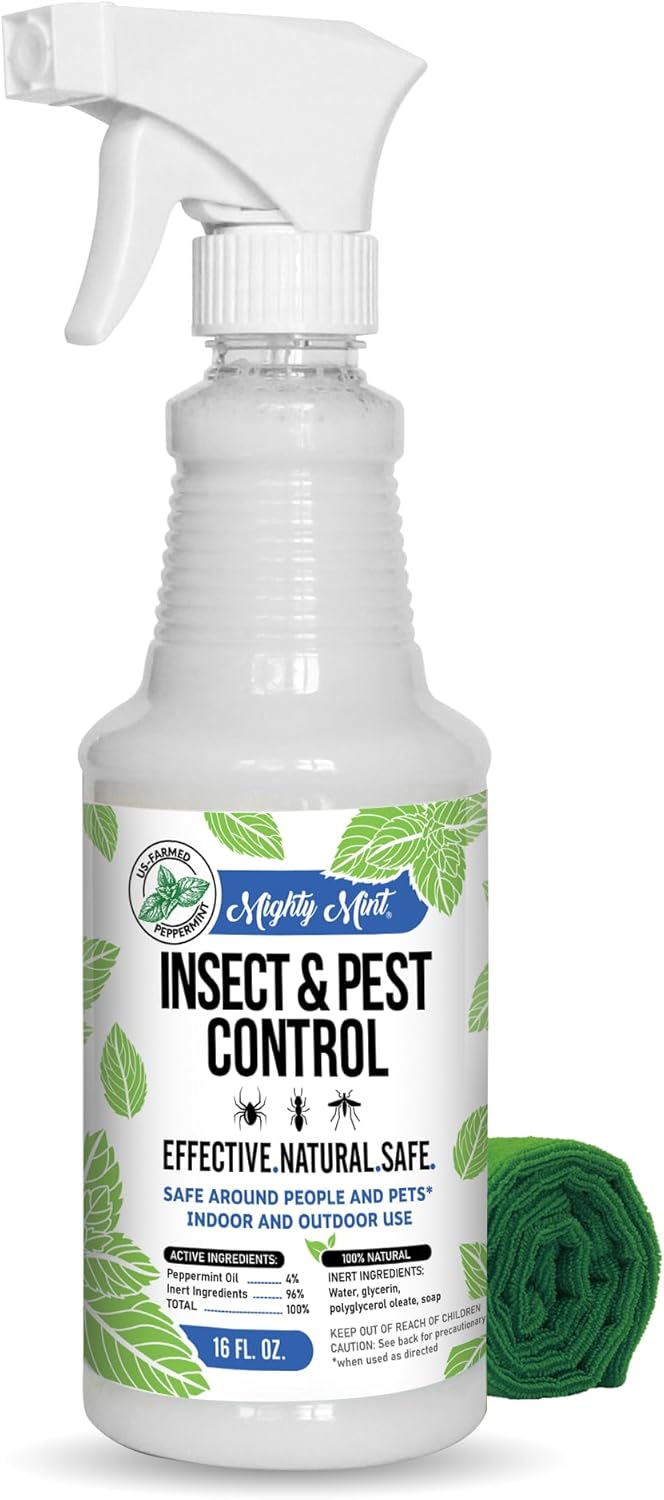
| Ingredients | Water, Glycerine, Polyglycerol oleate, Soap, Peppermint oil |
|---|---|
| Use Areas | Indoor / Outdoor |
| Size | 16 oz |
Mighty Mint is a plant-based, ready-to-use spray that uses concentrated peppermint oil to repel a broad range of household and patio pests. You apply it directly to problem areas such as baseboards, entryways, patios and around outdoor seating; the manufacturer recommends shaking and spraying until surfaces are covered and repeating applications two or more times per week for best results. Notable features include a peppermint-only scent profile, a formulation that avoids synthetic fragrances and the convenience of a 16 oz spray bottle for targeted spot treatments. Practical benefits are that it is safe to use around people and pets when dry and does not leave obvious stains on most surfaces, and the scent can make treated areas smell fresher than chemical alternatives. Important limitations are that it is a repellent rather than a pesticide so it works by discouraging pests rather than killing them, effectiveness depends on regular reapplication and it should not be applied when pollinators are present or to skin or food-contact surfaces.
Best for: Buyers who prioritize natural, low-toxicity solutions and want a targeted spray to reduce insects around patios and entryways while keeping family and pets in mind.
Less Ideal for: Anyone needing a one-time extermination or long-term residual pesticide for severe infestations should consider professional treatments or products formulated to kill pests rather than repel them.
- Plant-based peppermint formula that avoids synthetic fragrances
- Ready-to-use spray for quick, targeted indoor and outdoor applications
- Safe for people and pets when used as directed and allowed to dry
- Nonstaining on most surfaces and leaves a fresh mint scent
- Repels rather than kills insects so regular reapplication is needed to maintain protection
- Strong peppermint concentration may bother scent-sensitive individuals and requires keeping children and pets away until dry
Verdict: Choose Mighty Mint when you want a pet-friendly, plant-based spray to reduce patio and entryway insects with a fresh peppermint scent.
Atticus Talak 7.9% Bifenthrin Indoor/Outdoor Insecticide Concentrate, 32 oz

| Active Ingredient | Bifenthrin |
|---|---|
| Formulation | Suspension Concentrate |
| Liquid Volume | 32 fluid ounces |
| Length of Control | Up to three months |
| Target Species | Insects |
Talak 7.9% is a liquid concentrate for treating lawns, landscaping, outdoor living areas and indoor perimeter spots like baseboards and cabinets. You dilute the concentrate with water to create a spray for barrier treatments, spot applications or lawn mixes; label rates explain how much to mix per gallon depending on the use. The product uses bifenthrin, a proven broad-spectrum active ingredient, and the manufacturer states it controls over 75 species and can give residual control for as long as three months. Its water-based formula dries clear, leaves no odor or visible residue, and is not phytotoxic on plants when used per label. Practical benefits include flexible indoor and outdoor use, clear drying, and a bottle designed for easier pouring. Important limitations are that solutions should be mixed only for same-day use, it is not registered for sale in a few states, and it is not approved for fogger application, so professional-style misting methods are not appropriate.
Best for: Buyers who want a single, reliable product to protect yards, patios and building perimeters from a wide range of common pests and prefer conservative, label-driven application practices.
Less Ideal for: People seeking ready-to-use sprays or fogger-compatible products or those in states where this formulation is not registered should look at alternatives.
- Broad-spectrum control listed for 75+ indoor and outdoor pest species
- Water-based formula that dries clear and leaves no odor or residue
- Flexible label directions for lawns, landscapes, hardscapes and indoor perimeter treatments
- Long residual activity up to three months when applied at recommended rates
- Mixed spray solutions cannot be stored and must be used the same day
- Not approved for fogger application and not available for sale in some states
Verdict: A versatile, water-based bifenthrin concentrate that delivers long-lasting, broad-spectrum outdoor (and perimeter indoor) control when used according to the label.
Choosing the Right Bug Spray for Inside and Outside: Key Factors to Consider
Residual Control Duration
How long a product continues to kill or repel insects after application matters because it determines how often you need to reapply in both indoor and outdoor locations. Longer residual activity reduces the frequency of treatment on porches, door frames, and window sills, but indoor use may call for shorter-acting formulas to limit prolonged chemical presence in living spaces.
When assessing residual claims, consider the target pests and the typical activity patterns in your area. Some sprays leave a protective barrier on surfaces that persists for days or weeks, while others provide immediate knockdown with little lasting protection. Match expected duration to your tolerance for reapplication and the kinds of insects you commonly encounter.
Indoor Safety and Odor
Indoor suitability is about more than toxicity labels. It includes how quickly the spray dries, whether it leaves a strong chemical smell, and if it produces visible residue on furniture and fabrics. Low-odor, fast-drying formulations are easier to use near entryways and inside rooms where people spend time.
Also consider ventilation needs and any advice about reentry time after application. Products that are safe for indoor surfaces should still be used with care around children, elderly household members, and pets. Read directions on recommended ventilation and surface contact times to reduce exposure risks.
Surface and Plant Compatibility
You will likely spray a mixture of hard surfaces, painted trim, and plants near doors and windows. Some insecticides can stain or degrade wood, plastics, painted finishes, or sensitive foliage. A product that is labeled safe on ornamental plants and common exterior materials gives more flexibility for targeting insects around entry points and porch plants.
For outdoor use adjacent to garden beds, check whether the label allows application to ornamental plants and whether it warns about impact on beneficial insects like pollinators. Avoid overspray of blooms and follow directions for application timing to minimize unintended harm.
Application Ease
How you apply the product affects both coverage and convenience. Trigger sprays offer precise spot treatment and waste less product indoors, while aerosols or pump sprayers can cover larger exterior areas faster. Consider nozzle control, spray pattern, and whether the bottle offers continuous spray or requires repeated pumping.
Ease of use also includes how simple the label instructions are and whether the product requires mixing, protective gear, or specialized equipment. If you plan to treat both inside and outside frequently, choose a format you are comfortable handling and storing safely.
Weather Resistance and UV Stability
Outdoor applications face sun, rain, and temperature swings that can break down active ingredients or wash them off surfaces. A spray with good UV stability and some rainfastness holds up better on porches, thresholds, and exterior trim. This reduces reapplications after a rain or during hot, sunny periods.
Weather resistance is especially important for barrier treatments around a home. If a product deteriorates quickly outdoors, you will lose protection at the most vulnerable spots where insects enter. Balance weather durability with indoor safety when selecting a mixed-use spray.
Where to Apply Mixed Indoor/Outdoor Sprays
Target transition zones where insects move between the yard and the house. Door frames, window sills, thresholds, eaves, and patio furniture are high-value spots for a multi-use spray. Treating these areas creates a barrier that reduces pest entry without blanket-spraying entire rooms or lawns.
Avoid direct application to flowering plants and vegetable garden foliage. Focus outdoor application on structural surfaces and the soil line where crawling insects travel. Indoors, spot-treat baseboards, closets, and crawlspaces rather than spraying broad living areas.
- Focus on seams and crevices around doors and windows
- Treat under eaves and along foundation edges for crawling pests
- Use precise trigger sprays for indoor touches to limit exposure
Timing Treatments for Best Results
Apply outdoor barrier sprays during dry weather and when pollinators are least active, typically early morning or late evening. Scheduling around weather improves adhesion and reduces risk to beneficial insects. For indoor use, choose times when rooms can be ventilated and occupants can leave the area briefly if recommended.
Frequency depends on product residual and pest pressure. High mosquito or fly activity in warm months may require more frequent applications than for occasional indoor nuisance invaders.
- Treat outdoor edges before peak pest season to establish a barrier
- Reapply after heavy rain when using products not rated rainfast
- Avoid spraying during wind to reduce drift onto unintended areas
Protecting Pets, Children, and Beneficials
When using a product both inside and outside, plan for safe reentry and pet access. Keep pets and children away from treated areas until surfaces are dry and the label allows reoccupation. For outdoor use near plantings, avoid treating blooms and follow instructions to minimize exposure to pollinators.
Consider mechanical controls and nonchemical measures as part of an integrated plan. Screens, door sweeps, stagnant water removal, and habitat modification reduce reliance on sprays and lower overall chemical exposure for household members and wildlife.
- Store insecticides out of reach and in original containers
- Use exclusion measures like screens and sealed gaps to lower applications
- Time sprays when pets are indoors or can be kept away from treated areas
Application Tools and Protective Gear
Select an applicator that matches the job. Fine mist or fan nozzles cover broader surfaces outside, while jet or pinpoint sprays work best indoors for cracks and crevices. Pump-up garden sprayers are useful for larger perimeter jobs but require careful calibration to avoid overapplication near plants.
Wear basic protective gear recommended on labels, such as gloves and eye protection, especially during mixing or heavy outdoor treatments. Simple precautions reduce accidental exposure during application and cleanup.
- Use a precision nozzle for indoor spot treatments
- Rinse and store reusable sprayers according to instructions
- Keep an eye on wind direction to avoid drift
Nonchemical Alternatives and Complementary Tactics
Complement sprays with traps, screens, and habitat changes to reduce insect pressure. Mosquito larval source reduction, indoor fly traps, and sticky traps near entry points lower pest numbers without extra chemical use. Use these methods alongside targeted sprays for a balanced approach.
For some situations, physical barriers like door sweeps and mesh covers are more effective long term than frequent spraying. Integrating methods gives better control with less chemical exposure.
- Remove standing water and dense vegetation near foundations
- Use traps in combination with spot sprays for localized problems
- Repair screens and seal entry gaps to reduce re-infestation
How We Chose the Best Bug Spray for Inside and Outside
We focused on formulations and product traits that matter when a single spray will be used both inside the home and outside around patios, entryways, and plant beds. Primary evaluation criteria included how long a product continues to knock down or repel insects after application, the safety profile for indoor use such as low odor and fast drying, and the compatibility of the spray with typical outdoor surfaces and plant proximity. We also prioritized ease of application, including trigger or aerosol delivery and whether the spray leaves visible residue on furniture or foliage. Durability in varied weather conditions and resistance to breakdown from sunlight or rain were included because outdoor performance frequently differs from indoor behavior. We excluded products intended only for broad broadcast lawn treatment, foggers that are impractical for spot indoor use, and specialty repellents designed solely for personal wearable use. Products that rely on restricted-use chemicals or require professional application were not considered for this consumer roundup. The resulting shortlist focuses on homeowner-appropriate sprays that strike a practical balance between indoor air comfort and outdoor efficacy.
FAQ
Can I use the same bug spray indoors and outdoors safely?
Often you can use a product labeled for both indoor and outdoor use, but follow label instructions closely. Pay attention to ventilation, drying times, and any restrictions about treating occupied rooms or food-prep surfaces.
How long should I wait to re-enter a room after spraying?
Reentry time varies by formulation and ventilation. Many products are fine once surfaces are dry and the area is aired out for the recommended period. Always check the label for specific reentry guidance.
Will sprays harm my garden plants if I treat patio areas nearby?
Some sprays are safe on ornamental plants while others can damage sensitive foliage or flowers. Avoid spraying blooms, and follow label directions about plant safety and buffer distances to prevent harm.
How often do I need to reapply outdoor barrier sprays?
Reapplication frequency depends on residual activity, weather exposure, and pest pressure. Products with longer residual control can last days to weeks outdoors, but rain and sun can shorten effectiveness and require more frequent treatments.
Are pump sprayers better than aerosols for perimeter work?
Pump sprayers cover larger areas more efficiently and allow dilution control, while aerosols are convenient for quick spot treatments. Choose the tool that matches the job size and your comfort with calibration and cleanup.
How can I reduce exposure to pets when treating entryways?
Keep pets away from treated zones until surfaces are dry and the label indicates it is safe. Move food bowls and bedding out of areas being treated and ventilate indoor spaces thoroughly after application.
Final Verdict
Choose a mixed indoor/outdoor bug spray by balancing how long it stays active with indoor safety features like low odor and fast drying. Prioritize products that are compatible with common exterior materials and ornamental plants if you will be treating near garden beds. Match the delivery format to the job: precision sprays for indoor spots and broader nozzles or pump sprayers for perimeter work. Ultimately, integrate sprays with exclusion, habitat reduction, and traps to lower chemical use and maintain consistent control. Focus on clear label directions and safe reentry times so you get effective pest control without unnecessary exposure.
