

Note: This article contains affiliate links. If you click on these links and make a purchase, I may earn a small commission at no extra cost to you. This helps support my research and content. Read my full affiliate disclosure here.
A budget electric pressure washer can cut hours of scrubbing from driveway, patio, and siding work without the noise or maintenance of gas models. If you want reliable cleaning power on a modest budget, choosing the right unit matters because motor output, water flow, and nozzle options determine what surfaces you can clean safely and how quickly a job finishes. This guide shortlists seven top budget electric pressure washers and evaluates them on the performance and durability features that matter most to home gardeners and homeowners. Below we explain how we evaluated units and what to look for so you can match a model to the surfaces you clean most often.
Top Picks at a Glance
| Best Overall The best all-around choice for most situations | Westinghouse ePX3100s Electric Pressure Washer (2100 PSI, 1.76 GPM) with Foam Cannon and Turbo Nozzle |  |
| Best Quality Built to a higher standard if you want something more solid | Westinghouse ePX3100 Electric Pressure Washer (2300 PSI, 1.76 GPM) |  |
| Best Value The sweet spot between price and what you get | Westinghouse ePX3100v Electric Pressure Washer (2100 PSI, 1.76 GPM) |  |
| Best Budget The cheapest option that still gets the job done reliably | HoldwellS Portable Electric Pressure Washer 2200 MAX PSI with Foam Cannon |  |
| Highest Rated A top-rated pick with lots of positive feedback | MZK Lightweight Electric Pressure Washer with Foam Cannon |  |
| Most Popular A crowd favorite that many people choose with confidence | Sun Joe SPX100-GO 1800 PSI Electric Pressure Washer |  |
| Best Seller A high-volume bestseller chosen again and again | Westinghouse WPX2300e Electric Pressure Washer (2300 PSI, 1.76 GPM) |  |
Westinghouse ePX3100s Electric Pressure Washer (2100 PSI, 1.76 GPM) with Foam Cannon and Turbo Nozzle

| Power Source | ac |
|---|---|
| Maximum Flow Rate | 1.76 gpm |
| Maximum Pressure | 2100 psi |
| Hose Length | 20 feet |
The Westinghouse ePX3100s is a compact, plug-in pressure washer designed for regular vehicle and light exterior cleaning. It produces a maximum of 2100 PSI (rated 1800 PSI) and up to 1.76 GPM, and comes with a foam cannon, 15° and 25° nozzles plus a turbo nozzle so you can switch between gentle rinses for paint and more aggressive jets for concrete or stubborn grime. The long power cord and 20 foot high-pressure hose give good reach around most cars without constantly changing outlets, and built-in holders keep the gun and nozzles organized for quick setup. Because it is electric and engineered as a grab-and-go unit, it is quieter, easier to maintain, and safer to operate than a gas model. Limitations include modest water flow compared with larger machines and a reliance on household power, which reduces portability and continuous high-demand performance for heavy commercial jobs. For routine car washing and occasional patio or driveway cleaning it balances cleaning power, convenience, and low upkeep.
Best for: A cautious buyer who wants a reliable, easy-to-use electric washer for regular car cleaning and occasional home exterior jobs without dealing with gas engines or complex maintenance.
Less Ideal for: People who need sustained high-volume cleaning or frequent heavy-duty commercial use should choose a higher-flow or gas-powered model instead.
- Compact, lightweight design for easy carrying and storage
- Includes foam cannon and multiple nozzles for washing cars and varying surfaces
- Long 35 foot GFCI power cord and 20 foot high-pressure hose for good reach
- Electric power source is quieter and lower maintenance than gas alternatives
- Lower flow rate than larger pressure washers, which can slow cleaning of large areas
Verdict: Choose this Westinghouse if you want a low-maintenance, compact electric washer that delivers enough power and foam capability for confident regular car washing.
Westinghouse ePX3100 Electric Pressure Washer (2300 PSI, 1.76 GPM)

| Power Source | ac |
|---|---|
| Maximum Flow Rate | 1.76 gpm |
| Maximum Pressure | 2300 psi |
| Hose Length | 25 feet |
| Tank Volume | 20 fluid ounces |
The Westinghouse ePX3100 is a performance-minded electric pressure washer packaged in a compact, easy-to-store unit. It produces a 2300 psi peak and up to 1.76 gpm for short, powerful bursts and a 1900 psi rated output for sustained cleaning tasks. Typical use cases are cleaning driveways, decks, fences, cars, and patio furniture; the unit’s pro-style steel wand with five quick-connect tips and a 20 oz onboard soap tank make switching between rinse and detergent fast. The 25 foot nylon-braided hose and four 360° steering wheels with a low center of gravity improve reach and maneuverability around obstacles. A Total Stop System shuts the pump off when the trigger is released to save energy and extend pump life. Because it is an electric model, it is quieter and lower maintenance than gas machines but will not match the continuous power of a gas unit for very large jobs. Also, its higher pressures are best for stubborn stains rather than delicate surfaces without careful nozzle choice.
Best for: Buyers who want strong cleaning performance in a compact, low-maintenance electric unit for regular home tasks like driveways, decks, and vehicles and who prioritize convenience over gas-level continuous power.
Less Ideal for: Not a good choice for contractors or users needing long continuous run time and maximum sustained flow on very large commercial surfaces.
- High peak pressure (2300 PSI) for removing tough grime and stains
- Five quick-connect nozzle tips including turbo and soap for versatile spray patterns
- Onboard 20 oz detergent tank simplifies applying cleaning solution
- 25 ft nylon-braided hose and 360° steering wheels improve reach and maneuverability
- Total Stop System reduces wear by stopping the pump when not in use
- Electric motor delivers lower continuous flow than comparable gas models for very large surfaces
- Compact size limits long runtime and heavy commercial use
Verdict: If you want near-gas cleaning power for home projects without the fuss of a gas engine, this compact electric washer delivers strong, versatile performance.
Westinghouse ePX3100v Electric Pressure Washer (2100 PSI, 1.76 GPM)

| Power Source | ac |
|---|---|
| Maximum Flow Rate | 1.76 gpm |
| Maximum Pressure | 2100 psi |
| Hose Length | 25 feet |
The Westinghouse ePX3100v is a lightweight electric pressure washer built for general outdoor chores like siding, driveways, decks, and vehicle cleaning. It delivers up to 2100 PSI and a peak 1.76 GPM for short, powerful bursts and a rated output of about 1800 PSI at 1.2 GPM for steady cleaning. The unit includes a pro-style wand with three quick-connect tips, a detachable foam cannon for detergent cleaning, and a 20 to 25 foot hose that gives reasonable reach from a single outlet. Its compact 18 pound package and built-in handle make it easy to carry and store, and the Total Stop System pauses the pump when the trigger is released to save energy and reduce wear. For window cleaning specifically, the lower-pressure steady setting and foam cannon help remove grime without excessive force, but you will need a gentle nozzle or distance to avoid risking seal damage on older windows. Expect good portability and versatility for everyday household jobs, but not the continuous high flow of larger, cart-style machines.
Best for: Buyers who want a portable, easy-to-store pressure washer for routine exterior cleaning and occasional window work and who value proven performance and user safety.
Less Ideal for: Users who need a heavy-duty, high-flow pressure washer for large commercial surfaces or professional window cleaners who require sustained high GPM and industrial accessories.
- Compact and lightweight for easy carrying and storage
- 2100 PSI peak power with decent rated output for most household grime
- Includes detachable foam cannon for detergent-assisted cleaning
- Three quick-connect nozzles and pro-style wand for versatile spray patterns
- Total Stop System conserves energy and reduces pump wear
- Not a continuous high-flow commercial unit so larger areas take longer to clean
- Higher PSI settings can be aggressive for older or delicate window seals
Verdict: A light, well-equipped electric washer that gives reliable household cleaning power and portability for window and exterior maintenance.
HoldwellS Portable Electric Pressure Washer 2200 MAX PSI with Foam Cannon

| Power Source | AC |
|---|---|
| Maximum Flow Rate | 1.86 gpm |
| Maximum Pressure | 2200 psi |
| Hose Length | 6 meters |
This HoldwellS electric pressure washer is aimed at homeowners who need a budget-friendly machine for routine outdoor cleaning. The unit produces up to 2200 PSI with a maximum flow of 1.86 GPM from an 1800W motor, which is sufficient for washing cars, patios, fences, and light concrete cleaning. It ships with four quick-connect nozzles including a turbo tip and a foam cannon, so you can switch between gentle rinses and more aggressive cleaning without buying extras. Practical touches like a comfort-grip carry handle, a 33 foot power cord, integrated storage for the gun and nozzles, and an automatic total stop system make it simple to move, store, and conserve motor life. Expect usable power for most household jobs, but it is not a commercial-grade unit so it will struggle on very large or heavily soiled industrial surfaces. Buyers should also allow for routine maintenance of the pump and hose connections to keep performance consistent over time.
Best for: Budget-minded homeowners who need a compact, ready-to-use electric washer for cars, patios, driveways, and general seasonal cleaning.
Less Ideal for: Professionals or users who need sustained high-pressure performance for large commercial jobs should consider a more powerful, commercial-grade machine.
- Up to 2200 PSI and 1.86 GPM suitable for most home cleaning tasks
- Includes four quick-connect nozzles and a foam cannon for versatile cleaning
- Integrated onboard storage and a comfort-grip handle for easy transport and organization
- Total Stop System that shuts the pump off when the trigger is released to save energy
- Not powerful enough for heavy commercial or very large surface cleaning
Verdict: A practical, no-frills electric pressure washer that gives budget buyers useful cleaning power and useful accessories for everyday home tasks.
MZK Lightweight Electric Pressure Washer with Foam Cannon

| Power Source | Electric |
|---|---|
| Maximum Flow Rate | 2 gpm |
| Hose Length | 21 feet |
The MZK lightweight pressure washer is a portable electric cleaner built for routine outdoor jobs like patios, driveways, fences, and cars. It provides a steady water flow up to 2.0 gallons per minute and a 4-gear nozzle that switches between narrow jet and wide fan patterns, plus a foam cannon for detergent application. The included 21 foot hose and long power cord give a good working radius around a typical patio, and the one-button start and compact body make it easy to move and store. In practice it handles dirt, mildew, and light to moderate grime effectively without demanding complicated setup or maintenance. Because it is designed for convenience and mobility, performance on very large or heavily soiled surfaces will be slower than that of commercial-grade washers, and it relies on a household power source rather than a gas motor. For everyday patio cleaning and occasional vehicle or deck washing this unit balances ease of use with reliable build quality and leak-resistant connections.
Best for: Homeowners who want a reliable, easy-to-use electric washer for regular patio, deck, and vehicle cleaning and who prioritize portability and low maintenance.
Less Ideal for: Professionals or users who need high-flow, industrial-grade cleaning power for large commercial jobs or heavy-duty surface restoration should choose a more powerful machine.
- Up to 2.0 GPM flow rate suitable for effective patio and driveway cleaning
- Four interchangeable nozzle ranges for concentrated to wide spray patterns
- Includes foam cannon for easy detergent application when washing cars or decks
- Long 21-foot hose and extended power cord increase reach without moving the unit
- Compact, lightweight design for easy transport and storage
- Not as powerful as commercial or gas pressure washers for heavy-duty stripping
- Relies on household electric power which limits run time and maximum pressure compared with gas models
Verdict: A compact, dependable electric pressure washer that offers practical power and versatile spray options for regular patio and home exterior cleaning.
Sun Joe SPX100-GO 1800 PSI Electric Pressure Washer

| Power Source | ac |
|---|---|
| Maximum Pressure | 1800 psi |
| Hose Length | 20 feet |
The Sun Joe SPX100-GO is a lightweight electric pressure washer designed for routine outdoor cleaning tasks like bikes, ATVs, and gear. It produces a maximum of 1800 PSI and up to 1.7 GPM, and includes four quick‑connect nozzles for spraying patterns from a narrow jet to a wide fan. The built‑in 13.5 oz detergent bottle and foam cannon simplify applying soap for grime on dirt bike frames, wheels, and plastics. Practical features such as a total stop system that shuts off the pump when the trigger is released, thermal protection, GFCI, and a safety lock add durability and safer operation. The unit is portable and intended for plug‑in use, so it is quiet and requires less maintenance than gas models. Important limitations are the moderate pressure and flow compared with pro or gas washers, so it may take longer to remove heavy mud or thick caked‑on grime; an operator should use the narrower nozzles carefully at close range to avoid damaging plastics or bearings. For routine post-ride cleanup and light to moderate muck, it is an economical, easy-to-use option.
Best for: Dirt bike owners who want an affordable, low‑maintenance electric washer for regular post‑ride cleaning and light to moderate mud removal.
Less Ideal for: Riders who need a high‑power, professional‑grade washer for frequent deep cleaning or remote use without access to electricity should look at gas or higher‑PSI models.
- Portable, easy to move and store for spot cleanups
- Includes four quick‑connect nozzles for versatile spray patterns
- Onboard detergent bottle and foam cannon for easier soaping
- Safety features such as total stop system, thermal sensor, and GFCI
- 1800 PSI and 1.7 GPM are modest and slower on heavy, caked mud
- Requires AC power so not as convenient in remote locations
Verdict: An affordable, easy‑to‑use electric washer that handles routine dirt bike cleaning and light to moderate mud without the cost or upkeep of gas machines.
Westinghouse WPX2300e Electric Pressure Washer (2300 PSI, 1.76 GPM)
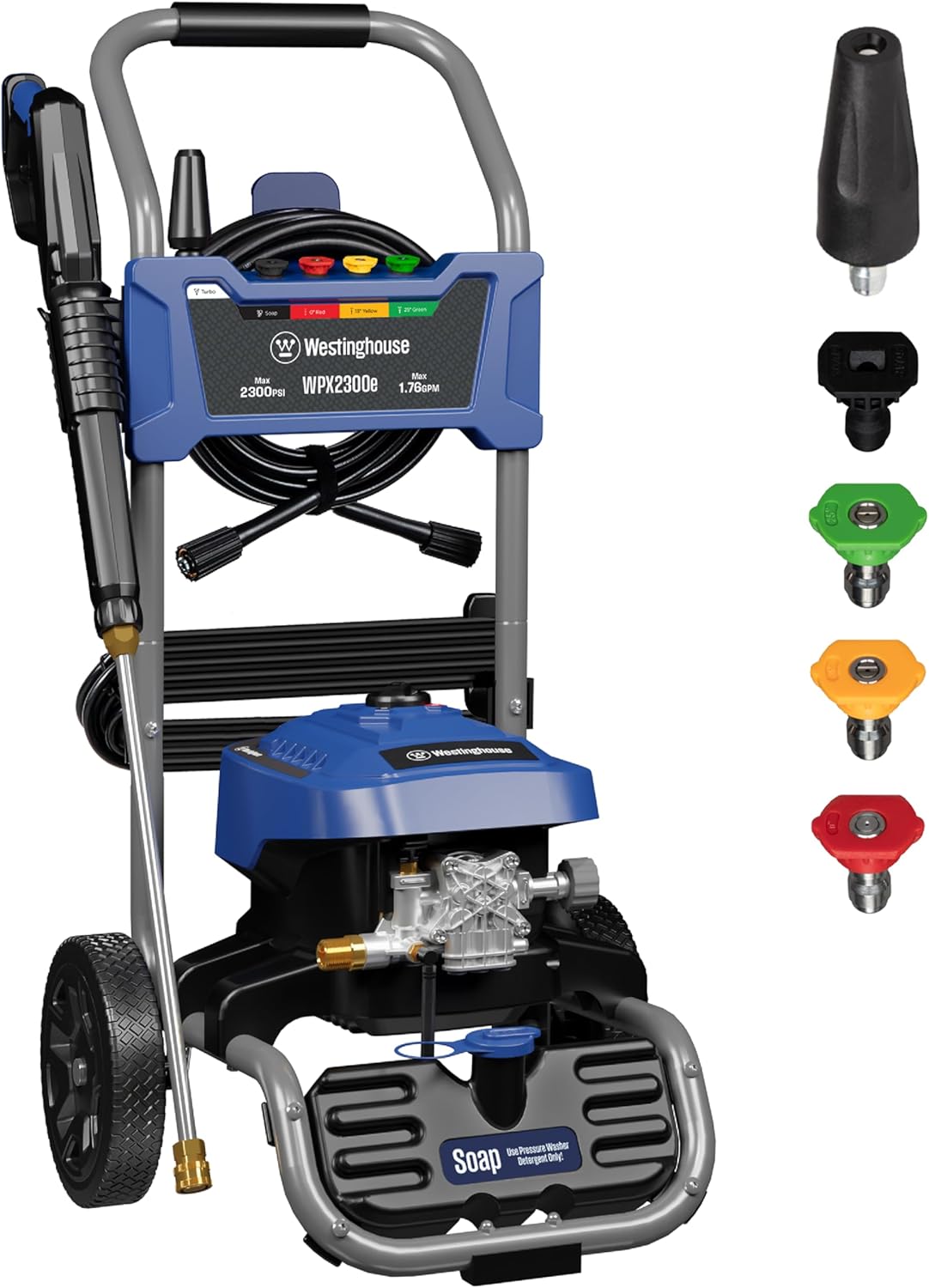
| Maximum Pressure | 2300 psi |
|---|---|
| Maximum Flow Rate | 1.76 gpm |
| Power Source | ac |
| Hose Length | 25 feet |
| Tank Volume | 20 fluid ounces |
The Westinghouse WPX2300e is a straightforward electric pressure washer aimed at homeowners who want a reliable, low-maintenance cleaner for driveways, decks, fences, cars and patio furniture. It uses a heavy-duty 120V AC motor paired with a maintenance-free axial three-piston pump to deliver 2300 max PSI and 1.76 max GPM (1900 PSI and 1.2 GPM rated), giving enough power to remove dirt and mildew without the complexity of a gas unit. Practical features include a built-in 0.42 gallon soap tank, five quick-connect nozzle tips (including turbo and soap), a 25-foot abrasion-resistant hose, never-flat wheels and a long 35-foot GFCI cord for safer outdoor use. The unit’s steel frame and onboard wand/gun storage make it easy to move and store. Limitations are typical for electric models: it depends on an AC outlet and its real-world cleaning power is lower than professional gas washers for very heavy-duty concrete stripping. For routine home jobs it balances power, convenience, and low maintenance well.
Best for: Practical homeowners who want a dependable, low-maintenance electric washer for regular cleaning around the yard and vehicles and who prefer safer, plug-in operation over gas engines.
Less Ideal for: Contractors or users who need commercial-level pressure and continuous runtime should choose a gas or professional-grade unit instead.
- Produces substantial cleaning power for a homeowner electric unit (2300 max PSI, 1900 rated PSI).
- Maintenance-free axial three-piston pump reduces upkeep compared with pumps that need frequent service.
- Onboard soap tank and five quick-connect nozzles provide versatility for different surfaces and cleaning tasks.
- Long hose and 35-foot GFCI cord plus never-flat wheels improve reach and safe mobility around the yard.
- Requires a nearby AC outlet so use is limited by cord length and available power.
- Not as powerful as gas pressure washers for very heavy-duty industrial or commercial cleaning tasks.
Verdict: A dependable, low-maintenance electric pressure washer that gives mainstream homeowners strong cleaning performance and useful accessories without the fuss of a gas machine.
Choosing the Right Budget Electric Pressure Washer: Key Factors to Consider
Pressure Consistency and Peak PSI
How consistently a pressure washer delivers stated PSI under real working conditions affects cleaning speed and safety. A unit that loses pressure quickly when the trigger is pulled will struggle with caked-on mud and mildew, forcing you to make multiple passes and increasing wear. Consistent pressure also helps avoid over-spraying on delicate surfaces; fluctuations can cause you to pause and adjust, slowing the job.
Look for designs with well-sized motors and pumps that maintain pressure during continuous use. Consider whether the unit uses an axial or triplex pump, because that affects longevity and how steady the pressure remains.
Water Flow and Coverage
Gallons per minute determines how much surface a machine can clean in a single pass. Higher flow rates rinse away loosened dirt faster and reduce rinse time on horizontal surfaces like patios and driveways. Flow rate works with PSI to define cleaning power; a moderate PSI with good GPM can outperform a high-PSI, low-flow unit on broad areas.
Assess the typical water supply you have available. Some budget electric washers are limited by inlet fittings or require higher household flow to reach rated GPM. If you plan to clean large paved areas, prioritize higher flow and a hose length that provides good reach without needing to relocate the machine often.
Pump and Motor Durability
The pump and motor are the components most likely to determine long-term reliability. Materials, cooling design, and whether the pump is brass, aluminum, or composite influence maintenance needs and service life. A better pump design can resist overheating and cavitation when household water supply dips.
For homeowners using a pressure washer several times each season, pick models with proven pump types and clear guidance for maintenance such as oil changes or easy-to-access seals. Durability expectations change if you run the unit for extended cleaning sessions versus occasional spot jobs.
Hose, Wand, and Nozzle Versatility
Hose length and quality affect mobility and how often you move the washer. A kink-resistant hose that reaches the work area reduces interruptions. The wand and nozzle options change how the spray behaves: narrow-angle nozzles concentrate force for stain removal, while wider patterns and low-pressure soap jets are gentler for wood, painted siding, or delicate patio furniture.
Check the ease of swapping tips and whether an adjustable turbo or fan nozzle is included. A wand with a comfortable trigger and quick-connect fittings makes routine tasks less tiring and speeds up transitions between cleaning tasks.
Portability and Storage
How easy the washer is to move and store matters for small yards and garages. Consider wheel size, handle height, and overall footprint so you can move the unit over gravel, grass, or uneven driveways. Compact designs that still allow short-term storage of a hose and wand reduce clutter.
Also consider weight if you need to lift the unit into a vehicle or up steps. Units designed with integrated storage for cords and accessories typically make seasonal use easier and keep accessories from getting lost.
Safety Features and Ease of Use
Safety and ergonomic controls reduce fatigue and the risk of accidental damage. Features like a trigger lock, thermal overload protection, and an easy-to-reach on/off switch prevent misuse and protect the motor. Good ergonomics on the wand and well-balanced unit weight lower wrist and back strain during longer cleaning sessions.
Also check for clear instructions on priming and winterizing the pump. Simple maintenance procedures and secure fittings help prevent leaks and prolong component life.
Best Uses for Budget Electric Pressure Washers
Budget electric pressure washers are well suited to routine home cleaning tasks: rinsing driveways and patios, washing vinyl siding, refreshing fences, and removing moss from pavers. They typically offer enough power to handle dirt and light oil stains without the complexity or fumes of a gas model.
These units excel when you need quick, occasional cleaning rather than heavy-duty construction cleanup. For vertical surfaces like house siding, choose a model with stable pressure and gentle nozzle options to avoid surface damage.
- Driveways and concrete patios – best with higher flow rates
- Decks and wood fences – use lower-pressure nozzles to protect wood
- Outdoor furniture and grills – short bursts and wider spray patterns work well
Maintaining Your Pressure Washer
Simple maintenance extends the life of an electric pressure washer. Flush the soap system after each use, inspect hoses and seals for wear, and follow recommended pump maintenance schedules. Store the unit indoors during freezing weather or use a pump saver product to avoid burst seals.
Clean the inlet water filter regularly and use a garden hose with adequate flow to avoid cavitation. Replace worn nozzles and check quick-connect fittings for leaks before each season.
- Rinse detergent from the system after use
- Inspect and replace O-rings as needed
- Keep the inlet filter free of debris
Nozzle Types and When to Use Them
Different nozzles concentrate or disperse the spray pattern. Narrow-angle jets offer maximum cleaning force for stubborn stains, while wider-angle fan nozzles cover more surface area for general rinsing. A low-pressure soap nozzle helps apply detergent without blasting it away.
Use the gentlest effective nozzle on wood and painted surfaces to avoid damage. Work at a moderate distance and test a small area first to ensure the spray does not etch or strip finishes.
- 0 to 15 degrees for heavy-duty stain removal
- 25 degrees for general cleaning
- 40 degrees for gentle rinsing and delicate surfaces
Common Mistakes to Avoid
Using the highest pressure setting or the narrowest nozzle on every surface can quickly cause damage. Match pressure and nozzle to the surface and keep the wand moving to prevent concentrated wear. Avoid pointing the spray at fragile plants or electrical fixtures.
Another frequent issue is underestimating water supply needs. Low household flow can lower real-world performance, so verify faucet flow and avoid long, restrictive hoses that reduce GPM.
- Do not use high-pressure tips on wood or painted surfaces
- Avoid long, undersized hoses that reduce flow
- Do not operate without a working inlet filter
Accessories That Make Jobs Easier
A surface cleaner accessory speeds up cleaning flat areas like driveways and patios and provides a more uniform finish than a wand alone. Brush attachments help for textured surfaces where dirt lodges in crevices. Extension wands increase reach for gutters and second-story siding without needing a ladder.
Choose accessories that match the pressure and flow rating of the washer to avoid premature wear. Quick-connect fittings and on-board accessory storage simplify switching tools mid-job.
- Surface cleaners for even, fast cleaning of flat areas
- Extension wands for gutters and high siding
- Brushes for textured concrete and stone
How We Chose the Best Budget Electric Pressure Washer
We focused on real-world cleaning performance, reliability, and practical features for homeowners who need an affordable electric pressure washer. Key evaluation criteria included sustained water flow and pressure delivery under load, which determines how well a unit cleans siding, decks, and concrete. Motor and pump durability were assessed via build materials and proven pump types, because these components affect lifetime and maintenance needs. Hose and nozzle systems were evaluated for reach, ease of swapping tips, and the inclusion of a turbo or variable nozzle for stubborn stains. Portability and storage considerations guided selection for garden and garage use, including handle design, wheel robustness, and how compactly units stow. Safety and user controls were checked, covering trigger gun ergonomics, thermal cutoffs, and licensed connection fittings. We excluded heavier-duty gas models and commercial-only units that are not practical for typical home use, and we did not consider specialty units designed only for industrial or vehicle-detailing applications.
FAQ
Can a budget electric pressure washer remove oil stains from a driveway?
Often a higher flow unit with a narrow nozzle and a degreasing detergent will lift fresh oil stains. Older, set-in oil may require repeated applications and scrubbing. For extensive oil removal, multiple passes and a surface cleaner can help.
Is it safe to use a pressure washer on a wooden deck?
Usually you should use a wide-angle nozzle and keep some distance to avoid gouging the wood. Test a small area first and avoid very high pressure settings. Follow with appropriate deck cleaning products and consider sanding and sealing after deep cleanings if needed.
How long will a typical budget electric pressure washer last with regular use?
It depends on frequency and maintenance. With seasonal use and basic care-cleaning filters, storing indoors over winter, and replacing worn seals-a well-made unit can last several years. Heavy daily use will shorten lifespan compared with occasional homeowner tasks.
Do I need a special hose or faucet adapter for a budget electric unit?
Most units work with a standard garden hose and common threaded fittings, but check inlet size and recommended flow. A hose rated for consistent household flow and a short run to the washer avoid flow loss. Some models include adapters for different faucets.
Will using detergent damage the pump?
Usually detergents designed for pressure washers are safe when used as directed and rinsed after use. Prolonged exposure without flushing can cause seals to degrade. Always follow the manufacturer guidance on detergent types and after-use flushing.
Final Verdict
A practical budget electric pressure washer should match the surfaces and frequency of your cleaning tasks. Prioritize consistent pressure and adequate flow for the areas you clean most often, and choose a pump design and hose system that support durability and ease of use. Balancing power, portability, and maintenance needs will help you pick a model that delivers dependable performance without unnecessary features. Focus on the evaluation criteria discussed here when comparing options to find the right unit for your yard and projects.
