

Note: This article contains affiliate links. If you click on these links and make a purchase, I may earn a small commission at no extra cost to you. This helps support my research and content. Read my full affiliate disclosure here.
When centipede grass is your lawn, choosing the right weed killer matters because this turfgrass is sensitive to common herbicides and recovers slowly from injury. You want a product that clears dandelions, clover, crabgrass seedlings, and other invaders without leaving yellow patches or long recovery times. This guide covers seven top options for centipede lawns, shortlisted for their balance of weed spectrum, turf safety, and ease of use. We explain the practical differences you will notice in the yard, the conditions that affect outcomes, and the evaluation criteria used to narrow these picks. Read on to match a control approach to your lawn size, weed mix, and tolerance for risk.
Top Picks at a Glance
| Best Overall The best all-around choice for most situations | Fertilome Centipede Weed & Feed 15-0-15, 16 lb |  |
| Best Quality Built to a higher standard if you want something more solid | Celsius WG Granular Herbicide 2-Pack |  |
| Best Value The sweet spot between price and what you get | Hi-Yield Atrazine Selective Herbicide, 32 oz |  |
| Best Budget The cheapest option that still gets the job done reliably | Ortho WeedClear Weed Killer for Lawns Concentrate, 32 fl. oz. |  |
| Highest Rated A top-rated pick with lots of positive feedback | Scotts Turf Builder Triple Action Lawn Fertilizer and Weed Control, 11.31 lb |  |
| Most Popular A crowd favorite that many people choose with confidence | Southern Ag Atrazine St. Augustine Weed Killer, 32 oz |  |
| Best Seller A high-volume bestseller chosen again and again | Southern Ag Atrazine St. Augustine Grass Weed Killer, 1 Gallon |  |
Fertilome Centipede Weed & Feed 15-0-15, 16 lb

| Item Form | Granules |
|---|---|
| Coverage | 5000 square feet |
| Target Species | Lawn Grass |
| Unit Count | 256 Ounce |
This is a two-in-one granular weed-and-feed designed specifically for centipede grass: it delivers slow-release nitrogen plus a Trimec-based broadleaf herbicide and added iron. Typical use is a spring and fall application to pre-moistened turf or dew-covered grass, with no watering for 24 hours afterward; one bag covers about 5,000 square feet and the manufacturer recommends only two applications per year. The formulation targets 200+ broadleaf weeds including dandelions, chickweed, and dollarweed while feeding the lawn to help improve color and vigor. Practical benefits include simplified maintenance since you combine feeding and broadleaf control in a single step and the slow-release nitrogen reduces burn risk compared with fast-release fertilizers. Limitations are typical for selective weed-and-feed products: it is intended for centipede and similar lawns only, it will not control grassy weeds or crabgrass, and timing and moisture rules must be followed to avoid reduced effectiveness or turf injury.
Best for: A homeowner who wants a low-effort, combined feeding and broadleaf control solution for a centipede lawn and prefers a product that reduces application frequency.
Less Ideal for: People managing lawns with mixed grass types, heavy grassy-weed pressure, or those needing a crabgrass preventer should look for specialized herbicides or separate weed control products.
- Combines slow-release nitrogen with post-emergent broadleaf control to feed and weed in one application
- Formulated specifically for centipede lawns to reduce risk of turf injury when used as directed
- Covers up to 5,000 square feet per bag which suits small to medium yards
- Controls a wide range of common broadleaf weeds including dandelions and chickweed
- Does not control grassy weeds or crabgrass so separate products may be needed
- Requires precise timing and dry period after application for best results
Verdict: If you have a centipede lawn and want one product to both feed and control common broadleaf weeds with only a couple of applications per year, this is a practical, low-effort choice.
Celsius WG Granular Herbicide 2-Pack

| Item Form | Granule |
|---|---|
| Item Highlight | Full Season Southern Lawn Weed Control | Safe on St. Augustine, Bermuda & Zoysia | Covers 4,000 sq ft | Kills 120+ Weeds |
| Manufacturer | Envu |
| Brand | Bug And Blade |
Celsius WG is a granular, two-treatment weed control system designed specifically for warm-season lawns like zoysia. The kit supplies two packets intended for a spring and a late-summer or fall application to cover up to 4,000 sq ft, and the triple-mode active ingredient mix is intended to attack weeds with three independent mechanisms to reduce resistance. In use you broadcast the granules when weeds are actively growing and above about 60°F; weeds stop growing within hours, yellowing appears in 1–2 weeks, and full control typically follows in 1–4 weeks. The product includes laminated weed ID cards to help you target common problem species and notes the lawn is safe for family and pets once the granules have dried. Limitations are that it is formulated only for warm-season turf and must be applied according to the label timing and rates for safe turf tolerance and effective results, and persistent perennials may need a follow-up application.
Best for: Homeowners or lawn-care-minded users with zoysia or other warm-season turf who prioritize effective, season-long weed control and want a planned two-application program.
Less Ideal for: Those managing cool-season lawns or users who need an all-purpose herbicide for mixed grass types should consider alternatives labeled for their turf.
- Two-packet system covers a full season with spring and season-ending treatments
- Formulated for safe use on zoysia and other warm-season turfgrasses
- Triple-mode-of-action formula helps control weeds with resistance to single-mode herbicides
- Includes laminated weed ID cards to simplify identification and timing
- Not labelled for cool-season grasses so it cannot be used on lawns like fescue or bluegrass
- May require a second follow-up application for stubborn perennial weeds
Verdict: If you need a targeted, season-long program for zoysia and other warm-season lawns, this two-pack granular system delivers reliable, resistance-minded weed control.
Hi-Yield Atrazine Selective Herbicide, 32 oz

| Unit Count | 32 Ounce |
|---|---|
| Item Form | Liquid |
| Coverage | Full |
| Active Ingredients | atrazine |
This 32 oz Hi-Yield atrazine concentrate is a selective herbicide designed for St. Augustine and centipede grass. You dilute the concentrate per the label and apply it with a pump sprayer or watering can to treat up to about 3,720 sq ft, and the product is intended for early spring applications though it can be used in dormant or growing seasons. The formula targets common lawn weeds such as henbit, clover, and chickweed and is presented as a full-coverage liquid for even application. Practical benefits include a long coverage area from one bottle and clear directions for timing and application, which suit routine seasonal weed control. Important limitations are that it is grass-type specific and contains atrazine, so users must follow safety and storage instructions and check label restrictions for nearby plants and environmental considerations. Expect effective selective control when applied correctly, but confirm compatibility with your turf variety and local regulations before use.
Best for: Homeowners with St. Augustine or centipede lawns who prioritize efficient, season-based weed control and want a concentrate that covers a large area without specialty equipment.
Less Ideal for: Gardeners with different turf varieties, mixed ornamental beds, or those seeking an all-purpose or non-chemical weed solution should consider alternatives.
- Selective herbicide formulated specifically for St. Augustine and centipede grass
- Liquid concentrate treats up to roughly 3,720 square feet from one 32 oz bottle
- Clear label directions for dilution and timing make seasonal applications straightforward
- Effective on common broadleaf and grassy weeds like henbit, clover, and chickweed
- Contains atrazine which has application restrictions and environmental considerations
- Not suitable for turf types outside St. Augustine and centipede grass
Verdict: Choose this concentrate if you need a single, high-coverage selective herbicide specifically for managing weeds in St. Augustine or centipede lawns.
Ortho WeedClear Weed Killer for Lawns Concentrate, 32 fl. oz.

| Unit Count | 32 Fluid Ounces |
|---|---|
| Coverage | 16000 square_feet |
| Item Form | Spray |
| Active Ingredients | Herbicide |
Ortho WeedClear Concentrate is a ready-to-dilute herbicide intended for treating broadleaf weeds in lawns. You mix the concentrate with water per the label and apply with a tank sprayer or an Ortho hose-end applicator to actively growing weeds in spring or fall. The formula claims fast visible results in hours, becomes rainproof about an hour after drying, and covers up to 16,000 square feet from a 32 fl. oz. bottle when diluted correctly. Notable features include labeled compatibility with many common lawn grasses and a claim to kill more than 250 listed weeds down to the root, including dandelions and clover. Practical benefits are wide coverage per bottle, quick action that reduces repeat spot treatments, and straightforward dilution instructions for common sprayers. Important limitations are that it must be applied only to the grasses listed on the label to avoid damage and users must keep people and pets off the treated area until the spray dries and follow safety precautions. Results depend on proper mixing, application timing, and treating actively growing weeds.
Best for: Homeowners who want a versatile, fast-acting weed control solution for common lawn grasses and prefer a concentrate for treating medium to large lawns.
Less Ideal for: People with small ornamental lawns planted with unlisted grass varieties or those who need a nonchemical or pet-safe alternative should consider other options.
- Concentrated formula treats up to 16,000 sq. ft. when diluted per directions
- Targets over 250 listed broadleaf weeds and claims to kill to the root
- Rainproof within one hour after the spray dries, reducing wash-off risk
- Compatible with a wide range of common lawn grasses when label directions are followed
- Only safe for grasses listed on the label so misuse can damage nonlisted turf
- Requires correct dilution and application equipment for effective coverage
Verdict: A concentrated, fast-acting lawn weed killer that treats large areas and controls many common broadleaf weeds while being safe for listed turf when used as directed.
Scotts Turf Builder Triple Action Lawn Fertilizer and Weed Control, 11.31 lb

| Item Form | Granule |
|---|---|
| Coverage | 4000 square_feet |
| Active Ingredients | Pendimethalin, Dicamba |
Scotts Turf Builder Triple Action combines fertilizer, broadleaf weed control, and a crabgrass pre-emergent into a single granular bag aimed at spring lawn care. You apply it with a broadcast spreader to a wet lawn, let granules sit for 24 hours, then water to move the active ingredients into the soil. Notable features are its 3-in-1 formulation and a coverage claim of 4,000 square feet from the 11.31 lb. bag, plus compatibility with common turf types such as Kentucky bluegrass, fescue, and bermudagrass. In practice it simplifies chores by replacing separate fertilizer and pre-emergent steps and helps prevent crabgrass for several months while also targeting common broadleaf weeds like dandelion and clover. Important limitations are that it will not kill existing crabgrass and it contains herbicides that require careful timing and following safety directions for people and pets. For a homeowner who wants a single spring treatment to strengthen turf and reduce weed pressure, this is a practical, time-saving option.
Best for: Homeowners who want a single spring treatment to both strengthen their lawn and reduce weed pressure without managing multiple products, and who follow label timing and safety instructions.
Less Ideal for: People needing a quick cure for established crabgrass or those who prefer separate targeted treatments for fertilizer and herbicide control.
- 3-in-1 formula feeds grass, kills listed broadleaf weeds, and prevents crabgrass
- Covers up to 4,000 square feet from a single 11.31 lb. bag
- Granular form works with broadcast spreaders for even application
- Suitable for a wide range of common turf types
- Does not control existing crabgrass since the product is a pre-emergent
- Contains herbicides that require strict timing, wet grass at application, and re-entry precautions
Verdict: Use this single-bag 3-in-1 granular treatment if you want an easy spring application that feeds your lawn while preventing crabgrass and treating common broadleaf weeds.
Southern Ag Atrazine St. Augustine Weed Killer, 32 oz
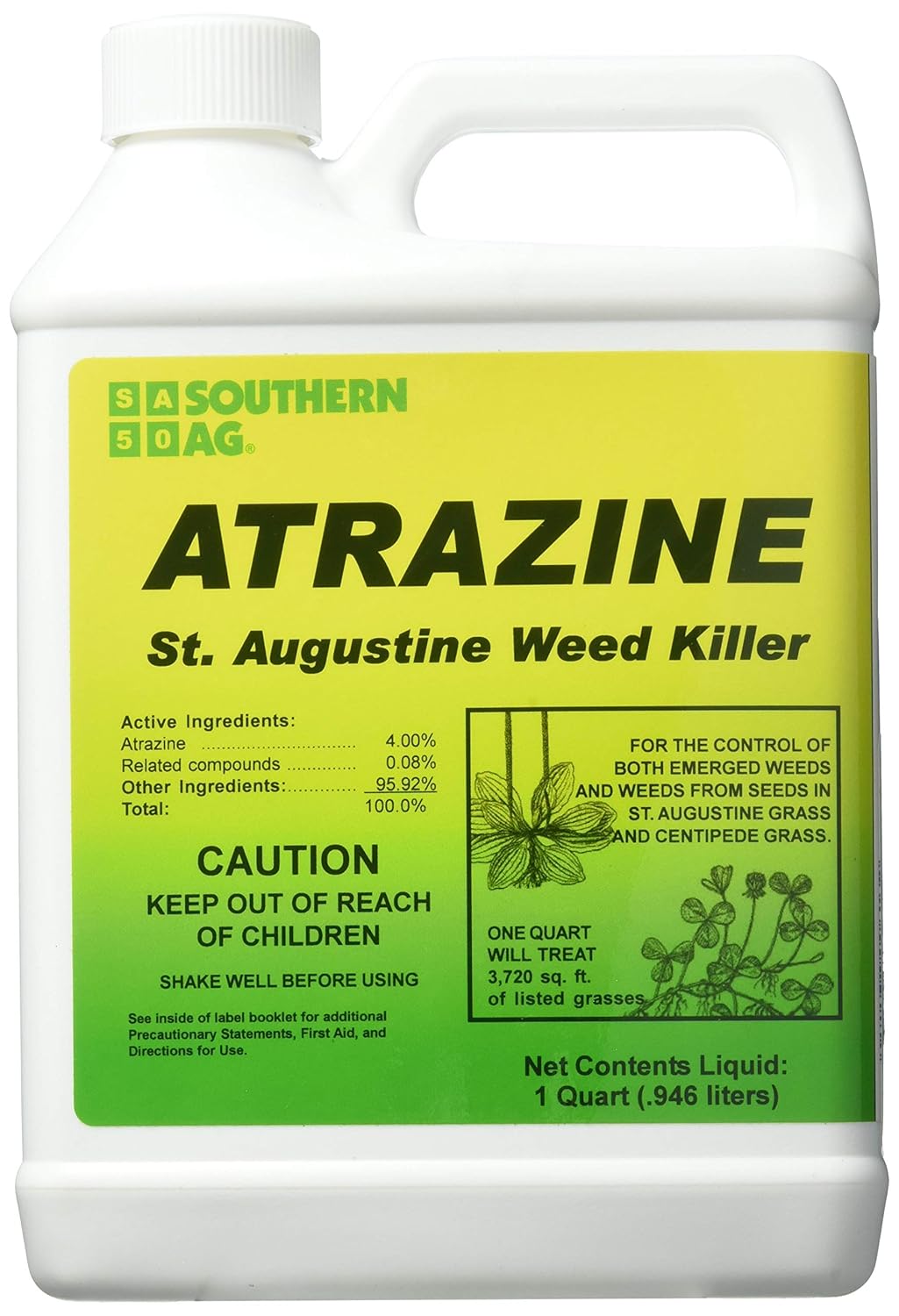
| Unit Count | 32 Fluid Ounces |
|---|---|
| Item Form | Spray |
| Coverage | 3,720 square_feet |
| Item Type Name | Specialty Herbicide |
Southern Ag Atrazine is a concentrated liquid herbicide made specifically for St. Augustine and centipede grasses. It is mixed into spray and applied across the lawn to suppress crabgrass and remove many common broadleaf and grassy weeds; one quart claims coverage of roughly 3,720 square feet when diluted at the recommended rate. The product is intended for targeted seasonal use, with best results from early spring applications and careful, overlap-free spraying. Practical benefits include a focused label for the two grass types and a coverage rate that stretches a single bottle across a medium-sized yard, which helps keep costs down. Important limitations are that it is a chemical herbicide requiring careful handling and strict label following, it is not recommended for hose-end sprayers, and it is not a fertilizer so it will not improve turf nutrition or overall lawn health by itself. Use protective gear and avoid off-target drift to protect desirable plants.
Best for: Buyers who need an affordable, targeted weed control for St. Augustine or centipede lawns and want a product that covers a medium-sized yard without repeated purchases.
Less Ideal for: Homeowners seeking an all-in-one lawn treatment for nutrition or for use on other grass types should choose a different product or combine this with appropriate fertilization.
- Formulated specifically for St. Augustine and centipede lawns for targeted control
- Concentrated formula with coverage up to about 3,720 sq ft per quart
- Controls a range of broadleaf and some grassy weeds including suppression of crabgrass
- Practical application instructions for spot or broadcast spray use in early spring
- Chemical herbicide that requires protective handling and careful application
- Not a fertilizer so it does not provide nutrients or improve turf vigor
Verdict: A cost-effective, concentrated herbicide for homeowners who need focused weed control on St. Augustine or centipede lawns.
Southern Ag Atrazine St. Augustine Grass Weed Killer, 1 Gallon

| Unit Count | 128 Fluid Ounces |
|---|---|
| Item Form | Spray |
| Coverage | 500 square_feet |
| Active Ingredients | atrazine |
Southern Ag Atrazine is a ready-to-mix liquid herbicide designed to target many broadleaf weeds and provide suppression of crabgrass in lawns, and it is commonly used on St. Augustine and centipede grass. You apply it as a spray over the lawn following label directions; it controls emerged weeds and offers some pre- and post-emergent activity against certain species. The key feature is atrazine as the active ingredient, which is effective against a broad spectrum of common turf weeds and can reduce follow-up spot treatments. The product lists coverage of about 500 square feet per gallon, so a single jug is suitable for small to medium patches rather than very large lawns. Important limitations are that atrazine is restricted or regulated in some areas and can harm sensitive turf varieties and nearby desirable plants if misapplied, so careful adherence to safety and application instructions is necessary. For a cautious homeowner, this product works well when used precisely where centipede grass is listed as a labeled tolerant species.
Best for: Homeowners with centipede or St. Augustine lawns who want a targeted chemical option to control broadleaf weeds and suppress crabgrass and who will follow label directions carefully.
Less Ideal for: Gardeners who prefer non-chemical control methods, those with mixed or sensitive plantings near the lawn, or anyone in regions where atrazine use is restricted or banned.
- Contains atrazine, a proven active ingredient for controlling many broadleaf weeds in tolerant warm-season grasses
- Ready-to-mix liquid formulation suitable for spray application over established turf
- Labels centipede grass as a use case so it can be used where centipede is present
- Covers about 500 square feet per gallon, adequate for targeted spot or small-area treatments
- Atrazine is regulated in some regions and requires careful handling and strict adherence to label restrictions
- Not intended for all turf types and can damage sensitive plants if applied off-target
- Coverage per gallon is modest for large lawns, requiring multiple gallons for big areas
Verdict: A practical, label-approved atrazine spray for homeowners needing a targeted herbicide for centipede and St. Augustine lawns.
Choosing the Right Weed Killer for Centipede Grass: Key Factors to Consider
Turf Safety And Tolerance
Centipede grass is more prone to herbicide injury than many other warm-season turfs, so turf safety is the top consideration. Look for products with specific guidance or trials showing low scorch risk on centipede when applied at recommended rates. Safety also depends on temperature at application, mower height, and recent cultural stress such as drought or fertilization. Applying during peak heat or to weakened turf increases the chance of discoloration or thinning.
Understanding turf tolerance helps you choose between whole-lawn treatments and spot applications. When in doubt, test a small area first and wait two weeks to observe any negative effects before treating the entire lawn.
Weed Spectrum And Growth Stage
Different herbicides target different groups of weeds. Broadleaf-selective products control dandelion, clover, oxalis, and others without harming grass, while preemergent herbicides prevent crabgrass and goosegrass seedlings from establishing. Postemergent grass-targeting herbicides can control grassy weeds but often carry a higher risk to sensitive turf.
Timing matters: preemergents must be applied before weed seeds germinate, often in early spring, whereas postemergents work best on actively growing, non-stressed weeds. Identify the dominant weeds in your centipede lawn and choose a product whose labeled spectrum and timing match the problem.
Application Method And Coverage Needs
Decide whether you need spot control or full-lawn treatment. Ready-to-use sprays are convenient for small patches, while hose-end or concentrate formulations are more economical for larger lawns but require proper dilution and even spray patterns. Spray droplet size and nozzle choice affect drift and coverage; for spot treatments use a coarse spray to reduce off-target movement.
Also consider whether a granular or liquid form is more practical for your lawn layout. Granules spread by a broadcast spreader can be easier for large areas, but liquids often give faster visible control on actively growing weeds.
Environmental Conditions And Timing
Temperature, rainfall, and mowing schedule influence both efficacy and safety. Apply postemergents when weeds are actively growing and air temperatures are within the product label range to maximize uptake and minimize turf stress. Avoid treating before heavy rain that can wash off contact products, and allow enough dry time for systemic herbicides to translocate.
Early morning or late afternoon applications can reduce volatilization and stress. Note any irrigation or reseeding restrictions after application; some products require several days without irrigation or a waiting period before overseeding.
Mixing, Calibration, And Application Accuracy
Proper mixing and accurate calibration of spray equipment are essential to avoid under- or over-application. Concentrates must be measured and diluted exactly as labeled. For hose-end sprayers, verify the flow rate and ensure the unit is compatible with the product. Handheld trigger sprayers offer control for small spots but need careful agitation for emulsifiable concentrates.
Calibration also includes setting nozzle type and pressure so you apply the labeled amount per 1,000 square feet. Over-application increases burn risk; under-application reduces efficacy and can encourage resistant weeds.
Post-Application Turf Care And Recovery
After treatment, follow label instructions on mowing, irrigation, and reseeding. Some herbicides require delaying mowing for a short period to let treated foliage translocate the active ingredient. Irrigation timing matters: heavy water soon after certain products can reduce effectiveness, while delayed irrigation may prolong turf stress in hot weather.
Plan follow-up observation and targeted retreatment for persistent weeds rather than broad repeated applications. Good cultural practices such as correct mowing height, proper fertilization, and overseeding thin areas will reduce future weed pressure and improve long-term turf health.
When To Use Preemergent Versus Postemergent Control
Preemergent herbicides form a barrier at the soil surface to prevent weed seedlings from emerging and are most effective when timed before germination. For centipede lawns, preemergents are commonly used in early spring and sometimes in late summer to block fall-germinating species. Use preemergents if your main issue is crabgrass or annual grassy weeds and plan applications relative to soil temperatures rather than calendar dates.
Postemergents treat weeds that are already growing. They are the tool for broadleaf weeds and perennial grassy weeds that slipped through preemergent timing. Spot-treating with a postemergent minimizes the amount of herbicide applied to the turf and reduces risk compared with blanket treatments.
- Preemergent: best for preventing annual grassy weeds and some small-seeded broadleaf weeds.
- Postemergent: best for controlling established broadleaf weeds and perennial grasses.
- Combine approaches seasonally: preemergents for prevention and spot postemergents for escapes.
Safe Application Window For Centipede Grass
Centipede grass has a defined growing season in warm months when it tolerates treatment better. Apply most broadleaf postemergents during active growth but avoid extremes of heat or drought. Early morning or late afternoon applications on mild days reduce stress and improve uptake.
If the lawn is recently fertilized or recovering from environmental stress, postpone herbicide applications until recovery is evident. Read label temperature ranges and adhere to irrigation and mowing guidance after treatment.
- Avoid treatment during heat waves or drought stress.
- Follow label guidance on temperature ranges and post-application care.
- Test a small inconspicuous patch if uncertain about safety.
Cultural Practices That Reduce Future Herbicide Needs
Improving turf vigor is the best long-term strategy to reduce weed pressure. Maintain proper mowing height for centipede grass, typically on the lower side for warm-season turf, and avoid excessive nitrogen which can invite weed competition and disease.
Address soil fertility and pH through testing; centipede prefers slightly acidic soils and can thin if pH drifts high. Regular core aeration, overseeding thin areas with compatible cultivars, and targeted fertilization at recommended rates will create a denser sward that naturally suppresses weeds.
- Mow to recommended heights and remove clippings if thatch is heavy.
- Test soil pH and adjust according to recommendations for centipede grass.
- Use cultural controls first, then apply herbicides only where needed.
Spot Treatment Techniques And Safety Tips
For small infestations, spot-treating reduces the amount of herbicide used and lowers risk to the overall lawn. Use a trigger sprayer with a low-pressure, coarse nozzle and apply only to the weed foliage. For hand-pulled or dug weeds, treat regrowth rather than freshly removed plants.
Wear protective equipment recommended on labels and avoid drift onto sensitive plants or garden beds. Rinse equipment immediately after use and follow local disposal rules for leftover product or containers.
- Apply coarse droplets to minimize drift.
- Avoid spraying on windy days and protect nearby ornamentals.
- Record treatment dates and locations to track efficacy and retreatment needs.
How We Chose the Best Weed Killer for Centipede Grass
We prioritized products and approaches that are appropriate for centipede grass by focusing on turf safety and effectiveness against weeds commonly found in warm-season lawns. Selection began with options labeled or widely recommended for centipede turf and those with documented efficacy on broadleaf and grassy weeds while minimizing injury risk. We favored formulations with clear application windows and concentration options for spot treatment versus whole-lawn care. Evaluation criteria included the herbicide spectrum against both common broadleaf and grassy weeds, the documented turf-safety profile on centipede grass, ease and flexibility of application for homeowners, and post-application recovery time and irrigation restrictions. We also considered packaging and formulation that reduce mixing errors and drift, plus any required waiting periods before reseeding or overseeding. Exclusions: products that are explicitly contraindicated for centipede grass, unregistered herbicides, or items lacking manufacturer guidance for warm-season turf were removed from consideration.
FAQ
Can I use a general-purpose weed killer on centipede grass?
Often general-purpose herbicides include active ingredients that can harm centipede. It depends on the product formulation and label. Always check the label to confirm centipede grass is listed as a tolerant turf or choose products specifically labeled for centipede lawns.
When is the best time to apply a preemergent on centipede lawns?
The best timing is before soil temperatures reach the threshold for weed seed germination, typically in early spring. Use a soil thermometer or local extension guidance to time the application rather than relying solely on calendar dates.
Will spot treatments prevent future weed infestations?
Spot treatments control current weeds but do not prevent new seeds from germinating. Combining spot treatments with good cultural practices and seasonal preemergents is the most effective strategy to reduce future infestations.
How long after treatment can I mow or irrigate my lawn?
This varies by product. Some herbicides advise waiting a day or two before mowing or irrigating to allow foliage uptake, while others require longer. Follow label directions for post-application restrictions to protect both efficacy and turf health.
Is it safe to overseed after using a weed killer on centipede grass?
Safety depends on the herbicide used and the waiting period required before seeding. Some residual products need several weeks before reseeding. Check label instructions for reseeding intervals and plan applications accordingly.
Final Verdict
Choose a weed control plan for centipede grass by prioritizing turf safety, matching the herbicide spectrum to the weeds present, and applying at the right time and rate. For many yards the best approach is a combination of preemergent prevention and targeted postemergent spot treatments, supported by sound cultural care to strengthen the turf. Balance immediate weed control needs against the risk of turf injury and recovery time. When in doubt, start small, read labels carefully, and favor strategies that reduce overall herbicide use while keeping your centipede lawn dense and healthy.
