

Note: This article contains affiliate links. If you click on these links and make a purchase, I may earn a small commission at no extra cost to you. This helps support my research and content. Read my full affiliate disclosure here.
Picking the right hydroponic fertilizer matters because in a soilless system the nutrient solution is the garden. The wrong mix or inconsistent solubility can stunt growth, cause nutrient lockout, or make pH management frustrating. This guide focuses on top-performing hydroponic fertilizers suited to a range of systems and crop goals, from leafy greens to flowering plants. We shortlisted seven options that represent reliable nutrient profiles and formulation types. Below you will find practical notes on how each kind behaves in a real water-based setup and the evaluation criteria used to compare them, such as nutrient balance and solubility. Read on to match your system and crops to the fertilizer style that will produce steady, manageable results.
Top Picks at a Glance
| Best Overall The best all-around choice for most situations | General Hydroponics Flora Trio Combo — Grow, Bloom, Micro (1 gal each, 3-pack) |  |
| Best Quality Built to a higher standard if you want something more solid | General Hydroponics FloraSeries Hydroponic Nutrient System, 1 gal (FloraMicro, FloraGro, FloraBloom) |  |
| Best Value The sweet spot between price and what you get | General Hydroponics MaxiGro Powder Plant Food, 2.2 lb |  |
| Best Budget The cheapest option that still gets the job done reliably | Ahopegarden 800ml A&B Hydroponic Nutrients Liquid Plant Food |  |
| Highest Rated A top-rated pick with lots of positive feedback | inbloom Hydroponic Nutrients A&B (1000 ml total) |  |
| Most Popular A crowd favorite that many people choose with confidence | TPS Nutrients Liquid Plant Food for AeroGarden and Hydroponics, 8 oz |  |
| Best Seller A high-volume bestseller chosen again and again | TPS Nutrients Liquid Plant Food for AeroGarden and Hydroponic Systems, 32 oz |  |
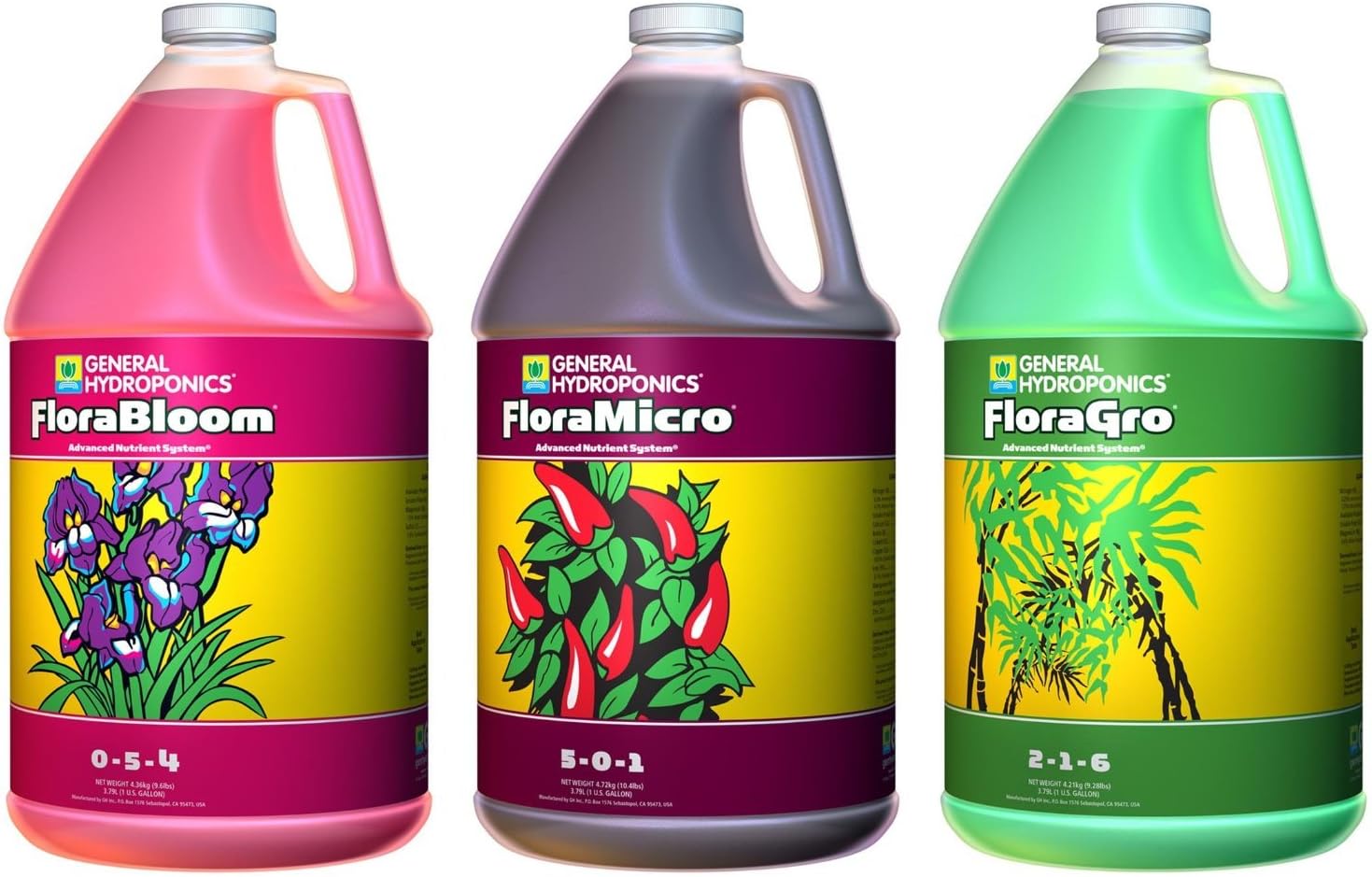
General Hydroponics Flora Trio Combo — Grow, Bloom, Micro (1 gal each, 3-pack)
| Item Form | Liquid |
|---|---|
| Unit Count | 384 Fluid Ounces |
| Mixing Ratio | 2-1-2 |
| Target Species | plants |
The General Hydroponics Flora Trio is a classic three-part liquid nutrient system intended to feed plants through vegetative and flowering stages. Farmers and hobby growers mix the FloraMicro, FloraGro, and FloraBloom in stage-appropriate ratios (the product notes a 2-1-2 mixing baseline) so plants get targeted nitrogen, phosphorus, potassium, calcium and trace elements. In practice the concentrates dissolve easily and the system gives precise control over nutrient balance, which helps build strong roots, vigorous vegetative growth, and fuller flower and fruit development. The trio is workable for both hydroponic reservoirs and soil feeds because it is concentrated and pH-friendly. The main downsides are that it requires measuring and stage-specific mixing rather than a one-bottle all-in-one solution, and beginners need to monitor EC/PPM and pH to avoid overfeeding. For growers seeking a proven, adjustable feeding program, this kit covers a full season from growth to bloom and supports higher-quality yields when used carefully.
Best for: Growers who want a flexible, proven feeding program and are comfortable mixing and adjusting nutrient ratios for different growth stages.
Less Ideal for: Casual gardeners who prefer pre-mixed, single-bottle fertilizers or those unwilling to monitor nutrient concentration and pH regularly.
- Complete three-part nutrient system for both vegetative and flowering stages
- Concentrated liquid formula with high solubility for easy dosing
- Designed to provide primary, secondary, and trace elements including calcium and magnesium
- pH-friendly formulation suitable for hydroponic and soil applications
- Requires careful measuring and staged mixing rather than a single-step feed
- Users need to monitor EC/PPM and pH to avoid nutrient imbalances
Verdict: Choose this three-part Flora system when you want a time-tested, adjustable nutrient program that supports both vigorous vegetative growth and abundant flowering.
General Hydroponics FloraSeries Hydroponic Nutrient System, 1 gal (FloraMicro, FloraGro, FloraBloom)

| Item Form | Liquid |
|---|---|
| Included Components | FloraMicro, FloraGro, FloraBloom |
| Specific Uses For Product | Plant Growth |
| Mixing Ratio | 1:2:3 |
The FloraSeries is a three-part liquid nutrient system (FloraMicro, FloraGro, FloraBloom) that gives growers direct control over feeding by adding each concentrate to a reservoir in sequence. It is typically used in hydroponic reservoirs but is also compatible with soil or soilless mixes when users want precise nutrient management. FloraMicro supplies nitrogen, calcium, and chelated micronutrients as the base, FloraGro supports vegetative structural and foliar growth, and FloraBloom supplies phosphorus and potassium for flowering and fruiting. The included mixing ratio and stepwise directions make it straightforward to dose and avoid nutrient lockout when following recommended order of addition. Practically, the system is flexible: you can tailor ratios by stage and add supplements like calcium separately as noted in the directions. Important limitations are that it is a concentrated chemical feed requiring careful handling, pH adjustment, and adherence to local rules about phosphorus use, and that growers must monitor EC and pH themselves to get the best results.
Best for: Growers focused on performance who want precise control over nutrient timing and ratios to maximize vegetative growth and yields in hydroponic systems.
Less Ideal for: Casual gardeners who prefer ready-to-use or organic blends and those who do not want to monitor pH and electrical conductivity regularly.
- Three-part formula lets growers independently adjust nutrient ratios by growth stage
- Contains both macro and chelated micronutrients including calcium for complete feeding
- Concentrated liquid form mixes easily into a reservoir following the provided mixing order
- Clear directions and mixing ratio make it usable for growers familiar with EC and pH management
- Concentrated chemical formulas require careful handling, storage, and protective measures
- Users must monitor and adjust pH and EC themselves for optimal results
Verdict: Choose FloraSeries when you want a proven, adjustable three-part nutrient system that gives you full control over feeding for peak hydroponic performance.
General Hydroponics MaxiGro Powder Plant Food, 2.2 lb

| Item Form | Powder |
|---|---|
| Specific Uses For Product | Hydroponics |
| Coverage | Medium |
| Mixing Ratio | 1-2 teaspoons per gallon |
General Hydroponics MaxiGro is a concentrated, water-soluble powder designed to feed seedlings, cuttings and plants through the vegetative stage. Mixed at 1 to 2 teaspoons per gallon, it supplies primary, secondary and micronutrients in a pH-buffered formula that works in both hydroponic reservoirs and soil-based applications. You can use it weekly or twice weekly depending on plant vigor, and the powdered form makes storage and dosing compact and economical. Notable features include complete nutrient coverage for vegetative growth and clear mixing instructions that make it straightforward to add to a reservoir or watering can. Practical benefits are faster early growth, easier foliar uptake in dilute mixes, and lower shipping/storage footprint compared with bulky liquids. Important limitations are that it is a single-stage vegetative formula so you will need a complementary bloom nutrient for flowering and careful handling is required because the dry concentrate can irritate skin and lungs if inhaled.
Best for: Growers who prioritize efficient, reliable vegetative feeding for hydroponic or soil starts and want a concentrated, easy-to-store nutrient they can dose precisely.
Less Ideal for: Gardeners who need an all-in-one grow-to-bloom program or who prefer pre-mixed liquid nutrients for no-mess handling should consider other options.
- Complete primary, secondary and micronutrients formulated for vegetative growth
- Powdered, water-soluble concentrate is compact to store and easy to mix
- pH-buffered formula helps stabilize nutrient solution in hydroponic systems
- Flexible dosing (1–2 teaspoons per gallon) lets you tailor strength to plant vigor
- Formulated specifically for vegetative growth and not intended as a standalone bloom/flowering feed
- Dry concentrate requires care when handling to avoid inhalation or skin/eye contact
Verdict: Choose MaxiGro when you want a concentrated, pH-buffered vegetative nutrient that is economical to store and simple to dose for hydroponic or soil-based growth.
Ahopegarden 800ml A&B Hydroponic Nutrients Liquid Plant Food

| Item Form | Liquid |
|---|---|
| Specific Uses For Product | Hydroponic Nutrients, Plant Growth, Root Development, Seed Development |
| Target Species | Vegetables, Fruits, Flowers |
| Liquid Volume | 800 ml |
| Mixing Ratio | 1:1 (5ml A + 5ml B per 1L then use 1:200) |
This two-part Ahopegarden hydroponic nutrient comes as an 800 ml concentrate intended to feed plants through every growth stage in indoor hydroponic systems. You mix 5 ml of Solution A and 5 ml of Solution B into 1 L of water (a 1:200 working ratio) and dose that solution to your reservoir; the product separates incompatible minerals across two bottles to keep the formula stable and bioavailable. In practice it is easy to use for beginners thanks to clear directions and a marked cap for measuring, and the complete A&B formula means you do not need multiple specialty bottles for veg versus bloom phases. The concentrate should support many refill cycles, which helps stretch value for budget-minded growers. Limitations are typical of concentrated A&B systems: you must keep the two parts separate until mixing and follow the dosing precisely to avoid nutrient imbalance, and no N-P-K breakdown or micronutrient list is provided on the label for fine-tuning advanced nutrient programs.
Best for: Growers who want an affordable, all-in-one hydroponic nutrient that is easy to measure and stretches across multiple refill cycles for year-round indoor vegetables and herbs.
Less Ideal for: Advanced hobbyists who need exact N-P-K and micronutrient specifications or growers running specialized nutrient regimens will want a product with full analytical data.
- Large 800 ml concentrate provides enough solution for multiple grow cycles
- Two-part A&B formulation keeps incompatible minerals separate for stable potency
- Simple, marked cap and clear mixing instructions make it beginner-friendly
- Marketed as complete full-cycle feed suitable for vegetables, fruits, and flowers
- Label does not list a detailed N-P-K or full micronutrient breakdown for precision feeding
- Requires careful mixing of two parts and accurate dosing to avoid imbalance
Verdict: Ahopegarden's 800 ml A&B concentrate is a budget-friendly, easy-to-use complete feed that stretches across many hydroponic cycles for reliable full-cycle indoor growing.
inbloom Hydroponic Nutrients A&B (1000 ml total)

| Unit Count | 33.81 Fluid Ounces |
|---|---|
| Included Components | Plant Food A&B |
| Item Form | Granules |
| Mixing Ratio | 1:1 (5 ml A + 5 ml B per 1 L) |
| Target Species | Indoor Plants |
The inbloom Hydroponic Nutrients A&B kit supplies a complete two-part nutrient program intended for small indoor hydroponic systems. The package contains 100 ml bottles of A and B plus 400 ml refill packs of each, giving a total of 1,000 ml and a mixing ratio of 5 ml A and 5 ml B per liter of water. It is fully water soluble with a balanced pH value and includes macro and trace elements useful through seedling, vegetative, and flowering stages. Typical use is straightforward: mix the measured doses into the reservoir and top up according to your system's water volume and crop stage. Practical benefits include a clear A&B dosing protocol, compatibility with common countertop hydroponic units, and enough volume to support multiple refill cycles. Limitations are that exact nutrient concentrations and an NPK breakdown are not listed, so advanced growers who want full formula transparency or highly tailored feed schedules may find it insufficient. Also handle with care since the product cautions against skin and eye contact.
Best for: Growers who prioritize a dependable, ready-to-use two-part nutrient that works with common indoor hydroponic systems and who want a simple, repeatable dosing routine.
Less Ideal for: Advanced hobbyists or commercial growers who need exact NPK breakdowns, custom nutrient curves, or laboratory-grade specification for tailored crop programs.
- Complete A and B system with a total of 1000 ml for multiple feedings
- Clear mixing ratio (5 ml A and 5 ml B per 1 liter) simplifies dosing
- Fully water soluble formula with macro and trace elements for all growth stages
- Packaged refills included to extend supply without buying new bottles
- No detailed nutrient analysis or NPK values provided for formula transparency
- Safety caution requires avoiding skin and eye contact during handling
Verdict: Choose this kit when you want a straightforward, compatible A&B nutrient set that delivers repeatable dosing for reliable indoor hydroponic results.
TPS Nutrients Liquid Plant Food for AeroGarden and Hydroponics, 8 oz

| Item Form | Liquid |
|---|---|
| Specific Uses For Product | Plant Growth, Root Development |
| Target Species | Herb, Vegetable |
| Mixing Ratio | 5 mL (1 tsp) per quart of feedwater |
| Unit Count | 8 Fluid Ounces |
This 8 oz liquid plant food provides concentrated, reservoir-safe nutrition intended for AeroGarden and comparable hydroponic units. It is used by mixing the recommended 5 mL per quart of feedwater into the system reservoir on a regular feeding schedule to supply macro and micronutrients for herbs, greens, and other compact edible plants. Notable features include a liquid formulation that dissolves easily, a focus on root development, and explicit compatibility with indoor hydroponic gardens. In practice it simplifies feeding for small indoor crops because a measured teaspoon per quart is straightforward to dose and store. Important limitations are the small bottle size, which will require frequent repurchasing for larger or multiple units, and the need to follow dilution directions carefully to avoid overfeeding. Safety handling is necessary because the concentrate should be kept away from children and pets. For risk-averse growers, the product’s clear mixing ratio and hydroponic focus make predictable feeding simple, but you should track reservoir concentrations rather than guessing frequency or volume adjustments.
Best for: Buyers who want a simple, low-risk feeding routine for indoor green onions and other small edible hydroponic crops and prefer clear dosing instructions they can follow reliably.
Less Ideal for: Growers managing large hydroponic setups, outdoor beds, or those who need a detailed NPK profile for tailored nutrient programs should look for larger or fully specified concentrates.
- Designed specifically for AeroGarden and similar hydroponic systems for straightforward compatibility
- Liquid formula mixes easily for even nutrient distribution in the reservoir
- Clear mixing ratio (5 mL per quart) simplifies dosing and repeatable feeding
- Targets root development and steady growth for herbs and vegetables
- Small 8 oz bottle may not last long for multiple or larger units
- No full nutrient analysis or NPK breakdown provided on the product listing
Verdict: A compact, easy-to-dose liquid fertilizer that makes predictable feeding of indoor green onions simple and low risk.
TPS Nutrients Liquid Plant Food for AeroGarden and Hydroponic Systems, 32 oz

| Brand | TPS NUTRIENTS |
|---|---|
| Unit Count | 32 Fluid Ounces |
| Item Form | Liquid |
| Specific Uses For Product | Plant Growth, Root Development |
| Mixing Ratio | 5 mL per quart of feedwater |
This liquid plant food is designed specifically for AeroGarden and comparable indoor hydroponic setups, delivering a balanced nutrient mix in a ready-to-dilute liquid form. You mix the recommended 5 mL per quart of feedwater and add it to the system reservoir on your regular feeding schedule. Because it is reservoir-safe and made for hydroponic use, it dissolves easily, supports steady vegetative growth and root development, and is suitable for herbs, leafy greens, and other compact indoor plants. Practical benefits include a concentrated 32 oz bottle that lasts for many feedings and clear directions that simplify dosing for routine maintenance. Important limitations are that it is formulated for general growth rather than crop-specific bloom or fruiting boosts, and safe handling precautions are required since it is a concentrated chemical solution. For someone looking for an easy-to-use, hydroponic-specific nutrient to maintain healthy indoor plants, this product gives predictable, consistent results when used as directed.
Best for: Buyers who want a reliable, easy-to-use nutrient for indoor hydroponic herb and salad gardens and who prioritize predictable, low-maintenance feeding routines.
Less Ideal for: Gardeners focused on heavy fruiting or bloom enhancement who need crop-specific bloom or bloom-boosting formulations should look elsewhere.
- Formulated for AeroGarden and similar indoor hydroponic systems so it integrates into reservoir feeding routines
- Liquid concentrate mixes easily and uses a simple 5 mL per quart dosing guideline
- Supports steady vegetative growth and root development for herbs and leafy greens
- Large 32 oz bottle provides many feedings for small indoor gardens
- Designed as a general growth formula and not tailored for flowering or high-yield fruiting stages
- Contains concentrated chemicals so safe handling and storage are required
Verdict: A straightforward, hydroponic-specific liquid concentrate that delivers consistent, low-effort nutrition for indoor herbs and leafy greens.
Choosing the Right Hydroponic Fertilizer: Key Factors to Consider
Nutrient Profile and Stage-Specific Ratios
What nutrients a fertilizer supplies and in what proportions determines how well it supports seedlings, vegetative growth, and flowering. Hydroponic systems rely on the dissolved nutrients in solution, so the N-P-K numbers and the presence of calcium, magnesium, sulfur, and micronutrients should match your crop stage. A grow formulation with higher nitrogen supports leaf and stem development, while a bloom formulation shifts to higher phosphorus and potassium to support flowers and fruit.
Choosing fertilizers with clear stage-specific recommendations simplifies dosing and reduces the risk of deficiency or excess. For mixed crops or continuous harvest systems, a balanced all-purpose formula can be useful, but expect to supplement for extreme demands such as large-fruited plants or heavy feeders.
Solubility and Precipitation Risk
How quickly and completely a fertilizer dissolves affects day-to-day system reliability. Poorly soluble salts settle, coat reservoir bottoms, and can clog emitters, leading to uneven watering and root issues. Some formulations separate nutrients into multiple parts to avoid chemical reactions that form precipitates; while that requires more handling, it reduces the chance of visible crystals forming in the reservoir.
Consider your system plumbing and whether you use fine emitters or large drippers. If you run a recirculating system, solubility is especially important because undissolved material will circulate and cause blockages. Always follow mixing order and temperature guidance to minimize precipitation risk.
Electrical Conductivity and Dosing Control
EC tells you how much total dissolved salts are in the solution and helps ensure plants receive consistent feeding. Fertilizers that produce predictable EC per given dose make it easier to standardize feed schedules and avoid overfeeding. If a product causes large EC jumps with small measurement changes, it increases the chance of mistakes for less experienced growers.
Accurate dosing also ties to how concentrated the product is. Highly concentrated formulas reduce storage volume but demand careful measurement. Look for fertilizers with clear dosing charts that show EC ranges for seedlings, vegetative, and flowering stages to simplify routine management.
pH Impact and Buffering Behavior
pH affects nutrient availability in hydroponics. Some fertilizers push pH up or down when added, which forces more frequent pH correction. Products that stabilize pH or have predictable pH drift reduce maintenance time. For crops sensitive to micronutrient availability, steady pH is particularly important.
If you want minimal pH swings, consider formulations labeled as pH-stable or those that require modest pH adjustments. Remember that water source chemistry influences pH behavior; a fertilizer that is stable in low-alkalinity water may behave differently with hard tap water.
Compatibility With Your Hydroponic System
Different systems have different demands. Aero and NFT setups use fine mists or narrow channels and need fully dissolved, clog-free solutions. Large reservoirs in ebb-and-flow or deep-water culture tolerate small particles better but still benefit from soluble mixes. Formulations that require multiple parts or staged additions may not suit automated dosing lines or gravity-fed systems.
Also check compatibility with common supplements such as silica, iron chelates, or beneficial microbes. Some combinations can precipitate or interact, so pick fertilizers known to work alongside the additives you plan to use.
Ease of Use and Label Clarity
Practical labeling and easy-to-follow mixing instructions matter for consistent results. Clear concentrations, dosing charts tied to reservoir sizes and EC targets, and guidance on mixing order reduce user error. Growers who prefer simplicity may choose single-part fertilizers with broad stage recommendations, while those chasing maximum yields often use multi-part programs with separate grow and bloom bottles.
Packaging that measures easily and written guidance for common crops shorten the learning curve. If you are new to soilless culture, prioritize products with straightforward instructions and support resources.
Types of Hydroponic Fertilizer Formulations
Hydroponic fertilizers come in single-part, two-part, and multi-part systems. Single-part mixes are the simplest to use but may sacrifice flexibility. Two-part and three-part systems separate salts that would otherwise react, improving solubility and allowing targeted nutrient shifts between growth stages.
Liquid concentrates and water-soluble powders behave differently in storage and mixing. Powders are often more shelf-stable and lighter to transport, while liquids dissolve quickly and are convenient for frequent dosing. Consider your storage space and how often you will be mixing reservoirs.
- Single-part: easiest to mix, good for beginners
- Two-part: prevents precipitation, common for versatile programs
- Multi-part: best for fine-tuning nutrient ratios across stages
How Water Quality Changes Dosing
Your source water chemistry dictates how a fertilizer performs. Hard water with high calcium or alkalinity will interact with nutrient salts differently than soft water. Test your tap water for alkalinity, calcium, and baseline EC before choosing a program.
Adjust dosing and pH targets based on water test results. In hard water, you may need to manage calcium and magnesium balance carefully or use products formulated for high-mineral water.
- Test source water for EC and alkalinity
- Adjust target EC for seedlings versus mature plants
- Account for background minerals when calculating doses
Common Supplement Additions and When to Use Them
Growers often add silica to strengthen stems, iron chelates to prevent chlorosis, and beneficial microbes to support root health. These supplements can complement a base hydroponic fertilizer but may interact chemically with certain formulations.
Introduce supplements after confirming compatibility. Start with low rates and observe plants and reservoir chemistry. Supplements are most valuable when tailored to crop needs rather than added by default.
- Silica for structural strength and stress tolerance
- Iron chelates for reliable micronutrient availability
- Microbial inoculants for root zone resilience
Adjusting Feeds for Different Crops
Leafy greens typically need higher nitrogen and lower EC than fruiting crops. Tomatoes, peppers, and cucurbits require more potassium and calcium as they set fruit. Follow crop-specific EC and pH targets rather than a one-size-fits-all schedule.
Monitor plant appearance and growth rate and adjust fertilizer strength gradually. Deficiencies show as specific leaf symptoms, while overfeeding often causes dark, clawed leaves or salt accumulation in the root zone.
- Leafy greens: moderate EC, higher nitrogen
- Flowering/fruiting crops: higher potassium and calcium
- Start at lower EC with young plants and ramp up as they mature
Storage, Shelf Life, and Handling
Store concentrates and powders in a cool, dry place away from direct sunlight. Powders can clump if exposed to humidity, and some liquid concentrates separate if frozen or heated. Proper storage preserves solubility and label accuracy.
Follow mixing order recommendations and dissolve salts fully before adding supplements. Keep measurement tools clean to avoid cross-contamination and inaccurate dosing.
- Keep powders dry and sealed
- Avoid temperature extremes for liquids
- Clean scoops and measuring tools after each use
How We Chose the Best Hydroponic Fertilizer
We evaluated candidates using criteria that reflect how hydroponic fertilizers actually behave in water-based systems. Primary factors included nutrient profile accuracy, meaning whether labeled N-P-K and secondary/trace elements match what plants need at different growth stages. Solubility and mixing behavior were assessed because undissolved salts clog pumps and drip lines and make EC readings unreliable. pH stability under normal dosing ranges was checked, since fertilizers that drive pH wildly force constant correction. Compatibility with common hydroponic systems and equipment mattered too; products that precipitate with calcium or magnesium are less useful in mixed-solution setups. We also considered formulation type and ease of use for everyday growers, including whether separate grow/finish formulas are provided or a single balanced solution is intended. Exclusions included any product lacking full ingredient disclosure or those intended only for soil use. We prioritized transparent labels and predictable solution chemistry over marketing claims, and we excluded fertilizers with known solubility or contamination issues from consideration.
FAQ
How often should I feed plants in a hydroponic system?
Feeding frequency depends on system type and crop. Recirculating systems typically maintain a constant solution, so adjust EC regularly but do not need daily full changes. Drain and replace reservoirs every one to two weeks while topping off more frequently. In non-recirculating systems, follow a schedule that replenishes nutrients at each irrigation event.
Can I use a single fertilizer for all growth stages?
You can, but single-formula products trade flexibility for simplicity. They work well for mixed or continuous harvest systems. For maximum control over vigor, flowering, and fruit set, many growers switch between grow and bloom formulations or adjust ratios in a multi-part program.
What is the best EC range to aim for with hydroponics?
EC targets vary by crop and stage. Young seedlings need lower EC, often around 0.6 to 1.2 mS/cm, while mature leafy greens do well in 1.2 to 1.8 mS/cm. Fruiting crops may require 1.6 to 2.4 mS/cm or higher depending on variety. Use the fertilizer's dosing chart and monitor plant response.
How does tap water hardness affect fertilizer choice?
Hard water already contains calcium and magnesium, which change how you balance the solution. Products that assume soft water may push EC and ionic balance too high when used with hard tap water. Test your water and adjust doses or choose formulas tolerant of background minerals.
Are organic hydroponic fertilizers a viable option?
Organic inputs can be used in some hydroponic setups, but they often introduce particulates that clog emitters and require specific microbial systems. Many growers prefer mineral-based fertilizers for predictable solubility and easier nutrient control.
How do I prevent precipitates when mixing nutrients?
Follow the manufacturer mixing order and use separate dissolution steps for incompatible salts. Dissolve each component fully in warm water before combining, and avoid mixing concentrated calcium products directly with phosphate-rich solutions. Using a two-part or three-part program reduces precipitation risk.
Final Verdict
When choosing a hydroponic fertilizer, prioritize predictable nutrient ratios, reliable solubility, and behavior that matches your system and water chemistry. Expect tradeoffs between convenience and fine-tuning: single-part formulas simplify routine feeding, while multi-part systems let you target growth stages more precisely. Focus on fertilizers with clear dosing guidance, predictable EC response, and documented compatibility with common supplements. Balance ease of use with the needs of your crops to arrive at a practical, repeatable feeding plan that supports steady growth in your water-based garden.
