

Note: This article contains affiliate links. If you click on these links and make a purchase, I may earn a small commission at no extra cost to you. This helps support my research and content. Read my full affiliate disclosure here.
If you want to start seedlings, maintain herbs on a windowsill, or supplement light for a balcony grow without overspending, the right budget grow light makes a big difference. Cheap fixtures can produce uneven light, high heat, or poor spectra that stunt growth or force short-term replacement. This guide covers seven shortlisted options that balance usable spectrum, energy efficiency, and durability for common home-garden situations. We evaluated each candidate on spectrum quality, energy draw, build durability, and ease of use so you can choose the fit that matches your space and plants. Read on to see the tradeoffs and practical tips for installing budget lights in small indoor gardens.
Top Picks at a Glance
| Best Overall The best all-around choice for most situations | APICDOM 2 ft LED Full Spectrum Linkable Grow Light (5000K + 660nm Red) |  |
| Best Value The sweet spot between price and what you get | LEOTER 4-Head LED Grow Light with Full Spectrum, Timer and 10-Level Dimming |  |
| Best Budget The cheapest option that still gets the job done reliably | CFGROW SPL-01 Full-Spectrum LED Grow Light with Adjustable Height and Timer |  |
| Highest Rated A top-rated pick with lots of positive feedback | LPMZMBL 8" Full-Spectrum LED Grow Light Strip (6‑Head, 15W) |  |
| Most Popular A crowd favorite that many people choose with confidence | GooingTop HY-021 6000K Full-Spectrum Clip Grow Light |  |
| Best Seller A high-volume bestseller chosen again and again | Aokrean Halo Full-Spectrum LED Grow Light with Base (3-Pack) |  |
APICDOM 2 ft LED Full Spectrum Linkable Grow Light (5000K + 660nm Red)

| Light Source Type | LED |
|---|---|
| Color Temperature | 5000 Kelvin |
| Light Output Maximum | 1900 lumens |
| Wattage | 16 watts |
| Light Source Special Features | 660nm Red-Light enhancement, Linkable design |
This APICDOM 2 ft LED grow light is a straightforward solution for supplementing indoor plant light on a budget. It delivers a full 5000K spectrum with an added 660nm red band useful for sprouting and flowering, while the integrated LEDs run at 16 watts and produce up to 1900 lumens. Installation is simple: plug in the cord, use the inline on/off switch, and hang or flush mount with the included hardware. A useful practical feature is the daisy chain/linkable design that lets you connect up to four fixtures on one circuit to cover larger benches or shelving. The unit is compact, damp rated for indoor use, and carries FCC certification and a three year limited warranty. Limitations are the small coverage area per fixture and the fixed 16 W output, so multiple units are needed for larger setups or dense plant canopies. Build materials are basic metal and plastic, which keeps cost down but may not match heavier-duty commercial fixtures.
Best for: Buyers who want an affordable, easy-to-install grow light to supplement small indoor gardens or seedling racks and who plan to scale by adding identical fixtures as needed.
Less Ideal for: Growers needing high-output single fixtures for large rooms or dense canopies should consider higher-wattage or professional-grade lights instead.
- Full spectrum 5000K with 660nm red enhancement tailored for vegetative growth and flowering
- Linkable daisy-chain design allows up to four units per circuit to scale lighting across racks or benches
- Simple plug-and-play installation with hanging and flush-mount hardware included
- Low power draw at 16 watts delivers reasonable brightness while keeping energy use down
- Damp rated and FCC certified with a 3-year limited warranty for indoor use
- Compact size and 16 W output limit useful coverage per fixture, requiring multiple units for bigger setups
- Basic metal and plastic construction is less robust than commercial-grade fixtures
Verdict: A budget-friendly, linkable 2 ft LED grow light that gives good full-spectrum performance for small indoor gardens and is easy to expand by adding more units.
LEOTER 4-Head LED Grow Light with Full Spectrum, Timer and 10-Level Dimming

| Light Source Type | LED |
|---|---|
| Number of Light Sources | 80 |
| Wattage | 80 watts |
| Control Method | Remote |
| Mounting Type | Clip On |
The LEOTER 4-head grow light is a USB-powered, clip-on lamp built for indoor plant care that combines full-spectrum and targeted red/blue diodes to support seedlings, vegetative growth and flowering. It uses 80 LEDs arranged across four adjustable heads on flexible goosenecks so you can position light over individual large plants or groupings. Notable features are three spectral modes (red+blue, warm/full spectrum, and combined), a circular memory timer with 3/9/12-hour presets, and ten brightness levels for fine control over intensity. The strong metal clip and flexible necks make it simple to aim light at tall foliage without permanent installation. Practical benefits include reduced need for supplemental natural light, convenient daily scheduling for busy users, and a compact footprint that suits shelves or plant stands. Important limitations are that the unit is described as a clip/desk lamp rather than a wide-panel fixture, so coverage for very large single specimens may require placing heads close to foliage or using multiple units, and the timer resets if unplugged so it needs occasional reprogramming after power loss.
Best for: Buyers who want a controllable, space-efficient grow light to supplement indoor sun for larger houseplants and prefer a proven, feature-rich unit with preset timers and adjustable heads.
Less Ideal for: Growers who need single-fixture coverage for floor-to-ceiling specimens or large multi-plant setups should consider full-size panel fixtures or multiple units instead.
- Full spectrum plus red and blue LEDs (80 total) to support all growth stages
- Ten dimming levels for precise intensity control
- Three timer presets with memory function for hands-off daily scheduling
- Adjustable 4-head design and flexible goosenecks for targeted placement
- Strong metal clip allows mounting on shelves, desks, or plant stands
- Designed as a clip-on lamp so single-unit coverage is limited for very large plants
- Timer settings must be reset after the light is unplugged
Verdict: A versatile, adjustable clip-on grow light that gives busy indoor gardeners precise control over spectrum, intensity and scheduling to boost large plant growth in compact spaces.
CFGROW SPL-01 Full-Spectrum LED Grow Light with Adjustable Height and Timer

| Power Source | Corded Electric |
|---|---|
| Light Source | LED |
| Wattage | 15 watts |
| Brightness | 2000 lumen |
| Control Method | Remote |
The CFGROW SPL-01 is a tabletop freestanding LED grow light made for small indoor gardens and desktop plants. It supplies a full 380–800 nm spectrum across selectable red, blue, and white modes, and offers 10 brightness settings so you can tailor light intensity to seedlings, succulents, or mature houseplants. The unit includes a height-adjustable pole system and a removable stake so you can place the lamp above pots or insert it in soil for lower profiles. A circular memory timer with 3/9/12 hour options automates daily on/off cycles, which is useful when you cannot tend plants every day. At roughly 15 watts and about 2000 lumens, it is energy efficient for continuous use and claims long LED life. Practical limits are its small coverage area and nonwaterproof plastic construction, so it is best for individual pots or small clusters indoors rather than larger grow racks or humid greenhouse setups. The remote control and dimmer make fine tuning easy, but the timer must be reset after a power interruption.
Best for: Buyers looking for an affordable, energy-efficient grow light to keep a few desktop plants, succulents, or seedlings healthy with minimal fuss and automated lighting.
Less Ideal for: Growers who need wide area coverage, commercial-scale output, or a waterproof fixture for humid environments should look at larger, higher-powered alternatives.
- Full spectrum LEDs with three light modes for different growth stages
- Ten dimmable levels allow precise control of intensity
- Height-adjustable pole and removable stake for versatile placement
- Built-in memory timer with 3/9/12 hour auto on/off for hands-off scheduling
- Low wattage (15W) and high lumen output for energy-efficient operation
- Small coverage area limits use to single pots or small clusters indoors
- Plastic, nonwaterproof construction makes it unsuitable for humid or wet locations
Verdict: A budget-friendly, energy-efficient full-spectrum lamp that automates light schedules and is ideal for keeping a few small indoor plants healthy.
LPMZMBL 8" Full-Spectrum LED Grow Light Strip (6‑Head, 15W)

| Light Output Maximum | 1500 lumens |
|---|---|
| Wattage | 15 watts |
| Voltage | 5 volts_of_direct_current |
| Color Temperature | 6500 Kelvin |
| Light Source Special Features | 3-way switching, Dimmable |
This LPMZMBL 8-inch grow light strip is a compact, budget-oriented solution for indoor gardeners who need reliable supplemental light on shelves, in tents, or over multiple small pots. The unit combines 168 LEDs across six flexible tubes to spread light more evenly than a single bar, and the 6500 K white plus 660 nm red diodes cover both vegetative and flowering needs. Setup is straightforward: the kit includes screws, double-sided tape, cable ties and a long power cord so you can mount it under shelves or hang it in a small grow space. Practical controls include three switch modes, five dim levels and a 3‑position auto timer (6/12/18 h), which make it easy to match daily photoperiods and reduce babysitting. At 15 watts per strip and with aluminum construction and PC lenses, it balances low power draw with decent heat dissipation for continuous indoor use. Expect good value for seedlings, herbs, succulents and small vegetable starts, though larger canopies will need multiple units or higher-output fixtures for full coverage.
Best for: Gardeners who want a dependable, low-maintenance supplemental light for seed starting, herbs and small indoor pots and who prioritize fuss-free timers and flexible mounting.
Less Ideal for: Growers planning to light large canopies, multiple mature fruiting plants, or full-sized vegetables should consider higher-output panels or multiple fixtures instead.
- Full-spectrum LED array (6500 K plus 660 nm red) suitable for veg and bloom stages
- Multiple mounting options and a long 95-inch power cord for flexible placement
- Built-in timers, three light modes and five dim levels for easy automated schedules
- Aluminum body and polycarbonate lens help with heat dissipation and durability
- Single 15 W strip provides limited area coverage so multiple units are required for larger setups
- Not a high-power commercial fixture, so maturation of large fruiting plants may be slower
Verdict: A compact, no-fuss full-spectrum strip that reliably delivers automated, adjustable supplemental light for seed trays and small indoor gardens.
GooingTop HY-021 6000K Full-Spectrum Clip Grow Light
| Power Source | Corded Electric |
|---|---|
| Color Temperature | 6000 Kelvin |
| Light Output Maximum | 2500 lumens |
| Light Source Special Features | Dimmable |
| Number of Light Sources | 84 |
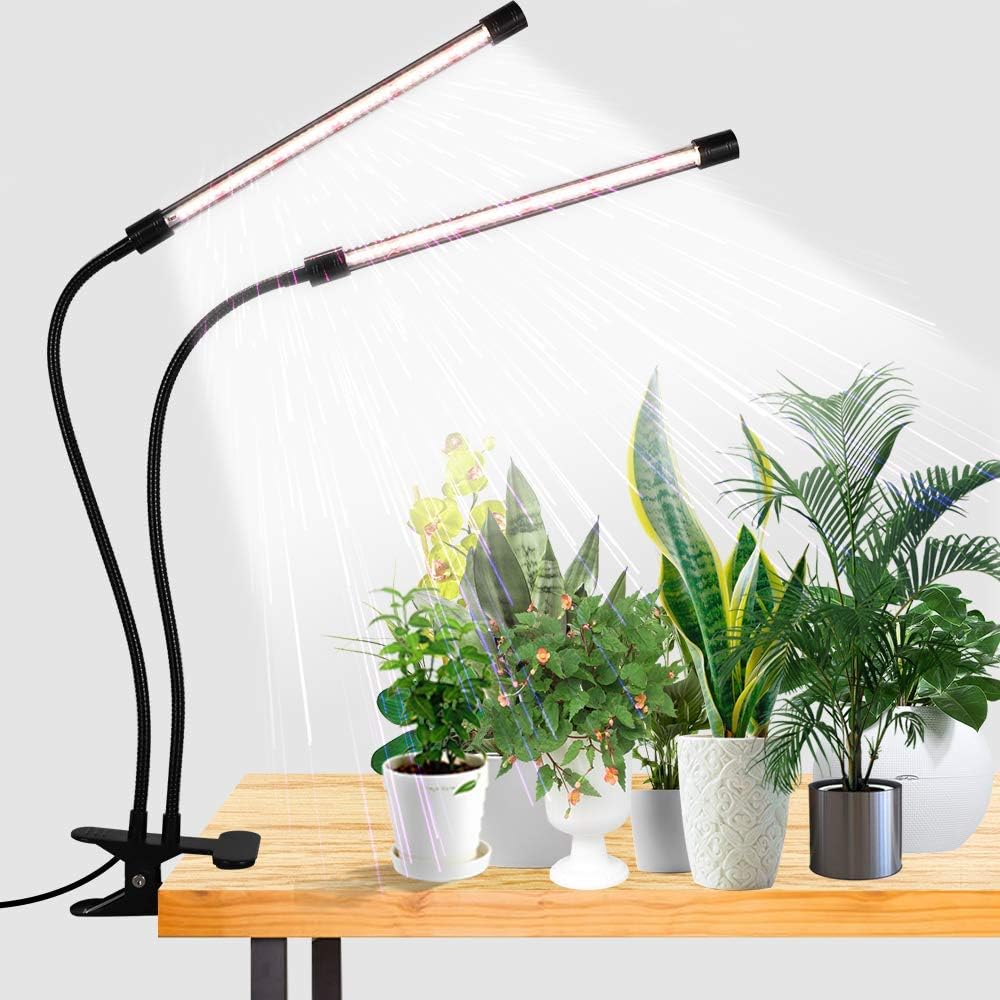
This GooingTop HY-021 is a compact clip-on grow light built for small houseplants, seedlings and shelf gardens. It uses 84 LEDs (white plus deep red) to deliver a 6000K full-spectrum output intended to mimic midday sun, with a high color-rendering output that also makes it pleasant as a reading lamp. Two flexible gooseneck heads and a strong clamp let you aim light precisely over pots and seed trays, while the attached remote provides 50%/100% dim levels and repeating timers at 4, 8 or 12 hours for hands-off scheduling. Practical benefits include low power draw (listed as roughly 10 W LED draw), a claimed 1 to 2 square meter coverage for seedlings, and an included timer that simplifies day/night cycles. Limitations are its design for small setups rather than large grow racks and the clip mounting limits placement compared with freestanding fixtures. The unit also relies on the corded remote instead of a smartphone app and the lifespan claim is typical of LEDs but not independently verifiable from the listing.
Best for: Buyers who want a simple, low-power, plug-and-play grow light to boost seedlings and a few houseplants on a desk or shelf and who value an easy-to-use timer and adjustable brightness.
Less Ideal for: Growers planning multi-shelf installations, larger vegetable grows, or who need networked or app-based control should consider larger bar lights or fixtures designed for commercial racks.
- Full-spectrum 6000K output with added 660 nm red LEDs to support vegetative growth and flowering
- Attached remote with dimming (50%/100%) and repeat timer settings (4/8/12 hours) for easy scheduling
- Flexible dual goosenecks and strong clamp enable precise positioning over small pots and seed trays
- High reported color rendering for comfortable viewing and accurate plant color assessment
- Low electrical draw around 10 W while covering small growing areas
- Clip-mount design and stated 1–2 m² coverage make it better suited to individual plants or small trays rather than large multi-shelf setups
- No smart app or wireless control option; remote is cord-attached which limits placement flexibility
Verdict: A compact, easy-to-use clip grow light that delivers full-spectrum light and convenient timer/dim controls for small indoor plant setups.
Aokrean Halo Full-Spectrum LED Grow Light with Base (3-Pack)

| Light Source Type | LED |
|---|---|
| Number of Light Sources | 48 |
| Wattage | 10 watts |
| Control Method | Touch |
| Power Source | Corded Electric |
This Aokrean Halo grow light is a small, versatile LED solution for indoor plants that offers a lot of convenience in a compact package. Each lamp uses 48 LEDs with a full-spectrum output and three lighting modes plus ten brightness levels, so it can be tuned for seedlings, vegetative growth, or supplemental light for potted houseplants. The lamp can be inserted into soil or mounted on the included base, and the telescoping pole adjusts up to about 26 inches to suit taller pots or change light intensity. Controls are touch-based and include a timer with preset cycles for automated daily on/off. Practical benefits include a neat decorative look, low power draw at 10 watts, and USB/Bluetooth connectivity for modern setups. Limitations are that the base requires the pot to help stabilize the stand and the unit is not water resistant, so it must stay dry and indoors. For balanced buyers looking for adaptable, easy-to-use grow lights for multiple indoor plants, this hits the mark.
Best for: Buyers who want a compact, adjustable grow light that works for seedlings and small to medium houseplants and who value easy controls and automated timers.
Less Ideal for: Growers needing heavy-duty, waterproof fixtures for greenhouse or outdoor use or those who require high-output lighting for large-scale indoor gardens.
- Full-spectrum LED array (48 LEDs) with three lighting modes and 10 brightness levels for flexible plant lighting
- Height-adjustable pole and dual mounting (insert in soil or use the base) to fit a range of pot sizes
- Touch controls with built-in timer options for automatic daily cycles
- Low power consumption (10 watts) and high efficiency for continuous use
- Base stability depends on placing a pot on it so it can be less secure with lighter containers
- Not water resistant so unsuitable for humid or outdoor environments
Verdict: Aokrean's Halo is a space-saving, full-spectrum grow light with adjustable height and timers that makes it easy to give small indoor plants the right light without complex setup.
Choosing the Right Budget Grow Light: Key Factors to Consider
Spectrum and PAR Relevance
Light spectrum determines how plants use the energy the fixture emits. For seedlings and vegetative growth, a balance of blue and red wavelengths or a reliable full-spectrum output supports compact, healthy development. Many budget lights do not publish PAR readings, so look for spectral graphs or manufacturer claims that include both blue and red peaks or a broad white spectrum.
If you plan to push plants to flower or fruit, spectrum becomes more critical. For seed-starting and leafy herbs, a broad white spectrum or a balanced red/blue mix is usually sufficient. Understanding spectrum helps you match a fixture to the stage of growth you expect to support.
Energy Use and Operating Cost
Wattage and fixture efficiency determine how much electricity will be consumed over the season. A higher-efficiency LED delivers more usable light per watt, which matters when lights run 12 to 18 hours daily. Check the actual power draw rather than rated replacement equivalents, and plan for weekly or monthly run-time when estimating costs.
Lower initial purchase price can be offset by higher operating expenses. For small spaces, pick a light with a balance of low draw and sufficient output so you are not forced to run multiple fixtures continuously.
Heat Output and Mounting Distance
Heat affects plant canopy and can force larger hang distances to avoid leaf burn. Budget fixtures sometimes use compact arrays that concentrate heat, which requires better ventilation or greater clearance. For seedlings and young plants, closer placement improves light intensity but increases risk of heat stress.
Choose fixtures with passive heat sinks, fans, or well-spaced LEDs that still allow safe close mounting. Consider the mounting options available so you can adjust height easily without disturbing delicate plants.
Fixture Size and Coverage
How much horizontal canopy a light will effectively cover determines how many fixtures you need. Small fixtures can be ideal for single racks, seed trays, or a shelf, but they may not scale efficiently for wider setups. Accurate coverage estimates depend on the fixture output and the distance above the canopy.
Plan the footprint first by measuring your trays or shelf and then match a fixture rated for that coverage at an appropriate hanging height. Using multiple smaller units can be more flexible but requires attention to even overlap to avoid hot and cold spots.
Controls, Timers, and Usability
Convenient controls make daily light management easier. Built-in timers or easy compatibility with plug-in timers are useful for consistent photoperiods. Dimming gives better control over intensity as plants grow, letting you keep a single fixture useful across stages.
Ease of installation, lightweight mounting hardware, and clear instructions reduce setup time and the chance of mistakes. For beginners, plug-and-play designs with adjustable hangers simplify deployment in small indoor spaces.
Matching Light to Your Growing Space
Assess the physical space before choosing a fixture. Measure the usable width and depth of the area and determine how close you can safely hang a light above plants. Low-clearance window shelves and mini greenhouses benefit from low-profile fixtures with good vertical light spread, while open racks can use larger panels hung higher.
Consider modular approaches for variable needs. A row of small lights over multiple trays gives flexibility for staggered plantings, while a single larger panel can be simpler for a single deep shelf. Think about future expansion so you do not buy a fixture that fits today but limits changes later.
- Measure canopy area and available hanging height before shopping
- Plan for at least 6 to 12 inches clearance for simple panels, closer for low-heat full-spectrum models
- Account for ventilation in enclosed spaces to avoid heat buildup
Seedlings, Clones, and Small Herbs: Best Practices
Seedlings and clones usually need a bright, cool spectrum with a shallow canopy depth. Place lights closer to the plants at first and raise them as stems lengthen to prevent stretching. Consistent photoperiods and gentle intensity reduce leggy growth.
For small herbs, full-spectrum light mimicking daylight helps maintain compact, flavorful growth. Rotate trays periodically to even out light exposure and check leaves for signs of stretch or heat stress, then adjust height or intensity accordingly.
- Start seedlings under higher blue content or full-spectrum at lower intensity
- Increase light duration gradually; many growers use 14 to 16 hours for seedlings
- Watch for leaf discoloration as a sign of too much heat or light
Mounting and Safety Considerations
Proper mounting reduces risk and improves uniformity. Use adjustable hangers or ratchet ropes to make frequent height changes simple. Ensure wiring is rated for indoor greenhouse conditions and keep cables away from water and wet surfaces.
Heat dissipation affects safety. Avoid enclosing fixtures with poor airflow and do not place them directly above flammable materials. If the fixture has an internal fan, consider dust access and maintenance to keep it running reliably.
- Use adjustable hangers to fine-tune light height
- Keep electrical connections dry and elevated away from trays
- Provide airflow around fixtures to reduce heat buildup
Scaling Up From Single Shelf to Multiple Fixtures
When expanding a setup, use consistent fixture types or ensure matched spectral output to maintain even plant development across the canopy. Mixing different spectra or intensities can produce uneven growth.
Plan wiring and power capacity in advance. Multiple fixtures add cumulative load, so group circuits logically and consider using timed circuits to manage photoperiod without manual switching.
- Match spectrum and intensity when adding fixtures
- Map power outlets and circuit load before finalizing layout
- Consider staggered timers or remote controls for larger arrays
Maintaining Budget Fixtures Over Time
A low initial cost does not mean no upkeep. Dust can reduce light output significantly, so schedule regular cleaning of lenses or panels. Inspect connectors and cords for wear and replace any damaged parts promptly to avoid heat or electrical issues.
Consider repurposing fixtures for other tasks as they age. Lower-intensity units still work well for low-light houseplants or as supplemental evening light to extend daylight hours.
- Clean panels regularly to maintain output
- Check thermal components and fans for dust buildup
- Store spare hangers and replacement cords for simple repairs
How We Chose the Best Budget Grow Light
We focused on real-garden performance rather than marketing claims. Our selection prioritized fixtures that deliver usable photosynthetic light across seedling and vegetative phases while keeping running costs low. We assessed spectral output for usable PAR or full-spectrum approximation, measured or rated power draw and efficiency, and considered heat management to avoid scorch in close-clearance setups. Durability and build quality were judged by materials, wiring and mounting options for indoor use, and expected lifespan based on LED component types. Controls and usability were included, such as dimming, timers, and plug-and-play mounting for small racks, shelves, and windowsills. Safety features and thermal design were also screening factors to reduce fire risk and prolong driver life. We excluded fixtures intended solely for large commercial operations or fixtures that required complex professional installation. Products that lacked basic spectral data or clear power specifications were ruled out. The final list emphasizes straightforward, energy-conscious choices that suit hobby and small-space gardeners.
FAQ
How close should a budget grow light be to seedlings?
That depends on the fixture's heat and intensity. Generally, start 6 to 12 inches above seedlings for low-heat LEDs and raise gradually as they grow. Monitor for stretching or leaf curl and adjust distance accordingly.
Are cheaper LEDs energy efficient enough for long-term use?
Many budget LEDs are reasonably efficient, but efficiency varies. Check actual power draw and expected runtime. Over months, a less efficient fixture can cost more to operate than a slightly pricier, higher-efficiency unit.
Can a single budget light cover multiple seed trays?
A single small panel can cover several trays if the canopy footprint is within the fixture's rated coverage at the chosen hanging height. For even light, you may prefer multiple small fixtures arranged to avoid hot and cold spots.
Do I need a timer or dimmer with a budget grow light?
Timers are highly recommended to maintain consistent photoperiods, and dimmers are useful if you want one fixture to serve multiple growth stages. Many affordable setups pair easily with plug-in timers for simplicity.
How do I know if the spectrum is suitable if PAR numbers are not listed?
Look for spectral graphs, mentions of full-spectrum white LEDs, or a combination of blue and red diodes. Broad white spectra are typically acceptable for seedlings and leafy greens when PAR is not specified.
Final Verdict
Choose a Budget Grow Light by prioritizing usable spectrum and reasonable energy draw for your intended stage of growth. Balance fixture size and coverage against the space you have and plan for safe mounting and adequate ventilation. Expect tradeoffs between initial cost and operating efficiency; decide whether lower upfront expense or lower long-term energy use matters more for your situation. Focus on spectrum usability, heat management, and control features when evaluating options. With those priorities in mind, you can pick a budget fixture that reliably supports seedlings, herbs, and small indoor gardens without overspending.
