

Note: This article contains affiliate links. If you click on these links and make a purchase, I may earn a small commission at no extra cost to you. This helps support my research and content. Read my full affiliate disclosure here.
Moss in lawns, patios, and shaded beds can make outdoor spaces look unkempt and create slippery surfaces. Choosing the right moss killer matters because different products work better on turf, masonry, or mulched beds, and timing, safety, and application method affect results and plant health. This guide shortlists seven top moss killers that suit common garden situations and explains the practical tradeoffs gardeners face. We evaluate each option for how reliably it eliminates moss, how it is applied, and how it affects surrounding grass and plants. Below you will find concise product summaries followed by decision-making guidance and practical tips to help you pick the best moss control approach for your space.
Top Picks at a Glance
| Best Overall The best all-around choice for most situations | Lilly Miller Moss Out! Granular Moss Killer for Roofs and Structures, 6 lb |  |
| Best Value The sweet spot between price and what you get | Scotts Turf Builder with Moss Control, 5,000 sq. ft. |  |
| Best Budget The cheapest option that still gets the job done reliably | Lilly Miller Moss Out for Lawns Ready-to-Spray, 32 oz |  |
| Highest Rated A top-rated pick with lots of positive feedback | Lilly Miller Moss Control Granules (2 × 20 lb) |  |
| Most Popular A crowd favorite that many people choose with confidence | Wet & Forget Outdoor Cleaner Concentrate, 128 oz |  |
Lilly Miller Moss Out! Granular Moss Killer for Roofs and Structures, 6 lb

| Item Form | Granule |
|---|---|
| Coverage | 6000 square feet |
| Active Ingredients | Zinc Sulfate Monohydrate |
| Unit Count | 96 Ounce |
Lilly Miller Moss Out! is a zinc sulfate monohydrate granular formula designed to kill existing moss on roofs, patios, sidewalks, brick and unpainted cement. You can apply it dry from the container or dissolve it in water and spray, which makes it flexible for spot treatments or larger surfaces; the package directions recommend 6 lb per 6,000 sq ft or 6 lb mixed into about 20 gallons of water for spray application. The product is non-staining and described as non-corrosive to galvanized gutters, so it is suitable where runoff onto metal gutters is a concern. It works best when applied before a period of rain or during active moss growth and may require repeat treatments for heavy infestations. Safety instructions warn to protect plants below treated areas and to avoid contamination of lawns or shrubs. This is a straightforward, no-frills option for knocking back moss across hard surfaces, but it requires careful handling around plantings and attention to application timing for best results.
Best for: Buyers seeking a proven, simple-to-use treatment to remove moss from roofs and hard surfaces who prioritize predictable results and conservative, established approaches.
Less Ideal for: People who need an all-purpose lawn-safe moss treatment for turf or who prefer organic or non-chemical methods should consider other options.
- Works on a variety of hard surfaces including roofs, patios, sidewalks and unpainted cement
- Can be applied dry or mixed with water for spray application, offering flexible use
- Non-staining and reported non-corrosive to galvanized gutters
- Covers a large area when used at the recommended rate
- Contains zinc sulfate which requires care to avoid contact with desirable plants and runoff
- May need repeated applications for heavy or persistent moss growth
Verdict: A reliable granular zinc sulfate treatment for quickly reducing moss on roofs and hard surfaces when applied with care and proper timing.
Scotts Turf Builder with Moss Control, 5,000 sq. ft.
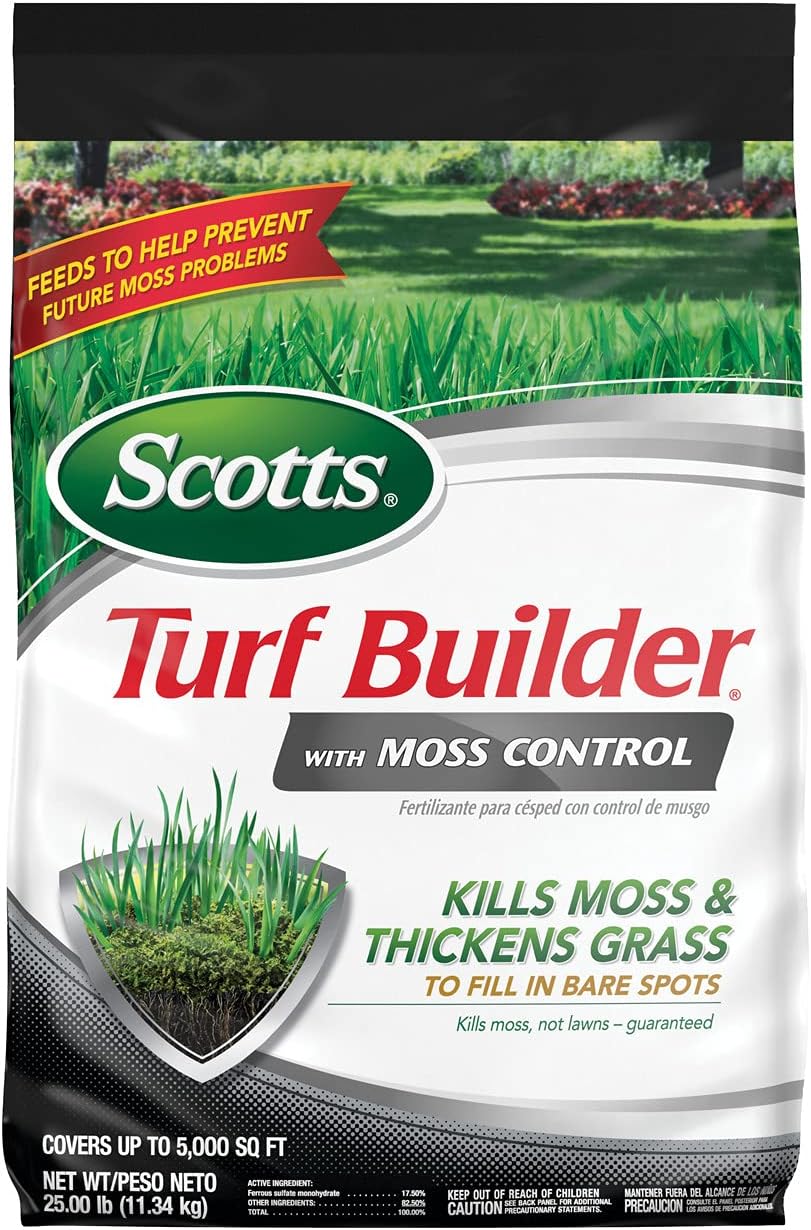
| Item Form | Granule |
|---|---|
| Coverage | 5000 |
| Unit Count | 400 Ounce |
| Item Type Name | Lawn Food with Moss Control Fertilizer |
Scotts Turf Builder with Moss Control combines a granular fertilizer with a moss-killing ingredient so you can feed the lawn while treating moss patches in the same application. It is applied with a broadcast or drop spreader during winter or spring when moss is actively growing; Scotts provides spreader settings for regular and heavy rates. The fertilizer thickens grass to help fill bare spots and improve water and nutrient uptake, and treated moss will darken briefly before fading after mowing. One 25 lb. bag covers about 5,000 sq. ft., and the label recommends waiting 6 to 8 weeks between applications and avoiding newly seeded lawns until after the fourth mowing. Practical strengths are the combined treatment and clear application guidance, which simplify seasonal lawn maintenance. Limitations are that it is a preventative/curative lawn food rather than a fast-acting spot herbicide, and results depend on correct timing, spreader calibration, and follow-up cultural practices to reduce reestablishment of moss.
Best for: Gardeners who want a straightforward, seasonally timed product to both feed their lawn and reduce moss across an entire yard and who prefer following manufacturer guidance and community-tested settings.
Less Ideal for: People needing instant spot control or those managing newly seeded lawns or very small isolated patches where a targeted liquid or manual removal approach is preferable.
- Combines fertilizer and moss control so you treat and feed in one application
- Covers up to 5,000 sq. ft. per 25 lb. bag, suitable for small to medium lawns
- Clear spreader settings provided for both broadcast and drop spreaders
- Formulated to thicken grass and help fill bare spots over time
- Not a rapid spot-killer for heavy moss infestations since it relies on seasonal application and turf recovery
- Can temporarily darken grass blades after application which may concern appearance-sensitive users
Verdict: Choose this product if you want a single granular treatment that feeds your lawn while reducing moss across up to 5,000 sq. ft. in routine seasonal care.
Lilly Miller Moss Out for Lawns Ready-to-Spray, 32 oz

| Liquid Volume | 32 fluid ounces |
|---|---|
| Coverage | 500 square feet |
| Item Form | Spray |
| Active Ingredients | Iron |
Lilly Miller Moss Out Hose N Go is a ready-to-use liquid iron moss treatment that attaches to a garden hose for quick application across affected turf. You connect the bottle to a hose and spray the product over mossy areas; the active ingredient (ferric sulfate/iron) darkens and kills moss within hours and can help reduce regrowth when used as directed. The built-in hose connection makes treatment fast and simple without measuring or mixing, and the 32 ounce bottle is intended to cover roughly 500 square feet. Important practical points are the safety precautions and re-entry guidance printed on the label since the product is corrosive to some materials and should not contact skin, eyes, clothing, or allow people and pets onto wet grass. This is a straightforward choice for spot treatments or small lawns where ease of use matters, though larger properties will require multiple bottles or alternative delivery methods.
Best for: Homeowners looking for an easy, no-mix solution to remove moss from small lawns or to spot-treat problem patches while keeping application simple and fast.
Less Ideal for: Large properties, turf managers, or users who need an organic or non-iron moss control should consider concentrated or different-format products.
- Ready-to-spray hose-attach design eliminates measuring and simplifies application
- Active iron formula works quickly and shows results in hours
- Covers about 500 sq ft per 32 oz bottle, suitable for small lawns or spot treatment
- Contains ferric sulfate so it requires careful handling and protective gear
- Not intended for very large lawns without buying multiple bottles
Verdict: A hassle-free, ready-to-spray iron treatment that makes fast spot removal of lawn moss easy for small lawns and quick fixes.
Lilly Miller Moss Control Granules (2 × 20 lb)

| Unit Count | 320 Ounce |
|---|---|
| Number of Packs | 2 |
| Item Form | Granule |
| Active Ingredients | Ferrous Sulfate Monohydrate |
These Lilly Miller granules are an iron-based moss treatment sold as two 20 lb bags intended for large lawns or repeat treatments. The granules are formulated to target and reduce moss where shade, moisture, compaction, or acidic soil encourage its growth, and they are applied with a broadcast or drop spreader for even coverage. Because iron is the active ingredient, the product both suppresses moss and can darken turf color, giving affected areas a quicker visual improvement. Each bag is stated to cover up to 5,000 sq ft which makes the two-pack convenient for larger properties or for treating in multiple passes during the season. Expect visible moss decline rather than an immediate removal overnight; repeat or follow-up treatments may be necessary in persistently damp or heavily shaded spots. The granular form is easy to store and handle compared with liquids, but it does require a spreader for the most consistent results and care to avoid staining hard surfaces if spilled.
Best for: Buyers who prioritize a dependable, season-long solution for moss on medium to large lawns and want a product that is simple to apply with standard spreaders.
Less Ideal for: Homeowners with very small lawns who prefer spot treatments, or those who need an immediate cosmetic removal method without follow-up treatments.
- Two 20 lb bags provide coverage for large lawns or multiple treatments
- Granular formula spreads evenly with standard broadcast or drop spreaders
- Contains iron (ferrous sulfate monohydrate) to both control moss and enhance turf color
- Suitable for common moss conditions in shaded, moist, compacted, or acidic lawn areas
- May require repeat applications in persistently damp or heavily shaded locations
Verdict: A reliable, iron-based granular treatment packaged for large lawns that controls moss while improving turf color.
Wet & Forget Outdoor Cleaner Concentrate, 128 oz

| Volume | 128 oz |
|---|---|
| Mix ratio | 1 part product to 5 parts water |
| Coverage (approx.) | 750 – 2,250 sq. ft. depending on surface |
| Application method | Garden sprayer; no rinsing required |
Wet & Forget Outdoor Cleaner is a gallon concentrate intended for treating green and black stains caused by moss, mold, mildew, and algae on outdoor surfaces without scrubbing or pressure washing. You dilute one part concentrate to five parts water in a pump-up garden sprayer, saturate a dry surface on a cool day, and leave it to work with wind and rain; green stains often clear in a few days to weeks while older black stains can take months. It is advertised as safe on many surfaces including roofs, siding, decks, patios, brick, and concrete and contains no bleach, so it avoids the harsh odor and immediate surface damage that some bleach-based products cause. The long working window and no-rinse approach make it low-effort for large areas, and a gallon concentrate makes multiple gallons of working solution to cover hundreds to a couple thousand square feet depending on porosity. The main limitation is patience: heavy or long-established stains require repeated applications and many months to fully disappear, and results depend on weather and surface porosity.
Best for: Buyers who want a low-effort, wide-area solution for moss and algae that relies on gradual, weather-assisted cleaning and prefer proven user experiences when choosing a product.
Less Ideal for: People who need immediate, visible results or who require a one-time, fast solution for stubborn stains should consider faster-acting mechanical or bleach-based treatments instead.
- Concentrated formula mixes 1:5 to treat large areas from a single bottle
- Works without scrubbing, rinsing, or pressure washing
- Non-bleach formulation reduces risk of immediate surface discoloration or odor
- Safe for a wide range of outdoor surfaces including roofs, siding, decks, and concrete
- Slow to fully remove heavy or long-established black stains, sometimes taking several months
- Effectiveness depends on rainfall and weather so results are variable
- Requires patience and occasional reapplication to maintain results
Verdict: Choose Wet & Forget when you want a low-effort, non-bleach concentrate that slowly eliminates moss and algae across large outdoor surfaces with minimal labor.
Choosing the Right Moss Killer: Key Factors to Consider
Target Surface and Location
Moss behaves differently on turf, stone, deck boards, and mulched beds. On lawns it often indicates shade or poor drainage and requires a product that kills moss without severely stressing grass. On hard surfaces such as pavers or concrete you want something that sticks and kills moss on contact and can be rinsed away without staining. For mulch or planted areas, choose formulations labeled safe around ornamentals or use physical removal combined with gentler treatments.
Matching the treatment to the surface reduces collateral damage. A liquid contact spray designed for masonry may be overkill on a delicate border planting, while a turf-safe granular option might not cling well to vertical stone. Think about where moss is growing, how you can access it, and whether rinsing or mechanical removal will follow chemical application.
Mode of Action and Speed
Some moss killers act quickly, showing whitening within days and full dieback within one to two weeks. Others act more slowly but leave residual effects that reduce regrowth. Rapid-contact products are useful when you need quick visual improvement on patios or walkways. Residual products are better for lawns where preventing return is a priority.
Consider how soon you need visible improvement and whether repeated treatments are practical. Faster-acting solutions may require follow-up to prevent recurrence, while slower-acting treatments might need fewer repeat applications but will take longer to see results.
Safety and Environmental Impact
Safety concerns include risk to desirable plants, pets, and waterways. Read product labels for reentry intervals, pet restrictions, and runoff warnings. Some chemistries bind to moss tissue and pose minimal uptake by nearby plants when used properly. Others can harm turf or ornamentals if overapplied or used in windy or rainy conditions.
Environmental considerations also include biodegradability and runoff potential. When treating slopes or areas near drains, choose products with lower mobility or plan containment and rinsing strategies. Always follow label directions for dilution and disposal to reduce unintended impacts.
Application Method and Equipment
Moss control products come in sprays, hose-end concentrates, granules, and ready-to-use trigger bottles. Equipment needs affect labor and precision. Granular treatments are convenient for even lawn coverage with a spreader but give less control on small patches. Hose-end and pump sprayers offer fast coverage for larger areas but require careful calibration to avoid streaking and overdosing.
Also consider whether you need a product that adheres to vertical or porous surfaces. Some formulations include surfactants that improve contact on rock and concrete. Ease of cleanup and whether protective gear is required will also influence your choice, especially for homeowners doing their own applications.
Impact on Nearby Plants and Turf
Moss killers vary in how tolerant they are of turf and ornamentals. Turf-specific products have label guidance for safe rates and timing to reduce stress on grass. Treatments applied in hot weather or to already weakened lawns can cause damage. For planted beds, choose approaches that minimize root contact or plan to protect desirable plants by rinsing or shielding them during application.
If you are treating mixed areas, err toward the gentlest effective option and plan for cultural corrections like improving drainage and light to reduce moss-friendly conditions over time.
Long-Term Control and Cultural Follow-Up
Chemical control should be paired with cultural changes to reduce recurrence. Soil aeration, correcting compaction, improving drainage, pruning to increase light, and adjusting mowing height in lawns all make conditions less favorable for moss. Some products provide a period of residual suppression, but none permanently prevent moss if environmental drivers remain unchanged.
Plan a follow-up regimen: treat actively visible moss, then address underlying conditions and schedule maintenance applications only if moss returns. This approach reduces chemical reliance and improves long-term landscape health.
When To Treat Moss Versus When To Rake It Out
Not every moss patch needs a chemical solution. In small, isolated patches you can often scrape or rake the moss out and then seed or patch the area for turf. Physical removal works well on hard surfaces too, especially where staining is minimal and the area can be scrubbed.
Use chemical treatments when moss is widespread, in hard-to-reach crevices, or when weather conditions favor rapid regrowth and physical removal would be impractical. Combining removal with a targeted treatment reduces the number of repeat applications.
- Rake small lawn patches to expose soil and encourage grass recovery.
- Pressure wash patios to remove residual spores before chemical treatment.
- Combine mechanical removal with a spot treatment on persistent areas.
Timing Treatments for Best Results
Treat when moss is actively growing but not stressed by extreme heat or drought. Early spring and autumn are often ideal because cooler, moist conditions promote moss activity and make treatments more effective. Avoid applications immediately before heavy rain because runoff reduces effectiveness.
For lawns, schedule treatments when grass is actively growing so it can quickly recover from any temporary stress. On hard surfaces, plan for a dry spell after treatment to let contact products work without being rinsed away.
- Aim for several dry hours after application for liquid products.
- Avoid hot midday applications on turf to reduce heat stress risks.
Post-Treatment Cleanup and Follow-Up
After moss dies back, remove loose material to reveal areas that need repair. On patios and walkways, use a broom or pressure washer to clear dead moss so new growth has less organic matter to reestablish. For lawns, dethatch or lightly rake treated patches and overseed thin areas.
Monitor the treated area for several weeks. If regrowth appears, reassess causes such as shade, compaction, or drainage and address those before repeating chemical treatments. Repeat applications can be effective but should follow label intervals and safety guidance.
- Clear dead moss to improve appearance and reduce spore load.
- Restore turf in bare spots to compete with moss for space and light.
Natural and Cultural Alternatives
If you prefer to avoid chemicals, cultural methods can reduce moss over time. Improve drainage, thin tree canopies to let in light, lime acidic soils where appropriate, and maintain a higher mowing height to promote dense turf. These measures make the environment less favorable for moss.
Hand scraping, sanding grit on hard surfaces to improve traction, and using boiling water or vinegar solutions can help small patches. These approaches are often slower and more labor-intensive but reduce chemical use and are suitable for sensitive areas.
- Adjust irrigation and improve soil structure to reduce persistent dampness.
- Consider lime applications only after testing soil pH to avoid overcorrection.
Protecting Pets and Pollinators
When applying any moss control product, follow label directions about pet access and reentry intervals. Keep pets off treated areas until the product has dried or the label reentry time has passed. Rinse pet bowls and toys left outside if they may have contacted products during application or runoff.
For pollinator safety, avoid spraying flowering plants and minimize drift onto nectar sources. Choose more targeted application methods and time treatments when pollinator activity is low to reduce exposure.
- Cover or remove pet items from the treatment area before applying.
- Apply treatments when pollinators are least active, such as early morning or late evening.
How We Chose the Best Moss Killer
We focused on solutions that gardeners actually use in lawns, on hardscapes, and around plantings rather than experimental or niche chemistries. Selection criteria emphasized measurable control, safety for surrounding plants and people when used as directed, and clarity of application so homeowners can follow label instructions without guesswork. We prioritized products with documented effectiveness across common moss types and those that work in typical garden conditions such as shade, compacted soil, or damp hardscape surfaces. Concrete evaluation dimensions included speed of visible moss whitening or dieback, residual control to slow regrowth, compatibility with turf and ornamental beds, and ease of application including spreader, hose-end, or spray options. We also considered safety information and cleanup guidance because reentry intervals and runoff risks matter in yards. Exclusions included experimental formulations without practical use instructions and products labeled only for industrial or agricultural settings. The result is a curated set of options that balance performance, practicality, and user safety for typical residential gardening needs.
FAQ
Will a moss killer damage my lawn grass?
It depends on the formulation and how it is used. Some products are labeled as turf-safe when applied at recommended rates and under appropriate weather conditions. Applying during heat stress or overapplying increases the chance of turf injury, so follow label guidance and avoid application to weakened grass.
How soon will I see results after treating moss?
Many contact treatments show visible whitening within a few days and more complete dieback within one to two weeks. Residual products may take longer to fully suppress moss but can reduce regrowth for a longer period. Weather and moss density affect timing.
Can I use the same product on my patio and lawn?
Not always. Some formulations are designed for masonry and may stain or harm turf, while turf-specific products may not adhere well to vertical or porous hardscapes. Choose a product labeled for the surface you are treating or use different approaches for different areas.
Is repeat treatment necessary to keep moss away?
Repeat treatments are often necessary if underlying conditions like shade, compaction, or poor drainage remain. Chemical control reduces visible moss, but cultural fixes are usually required to limit recurrence. Follow label intervals if repeating applications.
Are there nonchemical ways to control moss effectively?
Yes. Improving light, reducing shade, correcting drainage, aerating, and overseeding can all reduce the environmental factors that favor moss. Mechanical removal and targeted physical cleaning of hardscapes also work for small infestations but may be more labor intensive.
Final Verdict
Choose a moss control approach that matches the surface and the underlying cause of growth. Prioritize products that offer effective kill rates for the intended surface, while minimizing harm to turf, ornamentals, pets, and waterways. Combine chemical treatment with cultural fixes like improved drainage and increased light to reduce the need for repeat applications. If you need quick clearance on hardscapes pick a fast-contact solution and follow with mechanical cleanup. For lawns focus on turf-compatible formulas and address soil and light conditions to favor grass over moss.
