

Note: This article contains affiliate links. If you click on these links and make a purchase, I may earn a small commission at no extra cost to you. This helps support my research and content. Read my full affiliate disclosure here.
When you manage large lawns, athletic fields, or commercial landscapes, a dependable commercial fertilizer spreader changes how efficiently you apply nutrients. The right spreader saves time, reduces passes over turf, and helps deliver an even application so plants respond predictably. This guide covers seven shortlisted commercial fertilizer spreaders chosen for capacity, accuracy, durability, and ease of use. We explain the key performance factors that matter in real garden and turf conditions and outline what to expect from each top option. Read on to match a spreader to your property size and maintenance routine.
Top Picks at a Glance
| Best Overall The best all-around choice for most situations | Buyers Products Grounds Keeper 100 lb Walk-Behind Broadcast Spreader |  |
| Best Quality Built to a higher standard if you want something more solid | LESCO High Wheel Fertilizer Spreader with Manual Deflector (Model 101186) |  |
| Best Value The sweet spot between price and what you get | EarthWay 2150 Commercial 50 lb Broadcast Fertilizer Spreader |  |
| Best Budget The cheapest option that still gets the job done reliably | VEVOR 100 lb Capacity Walk-Behind Broadcast Spreader |  |
| Highest Rated A top-rated pick with lots of positive feedback | The Andersons Pacer Pro Walk-Behind Broadcast Spreader (80 lb Hopper) |  |
| Most Popular A crowd favorite that many people choose with confidence | Agri-Fab 130-lb Walk-Behind Broadcast Spreader (Model 45-0462) |  |
| Best Seller A high-volume bestseller chosen again and again | CHAPIN SaltPro 100 lb Contractor Salt Spreader (stainless parts) |  |
Buyers Products Grounds Keeper 100 lb Walk-Behind Broadcast Spreader

| Capacity | 100 lb |
|---|---|
| Spread width | Up to 24 ft |
| Tire size | 13-inch pneumatic |
| Drive | Axle-driven spinner |
| Hopper material | Polyethylene |
This Buyers Products Grounds Keeper is a work-oriented broadcast spreader built for frequent use on medium to large properties. The 100 lb polyethylene hopper and fully welded powder-coated steel frame let you cover large areas with fewer refills, while the axle-driven spinner produces a broadcast pattern up to about 24 feet for efficient coverage. Material flow is controlled by a simple lever and adjustable poly deflectors so you can direct product away from beds and hardscapes, and a hopper screen plus nylon rain cover help keep material flowing in damp conditions. Commercial-style features include an enclosed gearbox with grease fitting and alloy gears for better resistance to weather and corrosion, and 13-inch pneumatic tires that roll smoothly over uneven turf. Because the hopper is plastic, rinse it after spreading salt or ice melt to avoid corrosion of other components. It is heavier and more utilitarian than homeowner-grade spreaders, so assembly and storage require more space but reward you with durability and season-to-season reliability.
Best for: Users who prioritize reliable, commercial-style performance for frequent spreading tasks on medium to large properties and want a durable all-season tool.
Less Ideal for: Casual gardeners with small yards who need a lightweight, compact spreader or those unwilling to perform post-use cleaning after corrosive materials.
- 100 lb hopper reduces refill frequency for large lawns or properties
- Axle-driven spinner delivers wide coverage up to about 24 feet for faster job completion
- Enclosed gearbox with grease fitting and alloy gears improves durability in wet or cold conditions
- Adjustable flow lever and poly deflectors let you control application and protect adjacent beds
- Larger, heavier build requires more storage space and is less convenient for small yards
- Requires rinsing after salt or ice melt use to prevent corrosion of non-plastic parts
Verdict: Buy this if you need a durable, commercial-grade spreader that covers large areas efficiently and works year-round.
LESCO High Wheel Fertilizer Spreader with Manual Deflector (Model 101186)

| Coverage | 80 lb. hopper |
|---|---|
| Item Form | Spreader |
| Specific Uses For Product | Lawn Care |
| Target Species | lawn grasses |
The LESCO High Wheel Fertilizer Spreader (model 101186) is built for demanding, commercial-style lawn work where consistent coverage and durability matter. It is used to broadcast granular fertilizer, grass seed, salt, or ice melt across turf and paved surfaces; the 80 pound hopper lets you cover substantial areas between refills. Notable features for performance users include an enclosed gearbox with a 5:1 gear ratio for reliable drive, an oscillating agitator to keep material flowing, a manual deflector for controlled distribution, and oversized pneumatic tires that improve stability and reduce rutting on uneven ground. The all stainless steel frame, axle, and impeller shaft are practical for long-term outdoor exposure and frequent use. Expect some assembly and a need to calibrate settings for different materials to get precise application rates. This unit does not include a hopper cover, so wet conditions or dusty materials may require extra care or aftermarket protection.
Best for: Designed for landscape pros and performance-minded property managers who need a durable, commercial-capable spreader for frequent fertilizer, seed, or salt applications.
Less Ideal for: Casual homeowners with very small lawns or occasional use should consider smaller, lower-capacity spreaders that are lighter and easier to store.
- Large 80 lb hopper reduces refill frequency on medium to large jobs
- Enclosed gearbox with 5:1 ratio delivers dependable drive under heavy loads
- Stainless steel frame, axle, and impeller shaft resist corrosion for long service life
- Oversized pneumatic tires improve stability and minimize turf rutting
- Oscillating agitator and manual deflector enable consistent product flow and controlled spread pattern
- No hopper cover included which can allow wetting or spillage in poor weather
- Requires assembly and careful calibration to achieve accurate application rates
Verdict: A rugged, high-capacity spreader built for professional use that delivers reliable, consistent application across large lawns and turf areas.
EarthWay 2150 Commercial 50 lb Broadcast Fertilizer Spreader

| Brand | EarthWay |
|---|---|
| Model Number | 2150 |
| Hopper Capacity | 50 lb |
| Tire Type | 13 inch pneumatic |
| Gearbox | Fully enclosed |
The EarthWay 2150 is a professional-grade broadcast spreader designed to deliver an even application of fertilizer, seed, or ice melt across turf. It is typically used as a push spreader for lawns where accuracy and durability matter. Notable features include EarthWay’s patented 3-hole drop shut off system and side-spread control for an approximately 50/50 spread pattern, a clog-free removable grate, an enclosed gearbox that resists moisture, and large 13 inch pneumatic tires that roll smoothly over uneven turf. The rustproof poly hopper is impact resistant and easy to wash down, and stainless-steel linkage replaces sticky cables for reliable operation. In practice this means fewer missed spots, less product waste, and consistent results across multiple passes. The unit is engineered for longevity with powder-coated steel and a sealed gearbox, but its commercial construction makes it heavier and bulkier than lightweight consumer models and requires storage space. Assembly and calibration take a bit more time up front, but the payoff is precise, repeatable spreading season after season.
Best for: Buyers who prioritize application accuracy and long-term durability for frequent or professional lawn care and who are willing to trade portability for performance.
Less Ideal for: Casual or infrequent users with very small yards who prefer a lightweight, compact spreader that is easier to store and transport.
- Patented 3-hole drop system plus side-spread control for a consistent, even spread pattern
- Fully enclosed gearbox allows use in moist or damp conditions and reduces maintenance
- Large 13 inch pneumatic tires provide smooth movement over rough or uneven lawns
- Rustproof poly hopper with removable grate is clog resistant and easy to clean
- Commercial-grade weight and size make it less convenient to move and store than lightweight spreaders
- Requires initial assembly and calibration to achieve optimal accuracy
Verdict: Choose the EarthWay 2150 when you need a durable, precision spreader that delivers consistent, professional results across uneven lawns.
VEVOR 100 lb Capacity Walk-Behind Broadcast Spreader

| Load capacity | 100LB |
|---|---|
| Hopper volume | 56L |
| Spread width | 0-9.8 ft |
| Wheels | 13-inch anti-slip rubber |
| Adjustment | 30-step control |
The VEVOR walk-behind broadcast spreader is a heavy-capacity push model designed to cover large areas with fewer refills thanks to its 100 lb (56 L) hopper. It uses a 30-step control and an infinite adjustment system to change output size and achieve an even spread; the listed spread width adjusts with push speed so you can fine-tune application for seed, fertilizer, or granular weed control. Key practical features include pre-installed components to speed assembly, a powder-coated carbon steel frame and rust-resistant hopper for durability, and 13-inch anti-slip wheels that help it roll over uneven turf. The sealed gearbox and four-sided baffle design aim to reduce clogging and protect gears from corrosion. Trade-offs are that it is a manual push spreader so coverage speed depends on operator pace, and precise calibration for different products will require test passes to dial settings. For commercial crews or heavy homeowners who need a robust, budget-friendly high-capacity spreader, it offers straightforward, reliable performance for routine fertilizing and seeding tasks.
Best for: Buyers who need a high-capacity, no-frills spreader for regular fertilizing or seeding and prioritize value and durability over motorized convenience.
Less Ideal for: Those who need fast, large-acreage coverage or hands-free operation should consider tow-behind or ride-on commercial spreaders instead.
- Large 100 lb/56 L hopper reduces refills and speeds coverage
- 30-step adjustment plus infinite output control for precise application
- Powder-coated carbon steel frame and rust-resistant hopper for durability
- 13-inch anti-slip wheels handle uneven terrain and improve maneuverability
- Manual push design limits application speed compared with tow-behind or motorized spreaders
- Requires trial runs to calibrate settings for different granular products
Verdict: A sturdy, high-capacity push spreader that gives budget-focused crews reliable, precise coverage for routine fertilizing and seeding.
The Andersons Pacer Pro Walk-Behind Broadcast Spreader (80 lb Hopper)

| Hopper capacity | 80 lb |
|---|---|
| Tires | 12-inch pneumatic |
| Agitator | Spider agitator |
| Application control | Adjustable drop rate with 3-hole shut-off |
| Frame finish | Powder-coated frame |
The Andersons Pacer Pro is a heavy-duty broadcast spreader built to deliver consistent, reliable coverage for lawn care and winter tasks. It uses a spider agitator and dual material plates to keep fertilizer, seed, and salt flowing evenly, while the three-hole drop shut-off and adjustable drop rate let you dial in application without constant tweaks. The 80-pound hopper and included cover reduce refill frequency and protect materials from moisture, and the 12-inch knobby pneumatic tires give good traction and weight distribution across uneven terrain. The frame is powder-coated for corrosion resistance and the unit ships partially assembled, though you will need to finish setup and calibrate it before first use. If you expect pro-level consistency and year-round versatility, this spreader performs well, but it is a large, purpose-built tool better suited to medium to large lawns than tight, highly landscaped yards.
Best for: Buyers who prioritize dependable, pro-level spreading performance for medium to large lawns and need a durable, year-round tool for fertilizer, seed, and salt applications.
Less Ideal for: Not the best choice for owners of small, tightly planted yards or those who need a compact, lightweight spreader for occasional use.
- Large 80 lb hopper reduces refill frequency and includes a cover to protect materials
- Spider agitator and dual material plates promote consistent, even flow of fertilizer, seed, and salt
- Adjustable drop rate and three-hole shut-off allow precise application control
- 12-inch knobby pneumatic tires provide traction and smoother handling on uneven ground
- Arrives only partially assembled and requires calibration before first use
- Size and capacity make it less convenient for very small or highly detailed lawns
Verdict: Choose the Pacer Pro if you want a rugged, professional-grade spreader that delivers consistent, reliable applications across medium to large lawns.
Agri-Fab 130-lb Walk-Behind Broadcast Spreader (Model 45-0462)
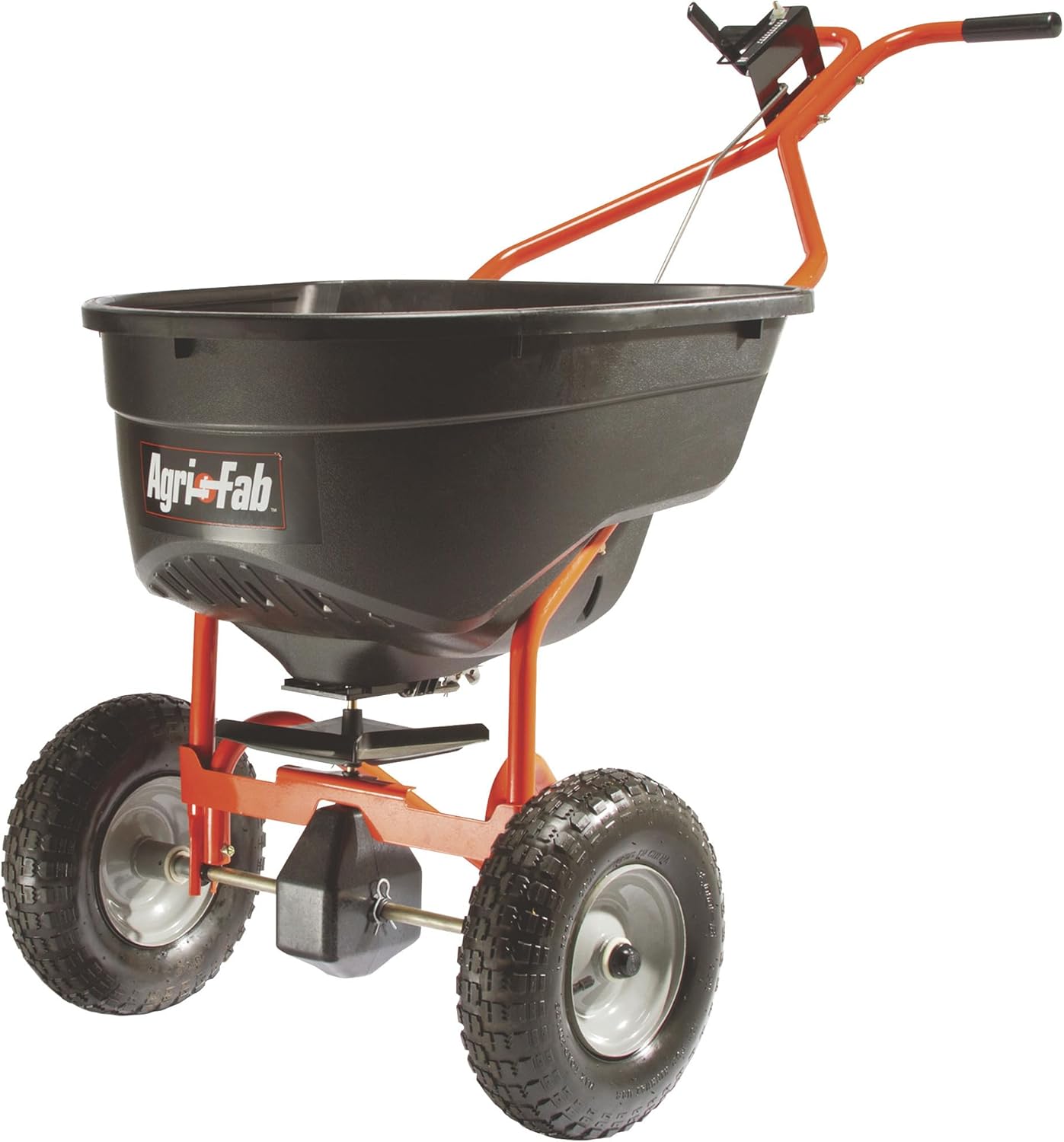
| Weight Capacity Maximum | 130 pounds |
|---|---|
| Number of Wheels | 2 |
| Tire Type | Tubeless |
| Material Type | Poly and steel |
The Agri-Fab 130-lb walk-behind broadcast spreader is a straightforward, high-capacity tool for spreading fertilizer, grass seed, or ice melt over lawns up to about half an acre. It uses a large polyethylene hopper and pneumatic tires to move smoothly over uneven turf, while a direct rod control makes adjusting and engaging the spread pattern simple during use. The wide broadcast pattern covers more ground per pass, reducing time spent spreading compared with lawn-size handheld options. Construction mixes poly and steel for a balance of durability and lighter weight, and the ergonomic handle improves comfort during longer passes. Expect reliable performance for routine residential lawn care, though assembly is required and the unit is a push-style spreader so it is physically demanding on larger sites. Controls are basic rather than precision-calibrated, so granular control for very small application rates may require extra care. For seasonal tasks from spring seeding to winter deicing, this model delivers consistent, no-frills coverage for homeowners focused on efficiency and capacity.
Best for: Homeowners who want a no-nonsense, high-capacity spreader to finish lawn tasks faster and who prioritize durability and ease of use over precision metering.
Less Ideal for: Owners of very large properties who prefer tow-behind or tractor-mounted spreaders and users who need highly precise, small-rate fertilizer application.
- Large 130 lb hopper reduces refills and speeds work on medium lawns
- Pneumatic tires and simple frame roll well over uneven yards
- Direct rod control is easy to use and intuitive while walking
- Polyethylene hopper and steel components provide a durable yet reasonably light build
- Push operation can be tiring on larger properties
- Controls are basic and may require testing to dial in precise spread rates
Verdict: A rugged, high-capacity push spreader that saves time on medium residential lawns by covering large areas with one hopper load.
CHAPIN SaltPro 100 lb Contractor Salt Spreader (stainless parts)

| Capacity | 100 lb hopper |
|---|---|
| Tire size | 12" pneumatic |
| Auger | Spiked auger |
| Hardware | Stainless steel |
The CHAPIN SaltPro 100 lb Contractor Spreader is a walk-behind broadcast spreader built for larger winter jobs where you need steady, reliable material delivery. It uses a 100 lb weather-resistant poly hopper and a spiked auger to break up clumps so pelletized or small ice-melt flows consistently through an adjustable gate and solid linkage. Side and rear baffles focus the pattern to reduce overspray and a T-handle sized for gloved use plus 12-inch pneumatic tires make it easier to push across uneven driveways and sidewalks. Stainless-steel hardware, enclosed gears with a grease fitting, and a rain cover add durability for frequent use. It is intended for salt and compatible ice melts rather than sand or lime blends, so it is best where melting agents are the chosen material. The unit is fairly large and built for regular commercial or heavy residential use, so it may be more than needed for small properties but will save time on larger areas and repeat jobs.
Best for: Buyers who need a dependable, heavy-use spreader for treating large driveways, commercial sidewalks, or multi-property winter maintenance and who prioritize reliability and low downtime.
Less Ideal for: Homeowners with only small yards or infrequent use who would prefer a lighter, simpler residential spreader or a handheld option.
- Large 100 lb poly hopper reduces refill frequency for big jobs
- Spiked auger and adjustable gate keep material flowing and let you control spread rate
- Stainless-steel hardware and enclosed, greased gears improve durability for frequent use
- 12" pneumatic tires and T-handle make it easier to maneuver over uneven ground
- Not recommended for sand, sand mixes, lime, or pelletized lime so material options are limited
- Relatively large and heavy which may be overkill for small lawns
Verdict: Choose this spreader when you need a durable, low-maintenance unit that handles large winter jobs reliably with stainless components.
Choosing the Right Commercial Fertilizer Spreader: Key Factors to Consider
Hopper Capacity and Construction
Hopper size determines how much product you can carry between fills and directly affects productivity on large properties. Larger hoppers reduce downtime but increase weight and require stronger frames and tires. The material matters for longevity and chemical resistance. Rotomolded polyethylene hoppers resist corrosion from fertilizers and salts and are lighter than metal, while metal hoppers with proper coatings can handle rough use but need rust protection.
Evaluate how the hopper mounts to the frame and whether it is shaped to minimize bridging or product hang-up. A well-designed hopper will promote consistent flow to the metering system and be easy to clean between different materials.
Spread Pattern and Accuracy
Even distribution is the core job of a spreader. Pattern width and how evenly product is deposited across the swath determine how many passes you need and whether you risk streaks or overlaps that stress turf. Spreaders with adjustable deflectors or multiple drop points let you tailor the pattern for different materials and target widths.
Accuracy depends on both the mechanical design and the ability to calibrate rate settings for the granule size you are using. Inspect how the unit handles fine fertilizers versus coarse granules and whether the spreader offers test settings or calibration charts to dial in application rates.
Flow Control and Metering Options
Reliable metering controls how much product leaves the hopper per pass. Simple gate systems are easy to use but can be sensitive to material characteristics. More advanced metering with variable openings, positive-drive agitators, or dual gates provide finer control and reduce clogging. Manual and remote rate controls change how quickly you can adjust on the fly while operating.
Consider whether the spreader allows for quick rate adjustments without stopping and whether it includes clear, repeatable markings or calibrated settings. Flow control also affects waste: poor metering increases material loss and uneven application.
Drive System and Agitation
How the spreader powers the agitator and ground-driven or motorized systems affects consistency and reliability. Ground-driven systems scale output with travel speed and are simple, but they require sufficient wheel traction and gearing. Motorized or hydraulic agitation can maintain consistent output regardless of travel speed but add complexity and maintenance points.
Agitators prevent bridging and keep material moving. Look for robust shafts, replaceable paddles, and protection from rocks or debris that could jam the mechanism. The system should be serviceable in the field for quick repairs.
Frame, Mounting, and Durability
Commercial use means heavy loads and frequent transport. Frame construction should resist bending and fatigue under full load and over uneven ground. Powder-coated steel, stainless fasteners, and reinforced mounting points extend operating life. Check whether the mounting system matches your vehicle or towing arrangement and how weight is distributed across tires or axles.
Tires, hubs, and bearings are part of the structural equation. Upgrading to heavy-duty tires and sealed bearings reduces downtime and maintenance in commercial settings.
Maintenance Needs and Operator Ergonomics
A rugged spreader that is difficult to maintain or operate can reduce productivity. Access panels, easy-to-reach grease points, and simple belt or chain tensioning keep routine service fast. Controls should be intuitive and within reach during operation so operators can react to changing conditions without stopping frequently.
Also consider refill ergonomics and cleanout. Wide openings, drain plugs, and smooth interior surfaces make filling and switching materials faster and reduce carryover between products.
Matching Spreader Capacity to Property Size
Estimate the area you typically cover in a single shift and choose a hopper size that minimizes refill trips while keeping towing and handling manageable. For expansive turf areas, a larger hopper reduces interruptions, but on properties with tight access or slopes, a more compact unit may be safer and faster to maneuver.
Consider how quickly you can refill on site. If you can top up from bulk containers or a loading dock, you can opt for a slightly smaller hopper and benefit from lighter handling and less stress on the tractor or vehicle.
- Balance capacity with your vehicle's payload and hitch rating
- Factor in transport across soft ground where heavy load can bog down equipment
- Think about how many material types you carry and if frequent switching is required
Calibrating for Different Fertilizers and Materials
Different granule sizes flow differently and will change the application rate. Perform a simple field calibration before applying product to valuable turf. Use the spreader at the intended travel speed, measure the material collected over a known distance, and adjust the gate until you reach the desired rate.
Keep notes for common materials so operators can reproduce settings reliably. Weather and humidity can slightly alter flow characteristics, so ongoing checks during long jobs keep coverage consistent.
- Record gate settings for each material and travel speed
- Re-check settings after a maintenance event or when switching product
Mounting Options and Vehicle Compatibility
Commercial spreaders come in towed, three-point hitch, and vehicle-mounted configurations. Match the mounting style to your fleet to avoid adapters or risky rigging. Consider turning radius, ground clearance, and how the spreader affects visibility and weight distribution on your tractor or truck bed.
If you plan to use multiple vehicles, look for models with modular mounting kits or standardized hitches to ease swapping between equipment.
- Confirm hitch class and tongue weight limits
- Check clearance for turns and when operating on slopes
Protecting Equipment From Corrosive Fertilizers
Many fertilizers contain salts and moisture that accelerate corrosion. Choose spreaders with corrosion-resistant finishes, stainless or galvanized hardware, and plastic components where appropriate. Regular wash-downs after use and prompt attention to surface damage extend service life.
Pay attention to electrical and hydraulic components. Sealings, protective routing, and accessible connection points reduce the chance of system failures caused by chemical exposure or high-pressure washdown.
- Inspect welds and fasteners regularly for early signs of rust
- Rinse interior hoppers and dry them before storage
Tires, Stability, and Safe Operation
Load distribution and tire choice influence stability during turns and on slopes. Wider tires reduce ground pressure and improve flotation on soft turf, while pneumatic tires can help absorb shocks and protect turf from ruts. Check axle ratings and use dual wheels or stabilizers on very wide hoppers to prevent tipping.
Train operators on safe speeds for full loads and emphasize secure hitching and proper load balancing to avoid accidents while transporting heavy fertilizer payloads.
- Match tire type to terrain: turf, gravel, or paved surfaces
- Avoid sudden turns or high speeds when hopper is full
How We Chose the Best Commercial Fertilizer Spreader
We focused on features that directly affect performance and day-to-day use in commercial and large-property settings. Primary evaluation criteria included hopper capacity and material, spread pattern consistency and calibration options, drive and agitation systems that influence flow control, and frame durability with corrosion resistance for long operating life. We also examined user ergonomics and maintenance needs such as ease of access to components, replacement parts availability, and serviceability. Exclusions included light-duty consumer models designed only for small lawns and spreaders lacking adjustable settings for rate and pattern. Products that could not demonstrate robust construction suitable for repeated, high-volume use were not considered. The result is a list of spreaders that meet the demands of larger properties and provide measurable differences in coverage, uptime, and operator effort.
FAQ
How often should I calibrate a commercial spreader?
Calibrate before each major job and whenever you change material or travel speed. For long runs, re-check settings after the first pass and periodically to account for humidity or product compaction.
Can I use one spreader for both fertilizer and seed?
Often you can, but seed and fertilizer have different flow characteristics. Clean the hopper and recalibrate the metering before switching materials to avoid misapplication or contamination of seed.
What maintenance keeps a spreader reliable in heavy use?
Regular lubrication of bearings, inspection of belts or chains, cleaning hopper interiors, and checking fasteners and seals will minimize downtime. Replace worn agitator paddles and protect exposed metal with coatings when damage appears.
Is a ground-driven system better than a motorized one?
It depends. Ground-driven systems are simple and scale with speed, which is useful for consistent overlap patterns. Motorized systems hold a steady output across speeds and are better when variable travel rates are common, but they add complexity and maintenance.
How do I prevent clogging with damp or sticky fertilizers?
Use agitators or paddles designed to break up lumps, and consider models with vibration or air-assisted flow if you regularly handle hygroscopic materials. Store product dry and only open the hopper when ready to apply.
What safety practices should operators follow?
Securely hitch and lock the spreader, avoid overloading beyond axle ratings, wear protective gear when handling fertilizers, and keep bystanders clear during application. Turn off drive and disengage agitators before servicing.
Final Verdict
Choose a commercial fertilizer spreader that matches the size of the properties you manage and the materials you use most often. Prioritize consistent spread pattern, reliable metering, and a frame that withstands heavy daily use. Balance hopper capacity against vehicle limits and site access so you do not trade efficiency for handling problems. With the right mix of capacity, calibration ease, and durability, you can reduce passes, protect turf health, and keep maintenance predictable.
