

Note: This article contains affiliate links. If you click on these links and make a purchase, I may earn a small commission at no extra cost to you. This helps support my research and content. Read my full affiliate disclosure here.
Picking the right gas leaf blower matters when you need fast, reliable cleanup around a lawn, driveway, or gutter line. Homeowners often juggle yard size, storage space, and noise restrictions, so the blower you choose should match how and where you work. This guide looks at seven shortlisted gas leaf blowers for homeowners and explains the practical tradeoffs between blowing power, weight, and maintenance. We evaluated each option against real gardening needs like airflow output, ergonomics, and serviceability to help you decide which model fits your routine. Read on for the factors we considered and how to match a blower to your yard tasks before the product list.
Top Picks at a Glance
| Best Overall The best all-around choice for most situations | Husqvarna 125BVx 28cc Gas Handheld Leaf Blower with Vac Kit |  |
| Best Quality Built to a higher standard if you want something more solid | Husqvarna 125B Gas Handheld Leaf Blower |  |
| Best Value The sweet spot between price and what you get | Elementool 28cc Handheld Gas Leaf Blower (490 CFM, 280 MPH) |  |
| Best Budget The cheapest option that still gets the job done reliably | YUNLAIGOTOP 25.4cc 2-Stroke Handheld Gas Leaf Blower |  |
| Highest Rated A top-rated pick with lots of positive feedback | ECHO PB-2520 25.4cc Handheld Leaf Blower |  |
| Most Popular A crowd favorite that many people choose with confidence | NEO-TEC NTEB260 25.4cc Handheld Gas Leaf Blower |  |
| Best Seller A high-volume bestseller chosen again and again | Husqvarna 350BT 50.2-cc Gas Backpack Leaf Blower |  |
Husqvarna 125BVx 28cc Gas Handheld Leaf Blower with Vac Kit

| Power Source | Gas Powered |
|---|---|
| Form Factor | Handheld |
| Additional Features | Leaf Vacuum |
| Air Flow Capacity | 425 cfm |
| Maximum Speed | 170 miles_per_hour |
The Husqvarna 125BVx is a gas-powered handheld blower that doubles as a vacuum/mulcher for light- to medium-duty yard work. It is typically used to blow leaves and debris from lawns, driveways and gutters and can be fitted with the included Vac-Kit to shred and collect material into a bag. Notable features include a 28-cc 2-cycle engine with up to 170 MPH airspeed and 425 to 470 CFM airflow, an ergonomically balanced inline tube and soft-grip handle to reduce wrist and arm strain, Smart Start for easier pull-starting, and a variable-speed throttle with cruise control for steady operation during larger jobs. Practical benefits are strong clearing performance, the convenience of switching between blowing and vacuuming, and a mulching function that reduces bag volume. Important limitations are that it is gas-powered so it requires fuel and maintenance and is not CARB-compliant for sale in California, and its 2-cycle engine will be louder and produce emissions compared with electric models.
Best for: Homeowners who want a powerful, handheld gas blower that also functions as a vacuum/mulcher and who prioritize reliable starting and comfort during moderate yard jobs.
Less Ideal for: People who prefer low-noise, zero-emission tools or who need a blower for very small, infrequent tasks better handled by a lightweight electric model.
- Strong airflow and speed for quick clearing (up to 170 MPH and ~425–470 CFM)
- Includes Vac-Kit with mulching knives to reduce leaf volume and collect debris
- Ergonomic inline tube and soft-grip handle reduce strain during use
- Smart Start and cruise control make starting and sustained operation easier
- Gas engine requires fuel mixing, routine maintenance and produces emissions
- Not CARB-compliant and therefore not legal for sale in California
Verdict: Choose this if you want a reliable, ergonomically balanced gas handheld blower that also vacuums and mulches for efficient yard cleanup.
Husqvarna 125B Gas Handheld Leaf Blower

| Power Source | Gas Powered |
|---|---|
| Form Factor | Handheld |
| Air Flow Capacity | 470 cfm |
| Maximum Speed | 170 miles_per_hour |
| Noise Level | 94 db |
The Husqvarna 125B is a compact gas handheld blower aimed at homeowners who need reliable clearing power for leaves, grass clippings, and sidewalks. It pairs a 28‑cc 2‑cycle engine with an adjustable tube and a flare nozzle to produce 470 CFM and wind speeds up to 170 MPH, which moves large piles and wet debris more effectively than light electric models. The unit is designed to be user-friendly: an ergonomic in-line tube and soft-grip handle reduce wrist twist, an air purge eases starting, and cruise control on the throttle helps maintain steady speed during longer runs. Practical benefits include strong clearing performance for driveways and beds and an adjustable tube for different tasks. Expect the usual gas-blower tradeoffs though — it requires fuel mixing, produces more noise than battery models, and needs routine maintenance on the engine. For routine homeowner jobs it offers a dependable balance of power and handling but it is not intended for heavy professional landscaping shifts.
Best for: Buyers who prioritize proven performance and want a handheld gas blower that handles regular homeowner cleanup with reliable starting and strong clearing power.
Less Ideal for: People who prefer very quiet, low-maintenance equipment or who need zero-emission tools for small urban yards should consider battery or electric models instead.
- High airflow (470 CFM) and strong wind speed (170 MPH) clear leaves and wet debris efficiently
- Ergonomic in-line tube and soft-grip handle reduce wrist torque and improve comfort
- Adjustable tube length and flare nozzle let you tailor airflow for different jobs
- Air purge and auto-reset stop switch simplify starting and restarts
- Gas 2-cycle engine requires fuel mixing and periodic maintenance
- Louder operation (about 94 dB) compared with battery blowers
Verdict: Choose the Husqvarna 125B if you want a compact gas blower that reliably delivers professional-level airflow for routine homeowner leaf and debris cleanup.
Elementool 28cc Handheld Gas Leaf Blower (490 CFM, 280 MPH)

| Power Source | fuel_powered |
|---|---|
| Form Factor | Handheld |
| Additional Features | Lightweight |
This Elementool 28cc handheld gas blower is built for fast yard cleanup where corded or battery models fall short. The 28cc two-stroke engine produces strong airflow (advertised 490 CFM and 280 MPH), letting you clear wet leaves, grass clippings, and debris from lawns, driveways, and garage floors more quickly than low-power alternatives. The unit emphasizes portability with a relatively light handheld design and a quick-start ignition to reduce hassle at startup. A translucent fuel tank lets you monitor fuel level during a job and the manufacturer claims extended runtime for larger properties. Practical buyers will appreciate the balance of power and single-handed handling for routine seasonal chores. Expect the usual gas-blower tradeoffs: it requires fuel mixing and periodic engine maintenance, it is louder than electric models, and emissions prevent use in strictly restricted areas. Assembly and occasional tuning may be needed to keep peak performance. For homeowners who need higher clearing power and longer runtime without running battery packs, this is a sensible, work-focused choice.
Best for: Homeowners who prioritize reliable raw clearing power and longer runtime for medium-to-large yards and want a portable handheld tool that finishes jobs faster.
Less Ideal for: People who need the quietest or lowest-maintenance option, those restricted by local noise or emissions rules, or gardeners who prefer cordless electric tools.
- Strong airflow suitable for wet leaves and embedded debris (advertised 490 CFM, 280 MPH).
- Handheld, lightweight design for easier single-handed use and better maneuverability.
- Quick-start ignition and translucent fuel tank for easier startup and fuel monitoring.
- Marketed long runtime that supports cleaning larger yards without frequent refueling.
- Requires gas fuel and routine two-stroke engine maintenance.
- Noisy compared with electric or battery models and produces exhaust emissions.
Verdict: Choose this handheld 28cc gas blower when you need dependable high clearing power and longer runtime for routine homeowner yard cleanup.
YUNLAIGOTOP 25.4cc 2-Stroke Handheld Gas Leaf Blower

| Power Source | Gas Powered |
|---|---|
| Form Factor | Handheld |
| Noise Level | 90 db |
| Maximum Speed | 7500 rpm |
This YUNLAIGOTOP handheld leaf blower uses a 25.4cc 2-stroke gas engine to deliver high-speed airflow for yard cleanup, leaf clearing, and light debris removal. Typical use is straightforward: mix fuel, pull the starter, and use the ergonomic handle and throttle switch to direct the blower tube for sidewalks, flowerbeds, and small lawns where a corded option would be inconvenient. Notable features include a translucent fuel tank, external spark plug access, a 360 degree protective mesh housing to reduce debris intake and help cooling, and included accessory tubes and a funnel for maintenance. Practical benefits are portability and strong performance for short-to-moderate tasks without relying on electricity and low reported fuel consumption from the carburetor design. Limitations are the usual ones for small two-stroke blowers: it produces around 90 dB of noise, requires fuel mixing and periodic maintenance, and may feel loud and polluting compared with electric or battery models. For budget-focused homeowners who need flexible cordless power for routine yard work, this is a capable option.
Best for: Homeowners on a tight budget who want cordless gas power for occasional to regular yard cleanup and value portability and out-of-the-box readiness.
Less Ideal for: People who prioritize low noise, low emissions, or minimal maintenance should consider electric or battery blowers instead.
- Compact handheld form gives good portability and easy maneuvering around beds and walkways
- 25.4cc 2-stroke engine with up to 7500 rpm offers strong airflow for clearing leaves and light debris
- Translucent fuel tank and external spark plug make refueling and basic maintenance easier
- Includes basic accessories (blast pipes, mixing pot, funnel) so it is ready to use out of the box
- Two-stroke gas engine requires fuel mixing and regular maintenance
- Noise level is high at about 90 dB compared with electric alternatives
- Not ideal for long professional use due to emissions and upkeep
Verdict: A budget-friendly handheld gas blower that delivers strong cordless performance for homeowners who need reliable, portable power for routine yard cleanup.
ECHO PB-2520 25.4cc Handheld Leaf Blower

| Power Source | Manual |
|---|---|
| Form Factor | Handheld |
| Additional Features | Lightweight |
The ECHO PB-2520 is a compact, handheld gas leaf blower intended for routine homeowner cleanup like blowing leaves, grass clippings, and light debris from driveways and lawns. It uses a small 25.4cc engine in a simple handheld form that makes it easy to maneuver around beds, walkways, and tight spaces. Notable features in the listing emphasize a lightweight construction, which reduces arm fatigue during short to medium jobs and helps with portability and storage. In practice this unit is best for homeowners who need dependable, no-frills power for seasonal cleanups rather than commercial workloads. Expect straightforward starting and operation typical of small two-stroke blowers, but also routine maintenance such as fuel mixing and spark plug care. The blower’s limited size means it will struggle with very heavy, wet leaves or long continuous use, so users should plan for occasional rest and basic upkeep to keep it reliable over time.
Best for: Homeowners who prioritize a reliable, easy-to-use blower for regular yard cleanups and want a portable, lightweight gas option for sidewalks, driveways, and small yards.
Less Ideal for: Property owners with large acres, heavy wet leaves, or commercial clearing needs should choose a higher-powered or backpack blower instead.
- Lightweight handheld design reduces operator fatigue for short jobs
- Simple gas power for cordless operation and good mobility
- Compact size makes storage and maneuvering around tight spaces easy
- Small-displacement engine limits power for heavy or wet debris
- Requires routine two-stroke maintenance such as fuel mixing and spark plug checks
Verdict: A simple, lightweight gas handheld blower that gives homeowners dependable portability and ease of use for routine yard cleanups.
NEO-TEC NTEB260 25.4cc Handheld Gas Leaf Blower

| Power Source | Gas Powered |
|---|---|
| Form Factor | Handheld |
| Noise Level | 95 db |
| Maximum Speed | 7000 rpm |
| Wattage | 1000 watts |
The NEO-TEC NTEB260 is a compact gas-powered handheld blower designed for routine yard cleanup. Its 25.4cc two-cycle engine delivers about 432 CFM at speeds up to 180 MPH, which is enough to move leaves, grass clippings, dirt and light snow from patios, driveways and lawns. The unit emphasizes ease of use with a simple pull-start, a low-vibration ergonomic housing and a one-handed 10 lb design that makes longer sessions less tiring. Practical benefits include strong single-pass clearing on small to medium properties and portability without needing a battery recharge. Expect typical gas-blower maintenance such as mixing fuel, occasional spark plug and air filter care, and some noise at the rated 95 dB level so hearing protection is advisable. For heavier commercial tasks the power and runtime will be more limited than backpack or larger two-stroke models, and emissions and fuel handling are inherent to gas machines. For homeowners who want straightforward, portable power for seasonal leaf and debris control, this is a sensible choice.
Best for: Homeowners who want a practical, no-frills handheld gas blower for routine yard and driveway cleanup and value portability and easy operation over maximum commercial power.
Less Ideal for: Large properties or professional landscapers who need extended runtime and higher sustained power should consider backpack or higher-displacement models.
- Powerful for its size at 432 CFM and 180 MPH for effective leaf and debris clearing
- Lightweight one-handed design (about 10 lb) reduces fatigue during longer jobs
- Low-vibration ergonomic housing and simple pull-start make it user-friendly
- Portable gas operation avoids battery charging and works until you run out of fuel
- Produces 95 dB of noise so hearing protection is recommended
- Requires regular gas engine maintenance and fuel mixing typical of two-cycle blowers
Verdict: A lightweight, easy-to-use gas blower that delivers strong single-pass clearing for homeowners who prioritize portable, reliable performance.
Husqvarna 350BT 50.2-cc Gas Backpack Leaf Blower
| Power Source | Gas Powered |
|---|---|
| Form Factor | Backpack |
| Air Flow Capacity | 692.17 cfm |
| Maximum Speed | 180 miles_per_hour |
| Additional Features | Anti-Vibration |
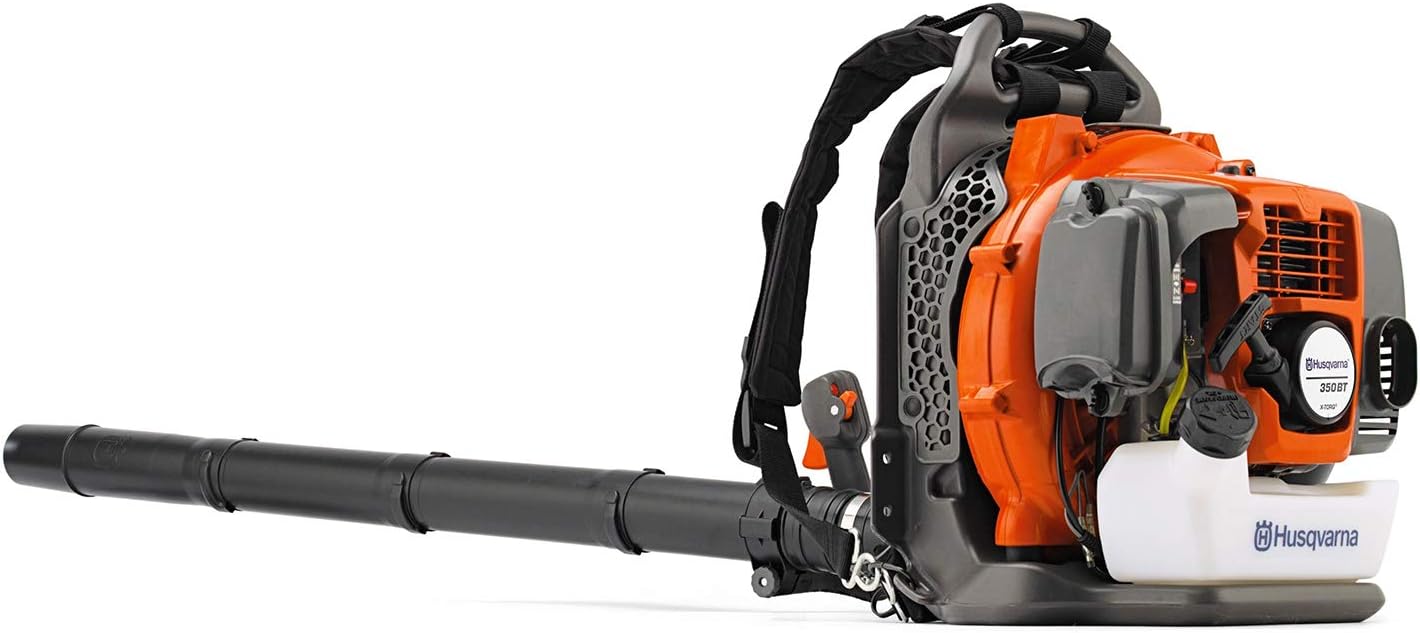
The Husqvarna 350BT is a purpose-built backpack leaf blower for regular yard cleanup on medium to large properties. Its 50.2-cc X-Torq two-cycle engine produces up to 180 MPH and about 692 CFM, giving it the power to move leaves, grass clippings and light debris quickly. The unit uses a padded ergonomic harness, hip belt and weight-leveling system so you can run it for extended periods with less strain, and LowVib technology reduces felt vibration. Practical features include an air purge for easier starting, tube-mounted throttle and cruise control for steady operation. The blower favors dependable, proven gas power over quieter electric alternatives, so you should expect regular fuel mixing, periodic two-cycle maintenance and typical engine noise. For buyers who prioritize robust clearing performance and an established brand, the 350BT balances power and operator comfort, but it is not the quietest or lowest-maintenance option available.
Best for: A cautious buyer who wants a reliable, proven gas backpack blower for regular yard maintenance and values operator comfort during longer jobs.
Less Ideal for: Those who need a near-silent, low-maintenance solution or who prefer cordless electric operation for small urban yards.
- Strong clearing power (around 692 CFM and 180 MPH) suitable for medium to large yards
- Ergonomic harness with padded straps and hip belt reduces operator fatigue during long runs
- LowVib technology and weight-leveling harness for improved comfort and control
- Air purge system and tube-mounted throttle with cruise control make starting and steady operation easier
- Gas two-cycle engine requires fuel mixing and routine maintenance
- Significant engine noise compared with battery-powered blowers
Verdict: Choose the Husqvarna 350BT if you want a comfortable, dependable gas backpack blower that delivers professional-level clearing power for medium to large properties.
Choosing the Right Gas Leaf Blower for Homeowners: Key Factors to Consider
Airflow and Airspeed
Airflow in cubic feet per minute and peak airspeed determine how effectively a blower moves leaves, grass clippings, and light debris. Higher airflow is better for wide open lawns and damp leaves, while higher airspeed helps break up compacted piles. Match the blower's reported CFM and MPH to the typical mess in your yard. A small driveway or patio usually does not require the highest CFM, but heavier tasks like wet leaves or stuck debris benefit from stronger units.
Weight and Ergonomics
How a blower balances and how much it weighs matter more than raw power for homeowners who use the tool intermittently. Heavier handheld blowers can tire your arms on longer jobs; backpack options shift weight to the shoulders but add setup and storage considerations. Look for padded handles, adjustable tube lengths, and vibration dampening if you expect longer run times. Ergonomics affect both comfort and control when directing airflow into tight spots like gutters and flower beds.
Engine Startability and Throttle Control
A blower that is hard to start or has finicky choke settings will add frustration to routine yard work. Easy pull starts, good primer placement, and predictable throttle response help homeowners get to work quickly. Throttle control that allows low-speed sweeping and high-speed blowing gives you flexibility for delicate flower beds or fast pile clearing. Consider how often you will restart the engine during a session because startability becomes more important with repeated stops and starts.
Maintenance and Serviceability
Gas blowers require periodic maintenance that homeowners should be able to perform without specialty tools. Accessible air filters, easy spark plug access, and straightforward carburetor adjustments reduce service time. Check whether fuel mixing is required or if the engine accepts straight gasoline with an oil injection system. Simple maintenance extends life and reduces the likelihood of needing professional repairs that can be costly and inconvenient.
Noise, Emissions, and Local Rules
Gas engines are louder and produce emissions, so consider neighborhood noise restrictions and local ordinances when choosing a blower. Noise ratings give a baseline, but real-world volume depends on throttle setting and how close you run to homes or property lines. Emissions also matter for gardeners who value lower environmental impact; newer two-stroke designs with improved mixing or four-stroke options will differ in both fumes and fuel handling. Verify local rules about leaf blower use to avoid fines or community complaints.
Durability and Build Quality
Homeowner blowers need to endure occasional bumps, storage in a garage, and sometimes rough handling. Check the construction of the housing, the mounting of the motor, and the robustness of switches and tubes. Durable units resist cracking in cold storage and maintain performance year after year. Consider whether replacement parts like tubes, impellers, and ignition components are commonly available to extend the blower's usable life.
Handheld Versus Backpack Options
Handheld gas blowers are compact and easy to store, making them a good fit for small to medium yards where you prioritize quick access and portability. They tend to be lighter but can be harder to use for extended periods.
Backpack models shift most of the weight to the shoulders and back, reducing arm fatigue during longer jobs or when clearing large properties. They are bulkier to store and may be overkill for small properties, but they deliver sustained power for heavy clearing tasks.
- Handheld: Better for quick jobs, smaller yards, and tight storage spaces.
- Backpack: Better for long sessions and large yards where sustained airflow is needed.
Common Maintenance Tasks Homeowners Should Know
Routine maintenance keeps a gas blower reliable and ready. Regular tasks include cleaning or replacing the air filter, inspecting and replacing the spark plug as needed, draining old fuel before long-term storage, and checking the tube and housing for debris or damage.
Learn to mix fuel correctly if your model requires a two-stroke oil-gas blend, and keep a basic toolkit on hand for minor adjustments. Following a simple service schedule will reduce the chance of unexpected failures and extend the blower's useful life.
- Clean or replace air filter every season or after heavy dusty use.
- Drain or stabilize fuel before winter storage to prevent carburetor problems.
Noise Management and Neighbor-Friendly Use
To minimize neighborhood disturbance, run the blower during typical daytime hours, use lower throttle settings where possible, and avoid early mornings on weekends. Using a nozzle extension to focus airflow reduces blown debris and lets you finish faster.
If noise is a major concern, consider limiting gas blower use to tasks that truly need the power and choose muffling practices such as starting the engine away from property lines and maintaining the muffler for effective noise reduction.
- Operate at lower throttle in landscaped areas to reduce noise and control debris.
- Schedule loud tasks during daytime and inform nearby neighbors if you expect extended work.
Storage and Winterizing
Proper storage keeps a gas blower in good condition across seasons. Empty or stabilize the fuel tank before storing for months to avoid varnish and carburetor clogging. Store the unit in a dry, temperature-stable spot away from direct sunlight and moisture.
A light coat of corrosion inhibitor on exposed metal parts and removing the battery if present on hybrid models prevents damage. Labeling a maintenance date on the blower helps you remember when to perform mid-season checks.
- Use fuel stabilizer or run the engine dry to prevent fuel system issues.
- Keep the blower covered and off the ground to avoid moisture damage.
Matching Blower Power to Yard Tasks
Think about the most frequent tasks you will perform. Clearing dry leaves from a lawn needs less sustained airspeed than moving wet leaves from a driveway. For light sweeping and patio cleanup, a moderate CFM with good maneuverability is often the best choice.
If you often clear heavy or damp debris, prioritize higher airflow and consider a backpack configuration to keep the work manageable. For mixed chores, look for models with adjustable throttle and nozzle options to adapt airflow quickly.
- Light tasks: Prioritize maneuverability and lower weight.
- Heavy tasks: Prioritize higher CFM and comfortable handling for longer sessions.
How We Chose the Best Gas Leaf Blower for Homeowners
We focused on features that matter to homeowners who need a gas-powered blower for routine yard cleanup and seasonal chores. Primary evaluation criteria included measured airflow (cubic feet per minute and airspeed) because those numbers determine how quickly leaves and debris move. We also assessed engine reliability and starting ease because a finicky unit quickly becomes frustrating for occasional use. Ergonomics and weight were included to reflect how long you can operate the blower comfortably during driveway and lawn cleanups. Maintenance and parts access were checked for things homeowners can handle without specialty tools, such as spark plug access, air filter replacement, and simple carburetor serviceability. Noise and emissions were considered for neighborhood use and local regulations. We excluded commercial-grade units designed for full-day landscaping crews and battery-only models that do not run on gas. The list favors models that balance power and homeowner-friendly handling, while removing options that demand professional-level servicing or are overbuilt for typical residential yards.
FAQ
How often should I service a gas leaf blower?
Service frequency depends on use, but many homeowners will do basic maintenance once per season. Inspect the air filter, spark plug, and fuel system after heavy use and perform full checks before storing for winter.
Can I use straight gasoline in any gas blower?
It depends on the engine type. Some models require a mixed oil-and-gas fuel for two-stroke engines, while others have separate oil reservoirs or use four-stroke engines that accept straight gasoline. Check the owner guidance for fuel requirements and mix ratios.
Are backpack blowers worth it for a medium-sized yard?
Backpack blowers reduce arm fatigue and are worth considering if you regularly spend long periods clearing leaves across a medium or large yard. For occasional short jobs, a handheld unit may be more convenient and easier to store.
How loud are gas blowers compared with electric models?
Gas blowers are generally louder than battery or corded electric models, especially at high throttle. Noise varies by model and muffler design, so check decibel ratings and plan to use lower throttle when possible to reduce volume.
What should I do with leftover fuel before storing the blower?
Either run the engine until the fuel is used or add a fuel stabilizer and store with the tank partly filled according to the manufacturer's guidance. Old fuel can gum up the carburetor and lead to starting problems after storage.
Final Verdict
Choose a gas blower that matches the size of your property and the type of debris you typically clear. Prioritize airflow and manageable weight for the jobs you do most often, and factor in startability and basic maintenance needs to avoid downtime. By balancing power, ergonomics, and serviceability, you can pick a homeowner-friendly blower that makes seasonal cleanup faster and less tiring.
