

Note: This article contains affiliate links. If you click on these links and make a purchase, I may earn a small commission at no extra cost to you. This helps support my research and content. Read my full affiliate disclosure here.
Roses respond quickly when pests and diseases are addressed with the right pesticide and care. The correct rose pesticide reduces visible damage, preserves blooms, and limits stress that can invite further problems. In this guide we shortlist top options across common garden situations so you can pick a solution matched to your yard, patio, or greenhouse. We evaluated products by how effectively they control key rose pests and diseases and by how safe and easy they are to use in a home garden. Read on for the factors that matter and the picks that met those standards.
Top Picks at a Glance
| Best Overall The best all-around choice for most situations | BioAdvanced 3-in-1 Insect, Disease & Mite Control Spray, 32 fl oz |  |
| Best Quality Built to a higher standard if you want something more solid | BioAdvanced All-in-One Rose & Flower Care Granules, 64 oz |  |
| Best Value The sweet spot between price and what you get | BioAdvanced 3-in-1 Insect, Disease & Mite Control Ready-to-Spray, 32 oz |  |
| Best Budget The cheapest option that still gets the job done reliably | BioAdvanced Rose & Flower Insect Killer Spray, 24 oz |  |
| Highest Rated A top-rated pick with lots of positive feedback | BioAdvanced 2-in-1 Rose & Flower Care Systemic Granules (10 lb) |  |
| Most Popular A crowd favorite that many people choose with confidence | Natria Neem Oil Ready-to-Use Spray, 24 oz |  |
| Best Seller A high-volume bestseller chosen again and again | Atticus Talak 7.9% Bifenthrin Indoor/Outdoor Insecticide Concentrate, 32 oz |  |
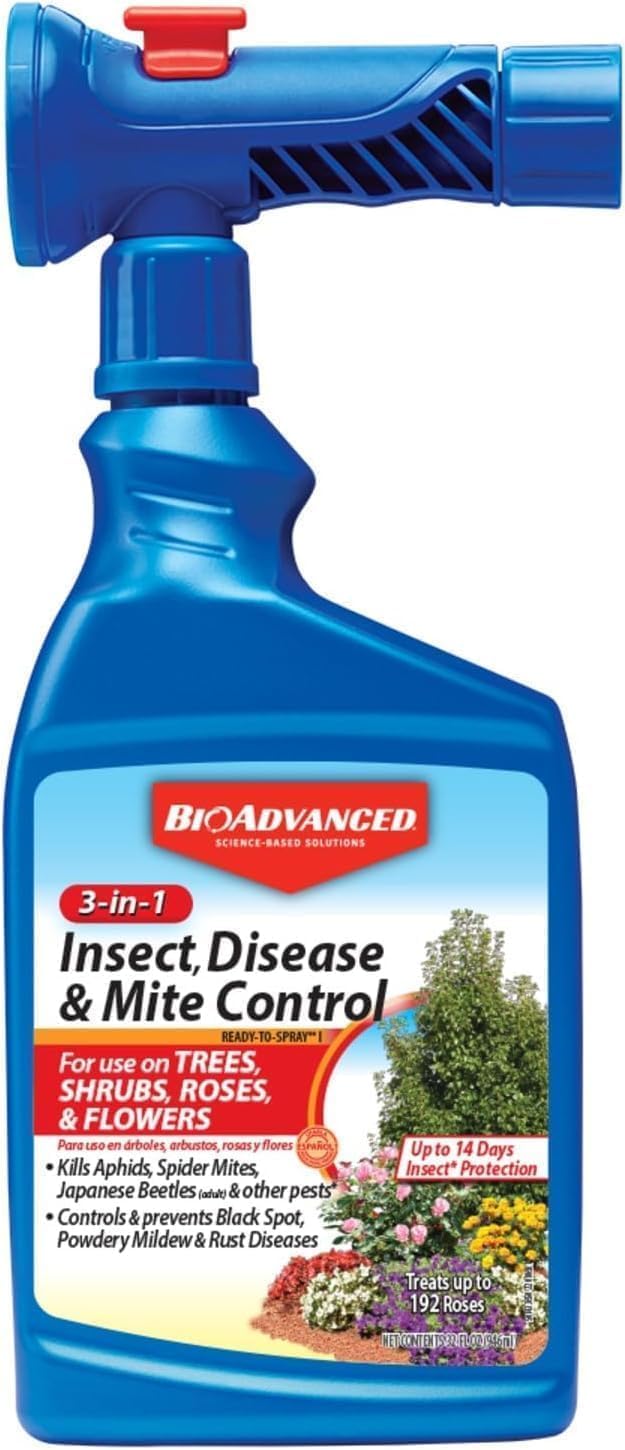
BioAdvanced 3-in-1 Insect, Disease & Mite Control Spray, 32 fl oz
| Unit Count | 32 Fluid Ounces |
|---|---|
| Item Form | Spray |
| Target Species | Aphids, caterpillars, leafminers, whiteflies and other listed pests |
| Active Ingredients | Tau-fluvalinate 0.61%, Tebuconazole 0.65% |
This BioAdvanced 3-in-1 spray is a performance-focused ready-to-use treatment that kills common pests on contact while also preventing and curing listed fungal diseases and controlling spider mites. It attaches to a garden hose for broad, even coverage and is labeled to treat up to 192 rose bushes, making it practical for medium to large beds and multiple shrubs. Key features include systemic ingredients plus contact control, rainproof protection lasting up to 14 to 30 days depending on labeled claims, and active ingredients targeting aphids, caterpillars, whiteflies, and mites. In use you spray foliage including undersides, and the product provides both immediate knockdown of insects and longer residual control so follow-up applications are less frequent. Limitations: it is a chemical treatment so users must follow safety directions and keep children and pets away until treated areas have dried, and it is not sold for use in New York. For someone prioritizing reliable, one-step control of aphids and associated fungal problems on roses and ornamentals, this bottle delivers convenient, broad-spectrum protection.
Best for: Gardeners who want a fast, high-performance one-step solution to control aphids and related pests while also preventing common fungal diseases on roses and ornamental plants.
Less Ideal for: Organic gardeners or those seeking nonchemical options should look for botanical or soap-based aphid controls instead.
- Combines insecticide, fungicide, and miticide in one ready-to-use formula for streamlined treatment
- Attaches to a garden hose for fast coverage of many plants including up to 192 roses
- Provides knockdown on contact and residual protection between labeled reapplications
- Controls a wide list of pests including aphids, spider mites, whiteflies, and caterpillars
- Contains chemical active ingredients that require careful handling and adherence to safety directions
- Not approved for sale in all states which limits availability for some users
Verdict: For gardeners focused on performance, this ready-to-spray 3-in-1 formula delivers fast aphid knockdown plus disease prevention in one convenient application.
BioAdvanced All-in-One Rose & Flower Care Granules, 64 oz

| Unit Count | 64 Ounce |
|---|---|
| Item Form | Granules |
| Target Species | Insects |
| Specification Met | EPA |
BioAdvanced All-in-One Rose & Flower Care is a granular, three-in-one product that combines fertilizer, insect control, and fungicide into a single application for roses and other flowering shrubs. You apply the granules around the base of the plant, pulling back mulch first, and the systemic formula is taken up by roots so no spraying is required and protection remains effective through rain for up to six weeks. Notable features include a balanced N-P-K analysis and active ingredients (acephate and tebuconazole) that target common pests like aphids and leafhoppers while reducing fungal issues such as black spot and powdery mildew. For a gardener seeking convenience, this simplifies routine rose care by reducing separate feeding and spray steps and helps maintain stronger roots and better blooms. The main limitations are that it contains conventional active ingredients that some gardeners may wish to avoid and it is formulated for listed pests and diseases rather than every possible problem, so you should follow label directions and local regulations when using it.
Best for: Gardeners who want a straightforward, low-effort way to feed roses and reduce common insect and fungal problems with a single seasonal application.
Less Ideal for: People who prioritize organic or all-natural products or who need treatments for pests or diseases not listed on the label.
- Combines fertilizer, insect control, and disease control in one granular application
- Systemic, rainproof formula provides protection for up to six weeks
- Easy to apply around the plant base with no spraying required
- Targets common rose pests and diseases, helping improve blooms and plant health
- Contains conventional pesticides and fungicides that may not suit organic gardeners
- Protection covers only listed pests and diseases and requires correct placement and timing
Verdict: Choose this product when you want a convenient single-product solution to feed roses and provide multiweek, rainproof insect and disease protection.
BioAdvanced 3-in-1 Insect, Disease & Mite Control Ready-to-Spray, 32 oz

| Item Form | Liquid |
|---|---|
| Target Species | Insect, Disease & Mite |
| Liquid Volume | 32 fluid ounces |
| Active Ingredients | Bifenthrin 0.57% Myclobutanil 0.53% |
This ready-to-spray 3-in-1 formula combines bifenthrin insecticide and myclobutanil fungicide to protect roses, flowers, shrubs, and trees from common pests and diseases. You connect the bottle to a garden hose and apply an even spray that kills listed insects on contact, controls diseases such as black spot and powdery mildew, and suppresses spider mites for up to about 14 days. The convenience of a hose-end applicator makes coverage fast on larger beds and established ornamentals, and the absorbed active ingredients provide a short-term protective barrier so you do not need to re-treat daily. Important limitations are that it is a broad synthetic pesticide formula, so users must follow label directions for safety, avoid using on edible food crops unless specified, and expect nonselective effects on beneficial insects if applied indiscriminately. For gardeners who want a single go-to product to handle insects, fungal problems, and mites on landscape ornamentals, this product simplifies care and reduces the number of separate treatments needed.
Best for: Gardeners who want a single, convenient product to manage common insect pests, fungal diseases, and mites on roses, flowers, shrubs, and landscape plants without mixing concentrates.
Less Ideal for: Growers who prioritize organic methods, home vegetable gardens, or highly targeted biological controls should consider specialized or organic alternatives.
- Combines insecticide, fungicide, and miticide in one ready-to-spray bottle
- Hose-end applicator provides fast, even coverage for shrubs and flower beds
- Active ingredients offer residual protection for up to about 14 days
- Effective against a wide range of listed pests including aphids, whiteflies, and Japanese beetles
- Contains synthetic pesticides that require careful handling and strict adherence to label safety instructions
- Not specified for use on edible food crops which limits use to ornamentals
Verdict: A convenient, ready-to-spray all-in-one solution for gardeners who want broad protection against insects, fungal diseases, and mites on landscape ornamentals.
BioAdvanced Rose & Flower Insect Killer Spray, 24 oz

| Unit Count | 24 Fluid Ounces |
|---|---|
| Item Form | Spray |
| Target Species | Insects |
| Active Ingredients | Cyfluthrin |
| Specification Met | EPA |
This ready-to-use BioAdvanced spray is designed for quick spot treatment of roses, flowers, shrubs and vegetable gardens. The bottle delivers a fast-acting cyfluthrin formula that kills common pests such as aphids, whiteflies, Japanese beetles and caterpillars on contact, and the label claims protection for up to 14 days after application. Typical use is a direct spray to foliage until leaves are coated but not dripping, making it convenient for spot treatments or treating individual plants without mixing. The product is easy to apply and covers many common garden pests, which is helpful when you want an immediate reduction in visible damage. Important limitations are that it is a chemical insecticide with a synthetic active ingredient and is formulated for above-ground pests only, so it does not target soil-dwelling stages and should be used according to label precautions around beneficial insects and flowering pollinators. For gardeners needing occasional, effective knockdown of common pests, this is a practical ready-to-use option.
Best for: Gardeners who want an affordable, no-mix spray to quickly knock down visible pests on roses and ornamental plants and who prioritize convenience and immediate results.
Less Ideal for: People looking for organic or pollinator-safe options or those needing systemic or soil-targeted pest control should consider alternatives.
- Ready-to-use sprayer for easy spot application
- Kills a wide range of listed pests on contact
- Provides up to 14 days of residual protection as stated on the label
- Contains a synthetic pyrethroid active ingredient which can harm beneficial insects if applied to blooms
- Not intended for control of soil-dwelling pests or grubs
Verdict: A convenient, budget-friendly ready-to-use spray for rapidly reducing common above-ground garden pests on roses and flowers.
BioAdvanced 2-in-1 Rose & Flower Care Systemic Granules (10 lb)

| Unit Count | 160 Ounce |
|---|---|
| Item Form | Granules |
| Target Species | Insects |
| Active Ingredient | 0.22% Imidacloprid |
| NPK Analysis | 6-9-6 |
This 2-in-1 systemic granule treatment combines a balanced fertilizer (NPK 6-9-6) with the insecticide imidacloprid to feed roses while protecting them from common pests for up to eight weeks. You apply the granules around the base of rose bushes where the formula is taken up through the roots to strengthen roots and improve blooms while reducing aphids, Japanese beetles, whiteflies, lace bugs and other listed insects. The product is rainproof once applied, so protection persists through light rain without immediate reapplication and one 10-pound container is sized to treat a large number of bushes. Practical limits include regional restrictions on sale and use in several states and counties, and the active ingredient means it should be used with care around pollinators and according to label directions. This is a straightforward option for gardeners who want a low-effort, season-long combination of fertilizer plus systemic insect control rather than spot-spraying or repeated manual treatments.
Best for: Gardeners who prioritize consistent, low-maintenance protection for rose beds and want a product that combines fertilizer with systemic insect control to reduce repeat treatments.
Less Ideal for: Organic gardeners or those who avoid systemic neonicotinoid insecticides should choose non-systemic or organic insect-control alternatives.
- Two-in-one formula feeds plants and provides insect control with a single application
- Systemic action protects plants for up to eight weeks after application
- Rainproof once applied so protection is not easily washed away
- Large unit covers many bushes, reducing frequency of repurchase
- Contains imidacloprid so requires careful use near pollinators and according to label
- Not permitted for sale or use in certain states and specific New York counties
Verdict: Choose this product if you want a single, reliable granular treatment that feeds roses and delivers up to eight weeks of systemic insect protection.
Natria Neem Oil Ready-to-Use Spray, 24 oz

| Unit Count | 24 Fluid Ounces |
|---|---|
| Item Form | Spray |
| Target Species | Insects |
| Active Ingredients | Clarified Hydrophobic Extract of Neem Oil – 0.9% |
Natria Neem Oil Spray is a 24 oz ready-to-use botanical spray formulated to kill common pests like aphids, whiteflies, spider mites and to suppress fungal diseases such as powdery mildew and black spot. You simply point and spray for spot treatments or broader coverage on roses, vegetables, ornamentals and houseplants without measuring or mixing. The product’s active ingredient is a clarified neem oil extract (0.9%) and the label allows use up to the day of harvest, which makes it practical for vegetable gardens and edible container crops. The spray combines insecticidal and fungicidal action, so it can reduce the number of separate products you need to keep on hand. Limitations to expect are that it is a contact product, so thorough coverage and repeat applications are required for good control, and it will be less effective against pests hidden in dense foliage or inside buds. For gardeners who prefer a low-toxicity botanical option and want a convenient ready-to-use format, this is an easy-to-use, multi-purpose choice.
Best for: Gardeners who want a low-toxicity, all-purpose spray they can use on vegetables, ornamentals and houseplants without mixing or juggling multiple products.
Less Ideal for: Growers needing a systemic or long-residual insecticide or those managing severe, established infestations that require professional-strength treatments.
- Ready-to-use trigger spray requires no mixing for quick application
- Controls both listed insects and several fungal diseases with a single product
- Label allows use up to the day of harvest, so safe for many edible crops when used as directed
- Active ingredient concentration is relatively low, so repeated applications may be needed for heavy infestations
- Effectiveness depends on thorough contact coverage and will be limited against hidden or systemic pests
Verdict: A convenient ready-to-use neem spray that delivers combined insect and fungal control for gardeners who want a low-toxicity, easy application.
Atticus Talak 7.9% Bifenthrin Indoor/Outdoor Insecticide Concentrate, 32 oz

| Active Ingredient | Bifenthrin |
|---|---|
| Formulation | Suspension Concentrate |
| Liquid Volume | 32 fluid ounces |
| Length of Control | Up to three months |
| Target Species | Insects |
Talak 7.9% is a liquid concentrate for treating lawns, landscaping, outdoor living areas and indoor perimeter spots like baseboards and cabinets. You dilute the concentrate with water to create a spray for barrier treatments, spot applications or lawn mixes; label rates explain how much to mix per gallon depending on the use. The product uses bifenthrin, a proven broad-spectrum active ingredient, and the manufacturer states it controls over 75 species and can give residual control for as long as three months. Its water-based formula dries clear, leaves no odor or visible residue, and is not phytotoxic on plants when used per label. Practical benefits include flexible indoor and outdoor use, clear drying, and a bottle designed for easier pouring. Important limitations are that solutions should be mixed only for same-day use, it is not registered for sale in a few states, and it is not approved for fogger application, so professional-style misting methods are not appropriate.
Best for: Buyers who want a single, reliable product to protect yards, patios and building perimeters from a wide range of common pests and prefer conservative, label-driven application practices.
Less Ideal for: People seeking ready-to-use sprays or fogger-compatible products or those in states where this formulation is not registered should look at alternatives.
- Broad-spectrum control listed for 75+ indoor and outdoor pest species
- Water-based formula that dries clear and leaves no odor or residue
- Flexible label directions for lawns, landscapes, hardscapes and indoor perimeter treatments
- Long residual activity up to three months when applied at recommended rates
- Mixed spray solutions cannot be stored and must be used the same day
- Not approved for fogger application and not available for sale in some states
Verdict: A versatile, water-based bifenthrin concentrate that delivers long-lasting, broad-spectrum outdoor (and perimeter indoor) control when used according to the label.
Choosing the Right Rose Pesticide: Key Factors to Consider
Pest and Disease Coverage
Roses face a mix of chewing, sucking, and fungal threats. A pesticide that only controls one class of pest may leave plants vulnerable to other common issues. Assess whether a product lists key rose pests-aphids, rose slugs, thrips, scale-and common fungal diseases such as black spot and powdery mildew. Broad-spectrum controls can simplify care, but targeted options are useful when you know the specific problem.
Understanding the expected pests in your area and the seasonality of those pests helps you choose a pesticide that will make a meaningful difference. Some products combine insecticidal and fungicidal ingredients or offer tank-mix compatibility so you can address multiple problems with a single treatment pass.
Plant Safety and Phytotoxicity
Roses can be sensitive to certain active ingredients and to application during heat or direct sun. Check label guidance for temperature restrictions, flowering-stage warnings, and dilution rates. Plant safety includes how gentle a product is on foliage, buds, and new shoots; products with a history of causing leaf burn or bud drop should be avoided on stressed plants.
If you grow roses in containers or in a greenhouse, reduced-risk formulations and lower concentration options are often safer. Always test a spray on a small area before treating an entire plant, especially for newly introduced products or varieties known to be sensitive.
Residual Activity and Rainfastness
Residual control duration affects how often you need to reapply. Short-residual soaps and oils require more frequent applications but often have lower environmental persistence. Longer-residual systemic products can protect for several weeks but may have greater non-target impacts. Evaluate how quickly a product becomes rainfast after application and whether it's easily washed off.
Frequent rain in your area or scheduled irrigation will influence whether a rainfast formulation or a systemic product is more practical. For heavy pest pressure, a product with longer residual activity reduces labor and can prevent repeated damage between applications.
Formulation and Ease of Application
Formulations range from ready-to-use sprays and hose-end applicators to concentrate bottles that require measuring and mixing. Consider how comfortable you are with mixing concentrates and whether you need a product that works for both spot treatments and full-plant sprays. A spray pattern that produces even coverage without excessive drift is important for reaching undersides of leaves where pests hide.
Ease of application also includes packaging that minimizes spills, clear label instructions, and compatibility with common sprayers. For small gardens or container roses, convenient ready-to-use options can be a better fit than bulk concentrates.
Pollinator and Environmental Considerations
Roses attract pollinators, including bees and hoverflies, so choose products judged safer around beneficial insects when possible. Look for label directions about avoiding application during bloom or in the early morning and late afternoon when pollinators are most active. Lower-toxicity biologicals and horticultural oils often pose less risk to pollinators than broad-spectrum insecticides.
Environmental considerations also include effects on aquatic life and the persistence of active ingredients in soil. If roses sit near water features or drains, prefer products with lower aquatic toxicity and follow buffer-zone instructions on the label.
Integrated Pest Management Compatibility
A single pesticide rarely solves all pest problems sustainably. Consider whether a product fits within an integrated pest management approach that includes cultural controls, timely pruning, resistant varieties, and biological controls. Products that are compatible with beneficial insects or that can be used at targeted timings to minimize collateral impact are more useful in long-term rose care.
Think about how a pesticide will interact with other control methods you use. For example, selective spot treatments can preserve predator populations better than broad-area sprays, and contact products are often best combined with physical removal of heavily infested parts.
Timing Treatments for Best Results
When to apply matters as much as what you apply. Early-season monitoring helps catch infestations before they spread. For many rose pests, treating at the first sign of damage or during active feeding stages reduces the need for repeated applications. For fungal issues, apply preventatively when wet weather or high humidity is forecast, and repeat according to label intervals if conditions persist.
- Target new shoots and undersides of leaves where pests congregate.
- Avoid spraying during the hottest part of the day to reduce phytotoxicity risk.
- Space applications to respect label reapplication intervals and cumulative exposure.
Spot Treatment Versus Whole-Plant Spray
Spot treatments limit exposure to beneficial insects and concentrate control where it is needed, while whole-plant sprays are better for widespread infestations. Use a flashlight or hand lens to inspect canes and leaf axils and decide which approach fits the scale of the problem. For isolated clusters of aphids or a single infected cane, pruning and targeted spraying often suffice.
- Spot treat small infestations to protect pollinators.
- Choose whole-plant sprays when damage is widespread across the shrub.
- Combine pruning of heavily infested parts with topical treatment for faster recovery.
Cultural Practices That Reduce Pesticide Need
Good cultural care reduces pest and disease pressure and lowers reliance on pesticides. Proper spacing for air circulation, regular deadheading, and timely removal of diseased leaves cut down fungal spread. Feeding and watering regimes that avoid overfertilizing and prevent prolonged leaf wetness make plants less attractive to pests and more resilient to minor damage.
- Maintain air circulation with selective pruning.
- Clean up fallen leaves and spent blooms promptly.
- Monitor regularly to catch small problems early.
Safe Use and Personal Protective Equipment
Read and follow label instructions for protective equipment and application limits. Even lower-toxicity products may require gloves and eye protection when handling concentrates or when working in tight growth where drift is possible. Mix and store products according to label guidance to prevent accidental exposure or environmental contamination.
- Wear gloves and eye protection when mixing concentrates.
- Avoid applying during windy conditions to reduce drift.
- Store products in original containers out of reach of children and pets.
Seasonal Strategy for Roses
Develop a seasonal plan that blends monitoring, cultural care, and selective pesticide use. In spring, focus on early inspection and prompt action for overwintering pests. During the main bloom period, avoid treatments that coincide with peak pollinator activity unless damage justifies intervention. In late season, clean-up and removal of heavily diseased material reduces overwintering inoculum and lowers next year's pest load.
- Inspect roses weekly during active growth periods.
- Prioritize nonchemical controls during peak bloom.
- Schedule systemic treatments earlier in the season when label directions allow.
How We Chose the Best Rose Pesticide
We created this list by focusing on the attributes most important to gardeners managing rose pests and diseases. Primary evaluation criteria included pest and disease control spectrum, measured by whether a product targets aphids, thrips, mites, black spot, and powdery mildew. We considered phytotoxicity and plant safety to determine how likely a product is to scorch leaves, disrupt bloom, or harm tender new growth. Application practicality was assessed: ease of mixing, available formulations for spot or spray treatment, and whether the product fits typical yard and container workflows. Environmental and user safety was another key filter, looking at residual activity, toxicity to pollinators, and whether the label permits use near flowering periods. Durability and weather tolerance were reviewed to estimate how well a product holds up to rain or intense sun after application. We excluded treatments intended only for broad lawn or agricultural row-crop use and any products without clear label directions for ornamental roses. The final selections balance control strength, garden safety, and real-world ease of use for home gardeners.
FAQ
When should I apply a rose pesticide to avoid harming pollinators?
Apply treatments early in the morning or late in the evening when pollinators are least active, and avoid spraying open blooms. Use label guidance about flowering-stage precautions and consider spot treatments instead of full-plant spraying during bloom.
Can I use the same pesticide for both aphids and fungal diseases?
Some products combine insecticidal and fungicidal activity, but many do not. Read the label to confirm which pests and diseases are listed. When in doubt, select a targeted product for the primary problem or use compatible products in rotation as directed.
How often do I need to reapply a contact pesticide on roses?
Contact pesticides generally require more frequent applications, often every 7 to 14 days, because they lack long residual activity. Frequency depends on the product label, weather conditions, and pest pressure. Reapply sooner after heavy rain if the product is not rainfast.
Are horticultural oils safe on all rose varieties?
Horticultural oils are widely used and safe for many roses when applied at the correct dilution and outside of high-heat conditions. Some sensitive varieties may show leaf burn, so test a small area first and follow label temperature and timing restrictions.
What should I do if pesticide spray causes leaf burn or other damage?
Stop applications immediately and rinse foliage with water if the product label recommends it. Move the plant out of direct sun to reduce further stress and allow time for recovery. Review recent products and application conditions to identify the likely cause before reapplying any treatment.
Final Verdict
Choose a rose pesticide based on the specific pests or diseases you face, the level of plant sensitivity in your garden, and the environmental context. Prioritize plant-safe formulations and application timing that protect blooms and pollinators. Balance residual needs against environmental impact and aim to integrate pesticides into an overall care plan that emphasizes monitoring and cultural prevention. A clear seasonal strategy and careful reading of labels will help you manage rose pests effectively while protecting the health and beauty of your plants.
