

Note: This article contains affiliate links. If you click on these links and make a purchase, I may earn a small commission at no extra cost to you. This helps support my research and content. Read my full affiliate disclosure here.
Finding the right spider repellent for use around the house matters because indoor treatments need to be effective without creating ongoing hazards for family and pets. You want a solution that actually deters spiders from entering living spaces, lasts long enough to avoid constant reapplication, and is straightforward to use in corners, basements, attics, and entryways. This guide shortlists the top options for home use and explains the criteria we used to evaluate them, including safety profile and real-world deterrent performance. Read on to see which approaches and product types suit different home situations and maintenance styles.
Top Picks at a Glance
| Best Overall The best all-around choice for most situations | Mighty Mint Peppermint Oil Insect Repellent Spray, 16 oz |  |
| Best Quality Built to a higher standard if you want something more solid | Ortho Home Defense Insect Killer for Indoor & Perimeter, 1.33 gal. with Comfort Wand |  |
| Best Value The sweet spot between price and what you get | ROTIAH Peppermint Oil Pest Rodent Repellent Pellets, 24-Pack |  |
| Highest Rated A top-rated pick with lots of positive feedback | Hoelesky Natural Spider Repellent Balls, 15-Pack |  |
| Most Popular A crowd favorite that many people choose with confidence | Ortho Home Defense Max Indoor Insect Barrier, 1 gal. (Wand Ready) |  |
| Best Seller A high-volume bestseller chosen again and again | Jqely Ultrasonic Indoor Pest Repeller, 6-Pack (3-Mode) |  |
Mighty Mint Peppermint Oil Insect Repellent Spray, 16 oz
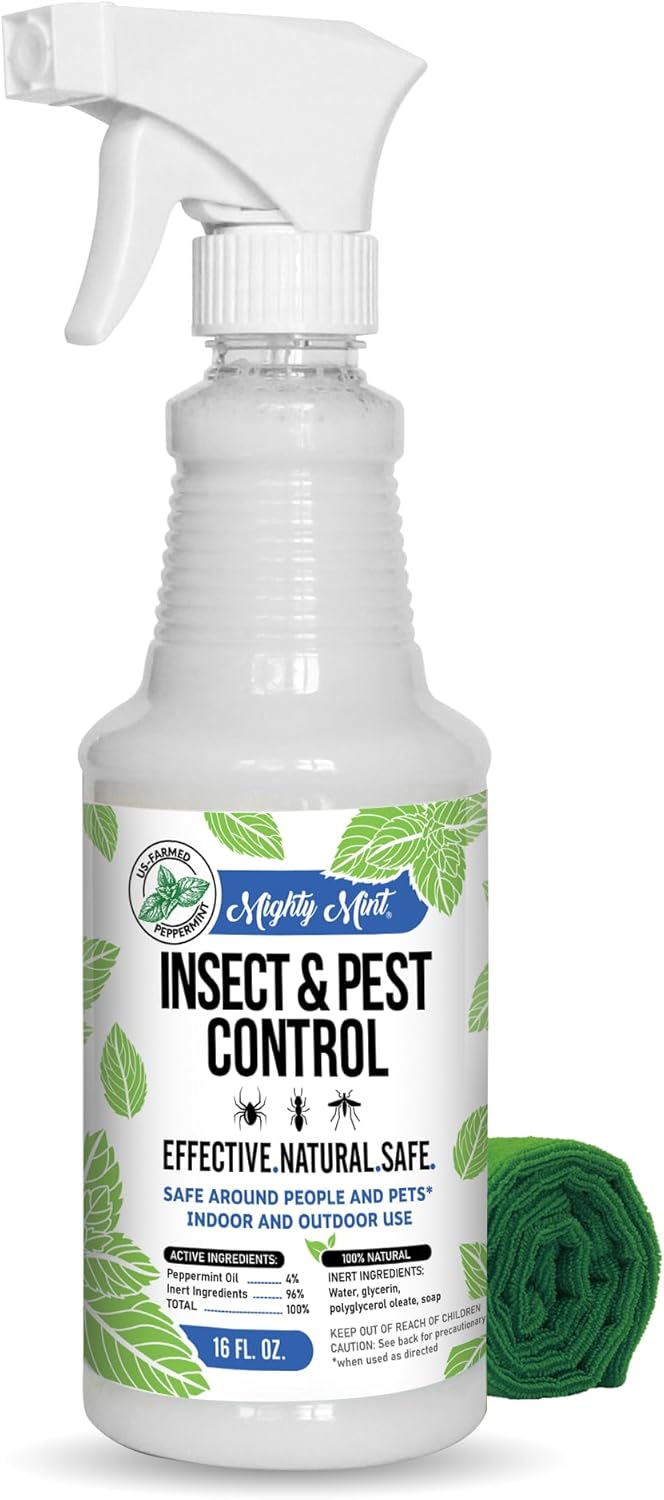
| Ingredients | Water, Glycerine, Polyglycerol oleate, Soap, Peppermint oil |
|---|---|
| Use Areas | Indoor / Outdoor |
| Size | 16 oz |
Mighty Mint is a plant-based, ready-to-use spray that uses concentrated peppermint oil to repel a broad range of household and patio pests. You apply it directly to problem areas such as baseboards, entryways, patios and around outdoor seating; the manufacturer recommends shaking and spraying until surfaces are covered and repeating applications two or more times per week for best results. Notable features include a peppermint-only scent profile, a formulation that avoids synthetic fragrances and the convenience of a 16 oz spray bottle for targeted spot treatments. Practical benefits are that it is safe to use around people and pets when dry and does not leave obvious stains on most surfaces, and the scent can make treated areas smell fresher than chemical alternatives. Important limitations are that it is a repellent rather than a pesticide so it works by discouraging pests rather than killing them, effectiveness depends on regular reapplication and it should not be applied when pollinators are present or to skin or food-contact surfaces.
Best for: Buyers who prioritize natural, low-toxicity solutions and want a targeted spray to reduce insects around patios and entryways while keeping family and pets in mind.
Less Ideal for: Anyone needing a one-time extermination or long-term residual pesticide for severe infestations should consider professional treatments or products formulated to kill pests rather than repel them.
- Plant-based peppermint formula that avoids synthetic fragrances
- Ready-to-use spray for quick, targeted indoor and outdoor applications
- Safe for people and pets when used as directed and allowed to dry
- Nonstaining on most surfaces and leaves a fresh mint scent
- Repels rather than kills insects so regular reapplication is needed to maintain protection
- Strong peppermint concentration may bother scent-sensitive individuals and requires keeping children and pets away until dry
Verdict: Choose Mighty Mint when you want a pet-friendly, plant-based spray to reduce patio and entryway insects with a fresh peppermint scent.
Ortho Home Defense Insect Killer for Indoor & Perimeter, 1.33 gal. with Comfort Wand

| Item Form | Spray |
|---|---|
| Target Species | Insects |
| Liquid Volume | 1.33 gallons |
| Active Ingredients | Bifenthrin 0.05%, Zeta-Cypermethrin 0.0125% |
This 1.33 gallon Ortho Home Defense spray is designed to treat both indoor problem spots and the outdoor perimeter of a home to reduce ants, roaches, spiders and many other crawling and flying insects. It comes with a battery-powered Comfort Wand that delivers a continuous spray so you can apply a uniform band around foundations, patios and entry points without bending or pumping. The formula with bifenthrin and zeta-cypermethrin is intended to kill on contact and establish a barrier that the manufacturer says lasts up to 12 months for ants, roaches and spiders on non-porous indoor surfaces. In real-world use that means fewer repeat treatments in busy yard perimeters and around doors and windows. The spray dries clear with minimal fumes which helps for indoor use near kitchens and living areas. Limitations are that this is a chemical insecticide so users should follow safety directions around children, pets and plants and it is not a specific solution for pests not listed on the label. For homeowners focused on strong, perimeter-level protection this product simplifies application and covers a large area per container.
Best for: Homeowners who want a performance-focused perimeter treatment to reduce recurring yard and entry-point insect problems and prefer a ready-to-use product that is easy to apply.
Less Ideal for: People seeking organic or non-chemical control methods or those who need a targeted solution for pests not listed on the label should consider alternative products.
- Includes battery-powered Comfort Wand for continuous, fatigue-free application
- Ready-to-use 1.33 gallon container covers large perimeters without mixing
- Formula creates a barrier claimed to provide up to 12 months protection against ants, roaches and spiders on non-porous indoor surfaces
- Dries clear and gives off minimal fumes, making indoor use more practical
- Contains synthetic insecticides so precautions are required around children, pets and ornamentals
- Protection claims are specific to certain species and surfaces so results vary by pest and conditions
Verdict: A powerful, ready-to-use perimeter and indoor spray for homeowners who want long-lasting, performance-oriented protection against common yard and household insects.
ROTIAH Peppermint Oil Pest Rodent Repellent Pellets, 24-Pack

| Item model number | PT-QSW |
|---|---|
| Manufacturer | ROTIAH |
| Date First Available | April 1, 2026 |
| ASIN | B0FVLPXRNY |
This ROTIAH repellent uses concentrated peppermint and lemon essential oils in premeasured pellets that slowly release scent to discourage rodents and small pests. Use is straightforward: open the sealed pellet, drop it into the included mesh bag and place the pouch where you see activity—kitchens, garages, attics, vehicle engine bays and storage areas are all listed uses. Each pellet is stated to scent roughly 120 sq ft and to last up to 30 days, so the pack can cover multiple trouble spots over time. The natural formula and lack of toxins make it a safer alternative to poison or sticky traps around family spaces and pets, and the lemony aroma is more pleasant than many chemical repellents. Limitations are that effectiveness depends on scent levels and placement so results can vary in heavy infestations, and pellets will need regular replacement to maintain protection rather than offering an ongoing mechanical or lethal solution.
Best for: Buyers who want a low-risk, easy-to-deploy deterrent to reduce occasional rodent or pest activity around the home, garage, or vehicle without using poisons.
Less Ideal for: People dealing with heavy, established infestations or those who need immediate removal rather than deterrence should look at more aggressive control methods.
- Natural essential-oil formula that avoids poisons or glue traps
- Easy four-step use with mesh bags for quick placement
- Each pellet covers about 120 sq ft and is claimed to last up to 30 days
- Suitable for indoor and outdoor problem areas including vehicles and storage spaces
- Effectiveness relies on maintaining scent so frequent replacement is required for continuous protection
- May be less effective in severe infestations where professional measures are needed
Verdict: Choose this pack if you want a nonpoisonous, easy-to-place peppermint oil deterrent for routine prevention and spot treatment of household rodents and pests.
Hoelesky Natural Spider Repellent Balls, 15-Pack

| Package quantity | 15 PCS |
|---|---|
| Suitable for | Indoor & Outdoor |
| Active ingredients | Peppermint, Cedarwood, Rosemary, Cinnamon, Garlic oils |
These Hoelesky repellent balls use a blend of peppermint, cedarwood, rosemary, cinnamon and garlic oils to deter common house spiders without sprays or sticky traps. You simply unwrap and place the scented balls in corners, under furniture, near entry points or around patios to form a passive barrier; the scent-driven formula is intended to keep spiders from entering treated areas rather than killing insects on contact. The product is marketed for both indoor and outdoor spots and is compact and mess-free, so it is easy to reposition and replace when the aroma fades. Practical benefits include being pet- and kid-friendly compared with harsh chemical sprays and avoiding residue or cleanup. Expect the effectiveness to depend on placement and scent longevity, so regular replacement will be needed to maintain protection and very large or heavily infested areas may require multiple packs or complementary control methods.
Best for: Homeowners who prioritize a low-toxicity, easy-to-use preventive approach to keep spiders out of living areas and who value a reliable barrier method over contact-kill products.
Less Ideal for: People dealing with heavy, established infestations or those who need immediate killing action should choose trapping or professional pest control instead.
- Plant-based essential oil formula avoids harsh synthetic pesticides
- Works indoors and outdoors for flexible placement
- No-spray, no-residue format that is simple to use and reposition
- Protection depends on scent strength and will require periodic replacement
Verdict: A convenient, kid- and pet-safe scent barrier that reliably repels household spiders when placed and refreshed regularly.
Ortho Home Defense Max Indoor Insect Barrier, 1 gal. (Wand Ready)

| Unit Count | 128 Fluid Ounces |
|---|---|
| Item Form | Spray |
| Target Species | Insects |
| Liquid Volume | 1 gallons |
| Active Ingredients | bifenthrin 0.05% |
Ortho Home Defense Max is a one-gallon, ready-to-use indoor insect spray that creates a barrier to kill and prevent common household pests including spiders, ants, roaches and more. It is applied using the included Extended Reach Comfort Wand so you can treat baseboards, doorframes and hard-to-reach corners without bending. The formula is fast-drying, advertised as non-staining and low-odor so treated rooms are usable once surfaces dry. For indoor spider control it works as both a spot treatment where you see activity and as a preventative band along entry points; outdoor perimeter applications are also recommended every three months to reduce re-entry. The active ingredient is bifenthrin 0.05%, a standard synthetic pyrethroid effective on crawling insects. Important limitations are that it is for nonporous indoor surfaces and perimeter use only and it requires following label safety instructions around children and pets until dry. Expect reliable seasonal suppression rather than complete elimination of all spiders in heavily infested structures.
Best for: Homeowners who want a straightforward, long-lasting indoor perimeter treatment to reduce spider activity without frequent reapplication and who prefer an easy-to-use wand for spot and barrier treatments.
Less Ideal for: People seeking an organic or insecticide-free option or those needing rapid knockdown for very heavy indoor infestations should consider alternative products or professional services.
- Ready-to-use gallon with an Extended Reach Comfort Wand for easier application in corners and along baseboards
- Fast-drying, low-odor formula that claims no stains so rooms can be reoccupied soon after treatment
- Provides up to 12 months of protection against ants, roaches and spiders on treated nonporous indoor surfaces when used as directed
- Contains bifenthrin so it is a synthetic insecticide and must be used with care around children, pets and sensitive areas
- Not formulated for porous surfaces or as a direct fogging solution for heavy indoor infestations
Verdict: A convenient, wand-ready indoor barrier spray that delivers long-lasting, low-odor protection against spiders and other common household insects.
Jqely Ultrasonic Indoor Pest Repeller, 6-Pack (3-Mode)

| Unit Count | 6 Count |
|---|---|
| Power Source | Electric |
| Frequency Range | 10kHz–65kHz |
| Coverage | Up to 1600 sq ft (open space) |
The Jqely six-pack ultrasonic repellers are plug-in devices intended to provide continuous, chemical-free pest deterrence around the home. Each unit offers three modes that emit different ultrasonic frequency bands so you can choose quieter operation for overnight use or higher frequencies intended for larger infestations when the home is empty. Typical use is to install one unit per room at recommended height and keep them running 24/7; the maker claims coverage up to 1600 sq ft in open space but notes walls and furniture reduce effectiveness. Practical benefits include a mess-free alternative to traps and sprays, very low power draw, and simple one-button operation. Important limitations are that ultrasonic devices depend on line of sight to pests, some modes can produce audible noise for people or pets, and results vary by pest species and room layout, so they work best as part of a layered approach rather than a guaranteed single solution.
Best for: A cautious homeowner who prefers non-chemical, low-maintenance pest control and wants a ready supply of units to place in several rooms for ongoing deterrence.
Less Ideal for: People seeking a guaranteed, immediate knockout of an active infestation or who need a single-room loud mechanical solution; not the best choice for outdoor mosquito control.
- Three selectable ultrasonic modes to target different pests and activity levels.
- Sold as a six-pack for room-by-room coverage without frequent repurchasing.
- Plug-in, low power design supports 24/7 operation with no batteries or messy cleanup.
- Chemical-free and silent in the lowest mode, making it suitable for occupied rooms at night.
- Effectiveness is reduced by walls and large furniture so multiple units are often required.
- Higher-intensity mode can produce audible noise and should not be used around people or pets.
Verdict: Buy this six-pack if you want a low-maintenance, chemical-free set of plug-in repellers to provide continuous, room-by-room deterrence as part of a cautious, layered approach to indoor mosquito and pest control.
Choosing the Right Spider Repellent for Home: Key Factors to Consider
Active Ingredient and Mode of Action
Understanding what actually repels or kills spiders matters because active ingredients determine both effectiveness and safety. Some home-focused repellents use botanical oils that create an unpleasant scent or surface film that spiders avoid, while others rely on low-toxicity synthetic actives designed to interrupt pests' sensory cues.
Knowing the mode of action also affects how and where you apply treatments. Contact agents need to be applied directly to harborages, while repellent sprays or volatile oils are more useful around entryways and corners. Match the ingredient to your tolerance for scent, reapplication frequency, and household safety concerns.
Safety for Pets and People
Indoor repellents are used around family and pets, so toxicity and exposure risk are major considerations. Look for products with clear label directions about reentry times, surface drying, and any food-contact restrictions. Botanical options often have lower acute toxicity but can still irritate sensitive pets or trigger allergies.
Consider application method too. Aerosolized sprays disperse into breathing zones more than spot treatments or glue-based approaches. If you have young children or animals that lick floors and baseboards, choose products with minimal residue and clear safety data.
Application Method and Convenience
How you apply a spider repellent determines whether you will keep up with maintenance. Spray bottles allow targeted control in crevices and windowsills, granular or bait-style products suit exterior perimeter treatments, and plug-in diffusers or passive strips can provide continuous protection indoors with less frequent attention.
Also think about storage and refills. Reusable spray containers and concentrates reduce waste but may require measuring and mixing. Pre-measured or disposable formats are simpler for occasional use but can be more wasteful over time.
Coverage Area and Residual Life
Different products vary widely in how much area a single container covers and how long effects last. Residual life affects how often you need to reapply and whether a product is suited for persistent infestations. Short-duration repellents are fine for temporary seasons of high activity, while long-residual treatments are better for ongoing protection in basements or attics.
Coverage is also practical: a product that treats many linear feet along baseboards will be more efficient for whole-room treatments than a formula designed only for spot application.
Surface and Material Compatibility
Treatments contact a variety of indoor surfaces, so compatibility is important to avoid staining, paint lifting, or fabric damage. Water-based sprays are usually safe on painted walls and trim, whereas oil-based or solvent formulas may leave residues or affect finishes.
Test any new repellent in an inconspicuous spot before widespread use. Consider whether a product can be wiped away if needed, and whether it leaves a visible sheen or odor that might be undesirable in living spaces.
Environmental and Indoor Air Considerations
Because repellents are used inside homes, think about indoor air quality and environmental persistence. Volatile botanical oils can evaporate quickly and cause temporary odors, while some synthetic actives persist longer but may off-gas for days after application.
Choose products with low volatile organic compound profiles when indoor air sensitivity is a concern. Also consider ventilation during and after application to reduce odor and airborne exposure, especially in small or poorly ventilated rooms.
Best Application Spots Around the House
Targeting the right locations makes treatments more effective and efficient. Focus on entry points such as door thresholds, window sills, basement steps, garage-to-house transitions, and crawlspace access. Indoors, treat undisturbed corners, behind furniture, in closets, and along baseboards where spiders build webs.
For perimeters, create a treated band outside the foundation and under eaves to reduce the number of spiders entering the structure. Inside, spot-treat likely harborages rather than blanket-spraying living areas to minimize exposure and residue.
- Door and window frames
- Basement corners and beams
- Attic access and storage areas
- Closets, behind electronics, and under furniture
Non-Chemical Approaches and Integrated Options
Physical and cultural controls can reduce spider numbers without direct chemical exposure. Regular vacuuming removes webs, egg sacs, and egg-bearing adults; decluttering eliminates hiding places; and sealing cracks and gaps reduces entry points. Sticky traps placed in corners can help monitor and reduce visible spiders without dispersing chemicals.
Combine non-chemical methods with targeted repellents for higher levels of protection. For example, use sealant around doors and then apply a perimeter repellent outside to create a layered barrier that reduces the need for frequent indoor applications.
- Vacuum and remove webs weekly
- Use sticky traps for monitoring
- Seal gaps and install weatherstripping
- Reduce outdoor lighting that attracts prey insects
Managing Expectations: What Repellents Will and Will Not Do
Repellents work differently depending on formulation and spider species. Most household repellents reduce activity and discourage web building in treated areas but do not guarantee complete elimination of all spiders. Expect lower visible activity rather than instant, permanent eradication.
Heavy infestations or structural entry points may require combined approaches or professional assessment. Think of repellents as one part of an ongoing management plan that includes exclusion, sanitation, and monitoring.
- Repellents reduce activity but rarely eliminate every individual
- Persistent infestations need a multi-pronged plan
- Regular maintenance extends repellent effectiveness
Storing and Reapplying Treatments Safely
Store products in their original containers with labels intact and keep them out of reach of children and pets. Observe manufacturer guidance on shelf life and storage temperature to maintain effectiveness. For concentrated products, mark dilution ratios clearly and store mixed solutions only for the recommended period.
When reapplying, follow label intervals to avoid overuse and unnecessary residue buildup. Ventilate treated areas well after application and keep pets and people away until the treated surfaces are dry or the recommended reentry time has passed.
- Keep containers sealed and labeled
- Observe recommended reapplication intervals
- Ventilate indoor areas after treatment
When to Call a Professional
If you have recurring, heavy spider activity despite repeated treatments and exclusion efforts, a professional can inspect for structural entry points, nesting sites, and food sources that are sustaining populations. Professionals can also offer targeted treatments that are not available over the counter and advise on safe application around sensitive household members.
Consider professional help if you are uncomfortable applying indoor treatments, have a fragile or elderly household member with respiratory issues, or live in a situation with high pest pressure due to nearby habitats that attract spiders.
- Persistent infestations despite DIY efforts
- Household members with chemical sensitivities
- Structural issues or hidden entry points
How We Chose the Best Spider Repellent for Home
We prioritized options that mix proven spider deterrent methods with practical home use features. Key evaluation criteria were safety for people and pets, measured by ingredient toxicity and label instructions; effectiveness at deterring common indoor spiders, judged by the type of active ingredient or repellent mechanism; residual duration, meaning how long a single application reduces spider activity; ease of application, including spray, granular, or plug-in formats and how they work in tight corners and entry points; and material compatibility, ensuring treatments are safe on common indoor surfaces like painted drywall, baseboards, and fabrics. Products were excluded if they relied on unverifiable claims, required professional-only application, or used restricted pesticides unsuitable for residential indoor use. We also filtered out options that presented unreasonable handling risks for households with pets or small children. The scoring emphasized realistic household scenarios and repeat-use practicality rather than laboratory-only efficacy data.
FAQ
Are botanical spider repellents safe to use around pets?
Botanical repellents often have lower acute toxicity but can still irritate sensitive animals, especially pets that groom and ingest residues. Follow label directions carefully, avoid treating pet bedding, and ventilate treated rooms. When in doubt, choose products explicitly labeled as pet-safe and consult your veterinarian for concerns.
How often should I reapply an indoor spider repellent?
Reapplication frequency depends on the product and its residual life. Some sprays need reapplication every few weeks, while passive devices may last months. Follow label guidance and monitor spider activity to judge when another treatment is needed.
Will sealing cracks and gaps eliminate the need for repellents?
Sealing entry points reduces incoming spiders but does not remove those already inside or eliminate attractants like insect prey. Combining exclusion with targeted repellents and sanitation gives the best, longest-lasting results.
Can I use outdoor perimeter products indoors to stop spiders?
Outdoor formulations are often stronger and may not be safe for indoor use due to higher persistence or solvents. Use only products labeled for indoor application and follow all safety instructions to avoid undue exposure.
Do sticky traps actually reduce spider populations?
Sticky traps can reduce visible spiders and provide a monitoring tool, but they often catch only a fraction of the population. They are most useful as part of an integrated approach that includes exclusion and targeted repellent use.
Is scentless repellent an option for living rooms and bedrooms?
Scentless or low-odor repellent formulations are available and are preferable for living spaces or bedrooms. These options may use less volatile actives or leave minimal residue, making them easier to live with in frequently used areas.
Final Verdict
Choose a spider repellent for home by balancing safety, coverage, and how you live in the space. If you have pets, prioritize low-toxicity formulations and application methods that minimize residue. For persistent activity, favor products with longer residual life and combine them with exclusion and sanitation to reduce the need for repeated treatment. The right choice depends on where spiders are appearing, how often you can maintain treatments, and household sensitivities. Use targeted, surface-safe options indoors and integrate non-chemical measures to keep indoor spider activity low without unnecessary exposure.
