

Note: This article contains affiliate links. If you click on these links and make a purchase, I may earn a small commission at no extra cost to you. This helps support my research and content. Read my full affiliate disclosure here.
If you maintain acres or multiple large yards, a broadcast spreader sized for large lawns makes fertilizer, seed, and granular lime chores faster and less fatiguing. The right unit reduces repeat passes, limits overlap streaks, and holds enough material so you spend more time working and less time refilling. This guide focuses on options suited specifically for large lawns and heavy-use seasons. We shortlisted top-performing spreaders and evaluated them on capacity, spread consistency, durability, and towing or push convenience. Read on to compare features that matter for big turf areas and to narrow choices by workload and storage needs.
Top Picks at a Glance
| Best Overall The best all-around choice for most situations | John Deere 130 lb Push Broadcast Spreader |  |
| Best Quality Built to a higher standard if you want something more solid | Yard Commander 125 lb Tow-Behind Broadcast Spreader |  |
| Best Value The sweet spot between price and what you get | AugFir Tow-Behind Broadcast Spreader — 130 lb Capacity, 12 ft Spread Width |  |
| Best Budget The cheapest option that still gets the job done reliably | Takywep 80 lb Tow-Behind Broadcast Spreader with 10" Pneumatic Tires |  |
| Most Popular A crowd favorite that many people choose with confidence | Agri-Fab 130-lb Walk-Behind Broadcast Spreader (Model 45-0462) |  |
John Deere 130 lb Push Broadcast Spreader

| Capacity | 130 lbs. |
|---|---|
| Approximate coverage | Up to 25,000 sq ft |
| Spread width | 10 – 12 ft |
| Wheels | 13" x 4" pneumatic tires |
This John Deere push broadcast spreader is built for larger lawns and frequent use. The 130 lb rust-proof poly hopper lets you cover roughly half an acre between refills, while the broadcast plate delivers a 10 to 12 ft spread that speeds application and reduces passes. Control is simple: a direct rod gate and adjustable flow stop let you dial output for seed, fertilizer, weed control products, or ice melt so you get more even coverage and less waste. Durability is focused on practical longevity rather than lightweight portability — heat-treated steel gears are enclosed to resist corrosive materials and large turf-tread pneumatic tires make it easy to push across uneven turf. Assembly is required and the unit is substantial to maneuver compared with compact hand spreaders, but that heft contributes to stability and capacity. For performance-focused gardeners with mid-size to large lawns, it reduces refill frequency and produces consistent spreading; casual users with very small yards may find it larger than necessary.
Best for: Gardeners and property owners who prioritize efficient, consistent coverage across mid-size to large lawns and want a durable spreader that reduces refill interruptions.
Less Ideal for: People with very small yards, limited storage space, or who need a lightweight, highly portable seed spreader.
- Large 130 lb poly hopper reduces refills for up to 25,000 sq ft of coverage
- Wide 10–12 ft broadcast spread speeds application and improves uniformity
- Direct rod control and adjustable flow stop for precise output with different materials
- Enclosed heat-treated steel gears and turf-tread pneumatic tires improve durability and maneuverability
- Substantial size and weight make it less convenient for very small yards or frequent transport
- Some assembly required before first use
Verdict: Choose this spreader if you need high-capacity, consistent broadcast coverage for mid-size to large lawns without frequent refilling.
Yard Commander 125 lb Tow-Behind Broadcast Spreader

| Capacity | 125 lb |
|---|---|
| Spread radius | 10–12 ft |
| Tire type | 12-inch pneumatic tires |
| Hopper | Corrosion-resistant composite with cover |
| Gears | Cast aluminum |
The Yard Commander 125 lb tow-behind broadcast spreader is built to handle large lawns and heavier materials like fertilizer, seed, and ice melt. It mounts to tractors, riding mowers, ATVs, or UTVs via a universal hitch and uses premium cast aluminum gears to deliver a steady 10–12 foot spread radius. The corrosion-resistant composite hopper and included weather cover keep materials dry and prevent clumping during light precipitation. Large 12-inch pneumatic tires improve flotation and traction across uneven or soft turf so you can tow it over rough ground without frequent stoppages. Flow is controlled with a simple gate lever for dosing adjustments so you can tune application rate for different materials. Expect basic assembly and occasional maintenance on moving parts, and note capacity varies by material so very dense mixes may not reach the full 125 lb in practice. The unit is practical for large properties where tow-behind performance, corrosion resistance, and a wide spread pattern matter most.
Best for: Gardeners and property owners who prioritize performance and efficiency on large lawns and need a tow-behind spreader that handles varied terrain and heavier materials.
Less Ideal for: Small-lot homeowners who prefer a walk-behind unit or users who want a completely maintenance-free, plug-and-play spreader.
- Large 125 lb composite hopper resists corrosion and holds enough material to cover up to 25,000 sq ft in one fill
- Premium cast aluminum gear drive provides smoother, durable spreading and supports a 10–12 ft broadcast width
- Universal hitch fits most lawn tractors, riding mowers, ATVs, and UTVs for versatile tow-behind use
- 12-inch pneumatic tires improve flotation and traction on rough or soft terrain
- Included hopper cover reduces clumping and allows light-rain operation
- Requires assembly and periodic maintenance of moving parts
- Actual capacity and coverage depend on material density and may be less than rated with heavy mixes
Verdict: Choose this spreader if you need a durable, tow-behind broadcast unit that covers large lawns efficiently while handling rough terrain and damp conditions.
AugFir Tow-Behind Broadcast Spreader — 130 lb Capacity, 12 ft Spread Width

| Hopper capacity | 130 lb |
|---|---|
| Spread width | Up to 12 ft |
| Tire type | 12.5 in pneumatic |
| Frame | Powder-coated steel |
This AugFir tow-behind broadcast spreader is built for covering large lawns quickly without constant refills. It mounts to most riding mowers, tractors, ATVs and UTVs via a universal hitch and includes an extender and handle rod so you can open the hopper from the seat. The trapezoidal 130 lb hopper and five-position flow control give precise, even distribution for seed, fertilizer, salt or ice melt across up to a 12 foot swath, which reduces passes and saves time on bigger properties. Rugged powder-coated steel construction, a gearbox and 12.5 inch pneumatic tires make it suitable on grass, gravel and light snow. Assembly is supported by step-by-step instructions and a video. Expect a bit of setup and the need to avoid overfilling the hopper to maintain consistent flow, and the unit does require a tow vehicle rather than hand operation. For a practical lawn owner focused on efficiency, this spreader turns several refill trips into one and handles varied seasonal tasks reliably.
Best for: Owners of large lawns, small farms, or properties who prioritize efficiency and want a tow-behind spreader that covers wide passes and reduces refill frequency while handling seasonal tasks.
Less Ideal for: If you have a small yard, need a handheld spreader, or want a unit for occasional sidewalk-only work, this tow-behind model is more capacity and setup than needed.
- Large 130 lb hopper reduces the number of refills on big lawns
- Adjustable five-position flow control and trapezoidal hopper deliver more even spreading up to 12 ft wide
- Universal hitch plus hitch and handle extenders allow convenient operation from the vehicle seat
- Powder-coated steel frame and gearbox with 12.5 in pneumatic tires for durable use on varied terrain
- Requires a tow vehicle so not usable for small yards or by hand
- Hopper must not be overfilled to avoid uneven application
Verdict: A high-capacity, tow-behind spreader that saves time on large lawns by delivering wide, even application across multiple seasonal tasks.
Takywep 80 lb Tow-Behind Broadcast Spreader with 10" Pneumatic Tires

| Hopper capacity | 80 lb (30 L) |
|---|---|
| Tire size | 10 in pneumatic |
| Frame material | Powder-coated carbon steel |
| Compatible tow | Riding mowers, ATVs, UTVs via pin-style hitch |
| Control | Adjustable rate-control lever |
The Takywep 80 lb tow-behind broadcast spreader is a basic, workmanlike machine for seeding, fertilizing, and winter de-icing on medium to large lawns. It mounts to riding mowers, ATVs, UTVs, and similar equipment using a pin-style hitch and rolls on large 10-inch pneumatic tires that handle uneven turf and light mud with less slipping. The rust-resistant poly hopper holds 80 pounds of granular material to reduce refills, and an accessible rate-control lever lets you dial coverage from light seed to heavier fertilizer or ice melt. A powder-coated carbon steel frame provides structural strength for regular seasonal use. Expect straightforward setup and operation but limited refinement: the unit is utilitarian rather than precision-engineered, and assembly and parts fit may require basic mechanical patience. For homeowners who want a simple tow-behind spreader that covers ground quickly without specialty features, this model delivers reliable performance for routine lawn and winter maintenance.
Best for: Buyers who want an affordable, no-frills tow-behind spreader to cover medium to large lawns quickly and handle seasonal seeding, fertilizing, and de-icing while keeping costs down.
Less Ideal for: Professional contractors or users who need precise commercial-grade calibration, premium fit and finish, or advanced spread pattern controls should consider higher-end models.
- Large 80 lb poly hopper reduces frequency of refills for bigger jobs
- 10" pneumatic tires improve traction and roll smoothly over uneven ground
- Adjustable rate-control lever for quick changes between seed, fertilizer, and ice melt
- Powder-coated carbon steel frame resists weather and adds durability
- Basic design with limited refinement in fit and finish compared with higher-end models
- Tow hitch and assembly may require time and basic tools to install properly
Verdict: A straightforward, budget-friendly tow-behind spreader that covers large lawns efficiently with a high-capacity hopper and all-terrain tires.
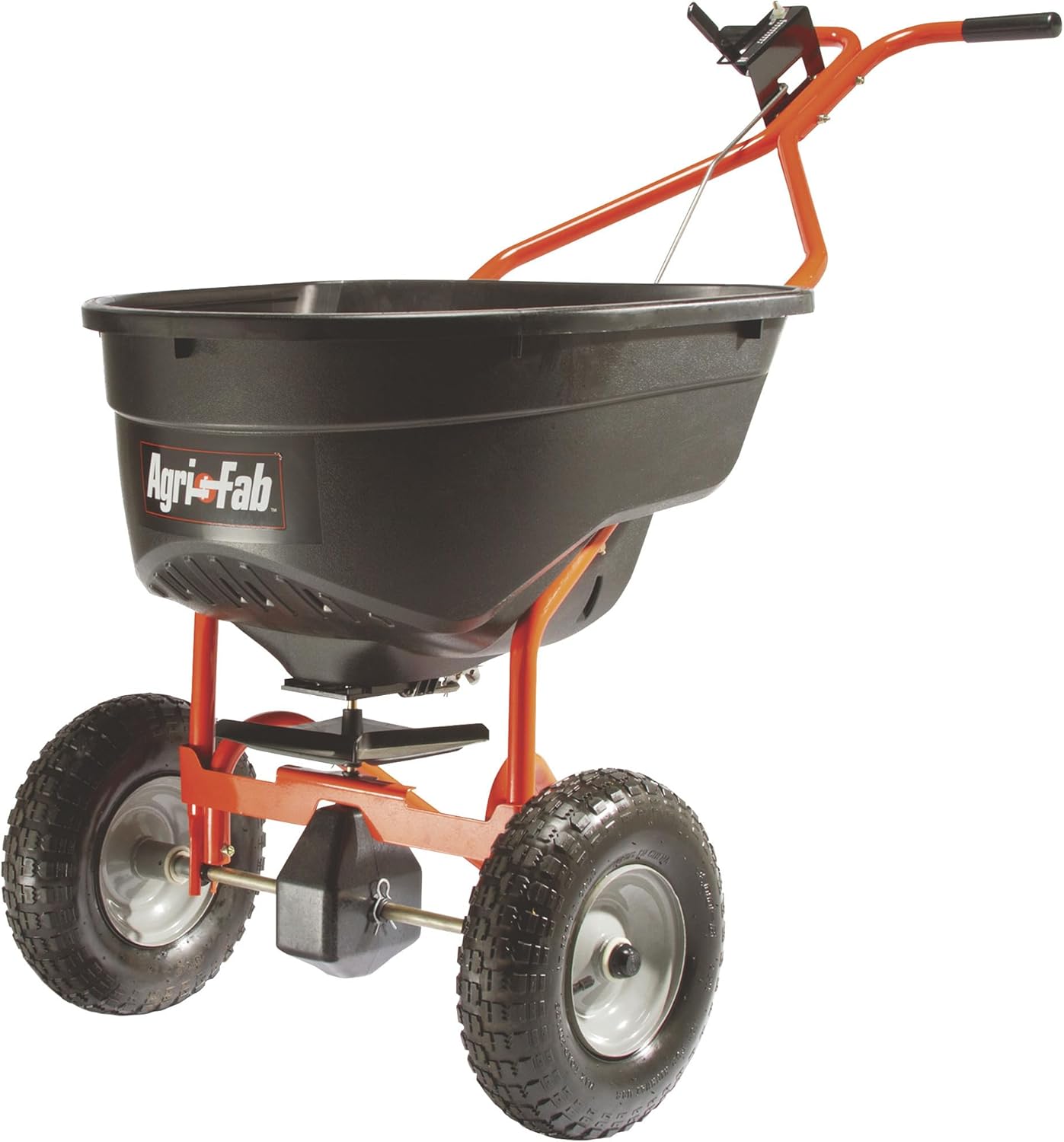
Agri-Fab 130-lb Walk-Behind Broadcast Spreader (Model 45-0462)
| Weight Capacity Maximum | 130 pounds |
|---|---|
| Number of Wheels | 2 |
| Tire Type | Tubeless |
| Material Type | Poly and steel |
The Agri-Fab 130-lb walk-behind broadcast spreader is a straightforward, high-capacity tool for spreading fertilizer, grass seed, or ice melt over lawns up to about half an acre. It uses a large polyethylene hopper and pneumatic tires to move smoothly over uneven turf, while a direct rod control makes adjusting and engaging the spread pattern simple during use. The wide broadcast pattern covers more ground per pass, reducing time spent spreading compared with lawn-size handheld options. Construction mixes poly and steel for a balance of durability and lighter weight, and the ergonomic handle improves comfort during longer passes. Expect reliable performance for routine residential lawn care, though assembly is required and the unit is a push-style spreader so it is physically demanding on larger sites. Controls are basic rather than precision-calibrated, so granular control for very small application rates may require extra care. For seasonal tasks from spring seeding to winter deicing, this model delivers consistent, no-frills coverage for homeowners focused on efficiency and capacity.
Best for: Homeowners who want a no-nonsense, high-capacity spreader to finish lawn tasks faster and who prioritize durability and ease of use over precision metering.
Less Ideal for: Owners of very large properties who prefer tow-behind or tractor-mounted spreaders and users who need highly precise, small-rate fertilizer application.
- Large 130 lb hopper reduces refills and speeds work on medium lawns
- Pneumatic tires and simple frame roll well over uneven yards
- Direct rod control is easy to use and intuitive while walking
- Polyethylene hopper and steel components provide a durable yet reasonably light build
- Push operation can be tiring on larger properties
- Controls are basic and may require testing to dial in precise spread rates
Verdict: A rugged, high-capacity push spreader that saves time on medium residential lawns by covering large areas with one hopper load.
Choosing the Right Broadcast Spreader for Large Lawns: Key Factors to Consider
Hopper Capacity and Refill Frequency
Hopper size directly affects how often you stop to refill when covering large lawns. A larger hopper reduces interruption, which saves time on acres and lets you maintain a steady pace for a more uniform application. Consider how many pounds or cubic feet the hopper holds in relation to the typical application rate you use; a unit with a larger capacity will benefit high-rate applications like starter fertilizer or lime.
Also think about how easy the hopper is to refill from your material bag or bulk container. Wide openings and lower fill heights reduce strain during repeated fills on long jobs. If you plan to switch materials mid-job, a hopper designed for quick emptying and cleaning will cut downtime.
Spread Pattern Consistency
Even distribution across the swath is essential to avoid streaks, thin patches, and over-applied strips that can burn turf or waste product. Check whether the spreader offers a uniform broadcast pattern across a broad swath and whether pattern controls are easy to set while walking or towing. Look for adjustable vanes or deflectors that let you correct drift on windy days or near beds and walkways.
Spreader calibration matters. A model with clear, reproducible metering settings and a predictable feed rate lets you match the label rates of fertilizers or seed with confidence. For very large lawns, consistent coverage reduces the need for follow-up spot applications.
Frame, Wheel, and Axle Durability
Large-lawn work increases wear on structural components, so a rugged frame and heavy-duty axle are key to long service life. Steel frames or reinforced composites resist flexing under load; sealed bearings and larger pneumatic tires handle rough turf and reduce vibration. Consider whether replacement parts like tires, axles, and bearings are readily available and how easy routine service is.
Also evaluate corrosion resistance if you use corrosive materials such as some fertilizers or soil amendments. Coatings, stainless hardware, and nonferrous components will extend life when exposure is frequent.
Towing and Handling Options
How you move the spreader affects efficiency on large properties. Tow-behind models that attach to lawn tractors or ATVs are often the fastest choice for acres, while rugged walk-behind or pull models can still work well where tight turns or gate access matter. Consider hitch compatibility, turning radius, and whether the spreader rides level when loaded.
Balance ergonomics with control. Models with easy-adjust handles, single-lever on-off controls, or remote metering controls reduce operator fatigue and improve accuracy during long passes.
Metering Adjustability and Material Compatibility
Large-lawn applications require flexible metering to handle different particle sizes and application rates. A spreader with multiple calibrated settings and a robust metering gate adapts to fine seeds, granular fertilizers, and heavier materials like lime. Look for units that allow precise adjustments and that include calibration instructions or simple charts.
Material flow behavior also matters. Anti-clogging features, agitators, or internal paddles keep coarser or damp materials moving. If you plan to broadcast both seed and fertilizer in the same season, choose a spreader that handles a range of particle sizes without frequent clogging.
Sizing the Spreader to Your Lawn Workload
Match hopper volume and tow method to the acreage and how often you expect to apply material. For half-acre properties a mid-size hopper can be efficient, but for multiple acres a high-capacity hopper or tow-behind unit saves repeated stops. Also think about how many different materials you apply per season; larger hoppers reduce switching frequency and speed multi-product routines.
- Estimate application rates per 1,000 square feet and calculate expected hopper consumption to estimate refill intervals.
- For frequent, large-volume tasks choose towable options; for tight gardens choose maneuverable walk-behind types.
Calibration: Getting the Spread Rate Right
Calibrating your spreader to each material produces consistent results. Use small test runs, measure the product delivered over a known distance, and adjust the metering until the output matches the recommended label rate. Many manufacturers provide charts that are a starting point, but real-world tests on your turf and with your product are the most reliable method.
- Perform a short calibration pass on pavement to catch material and weigh or measure output.
- Record settings that worked for each product so you can repeat accurate applications later.
Maintenance Habits That Keep Large-Scale Jobs Running
Simple maintenance extends service life and prevents in-season failures. After each use, brush out residue, flush or rinse corrosive materials, and inspect bearings, hitch points, and tires. Grease fittings and replace worn components before an intensive application season. Keep a small parts kit with extra pins, bolts, and a spare tire if you cover extensive ground.
- Rinse hoppers and metering gates after using lime or corrosive amendments.
- Check tire pressure and wheel bearings before long runs to avoid breakdowns.
Managing Wind, Edges, and Sensitive Areas
On large lawns wind can widen or skew the broadcast pattern, creating uneven edges. Plan application windows for calmer conditions, reduce spread width near sensitive beds, and use deflectors or lowered speeds to tighten the pattern near sidewalks and ornamentals. For narrow strips, consider overlapping passes deliberately at reduced spread settings to avoid gaps.
- Run perimeter passes at reduced spread settings or with deflectors in place.
- Time heavier applications for mornings or evenings when wind tends to be lower.
How We Chose the Best Broadcast Spreader for Large Lawns
We selected spreaders that match the demands of large lawns by focusing on measurable, practical attributes. First, we prioritized hopper capacity and feed system type because large properties need fewer refills to stay efficient. Second, we evaluated spread pattern consistency and adjustable drop rates since even application matters for turf health and avoiding waste. Durability was judged by frame material, axle and wheel robustness, and corrosion resistance to handle frequent use and exposure. Maneuverability and mounting options were included, assessing towable compatibility, ride-on mounting points, and easy-push ergonomics for long jobs. Finally, maintenance and replacement-part availability were considered because large-lawn routines intensify wear. Products were excluded if they lacked clear capacity specs, used proprietary parts with no service info, or were strictly intended for small lawns or narrow walk-behind use. The result is a list of options that genuinely scale to larger turf areas while minimizing downtime and uneven application.
FAQ
How often should I calibrate a broadcast spreader for consistent application?
Calibrate whenever you change products or notice visible coverage issues. For consistent results on a large lawn, do a short calibration before each major application and record the settings that match label rates.
Can I use the same spreader for seed and fertilizer?
Often yes, but you must clean the hopper and metering mechanism between materials to avoid cross-contamination. Also adjust the metering to match particle size and application rate for each product.
Is a tow-behind spreader always better for large lawns?
Not always. Tow-behind units usually cover more ground faster, but walk-behind or pull models can be more maneuverable in tight areas. Choose based on acreage, access, and whether you already use a tractor or ATV for other tasks.
What maintenance prevents clogging when using damp or coarse materials?
Use models with agitators or paddles, keep the hopper dry, and clean screens or gates regularly. If materials tend to cake, break up clumps before loading and perform brief agitation cycles during use.
How do I reduce overlap streaks on long passes?
Maintain a consistent walking or towing speed and overlap the manufacturer's recommended swath by a small margin. Calibrate the spreader and keep hopper levels consistent to avoid changes in feed rate as the hopper empties.
Final Verdict
For large lawns focus on capacity, consistent spread pattern, and mechanical robustness. Larger hoppers and reliable metering reduce stops and improve uniformity, while a sturdy frame and serviceable components keep a spreader working season after season. Decide whether towing or walk-behind handling fits your property layout, and prioritize models that are easy to calibrate and maintain. With those tradeoffs in mind, you can pick a spreader that balances efficiency with long-term durability for big-turf care.
