

Note: This article contains affiliate links. If you click on these links and make a purchase, I may earn a small commission at no extra cost to you. This helps support my research and content. Read my full affiliate disclosure here.
Pests like cockroaches are stressful and unhygienic, and choosing the right natural control can limit infestations while reducing exposure to harsh chemicals. A good natural cockroach killer works in real indoor conditions, targeting hiding spots, breaking life cycles, or repelling invaders without creating new hazards for children, pets, or food-prep areas. This guide shortlists the top options and explains the tradeoffs between speed of control, safety, and ease of use. Below we review seven top natural cockroach killers and evaluate them on practical garden- and home-focused criteria like knockdown speed and household safety to help you pick the product that best fits your living situation.
Top Picks at a Glance
| Best Overall The best all-around choice for most situations | Wondercide Indoor Pest Control Spray, Peppermint, 16 fl oz |  |
| Best Quality Built to a higher standard if you want something more solid | EcoVenger Roach Killer Repellent Spray, Plant-Based, 16 oz |  |
| Best Value The sweet spot between price and what you get | Harris Diatomaceous Earth Crawling Insect Killer, 8 oz |  |
| Best Budget The cheapest option that still gets the job done reliably | STEM Plant-Based Bug Spray for Ants, Roaches and Flies, 12 fl oz |  |
| Highest Rated A top-rated pick with lots of positive feedback | SWIALLS Keep Roach Away Repellent Indoor, 16-Pack (120 sq ft coverage, up to 60 days) |  |
| Most Popular A crowd favorite that many people choose with confidence | Mighty Mint Peppermint Oil Insect Repellent Spray, 16 oz |  |
| Best Seller A high-volume bestseller chosen again and again | Safer Home Diatomaceous Earth 4 lb (OMRI Listed) |  |
Wondercide Indoor Pest Control Spray, Peppermint, 16 fl oz

| Unit Count | 16 Fluid Ounces |
|---|---|
| Item Form | Spray |
| Target Species | Ants, Roaches, Spiders, Flies, Fleas, Ticks, Mosquitoes, Silverfish, Moths, Gnats |
| Active Ingredients | 4.2% Cedar Oil; 1.5% Peppermint Oil; 2.2% Sodium Lauryl Sulfate; 0.1% Sesame Oil |
Wondercide Indoor Pest Control is a ready-to-use peppermint-scented spray designed to kill and repel flying and crawling household pests including ants, roaches, spiders, flies, fleas, ticks, mosquitoes, moths, and gnats. It is typically used around baseboards, windows, doors, under sinks, in cabinets, on furniture and carpets, or sprayed directly on visible insects from 8 to 12 inches. Key features include a plant-derived active blend led by cedarwood and peppermint oils, a multi-surface sprayer with adjustable nozzle, and labeling that emphasizes safe use around people and pets when directions are followed. In practical terms this makes it a straightforward option for spot treatments and routine preventative spraying in kitchens, bathrooms, pet areas and living spaces. Limitations to keep in mind are that it must contact flying insects to kill them, surfaces can be slippery when wet, and some people may experience mild skin or eye irritation if misused. For someone looking to reduce reliance on synthetic pesticides while keeping indoor pest problems under control, this product delivers an easy, plant-based approach.
Best for: Buyers who prioritize practical, lower-toxicity solutions and want a versatile, easy-to-use indoor spray for routine spot treatment and prevention around the home and pet areas.
Less Ideal for: People who need long-duration residual control or professional-grade pesticide strength for large infestations should consider stronger or specialized treatments.
- Plant-powered formula with cedarwood and peppermint oils as primary active ingredients
- Kills and repels a broad list of common indoor pests including fleas, ants, roaches and flies
- Ready-to-use spray with adjustable nozzle for targeted or mist application
- Labeled safe for use around people and pets when directions are followed
- Must directly contact flying insects to be effective against them
- Can cause mild skin or eye irritation and surfaces may be slippery when wet
Verdict: A practical, plant-based indoor spray for homeowners who want an easy, lower-toxicity way to kill and repel common household pests while using a product safe for family and pets when used as directed.
EcoVenger Roach Killer Repellent Spray, Plant-Based, 16 oz

| Net volume | 16 oz |
|---|---|
| Active ingredients | Geraniol, Cedarwood Oil, Peppermint Oil, Sodium Lauryl Sulfate |
| Intended pests | Roaches, ants and other crawling insects |
| Residual protection | Up to 4 weeks |
EcoVenger Roach Killer is a ready-to-use, plant-derived spray designed to kill roaches on contact and act as a longer-lasting deterrent. You use it like a standard spray: shake, apply directly to visible pests for knockdown, and treat hiding places such as baseboards, under sinks, cabinets, and around pipes to create a barrier. Notable features include a peppermint scent that fades quickly, a water-based, nonstaining formula, and active botanical ingredients (geraniol, cedarwood oil, peppermint oil) that target insect nervous systems without synthetic pyrethroids. In practical terms it is well suited for kitchens, bathrooms, and food-storage areas because it claims safe use around people and pets and does not require vacating treated spaces. Expect fast contact kills and residual repellent effect that the brand states can last up to four weeks, which helps reduce follow-up treatments. Limitations are that results can vary with heavy infestations and it is not a bait or systemic solution for nests behind walls, so severe or hidden infestations may still need an integrated approach.
Best for: Buyers who want a low-odor, plant-based indoor roach spray for routine control and prevention in kitchens, bathrooms, or rental properties where quick knockdown plus short-term deterrence is a priority.
Less Ideal for: People dealing with large, established infestations inside wall voids or plumbing where professional nest-targeted treatments or baits are needed.
- Plant-based active ingredients that avoid synthetic pyrethroids
- Kills on contact while also providing reported residual repellency for up to four weeks
- Water-based, low-odor formula that is described as non-staining
- Suitable for use around people, pets, and in sensitive indoor areas without vacating
- May be less effective on severe, hidden infestations where nest treatment or baits are required
- Effectiveness and duration of residual control can vary by environment and pest pressure
Verdict: A plant-based indoor spray that delivers fast on-contact roach kills plus weeks of repellency for routine, low-odor home control.
Harris Diatomaceous Earth Crawling Insect Killer, 8 oz

| EPA registration | No. 3-18 |
|---|---|
| Active ingredient | 100% freshwater diatomaceous earth |
| Intended use | Indoor & outdoor |
This ready-to-use diatomaceous earth product provides a non-chemical way to control ants and other crawling pests around the home. You apply the fine powder in cracks, along baseboards, near entry points, or in crawlspaces using the included puffer tip for targeted placement. The diatomaceous earth works mechanically by abrading insect exoskeletons and causing dehydration, so insects that contact the dust typically die within 48 hours. Because the material is 100% freshwater diatomaceous earth with no additives and is EPA registered, it is a good fit when you want a low-toxicity option usable near people and pets when directions are followed. It stays effective indefinitely as long as it stays dry, making it a convenient barrier treatment in attics, basements, garages, and around foundations. Limitations are that it must remain dry to work and it is a contact-only control method, so heavy infestations or nesting insects may require repeated application or combined methods for faster results.
Best for: Practical households that prioritize low-toxicity, long-lasting ant control and want a simple, targeted treatment they can apply themselves around entry points and inside cracks.
Less Ideal for: People facing severe or widespread infestations who need rapid knockdown or prefer liquid chemical treatments should consider professional services or a different product.
- 100% freshwater diatomaceous earth with no additives for a non-chemical control option
- Built-in puffer tip allows precise application into cracks and crevices
- Remains effective indefinitely when kept dry, providing long-lasting barrier protection
- Mechanically kills a wide range of crawling insects including ants, roaches, fleas, and bed bugs
- Only effective on insects that contact the powder and must stay dry to work
- Not a fast-acting spray alternative for large, established infestations
Verdict: Choose this product if you want a low-toxicity, long-lasting mechanical barrier to control ants and other crawling insects around the home.
STEM Plant-Based Bug Spray for Ants, Roaches and Flies, 12 fl oz

| Active ingredients | Geraniol 6.2%, Lemongrass Oil 0.5% |
|---|---|
| Other ingredients | White Mineral Oil, Isopropyl Myristate, (+)-Ethyl Lactate 93.9% |
| Form | Trigger spray |
| Use | Indoor and outdoor spot treatments |
This STEM bug spray is a trigger-spray insecticide formulated with plant-derived actives such as geraniol and lemongrass oil to kill ants, roaches and flies on contact. It is intended for targeted indoor and outdoor spot treatments: shake, hold about a foot from the insect and spray directly on or where insects congregate. The product’s botanical formula and absence of added dyes or strong chemical fragrances make it a reasonable choice for homes where users prefer less synthetic-smelling options. The trigger bottle gives control for spot application and repeated short bursts, and the directions note it is oil-based so spills should be cleaned promptly. Important limitations are that it is not for spraying on people, pets or plants and requires direct hits for best effect rather than long-range fogging. For persistent infestations you may need supplemental measures because this is designed for surface and contact kills rather than residual baiting or area-wide control.
Best for: Buyers who want an affordable, low-odor botanical spray for quick spot control of common household pests and who prioritize a simple, easy-to-use trigger bottle for targeted treatments.
Less Ideal for: People facing large or hidden infestations who need long-lasting residual control or bait-style solutions should consider professional products or integrated pest control approaches.
- Plant-based active ingredients (geraniol and lemongrass oil) that reduce strong chemical odor
- Trigger-spray bottle for controlled, targeted application
- Labeled for both indoor and outdoor spot treatments when used as directed
- No added dye or fragrance listed, which minimizes residue and scent
- Oil-based formula can leave slippery residue if spilled
- Requires direct spraying of insects for effectiveness and offers limited residual control
- Not safe to spray on people, pets or plants
Verdict: A budget-friendly, low-odor plant-based trigger spray that provides quick, targeted kills of ants, roaches and flies for everyday spot treatments.
SWIALLS Keep Roach Away Repellent Indoor, 16-Pack (120 sq ft coverage, up to 60 days)

| Coverage per pack | 120 sq ft |
|---|---|
| Packs included | 16 Packs |
| Duration | Up to 60 days |
| Ingredients | Plant-based (meets FIFRA 25(b) criteria) |
This SWIALLS Keep Roach Away product is a plant-based indoor roach repellent supplied as 16 small packs intended to be placed where roaches travel, such as under sinks, near appliances, in pantries, or in corners. Each pack is formulated to repel roaches and is described as transferable by contact so treated insects may spread the repellent into hidden harborage areas. The packs are quick to deploy with no setup and are rated for up to 60 days of use and roughly 120 square feet of coverage per pack, making them convenient for routine maintenance in kitchens, bathrooms, basements, RVs and storage areas. Because the formula meets FIFRA 25(b) criteria and uses plant-based ingredients, it is positioned for households seeking a lower‑toxicity approach. Important limitations are that it is a repellent rather than an instant-kill insecticide and results depend on consistent placement and regular replacement; heavy or established infestations may need a stronger contact‑kill product or professional treatment.
Best for: Buyers who prioritize a lower-toxicity, maintenance-style solution for preventing roach activity in living spaces and who want an easy, set-and-forget product for kitchens, bathrooms, or small indoor rooms.
Less Ideal for: Homes facing a large or well-established infestation or users wanting immediate knockdown should consider a contact insecticide or professional pest control instead.
- Plant-based formula meeting FIFRA 25(b) criteria for a lower-toxicity option
- Premeasured packs are simple to place with no mixing or tools required
- Each pack is rated for up to 60 days which reduces frequency of replacement
- Designed to cover about 120 sq ft per pack suitable for typical rooms and small spaces
- Marketed as a repellent rather than a fast-acting kill so slow reduction in visible activity is likely
- Effectiveness depends on correct placement and regular use and may be limited against heavy infestations
Verdict: A low-toxicity, easy-to-deploy repellent for routine indoor roach control in kitchens and small rooms where steady, maintenance-style protection is the priority.
Mighty Mint Peppermint Oil Insect Repellent Spray, 16 oz
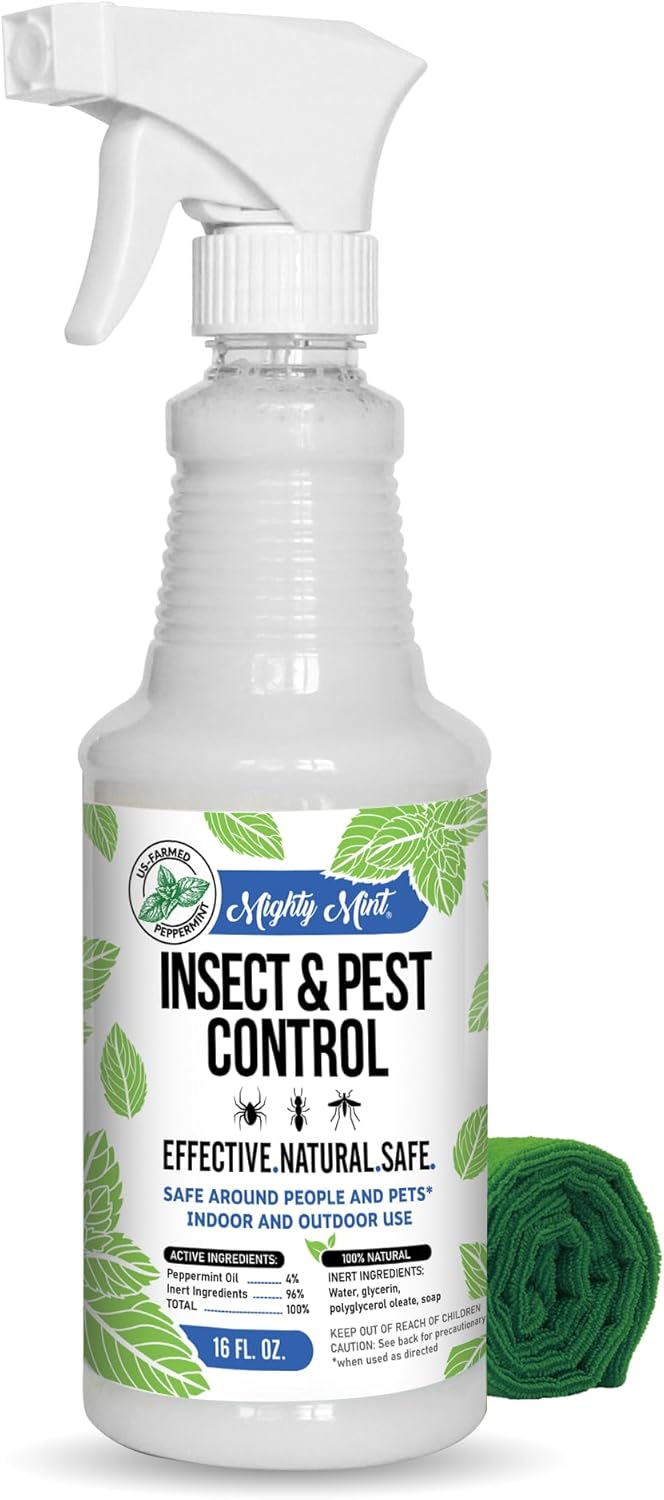
| Ingredients | Water, Glycerine, Polyglycerol oleate, Soap, Peppermint oil |
|---|---|
| Use Areas | Indoor / Outdoor |
| Size | 16 oz |
Mighty Mint is a plant-based, ready-to-use spray that uses concentrated peppermint oil to repel a broad range of household and patio pests. You apply it directly to problem areas such as baseboards, entryways, patios and around outdoor seating; the manufacturer recommends shaking and spraying until surfaces are covered and repeating applications two or more times per week for best results. Notable features include a peppermint-only scent profile, a formulation that avoids synthetic fragrances and the convenience of a 16 oz spray bottle for targeted spot treatments. Practical benefits are that it is safe to use around people and pets when dry and does not leave obvious stains on most surfaces, and the scent can make treated areas smell fresher than chemical alternatives. Important limitations are that it is a repellent rather than a pesticide so it works by discouraging pests rather than killing them, effectiveness depends on regular reapplication and it should not be applied when pollinators are present or to skin or food-contact surfaces.
Best for: Buyers who prioritize natural, low-toxicity solutions and want a targeted spray to reduce insects around patios and entryways while keeping family and pets in mind.
Less Ideal for: Anyone needing a one-time extermination or long-term residual pesticide for severe infestations should consider professional treatments or products formulated to kill pests rather than repel them.
- Plant-based peppermint formula that avoids synthetic fragrances
- Ready-to-use spray for quick, targeted indoor and outdoor applications
- Safe for people and pets when used as directed and allowed to dry
- Nonstaining on most surfaces and leaves a fresh mint scent
- Repels rather than kills insects so regular reapplication is needed to maintain protection
- Strong peppermint concentration may bother scent-sensitive individuals and requires keeping children and pets away until dry
Verdict: Choose Mighty Mint when you want a pet-friendly, plant-based spray to reduce patio and entryway insects with a fresh peppermint scent.
Safer Home Diatomaceous Earth 4 lb (OMRI Listed)

| Unit Count | 67.2 Ounce |
|---|---|
| Item Form | Powder |
| Target Species | Insects |
| Specification Met | OMRI |
| Active Ingredients | Silicon Dioxide 85.0% |
Safer Home Diatomaceous Earth is a fine powder that kills a broad range of crawling insects by abrading their exoskeletons and causing dehydration rather than using chemical toxins. It is applied dry to cracks, crevices, along baseboards, or as a perimeter barrier outside and can also be placed directly on visible insects. The product is OMRI listed so it is compliant for use in organic gardening and leaves no odor or stains, which makes it safe for use around planted beds when directions are followed. Because the mechanism is mechanical, insects cannot build resistance and you can expect affected pests to die within about 48 hours of contact, although large infestations will take longer for individuals to encounter the powder. Reapplication is necessary after rain or watering since the powder washes away. Note that this formulation is not food grade, so avoid applying where it might contaminate edible produce or food preparation surfaces.
Best for: Buyers who prefer low-toxicity, nonchemical pest control and want an organic-compliant option for managing crawling insects around the home and garden.
Less Ideal for: People who need rapid knockdown of very large infestations or require a product safe to apply directly on food or inside food-preparation areas.
- OMRI listed for use in organic gardening, suitable for beds and around plants when applied correctly
- Kills by physical action so insects do not develop resistance
- Odorless and non-staining, suitable for indoor use along baseboards and in cracks
- Versatile for indoor or outdoor application and can be used directly on crawling insects
- Not food grade so must be kept away from areas where it could contaminate food or edible crops
- Loses effectiveness when wet and requires reapplication after rain or watering
- Works slowly on individuals so may take several days to reduce large infestations
Verdict: Choose this OMRI-listed diatomaceous earth if you want a low-toxicity, nonchemical way to reduce crawling insects in and around the home and garden.
Choosing the Right Natural Cockroach Killer: Key Factors to Consider
Effectiveness Against Different Life Stages
Cockroach infestations persist when treatments only affect adults. An effective option should either kill nymphs and adults quickly or deliver an ingredient that transfers between insects to reach hidden eggs and young. In practice, products that include a slow-acting toxicant or a desiccant mechanism can help reduce population rebound by interrupting breeding. Consider whether the treatment explicitly notes egg destruction or acts via ingestion and transfer, because that determines how many repeat applications you will need and how quickly you can expect visible results.
Safety Around People and Pets
Natural does not automatically mean nonhazardous, so evaluate human and pet exposure risks before selecting a treatment. Check active ingredient types and typical exposure pathways: inhalation for sprays, dermal contact for residues, and ingestion for baits. For households with toddlers, seniors, or curious pets, favor contained delivery methods such as enclosed baits or gels and avoid aerosols in food-prep areas. Also consider ventilation needs for sprays and whether the product requires temporary removal of people or animals from treated rooms.
Application Method and Placement
How you apply a product affects both effectiveness and convenience. Baits and gels are useful for cracks, voids, and behind appliances where cockroaches forage. Dusts and desiccants work well in voids and wall cavities but can be messy and require careful placement. Sprays provide quick contact knockdown on sighted roaches but have limited residual action and can push insects deeper into hiding. Choose a delivery method that matches the infestation pattern in your home and your comfort level with performing reapplications or reaching tight spaces.
Residual Activity and Reapplication Frequency
Residual longevity determines how often you must reapply and how well the product prevents reinfestation. Some natural formulations rely on desiccants or botanical oils that lose potency faster and need more frequent reapplication, while others use slow-acting transfer mechanisms that provide longer-term suppression. Think about living conditions such as humidity and cleaning routines that reduce residual deposits. If you prefer low-maintenance control, prioritize options with longer residual activity or mechanisms that continue working after initial placement.
Impact on Indoor Environment
Consider odors, dust, staining, and effects on sensitive surfaces. Sprays and some botanical oils can leave noticeable smells that linger in small spaces. Dusts may be tracked or redistributed by pets and foot traffic. Enclosed baits typically have minimal impact on indoor air quality and surfaces. Also weigh any compatibility issues with food-prep surfaces and indoor plants. Minimizing collateral effects reduces the need for additional cleaning and lowers the chance of accidental human or pet exposure.
Ease of Monitoring and Follow-Up
Effective control requires follow-up to confirm population decline. Choose products that are easy to monitor visually or with simple traps after application, so you can assess progress and adjust tactics. Clear indicators include dead cockroaches near bait stations or reduced live sightings in typical harborage zones. Some treatments make it easier to measure success because they are applied in fixed placements rather than broadcast methods. An approach that simplifies monitoring reduces wasted effort and helps you time reapplications more efficiently.
How Natural Options Work in Real Homes
Natural cockroach control relies on several mechanisms that behave differently in lived-in spaces. Botanical oils often repel and can cause quick knockdown on contact but fade with cleaning or ventilation. Desiccant dusts physically dry insects and can be very effective in wall voids and under appliances where they are protected from humidity and foot traffic. Baits deliver active ingredients through ingestion and can produce colony-level reductions if cockroaches carry bait particles back to harborage sites.
When choosing a delivery form for your home, think about where cockroaches hide and how people use the space. Enclosed baits and gels work well in kitchens and bathrooms because they limit exposure to residents while targeting foraging insects. Desiccants and dusts are better suited to dry, undisturbed voids or behind baseboards.
- Botanical sprays: immediate contact effect, limited residual
- Desiccant dusts: physical mechanism, strong where dry
- Baits and gels: ingestion-based, good for lifecycle control
Application Tips for Kitchens and Bathrooms
Focus treatment in the typical travel routes: along baseboards, under sinks, behind appliances, and near plumbing penetrations. Clean visible food debris and store food in sealed containers before placing baits. For sprays, avoid applying directly on food-prep surfaces; treat cracks and behind appliances instead.
If using baits, place them in narrow gaps and under appliances where pets and children cannot access them. For dusts and desiccants, use small, targeted applications in voids and use a hand duster or injector nozzle for precise placement to minimize tracking.
- Seal food and clean surfaces before treatment
- Place baits in protected, low-traffic locations
- Use injector nozzles for dusts to reach voids
Integrating Natural Control Into Longer-Term IPM
Natural treatments perform best as part of an integrated pest management approach. Combine sanitation, exclusion, and targeted treatments to reduce harborages and food sources. Seal cracks, fix leaks, and reduce clutter to make treatments more effective and reduce the frequency needed.
Regular monitoring with sticky traps and periodic inspections helps confirm whether the chosen natural approach is working. If activity persists after correct application and follow-up, consider rotating modes of action or consulting a pest professional for hard-to-reach infestations.
- Sanitation and exclusion reduce reinfestation pressure
- Rotate treatment modes if control stalls
- Use traps to monitor treatment progress
Special Considerations for Households With Pets
Pets alter exposure dynamics; treatments that leave loose powders or accessible bait blocks can be risky if not secured. Look for enclosed bait options or apply dusts only in voids and behind barriers that pets cannot reach. Keep treated areas off-limits until residues have settled or been wiped away per product instructions.
Also consider pets that groom themselves outdoors and may carry residues into the home. Choose low-odor, low-transfer formulations and store all pest control products out of reach to prevent accidental ingestion.
- Prefer enclosed baits or gels in pet households
- Apply dusts only in inaccessible voids
- Store products securely away from pets
When to Reapply and What to Expect
Expect some variability in how quickly you see reductions. Contact sprays may produce visible knockdown within hours but rarely solve an infestation alone. Baits can take several days to weeks for colony-level declines because they depend on feeding behavior and transfer. Desiccants start working after exposure but may require time for insects to contact treated areas.
Check placements weekly for signs of activity and dead insects. If you do not see reduced activity after two to three weeks, reassess sanitation and placement, and consider alternating delivery methods to reach hidden pockets of infestation.
- Sprays: fast knockdown, short residual
- Baits: slower but colony-impacting
- Desiccants: persistent where kept dry
How We Chose the Best Natural Cockroach Killer
We focused on formulations and delivery methods that are suitable for home and indoor use and that rely primarily on non-synthetic or minimally toxic active approaches. Selection prioritized options that demonstrably interrupt cockroach life cycles, provide measurable knockdown or population reduction, and do so with lower acute toxicity compared with conventional synthetic insecticides. We also considered application ease for typical households, the ability to place or hide treatments in crawl spaces and kitchen crevices, and compatibility with pets and children when used per label directions. Long-term control potential and resistance management were evaluated by looking at mode of action variety and whether the approach targets eggs or only adults. Products that required specialized equipment, professional-only application, or unproven anecdotal claims were excluded. Final picks represent a balance of control effectiveness, safety profile, practical placement options, and lifecycle disruption.
FAQ
Are natural cockroach treatments safe to use around children?
Many natural treatments have lower acute toxicity than conventional insecticides, but safety varies by formulation and exposure route. Enclosed baits and gels generally reduce risk because they limit access, while sprays and loose dusts can increase exposure. Always follow label directions and keep treated areas away from children until the product indicates it is safe.
Will natural options eliminate a severe infestation on their own?
Severe or well-established infestations are harder to control and often require an integrated approach. Natural options can reduce numbers and help with maintenance, but severe cases may need repeated targeted treatments, diligent sanitation, and exclusion work. Persistence and correct placement are key to success.
How long before I see results from a natural bait?
Baits rely on feeding and transfer, so it can take several days to a few weeks to see a significant population drop. Initial dead insects might appear sooner, but colony-level reductions depend on how widely cockroaches forage and whether bait reaches hidden harborage sites.
Can I use natural dusts in wall voids and behind cabinets?
Yes. Dusts and desiccants are particularly effective in voids where cockroaches move and remain undisturbed. Use small, precise applications with an injector to place dust into cavities and avoid broadcasting powders where people or pets can contact them.
Do natural repellents prevent reinfestation?
Some botanical repellents can deter foraging cockroaches temporarily, but repellents rarely provide long-term population suppression on their own. Repellents are best used alongside sanitation and exclusion measures to reduce the chance of reinvasion.
Final Verdict
Natural cockroach control can be an effective, lower-risk option when you choose the right delivery method for the infestation and living environment. Prioritize products that either interrupt the cockroach life cycle or provide a reliable residual while fitting your household safety needs. Expect tradeoffs: fast-contact methods work quickly but need repeat applications, while baits and transfer-based options take longer but can reduce populations more sustainably. Use monitoring and exclusion to confirm progress and pick the approach that best matches your home and tolerance for follow-up.
