

Note: This article contains affiliate links. If you click on these links and make a purchase, I may earn a small commission at no extra cost to you. This helps support my research and content. Read my full affiliate disclosure here.
If you want to cut cockroach populations without relying on harsh synthetic pesticides, an organic cockroach killer narrows the field to lower-toxicity options you can use around people and pets. Choosing the right product matters because cockroaches live in hidden cracks, reproduce quickly, and can survive many standard treatments if placement or formulation is wrong. This guide covers seven shortlisted organic cockroach killers that perform well in homes and apartments and explains how we evaluated them for real-world use. Expect clear information on effectiveness, safe application, and where each style fits in a home pest-control plan.
Top Picks at a Glance
| Best Overall The best all-around choice for most situations | EcoVenger Roach Killer Repellent Spray, Plant-Based, 16 oz |  |
| Best Quality Built to a higher standard if you want something more solid | Geomust Diatomaceous Earth with Peppermint Oil, Food Grade, 1 lb |  |
| Best Value The sweet spot between price and what you get | Harris Diatomaceous Earth Crawling Insect Killer, 8 oz |  |
| Best Budget The cheapest option that still gets the job done reliably | EcoLogic Ant & Roach Killer Aerosol 14 oz |  |
| Highest Rated A top-rated pick with lots of positive feedback | NCSIFDD Roach Away Repellent gel, 6-Pack |  |
| Most Popular A crowd favorite that many people choose with confidence | STEM Plant-Based Bug Spray for Ants, Roaches and Flies, 12 fl oz |  |
| Best Seller A high-volume bestseller chosen again and again | Safer Home Diatomaceous Earth 4 lb (OMRI Listed) |  |
EcoVenger Roach Killer Repellent Spray, Plant-Based, 16 oz

| Net volume | 16 oz |
|---|---|
| Active ingredients | Geraniol, Cedarwood Oil, Peppermint Oil, Sodium Lauryl Sulfate |
| Intended pests | Roaches, ants and other crawling insects |
| Residual protection | Up to 4 weeks |
EcoVenger Roach Killer is a ready-to-use, plant-derived spray designed to kill roaches on contact and act as a longer-lasting deterrent. You use it like a standard spray: shake, apply directly to visible pests for knockdown, and treat hiding places such as baseboards, under sinks, cabinets, and around pipes to create a barrier. Notable features include a peppermint scent that fades quickly, a water-based, nonstaining formula, and active botanical ingredients (geraniol, cedarwood oil, peppermint oil) that target insect nervous systems without synthetic pyrethroids. In practical terms it is well suited for kitchens, bathrooms, and food-storage areas because it claims safe use around people and pets and does not require vacating treated spaces. Expect fast contact kills and residual repellent effect that the brand states can last up to four weeks, which helps reduce follow-up treatments. Limitations are that results can vary with heavy infestations and it is not a bait or systemic solution for nests behind walls, so severe or hidden infestations may still need an integrated approach.
Best for: Buyers who want a low-odor, plant-based indoor roach spray for routine control and prevention in kitchens, bathrooms, or rental properties where quick knockdown plus short-term deterrence is a priority.
Less Ideal for: People dealing with large, established infestations inside wall voids or plumbing where professional nest-targeted treatments or baits are needed.
- Plant-based active ingredients that avoid synthetic pyrethroids
- Kills on contact while also providing reported residual repellency for up to four weeks
- Water-based, low-odor formula that is described as non-staining
- Suitable for use around people, pets, and in sensitive indoor areas without vacating
- May be less effective on severe, hidden infestations where nest treatment or baits are required
- Effectiveness and duration of residual control can vary by environment and pest pressure
Verdict: A plant-based indoor spray that delivers fast on-contact roach kills plus weeks of repellency for routine, low-odor home control.
Geomust Diatomaceous Earth with Peppermint Oil, Food Grade, 1 lb
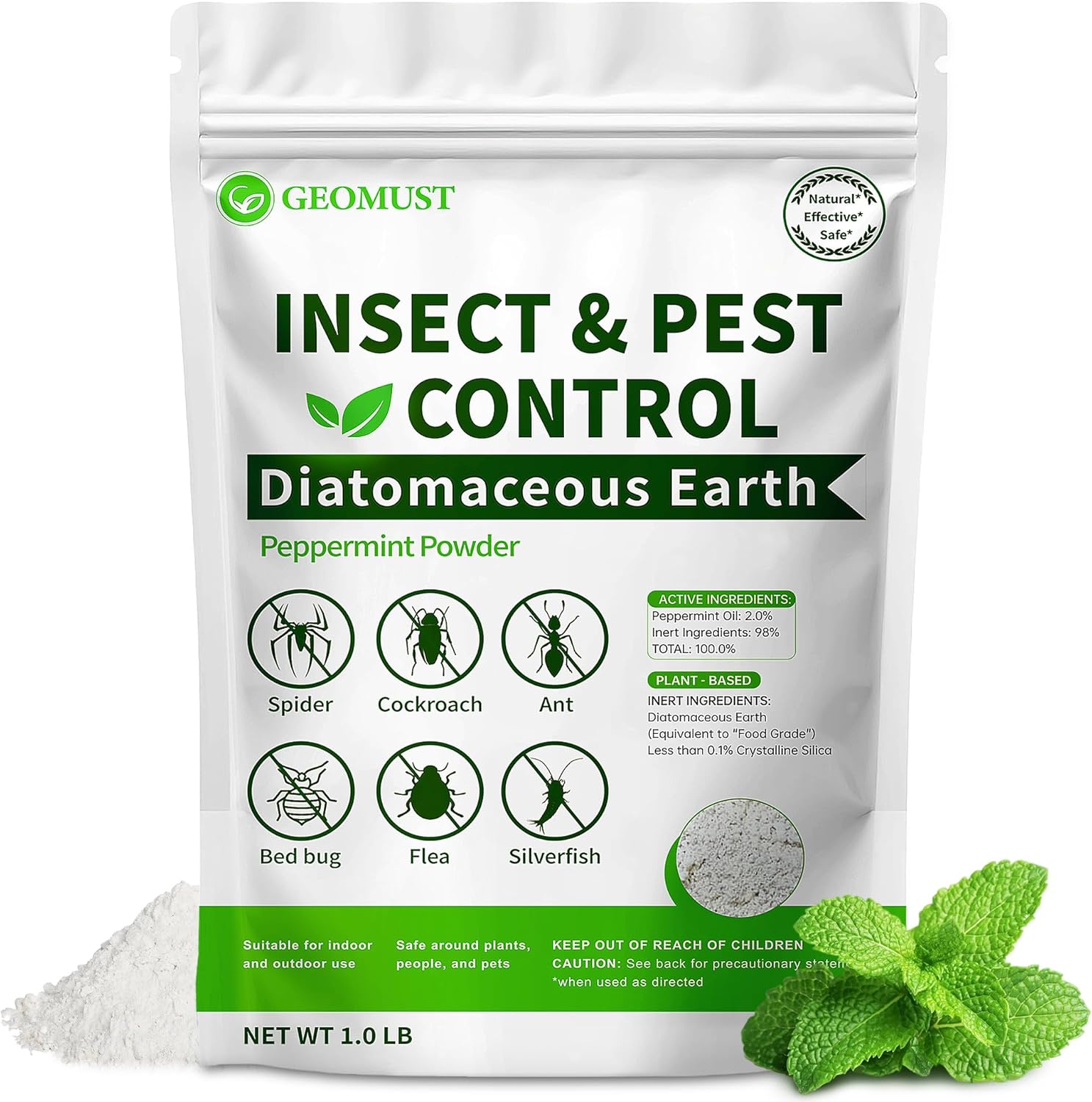
| Unit Count | 16 Ounce |
|---|---|
| Item Form | Powder |
| Target Species | Ants; Cockroaches; Fleas; Bed Bugs; Silverfish; Insects |
| Ingredients | Diatomaceous Earth; Peppermint Oil |
This Geomust diatomaceous earth product is a food-grade powder mixed with peppermint oil designed to kill ants, roaches, fleas, bed bugs, silverfish and other crawling pests by physical desiccation. It is typically applied as a dry dust along baseboards, entry points, under appliances and around foundations; the peppermint oil also helps mask odors and may deter insects from treated areas. The formula is safe to use around children and pets when applied as directed and works best when kept dry, providing a lingering barrier that does not rely on synthetic pesticides. Expect visible results against smaller infestations within a few days, but heavy infestations will require repeated applications and thorough placement in hiding spots. Because it acts mechanically rather than chemically, it does not provide instant knockdown and must remain dry to remain effective. For someone focused on performance using an organic approach, it is a reliable, low-toxicity option when used consistently and with careful targeting of pest pathways.
Best for: Buyers who prioritize effective, low-toxicity pest control and are willing to apply treatments carefully and reapply as needed for sustained performance.
Less Ideal for: People who need rapid, immediate elimination of large roach infestations or who cannot keep treated areas dry should consider faster-acting or professional solutions.
- Food-grade diatomaceous earth provides a non-chemical, physical mode of action against crawling insects
- Includes peppermint oil to help mask odors and add a natural repellent effect
- Can be used indoors and outdoors to create a dry barrier at entry points and hiding places
- Long-lasting when kept dry and does not leave toxic residues
- Ineffective when wet and requires reapplication after moisture exposure
- Works slowly and does not provide immediate knockdown on heavy infestations
Verdict: A reliable organic, low-toxicity dust that delivers sustained control of crawling pests when applied correctly and kept dry.
Harris Diatomaceous Earth Crawling Insect Killer, 8 oz

| EPA registration | No. 3-18 |
|---|---|
| Active ingredient | 100% freshwater diatomaceous earth |
| Intended use | Indoor & outdoor |
This ready-to-use diatomaceous earth product provides a non-chemical way to control ants and other crawling pests around the home. You apply the fine powder in cracks, along baseboards, near entry points, or in crawlspaces using the included puffer tip for targeted placement. The diatomaceous earth works mechanically by abrading insect exoskeletons and causing dehydration, so insects that contact the dust typically die within 48 hours. Because the material is 100% freshwater diatomaceous earth with no additives and is EPA registered, it is a good fit when you want a low-toxicity option usable near people and pets when directions are followed. It stays effective indefinitely as long as it stays dry, making it a convenient barrier treatment in attics, basements, garages, and around foundations. Limitations are that it must remain dry to work and it is a contact-only control method, so heavy infestations or nesting insects may require repeated application or combined methods for faster results.
Best for: Practical households that prioritize low-toxicity, long-lasting ant control and want a simple, targeted treatment they can apply themselves around entry points and inside cracks.
Less Ideal for: People facing severe or widespread infestations who need rapid knockdown or prefer liquid chemical treatments should consider professional services or a different product.
- 100% freshwater diatomaceous earth with no additives for a non-chemical control option
- Built-in puffer tip allows precise application into cracks and crevices
- Remains effective indefinitely when kept dry, providing long-lasting barrier protection
- Mechanically kills a wide range of crawling insects including ants, roaches, fleas, and bed bugs
- Only effective on insects that contact the powder and must stay dry to work
- Not a fast-acting spray alternative for large, established infestations
Verdict: Choose this product if you want a low-toxicity, long-lasting mechanical barrier to control ants and other crawling insects around the home.
EcoLogic Ant & Roach Killer Aerosol 14 oz

| Unit Count | 14 Ounce |
|---|---|
| Item Form | Spray |
| Target Species | Insects |
| Liquid Volume | 14 fluid ounces |
| Active Ingredients | carbon,sodium benzoate |
EcoLogic Ant & Roach Killer is an aerosol contact spray that uses cornmint, cinnamon and clove oils to kill ants, cockroaches, spiders and other listed insects. It is used like a conventional spray: direct into cracks, crevices and entry points until surfaces are visibly wet, repeating treatments as needed. The formula is positioned as a mindful, plant-oil alternative and is labeled safe around children and pets when used and stored according to directions. Practical benefits include fast knockdown on contact and flexibility for indoor or outdoor spot treatments around baseboards, sinks, doorways and patios. Because it is an aerosol, application is quick and reaches hard-to-access hiding spots. Important limitations are that it is a contact-only killer so it will not control hidden nests or provide long-term residual control, and users should avoid spraying food-preparation surfaces and test outdoor finishes for discoloration before use. For routine, targeted control where you prefer a plant-oil formulation, this works well; for heavy infestations a bait or professional treatment will be more effective.
Best for: Buyers who want a low-cost, plant-oil alternative for quick, targeted control of visible ants and roaches around the home and yard.
Less Ideal for: Those facing large or hidden infestations, or people who need long-lasting residual control should consider baits or professional services instead.
- Uses plant-derived oils (cornmint, cinnamon, clove) as active ingredients
- Designed for both indoor and outdoor spot treatments
- Aerosol format reaches cracks and crevices for quick contact kill
- Contact-only action provides little residual protection or colony control
- May discolor some outdoor surfaces if not tested first
Verdict: A budget-friendly, plant-oil aerosol that delivers fast contact kills for spot treatment of ants and roaches around home and outdoor entry points.
NCSIFDD Roach Away Repellent gel, 6-Pack

| Item model number | ROACH |
|---|---|
| Date First Available | June 3, 2026 |
| Manufacturer | NCSIFDD |
| Package quantity | 6 Pcs per box |
This Roach Away Repellent is a gel tube system intended for indoor use around kitchens, cabinets, appliances, and plumbing lines. You cut the nozzle, attach the included applicator, and apply small drops into cracks and crevices where roaches travel. The formula is designed to attract roaches so they pick up the gel and carry it back to the nest, which can reduce the colony rather than only killing visible insects. The package contains six tubes and the manufacturer says a single application can provide protection for up to 60 days. Practical benefits include precise placement with the applicator and an approach that addresses hidden infestations rather than just surface sightings. Expect to see increased roach activity in the first few days as insects are drawn to the bait before the colony impact becomes apparent. The product is marketed as family and pet safe when used as directed, but you should follow label instructions and avoid placing gel where pets or children can access it. This works best as part of an overall sanitation and exclusion plan rather than a lone long-term solution.
Best for: Buyers who want a reliable indoor bait product that focuses on eliminating roach colonies rather than just killing stray individuals and who will apply treatments carefully in targeted areas.
Less Ideal for: People needing an immediate knockdown for a large visible infestation without follow-up measures or those who cannot keep baited areas inaccessible to pets or children.
- Targets hidden nests by attracting roaches to carry bait back to colony
- Includes applicator for precise application in cracks and tight spaces
- Single application claimed to last up to 60 days
- Six tubes per box provide multiple treatment points around the home
- Initial increase in visible roaches as bait attracts them before colony suppression takes effect
- Effectiveness depends on proper placement and concurrent sanitation measures
Verdict: Choose this gel if you want a targeted, colony-focused indoor bait that is applied precisely and designed for longer-lasting control.
STEM Plant-Based Bug Spray for Ants, Roaches and Flies, 12 fl oz

| Active ingredients | Geraniol 6.2%, Lemongrass Oil 0.5% |
|---|---|
| Other ingredients | White Mineral Oil, Isopropyl Myristate, (+)-Ethyl Lactate 93.9% |
| Form | Trigger spray |
| Use | Indoor and outdoor spot treatments |
This STEM bug spray is a trigger-spray insecticide formulated with plant-derived actives such as geraniol and lemongrass oil to kill ants, roaches and flies on contact. It is intended for targeted indoor and outdoor spot treatments: shake, hold about a foot from the insect and spray directly on or where insects congregate. The product’s botanical formula and absence of added dyes or strong chemical fragrances make it a reasonable choice for homes where users prefer less synthetic-smelling options. The trigger bottle gives control for spot application and repeated short bursts, and the directions note it is oil-based so spills should be cleaned promptly. Important limitations are that it is not for spraying on people, pets or plants and requires direct hits for best effect rather than long-range fogging. For persistent infestations you may need supplemental measures because this is designed for surface and contact kills rather than residual baiting or area-wide control.
Best for: Buyers who want an affordable, low-odor botanical spray for quick spot control of common household pests and who prioritize a simple, easy-to-use trigger bottle for targeted treatments.
Less Ideal for: People facing large or hidden infestations who need long-lasting residual control or bait-style solutions should consider professional products or integrated pest control approaches.
- Plant-based active ingredients (geraniol and lemongrass oil) that reduce strong chemical odor
- Trigger-spray bottle for controlled, targeted application
- Labeled for both indoor and outdoor spot treatments when used as directed
- No added dye or fragrance listed, which minimizes residue and scent
- Oil-based formula can leave slippery residue if spilled
- Requires direct spraying of insects for effectiveness and offers limited residual control
- Not safe to spray on people, pets or plants
Verdict: A budget-friendly, low-odor plant-based trigger spray that provides quick, targeted kills of ants, roaches and flies for everyday spot treatments.
Safer Home Diatomaceous Earth 4 lb (OMRI Listed)

| Unit Count | 67.2 Ounce |
|---|---|
| Item Form | Powder |
| Target Species | Insects |
| Specification Met | OMRI |
| Active Ingredients | Silicon Dioxide 85% |
Safer Home Diatomaceous Earth is a nonchemical powder insecticide that kills crawling pests by physically damaging their exoskeletons, causing dehydration within about 48 hours after contact. It is typically applied as a thin dust in cracks, along baseboards, around entry points, or as a perimeter barrier outside; the powder is odorless and nonstaining so it can be used in living areas without leaving residues. The product is OMRI listed, which makes it acceptable for organic gardening and appealing to buyers who want to avoid synthetic pesticides. Because it is a mechanical rather than chemical control, insects cannot develop resistance and the product is safe to leave in place until it is disturbed by cleaning or rainfall, at which point reapplication is recommended. Important limitations are that the powder must be placed where insects will contact it so large infestations may take several days to decline and it is not food grade, so avoid applying near edible food or where children and pets might inhale significant dust.
Best for: Buyers who prefer low-toxicity, nonchemical pest control and want an organic-compliant solution for preventing or reducing crawling insect activity around the home and garden.
Less Ideal for: Those needing a fast knockdown for large, established infestations or who require a ready-to-use spray formulation should consider professional services or different products.
- OMRI listed for use in organic gardening
- Works mechanically so insects do not develop chemical resistance
- Odorless and nonstaining for indoor use
- Versatile for indoor cracks and outdoor perimeter barriers
- Not food grade so avoid use near edible items or food prep areas
- Requires direct insect contact and reapplication after rain or heavy cleaning
Verdict: Choose this OMRI-listed diatomaceous earth if you want an organic, nonchemical way to reduce crawling insects by placing a safe, odorless powder barrier where pests travel.
Choosing the Right Organic Cockroach Killer: Key Factors to Consider
Mode of Action
How an organic cockroach killer works determines where and how you use it. Baits rely on ingestion and transfer within the colony, desiccant dusts abrade the insect cuticle to cause dehydration, and botanical contact actives can kill on touch. Knowing the mode of action helps you place the product where roaches feed or travel rather than spraying broadly.
A product that targets feeding behavior will be more effective when placed along foraging routes and near harborages. Desiccant materials perform best in dry cracks and voids where they stay dry and in direct contact with insects. Contact botanicals often require direct exposure and may act faster but with less residual control. Choose a mode of action that matches the infestation size and the access you have to likely roach pathways.
Safety Around People and Pets
Organic does not automatically mean nonhazardous, so check label precautions and active ingredients. Some botanical extracts can irritate skin or airways, while desiccant dusts can be harmful if inhaled in large quantities. Read instructions for use around children, pets, and food-preparation areas, and favor formulations with low inhalation risk and clear placement guidance.
Application format affects exposure risk. Pre-baited stations contain product inside a tamper-resistant housing, reducing direct contact. Loose powders or sprays require more care and may need temporary exclusion of pets and children from treated areas until settled or cleaned according to label directions.
Application Method and Placement
The delivery format determines how easy and precise treatment will be. Gel baits and bait stations let you target cracks, under appliances, and in cabinets without moving furniture. Dusts are useful inside wall voids, under baseboards, and in attics, but they need dry conditions to stay effective. Sprays and aerosols can reach visible surfaces but often lack long-term residual action and are less effective for hiding populations.
Consider how frequently you can monitor and reapply treatments. Baits left undisturbed will work over weeks, while sprays may need repeated application. If access to behind appliances or inside cabinets is limited, choose a format that fits the available application points.
Residual Activity and Longevity
Residual protection varies widely between product types. Some baits maintain attractiveness and lethality for weeks, while botanical sprays may break down quickly from light and heat. Desiccant dusts can remain active for months if kept dry, making them valuable for long-term reduction in sheltered spots.
Plan treatments based on expected longevity. For persistent infestations, combine a long-lasting residual product in key harborages with more immediate-contact options for visible roaches. Note that environmental factors like humidity, cleaning frequency, and foot traffic shorten residual life and will influence reapplication intervals.
Speed of Knockdown Versus Colony Control
Some organic options kill quickly on contact and reduce visible roaches fast, which is useful for immediate relief. Others act slowly and rely on bait transfer to reach eggs and hidden individuals, which is better for long-term colony suppression. Quick knockdown may leave survivors that repopulate, while slower-acting baits can spread through the population and reduce future generations.
Match your choice to the problem stage: use rapid-contact tools when you need immediate reduction and bait-based or transfer-capable options when you aim to break the reproduction cycle over weeks.
Ease of Monitoring and Maintenance
Successful control depends on monitoring to see whether treatments are working and when to reapply. Products that are easy to inspect, such as tamper-resistant bait stations or visible dust lines, make it simpler to track activity. If a product requires frequent replacement or is messy to handle, you may skip steps and reduce overall effectiveness.
Consider how accessible treated sites are for follow-up. Choose materials that stay in place and are simple to renew so you can maintain control until the infestation is resolved.
When to Use Organic Options
Organic cockroach killers are best suited for indoor environments where reducing chemical exposure is a priority, such as homes with young children, pets, or people with sensitivities. They are appropriate for both early-stage infestations and as part of a prevention plan once populations are low.
Use organic approaches alongside sanitation and exclusion. Removing food residues, sealing cracks, and reducing moisture eliminates the conditions that sustain roach populations and boosts the performance of any product you apply.
- Target harbourages: under sinks, behind appliances, inside cabinets
- Combine baiting with physical exclusion and cleanliness
- Rotate modes of action to avoid reduced sensitivity over time
How to Deploy Baits Effectively
Place gel or contained baits along known foraging paths and near harborages rather than on open countertops. Good locations include behind stoves, inside baseboard gaps, and in dark corners where grease accumulates.
Avoid placing baits where routine cleaning will remove them, and check stations periodically to measure uptake. If you see little bait removal after a week, try moving stations closer to visible activity or switch to a different attractant style.
- Use small bait dots instead of large quantities to encourage sharing among roaches
- Keep baits out of reach of children and pets, even if labeled low-toxicity
- Pair baits with sticky traps to monitor activity
Using Desiccant Dusts and Physical Materials
Desiccant dusts are a nonchemical mode of control that can remain active for months when placed in dry cracks and voids. They work best in hidden spaces where they will not be brushed away or exposed to humidity.
Apply dusts sparingly and in thin lines to conserve material and reduce tracking. Use a dedicated applicator for precise placement and avoid areas where cleaning will disperse the dust into living spaces.
- Target under and behind appliances, inside voids, and along attic eaves
- Keep dusts out of wet areas to retain desiccant action
- Wear a dust mask during application to reduce inhalation
Integrating Nonchemical Controls
Sanitation and exclusion are the backbone of long-term control. Seal cracks and gaps around pipes, replace failing weatherstripping, and store food in sealed containers. Reducing moisture with dehumidifiers or fixing leaks removes key attractants for roaches.
Sticky traps and timed monitoring let you gauge infestation size and the effectiveness of treatments without introducing more product. Use findings to adjust placement and frequency rather than applying more product blindly.
- Inspect plumbing and wall voids for hidden moisture
- Keep compost and pet food away from building foundations
- Use door sweeps and mesh screens on vents to block entry
Safety and Cleanup Best Practices
Follow label instructions for reentry intervals and cleanup. Even organic actives can irritate sensitive individuals, so maintain ventilation and avoid applying near food preparation surfaces. If using dusts, avoid sweeping into living areas; instead, vacuum settled dust using a machine with a HEPA filter if cleanup is required.
Store all materials out of reach of children and pets and dispose of empty containers according to local guidance. Keep a small log of application dates and locations to track what was used where and when for follow-up treatments.
- Wear gloves when handling concentrated formulations
- Keep application areas ventilated for several hours if using sprays
- Label and date bait placements for future monitoring
How We Chose the Best Organic Cockroach Killer
We started by focusing on formulations that use low-toxicity active ingredients, mechanical approaches, or biopesticide-derived actives acceptable under organic standards. Each candidate had to demonstrate a plausible mechanism for cockroach control such as ingestion baiting, desiccation, or contact mortality. We prioritized products with clear indoor use directions, minimal off-gassing, and labels that specify safe application zones around food prep and sleeping areas. Longevity of effect and ease of placement were measured through manufacturer persistence claims and typical deployment methods. We excluded broad-spectrum household insecticides that rely on synthetic neurotoxins and any product without clear indoor-safety labeling. Evaluation criteria focused on effectiveness against common indoor roach species, residual activity period, safety profile for people and pets, ease of application and placement, and resistance-management benefits like bait matrices or physical modes of action. These criteria reflect what matters for home use: controlling current infestations, preventing quick reinfestation, and minimizing exposure risks during routine household activities.
FAQ
Are organic cockroach killers safe to use around pets?
Many organic options are lower in acute toxicity but safety depends on the active ingredient and application format. Tamper-resistant bait stations are usually safer than loose powders or sprays. Always follow label precautions and keep pets away from treated zones until the product is settled or secured.
How long does it take to see results with organic baits?
Bait-based approaches often take several days to weeks to show population declines because they rely on roaches feeding and transferring the material through the colony. Visible reductions in active roaches can appear within a week for many infestations, but full colony suppression typically requires sustained placement and monitoring.
Can I use desiccant dusts in kitchens and food prep areas?
Desiccant dusts can be used in cracks and voids near kitchens but should not be applied directly on food-contact surfaces. Avoid areas where dust can be swept into food prep zones. Use targeted applications under appliances and inside wall voids instead of open counters.
Will organic products prevent re-infestation?
Organic products help reduce populations but preventing re-infestation depends on sanitation and exclusion. Sealing entry points, removing food sources, and maintaining dry conditions are necessary to keep cockroaches from returning. Use treatments as part of a broader integrated pest management plan.
Can I combine different organic methods for better control?
Combining complementary methods often improves results, such as pairing long-lasting bait stations with desiccant dust in voids and intensified sanitation. Avoid applying multiple products to the exact same spot at the same time, and follow label instructions to prevent reducing bait attractiveness or creating unsafe conditions.
Final Verdict
When choosing an organic cockroach killer, focus on the mode of action, application method, and safety profile rather than assuming all organic options perform the same. For immediate reduction, select a contact option placed strategically; for lasting colony control, prefer baits or transfer-capable formulations combined with exclusion and sanitation. Prioritize products that match the infestation stage and that you can monitor and maintain easily to achieve the best long-term outcome.
