

Note: This article contains affiliate links. If you click on these links and make a purchase, I may earn a small commission at no extra cost to you. This helps support my research and content. Read my full affiliate disclosure here.
Potted citrus need a feeding strategy different from in-ground trees because root space, watering frequency, and potting mix all change nutrient dynamics. The right fertilizer for citrus trees in pots replaces what washes out with regular watering, supports balanced leaf and fruit growth, and avoids salt buildup that can harm roots. This guide covers seven shortlisted fertilizers that suit container citrus, and explains the practical tradeoffs in nutrient form, release rate, and application frequency. Read on to see how we evaluated ease of use, nutrient balance, and long-term soil health to help you pick the best fit for your patio or balcony trees.
Top Picks at a Glance
| Best Overall The best all-around choice for most situations | FoxFarm Happy Frog Citrus & Avocado Fertilizer (4 lb) |  |
| Best Quality Built to a higher standard if you want something more solid | Espoma Organic Citrus-Tone 5-2-6 Organic Fertilizer for Citrus, Fruit, Nut & Avocado Trees, 4 lb |  |
| Best Value The sweet spot between price and what you get | Miracle-Gro Shake 'N Feed Citrus, Avocado, Mango Plant Food, 4.5 lb |  |
| Best Budget The cheapest option that still gets the job done reliably | Grow More Citrus Grower Blend (10 oz) Organic Citrus Fertilizer with Chelated Micronutrients |  |
| Highest Rated A top-rated pick with lots of positive feedback | Jack's Classic Citrus FeED 20-10-20 Water‑Soluble Fertilizer, 24 oz |  |
| Most Popular A crowd favorite that many people choose with confidence | Jobe's Organics Granular Fruit & Citrus Fertilizer, 4 lb |  |
| Best Seller A high-volume bestseller chosen again and again | TPS Nutrients Lemon Tree Fertilizer Liquid, 8 fl oz |  |
FoxFarm Happy Frog Citrus & Avocado Fertilizer (4 lb)

| Item Form | Granules |
|---|---|
| Specific Uses For Product | Organic |
| Target Species | Citrus, Avocado |
| Unit Count | 64 Ounce |
| Mixing Ratio | 7:3:3 |
This granular fertilizer is designed specifically for citrus and avocado trees and supplies slow-release nitrogen alongside calcium and sulfur to support steady vegetative growth. It is typically applied to the root zone a few times per year (manufacturer suggests 1/2 cup per foot of tree height for established trees, three times annually) and should be watered in after application. Notable features include an OMRI-listed organic formulation and a mycorrhizal fungi blend intended to improve root efficiency and nutrient uptake. In practice this product simplifies seasonal feeding for home orchardists who want a reliable, low-maintenance feed that promotes steady growth without frequent applications. Practical benefits are ease of use, organic certification, and the addition of microbes that can help marginal soils. Important limitations are that it is a single-purpose, granular formula so it does not replace targeted nutrient correction for specific deficiencies and it requires following the mixing/measurement guidance to avoid overapplication on small or container trees.
Best for: Home orchardists and gardeners who prioritize reliable, low-maintenance fertilization to support steady growth and want an organic, microbe-enhanced option for citrus and avocado trees.
Less Ideal for: Growers who need rapid correction of a diagnosed nutrient deficiency or who require a water-soluble feed for foliar or drip-irrigation applications should consider other products.
- Formulated specifically for citrus and avocado so nutrient balance matches common needs
- OMRI-listed organic formula suitable for organic gardeners
- Includes mycorrhizal fungi to aid root efficiency and nutrient uptake
- Slow-release granules reduce how often you need to feed trees
- Granular single-formula does not address specific micronutrient deficiencies
- Application amounts must be measured by tree height which may be awkward for mixed-size plantings
Verdict: A dependable organic slow-release fertilizer with beneficial microbes that makes seasonal feeding of citrus and avocados simple and low maintenance.
Espoma Organic Citrus-Tone 5-2-6 Organic Fertilizer for Citrus, Fruit, Nut & Avocado Trees, 4 lb

| Item Form | Granules |
|---|---|
| Specific Uses For Product | Agriculture,Gardening,Plant Growth |
| Application Method | Spread evenly over the entire tree or plant area |
| Target Species | Citrus, Fruit Trees, Nut Trees, Avocado |
Espoma Citrus-Tone is a ready-to-use granular organic fertilizer designed specifically for citrus and other fruit and nut trees, including avocados. You apply it by spreading the measured amount around the tree drip line and watering it in; the product requires no mixing. The 5-2-6 NPK formula with 5% calcium and the Bio-tone microbial blend supports steady vegetative growth, flowering and fruit set while feeding soil biology. As a granular, slow-release option it is convenient for seasonal feedings in late winter, after bloom and in fall. It is certified for organic production and contains no inert sludges or fillers, so it fits an organic care program. Limitations are the small 4 lb package size for larger trees or multiple specimens and the need to reapply seasonally rather than provide continuous feeding like some slow-release spikes or timed-release products. For home gardeners managing a few avocado trees this product gives targeted, organic nutrition in an easy-to-apply format.
Best for: Home gardeners who want an organic, easy-to-apply fertilizer to support flowering and fruiting on one or a few avocado trees and who prefer simple seasonal feedings.
Less Ideal for: Large-scale growers or anyone seeking a single-season, low-maintenance slow-release system for many large trees should consider higher-capacity or different delivery formats.
- Organic, certified input suitable for organic avocado production
- 5-2-6 NPK with 5% calcium supports fruit set and overall tree health
- Ready-to-use granules require no mixing and are simple to apply
- Includes Bio-tone microbial blend to support soil biology
- Small 4 lb bag may be insufficient for large mature trees or multi-tree yards
- Granular application requires seasonal reapplication rather than long-term timed release
Verdict: A compact, certified organic granular fertilizer that delivers targeted nutrition and soil biology support for home avocado trees in a simple seasonal application.
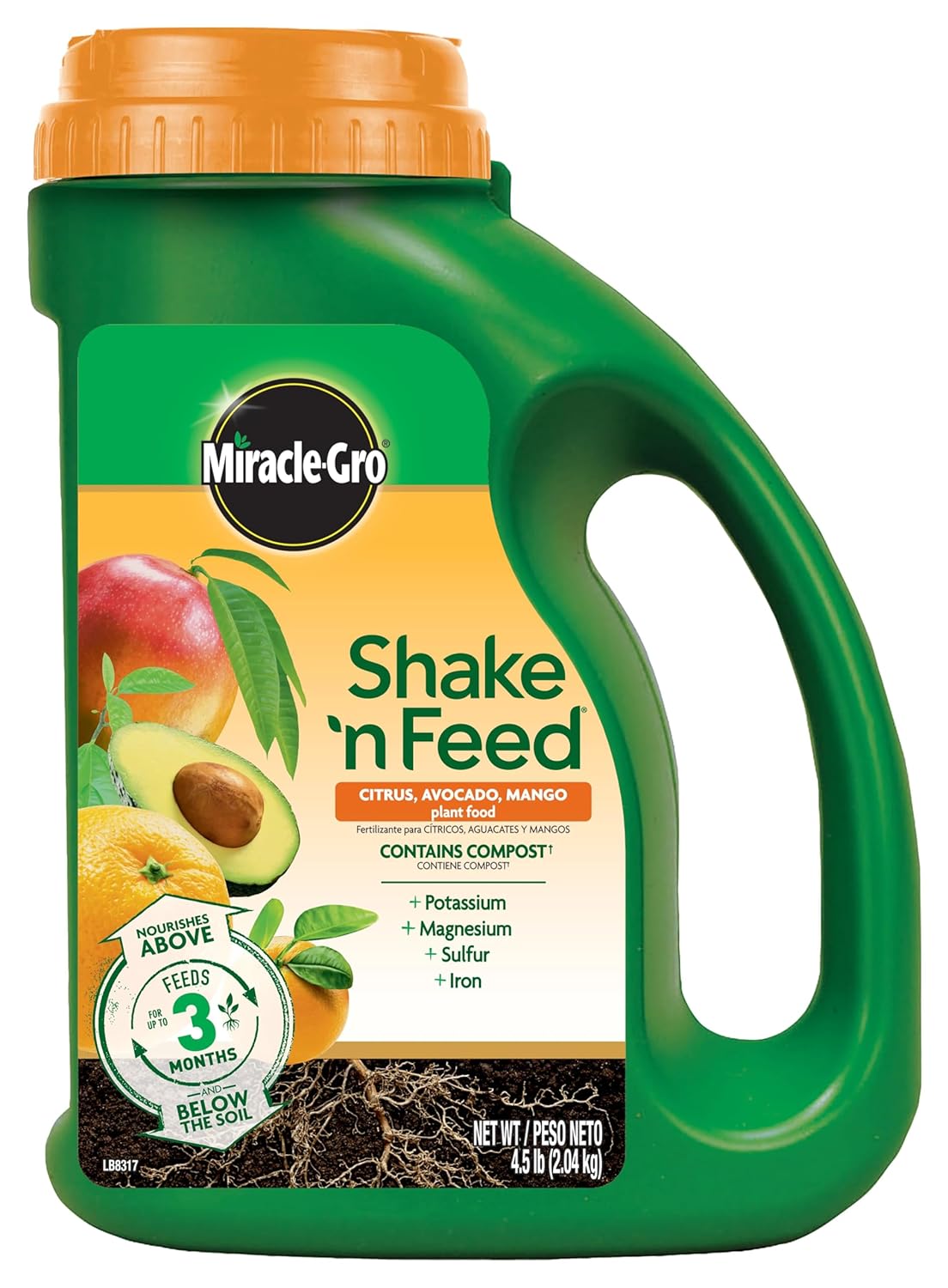
Miracle-Gro Shake 'N Feed Citrus, Avocado, Mango Plant Food, 4.5 lb
| Item Form | Granules |
|---|---|
| Application Method | Shake evenly onto soil |
| Target Species | citrus, avocado, mango |
| Mixing Ratio | 8-2-10 |
| Coverage | Medium |
This Shake 'N Feed formula is a granular, slow-release fertilizer made for citrus, avocado and mango trees in containers or in-ground. You shake the granules evenly onto the soil within the branch spread or mix into potting mix at planting, then water to start feeding; one application feeds plants for up to three months. The N-P-K listed (8-2-10) and added micronutrients such as potassium, magnesium, sulfur and iron help correct common deficiencies and support root development through microbes in the mix. It is practical for seasonal feeding and reduces the frequency of applications compared with quick-release fertilizers. Limitations include that it is a general fruit-tree feed rather than a lemon-specific formula and needs correct placement to avoid contact with trunks or foliage. For established trees you must follow label rates to avoid overfeeding and reapply every three months to maintain nutrition through the growing season.
Best for: Practical gardeners who want an easy, low-maintenance feeding schedule for lemon and other citrus trees and prefer a single product that works in pots and beds.
Less Ideal for: Growers who need a custom nutrient program based on soil tests or who want a fast-acting liquid feed for quick corrections should consider more targeted products.
- Slow-release formula provides up to 3 months of feeding per application
- Contains N-P-K 8-2-10 plus micronutrients to address common deficiencies
- Works for both container and in-ground citrus and other fruit trees
- Easy shake-and-feed application that reduces application frequency
- Not a lemon-specific formulation so may lack tailor-made ratios for particular soil tests
- Requires careful placement and incorporation to avoid trunk or foliage contact
Verdict: Use this to keep lemon trees consistently fed with a convenient, three-month slow-release granular fertilizer.
Grow More Citrus Grower Blend (10 oz) Organic Citrus Fertilizer with Chelated Micronutrients

| Item Form | Powder |
|---|---|
| Specific Uses For Product | Plant Growth |
| Coverage | Medium |
| Target Species | Citrus |
| Mixing Ratio | 17:0:0 |
Grow More Citrus Grower Blend is a small, water‑soluble powder designed for citrus trees in containers and similar ornamental plants. Mixed at the manufacturer ratio, it delivers a high nitrogen formulation along with chelated micronutrients such as iron, zinc, manganese, and copper for quicker leaf response and improved vigor. It can be applied to the soil or as a foliar feed, which makes it handy for correcting micronutrient deficiencies without repotting. The product is compact and concentrated so a 10 ounce container stretches across many feedings for individual potted trees, which helps keep ongoing costs low. Important limitations are that the NPK is heavily weighted toward nitrogen so it is better for vegetative growth than for pushing fruit set, and handling precautions are needed because it is an active powder. For budget‑minded growers with a few patio citrus in pots, this is a practical concentrated option to maintain green, healthy foliage and address minor nutrient shortfalls.
Best for: Owners of a few potted citrus or other patio ornamentals who want a low-cost, concentrated fertilizer to keep foliage healthy and correct micronutrient deficiencies without frequent repurchasing.
Less Ideal for: Growers focused primarily on maximizing flowering and fruit set or those managing large numbers of trees who need a balanced NPK program tailored to fruiting.
- Concentrated powder form covers many feedings from a small container
- Contains chelated micronutrients (iron, zinc, manganese, copper) for easier uptake
- Usable as soil drench or foliar spray for flexible application
- Targets citrus with a formulation intended to improve leaf vigor and fruit quality
- NPK is heavily nitrogen‑biased, so it is not optimized for bloom and fruiting stages
Verdict: A concentrated, budget‑friendly powder fertilizer that keeps potted citrus foliage vigorous and corrects micronutrient shortages with flexible soil or foliar application.
Jack's Classic Citrus FeED 20-10-20 Water‑Soluble Fertilizer, 24 oz

| Item Form | Powder |
|---|---|
| Application Method | foliar or root feeding |
| Specific Uses For Product | Plant Growth |
| Mixing Ratio | 20:10:20 |
Jack's Classic Citrus FeED is a professional‑grade, water‑soluble powder designed to feed potted citrus and other tropical fruiting plants. Mix the powder to the label rate to create liquid feed for either foliar sprays or soil drench applications, and use the included measuring spoon for consistent dosing. The 20-10-20 NPK balance promotes leafy growth and strong branches while supporting fruit set, and the built‑in micronutrient package reduces the need for separate supplements. Because it is a concentrated powder, a single container makes multiple gallons of feed, which is convenient for regular scheduled applications on patio citrus. Practical limits are that you must measure and dissolve it correctly and follow the recommended feeding schedule to avoid overfertilizing sensitive container roots, and it does not include an automatic feeder or slow‑release option for low‑maintenance setups. For gardeners who prioritize reliable, repeatable nutrition, this product delivers precise, professional formulations that translate directly to healthier potted citrus when used as directed.
Best for: Buyers who want a dependable, lab-formulated fertilizer for regular, hands‑on feeding of potted citrus and tropical fruit; ideal for gardeners who follow a feeding schedule and value consistency.
Less Ideal for: People seeking a set‑and‑forget slow‑release product or those who want a liquid ready‑to‑use feeder with no mixing required.
- Professional 20-10-20 NPK formula tailored for citrus and tropical fruiting plants
- Water-soluble powder concentrates make many gallons of feed from one container
- Includes micronutrients so additional supplements are usually unnecessary
- Suitable for foliar or root feeding for flexible application methods
- Comes with a measuring spoon for consistent, repeatable mixes
- Requires manual measuring and mixing each feed rather than providing slow-release convenience
- Not designed for automated or continuous-feed systems without additional equipment
Verdict: A concentrated, professional 20-10-20 water‑soluble feed that gives reliable, repeatable nutrition for potted citrus when mixed and applied on a regular schedule.
Jobe's Organics Granular Fruit & Citrus Fertilizer, 4 lb

| Item Form | Granules |
|---|---|
| Specific Uses For Product | Plant Growth, Root Development, Seed Development, Soil Conditioning |
| Application Method | Spread evenly around base |
| NPK | 3-5-5 |
| OMRI Listed | Yes |
This granular Jobe's Organics fertilizer is designed to feed fruit and citrus trees with a slow-release, root-targeted NPK of 3-5-5. It is typically applied by measuring and spreading the granules evenly around the base of the tree, then watering in; applications are recommended every 4 to 8 weeks during the growing season. Notable features include OMRI listing for organic gardening, a blend of feather meal, bone meal and processed poultry manure for organic nutrient sources, and a resealable bag for convenient storage. In practice the formula supports root development and fruit set without synthetic chemicals, and the slow-release nature reduces the need for very frequent feeding. Limitations are that the lower nitrogen level makes it better suited for fruiting and flowering stage nutrition rather than rapid leafy growth, and larger trees will require repeated applications or larger quantities. For gardeners aiming for an organic, low-fuss feed for citrus, this provides predictable, targeted nutrition, but it is not a quick-fix soluble feed for immediate green-up.
Best for: Gardeners who prefer organic, low-maintenance feeding for citrus and fruit trees and want a slow-release product that focuses on fruit and root health.
Less Ideal for: Growers needing fast, high-nitrogen correction or a soluble foliar feed; landscapers managing many mature trees who need bulk quantities more often.
- OMRI listed organic formula suitable for certified organic gardens
- Balanced 3-5-5 NPK aimed at improving flowering and fruit production
- Slow-release granules that feed roots over time and reduce application frequency
- Resealable packaging keeps product fresh between uses
- Lower nitrogen content means it will not rapidly promote leafy growth
- 4 lb bag may be insufficient for mature trees or larger plantings
Verdict: A reliable OMRI-listed granular fertilizer that delivers slow-release, fruit-focused nutrition for organic citrus gardeners.
TPS Nutrients Lemon Tree Fertilizer Liquid, 8 fl oz

| Item Form | Liquid |
|---|---|
| Application Method | Watering can, hose end sprayer, or leaf misting |
| Target Species | Lemon Trees |
| Mixing Ratio | 1:200 |
| Liquid Volume | 8 fluid ounces |
This 8 fl oz liquid fertilizer from TPS Nutrients is made specifically for lemon and other citrus trees and is used by diluting at the recommended 1:200 ratio and applying with a watering can, hose‑end sprayer, or by leaf misting. It is designed to promote fruit production, support healthy leaves and shoots, and build stronger roots so trees absorb water and nutrients more effectively. The liquid form delivers nutrients quickly for potted trees on patios as well as in-ground specimens, and the medium coverage makes it suitable for individual trees or small groups. Practical benefits include fast absorption, simple dilution and multiple application methods that fit common garden routines. Limitations are the small 8 ounce bottle size, which means frequent repurchasing for larger citrus collections, and lack of detailed NPK values on the label for gardeners who prefer exact nutrient ratios. Overall this is a convenient, citrus-focused supplement for home growers seeking straightforward feeding for Meyer and dwarf varieties.
Best for: Home gardeners who want a ready-to-use, citrus-specific feed for one or a few lemon trees and prefer simple dilution and flexible application methods.
Less Ideal for: Growers managing larger orchards or multiple mature trees who need bulk quantities or exact NPK formulations should consider commercial‑scale fertilizers instead.
- Formulated specifically for lemon and citrus so nutrients suit citrus needs.
- Liquid concentrate with 1:200 mixing for quick uptake and flexible application.
- Multiple application methods: watering can, hose‑end sprayer, or foliar misting.
- Suitable for both potted and in‑ground citrus, useful for patios and small orchards.
- Small 8 fl oz bottle may not last for multiple trees or large plantings.
- Product listing does not provide explicit NPK numbers for precise nutrient planning.
Verdict: A convenient liquid concentrate tailored to lemon and citrus that makes regular feeding easy for home growers with one or a few trees.
Choosing the Right Fertilizer for Citrus Trees in Pots: Key Factors to Consider
Nutrient Ratio and Timing
Citrus in containers need a fertilizer with an N-P-K balance that supports both leafy growth and fruit development. Too much nitrogen can lead to vigorous foliage at the expense of blooms, while insufficient phosphorus and potassium can limit fruit set and flavor. Look for products with a moderate first number for nitrogen, and reasonable middle and last numbers to support flowering and fruiting. Timing matters because potted trees often benefit from lower-rate, steady feeding throughout the growing season rather than a single heavy boost.
Consider seasonal adjustments: slightly higher nitrogen in early spring for canopy recovery, then shifting to formulations or schedules that favor bloom and fruit development as the season progresses.
Micronutrients and Chelation
Citrus are prone to iron and zinc deficiencies, especially in potting mixes that drain well or have alkaline tendencies. A fertilizer that includes essential micronutrients – iron, manganese, zinc, copper, and boron – reduces the chance of chlorosis and poor fruit set. Chelated iron or other chelated trace elements are particularly useful in containers because they stay plant-available across a wider pH range.
Regular micronutrient feeding or selecting a comprehensive formula can prevent recurring foliar deficiency symptoms and support steady growth without needing separate corrective sprays.
Release Mechanism: Quick-Release Versus Slow-Release
Fast-release liquid fertilizers give rapid correction and are useful when trees show clear deficiency symptoms or during active growth spurts. They require more frequent applications and careful dosing to avoid salt buildup. Slow-release granular or coated formulas feed for weeks to months, reducing application frequency and the risk of accidental overfeeding in small containers.
Match the release mechanism to your maintenance style: choose liquids if you monitor and water frequently and want fast response; choose slow-release if you prefer set-and-forget feeding and less frequent handling.
Salt Index and Root Health
Containers concentrate salts because watering flushes nutrients out slowly and there is limited soil volume to dilute buildup. High-salt fertilizers can damage feeder roots and cause leaf burn over time. Check product labeling for guidance on salt index or recommended application rates for containers. Also plan periodic leaching with extra water to flush accumulated salts when appropriate.
Lower-salt formulations and slow-release options that avoid large salt pulses are generally safer for long-term potted citrus health.
Application Convenience and Dosing
Practical factors like whether the fertilizer is a soluble powder, liquid concentrate, or granular spike affect everyday use. Small containers need precise, low-volume dosing; a concentrated liquid with an easy dilution chart or measured scoops for granules makes feeding less error-prone. Spikes and coated granules reduce measuring errors but may offer less flexibility in fine-tuning rates.
Also consider whether the product requires special tools to apply and how easy the label instructions are to interpret for typical container sizes.
Compatibility with Potting Mix and Watering Regimen
Your potting mix texture, organic matter content, and watering frequency influence nutrient availability. Fast-draining mixes may leach soluble nutrients faster and thus benefit from more frequent feeding or slow-release granules. Heavier, moisture-retentive mixes release nutrients more slowly and can tolerate less frequent applications.
Match fertilizer form and schedule to how often you water and the mix you use to avoid underfeeding or salt accumulation.
When to Start Feeding Potted Citrus
Begin feeding as new growth starts in spring when trees exit winter dormancy. For young trees, start with a lighter schedule to avoid overstimulating root growth, and increase nutrient supply as the canopy develops. Stop or reduce feeding as growth slows in late fall to let the tree harden off.
If you repot in spring, delay heavy applications until roots reestablish and you have watered a few times. Newly repotted trees benefit from a lower initial dose because fresh potting mixes often contain starter nutrients.
- Start light after repotting; increase gradually.
- Feed more frequently during active growth and bloom.
- Reduce feeding entering dormancy or cool weather.
How to Apply Fertilizer in Different Container Sizes
Small patio pots and large patio tubs need different dosing approaches because root volume and dilution differ. In small pots, use dilute liquid feeds or low-rate slow-release granules to avoid salt stress. Larger containers can handle full-strength applications but still require careful measurement.
For even nutrient distribution in large containers, scatter granules evenly and water thoroughly after application. For liquids, pour around the root ball at multiple points rather than one concentrated spot to avoid localized salt concentrations.
- Small pots: frequent low-dose liquids or low-rate spikes.
- Large containers: standard dosing with even distribution.
- Always water after applying granular fertilizers to activate them.
Signs of Overfeeding and How to Respond
Overfeeding commonly shows as leaf burn, brown leaf margins, wilting despite moist soil, or poor root health. In containers, salt accumulation is the usual culprit. If you suspect overfeeding, stop applications immediately and flush the potting mix by watering thoroughly until water runs clear from drainage holes.
If symptoms persist after leaching, consider repotting into fresh mix or trimming damaged roots and foliage. Adjust future feeding to smaller, more frequent doses or switch to a lower-salt formula.
- Look for brown margins, sudden wilting, and stunted growth.
- Leach pots thoroughly to remove excess salts.
- Reduce dose frequency and monitor recovery over weeks.
Using Foliar Feeding and Soil Applications Together
Foliar sprays can quickly correct micronutrient deficiencies like iron chlorosis because leaves absorb trace elements faster than roots can recover them. However, foliar feeding is a short-term fix and should complement a proper soil feeding program rather than replace it.
Use foliar applications sparingly and follow label directions. Combine with a balanced soil fertilizer that supplies macronutrients and ongoing micronutrient support to maintain tree health between foliar corrections.
- Foliar sprays are fast for micronutrient fixes.
- Use foliar feeding as a supplement, not a primary program.
- Avoid excessive foliar applications to prevent leaf scorch.
Adjusting Feeding for Bloom and Fruit Set
As citrus move from vegetative growth into bloom, slightly reduce high-nitrogen inputs and ensure adequate phosphorus and potassium to support flower development and fruit quality. Balanced feeding during bloom helps increase fruit set and reduces flower drop caused by nutritional imbalances.
Consider switching to a bloom or fruiting-focused schedule or formula during heavy flowering, then return to a maintenance program once fruit is established and sizing begins.
- Lower nitrogen during bloom, emphasize P and K.
- Maintain micronutrients for pollination and fruit development.
- Reassess feeding once fruits begin to size and mature.
How We Chose the Best Fertilizer for Citrus Trees in Pots
We focused on fertilizers that match the needs of citrus grown in containers rather than orchard or landscape formulas. Evaluation emphasized nutrient ratios useful to citrus, nitrogen source and timing, and whether formulas include the micronutrients citrus commonly need such as iron, manganese, and zinc. We also considered release mechanism since potted trees respond differently to fast-release versus slow-release products. Ease of application and clarity of dosing were important for container gardeners who often feed smaller, more frequent portions. Salt content and the presence of chelated micronutrients were used to judge root-safety and uptake in potting mixes. Exclusions: we did not include bulk agricultural blends intended for field use, concentrated industrial blends that require equipment, or products lacking clear nutrient labeling. The final shortlist balances measured nutrient content, release characteristics, container-friendly dosing, and documented suitability for fruiting citrus in pots.
FAQ
How often should I feed a citrus tree in a pot?
It depends on the fertilizer form. Liquid feeds are usually applied every 2 to 4 weeks during the growing season, while slow-release granules can last several months. Adjust frequency based on growth rate and container size.
Can I use general houseplant fertilizer for potted citrus?
General houseplant formulas can work short-term but may lack the micronutrient balance citrus often need. Choose products with appropriate N-P-K ratios and added iron and trace elements for best results.
Will too much fertilizer make my citrus leafier and reduce fruit?
Yes. Excessive nitrogen favors leafy growth and can suppress flowering and fruit set. Use balanced feeding and reduce nitrogen as trees begin to bloom to encourage fruit development.
How do I fix yellow leaves on my potted citrus?
Yellow leaves can indicate overwatering, nutrient deficiencies, or iron chlorosis. Test soil moisture first, then check for signs of nutrient lack. A citrus-suited fertilizer with chelated iron often corrects iron-related yellowing within weeks.
Should I flush my potting mix to remove salts?
Periodic leaching helps prevent salt buildup, especially after frequent liquid feeding or heavy granular use. Water thoroughly until runoff clears, and avoid overwatering afterward to prevent root oxygen loss.
Final Verdict
For citrus in containers, prioritize a fertilizer that matches seasonal needs, supplies essential micronutrients, and minimizes salt stress. Decide between fast-acting liquids for quick corrections and slow-release formulas for low-maintenance feeding based on how often you monitor and water. Focus on nutrient ratio, micronutrient inclusion, and clear dosing guidance to avoid common container problems. With the right feeding approach you can keep potted citrus productive and healthy without frequent trial and error.
