

Note: This article contains affiliate links. If you click on these links and make a purchase, I may earn a small commission at no extra cost to you. This helps support my research and content. Read my full affiliate disclosure here.
Choosing the right full spectrum grow light makes a big difference for indoor and small greenhouse gardens. The correct fixture affects plant stretch, leaf color, flowering timing, and electricity use, so selecting a light that matches your crop and space saves time and frustration. This guide reviews seven top full spectrum grow lights chosen for different indoor growing situations. We shortlisted options that deliver usable light across the PAR band, offer sensible mounting and coverage, and keep energy use manageable. Read on to see the criteria we used and what matters when picking a fixture for seedlings, leafy greens, or flowering plants.
Top Picks at a Glance
| Best Overall The best all-around choice for most situations | Spider Farmer SF1000 100W Full Spectrum LED Grow Light |  |
| Best Quality Built to a higher standard if you want something more solid | VIVOSUN LumaLight 100W LED Full Spectrum Grow Light |  |
| Best Value The sweet spot between price and what you get | LBW Halo Full Spectrum LED Grow Light with Base (3-Head) |  |
| Best Budget The cheapest option that still gets the job done reliably | Briignite A19 Full Spectrum LED Grow Light Bulb (2-Pack) |  |
| Highest Rated A top-rated pick with lots of positive feedback | Ximraek Full-Spectrum Dual-Head Grow Light with Adjustable Stand and Timer |  |
| Most Popular A crowd favorite that many people choose with confidence | GooingTop HY-021 6000K Full-Spectrum Clip Grow Light |  |
| Best Seller A high-volume bestseller chosen again and again | Barrina T5 1 ft Full-Spectrum Grow Light, 4-Pack |  |
Spider Farmer SF1000 100W Full Spectrum LED Grow Light

| Light Source Type | LED |
|---|---|
| Light Output Maximum | 10000 lumens |
| Light Source Wattage | 100 watts |
| Light Source Special Features | Dimmable |
| Specification Met | IP67 |
The Spider Farmer SF1000 is a compact 100W full spectrum LED grow light intended for 2×2 to 3×3 grow spaces and small tents. It uses a high diode count and upgraded LED chips to deliver broad-spectrum output that supports seedlings through flowering, with a dimmer knob to reduce intensity for early stages and ramp up for bloom. The fanless design and thick aluminum heatsink keep operation quiet while providing passive cooling, and the fixture meets IP67 for durable performance. Typical use is ceiling or tent mounting above individual plants or a small canopy where uniform coverage and deeper canopy penetration matter. Notable features include daisy-chain compatibility for linking multiple units under unified dimming, a 0–100% dimmable control, and a driver claimed to offer efficient power delivery. Practical benefits are even light distribution in a small footprint, predictable veg-to-flower capability, and near-silent operation. Limitations are inherent to its class: it is sized for small areas so you will need multiple units for larger tents, and the product description emphasizes specs from manufacturer tests rather than independent third-party PPFD maps.
Best for: Growers who want a quiet, compact full spectrum light for a small tent or single-plant setup and value adjustable intensity for each growth stage.
Less Ideal for: People running larger multi-plant rooms or commercial operations who need higher total output and broader single-fixture coverage.
- Full spectrum output suitable for all growth stages with added red and IR for flowering
- Dimmable 0–100% control lets you tailor light intensity to seedlings, veg, and bloom
- Fanless design with sturdy aluminum heatsink for quiet, low-maintenance operation
- Compact footprint ideal for 2×2 to 3×3 tents and small indoor setups
- Daisy-chain capable so multiple fixtures can be linked and dimmed together
- Coverage and power are intended for small grows so larger areas require multiple units
- Manufacturer gives efficiency and coverage figures without independent third-party PPFD charts
Verdict: A quiet, dimmable 100W full spectrum fixture that is a practical, balanced choice for hobbyists running 2×2 to 3×3 tents.
VIVOSUN LumaLight 100W LED Full Spectrum Grow Light

| Wattage | 100 watts |
|---|---|
| Light Source Type | LED |
| Number of Light Sources | 336 |
| Is Waterproof | True |
| Control Method | Remote |
The VIVOSUN LumaLight 100W is a compact full-spectrum LED grow light intended for indoor gardens and patios. It uses a mix of white, blue, red and far-red diodes to support all growth stages from seedlings through flowering, and the array is arranged to deliver uniform intensity across the canopy. Typical use is hanging above a small grow area with the included rope hangers and adjusting intensity via the four-level dimming knob or remote/mobile control when paired with VIVOSUN accessories. Notable features include IP65 water and dust resistance for high-humidity setups, a low-heat design for closer placement to plants, and Bluetooth/remote control compatibility for easier scheduling. Practical benefits are even coverage for several small plants, lower heat stress, and long expected LED life. Limitations are its 100W power level, which is best for small tents or a few plants rather than larger grow rooms, and some advanced scheduling requires the separate GrowHub controller for full smart automation.
Best for: A practical home grower who wants a reliable, compact full-spectrum light for seedlings through flowering and values even coverage and low heat in a small tent or patio setup.
Less Ideal for: Large-scale growers or those outfitting multi-shelf systems who need higher wattage fixtures or broader coverage should consider more powerful models.
- Full-spectrum diode mix (white, blue, red, far-red) suitable for all growth stages
- Dimmable four-level control plus Bluetooth/remote connectivity for convenient intensity adjustments
- IP65 waterproof and dustproof rating allows use in humid or misted environments
- Low-heat design with aluminum body for efficient thermal management and longer LED life
- At 100 watts it is intended for small tents or modest plant counts and not optimized for larger grows
- Advanced smart scheduling requires purchasing the GrowHub controller separately
Verdict: A dependable, compact full-spectrum LED grow light that delivers even coverage and low heat for small indoor grows.
LBW Halo Full Spectrum LED Grow Light with Base (3-Head)

| Number of Light Sources | 3 |
|---|---|
| Wattage | 7 watts |
| Power Source | Corded Electric |
| Switch Type | Dimmer |
| Voltage | 5 volts |
This LBW Halo grow light is a small plug-in LED lamp designed to give potted plants steady supplemental light year-round. It uses a three-head design with a tabletop base or a soil stake option so you can either sit the pot on the widened base or insert the pole into the pot for more direct placement. The fixture offers full-spectrum output with white, warm, and full-spectrum modes plus five brightness steps and an automatic timer with 6/8/12/16-hour settings, which makes it easy to set-and-forget light schedules for seedlings, herbs, succulents, and other plants up to about 20 inches tall. The low 7-watt draw and 5-volt operation keep energy use minimal, and the aluminum base adds stability. Limitations to expect are modest light power and reach compared with larger multi-LED panels, so it is best for single pots or small clusters rather than a wider grow bench; the built-in timer also means you should not use an external smart plug or timer with it.
Best for: Buyers who want a compact, low-energy grow light that simplifies care with preset timers and dimming for single pots, seedlings, herbs, or succulents in apartments or small indoor setups.
Less Ideal for: Not a good choice for growers who need high-output panels to light multiple plants, large specimens, or a full seed-starting bench.
- Full-spectrum LEDs with three color modes to match growth stages
- Five brightness levels plus 6/8/12/16-hour timer for easy automated schedules
- Two mounting options: stable widened base or soil stake for flexibility
- Low power consumption suitable for long daily runtimes
- Aluminum base adds stability and durable feel
- Light output and coverage are limited to small pots and plants up to about 20 inches tall
- Not intended for use with external smart plugs or timers
Verdict: A small, energy-efficient full-spectrum lamp that automates light schedules and delivers practical supplemental light for single potted plants and seedlings.
Briignite A19 Full Spectrum LED Grow Light Bulb (2-Pack)

| Light Type | LED |
|---|---|
| Additional Features | Full Spectrum |
| Bulb Base | E26 |
| Light Output Maximum | 1000 lumens |
| Light Source Operating Life | 30000 hours |
These Briignite A19 grow bulbs are full-spectrum LED replacements that screw into any standard E26 fixture to give indoor plants consistent, natural-looking light. Each bulb outputs about 1000 lumens at roughly 11 to 12 watts, so they act like a 60 to 100 watt incandescent while using far less energy, which is handy for running multiple bulbs on a budget. The 3500–4000K warm daylight color and high CRI make foliage colors appear normal rather than the purple hue of some grow lights, so they work well in living spaces and plant shelves. Built-in features include app control and push-button options and an advertised 25,000 to 30,000 hour operating life. Limitations to note are modest reported PPF compared with purpose-built high‑output grow fixtures and the 180 degree beam, which is better for general room lighting than targeted canopy penetration for dense or tall plants. For small collections, seed starting, or supplementing light in low-light rooms these bulbs are an economical, easy-to-install choice.
Best for: Houseplant owners who need an affordable, plug-and-play light to supplement natural light for a few pots, seedlings, or a small indoor garden while keeping energy costs low.
Less Ideal for: Growers aiming to flower large or dense canopy crops or outfitting multi-tiered grow racks will want higher‑PPF, purpose-built fixtures instead.
- Full spectrum output that looks like natural white light and preserves true foliage color
- Low power draw (around 11–12W) with 1000 lumens brightness for energy-efficient continuous use
- Standard E26 base fits common fixtures for tool-free installation
- High CRI of 90 helps accurate color rendering in living spaces
- Beam angle and lumen-focused design give less concentrated PAR/PPF than dedicated high‑output grow fixtures
- App and push-button controls are basic compared with advanced programmable controllers
Verdict: A low-cost, easy-to-install full-spectrum LED bulb that gives natural-looking light and energy savings for small indoor plant collections.
Ximraek Full-Spectrum Dual-Head Grow Light with Adjustable Stand and Timer

| Light Output Maximum | 1800 lumens |
|---|---|
| Wattage | 45 watts |
| Color Temperature | 6000 Kelvin |
| Color Rendering Index | 95 |
| Light Source Special Features | Full Spectrum |
The Ximraek Full-Spectrum Dual-Head Grow Light is designed to provide adjustable, balanced illumination for indoor plants. It uses 174 LEDs (a mix of white, red, and blue) and offers three lighting modes plus ten brightness levels so you can match spectrum and intensity to seedlings, vegetative growth, or flowering. Two rotating light bars on flexible goosenecks and a telescoping stand (about 10 to 19.6 inches) make it easy to direct light over several small pots or a single taller houseplant. A built-in timer supports 4/8/12/18-hour cycles for hands-off schedules. Practical benefits include high CRI for color accuracy, a broad 120 degree beam angle for wide coverage, and an aluminum build that keeps the unit lightweight yet stable on a stand base. Limitations to note are the single light source design rather than a broad panel, and its reach is best suited to shelf- and tabletop-sized setups rather than large grow racks or full-canopy coverage for many plants.
Best for: Buyers who prioritize consistent, fuss-free indoor lighting for a handful of houseplants and want flexible spectrum and timer controls to maintain reliable daily schedules.
Less Ideal for: Growers planning to light large collections, multi-shelf grow racks, or full-canopy vegetable grows should choose a larger panel or multiple units instead.
- Full-spectrum LED array with red, blue, and white diodes for stage-specific plant needs
- Three lighting modes and 10 brightness levels for precise control
- Dual rotating heads and 360° goosenecks allow targeted coverage for multiple pots
- Built-in 4/8/12/18-hour timer for consistent daily light cycles
- Aluminum construction gives a lightweight yet durable stand-mounted form factor
- Telescoping height and single-unit beam are best for small to medium setups and may not cover large multi-shelf systems
- Reported wattage specs vary (45 watts vs 80 watts listed) which may require checking actual power draw
Verdict: A dependable, adjustable full-spectrum grow light that delivers targeted, timer-controlled illumination for small to medium indoor plant collections.
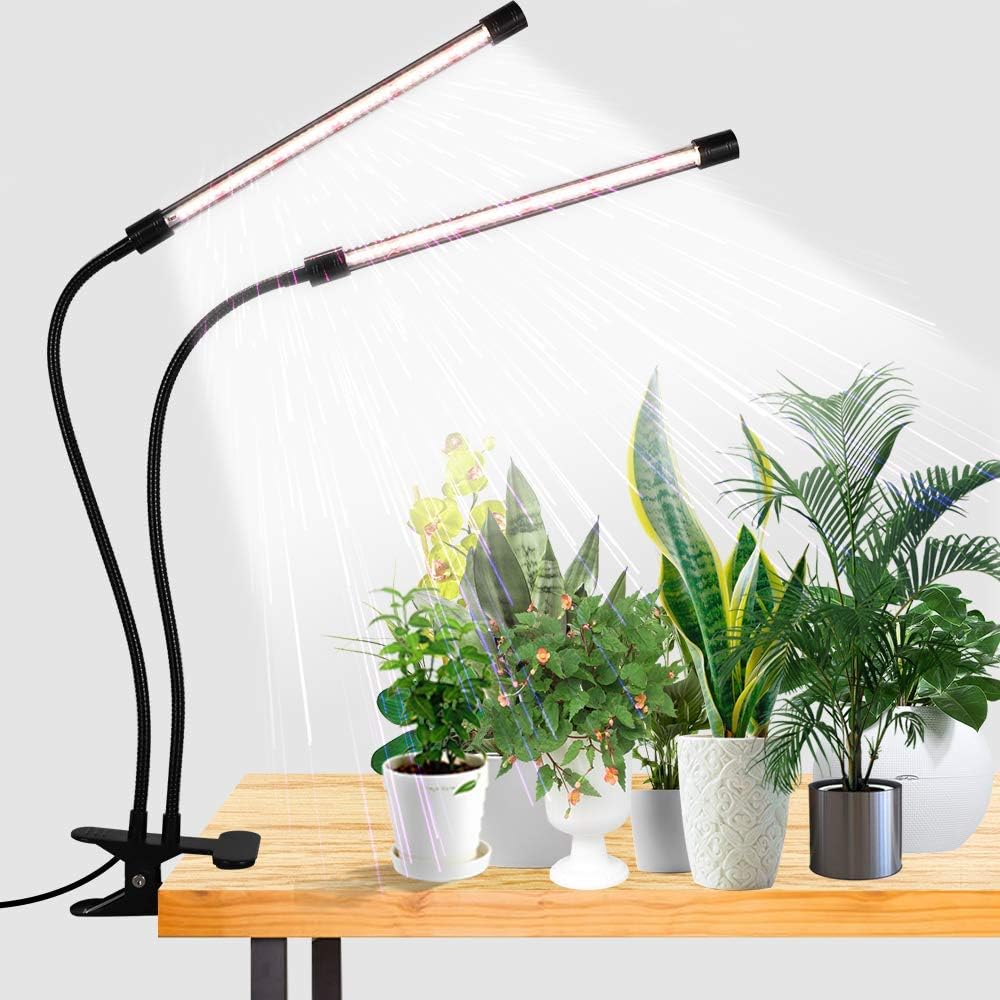
GooingTop HY-021 6000K Full-Spectrum Clip Grow Light
| Power Source | Corded Electric |
|---|---|
| Color Temperature | 6000 Kelvin |
| Light Output Maximum | 2500 lumens |
| Light Source Special Features | Dimmable |
| Number of Light Sources | 84 |
This GooingTop HY-021 is a compact clip-on grow light built for small houseplants, seedlings and shelf gardens. It uses 84 LEDs (white plus deep red) to deliver a 6000K full-spectrum output intended to mimic midday sun, with a high color-rendering output that also makes it pleasant as a reading lamp. Two flexible gooseneck heads and a strong clamp let you aim light precisely over pots and seed trays, while the attached remote provides 50%/100% dim levels and repeating timers at 4, 8 or 12 hours for hands-off scheduling. Practical benefits include low power draw (listed as roughly 10 W LED draw), a claimed 1 to 2 square meter coverage for seedlings, and an included timer that simplifies day/night cycles. Limitations are its design for small setups rather than large grow racks and the clip mounting limits placement compared with freestanding fixtures. The unit also relies on the corded remote instead of a smartphone app and the lifespan claim is typical of LEDs but not independently verifiable from the listing.
Best for: Buyers who want a simple, low-power, plug-and-play grow light to boost seedlings and a few houseplants on a desk or shelf and who value an easy-to-use timer and adjustable brightness.
Less Ideal for: Growers planning multi-shelf installations, larger vegetable grows, or who need networked or app-based control should consider larger bar lights or fixtures designed for commercial racks.
- Full-spectrum 6000K output with added 660 nm red LEDs to support vegetative growth and flowering
- Attached remote with dimming (50%/100%) and repeat timer settings (4/8/12 hours) for easy scheduling
- Flexible dual goosenecks and strong clamp enable precise positioning over small pots and seed trays
- High reported color rendering for comfortable viewing and accurate plant color assessment
- Low electrical draw around 10 W while covering small growing areas
- Clip-mount design and stated 1–2 m² coverage make it better suited to individual plants or small trays rather than large multi-shelf setups
- No smart app or wireless control option; remote is cord-attached which limits placement flexibility
Verdict: A compact, easy-to-use clip grow light that delivers full-spectrum light and convenient timer/dim controls for small indoor plant setups.
Barrina T5 1 ft Full-Spectrum Grow Light, 4-Pack

| Wattage | 5W per fixture |
|---|---|
| Color temperature | 5000K Full Spectrum |
| Linkable | Link up to 16 lights |
| Control | Separate on/off for each fixture |
The Barrina T5 1 ft grow light 4-pack is a compact, plug-and-play LED kit designed for starting seedlings and maintaining young plants. Each slim fixture delivers 5000K full-spectrum light and can be switched independently, so you can tailor run time and intensity across a seed tray or multi-shelf setup. Installation is straightforward: magnetic bars, clips and cable ties are included and lights can be linked in series up to 16 units to cover longer benches. At low power (about 5W per fixture) the strips offer a high density of LEDs and claim strong PPFD for seedlings and vegetative growth while staying energy efficient. Practical benefits include a discreet black housing and dark cords that blend into indoor shelving and simple separate controls for staged germination. Limitations are that the fixtures are short (1 ft), so covering wider trays requires multiple units and you may need to mount them close to plants for optimal intensity, which reduces headroom for taller seedlings.
Best for: Buyers who want a low-risk, easy-to-install grow light for seed starting and early growth and who prefer straightforward controls and modest energy use.
Less Ideal for: Growers who need a single wide fixture to cover large trays or who require high vertical clearance for taller seedlings should consider longer or higher-output fixtures instead.
- Full-spectrum 5000K output suited to seedling and vegetative stages
- Magnetic and clip mounting with plug-and-play setup for fast installation
- Linkable design lets you run up to 16 fixtures from one source for larger racks
- Separate on/off control for each 1 ft unit to customize light schedules
- Short 1 ft length means multiple fixtures are needed to cover larger seed trays
Verdict: A compact, energy-efficient full-spectrum kit that makes seed starting simple with easy mounting, separate controls, and scalable linkable units.
Choosing the Right Full Spectrum Grow Light: Key Factors to Consider
Photosynthetic Photon Flux Density (PPFD)
PPFD measures the number of photosynthetically active photons that hit a surface each second and is the most direct indicator of how well a light will drive plant growth.
Higher PPFD supports faster growth and higher yields for fruiting or flowering crops, while seedlings and delicate herbs do better under moderate PPFD. Look at PPFD maps or stated output at realistic hanging heights rather than peak numbers at the fixture surface. Consider the crop and growth stage when choosing the PPFD you need.
Spectrum Balance Across PAR
A full spectrum grow light should deliver usable wavelengths throughout the photosynthetically active radiation range, roughly 400 to 700 nm.
Blue light helps compact, sturdy growth, while red light drives flowering and fruiting responses. A balanced spectrum prevents leggy seedlings and supports robust canopy development. For mixed-use gardens, favor fixtures with a broad, continuous spectrum rather than narrow spikes in a few bands.
Energy Use and Efficiency
Energy efficiency determines running cost and how much heat a fixture will emit for a given light output.
Compare micro-moles per joule (µmol/J) rather than watts alone, because a higher-efficiency fixture gives more usable light for the same electricity. Efficient units are especially important if you run multiple fixtures or operate lights for long photoperiods. Efficiency also influences how close you can hang the light without overheating the plants.
Heat Management and Lifespan
How a fixture dissipates heat affects both its output stability and component life.
Passive sinks, active fans, and driver placement each carry tradeoffs. Passive cooling is quiet and low-maintenance but needs sufficient surface area. Fans can allow compact designs but add moving parts and potential noise. Good heat management maintains consistent light output and extends LED and driver life.
Coverage Area and Mounting Flexibility
A light's usable footprint depends on lensing, beam angle, and height above the canopy.
Choose a fixture whose coverage matches your grow bench or tent at recommended hanging heights. Adjustable hang points, dimming, and daisy-chain options let you tune distance and intensity as plants grow. Consider modular setups or fixtures that work well in arrays for larger benches.
Controls, Dimming, and Practical Features
User-facing controls determine how easy it is to tune the fixture to different growth stages.
Dimming lets you reduce intensity for seedlings or raise it for vegetative and bloom stages without changing the install. Timers, spectrum switches, and simple mounting hardware speed routine tasks. Safety features such as waterproofing for humid environments and reliable drivers are also important for daily use.
Matching Light Output to Plant Stage
Seedlings, vegetative plants, and flowering crops need different light intensities and spectral emphasis. Seedlings and cuttings do best under lower PPFD and a higher proportion of blue light to keep stems compact. Vegetative growth benefits from moderate to high PPFD with ample blue and white light for leaf expansion. Flowering and fruiting stages accept higher red content and substantially higher PPFD to maximize yields.
- Seedlings: low PPFD, more blue light
- Vegetative: moderate PPFD, balanced spectrum
- Flowering: high PPFD, increased red and full PAR coverage
Setting Up for Even Canopy Coverage
Positioning and spacing are crucial to prevent hotspots and shading. Use manufacturer coverage charts as a starting point but verify with a PAR meter or visually check for even growth across the bench. Taller plants at the back and shorter at the front can reduce shading in mixed-height setups.
- Hang at recommended heights for desired PPFD
- Overlap fixtures slightly for uniformity
- Adjust height as plants grow to maintain target PPFD
Managing Heat and Humidity in Small Spaces
Good ventilation is essential when using powerful LEDs in a tent or small greenhouse. Even efficient lights produce some heat that raises canopy temperature and humidity, which can create stress or disease risk. Combine exhaust or circulation fans with temperature monitoring and maintain a few degrees of difference between day and night temperatures to support plant processes.
- Provide steady airflow across the canopy
- Monitor temperature and humidity near the plant crowns
- Position lights to allow air movement around fixtures
Scaling From Single Pots to Multi-Shelf Racks
Different fixtures suit single-pot setups versus vertical racks. Compact bars and strip lights work well for multi-shelf arrays because they distribute light evenly along a narrow footprint. Larger panels or high-output fixtures suit single large benches. Think about modularity so you can add or reconfigure fixtures as your garden grows.
- Strip lights for narrow shelves
- Panels for bench-top or canopy coverage
- Consider daisy-chaining for simpler wiring
Routine Maintenance and Long-Term Reliability
Inspect mounting hardware and wiring periodically to ensure secure installations. Clean lenses and reflectors to maintain light output, especially in dusty or humid environments. Track runtime hours where possible; even LEDs gradually lose output and knowing when a fixture is nearing end of useful life helps you plan replacements without disrupting crops.
- Wipe lenses on a regular schedule
- Check drivers and connections for corrosion in humid setups
- Keep a log of fixture hours for long-term planning
How We Chose the Best Full Spectrum Grow Light
We focused on criteria gardeners can verify from specs and real-use reports to assemble a practical shortlist of grow lights. Primary evaluation points included measured photosynthetic photon output and spectrum balance across PAR, because plants respond to usable photons rather than just lumens. Energy efficiency was next, using delivered PPFD per watt to estimate running cost and heat tradeoffs for small indoor spaces. Coverage and mounting flexibility were assessed so lights actually fit common setups from single pots to multi-tier racks. Build quality and cooling approach were included because sustained output and component life depend on heat management and driver reliability. Usability features such as dimming, daisy-chaining, and simple hang systems were also considered since they matter in everyday adjustments. We excluded specialty fixtures designed only for research or large commercial installs, and we did not consider lights that lack published output data or basic safety listings. The resulting picks balance verified light performance, energy and thermal management, installation flexibility, and user-facing controls that gardeners need for reliable crop results.
FAQ
How close should I hang a full spectrum grow light to seedlings?
Seedlings typically need lower PPFD and benefit from a higher blue ratio. Start with the manufacturer's recommended seedling height and raise or lower the fixture based on leaf response. If leaves curl, bleach, or show heat stress, raise the light; if stems stretch, lower it slightly or increase blue light exposure.
Can I use one light for both vegetative and flowering stages?
Often you can if the fixture offers adequate PPFD and a balanced spectrum across PAR. Dimming and spectrum controls help tune the same light to different stages. For heavy-yielding flowering crops, some gardeners add supplemental high-PPFD fixtures during bloom to reach target intensities.
Is a higher wattage rating always better?
No. Watts tell you energy draw, not usable light. Compare reported PPFD or µmol/J ratings to understand actual light delivered. A lower-watt, higher-efficiency fixture can outperform a higher-watt, inefficient unit in usable photons per energy consumed.
Do I need a PAR meter to use these lights effectively?
A PAR meter is helpful for precise tuning, especially across larger benches or when optimizing for yield. For small setups, you can use manufacturer charts and visual plant cues. A meter becomes more valuable as you scale or pursue consistent repeatable results.
Final Verdict
Focus on the light qualities that directly affect plant physiology: usable photon output, spectrum across the PAR band, and how the fixture fits your space. Balance PPFD needs for the crop and growth stage against energy efficiency and heat management. Prioritize fixtures that offer reliable thermal control and practical controls so you can adapt intensity as plants develop. With those tradeoffs in mind, choose the unit that matches your canopy size and target PPFD while keeping running costs and ventilation demands manageable. That approach will deliver consistent, healthy growth across seedling, vegetative, and flowering stages.
