

Note: This article contains affiliate links. If you click on these links and make a purchase, I may earn a small commission at no extra cost to you. This helps support my research and content. Read my full affiliate disclosure here.
Choosing the right outdoor fly spray matters when you want to protect people, pets, and livestock from nuisance flies without constant reapplication. The wrong choice leaves you re-treating surfaces, exposing animals to unnecessary chemicals, or getting poor knockdown in windy conditions. This guide covers six shortlisted options that perform well in outdoor settings and explains the evaluation criteria used to compare them. We'll walk through spray coverage, how long the active effect lasts, safety considerations for animals and plants, and ease of use so you can pick the right product for your specific outdoor situation.
Top Picks at a Glance
| Best Overall The best all-around choice for most situations | HOT SHOT Flying Insect Killer Aerosol, 15 fl oz (3 pack) |  |
| Best Value The sweet spot between price and what you get | Ortho BugClear Insect Killer for Lawns & Landscapes Ready-to-Spray, 32 oz |  |
| Best Budget The cheapest option that still gets the job done reliably | Cutter Backyard Bug Control Outdoor Fogger, 16 oz |  |
| Highest Rated A top-rated pick with lots of positive feedback | Raid Flying Insect Killer Spray, Outdoor Fresh Scent, 15 oz (pack of 12) |  |
| Most Popular A crowd favorite that many people choose with confidence | Mighty Mint Peppermint Oil Insect Repellent Spray, 16 oz |  |
| Best Seller A high-volume bestseller chosen again and again | Atticus Talak 7.9% Bifenthrin Indoor/Outdoor Insecticide Concentrate, 32 oz |  |
HOT SHOT Flying Insect Killer Aerosol, 15 fl oz (3 pack)

| Unit Count | 45 Ounce |
|---|---|
| Included Components | 15 Fl Oz (3 Pack) |
| Item Form | Aerosol |
| Target Species | Insects |
| Active Ingredients | Permethrin (0.15%), Tetramethrin (0.15%) |
This HOT SHOT aerosol comes as a three-pack of 15 fl oz cans and is formulated to kill houseflies, mosquitoes and other listed flying insects by direct contact. You can use it indoors as a space spray to quickly knock down flies, gnats and moths by filling a room with mist and ventilating after 15 minutes, or apply it directly to nests, rafters and door frames outdoors where insects congregate. The formula lists permethrin and tetramethrin as active ingredients and the label says it leaves a clean, fresh scent rather than a strong chemical odor. Practical features include both immediate knockdown and a residual effect on nonporous surfaces for up to four weeks against certain pests, plus clear directions for timed room treatment and spot application. Important limitations are typical for pressurized aerosols: it is toxic to fish and should not be used near water, and precautions are needed to avoid skin contact and exposure to heat or flames. It is best used as a targeted control for nuisance flying insects rather than a broad landscape or aquatic application.
Best for: Buyers who want a convenient, ready-to-use spray for quick knockdown and short-term residual control of common indoor and porch/entryway flying pests.
Less Ideal for: People who need year-round landscape-wide pest control, aquatically sensitive sites, or low-toxicity solutions for homes with fish or heavily exposed outdoor wildlife should consider alternative methods.
- Kills a wide range of common flying nuisance insects on contact
- Provides residual control on nonporous surfaces for up to four weeks against mosquitoes and houseflies
- Clear label directions for indoor space-spray and targeted outdoor applications
- Aerosol format delivers quick knockdown and convenient spot treatment
- Contains pyrethroid active ingredients and is toxic to aquatic life
- Pressurized cans require careful storage and cannot be used near heat or open flame
Verdict: A practical, ready-to-use aerosol for fast knockdown and short-term residual control of common flying nuisance insects around the home.
Ortho BugClear Insect Killer for Lawns & Landscapes Ready-to-Spray, 32 oz

| Item Form | Aerosol |
|---|---|
| Target Species | Ant |
| Liquid Volume | 32 fluid ounces |
Ortho BugClear Ready-to-Spray is a hose‑end insecticide designed for homeowners who want a fast, no-mix solution to reduce mosquitoes and many other yard pests. You attach the 32 oz. bottle to a garden hose and apply across lawns, foundation perimeters and ornamentals; one bottle covers up to about a 5,300 sq ft lawn or targeted perimeter areas. The formula lists bifenthrin and zeta‑cypermethrin and is described as non‑staining and odor free, with knockdown that starts within minutes and protection that can last for months. Practical benefits include quick application without measuring, broad-spectrum control of dozens of species including mosquitoes and ticks, and compatibility with turf, shrubs and listed edibles when used as directed. Important limitations are that it is a contact/residual insecticide so timing matters for weather and pollinator safety, and hose-end coverage is fixed so very large properties may need multiple bottles; follow label precautions for pets, people and bloom protection.
Best for: Homeowners who want an affordable, easy-to-use mosquito and general yard pest treatment they can apply themselves without mixing concentrates.
Less Ideal for: People who prefer organic or non-chemical mosquito control methods or those managing very large properties who need professional-scale coverage.
- Ready-to-spray hose-end design for quick, no-mix application
- Claims fast knockdown and long-lasting residual control
- Broad-spectrum label lists many outdoor pests including mosquitoes and ticks
- Non-staining and low odor for outdoor use near living spaces
- Contains synthetic pyrethroids that require careful timing and avoidance of blooming plants to protect pollinators
- Single bottle covers limited area for very large yards
Verdict: A budget-friendly, ready-to-spray option that makes quick, DIY mosquito and yard pest control simple for typical residential lawns.
Cutter Backyard Bug Control Outdoor Fogger, 16 oz

| Unit Count | 16 Ounce |
|---|---|
| Item Form | Spray |
| Target Species | Insects |
| Liquid Volume | 16 fluid ounces |
The Cutter Backyard Bug Control Outdoor Fogger is a spray can fogger intended to treat localized outdoor spaces like backyards, decks and patios. You use it by placing the can in the area to be treated and activating the canister to disperse a fine insecticidal fog that contacts and kills mosquitoes, flies, gnats, wasps, flying moths and certain ants. Each 16-ounce can is rated to treat up to 1,200 cubic feet and the water-based formula is advertised to maintain protection after light rain. Notable features include a combination of active ingredients (tetramethrin and phenothrin) that deliver quick contact kill and a simple single-can application that can provide several weeks of reduced insect activity. Practical benefits are quick area coverage without equipment setup and suitability for occasional use around outdoor gatherings. Limitations include chemical exposure warnings and the product not covering nonflying ants or carpenter and fire ants, plus repeated treatments are sometimes needed for large yards rather than a single canister covering expansive spaces.
Best for: Best for budget-minded homeowners or renters who need an easy, no-fuss solution to reduce mosquitoes and flying insects around small to medium outdoor gathering areas.
Less Ideal for: Not a good choice for people wanting organic or nonchemical control methods or for treating extensive acreage and persistent infestations that require professional or repeated solutions.
- Water-based formula that claims residual protection after light rain
- Covers up to 1,200 cubic feet per 16 oz can for quick spot treatments
- Kills a broad list of common flying insects on contact
- Simple, single-can application requires no special equipment
- Contains chemical active ingredients with California warning for cancer and reproductive harm
- Not effective against certain ant species and large infestations may need multiple cans
Verdict: A compact, affordable fogger that quickly reduces mosquitoes and other flying insects around patios and small yards with minimal setup.
Raid Flying Insect Killer Spray, Outdoor Fresh Scent, 15 oz (pack of 12)

| Item Weight | 15 ounces |
|---|---|
| Manufacturer | Raid |
| Date First Available | April 9, 2014 |
This Raid Flying Insect Killer is an easy-to-use aerosol intended for quick knockdown of flies, mosquitoes, wasps, and hornets both inside and outside the home. You aim and spray directly at visible flying insects to kill on contact; the product is presented with an Outdoor Fresh scent designed to mask strong chemical odors. It is useful for spot treatments around patios, doorways, eaves, and inside garages or screened porches where flying pests appear. Because it is an established brand formulation in a standard 15 ounce aerosol, you can expect consistent performance and predictable spray behavior. Limitations are typical for contact aerosol sprays: it only affects insects you can target directly and does not provide residual ground or systemic control, so recurring problems require repeat applications or complementary tools. Users should follow label directions for safe indoor use and avoid spraying near people, pets, and open food.
Best for: Buyers who prioritize a dependable, easy-to-use spray for immediate control of visible flying insects around patios, entryways, and screened outdoor living areas.
Less Ideal for: People who need long-lasting residual protection or perimeter/landscape-scale insect management should consider residual sprays, baits, or professional services instead.
- Kills a wide range of common flying insects on contact including flies, mosquitoes, wasps, and hornets
- Suitable for both indoor and outdoor spot treatments
- Pleasant Outdoor Fresh scent reduces lingering chemical odor compared with unscented aerosols
- Familiar, consistent aerosol format that is easy to aim and apply
- Provides only contact knockdown and no long-term residual control
- Requires direct sight and aim at flying insects so not effective for hidden nests or larvae
Verdict: A straightforward, reliable aerosol for fast on-contact removal of common flying pests around outdoor living spaces.
Mighty Mint Peppermint Oil Insect Repellent Spray, 16 oz
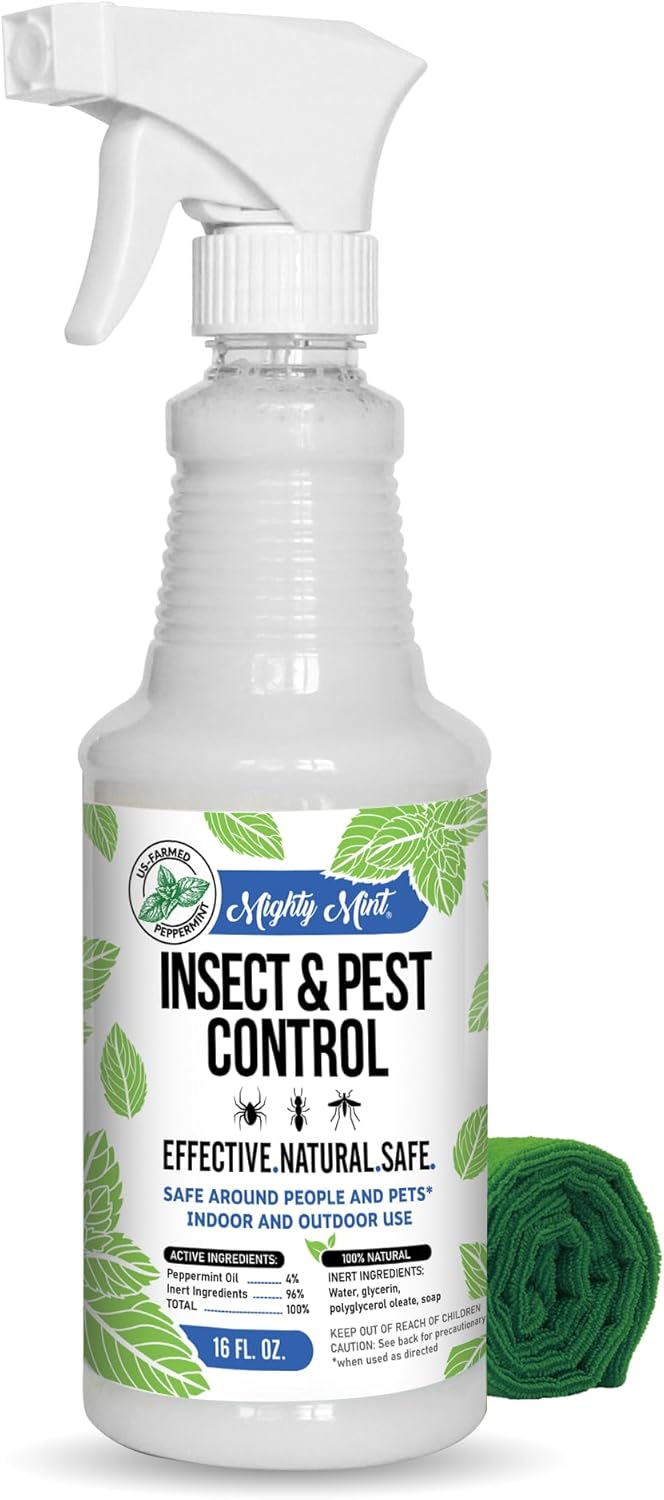
| Ingredients | Water, Glycerine, Polyglycerol oleate, Soap, Peppermint oil |
|---|---|
| Use Areas | Indoor / Outdoor |
| Size | 16 oz |
Mighty Mint is a plant-based, ready-to-use spray that uses concentrated peppermint oil to repel a broad range of household and patio pests. You apply it directly to problem areas such as baseboards, entryways, patios and around outdoor seating; the manufacturer recommends shaking and spraying until surfaces are covered and repeating applications two or more times per week for best results. Notable features include a peppermint-only scent profile, a formulation that avoids synthetic fragrances and the convenience of a 16 oz spray bottle for targeted spot treatments. Practical benefits are that it is safe to use around people and pets when dry and does not leave obvious stains on most surfaces, and the scent can make treated areas smell fresher than chemical alternatives. Important limitations are that it is a repellent rather than a pesticide so it works by discouraging pests rather than killing them, effectiveness depends on regular reapplication and it should not be applied when pollinators are present or to skin or food-contact surfaces.
Best for: Buyers who prioritize natural, low-toxicity solutions and want a targeted spray to reduce insects around patios and entryways while keeping family and pets in mind.
Less Ideal for: Anyone needing a one-time extermination or long-term residual pesticide for severe infestations should consider professional treatments or products formulated to kill pests rather than repel them.
- Plant-based peppermint formula that avoids synthetic fragrances
- Ready-to-use spray for quick, targeted indoor and outdoor applications
- Safe for people and pets when used as directed and allowed to dry
- Nonstaining on most surfaces and leaves a fresh mint scent
- Repels rather than kills insects so regular reapplication is needed to maintain protection
- Strong peppermint concentration may bother scent-sensitive individuals and requires keeping children and pets away until dry
Verdict: Choose Mighty Mint when you want a pet-friendly, plant-based spray to reduce patio and entryway insects with a fresh peppermint scent.
Atticus Talak 7.9% Bifenthrin Indoor/Outdoor Insecticide Concentrate, 32 oz

| Active Ingredient | Bifenthrin |
|---|---|
| Formulation | Suspension Concentrate |
| Liquid Volume | 32 fluid ounces |
| Length of Control | Up to three months |
| Target Species | Insects |
Talak 7.9% is a liquid concentrate for treating lawns, landscaping, outdoor living areas and indoor perimeter spots like baseboards and cabinets. You dilute the concentrate with water to create a spray for barrier treatments, spot applications or lawn mixes; label rates explain how much to mix per gallon depending on the use. The product uses bifenthrin, a proven broad-spectrum active ingredient, and the manufacturer states it controls over 75 species and can give residual control for as long as three months. Its water-based formula dries clear, leaves no odor or visible residue, and is not phytotoxic on plants when used per label. Practical benefits include flexible indoor and outdoor use, clear drying, and a bottle designed for easier pouring. Important limitations are that solutions should be mixed only for same-day use, it is not registered for sale in a few states, and it is not approved for fogger application, so professional-style misting methods are not appropriate.
Best for: Buyers who want a single, reliable product to protect yards, patios and building perimeters from a wide range of common pests and prefer conservative, label-driven application practices.
Less Ideal for: People seeking ready-to-use sprays or fogger-compatible products or those in states where this formulation is not registered should look at alternatives.
- Broad-spectrum control listed for 75+ indoor and outdoor pest species
- Water-based formula that dries clear and leaves no odor or residue
- Flexible label directions for lawns, landscapes, hardscapes and indoor perimeter treatments
- Long residual activity up to three months when applied at recommended rates
- Mixed spray solutions cannot be stored and must be used the same day
- Not approved for fogger application and not available for sale in some states
Verdict: A versatile, water-based bifenthrin concentrate that delivers long-lasting, broad-spectrum outdoor (and perimeter indoor) control when used according to the label.
Choosing the Right Outdoor Fly Spray: Key Factors to Consider
Coverage Area and Spray Pattern
How far a product projects and the pattern it creates determine how quickly you can treat a patio, fence line, or row of stalls. A wide fan or cone pattern can cover broad surfaces with fewer passes, reducing application time and operator fatigue. For spot treatments around animals, a narrower targeted stream is often preferable to avoid overspray.
Coverage interacts with nozzle design, pressure, and liquid viscosity. Thinner formulations travel farther but may evaporate faster in hot, dry conditions. Consider how much treated surface you need to cover and whether you will be using handheld pump sprayers, backpack units, or attached hose-end sprayers.
Residual Duration
Residual duration is the length of time the active ingredient continues to repel or kill flies after application. Longer residuals lower reapplication frequency and are especially valuable in high-fly conditions such as near compost piles, manure, or animal pens. However, longer residuals can mean more persistent chemical presence on treated surfaces, so balance longevity with safety needs.
Expect environmental factors such as rain, irrigation, sunlight, and dust to shorten residual effect. For covered patios or shaded barn areas, a product with moderate-to-long residual can provide reliable control; in exposed sunny locations, plan for shorter effective windows and possibly more frequent spot treatments.
Animal and Plant Safety
Using fly spray around animals and ornamental plants requires attention to formulation and label directions. Some active ingredients are designed for use on or near livestock and have clear withdrawal or contact guidance. Others are formulated for treating structures only and should not contact animal skin or forage.
Also consider drift onto flowers and pollinator-attractive plants. Choose a product whose label allows the intended use and follow directions on application distance, drying time, and when animals can return to treated areas to reduce stress or toxic exposure.
Wind and Weather Resistance
Outdoor application is subject to wind, rain, and changing temperature. A spray that atomizes into fine droplets may provide excellent initial contact but will drift in breezy conditions, reducing effectiveness and increasing non-target exposure. Coarser droplets resist drift but may not coat awkward surfaces as evenly.
Rainfastness is also important. Some formulations bind to surfaces or contain adjuvants that improve rain resistance, while others wash off quickly. Consider local weather patterns and the need to reapply after storms when planning a control program.
Application Ease and Ergonomics
How you apply fly spray affects how often you will treat and how thorough the coverage will be. Handheld pump sprayers are simple and inexpensive but can be tiring for large areas. Backpack sprayers and hose-end applicators reduce fatigue and speed coverage for fences and barns. Look for comfortable handles, adjustable nozzles, and clear dilution instructions.
Ease of cleanup and storage matters too. Products that rinse clean from equipment and do not require special disposal simplify seasonal transitions. Clear labeling for mixing rates and protective equipment reduces misuse and improves safety for the operator.
Where to Use Outdoor Fly Spray Effectively
Outdoor fly sprays are best used on structures, perimeter vegetation, and around animal housing where flies rest or congregate. Focus treatments on shade walls, fence posts, stall fronts, and seating areas rather than broadcasting over open ground. Targeting known fly harborage points gives better results with less chemical use.
- Treat shaded resting surfaces and underside of eaves where flies land
- Apply around doorways and feeding areas to create a barrier
- Avoid spraying flowering plants where pollinators forage
Integrating Fly Spray with Sanitation
Spray application should be one element in an integrated fly control plan. Removing breeding materials such as manure, soiled bedding, and wet feed dramatically reduces fly pressure so sprays perform better and are needed less often. Combine physical sanitation, mechanical traps, and targeted treatments for a balanced program.
- Regularly remove manure and clean water troughs
- Keep feed areas dry and covered when possible
- Use traps or sticky cards to monitor fly levels
Safe Application Around Animals and People
Always read and follow label directions for where animals and people can be during and after application. Apply in calm conditions to minimize drift and allow treated surfaces to dry before permitting contact. When treating stables or stalls, remove or cover feed and bedding that could be contaminated.
- Use low-drift nozzles near animals
- Ventilate treated spaces before returning animals
- Wear recommended protective equipment during mixing and application
Seasonal Timing and Frequency
Fly activity varies seasonally, peaking in warm months when breeding conditions are ideal. Begin targeted treatments before populations explode and increase frequency during peak season. In cooler months, reduce treatments and focus on sanitation to limit overwintering populations.
- Start preventive treatments in early warm season
- Increase monitoring during midsummer and after rainy spells
- Scale back treatment frequency in late fall when fly activity declines
Application Equipment Options
Choose equipment that matches the scale of the area. For patios and small yards, a simple handheld pump sprayer or trigger bottle allows precise placement. For barns, pastures, and long fence lines, a backpack sprayer or motorized unit covers more area with less labor. Consider hose-end adapters for large, continuous spraying tasks, but check compatibility with the chosen product.
- Handheld sprayers for small targeted jobs
- Backpack sprayers for stalls and multiple pens
- Hose-end or motorized sprayers for large perimeter treatments
How We Chose the Best Outdoor Fly Spray
We focused on attributes that matter most to gardeners, hobby farmers, and homeowners using fly spray outdoors. Primary evaluation criteria included spray coverage and application method, because how far and how easily a product covers fences, stalls, and patios drives real-world effectiveness. Residual duration was evaluated to estimate how often reapplication is needed in sun, rain, and wind. Safety profile for non-target animals and plants was weighed to limit risk around pets, livestock, and ornamentals. Odor and user comfort were considered since strong smells reduce usable placement near seating areas. Finally, ease of cleanup and formulation stability under heat or freezing were included to reflect seasonal storage and handling. We excluded products intended solely for indoor use or for aerosol-only consumer household cleaners that are not formulated for sustained outdoor exposure. We also filtered out specialty veterinary treatments that require professional administration. The final list balances coverage, longevity, and practical safety for typical outdoor settings.
FAQ
Can I spray outdoor fly spray directly on animals?
It depends on the product. Some formulations are labeled for use on livestock and contain directions for application and withdrawal times. Others are intended for treating structures only. Always follow the label and keep animals away from treated areas until the product is dry if the label does not permit direct application.
How often should I reapply fly spray in hot weather?
Reapplication intervals vary by product and conditions. In hot, sunny, or rainy weather residual activity shortens, so treatments may need repeat applications every few days to a week. Look to the product label for recommended intervals and monitor fly activity to judge timing.
Will fly spray harm pollinators or beneficial insects?
Some formulations can harm pollinators if applied directly to flowering plants. To protect bees and other beneficials, avoid spraying blooms and apply during times when pollinators are less active, such as early morning or late evening. Choosing products labeled safe for use around vegetation reduces risk.
Can I use outdoor fly spray near vegetable gardens?
Care is needed when treating near edible crops. Many outdoor sprays are formulated for structures and animal areas and should not contact produce. Keep a safe buffer, follow label restrictions, and avoid treating edible foliage or areas where produce will be harvested soon.
Is a residual spray better than a knockdown-only product?
Residual sprays reduce the need for constant reapplication but can leave a persistent chemical on treated surfaces. Knockdown-only products act fast but require more frequent application. The best choice balances how often you can reapply, safety around animals, and the level of fly pressure.
Final Verdict
Choose an outdoor fly spray based on where you will apply it, how long you need protection, and the presence of animals or pollinator-attractive plants. Prioritize products with a spray pattern and coverage suited to your surfaces, a residual duration that fits your maintenance schedule, and clear safety directions for nearby animals. Combine targeted spraying with sanitation and monitoring to keep fly populations manageable while minimizing chemical use. With those tradeoffs in mind, you can select a treatment that delivers consistent control for your outdoor spaces.
