

Note: This article contains affiliate links. If you click on these links and make a purchase, I may earn a small commission at no extra cost to you. This helps support my research and content. Read my full affiliate disclosure here.
Silverfish are stealthy, damage-focused pests that feed on paper, fabrics, and pantry goods. Choosing the right bug spray for silverfish matters because these insects hide in narrow cracks, behind baseboards, in closets, and in damp basements where a mist that lands in the right place can stop further damage. This guide covers seven shortlisted bug sprays for silverfish that are suitable for home use. We evaluated how quickly each option knocks down silverfish, how long its residual protection lasts on typical indoor surfaces, and how easy it is to apply safely in living spaces and storage areas. Read on for practical guidance to match a spray to your room, application style, and household needs.
Top Picks at a Glance
| Best Overall The best all-around choice for most situations | GoneNaturally Peppermint Oil Bug Spray (16 oz) |  |
| Best Quality Built to a higher standard if you want something more solid | ECOPEST Silverfish Spray, Plant‑Based Indoor and Outdoor Silverfish Killer, 22 oz |  |
| Best Value The sweet spot between price and what you get | Eco Defense Silverfish Killer Indoor Spray, 16 oz |  |
| Best Budget The cheapest option that still gets the job done reliably | Safer Home Indoor Ant, Roach & Spider Multi-Insect Aerosol Spray (13.25 oz) |  |
| Highest Rated A top-rated pick with lots of positive feedback | Migdracy Silverfish Repellent Spray, 16 oz Plant-Based |  |
| Most Popular A crowd favorite that many people choose with confidence | Safer Home Indoor Pest Control Multi-Insect Spray, 24 fl oz |  |
| Best Seller A high-volume bestseller chosen again and again | Ortho Home Defense Insect Killer for Indoor & Perimeter, 1.33 gal. with Comfort Wand |  |
GoneNaturally Peppermint Oil Bug Spray (16 oz)

| Volume | 16 oz |
|---|---|
| Active ingredient | Peppermint Oil |
| Indoor/Outdoor | Indoor and Outdoor |
| Ready to use | Yes |
This peppermint oil spray is a plant-based, ready-to-use insecticide designed for targeted indoor and outdoor spot treatments. You shake and spray directly onto ants, roaches, spiders and other crawling insects for quick knockdown, and the peppermint scent helps repel returning pests when used as directed. It is marketed for use around children and pets on surfaces after drying, which makes it suitable for kitchens, baseboards, door frames, patios and pet areas when you follow the label precautions. The formula dries clear and requires no mixing, so one bottle stretches through many applications if you use a light mist rather than soaking. Important limits: it is a surface and area spray only and should not be applied to skin or directly to animals, and cat owners must keep cats out until treated areas are dry. For heavy or hidden infestations you will likely need follow-up treatments or a professional service since this product is optimized for spot control rather than whole-structure fumigation.
Best for: Buyers who want a pet- and family-conscious pest spray for routine spot control around the home and outdoor living areas and who prioritize plant-based ingredients and ease of use.
Less Ideal for: Homeowners facing severe, widespread infestations or users who need a product to apply directly to pets should consider stronger professional treatments or veterinarian-recommended products instead.
- Plant-based active ingredient (peppermint oil) for a low-chemical alternative
- Ready-to-use spray that requires no mixing and dries clear for easy spot treatments
- Labeled for indoor and outdoor surface use including kitchens and patios
- Pleasant peppermint scent that also helps deter ants and other pests after application
- Not for direct application to pets or skin and requires ventilation and drying time before pets or birds re-enter treated areas
- Designed for spot and surface treatment so it may not eliminate large or hidden infestations without repeated applications or professional help
Verdict: Choose this peppermint oil spray if you want an easy, plant-powered spot treatment that is formulated to be used around homes with kids and pets when directions are followed.
ECOPEST Silverfish Spray, Plant‑Based Indoor and Outdoor Silverfish Killer, 22 oz
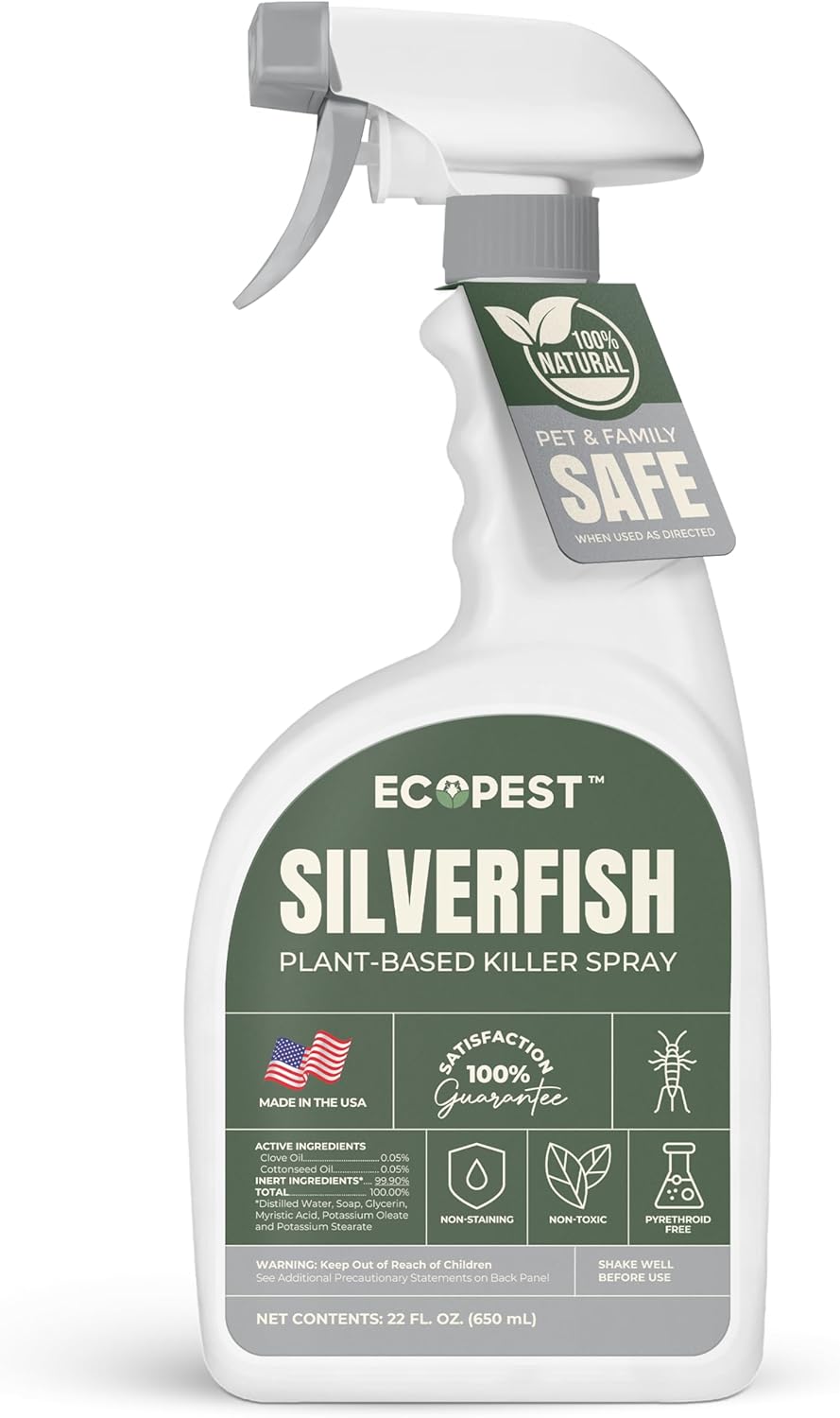
| Volume | 22 oz |
|---|---|
| Ingredients | Clove oil; cottonseed oil |
| Intended target | Silverfish |
| Manufacturer | ECOPEST |
The ECOPEST Silverfish Spray is a ready‑to‑use, essential‑oil based insecticide intended for targeted silverfish control in and around the home. You use it by shaking and spraying directly onto visible insects or likely hiding spots from about 8–12 inches away, which makes spot treatments quick and low‑effort. Notable features include a tested contact kill—manufacturer data reports rapid mortality in lab tests—plus a formula free from synthetic pyrethroids and listed as non‑staining and residue‑free, so it can be applied to water‑safe carpets, baseboards, and furniture without visible damage. Because it is plant‑based and described as pet‑ and child‑friendly, it is a good choice for households that need effective control but want to avoid conventional neurotoxic ingredients. Limitations are that performance claims come from lab testing rather than independent field studies in varied infestations and that heavy or hidden infestations may require layered tactics like traps or dusts for full elimination. The spray is best used as a quick contact treatment and part of a broader integrated approach to persistent silverfish problems.
Best for: Buyers who prioritize effective, fast silverfish knockdown but want a lower‑toxicity, family‑friendly option for spot treatments around the home.
Less Ideal for: People facing severe, widespread infestations who need a single, heavy‑duty chemical treatment rather than a plant‑based spray used as part of a multi‑product control plan.
- Plant‑based formula that is free from synthetic pyrethroids
- Designed to kill silverfish on contact with rapid tested mortality
- Non‑staining and residue‑free for use on water‑safe surfaces
- Labeled safe for use around children and pets when used as directed
- Efficacy claims are based on lab testing rather than independent field trials
- May not fully eliminate heavy or hidden infestations on its own
Verdict: Choose this spray if you want a fast, plant‑based contact killer that controls silverfish while minimizing exposure to conventional insecticides.
Eco Defense Silverfish Killer Indoor Spray, 16 oz

| Brand | Eco Defense |
|---|---|
| Unit Count | 16 Fluid Ounces |
| Item Form | Oil |
| Target Species | Silverfish |
| Liquid Volume | 16 fluid ounces |
This Eco Defense spray is a plant-derived indoor insecticide designed to kill silverfish and earwigs on contact and to treat the cracks and hidden spots where these pests hide. It is applied directly from the bottle to baseboards, closets, under sinks, and other damp, dark areas; the formula dries quickly, is non-staining on water-safe surfaces, and can be reapplied every few days during an active infestation. Notable features include a botanical oil base instead of synthetic pyrethroids and a lab claim of rapid knockdown. The practical benefit is immediate visible control without waiting for traps or baits to work, and the ability to reach crevices a stationary bait cannot. Limitations to plan for are the need for repeated applications during heavy infestations and the product being formulated for spot and perimeter treatment rather than area fogging. Follow label directions for use around children and pets despite the plant-based formulation because it is still an insecticide.
Best for: Buyers who want fast, visible reduction of silverfish using a botanical spray and who prefer targeted treatments applied to baseboards, closets, and other hiding spots.
Less Ideal for: People seeking a one-time, long-term bait or an area-wide fogging solution should consider alternate products or integrated strategies.
- Kills silverfish and earwigs on contact according to lab testing
- Plant-based formula intended for use around children and pets when used as directed
- Non-staining and residue-free on water-safe surfaces for indoor use
- Spray application reaches cracks, baseboards, and entry points where silverfish hide
- Requires repeated reapplication during active infestations
- Designed for spot and perimeter treatments rather than whole-room fumigation
Verdict: A quick-contact, plant-based spray for spot-treating silverfish hotspots when you want immediate results without synthetic pyrethroids.
Safer Home Indoor Ant, Roach & Spider Multi-Insect Aerosol Spray (13.25 oz)
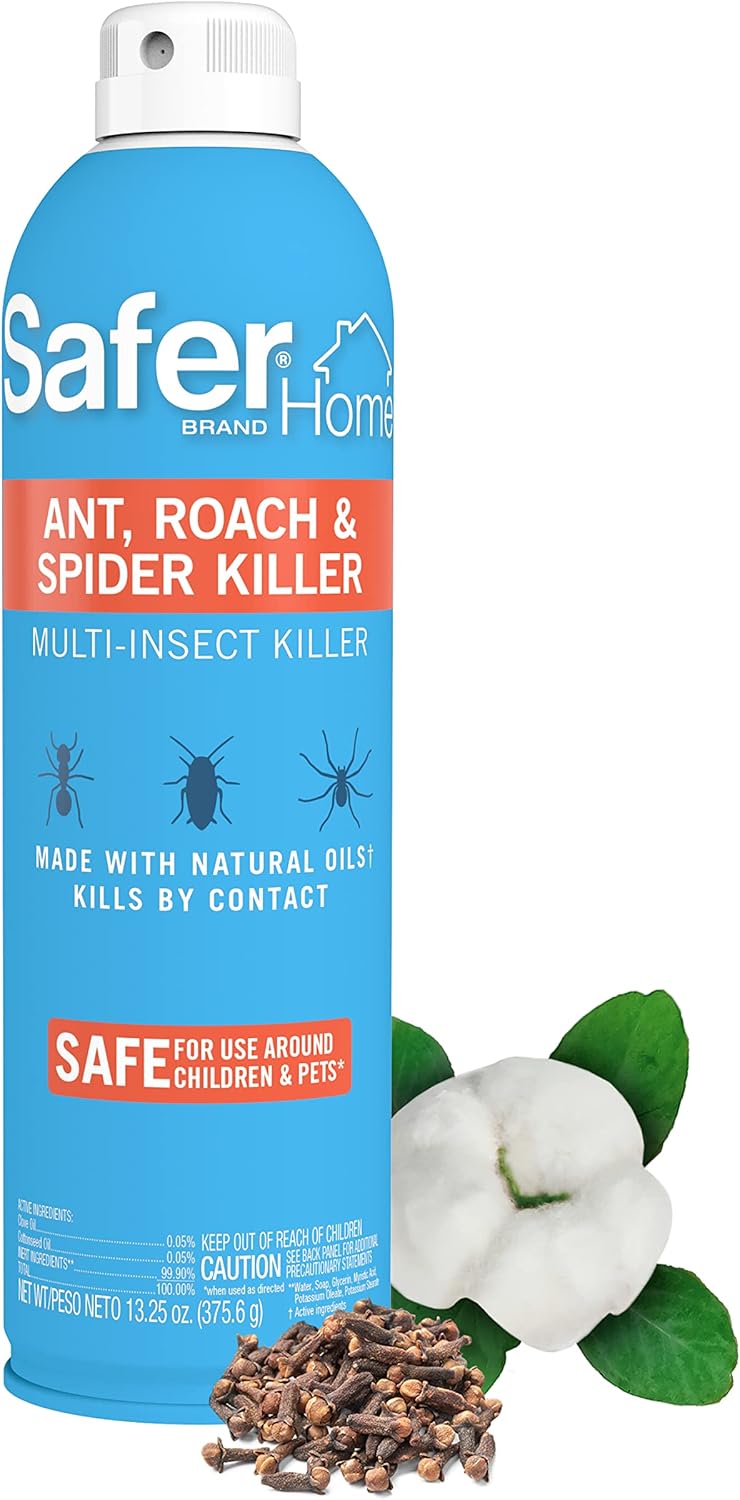
| Unit Count | 13.25 Ounce |
|---|---|
| Item Form | Aerosol |
| Target Species | Insects |
| Active Ingredients | Clove Oil 0.05%, Cottonseed Oil 0.05% |
This aerosol from Safer Home is a contact-kill multi-insect spray designed for indoor use against ants, roaches, spiders, silverfish, flies, fleas and many other common pests. You use it by shaking and spraying directly onto visible pests from about 8 to 12 inches until wet; the manufacturer reports ants, flies and roaches die within three minutes. The formula relies on small amounts of clove oil and cottonseed oil rather than conventional synthetic pesticides, so it is positioned for households that prioritize gentler ingredients and safer use around children and pets when directions are followed. The aerosol dries without leaving a residue, which makes spot treatments in pantries, behind baseboards and around doorframes quick and low‑maintenance. Limitations are that it is a contact spray, so it works best on pests you can reach or see rather than as a long‑lasting barrier treatment, and active ingredient concentrations are very low compared with synthetic options, which may mean repeat applications for heavy infestations.
Best for: Buyers who want a quick, easy indoor spray that uses naturally derived ingredients and is suitable for spot treatments around the home while prioritizing safety for households with children or pets when used as directed.
Less Ideal for: People facing large or hidden infestations or who need a lasting perimeter control should consider a residual or professional solution instead.
- Made with naturally derived oils (clove and cottonseed) for a less harsh formulation
- Fast contact kill for visible pests with reported 3‑minute mortality for ants, flies and roaches
- Aerosol dries without residue so treated areas do not require cleanup
- Convenient spray format for targeted spot treatments around baseboards, pantries and entry points
- Very low percentage of active ingredients so may require repeat applications or not control large infestations
- Contact‑only action means it does not provide long residual protection
Verdict: A quick, family‑friendly aerosol for spot‑treating visible silverfish and other household insects using naturally derived oils.
Migdracy Silverfish Repellent Spray, 16 oz Plant-Based

| Volume | 16 oz |
|---|
This Migdracy spray uses cedarwood, peppermint, geraniol, and clove oils to create a scented barrier that discourages silverfish and firebrats from bathrooms, basements, pantries, closets, and other indoor hiding spots. It is applied directly to baseboards, cracks, doorways, window frames, storage areas, and around likely entry points; the 16 oz spray bottle is convenient for spot treatments and perimeter maintenance. Because it is plant-based and labeled for everyday use, it is a practical non-chemical option for regular prevention rather than an instant kill aerosol. The scent can mask musty areas while providing protection, but you'll need to reapply periodically to maintain effectiveness and it is best used as part of an integrated approach with sanitation and sealing gaps. Simple spray application and the botanical formula make it a low-effort addition to routine home pest management, especially where occupants prefer reduced reliance on synthetic insecticides.
Best for: Buyers who want a low-toxicity, maintenance-focused solution to discourage silverfish in living spaces and prefer a routine preventative product over aggressive chemical controls.
Less Ideal for: People needing immediate knockdown of heavy infestations or professional-grade extermination should choose a fast-acting insecticide or consult pest control services.
- Plant-based formula using cedarwood, peppermint, geraniol, and clove oils
- Ready-to-use 16 oz spray bottle for easy spot and perimeter application
- Designed specifically to target silverfish and firebrats in common indoor hiding spots
- Not marketed as a fast-acting insecticide so results rely on regular reapplication
- Effectiveness depends on preventing re-entry and good housekeeping rather than sole reliance on the spray
Verdict: A convenient plant-based spray that provides an easy, daily-use barrier to help reliably discourage silverfish and firebrats in indoor hiding spots.
Safer Home Indoor Pest Control Multi-Insect Spray, 24 fl oz

| Item model number | SH110 |
|---|---|
| Ingredients | Clove Oil 0.05%, Cottonseed Oil 0.05%, Inert Ingredients 99.90% |
| Volume | 24 fl oz |
| Manufacturer | Woodstream Corporation |
Safer Home Indoor Pest Control Spray is a ready-to-use contact insecticide formulated with natural oils like clove and cottonseed to tackle ants, roaches, flies, spiders, fleas, mosquitoes, ticks, wasps and many other indoor pests. You use it by switching the nozzle between a spray setting for general areas and a stream setting for crack-and-crevice work, holding the bottle about 8 to 12 inches from the target. The formula claims fast knockdown, killing ants, flies, and roaches within minutes, and it dries without leaving a residue so no wiping is required. Its main practical benefit is offering a broad-spectrum, easy application for spot treatments around kitchens, baseboards, windows, doors and crawl spaces while relying on naturally derived active ingredients that are presented as safer for homes with children and pets when directions are followed. The limitations are that it is a contact killer rather than a residual barrier product and effectiveness against heavy infestations may be slower than synthetic insecticides, so repeated or complementary measures may be needed for persistent problems.
Best for: Households that prioritize practical, lower-toxicity solutions for spot-treating common indoor pests and want an easy, no-mess spray safe for use around kids and pets when directions are followed.
Less Ideal for: Homes facing severe or persistent infestations that need long-lasting residual control or professional-strength treatments should consider stronger or specialized options.
- Made with naturally derived oils (clove oil and cottonseed oil) instead of harsh synthetic chemicals
- Ready-to-use spray with adjustable nozzle for both general spray and crack-and-crevice stream
- Fast contact kill for common pests with no residue to wipe up after application
- Broad-spectrum label covering many common indoor insects including ants, roaches, flies, spiders, fleas and mosquitoes
- Contact-only action offers limited residual protection, so repeat applications may be necessary
- May be less effective than conventional synthetic insecticides on heavy infestations
Verdict: A convenient, low-toxicity indoor spray for quick spot control of common household pests in pet-friendly homes.
Ortho Home Defense Insect Killer for Indoor & Perimeter, 1.33 gal. with Comfort Wand

| Item Form | Spray |
|---|---|
| Target Species | Insects |
| Liquid Volume | 1.33 gallons |
| Active Ingredients | Bifenthrin 0.05%, Zeta-Cypermethrin 0.0125% |
This 1.33 gallon Ortho Home Defense spray is designed to treat both indoor problem spots and the outdoor perimeter of a home to reduce ants, roaches, spiders and many other crawling and flying insects. It comes with a battery-powered Comfort Wand that delivers a continuous spray so you can apply a uniform band around foundations, patios and entry points without bending or pumping. The formula with bifenthrin and zeta-cypermethrin is intended to kill on contact and establish a barrier that the manufacturer says lasts up to 12 months for ants, roaches and spiders on non-porous indoor surfaces. In real-world use that means fewer repeat treatments in busy yard perimeters and around doors and windows. The spray dries clear with minimal fumes which helps for indoor use near kitchens and living areas. Limitations are that this is a chemical insecticide so users should follow safety directions around children, pets and plants and it is not a specific solution for pests not listed on the label. For homeowners focused on strong, perimeter-level protection this product simplifies application and covers a large area per container.
Best for: Homeowners who want a performance-focused perimeter treatment to reduce recurring yard and entry-point insect problems and prefer a ready-to-use product that is easy to apply.
Less Ideal for: People seeking organic or non-chemical control methods or those who need a targeted solution for pests not listed on the label should consider alternative products.
- Includes battery-powered Comfort Wand for continuous, fatigue-free application
- Ready-to-use 1.33 gallon container covers large perimeters without mixing
- Formula creates a barrier claimed to provide up to 12 months protection against ants, roaches and spiders on non-porous indoor surfaces
- Dries clear and gives off minimal fumes, making indoor use more practical
- Contains synthetic insecticides so precautions are required around children, pets and ornamentals
- Protection claims are specific to certain species and surfaces so results vary by pest and conditions
Verdict: A powerful, ready-to-use perimeter and indoor spray for homeowners who want long-lasting, performance-oriented protection against common yard and household insects.
Choosing the Right Bug Spray for Silverfish: Key Factors to Consider
Knockdown Speed and Initial Contact
How quickly a spray incapacitates silverfish matters because these insects can escape into hidden voids. A formulation with a fast knockdown action reduces the chance of survivors retreating deeper into wall voids or behind stored items. Consider whether the product is an aerosol that delivers instantaneous contact or a low-pressure spray that allows better aim into cracks.
Fast knockdown does not always equal long-term control, so balance immediate effectiveness with other factors that maintain protection after the spray dries. For infestations with heavy activity, faster action reduces visible damage and makes follow-up treatments easier.
Residual Protection on Common Indoor Surfaces
Silverfish often spend time on paper, cardboard, drywall, wood trim, and fabric. Residual activity describes how long treated surfaces remain toxic to returning insects after the spray dries. Longer residual protection reduces how often you must retreat closets, bookshelves, and baseboards.
Look for products that advertise residual control on porous and nonporous surfaces and consider how frequently items in the treated area are handled or cleaned, since wiping or laundering will remove residues and shorten protection.
Spray Reach, Pattern, and Application Control
Reaching into narrow crevices and behind baseboards is a practical challenge. Spray delivery style affects where the product deposits: fine aerosols may drift and reach deep gaps, pump sprays allow precise targeting, and foam or crack-and-crevice attachments help place material exactly where silverfish hide.
Evaluate whether you need a long-reach aerosol for wall voids or a controllable stream for shelves and fabric edges. Ease of aiming and the ability to treat without saturating paper or clothing are critical in delicate indoor settings.
Indoor Safety, Odor, and Ventilation Needs
Products used inside homes must balance effectiveness with occupant safety. Check label directions on ventilation, reentry intervals, and whether the spray is suitable for use around stored clothing and books. Strong odors can linger and may be objectionable in small closets or bedrooms.
Choose sprays with clear safety directions, low odor when dry, and options that allow limited reentry intervals for households with children, pets, or sensitive occupants. Personal protective steps such as airing out spaces and removing or covering fragile items can reduce exposure risk.
Surface Compatibility and Staining Risk
Some sprays leave residues that can stain, discolor, or degrade paper, fabrics, or painted surfaces. Since silverfish feed on books and stored textiles, treating these areas requires a product that will not damage the items you are trying to protect.
Test sprays on an inconspicuous area when possible and avoid treatments that advise against use on fabric or paper. Consider product labels that specify compatibility with common indoor materials to prevent unintended damage.
Application Frequency and Long-Term Management
The need to retreat affects maintenance time and cost. Products with longer residuals reduce the frequency of applications, while short-lived sprays may require repeated treatment in high-activity areas. Also think about integrated measures such as humidity control and decluttering, which complement chemical control and reduce reapplication needs.
Plan a follow-up schedule based on label guidance and monitor treated areas for renewed activity. Combining targeted sprays with environmental changes usually yields better long-term suppression of silverfish populations.
Where Silverfish Hide and How That Affects Treatment
Silverfish prefer dark, undisturbed, and humid microenvironments such as book spines, cardboard boxes, baseboard gaps, and behind loose wallpaper. Understanding these habits helps you decide where to apply a spray and which spray delivery is most useful.
Treat edges of shelving, seams of cardboard, behind picture frames, and baseboards rather than saturating open room surfaces. For wall voids and hard-to-reach cracks, a fine aerosol or crack-and-crevice applicator increases the chance of contacting hidden insects.
- Inspect closets, attics, and basements for signs like irregular holes in paper or scorched-looking edges on fabrics.
- Target application at edges and seams where silverfish travel rather than broad surface sprays.
Preparing a Room and Protecting Valuables Before Spraying
Remove or cover books, clothing, and foodstuffs before treatment. Move loose papers and textiles out of the treatment zone or seal them in plastic to prevent contamination. Vacuum first to remove debris and eggs so the spray contacts active insects and not just dust.
If treating inside cabinets or bookshelves, work in small sections and allow treated surfaces to dry fully before returning items. Good preparation reduces the chance of residue transfer to delicate materials and improves the spray's effectiveness.
- Vacuum shelves and baseboards to reduce food sources and expose hiding silverfish.
- Cover or remove hand-wash-only textiles and valuable paper items prior to application.
Nonchemical Steps That Complement Spray Treatments
Addressing humidity and clutter reduces silverfish habitat and works with sprays to lower populations. Dehumidifiers, improved ventilation, and fixing leaks remove the moist conditions these pests need to thrive. Sealing cracks and repairing damaged wallpaper or cardboard storage limits shelter and feeding sites.
Sticky traps placed along baseboards and in closets can help monitor activity and reduce numbers without chemicals. These measures reduce reliance on repeat spraying and make chemical control more effective in the long term.
- Run dehumidifiers in basements and behind appliances.
- Use sealed plastic bins for long-term paper or textile storage.
Safe Application Around Pets and Children
When applying any indoor spray, read and follow reentry and ventilation guidance on the label. Keep children and pets out of treated rooms until the product has dried and the space has been aired according to directions. Store sprays in a secure location away from curious hands.
Consider spot treatments in inaccessible spots where pets and kids cannot reach, and avoid spraying open food surfaces. If sensitivity or allergies are a concern, choose low-odor formulations and allow extra airing time before reoccupation.
- Use gloves and a mask if the label suggests personal protective equipment.
- Limit sprays to cracks and edges rather than treating entire room interiors when possible.
Monitoring Results and Scheduling Follow-Ups
After treatment, monitor treated areas for activity for at least several weeks. Sticky traps, periodic inspections, and checking the same book spines or storage boxes will show whether the treatment had an immediate and lasting effect. Note that visible dead insects may appear as the product takes effect, so clean up once activity subsides.
Plan follow-up treatments based on label intervals and observed activity. If silverfish persist despite correctly applied sprays and good sanitation, consider integrating nonchemical controls and rechecking potential moisture sources.
- Place monitoring traps in treated zones before and after treatment to gauge effectiveness.
- Record treatment dates and locations to avoid overapplication in the same area.
How We Chose the Best Bug Spray for Silverfish
We focused on sprays formulated and labeled for crawling-insect control that are appropriate for indoor living spaces where silverfish live. Selection criteria emphasized real-world performance metrics that matter in the home: knockdown speed against silverfish-like arthropods, residual protection on common indoor substrates (paper, drywall, wood, fabric), and the ability to reach into cracks and crevices via spray pattern or aerosol delivery. Application ease and user safety were weighted heavily because homeowners often treat closets, bookshelves, attics, and basements; products with clear instructions and controlled spray patterns were preferred. We also considered odor and staining potential since these sprays are used around clothing and paper. Exclusions included products not labeled for indoor use, granular or bait-only approaches that cannot contact silverfish directly, or aerosols intended only for flying insects. The final picks balance quick control, usable residual activity, and straightforward, safe application for household settings.
FAQ
How often should I reapply a bug spray for silverfish?
Reapplication depends on the product's labeled residual period, surface cleaning, and activity levels. Many indoor sprays recommend re-treating every few weeks to months, but heavy activity or cleaning that removes residues can require more frequent applications.
Can I spray directly on books and papers to kill silverfish?
Direct spraying on valuable books and papers is not recommended because residues can stain or damage paper fibers. Instead, treat nearby edges, shelves, and crevices and remove or isolate treasured items before applying sprays.
Are aerosols better than pump sprays for reaching silverfish?
Aerosols deliver a fine mist that can reach deep crevices, which helps contact hidden silverfish. Pump or trigger sprays offer more control and reduce overspray on nearby items. Choose based on the specific hiding spots you need to treat.
Will controlling humidity alone stop silverfish?
Lowering humidity and fixing leaks reduces silverfish habitat and can greatly reduce populations, but it may not eliminate an established infestation quickly. Combine environmental changes with targeted spray treatments for the best results.
Is it safe to use bug sprays for silverfish around pets?
Many indoor sprays are safe when used according to label directions, but pets should be kept out of treated rooms until surfaces are dry and the area ventilated. Some products have specific warnings; follow the label and consult a veterinarian if uncertain.
Final Verdict
Focus your choice on a spray that balances quick knockdown with useful residual protection and safe indoor use. Prioritize application formats that let you reach cracks and seams without saturating books or fabrics, and select products with clear label directions for reentry and surface compatibility. Pair chemical treatment with humidity control, decluttering, and monitoring to reduce repeat applications and protect stored items. With the right combination of application method and ongoing prevention, you can suppress silverfish and minimize damage to paper and textiles.
