

Note: This article contains affiliate links. If you click on these links and make a purchase, I may earn a small commission at no extra cost to you. This helps support my research and content. Read my full affiliate disclosure here.
If you grow turnips or radishes, the right fertilizer makes a real difference in root size, texture, and harvest timing. These root crops respond to specific nutrient ratios and predictable feeding schedules, so picking a fertilizer that matches their needs helps you avoid woody, forked, or spindly roots. This guide covers seven top-rated fertilizer options suitable for turnips and radishes, shortlisted for steady root development and easy application. We evaluate each option on nutrient balance, application method, feeding frequency, and how they behave in backyard soil and raised beds. Read on to understand which traits matter most for quick, even root bulking and consistent harvests.
Top Picks at a Glance
| Best Overall The best all-around choice for most situations | Big A Carrot Organic Fertilizer for Vegetables |  |
| Best Quality Built to a higher standard if you want something more solid | FoxFarm Happy Frog Tomato & Vegetable Fertilizer, 5-7-3 Blend, 4 lb |  |
| Best Value The sweet spot between price and what you get | Pennington Water-Soluble All-Purpose Plant Food 20-10-20, 1.5 lb |  |
| Best Budget The cheapest option that still gets the job done reliably | RAINFLOW Slow-Release Granular Fertilizer 17-17-17 (11.28 oz) |  |
| Highest Rated A top-rated pick with lots of positive feedback | MEZFER Micros All-Purpose Granular Fertilizer 3-3-0, 4 lb |  |
| Most Popular A crowd favorite that many people choose with confidence | Miracle-Gro Water Soluble All Purpose Plant Food, 3 lb |  |
| Best Seller A high-volume bestseller chosen again and again | Southern Ag All Purpose Granular Fertilizer 10-10-10 (5 lb) |  |
Big A Carrot Organic Fertilizer for Vegetables

| Item Form | Granules |
|---|---|
| Specific Uses For Product | Growing vegetables and fruits |
| Application Method | Directly to the soil before seeding |
| Target Species | Fruits, Vegetables |
Big A Carrot Organic Fertilizer is a soluble granular fertilizer designed for vegetables and fruits with a formulation that emphasizes root crops. You apply it directly to the soil before planting so nutrients are available as seeds germinate and roots develop. The blend includes nitrogen and phosphorus plus secondary nutrients like calcium and magnesium, and added kelp to support root vigor and overall plant health. The highly soluble granules make it easy to incorporate into beds and raised planters and should speed early nutrient uptake for fast-growing small roots. Practical benefits include an organic label for gardeners avoiding synthetic inputs and a mix targeted at root development, which suits quick-turn crops. Limitations are that instructions are basic and it is sold in a single 13.5 ounce unit which may be small for large plots, and granular application requires even distribution and occasional reapplication through the season.
Best for: Gardeners who want an organic, root-focused fertilizer for mixed beds and small-scale vegetable patches and who value a simple pre-seeding soil application.
Less Ideal for: Large-scale vegetable growers who need bulk quantities or gardeners who prefer liquid feed schedules and precise, measured dosing plans.
- Organic formulation with kelp to support root development and microbial activity
- Contains primary and secondary nutrients including nitrogen, phosphorus, calcium and magnesium
- Highly soluble granules that are easy to mix into soil and available for young seedlings
- Designed for a wide range of vegetables and fruits, useful for mixed garden beds
- Sold as a single 13.5 ounce unit which may be insufficient for larger vegetable gardens
- Application guidance is minimal so precise rates and reapplication timing may require interpretation
Verdict: A compact organic granular fertilizer with kelp and balanced nutrients that helps support healthy root development in small vegetable beds.
FoxFarm Happy Frog Tomato & Vegetable Fertilizer, 5-7-3 Blend, 4 lb

| Item Form | Granules |
|---|---|
| Specific Uses For Product | Vegetables, Tomatoes, Soft Fruits, and Berries |
| Unit Count | 64 Ounce |
| Mixing Ratio | 5:7:3 |
| Target Species | Vegetables |
This granular FoxFarm Happy Frog fertilizer supplies a balanced 5-7-3 N-P-K blend designed to support leafy growth and plentiful fruit set, plus added calcium and mycorrhizal fungi to improve root uptake and reduce blossom end rot. It is applied to in-ground beds and containers following the package directions and is suitable across vegetable plantings. The OMRI listing means it fits organic-minded plots, and the inclusion of mycorrhizae can help young roots access nutrients and moisture more efficiently. For root crops such as turnips the moderate nitrogen level encourages healthy foliage without overly stimulating excessive top growth that can reduce root development when used at recommended rates. Practical limits are that it is a general vegetable formula rather than a turnip-specific mix, so tight control of nitrogen and timing is still needed for optimal root size, and application rates must be followed to avoid uneven root formation. The dry granules are easy to store and apply but require incorporation or watering in to activate nutrients.
Best for: Gardeners focused on reliable, performance-oriented nutrition for a variety of vegetable crops who want an organic-certified, all-purpose fertilizer that supports both roots and fruiting.
Less Ideal for: Growers seeking a specialized low-nitrogen or root-maximizing formula specifically for large-scale root vegetable production should consider a product formulated expressly for root crops.
- Balanced 5-7-3 N-P-K suited to vegetables that need both foliage and root development
- Contains calcium to help prevent blossom end rot and related fruiting issues
- Includes mycorrhizal fungi to improve root nutrient and water uptake
- OMRI listed, making it acceptable for organic gardens
- Granular form is simple to store, measure, and apply to containers or beds
- Not tailored specifically to root crops so growers may need to adjust application timing or rates for turnips
- Sold in a single size that may require multiple purchases for larger plots
Verdict: Choose this OMRI-listed 5-7-3 granular if you want a performance-oriented, organic-friendly fertilizer that supports healthy roots and reliable vegetable yields.
Pennington Water-Soluble All-Purpose Plant Food 20-10-20, 1.5 lb

| Item Form | Powder |
|---|---|
| Specific Uses For Product | Indoor, Outdoor |
| Application Method | Pour |
| Coverage | 100 square feet |
| Mixing Ratio | 20:10:20 |
This Pennington water-soluble 20-10-20 plant food is a straightforward, no-frills fertilizer for flowers, vegetables, shrubs and houseplants. You scoop the powder into a watering can (a measuring scoop is included), mix to the label rate and water the soil around plants every 2 to 4 weeks during the growing season. The formula delivers quick-release nitrogen for rapid green-up plus balanced phosphate and potassium to support blooms and fruiting. Practical touches like a wide-mouth jar and foam-seal lid keep the powder dry and make measuring tidy. Because it is water-soluble it is easy to apply to established beds and potted plants and works well for routine feedings when you want consistent results without specialty mixes. Limitations are that it is a general-purpose, fast-release formula not tailored to specific crop nutrient needs and requires regular reapplication during long seasons; gardeners wanting slow-release feeding or tailored micronutrient blends may prefer a different product.
Best for: Gardeners looking for an affordable, easy-to-use general-purpose fertilizer to feed mixed beds, container plants, and vegetable or flower plantings on a regular schedule.
Less Ideal for: Gardeners who want slow-release feeding, customized nutrient mixes for specific crops, or products formulated for soil amendment rather than quick foliar or root feeding.
- Balanced 20-10-20 ratio supplies quick nitrogen and supports blooms and fruit
- Water-soluble powder mixes easily for fast feeding and even distribution
- Includes measuring scoop and wide-mouth jar for tidy, repeatable dosing
- Suitable for both indoor and outdoor plants so one product covers many uses
- Fast-release formula requires regular reapplication through the growing season
- Not tailored to specific crops or soil deficiencies
Verdict: A simple, budget-friendly water-soluble 20-10-20 fertilizer that makes regular feeding of flowers and vegetables quick and reliable.
RAINFLOW Slow-Release Granular Fertilizer 17-17-17 (11.28 oz)

| Item Form | Granules |
|---|---|
| Application Method | Spread and mix into the soil |
| Coverage | general-purpose, suitable for various plants and gardens |
| Mixing Ratio | 17:17:17 |
| Unit Count | 11.28 Ounce |
This RAINFLOW slow-release granular fertilizer delivers a balanced 17-17-17 NPK dose in a compact 11.28 ounce pack designed for indoor and outdoor use. It is applied by sprinkling or mixing into the soil and lightly covering, with the manufacturer recommending reapplication every 60 days. The granules make it simple to dose for small pots and container gardens using the provided rate guidance, and the slow-release formulation reduces how often you need to feed plants. Practical benefits include support for root development, foliage and stem growth across vegetables, flowers, herbs and potted plants, plus straightforward directions that suit beginner gardeners. Limitations are the small unit size, which means frequent repurchases for larger beds or multiple containers, and the product information does not list trace nutrients or organic certification beyond a generic "organic" claim. Users should measure carefully to avoid overapplication, especially in small pots where recommended grams are low.
Best for: Budget-minded gardeners who need an easy, general-purpose fertilizer for houseplants, small pots, or a few garden beds and prefer infrequent feeding schedules.
Less Ideal for: Large vegetable beds, commercial growers, or gardeners who need trace nutrient formulations or certified organic inputs should consider larger or specialty fertilizers instead.
- Balanced 17-17-17 NPK supports general plant growth across many species
- Slow-release granules feed plants for up to 60 days, reducing application frequency
- Granular form and clear dosing guidance make it easy to measure for pots and containers
- Small 11.28 ounce package requires repeated purchases for larger gardens
- No detailed listing of micronutrients or independent organic certification in the product information
Verdict: A simple, budget-friendly slow-release 17-17-17 granular fertilizer that makes feeding small pots and casual garden projects easy.
MEZFER Micros All-Purpose Granular Fertilizer 3-3-0, 4 lb

| Item Form | Granules |
|---|---|
| Specific Uses For Product | Plant Growth |
| Mixing Ratio | 3:3:0 |
| Unit Count | 4 Ounce |
The MEZFER Micros 3-3-0 granular fertilizer is a simple, year-round feed intended to supply a range of micronutrients and moderate amounts of nitrogen and phosphorus to garden plants. It is applied by spreading granules evenly over the soil surface and can be used across beds, rows, or around individual plants. Notable features include a 3-3-0 N-P-K ratio, added micronutrients such as calcium, zinc, iron, copper, manganese and boron, and a user-recommended mixing ratio for formulations. For root crops like turnips and radishes the low potassium and balanced N-P make it suitable during early growth to support foliage and root development without excessive salt buildup. The product covers a large area relative to its size and is convenient to store and use. Limitations are the small 4 pound unit for larger gardens and the lack of a higher potassium component if you want to push bulb or tuber sizing later in the season. Handle with care and follow the label because it contains several metal sulfates and salts.
Best for: Gardeners who prioritize consistent, reliable feeding for small to medium vegetable beds and want a straightforward, all-purpose granular feed for early-season growth.
Less Ideal for: Growers with large acreage or those aiming to aggressively increase root bulb size late in the season should choose a larger bag or a fertilizer with higher potassium content.
- Balanced 3-3-0 N-P-K suitable for general feeding
- Contains multiple micronutrients (Ca, Zn, Fe, Cu, Mn, B) that support overall plant health
- Granular form is easy to apply and can be spread over beds or worked into soil
- Year-round use recommended so application timing is flexible
- Small 4 pound package limits coverage for larger plots
- No appreciable potassium content for late-season root bulking
Verdict: A dependable, micronutrient-rich all-purpose granular feed for small vegetable patches that supports steady early growth of turnips and radishes.
Miracle-Gro Water Soluble All Purpose Plant Food, 3 lb

| Item Form | Powder |
|---|---|
| Application Method | Mix with water in a watering can |
| Fertilizer Analysis (N‑P‑K) | 24-8-16 |
| Unit Count | 48 Ounce |
| Coverage | Feeds approximately 1,200 sq. ft. |
Miracle‑Gro Water Soluble All Purpose Plant Food is a powdered NPK 24‑8‑16 formula that dissolves in water to give plants a quick nutrient boost. You mix measured scoops into a watering can and apply to the soil at the base of plants every 7–14 days for outdoor use or every 14 days for houseplants. Notable features include a high nitrogen content for leafy growth, compatibility with containers and in‑ground beds, and guidance for use with a Miracle‑Gro Garden Feeder for larger areas. In practical terms this is a fast‑acting feed that encourages bigger, greener foliage and works well in regular maintenance of perennials like hostas. Limitations are that it is a fast‑release fertilizer rather than a slow‑release option, so it requires regular reapplication and careful measuring to avoid overfeeding. Also, the 24‑8‑16 balance is geared toward vegetative growth, so it is not optimized if you want to prioritize flowering or bloom boosting.
Best for: Buyers who want a reliable, fast‑acting feed to maintain lush, leafy perennials and container plants and who value proven products with broad user endorsement.
Less Ideal for: Gardeners seeking a single, long‑lasting granular fertilizer or a bloom‑focused formula should consider alternative slow‑release or high‑phosphorus products.
- Water‑soluble powder mixes easily for quick uptake by roots
- High nitrogen formula promotes robust leafy growth ideal for shade plants
- Clear mixing and application instructions for both indoor and outdoor use
- Suitable for containers and in‑ground gardens and compatible with garden feeders
- Requires frequent applications so it is not a low‑maintenance, slow‑release option
- High nitrogen ratio is less suitable when the primary goal is more flowers than foliage
Verdict: A fast‑acting, water‑soluble fertilizer that reliably produces bigger, greener hosta leaves when used as directed.
Southern Ag All Purpose Granular Fertilizer 10-10-10 (5 lb)
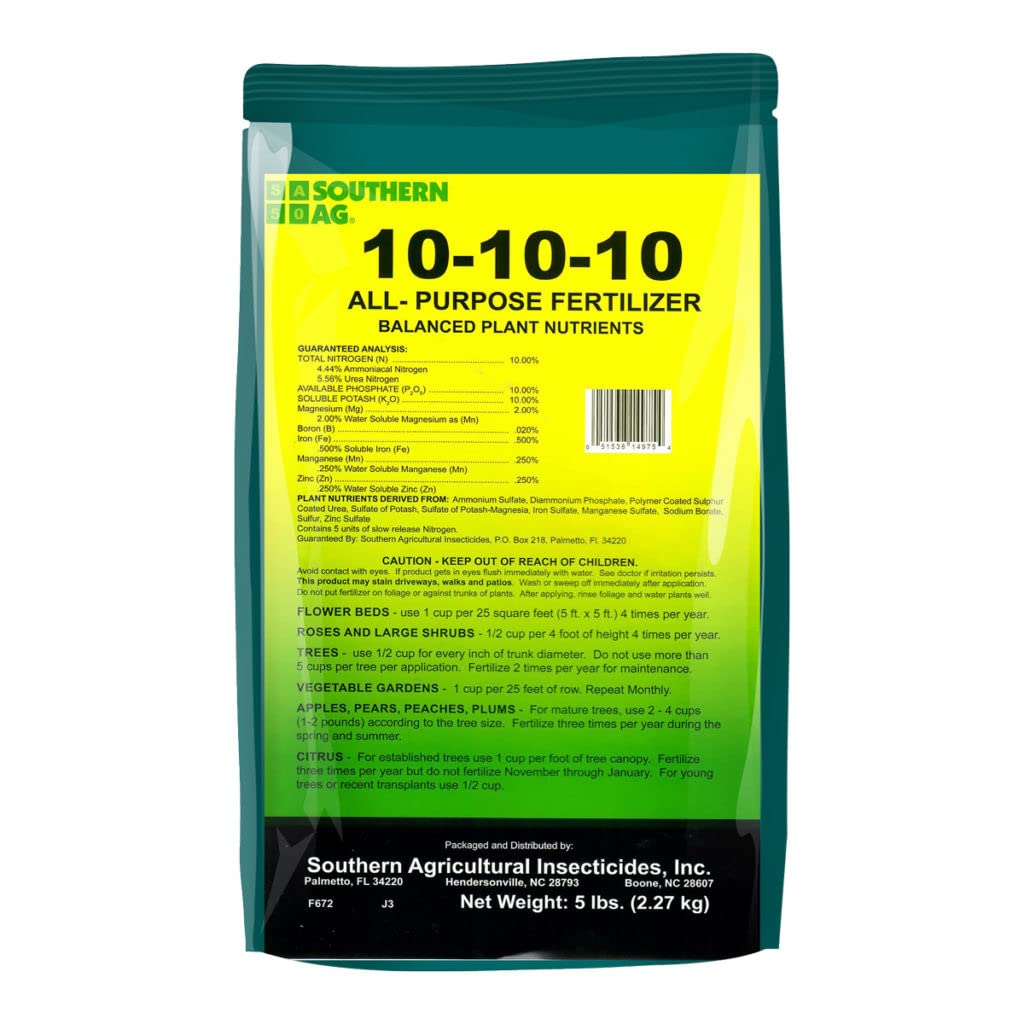
| Item Form | Granules |
|---|---|
| Specific Uses For Product | Citrus and Fruit Trees, Flowerbeds, Roses, and Large Shrubs, Vegetable Gardens |
| Application Method | Broadcast evenly over area and water in. |
| Mixing Ratio | 10:10:10 |
This 5 lb bag of Southern Ag 10-10-10 granular fertilizer is a straightforward, balanced all-purpose feed for vegetable beds, fruit trees, roses, and shrubs. You spread the granules uniformly over soil or beds and water them in; directions and recommended cup measurements are printed for common uses so dosing is easy. The formula supplies equal parts nitrogen, phosphorus, and potassium plus trace minerals like magnesium, iron, manganese, zinc, and boron, which supports steady vegetative growth and overall plant health. For asparagus specifically it can be used as a periodic maintenance feed during the growing season to support fern growth and energy storage in crowns. The product is simple to store and apply, and the small bag size is convenient for trialing on a single bed or patch. Limitations are that it is a general blend rather than a tailored asparagus formula, so heavy feeders or soils needing specific nutrient correction may require additional amendments, and granular broadcast feedings require careful placement to avoid contact with foliage or runoff risks described on the label.
Best for: Gardeners on a budget who want a simple, balanced fertilizer to maintain small asparagus patches and other mixed beds without buying specialty formulas.
Less Ideal for: Growers managing large asparagus plantings, or who need a targeted high-potassium or soil-specific amendment, should choose a crop-specific or soil-test-driven fertilizer.
- Balanced 10-10-10 N-P-K supports general growth and root development.
- Includes micronutrients (iron, manganese, zinc, boron) for broader plant nutrition.
- Clear application instructions and coverage rates for common garden uses.
- Small 5 lb size is convenient for testing on a single asparagus bed or small garden.
- Not formulated specifically for asparagus so may lack the higher potassium or phosphorus some heavy beds benefit from.
- Granular broadcast application can stain hard surfaces and requires watering after application to activate nutrients.
Verdict: A low-cost, easy-to-use balanced granular fertilizer that is a practical maintenance feed for small asparagus beds and mixed gardens.
Choosing the Right Fertilizer for Turnips and Radishes: Key Factors to Consider
Nutrient Ratio and Root Prioritization
Turnips and radishes need a nutrient profile that supports root bulking rather than excessive leaf growth. A fertilizer with moderate nitrogen, adequate phosphorus, and steady potassium encourages stronger root development and good skin quality.
High nitrogen early can produce lush tops but smaller, woody roots. Look for formulas where phosphorus is sufficient to support root initiation and potassium helps overall root health and storage life. The form of nutrients matters too: soluble forms act quickly for fast-growing radishes, while controlled-release forms feed over several weeks for slower-bulking turnips.
Release Profile and Feeding Schedule
How a fertilizer releases nutrients affects timing of root bulking and harvest size. Fast-release soluble feeds deliver a quick nutrient spike that is useful for successive radish sowings or correcting a deficiency.
Controlled-release or slow-release products provide a steadier supply that reduces the risk of nutrient swings and makes sense for longer-growing turnip varieties. Consider your planting rhythm: frequent, quick crops benefit from water-soluble feeds; a single, longer season crop often does better with a balanced slow-release option.
Application Method and Practicality
Choose a fertilizer format that matches your gardening style and bed type. Granules and spikes can be useful in raised beds and larger plots where you want less frequent feeding. Water-soluble powders or liquids are easiest for containers and quick succession plantings since you can feed at seeding and again at thinning.
Ease of measuring and applying matters too. Products requiring complex dilution or frequent feeding may be impractical for casual gardeners. Look for clear label instructions and predictable results in small-scale garden settings.
Salt Index and Seedling Safety
High-salt fertilizers can damage young root seedlings and cause poor germination or stunted early growth. For turnips and radishes, which are often direct-seeded, a low to moderate salt index helps protect delicate roots and emerging seedlings.
When using stronger formulations, apply them after seedlings establish or use banded applications away from the seed row. If growing in shallow containers, be especially cautious of soluble salts concentrating after repeated feedings.
Soil Type and pH Compatibility
Soil texture and pH influence nutrient availability and how a fertilizer behaves. Heavy clay holds nutrients differently than sandy soil, and acidic or alkaline pH can lock up phosphorus or micronutrients.
Match fertilizer choice to your soil. In light, sandy soils choose products with some organic matter retention or slower release to prevent leaching. In heavier soils, readily available nutrients can be useful early on, but ensure good drainage to avoid root issues.
Organic Vs Synthetic Considerations
Organic fertilizers release nutrients through microbial activity and add organic matter that improves soil structure over time. They are gentler on seedlings and support long-term soil health, which is helpful for repeated root crops in the same bed.
Synthetic options offer precision and faster correction of deficiencies, which can be important if you need quick results for a crop rotation. Decide whether long-term soil building or short-term corrective feeding is your priority when choosing between organic and synthetic products.
Timing Feedings Around Planting and Thinning
Timing your applications influences whether nutrients go to roots or leaves. For direct-seeded radishes and turnips, avoid heavy feeding at sowing. Instead, provide a starter dose at seeding that is mild and low in soluble salts, then follow up after the first true leaves appear to support root bulking.
- Apply a light starter application at sowing or incorporate a low-strength granular into the bed before planting.
- Feed again when seedlings are thinned so plants have resources to expand their roots rather than compete.
Soil Testing and Adjusting Nutrient Needs
A simple soil test removes guesswork. Knowing baseline nitrogen, phosphorus, potassium, and pH lets you pick a fertilizer that corrects the biggest limitation without overdoing other nutrients. For example, if soil phosphorus is adequate, adding more nitrogen-free phosphorus-heavy product is unnecessary and can imbalance growth.
Adjustments based on soil test results prevent common problems like excessive foliage or poor root bulking, and they guide whether an organic amendment or a targeted synthetic supplement is the right choice.
- Test every 2 to 3 years for home gardens.
- Pay attention to phosphorus index and pH to ensure root-available nutrients.
Feeding in Containers and Small Raised Beds
Containers and small raised beds dry and deplete nutrients faster than in-ground rows. Use soluble feeds or light, frequent applications in containers to maintain steady availability for quick-growing radishes. In raised beds, a balanced slow-release granule mixed into the planting mix reduces the need for mid-season attention.
Watch for salt buildup in containers; flush pots occasionally to prevent concentration.
- Use water-soluble feeds for containers and quick successions.
- Use low-salt slow-release granules for raised beds to minimize reapplication.
Organic Amendments That Aid Root Development
Compost and well-aged manure improve soil structure, moisture retention, and microbial activity, all of which support healthier roots. Bone meal and rock phosphate can add phosphorus slowly to encourage root initiation in soils that are low in that nutrient.
Combine organic soil-building steps with targeted feeding plans rather than relying solely on slow organic inputs when quick bulking is needed.
- Add compost during bed preparation to improve texture and nutrient-holding capacity.
- Use bone meal sparingly and according to soil test phosphorus levels.
Avoiding Common Root Crop Problems
Forking, cracking, and woody texture are often tied to inconsistent moisture, uneven fertility, or planting too densely. Manage fertility so nutrients are available during the window of root bulking and avoid excess nitrogen late in the cycle, which favors foliage.
Consistent irrigation, correct spacing, and feeding timed after thinning reduce many of the visual and textural issues gardeners see with turnips and radishes.
- Keep moisture even during root bulking to prevent splitting.
- Do not over-fertilize with high nitrogen after roots begin to swell.
How We Chose the Best Fertilizer for Turnips and Radishes
We shortlisted fertilizers based on attributes that matter for small root vegetables like turnips and radishes. Our focus was on formulas and formats that promote healthy root bulking without encouraging excessive leaf overgrowth. Key evaluation criteria included nutrient ratio and bioavailability, because NPK balance and how quickly nutrients become available shape root versus top growth. Application method and ease measured how practical a product is for beds, containers, and no-till patches. Salt index and burn risk were considered to avoid young-root damage. Timing and release profile assessed whether a fertilizer supports early establishment and mid-season bulking. Compatibility with common soil types and organic options determined suitability across typical backyard conditions. We excluded products whose formulations are clearly aimed at fruiting or heavy-feeding brassicas that prioritize foliage and flowering over root size. Also excluded were broad commercial blends without transparent nutrient analysis. The final picks balance measurable nutrient data with gardener-friendly application and predictable outcomes for turnips and radishes.
FAQ
How often should I feed radishes and turnips?
Frequency depends on the fertilizer type. Water-soluble feeds are usually applied every 1 to 3 weeks during active growth. Slow-release or granular formulations often need only one application at planting or a mid-season top-up.
Can I use a general vegetable fertilizer for turnips and radishes?
Often yes, if the general vegetable fertilizer has a balanced NPK that does not overemphasize nitrogen. Look for products that support roots with sufficient phosphorus and steady potassium rather than high nitrogen ratios.
Are organic fertilizers effective for root crops?
Organic fertilizers can be very effective, especially when combined with good soil structure and compost. They release nutrients more slowly, which suits longer-growing turnips, but may be slower to correct a deficiency for quick radish crops.
Will fertilizer cause radishes to bolt or become woody?
Excessive nitrogen or erratic feeding can encourage too much top growth, which may reduce root quality and cause woody texture. Balanced feeding and correct timing reduce this risk.
Should I fertilize before planting or after seedlings appear?
A light pre-plant amendment provides a baseline of nutrients. For direct-seeded root crops, follow with a mild application after seedlings establish so nutrients support root bulking rather than seedlings or competing weeds.
Final Verdict
Prioritize a fertilizer that supplies the right balance of nutrients and fits your planting rhythm. For quick radish success, favor soluble, low-salt feeds applied in short intervals. For longer-growing turnips, choose a steadier release that supports gradual root bulking and soil health. Tradeoffs exist between fast corrective feeding and long-term soil building, so match the product to your schedule and soil test results. Focus on nutrient ratio, release profile, and application practicality to get consistently full, well-formed roots at harvest.
