

Note: This article contains affiliate links. If you click on these links and make a purchase, I may earn a small commission at no extra cost to you. This helps support my research and content. Read my full affiliate disclosure here.
If you grow lettuce, kale, spinach, or other leafy greens you know foliage quality and steady growth matter more than flashy blooms. The right fertilizer for leafy green vegetables supplies the nitrogen and micronutrients that drive tender, productive leaves while avoiding salt buildup or uneven fertility. This guide shortlists six top options gardeners commonly choose for leafy greens and explains how we evaluated them. We focus on nutrient ratios, release characteristics, and ease of use so you can pick a fertilizer that matches your soil, planting method, and harvest rhythm.
Top Picks at a Glance
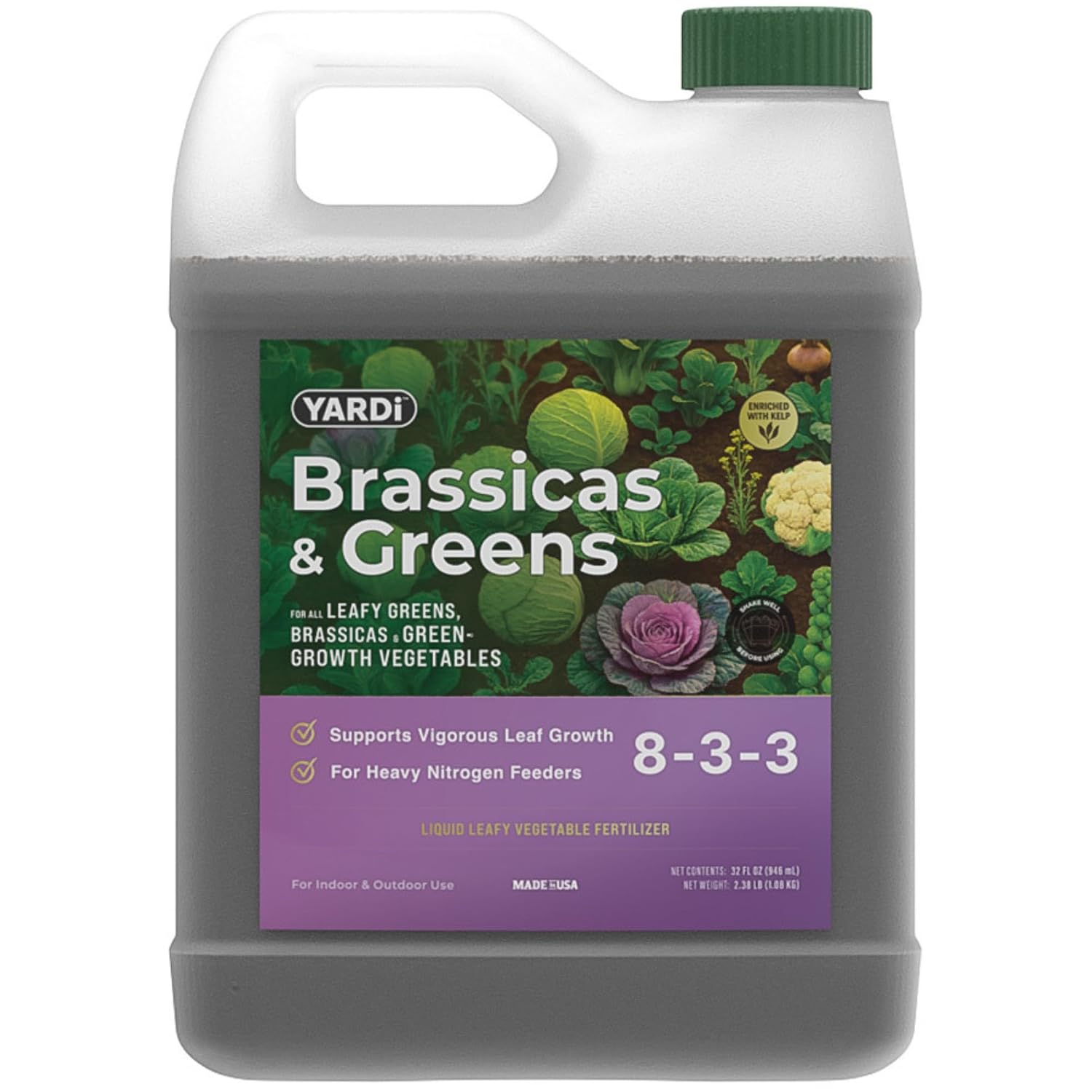
| Best Overall The best all-around choice for most situations | YARDi Brassicas & Greens Liquid Plant Food 32 oz (8-3-3) |  |
| Best Quality Built to a higher standard if you want something more solid | FoxFarm Happy Frog Tomato & Vegetable Fertilizer, 5-7-3 Blend, 4 lb |  |
| Best Value The sweet spot between price and what you get | Dr. Earth Organic Tomato, Vegetable & Herb Fertilizer (64 oz) |  |
| Highest Rated A top-rated pick with lots of positive feedback | Down To Earth All Natural Vegetable Garden Fertilizer, 25 lb (4-4-4) |  |
| Most Popular A crowd favorite that many people choose with confidence | Miracle-Gro Water Soluble All Purpose Plant Food, 1.5 lb |  |
| Best Seller A high-volume bestseller chosen again and again | TPS Nutrients Liquid Plant Food for AeroGarden and Hydroponics, 8 oz |  |
YARDi Brassicas & Greens Liquid Plant Food 32 oz (8-3-3)
| Item Form | Liquid |
|---|---|
| Specific Uses For Product | Leafy Greens |
| Target Species | Vegetables |
| Unit Count | 32 Fluid Ounces |
This 32-ounce YARDi liquid plant food is a nitrogen-forward 8-3-3 concentrate designed for outdoor brassicas and salad greens. It mixes easily with water (the label suggests 1–2 teaspoons per gallon) and can be applied as a soil drench, foliar spray, through drip irrigation, or with a hose-end applicator, making it flexible for beds, raised planters, and small-scale vegetable plots. The higher nitrogen ratio promotes lush, dark green foliage and sustained leafy growth in crops like kale, cabbage, broccoli, spinach and lettuce, and the formula includes micronutrients to support overall plant vigor. Practical benefits include straightforward dilution instructions and multiple application methods so you can feed regularly every 2–3 weeks during the growing season. Limitations are that the product is targeted to leafy vegetables and may be less appropriate for fruiting or flowering stages where balanced or phosphorus-heavy feeds are preferred, and frequent foliar or high-nitrogen use can require monitoring to avoid excess vegetative growth at the expense of yield.
Best for: Gardeners who prioritize big, healthy leaves on brassicas and salad greens and want a simple liquid feed they can use across beds and containers throughout the season.
Less Ideal for: Growers focused on flowering or fruiting crops or those who prefer granular slow-release fertilizers for low-maintenance feeding.
- High nitrogen 8-3-3 formula tailored for vigorous leafy growth
- Liquid concentrate that dilutes easily for foliar, soil drench, drip, or hose-end use
- Clear directions for regular feeding every 2–3 weeks during the season
- Includes micronutrients to support plant vigor beyond basic NPK
- Formulated specifically for leafy greens so not ideal as an all-purpose or bloom-promoting fertilizer
- Requires regular applications and careful dosing to avoid excessive leafy growth
Verdict: Choose this liquid 8-3-3 feed when your goal is consistently lush, vigorous leafy growth in brassicas and salad greens.
FoxFarm Happy Frog Tomato & Vegetable Fertilizer, 5-7-3 Blend, 4 lb

| Item Form | Granules |
|---|---|
| Specific Uses For Product | Vegetables, Tomatoes, Soft Fruits, and Berries |
| Unit Count | 64 Ounce |
| Mixing Ratio | 5:7:3 |
| Target Species | Vegetables |
This granular FoxFarm Happy Frog fertilizer supplies a balanced 5-7-3 N-P-K blend designed to support leafy growth and plentiful fruit set, plus added calcium and mycorrhizal fungi to improve root uptake and reduce blossom end rot. It is applied to in-ground beds and containers following the package directions and is suitable across vegetable plantings. The OMRI listing means it fits organic-minded plots, and the inclusion of mycorrhizae can help young roots access nutrients and moisture more efficiently. For root crops such as turnips the moderate nitrogen level encourages healthy foliage without overly stimulating excessive top growth that can reduce root development when used at recommended rates. Practical limits are that it is a general vegetable formula rather than a turnip-specific mix, so tight control of nitrogen and timing is still needed for optimal root size, and application rates must be followed to avoid uneven root formation. The dry granules are easy to store and apply but require incorporation or watering in to activate nutrients.
Best for: Gardeners focused on reliable, performance-oriented nutrition for a variety of vegetable crops who want an organic-certified, all-purpose fertilizer that supports both roots and fruiting.
Less Ideal for: Growers seeking a specialized low-nitrogen or root-maximizing formula specifically for large-scale root vegetable production should consider a product formulated expressly for root crops.
- Balanced 5-7-3 N-P-K suited to vegetables that need both foliage and root development
- Contains calcium to help prevent blossom end rot and related fruiting issues
- Includes mycorrhizal fungi to improve root nutrient and water uptake
- OMRI listed, making it acceptable for organic gardens
- Granular form is simple to store, measure, and apply to containers or beds
- Not tailored specifically to root crops so growers may need to adjust application timing or rates for turnips
- Sold in a single size that may require multiple purchases for larger plots
Verdict: Choose this OMRI-listed 5-7-3 granular if you want a performance-oriented, organic-friendly fertilizer that supports healthy roots and reliable vegetable yields.
Dr. Earth Organic Tomato, Vegetable & Herb Fertilizer (64 oz)

| Unit Count | 64 Ounce |
|---|---|
| Item Form | Granules |
| Specific Uses For Product | Organic |
| Target Species | Herb |
| Coverage | Medium |
This granular organic fertilizer is designed to boost vegetable and herb production by supplying balanced nutrients and soil biology support. It is typically broadcast into beds, mixed into potting mixes, or applied at planting and midseason for a nutritional lift; the manufacturer recommends reapplying every six weeks for containers. Notable features include a fully organic ingredient list, fast but sustained nutrient release, and a blend of probiotic microbes plus ecto and endo mycorrhizae intended to improve nutrient uptake and drought tolerance. In practice that means healthier root systems and potentially better yields and flavor in crops like cucumbers when used as part of an organic program. Limitations are that it is a medium coverage product in a 64 ounce bag so larger plots will need more frequent purchases, and it contains phosphorus so local runoff rules should be checked before use. Follow the directions for pH and application timing to avoid overapplication in small containers.
Best for: Gardeners who prioritize organic soil health and want a single, biology‑focused fertilizer to support vegetables like cucumbers in beds or containers.
Less Ideal for: Large‑scale growers seeking a bulk, high‑coverage fertilizer or those who must avoid phosphorus due to local regulations should consider other options.
- 100 percent organic formula suitable for certified organic gardens
- Contains beneficial microbes and eight strains of mycorrhizae to support root health and nutrient uptake
- Granular form releases nutrients quickly and continues feeding for several months
- Works for beds, raised planters and containers and can be used at planting, transplanting or midseason
- Bag is medium coverage so not economical for very large vegetable plots
- Includes phosphorus which may be restricted in some local jurisdictions
Verdict: Choose this product if you want an organic, microbe‑rich granular fertilizer that supports root health and steady feeding for cucumber and other vegetable plantings.
Down To Earth All Natural Vegetable Garden Fertilizer, 25 lb (4-4-4)

| Item Form | Granules |
|---|---|
| Target Species | vegetables |
| Unit Count | 400 Ounce |
| Mixing Ratio | 4-4-4 |
This 25 lb Down To Earth Vegetable Garden fertilizer is a granular, OMRI-listed organic blend designed to feed vegetables, herbs and container-grown edibles throughout the spring and summer. Gardeners typically broadcast or side-dress it into beds and containers to support leafy growth early in the season and to boost fruit size and yield for crops like tomatoes. The formula combines fish bone meal, alfalfa, feather meal, langbeinite, basalt, potassium sulfate, dolomite and seaweed meal to provide nitrogen, phosphorus and potassium along with mineral trace elements. Being granular makes it easy to handle and apply without measuring liquid mixes, and the organic inputs help build soil biology over time. Important limitations are that results are slower than synthetic fertilizers and you will need to follow application timing for best effect; heavy-feeding vegetables may require repeat applications. For gardeners prioritizing natural ingredients and steady long-term soil health, this is a dependable baseline fertilizer.
Best for: Gardeners who want a straightforward, naturally derived all-purpose fertilizer to support vegetables, herbs and container crops while building soil health over time.
Less Ideal for: Growers who need rapid, immediate nutrient correction or who prefer small single-season quantities for tiny balcony gardens.
- OMRI-listed organic formulation safe for certified organic gardens
- Balanced 4-4-4 N-P-K suitable for general vegetable and herb feeding
- Granular form is easy to apply as broadcast or side-dress for beds and containers
- Contains a mix of natural nutrient sources and mineral amendments to feed plants and soil biology
- Slower nutrient release compared with synthetic fertilizers, so effects appear over weeks rather than days
- Large 25 lb bag may be more than casual or balcony gardeners need at once
Verdict: A reliable, OMRI-listed organic 4-4-4 granular fertilizer that provides balanced, long-term nutrition for vegetable and herb gardens.
Miracle-Gro Water Soluble All Purpose Plant Food, 1.5 lb

| Item Form | Powder |
|---|---|
| Application Method | Watering Can |
| Target Species | For all flowers, vegetables, trees, shrubs and houseplants |
| Mixing Ratio | 24-8-16 |
Miracle-Gro Water Soluble All Purpose Plant Food is a powdered, water-soluble fertilizer formulated to deliver fast nutrition to a broad mix of plants. You mix the powder into a watering can or a garden feeder and apply every 1 to 2 weeks depending on whether plants are indoors or out. The 24-8-16 NPK ratio supplies a strong nitrogen boost for leafy growth along with phosphorus and potassium to support flowering and fruit set. For pepper growers this means it can help produce vigorous plants and encourage fruit development when used at the recommended strengths. Notable features include clear mixing guidance for both indoor and outdoor use and compatibility with container and in-ground plantings. Practical benefits are quick uptake by roots and flexible application options. Important limitations are the high nitrogen proportion, which can favor foliage over fruit if overused, and the need to follow dilution instructions to avoid nutrient burn. This product is best used as a regular boost within a balanced feeding plan rather than the only fertility source for long-term soil health.
Best for: Home gardeners looking for an affordable, easy-to-use boost to support vigorous pepper plant growth and quick results in both containers and garden beds.
Less Ideal for: Growers who want a low-nitrogen or slow-release fertility plan for long-term soil building should consider specialized or organic alternatives.
- Water-soluble powder that feeds plants quickly through the roots
- Clear mixing instructions for indoor and outdoor applications
- Broadly labeled for use on flowers, vegetables, trees, shrubs and houseplants
- Feeds approximately 600 sq. ft. from the 1.5 lb container
- High nitrogen ratio may encourage foliage more than fruit if used too frequently
Verdict: A budget-friendly, fast-acting soluble fertilizer that gives bell pepper plants a regular nitrogen-rich boost to promote vigorous growth and quicker results.
TPS Nutrients Liquid Plant Food for AeroGarden and Hydroponics, 8 oz

| Item Form | Liquid |
|---|---|
| Specific Uses For Product | Plant Growth, Root Development |
| Target Species | Herb, Vegetable |
| Mixing Ratio | 5 mL (1 tsp) per quart of feedwater |
| Unit Count | 8 Fluid Ounces |
This 8 oz liquid plant food provides concentrated, reservoir-safe nutrition intended for AeroGarden and comparable hydroponic units. It is used by mixing the recommended 5 mL per quart of feedwater into the system reservoir on a regular feeding schedule to supply macro and micronutrients for herbs, greens, and other compact edible plants. Notable features include a liquid formulation that dissolves easily, a focus on root development, and explicit compatibility with indoor hydroponic gardens. In practice it simplifies feeding for small indoor crops because a measured teaspoon per quart is straightforward to dose and store. Important limitations are the small bottle size, which will require frequent repurchasing for larger or multiple units, and the need to follow dilution directions carefully to avoid overfeeding. Safety handling is necessary because the concentrate should be kept away from children and pets. For risk-averse growers, the product’s clear mixing ratio and hydroponic focus make predictable feeding simple, but you should track reservoir concentrations rather than guessing frequency or volume adjustments.
Best for: Buyers who want a simple, low-risk feeding routine for indoor green onions and other small edible hydroponic crops and prefer clear dosing instructions they can follow reliably.
Less Ideal for: Growers managing large hydroponic setups, outdoor beds, or those who need a detailed NPK profile for tailored nutrient programs should look for larger or fully specified concentrates.
- Designed specifically for AeroGarden and similar hydroponic systems for straightforward compatibility
- Liquid formula mixes easily for even nutrient distribution in the reservoir
- Clear mixing ratio (5 mL per quart) simplifies dosing and repeatable feeding
- Targets root development and steady growth for herbs and vegetables
- Small 8 oz bottle may not last long for multiple or larger units
- No full nutrient analysis or NPK breakdown provided on the product listing
Verdict: A compact, easy-to-dose liquid fertilizer that makes predictable feeding of indoor green onions simple and low risk.
Choosing the Right Fertilizer for Leafy Green Vegetables: Key Factors to Consider
Nutrient Ratio and Nitrogen Dominance
Leafy greens depend on nitrogen to build large, tender leaves. A fertilizer for leafy green vegetables typically has a higher nitrogen proportion relative to phosphorus and potassium. You should check the N-P-K numbers and prefer formulas that emphasize nitrogen without totally neglecting P and K, since those support root health and stress tolerance.
Too much nitrogen can cause overly lush, weak tissue and increase pest or disease pressure, so look for balanced products or dilute concentrated feeds appropriately. Also consider micronutrients like iron, magnesium, and calcium because deficiencies can show quickly in leaf color and texture.
Release Type and Feeding Schedule
Immediate-release fertilizers deliver nutrients fast and are useful when you need a quick greening effect, such as correcting a deficiency or boosting growth before harvest. Slow-release or controlled-release formulas provide a steadier supply and reduce the chance of burning young plants from overfeeding.
Pick a release type that fits your gardening routine: if you want low-maintenance beds, a controlled-release granular may be best. If you grow in containers or use foliar feeding, water-soluble or liquid feeds give more control but require more frequent application.
Application Method Compatibility
How you plant determines what fertilizer form will work best. Raised beds and in-ground rows accept granular amendments and side-dressing well. Containers and grow bags often need water-soluble or liquid fertilizers for even uptake. Hydroponic and soilless systems require specialized soluble mixes with all essential elements in forms plants can absorb.
Also consider how easily you can measure and apply the product. Clear dosing instructions and adaptable concentration ranges let you scale feeding for small hobby plots or larger kitchen-garden setups.
Salt Index and Seedling Safety
Some fertilizers have higher salt content and can desiccate fine roots or burn seedlings. For tender leaf crops, salt-sensitive stages include germination, early leaf expansion, and post-transplant shock. Products labeled as low-salt or with explicit dilution guidance are safer for young plants.
When using stronger formulations, apply them at reduced strength to seedlings and newly transplanted greens, and allow a watering period after application to move salts away from roots when possible.
Micronutrients and pH Influence
Leaf color, texture, and nutrient-use efficiency depend not only on macronutrients but also on adequate micronutrients and soil pH. Iron and magnesium deficiencies are common in high pH soils and show as chlorosis in young leaves. Choose fertilizers that include a trace element package if your soil test indicates potential shortfalls.
Consider how a fertilizer interacts with your soil's pH. Some formulations include acidity modifiers or are more effective in certain pH ranges. If you do not test soil, use balanced products and monitor leaf color closely across the season.
Packaging, Dosing, and Environmental Impact
Practical packaging and straightforward dosing reduce mistakes that lead to overapplication. Look for products with easy-to-read concentration charts and resealable containers for small-batch gardeners.
Also weigh environmental concerns. Slow-release options and targeted application techniques can reduce nutrient runoff. If you garden near waterways, pick fertilizers and application methods designed to minimize leaching and surface runoff.
Timing Fertilizer Applications for Peak Leaf Quality
Feeding schedule affects texture, flavor, and harvest timing. Start with a light feed at true leaf stage or after transplanting, then switch to a regular maintenance feed as plants establish. For continuous-cut greens, plan lower-strength, frequent feeds to maintain steady regrowth without stressing the plants.
Avoid heavy late-season nitrogen applications on greens that will be left in the ground when temperatures rise, as this can produce overly tender tissue prone to bolting and heat stress.
- Light starter feed at transplant or true leaf stage
- Regular, lower-strength maintenance feeds for cut-and-come-again beds
- Reduce nitrogen as plants approach seeding or bolting windows
Adjusting Feeding for Soil Vs Container Gardens
In-ground beds often have more buffering capacity from soil organic matter, so granular feeds and soil amendments can provide sustained nutrition. Containers have limited root volume and require more regular, soluble feeding because nutrients wash out with frequent watering.
Monitor containers closely for signs of nutrient washout like pale new leaves and use a balanced soluble formula on a schedule suited to your potting mix and watering frequency.
- Use slow-release granulars in beds with good organic matter
- Prefer soluble feeds in containers and hanging planters
- Flush containers occasionally to prevent salt buildup
Organic Vs Synthetic Fertilizers for Leafy Greens
Organic fertilizers release nutrients more slowly as microbes break down material. They improve soil structure and microbial life over time, which benefits long-term fertility. However, organics may not correct acute deficiencies quickly and can be variable in nutrient concentration.
Synthetic fertilizers provide predictable, concentrated nutrients and quick correction of deficiencies. For gardeners who prefer organic practices, combining organic base amendments with occasional gentle soluble feeds can strike a balance between steady soil building and reliable leaf production.
- Organics build soil but act more slowly
- Synthetics act fast and are measurable
- Combining approaches can offer immediate and long-term benefits
Recognizing Nutrient Deficiencies in Leafy Greens
Common deficiencies show quickly on leaves. Nitrogen shortage causes uniform pale green or yellowing of older leaves. Iron or magnesium shortages usually affect new growth first, causing interveinal chlorosis. Potassium deficiency can show as marginal scorching or weak growth.
Correct diagnoses begin with observing which leaves are affected and whether symptoms are uniform or patchy. When in doubt, run a soil or tissue test rather than guessing, and start with moderate corrective feeds to avoid overreaction.
- Nitrogen: pale older leaves
- Iron/Magnesium: chlorosis on new leaves
- Potassium: edge scorching and brittle tissue
Safe Dilution and Application Techniques
Always follow dilution guidance closely, starting at the lower end for seedlings and then increasing as plants grow. Foliar feeding can quickly correct minor deficiencies but should be done during cool parts of the day to avoid leaf scorch. For granular products, incorporate them lightly into the soil surface and water in to move nutrients into the root zone.
Use hand-held spreaders or measuring spoons for small plots to ensure even distribution. After applying any concentrated feed, irrigate thoroughly to reduce salt stress unless the product instructions advise otherwise.
- Begin with half-strength on young plants
- Apply foliar sprays in morning or evening
- Water in granular feeds to move nutrients into roots
How We Chose the Best Fertilizer for Leafy Green Vegetables
We shortlisted fertilizers that match the specific nutritional needs of leafy green vegetables and that perform reliably in home garden conditions. Selection prioritized nutrient formulations aimed at foliage production, including higher nitrogen ratios and balanced secondary nutrients that support dark green color and leaf robustness. We evaluated release type because immediate-available versus slow-release products change feeding frequency and risk of leaf burn. Application methods were another filter: granular, water-soluble, and liquid concentrates behave differently in beds, containers, and hydroponic setups. Solubility and salt index were considered to avoid products likely to stress young transplants or thin-skinned greens. Packaging size and dosing clarity were checked because accurate, repeatable application matters for consistent harvests. Exclusions: we left out general-purpose bloom-focused fertilizers and any formulations clearly intended only for fruiting or ornamental plants. The final list emphasizes nutrient balance for leaf growth, predictable release behavior, ease of application, and gardener-friendly labeling that supports accurate dosing.
FAQ
How often should I feed leafy greens?
It depends on the fertilizer type. Water-soluble feeds are often applied every one to two weeks at reduced strength, while controlled-release granulars can last several months. Monitor plant vigor and leaf color to fine-tune frequency.
Can I use houseplant fertilizer on my lettuce and spinach?
Often you can if the houseplant fertilizer is balanced and applied at a gentler rate. Check the N-P-K and dilute to about half strength for young outdoor greens to avoid salt stress and excessive growth.
What should I do if my greens show yellowing leaves?
Yellowing can mean several things. Uniform yellowing of older leaves usually points to low nitrogen. If new leaves are pale between veins, suspect iron or magnesium issues. Start with a moderate nitrogen feed and consider a soil test if symptoms persist.
Are slow-release fertilizers safe for container-grown greens?
Yes, slow-release granules can be safe and convenient in containers, but containers often need more frequent feeding. Choose a formula rated for containers or supplement slow-release products with occasional soluble feeds during heavy growth periods.
Will more fertilizer always mean bigger leaves?
No. Excess nitrogen can produce soft, fragile tissue susceptible to pests and disease and can suppress root development. Balanced feeding that matches plant stage yields healthier, more productive leaves than simply increasing concentration.
How do I avoid salt buildup in raised beds and pots?
Flush soil with fresh water periodically and avoid overapplication. Use low-salt formulas for sensitive stages and water deeply after applying granular feeds to move salts below the root zone.
Final Verdict
For leafy green vegetables prioritize a fertilizer that supplies reliable nitrogen while also offering balanced secondary nutrients and low salt stress. Match the release type and application form to your planting method: slow-release or granular for low-maintenance beds, and soluble feeds for containers and quick corrections. Watch seedlings closely and start at reduced strength to avoid burn. With the right nutrient balance and a feeding rhythm that suits your garden, you can produce tender, flavorful greens consistently.
