

Note: This article contains affiliate links. If you click on these links and make a purchase, I may earn a small commission at no extra cost to you. This helps support my research and content. Read my full affiliate disclosure here.
Picking the right fertilizer for mango plant matters because mango trees respond to nutrient timing and balance more than many other fruit trees. The right regimen improves vegetative growth, encourages regular flowering, and supports fruit development without wasting nutrients or stressing the tree. In this guide we shortlist seven top fertilizer options suited to feeding mango trees in various settings, from potted patio specimens to established orchard trees. Each selection was evaluated for nutrient balance, ease of application, and suitability across common soil types and climates. Read on to see the criteria we used and practical guidance for applying fertilizer to get stronger growth and better yields.
Top Picks at a Glance
| Best Overall The best all-around choice for most situations | HiThrive Mango Tree Liquid Fertilizer, 16 oz |  |
| Best Quality Built to a higher standard if you want something more solid | GARDENWISE 6-4-6 Granular Fertilizer for Citrus, Avocado & Mango Trees (16 fl oz) |  |
| Best Value The sweet spot between price and what you get | Jobe's Organics Granular Fruit & Citrus Fertilizer, 4 lb |  |
| Best Budget The cheapest option that still gets the job done reliably | Ironite Plus Granular Plant Food 12-10-10 (3 lb) |  |
| Highest Rated A top-rated pick with lots of positive feedback | Miracle-Gro Shake 'N Feed Citrus, Avocado, Mango Plant Food, 4.5 lb |  |
| Most Popular A crowd favorite that many people choose with confidence | TPS Nutrients Mango Tree Fertilizer, Liquid Plant Food, 8 oz |  |
| Best Seller A high-volume bestseller chosen again and again | Miracle-Gro Water Soluble All Purpose Plant Food, 1.5 lb |  |
HiThrive Mango Tree Liquid Fertilizer, 16 oz

| Item Form | Liquid |
|---|---|
| Application Method | Spray |
| Coverage | Full |
| Target Species | Mango |
| Mixing Ratio | 1:16 |
HiThrive Mango Tree Liquid Fertilizer is a concentrated 16 oz plant food designed specifically for mango trees and formulated with macronutrients and micronutrients to encourage leafy growth, stronger roots, and sweeter fruit. It mixes at a 1:16 ratio and can be applied by watering can, hose-end sprayer, or as a foliar spray, which makes it easy to use across container and in-ground trees. The label calls out nitrogen, phosphorus and potassium plus elements like calcium, iron and zinc, so it addresses common deficiencies that cause yellowing or slow growth. Practical benefits include a small bottle that stretches to many gallons of ready-to-use solution, clear mixing instructions for different application methods, and an easy schedule for weekly to monthly feeding depending on season. Expect noticeably fuller foliage and improved fruit set when used as directed during active growth. The product is focused on nutrition rather than soil amendment, so growers who need pH adjustment, organic certification, or slow-release granular feeding should plan to use it alongside other cultural practices rather than as a sole long-term soil conditioner.
Best for: Gardeners who want a straightforward, concentrated feed to boost mango tree growth and fruiting and who prioritize easy mixing and repeatable application for practical maintenance.
Less Ideal for: Growers seeking an organic, granular, or soil-building fertilizer as their primary long-term amendment should consider other products or combine this with soil conditioners.
- Concentrated 16 oz bottle mixes to 16 gallons, providing extended use from a small container
- Formulated with NPK plus micronutrients like calcium, iron and zinc to correct common deficiencies
- Multiple application methods supported: watering can, foliar spray, and hose-end sprayer
- Clear mixing ratios and seasonal feeding schedule simplify routine maintenance
- Not an organic-certified product, so it may not suit organic orchard management
- Does not amend soil structure or provide slow-release nutrition
Verdict: A concentrated, easy-to-use liquid feed that stretches far and reliably boosts mango tree foliage and fruit when used as part of routine seasonal care.
GARDENWISE 6-4-6 Granular Fertilizer for Citrus, Avocado & Mango Trees (16 fl oz)

| Item Form | Granules |
|---|---|
| Specific Uses For Product | avocado, mango and citrus tree fertilizer |
| Unit Count | 16 Fluid Ounces |
| Mixing Ratio | 6:4:6 |
This Gardenwise 6-4-6 granular fertilizer is designed for citrus, avocado and mango trees and delivers balanced, slow-release nutrition you apply around the root zone. Typical use is sprinkling and mixing it into backfill or soil for potted or landscape trees, then watering in; the manufacturer recommends feeding three times a year (late winter, late spring, early fall). The 6-4-6 NPK gives an emphasis on nitrogen to push leafy growth and vigor while still supplying phosphorus and potassium for fruit set and root health. Practical benefits include easy granular application, compatibility with indoor potted specimens and larger outdoor trees, and a formula intended to release nutrients over weeks so you do not need frequent reapplications. Limitations are the small 16 fl oz unit size for larger trees or orchards and that the label gives general mixing ratios rather than detailed rates by tree age or canopy spread, so heavier-feeding trees may require multiple bags or supplemental feeding during heavy fruiting years.
Best for: Gardeners who prioritize performance and steady, predictable feeding for mango and other fruit trees and want a specialized, slow-release fertilizer that supports both vegetative growth and fruiting.
Less Ideal for: People managing large orchards or many mature trees who need bulk quantities or precise high-rate feeding schedules should consider commercial-scale fertilizers or larger package sizes.
- Formulated specifically for citrus, avocado and mango so nutrient balance suits fruit trees
- Slow-release granular form reduces application frequency to about three times per year
- Simple application instructions work for both potted and landscape trees
- Contributes to leafy vigor and supports fruit development with an NPK focused on nitrogen and potassium
- Small 16 fl oz unit may not cover mature trees or multiple plants without additional purchases
- Product information provides general mixing ratios but not precise per-tree dosing by size
Verdict: Choose this product when you want a specialized, slow-release 6-4-6 fertilizer that reliably supports steady growth and fruiting in mango and other small-to-medium fruit trees.
Jobe's Organics Granular Fruit & Citrus Fertilizer, 4 lb

| Item Form | Granules |
|---|---|
| Specific Uses For Product | Plant Growth, Root Development, Seed Development, Soil Conditioning |
| Application Method | Spread evenly around base |
| NPK | 3-5-5 |
| OMRI Listed | Yes |
This granular Jobe's Organics fertilizer is designed to feed fruit and citrus trees with a slow-release, root-targeted NPK of 3-5-5. It is typically applied by measuring and spreading the granules evenly around the base of the tree, then watering in; applications are recommended every 4 to 8 weeks during the growing season. Notable features include OMRI listing for organic gardening, a blend of feather meal, bone meal and processed poultry manure for organic nutrient sources, and a resealable bag for convenient storage. In practice the formula supports root development and fruit set without synthetic chemicals, and the slow-release nature reduces the need for very frequent feeding. Limitations are that the lower nitrogen level makes it better suited for fruiting and flowering stage nutrition rather than rapid leafy growth, and larger trees will require repeated applications or larger quantities. For gardeners aiming for an organic, low-fuss feed for citrus, this provides predictable, targeted nutrition, but it is not a quick-fix soluble feed for immediate green-up.
Best for: Gardeners who prefer organic, low-maintenance feeding for citrus and fruit trees and want a slow-release product that focuses on fruit and root health.
Less Ideal for: Growers needing fast, high-nitrogen correction or a soluble foliar feed; landscapers managing many mature trees who need bulk quantities more often.
- OMRI listed organic formula suitable for certified organic gardens
- Balanced 3-5-5 NPK aimed at improving flowering and fruit production
- Slow-release granules that feed roots over time and reduce application frequency
- Resealable packaging keeps product fresh between uses
- Lower nitrogen content means it will not rapidly promote leafy growth
- 4 lb bag may be insufficient for mature trees or larger plantings
Verdict: A reliable OMRI-listed granular fertilizer that delivers slow-release, fruit-focused nutrition for organic citrus gardeners.
Ironite Plus Granular Plant Food 12-10-10 (3 lb)

| Item Form | Granules |
|---|---|
| Specific Uses For Product | Outdoor |
| Application Method | Pour |
| Coverage | 100 square feet |
| Target Species | Shrubs, Trees, Flower gardens |
Ironite Plus is a small-bag granular fertilizer intended for routine feeding of shrubs, trees, and flowering beds. You spread or pour the granules around the root zone following package directions; the 12-10-10 N-P-K ratio supports leafy growth early in the season while phosphorus encourages stronger roots and better blooms. The formula also includes iron, sulfur, and other micronutrients that can help correct minor iron deficiencies and improve color. A 3 pound unit is easy to store and convenient for spot treatments or for homeowners with a few specimens rather than large landscapes. Coverage is listed at about 100 square feet, so it is best used on a handful of trees or concentrated flower beds rather than broad lawns. Limitations are the modest package size and the nitrogen-forward ratio, which may not be ideal if you need a lower-nitrogen bloom booster or long-term slow-release feeding for large plantings. Follow the label rates to avoid overapplication near young roots.
Best for: Home gardeners who want an affordable, easy-to-apply granular fertilizer for a few flowering trees, shrubs, or concentrated beds and who prefer quick visible results over long-term slow-release feeding.
Less Ideal for: People managing large landscapes or beds who need coverage from a single purchase or gardeners seeking a specialized low-nitrogen bloom booster should consider larger bags or different formulas.
- Balanced 12-10-10 N-P-K that supports growth, root development, and flowering
- Includes iron and micronutrients to help correct minor deficiencies and improve foliage color
- Granular form is easy to apply by hand and suitable for spot treatments
- Small 3 lb bag is convenient and reduces waste for homeowners with a few trees or beds
- Small package covers limited area so multiple purchases are needed for larger gardens
- Not a low-nitrogen bloom-specific formula for gardeners seeking a dedicated flowering booster
Verdict: A budget-friendly, easy-to-use granular 12-10-10 fertilizer that supplies iron and micronutrients for a few flowering trees and shrubs.
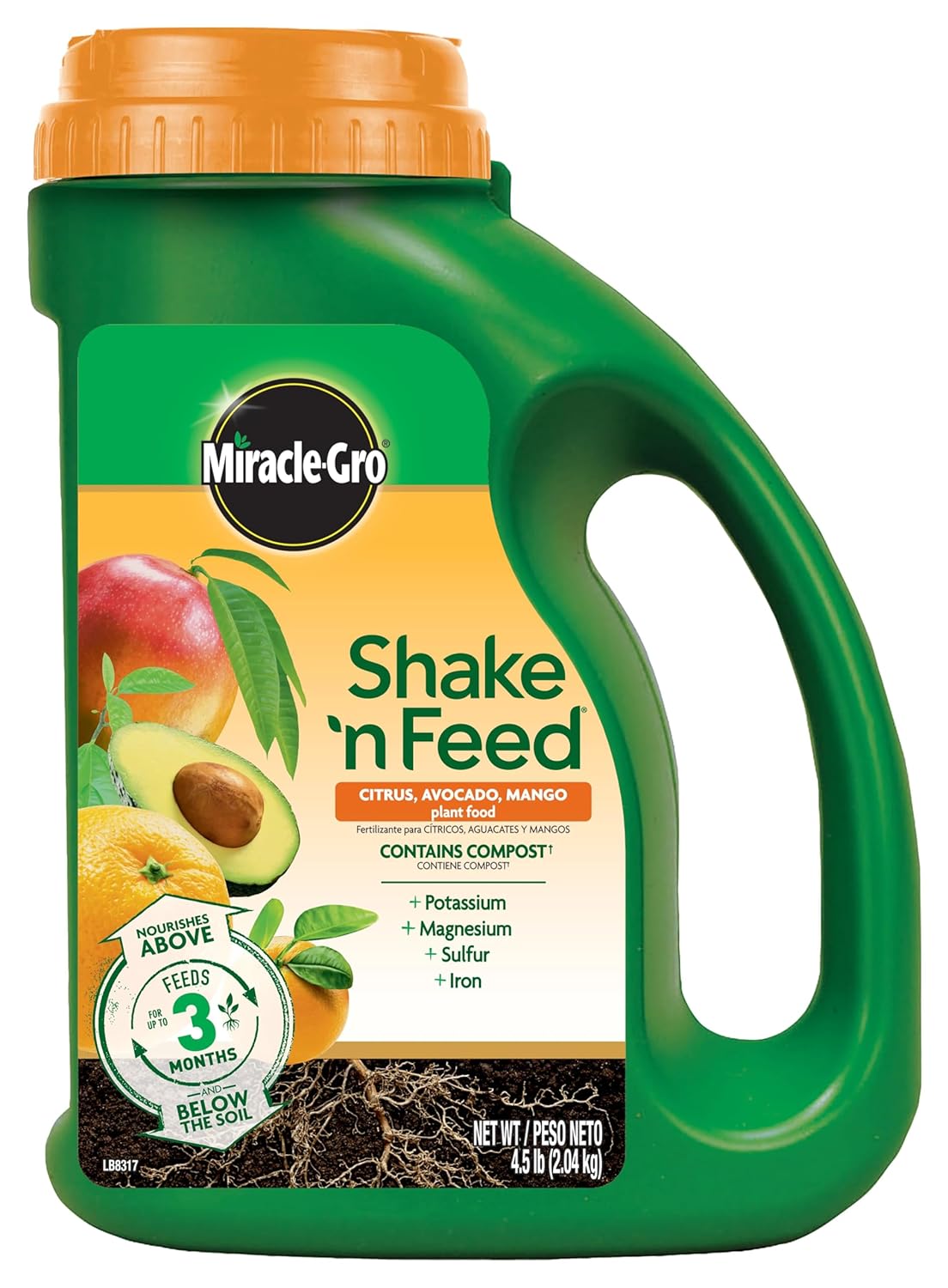
Miracle-Gro Shake 'N Feed Citrus, Avocado, Mango Plant Food, 4.5 lb
| Item Form | Granules |
|---|---|
| Application Method | Shake evenly onto soil |
| Target Species | citrus, avocado, mango |
| Mixing Ratio | 8-2-10 |
| Coverage | Medium |
This Shake 'N Feed formula is a granular, slow-release fertilizer made for citrus, avocado and mango trees in containers or in-ground. You shake the granules evenly onto the soil within the branch spread or mix into potting mix at planting, then water to start feeding; one application feeds plants for up to three months. The N-P-K listed (8-2-10) and added micronutrients such as potassium, magnesium, sulfur and iron help correct common deficiencies and support root development through microbes in the mix. It is practical for seasonal feeding and reduces the frequency of applications compared with quick-release fertilizers. Limitations include that it is a general fruit-tree feed rather than a lemon-specific formula and needs correct placement to avoid contact with trunks or foliage. For established trees you must follow label rates to avoid overfeeding and reapply every three months to maintain nutrition through the growing season.
Best for: Practical gardeners who want an easy, low-maintenance feeding schedule for lemon and other citrus trees and prefer a single product that works in pots and beds.
Less Ideal for: Growers who need a custom nutrient program based on soil tests or who want a fast-acting liquid feed for quick corrections should consider more targeted products.
- Slow-release formula provides up to 3 months of feeding per application
- Contains N-P-K 8-2-10 plus micronutrients to address common deficiencies
- Works for both container and in-ground citrus and other fruit trees
- Easy shake-and-feed application that reduces application frequency
- Not a lemon-specific formulation so may lack tailor-made ratios for particular soil tests
- Requires careful placement and incorporation to avoid trunk or foliage contact
Verdict: Use this to keep lemon trees consistently fed with a convenient, three-month slow-release granular fertilizer.
TPS Nutrients Mango Tree Fertilizer, Liquid Plant Food, 8 oz

| Item Form | Liquid |
|---|---|
| Specific Uses For Product | Mango Tree Fertilizer |
| Coverage | Full |
| Target Species | Mangoes |
| Mixing Ratio | 1:100 |
This 8 oz liquid formula is designed for mango and other tropical fruit trees and is used diluted at the manufacturer-recommended 1:100 mixing ratio. It supplies balanced, kelp-enriched minerals plus added calcium and magnesium to support shoot and root growth, stronger fruit set, and reduced fruit drop. In practice you mix small amounts into water and apply to the root zone or as a foliar feed according to directions, making it convenient for backyard trees and patio specimens. The liquid form allows quick uptake compared with granular fertilizers and is useful during active growth and just before fruiting. The small bottle is easy to store and works well for a few trees or for trialing on young specimens, but you will need to repurchase for larger plantings. Follow safety guidance to avoid skin or eye contact and keep away from children and pets. For gardeners seeking a mango-specific, easy-to-use liquid feed to encourage healthier growth and better harvests, this product is a practical option.
Best for: Home gardeners and backyard mango owners who want a purpose-made, easy-to-apply liquid feed to support fruiting and reduce fruit drop without complex mixing or timing schedules.
Less Ideal for: Large-scale orchard growers or anyone needing a bulk, long-lasting fertilizer solution should consider concentrated or granular options better suited to high-volume use.
- Formulated specifically for mango trees with kelp-enriched minerals plus added calcium and magnesium
- Liquid concentrate mixes 1:100 for quick uptake and easy foliar or soil application
- Compact 8 oz bottle is easy to store and suitable for backyard or patio trees
- Helps support root and shoot development and can reduce fruit drop when used properly
- Small 8 oz volume means frequent repurchasing for multiple or mature trees
Verdict: A convenient, mango-specific liquid feed that helps strengthen trees and encourage better fruit set for home gardeners.
Miracle-Gro Water Soluble All Purpose Plant Food, 1.5 lb

| Item Form | Powder |
|---|---|
| Application Method | Watering Can |
| Target Species | For all flowers, vegetables, trees, shrubs and houseplants |
| Mixing Ratio | 24-8-16 |
Miracle-Gro Water Soluble All Purpose Plant Food is a powdered, water-soluble fertilizer formulated to deliver fast nutrition to a broad mix of plants. You mix the powder into a watering can or a garden feeder and apply every 1 to 2 weeks depending on whether plants are indoors or out. The 24-8-16 NPK ratio supplies a strong nitrogen boost for leafy growth along with phosphorus and potassium to support flowering and fruit set. For pepper growers this means it can help produce vigorous plants and encourage fruit development when used at the recommended strengths. Notable features include clear mixing guidance for both indoor and outdoor use and compatibility with container and in-ground plantings. Practical benefits are quick uptake by roots and flexible application options. Important limitations are the high nitrogen proportion, which can favor foliage over fruit if overused, and the need to follow dilution instructions to avoid nutrient burn. This product is best used as a regular boost within a balanced feeding plan rather than the only fertility source for long-term soil health.
Best for: Home gardeners looking for an affordable, easy-to-use boost to support vigorous pepper plant growth and quick results in both containers and garden beds.
Less Ideal for: Growers who want a low-nitrogen or slow-release fertility plan for long-term soil building should consider specialized or organic alternatives.
- Water-soluble powder that feeds plants quickly through the roots
- Clear mixing instructions for indoor and outdoor applications
- Broadly labeled for use on flowers, vegetables, trees, shrubs and houseplants
- Feeds approximately 600 sq. ft. from the 1.5 lb container
- High nitrogen ratio may encourage foliage more than fruit if used too frequently
Verdict: A budget-friendly, fast-acting soluble fertilizer that gives bell pepper plants a regular nitrogen-rich boost to promote vigorous growth and quicker results.
Choosing the Right Fertilizer for Mango Plant: Key Factors to Consider
Nutrient Ratio and Growth Stage
Mango plants need different nutrient emphasis depending on age and season. Young trees benefit from a bit more nitrogen to encourage leafy growth and root development, while mature, fruiting trees require higher potassium and adequate phosphorus to support flowering and fruit set.
Understanding the ratio printed as N-P-K helps you pick a fertilizer that matches the tree's current stage. Overapplying nitrogen when the tree should be shifting to reproductive growth can suppress flowering and delay fruiting, so choose a product or schedule that lets you lower nitrogen and increase potassium as flowering approaches.
Release Profile and Frequency
Fertilizers come as quick-release liquids or soluble granules and as slow-release or controlled-release formulations. Quick-release feeds produce a fast nutrient boost useful for correcting deficiencies or feeding potted trees, but they require more frequent applications and carry a higher risk of root burn if misapplied.
Slow-release options reduce labor by providing nutrients over weeks or months and are often safer for larger established mango trees. Match the release profile to how often you want to feed and your tolerance for monitoring soil moisture and salt buildup.
Salt Content and Root Safety
High soluble salt fertilizers can harm mango roots, especially in containers or compacted soils where leaching is limited. Salt stress shows as leaf scorch, marginal browning, or reduced fruit set.
Look for fertilizers with lower salt indexes or those formulated to minimize soluble salt concentrations. If you use a higher-salt product, plan for thorough watering after application and occasional leaching to prevent accumulation.
Formulation and Application Method
Granular, liquid, and foliar formulations each behave differently in the garden. Granules spread under the canopy or banded around the drip line provide steady nutrient release when watered in. Liquids deliver a faster response and are useful for foliar feeding or quick corrections. Foliar sprays can supply micronutrients rapidly but do not replace root feeding for macronutrients.
Consider your physical ability, time, and equipment when selecting a form. Containers typically benefit from frequent light liquid or soluble feeds, while in-ground trees do well with periodic granular or slow-release products.
Soil Type and pH Compatibility
Soil texture and pH influence nutrient availability for mango plants. Sandy soils drain quickly and may require more frequent feeding and heavier potassium and nitrogen applications due to leaching. Clay soils hold nutrients but may lock up phosphorus if pH is off. Neutral to slightly acidic pH is usually best for mango nutrient uptake.
Choosing a fertilizer that performs well across your soil type or pairing it with soil amendments will improve results. Regular soil testing helps tailor fertilizer choice and avoid wasted applications.
Micronutrients and Deficiency Management
Beyond N-P-K, mango trees need micronutrients such as magnesium, zinc, iron, and boron for healthy growth and good fruit quality. Deficiencies can show as chlorosis, poor flowering, or malformed fruit.
Select fertilizers that include or can be complemented by targeted micronutrient feeds. Foliar applications are often the fastest way to correct micronutrient shortfalls, while balanced soil-applied mixes support long-term tree health.
Feeding Timelines for Mango Plants
Feeding should follow the tree's seasonal cycle. In warm seasons when growth resumes, apply a higher-nitrogen feed to promote canopy and root expansion. Transition to a higher-potassium emphasis in the months before flowering to encourage bud set and fruit development.
For recently planted or container trees, use smaller, more frequent feedings. Established in-ground trees can tolerate larger, less frequent applications, especially with slow-release products. Record your feeding dates and observe bloom and leaf responses to refine timing the next year.
- Young trees: lighter, more frequent nitrogen-focused feedings.
- Pre-flowering: reduce nitrogen, increase potassium and phosphorus.
- Fruit development: maintain potassium and monitor for micronutrients.
Applying Fertilizer Around the Root Zone
Place granular fertilizers in a band slightly beyond the trunk, roughly under the canopy edge where most feeder roots reside. Avoid piling material against the trunk. Water in granular applications thoroughly to move nutrients into the root zone.
For liquid feeds, dilute according to label directions and apply evenly across the drip zone. Foliar sprays are best in cooler parts of the day and are for micronutrient supplementation rather than replacing soil-applied macronutrients.
- Band granules under the canopy, not at the trunk base.
- Water after application to reduce burn risk and start nutrient movement.
- Use foliar sprays for quick micronutrient correction, not for N-P-K bulk feeding.
Adjusting Fertilizer When Growing in Containers
Container-grown mango plants need more frequent and milder feeding schedules because pots restrict root volume and increase leaching with frequent watering. Use soluble or liquid fertilizers at reduced strength and consider slow-release pellets to reduce application frequency.
Ensure containers have good drainage and flush the potting mix occasionally to prevent salt buildup. Monitor leaf color and growth, and reduce feed strength if you see tip burn or foliar scorch.
- Prefer lower-strength, more frequent applications in pots.
- Combine slow-release and occasional liquid feeds for stability.
- Flush pots periodically to prevent salt accumulation.
Correcting Common Nutrient Deficiencies
Yellowing between leaf veins often indicates iron or magnesium deficiency, while stunted growth and poor leaf color can point to nitrogen shortage. Zinc and boron deficiencies may appear as distorted or poorly set fruit. A targeted foliar treatment or a soil-applied micronutrient blend can correct these issues.
Before treating, confirm the problem with a soil or tissue test when possible. Over-applying a single nutrient can create secondary deficiencies and harm overall tree health, so follow label rates and recheck after treatment.
- Use tissue tests to confirm suspected micronutrient shortages.
- Apply targeted micronutrient sprays for quick correction when needed.
- Avoid repeated single-nutrient applications without testing.
Organic Versus Synthetic Options
Organic fertilizers release nutrients more slowly and improve soil structure over time, benefiting long-term orchard health. They often supply a broader mix of trace elements but may require larger application volumes to match synthetic N-P-K rates.
Synthetic fertilizers deliver predictable nutrient amounts and faster correction of deficiencies. They are useful when you need a timely response, but they may increase salt load and require careful management to avoid overfeeding. Choose based on your garden philosophy, labor tolerance, and the speed of correction you need.
- Organics build soil health but release nutrients slowly.
- Synthetics act fast and are precise but need careful salt management.
- Hybrid approaches can give steady long-term improvement plus periodic boosts.
How We Chose the Best Fertilizer for Mango Plant
We focused on criteria that matter for mango trees in both home and small-scale orchard settings. Nutrient balance was a primary filter because mango plants need different ratios of nitrogen, phosphorus, and potassium at different growth stages. Ease of application was important for gardeners who prefer granular, liquid, or slow-release formats. Release profile and longevity were used to predict how often a gardener must reapply fertilizer. Compatibility with common soil types and pH conditions guided selections to avoid products that require extensive soil amendments. Safety and salt load were considered to reduce risk of root burn and long-term soil salinity. Finally, practical availability of clear dosing instructions and suitability for container versus in-ground planting were required for inclusion. We excluded any fertilizer that lacked clear N-P-K labeling, omitted instructions for young trees, or had an unusually high soluble salt rating without mitigation advice. The result is a list of fertilizers that meet predictable nutrient needs for mango plants, are usable by typical gardeners, and cover the main application styles and release profiles you are likely to choose between.
FAQ
How often should I fertilize a young mango tree?
Young mango trees usually benefit from lighter, more frequent feedings during the growing season, such as every 6 to 8 weeks with a balanced fertilizer at reduced strength. Frequency depends on the fertilizer type and pot or soil drainage, so adjust if you see signs of nutrient excess or deficiency.
Can I use a standard fruit-tree fertilizer on mango plants?
Often a general fruit-tree fertilizer works if its N-P-K ratio matches your tree's stage and it has low to moderate soluble salts. Check the nutrient ratio and application instructions and adjust timing to favor potassium before flowering for better fruit set.
When should I reduce nitrogen to encourage flowering?
Reduce nitrogen several weeks before the expected flowering period so the tree shifts from vegetative growth to reproductive development. The exact timing depends on your climate and local bloom cycle, but plan adjustments during the pre-flowering growth slowdown.
Are foliar sprays effective for fixing deficiencies quickly?
Yes, foliar sprays can quickly correct certain micronutrient deficiencies like iron or zinc, because leaves absorb nutrients rapidly. They are not a substitute for soil-applied macronutrients and should be used as a targeted short-term remedy or supplement.
How do I avoid salt build-up in container-grown mango trees?
Use lower-strength feeds more frequently, choose low-salt or slow-release fertilizers, and flush the pot thoroughly with water periodically to leach accumulated salts. Good drainage and occasional repotting with fresh mix also help prevent buildup.
Final Verdict
Choosing the right fertilizer for mango plant is about matching nutrient ratios and release profile to the tree's age and seasonal needs. Prioritize N-P-K balance and salt safety, and pick an application style that fits your garden setup and maintenance habits. Regular soil or tissue testing and paying attention to leaf and flowering cues will let you refine feeding over time and get reliable growth and fruiting.
