

Note: This article contains affiliate links. If you click on these links and make a purchase, I may earn a small commission at no extra cost to you. This helps support my research and content. Read my full affiliate disclosure here.
Planting a young apple tree is only the start; the right fertilizer helps it establish roots, build a sturdy trunk, and develop a productive canopy. For new apple trees you need products that supply the right nutrients at the right time without pushing excessive leafy growth that weakens structure. This guide examines seven top fertilizer options suited for newly planted apple trees in home orchards, small yards, and mixed garden beds. We shortlisted products based on nutrient ratios appropriate for young trees, ease of use in typical garden settings, and evidence of predictable, gradual feeding. Below we explain what matters and why, then walk through our top picks and practical guidance for application and timing.
Top Picks at a Glance
| Best Overall The best all-around choice for most situations | Down To Earth Organic Fruit Tree Fertilizer, 6-2-4, 5 lb |  |
| Best Quality Built to a higher standard if you want something more solid | Down To Earth Fruit Tree Organic Fertilizer, 6-2-4, 25 lb |  |
| Best Value The sweet spot between price and what you get | Farmer's Secret Fruit Tree Booster Liquid Fertilizer (8 oz) |  |
| Best Budget The cheapest option that still gets the job done reliably | Jobe's Organics Granular Fruit & Nut Fertilizer, 4 lb |  |
| Highest Rated A top-rated pick with lots of positive feedback | Espoma Organic Bio-Tone Starter Plus 4-3-3 Organic Starter Fertilizer, 8 lb |  |
| Most Popular A crowd favorite that many people choose with confidence | Miracle-Gro Fruit & Citrus Plant Food Spikes (12-count) |  |
| Best Seller A high-volume bestseller chosen again and again | Jobe's Organics Granular Fruit & Citrus Fertilizer, 4 lb |  |
Down To Earth Organic Fruit Tree Fertilizer, 6-2-4, 5 lb

| Item Form | Powder |
|---|---|
| Specific Uses For Product | Plant Growth,Potting |
| Target Species | fruit trees |
| Mixing Ratio | 6:2:4 |
This Down To Earth Fruit Tree mix is an all‑natural, soil‑applied fertilizer intended for backyard orchards and fruiting shrubs. It comes as a dry powder you broadcast around the tree dripline, lightly incorporate or cover with mulch, then water in so nutrients reach the root zone. The 6-2-4 formula supplies a higher proportion of nitrogen with potassium and phosphate plus added calcium and organic inputs like fish bone meal, alfalfa and kelp to support fruit set and development. Practical benefits include OMRI listing for organic use, a stable shelf life, and ingredients that build soil biology rather than just feeding leaves briefly. Because it is a slow soil feed rather than water soluble, you should expect gradual improvements and plan regular seasonal applications rather than instant greening. Also handle with basic safety precautions and keep it away from children and pets. For gardeners wanting to improve fruit yield and soil health with an organic, multi‑nutrient fertilizer, this is a straightforward option that pairs well with compost and mulch.
Best for: Gardeners building or maintaining a backyard orchard who prioritize organic, soil‑building nutrition and steady seasonal feeding rather than quick foliar fixes.
Less Ideal for: People needing immediate, fast‑acting foliar feeding or quick corrective treatments for acute nutrient deficiencies should consider soluble fertilizers or foliar sprays instead.
- Formulated specifically for fruit trees with added calcium to support fruit development
- OMRI listed compatible with organic production practices
- Powdered dry mix feeds soil biology for longer‑term nutrient availability
- Shelf stable so it can be stored without losing effectiveness
- Uses a blend of animal, marine and plant ingredients for broad nutrient profile
- Not water soluble so it will not give an immediate foliar response
- Requires spreading and light incorporation which takes more time than liquid feeds
Verdict: A practical organic soil fertilizer tailored to fruit trees that builds soil health and supports better fruit development over time.
Down To Earth Fruit Tree Organic Fertilizer, 6-2-4, 25 lb

| Item Form | Powder |
|---|---|
| Specific Uses For Product | Plant Growth |
| Target Species | Trees |
| Mixing Ratio | 6-2-4 (N-P-K) |
This 25 lb bag of Down To Earth Fruit Tree fertilizer is an organic, soil-applied powder designed to feed fruiting trees and shrubs during the growing season. With a 6-2-4 N-P-K formula and added calcium, it supplies slow-release nitrogen and potassium along with bone and feather meals that support sustained growth and fruit set. You apply it by broadcasting or hand-applying around the tree dripline, lightly raking in or covering with mulch, then watering it in. Its OMRI listing and use of natural inputs like fish bone, feather meal, kelp and langbeinite make it a good fit for organic backyard orchards and diversity of fruit types from apples and pears to figs and pomegranates. Practical benefits include long-lasting nutrient supply, calcium for better fruit quality, and shelf stability. Limitations are that it is not water soluble so it must be incorporated into soil and it requires careful handling (dust) and adherence to bag instructions for rates; it is a general fruit-tree feed rather than a tailored formula for specific deficiencies.
Best for: Home orchardists who want a straightforward organic fertilizer to maintain healthy crabapple trees and improve fruit set and quality through season-long nutrient release.
Less Ideal for: Growers seeking a fast-acting, water-soluble feed or a product formulated to correct a specific soil nutrient deficiency should consider targeted or soluble alternatives.
- OMRI-listed organic formula suitable for certified organic and home orchards
- 6-2-4 N-P-K with added calcium supports fruit development and quality
- Contains diverse natural nutrient sources (feather meal, fish bone, kelp) for slow-release feeding
- Large 25 lb bag provides season-long coverage for multiple trees
- Shelf-stable dry blend that can be stored long term if kept dry
- Not water soluble so benefits rely on soil incorporation and microbial activity
- Powder can be dusty; gloves and a mask are recommended during application
Verdict: A reliable OMRI-listed organic fertilizer that gives crabapple trees steady, season-long nutrition and added calcium to help improve fruit set and quality.
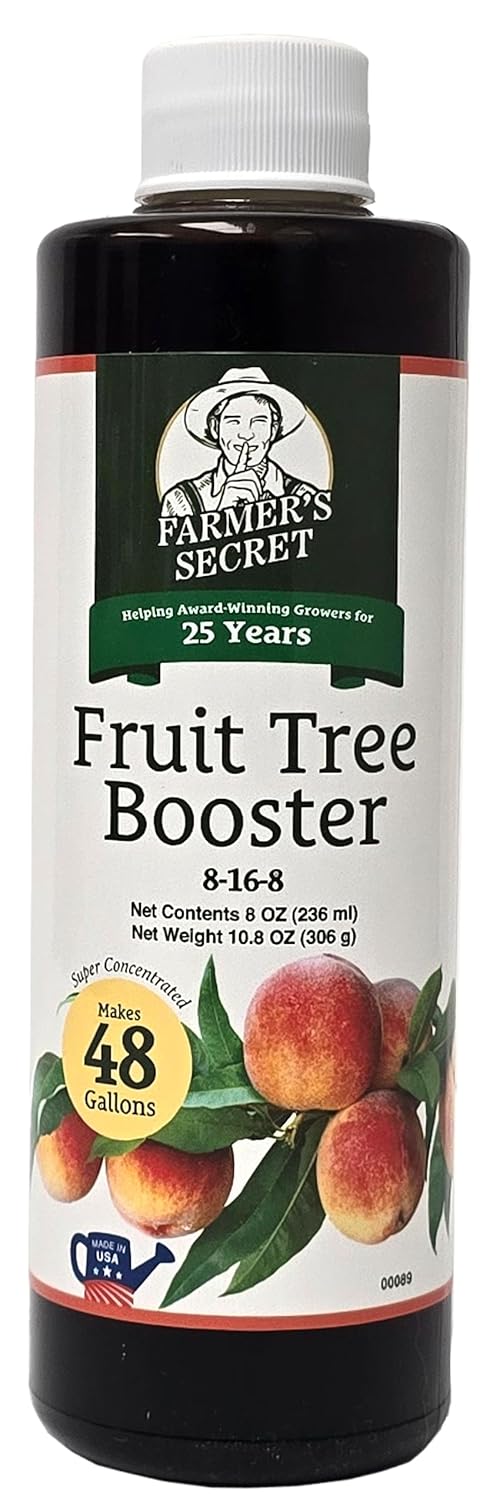
Farmer's Secret Fruit Tree Booster Liquid Fertilizer (8 oz)
| Item Form | Liquid |
|---|---|
| Specific Uses For Product | Plant Growth, Fruit Production |
| Coverage | Full |
| Target Species | Apple, Banana, Peach |
| Unit Count | 7.98 Fluid Ounces |
This concentrated liquid booster is designed for fruit trees and is used as a weekly soil drench or foliar feed to support root growth and fruit production. The formula emphasizes phosphorus to encourage strong roots and early-season fruit development while also supplying nitrogen, potassium and trace minerals like zinc and iron. It is highly concentrated so a teaspoon per gallon is the standard dilution, with higher recommended doses for young trees and mature trees, which makes a small bottle go a long way. Practical benefits include quick availability of nutrients compared with granules, compatibility with watering cans, sprayers and irrigation systems, and clear directions aimed at beginners. Important limitations are that you must follow dilution guidance to avoid overfeeding and the 8 ounce bottle is small, so multiple trees or long seasons may require repeat purchases or larger sizes. The product carries safety advice to keep it away from children and to avoid skin or eye contact.
Best for: Gardeners who want a beginner-friendly, agronomist-formulated liquid fertilizer to boost root strength and fruiting on apple trees and prefer a product with clear weekly dosing guidance.
Less Ideal for: Large-scale growers or those managing many mature trees who need bulk or measured NPK analyses for precise fertility programs should consider larger or lab-analyzed options.
- Highly concentrated formula stretches a small bottle across multiple feedings
- Phosphorus-forward blend supports root expansion and early fruit set
- Suitable for soil drench or foliar feeding and compatible with irrigation systems
- Includes both macronutrients and trace minerals for more complete nutrition
- Clear, simple dilution and feeding guidance for beginners
- Small 8 ounce bottle may not be economical for large orchards or many trees
- Requires careful dilution to avoid potential overapplication
- Ingredient list is general rather than listing exact nutrient percentages
Verdict: A concentrated, easy-to-use liquid booster that gives apple trees quick-access phosphorus and trace minerals to strengthen roots and encourage fruiting.
Jobe's Organics Granular Fruit & Nut Fertilizer, 4 lb

| NPK | 3-5-5 |
|---|---|
| Target Species | Fruit and nut |
| Item Form | Granules |
| Unit Count | 64 Ounce |
| Specific Uses For Product | Plant Growth, Root Development, Seed Development, Soil Conditioning |
Jobe's Organics Granular Fruit & Nut Fertilizer is a small-bag, slow-release granular designed to feed the roots of fruit and nut trees, including pears. It supplies a balanced 3-5-5 NPK plus calcium, magnesium, and sulfur derived from organic sources such as feather meal and bone meal. Typical use is to broadcast or side-dress around the root zone every 4 to 8 weeks during the growing season; granules release nutrients gradually so you do not need frequent reapplication. Benefits include organic certification for use in organic gardens, straightforward measuring and application, and nutrients aimed at improving bloom and fruit set rather than quick leafy growth. Important limitations are the small 4 lb bag size, which means multiple bags will be needed for larger orchards, and the lower nitrogen ratio compared with general-purpose fertilizers if you want foliage-heavy growth. It is safe to use around people and pets when directions are followed, but users should avoid applying in windy conditions to prevent drift.
Best for: Home gardeners and small-plot fruit growers who prioritize organic inputs and want an easy-to-apply fertilizer to support fruit set and steady production in pear trees.
Less Ideal for: Commercial orchards or large properties that need bulk fertilizer or fast-acting high-nitrogen feed to drive rapid vegetative growth.
- OMRI listed organic formula suitable for certified organic gardens
- Balanced 3-5-5 NPK geared toward flowering and fruit production
- Slow-release granules that feed roots over weeks reducing application frequency
- Includes secondary nutrients like calcium and magnesium to support fruit quality
- 4 lb bag is small for multiple or mature trees
- Lower nitrogen percentage may be insufficient when rapid vegetative growth is desired
Verdict: A small, OMRI-listed granular fertilizer that reliably supports flowering and fruit production in pear trees for gardeners who prefer organic, slow-release nutrition.
Espoma Organic Bio-Tone Starter Plus 4-3-3 Organic Starter Fertilizer, 8 lb

| Item Form | Granules |
|---|---|
| Application Method | Mix with soil |
| Specific Uses For Product | Gardening |
| Target Species | For everything you plant |
Espoma Organic Bio-Tone Starter Plus is a granular, ready-to-use starter fertilizer designed for planting and transplanting a wide range of garden plants. You mix it into backfill soil or potting mixes so the nutrients and added mycorrhizae sit in the root zone at planting time. The formula combines an organic 4-3-3 nutrient ratio with beneficial bacteria, humates, and both endo and ecto mycorrhizae to encourage faster root development, improved soil structure, and better establishment under stressful conditions. Typical uses include flower beds, bulbs, transplant holes, and planting mixes where quick root growth matters. Because it is organic and approved for organic gardening, it is suited to gardeners who prefer natural inputs. The main limitations are that it is intended as a starter or planting amendment rather than an all-season feed and dosing is by volume for different applications so you need to follow the mixing instructions for correct results. For gardeners wanting an easy organic boost at planting, this product provides a focused, microbially active start.
Best for: Gardeners who prioritize natural, microbially active amendments and want a reliable organic boost when planting or transplanting ornamentals, vegetables, and bulbs.
Less Ideal for: Buyers looking for a one-product solution for seasonal feeding or those who prefer liquid feeds or quick-release chemical fertilizers for immediate foliar results.
- Contains both endo and ecto mycorrhizae to aid root establishment
- Organic 4-3-3 formula enhanced with beneficial bacteria and humates
- Ready-to-use granules that are mixed into soil at planting
- Approved for organic gardening and made by a long-standing organic fertilizer brand
- Formulated primarily for initial planting and transplant use rather than ongoing feeding
- Dosing instructions vary by application and require measuring by volume for correct results
Verdict: Choose this if you want an organic, microbe-enhanced starter fertilizer to help new plantings establish strong roots.
Miracle-Gro Fruit & Citrus Plant Food Spikes (12-count)

| Item Form | Sticks |
|---|---|
| Specific Uses For Product | Fruit & Citrus Tree Care |
| Application Method | Insert spikes into the ground |
| Mixing Ratio | 10:15:15 |
| Number of Items | 12 |
These Miracle-Gro Fruit & Citrus Plant Food Spikes are pre-measured, slow-release sticks designed to feed in-ground fruit and citrus trees, including avocados, with a 10-15-15 NPK formula. Use is simple: water the soil to soften it, place spikes around the tree drip line according to the label chart, then drive them below the soil surface with a mallet or by stepping on them. The spikes deliver nutrients directly to the root zone, which reduces mess compared with granular feeding and eliminates monthly mixing. They are intended for a twice-yearly schedule, one application in early spring and another in mid-fall, so maintenance is low. Because the spikes are targeted and contain a balanced NPK higher in phosphorus and potassium, they can support flowering and fruit set for productive trees. Limitations to note are the infrequent feeding schedule and fixed nutrient ratio, so if your soil test shows different needs or you prefer monthly liquid feeding you may need supplemental products. Very compact root zones or heavy clay that stays hard when wet can make insertion difficult without extra effort or tools.
Best for: Home gardeners who want a low-effort, seasonal fertilizer for established avocado and other fruit trees and who prefer a simple apply-twice-a-year routine backed by broad user experience.
Less Ideal for: Growers who rely on frequent liquid feeding, need a customized nutrient program from soil tests, or work exclusively with container-grown trees.
- Direct root-zone delivery reduces surface runoff and mess compared with broadcast granules
- Pre-measured spikes make seasonal feeding fast and low-effort
- 10-15-15 NPK supports flowering and fruit development useful for fruiting trees
- Works on a range of trees listed for the product including avocado and palm
- Fixed NPK ratio and twice-yearly schedule may not match specific soil test recommendations
- May be hard to insert in very compacted or rocky soils without a mallet or tool
Verdict: A low-maintenance, targeted fertilizer solution that makes seasonal feeding of avocado and other fruit trees quick and reliable.
Jobe's Organics Granular Fruit & Citrus Fertilizer, 4 lb

| Item Form | Granules |
|---|---|
| Specific Uses For Product | Plant Growth, Root Development, Seed Development, Soil Conditioning |
| Application Method | Spread evenly around base |
| NPK | 3-5-5 |
| OMRI Listed | Yes |
This granular Jobe's Organics fertilizer is designed to feed fruit and citrus trees with a slow-release, root-targeted NPK of 3-5-5. It is typically applied by measuring and spreading the granules evenly around the base of the tree, then watering in; applications are recommended every 4 to 8 weeks during the growing season. Notable features include OMRI listing for organic gardening, a blend of feather meal, bone meal and processed poultry manure for organic nutrient sources, and a resealable bag for convenient storage. In practice the formula supports root development and fruit set without synthetic chemicals, and the slow-release nature reduces the need for very frequent feeding. Limitations are that the lower nitrogen level makes it better suited for fruiting and flowering stage nutrition rather than rapid leafy growth, and larger trees will require repeated applications or larger quantities. For gardeners aiming for an organic, low-fuss feed for citrus, this provides predictable, targeted nutrition, but it is not a quick-fix soluble feed for immediate green-up.
Best for: Gardeners who prefer organic, low-maintenance feeding for citrus and fruit trees and want a slow-release product that focuses on fruit and root health.
Less Ideal for: Growers needing fast, high-nitrogen correction or a soluble foliar feed; landscapers managing many mature trees who need bulk quantities more often.
- OMRI listed organic formula suitable for certified organic gardens
- Balanced 3-5-5 NPK aimed at improving flowering and fruit production
- Slow-release granules that feed roots over time and reduce application frequency
- Resealable packaging keeps product fresh between uses
- Lower nitrogen content means it will not rapidly promote leafy growth
- 4 lb bag may be insufficient for mature trees or larger plantings
Verdict: A reliable OMRI-listed granular fertilizer that delivers slow-release, fruit-focused nutrition for organic citrus gardeners.
Choosing the Right Fertilizer for New Apple Trees: Key Factors to Consider
Nutrient Ratio and Timing
A fertilizer's N-P-K ratio determines how a young apple tree allocates growth energy. New trees benefit from moderate nitrogen to support leaf and shoot formation, but excess nitrogen early on can produce weak, overly vegetative growth and delay structural wood development.
Phosphorus supports root establishment and should be present in sufficient amounts during the first growing season. Potassium helps general vigor and disease resistance. Consider seasonality: give balanced, gentle feeding in the first spring and avoid high-nitrogen boosts late in the season that could interfere with winter hardening.
Release Type and Longevity
Slow-release or controlled-release fertilizers provide steady nutrition over weeks to months, reducing the chance of nutrient spikes that stress young roots. Granular slow-release or organic-amendment-based options tend to be safer for transplants than quick-release soluble formulas.
Knowing how long a product feeds helps you time applications with mulching and irrigation. Fast-release products can be useful for correcting a clear deficiency but are riskier as routine feeds for newly planted apple trees.
Form and Application Method
Fertilizers come as granules, spikes, liquids, and organic amendments. Granules spread under mulch or banded around the root zone are common for home gardeners because they are simple and slow to act. Liquid feeds offer quicker uptake but require careful dilution to avoid burning roots.
Consider how you will access the root zone without disturbing the new root system. Surface-applied, slow-release granules or lightly worked organic materials are often best for young trees to avoid damaging seedlings or root collars.
Salt Content and Root Safety
Salt-heavy formulations can desiccate or burn fine feeder roots, especially in newly planted trees with limited root mass. Look for products with low salt index or those labeled safe for seedlings and transplants.
If you use a more concentrated formula, adjust application rates, and ensure consistent watering to dilute salts. Avoid high-salt foliar feeds on new trees and be cautious with repeated applications in dry soils where salts accumulate.
Compatibility with Soil and Mulch Practices
How a fertilizer interacts with your soil type and mulching strategy affects nutrient availability. Organic materials and slow-release granules break down differently in heavy clay than in sandy soils, and mulches can either slow nutrient release or help retain moisture that aids nutrient uptake.
Match product choice to your soil: lighter soils may benefit from more frequent, lighter feeds, while heavier soils can use longer-acting formulas. Also think about whether the fertilizer can be applied safely on top of an existing mulch layer or needs to be incorporated into a planting ring.
Ease of Measuring and Applying Correct Rates
Accurate dosing is important for young trees because over-application causes damage. Products with clear, tree-size-based application instructions reduce guesswork. Granular products with easy-to-read measuring scoops or clear spreader settings help home gardeners apply consistent amounts.
If a product requires dilution or repeated small applications, assess whether you will reliably follow that schedule. Simpler application regimens lead to more consistent results in typical backyard settings.
When to Start Fertilizing Newly Planted Apple Trees
Begin feeding only after the tree has shown signs of active growth and the transplant shock has eased. For most climates this means waiting until new shoots or leaves appear in spring rather than applying heavy feeds at planting time.
A light, targeted application timed with the first flush of growth supports root establishment without encouraging an early surge of weak top growth. Avoid late-season nitrogen that can delay dormancy.
- Apply first light feeding in early active growth, not at planting for most young trees
- Avoid high-nitrogen applications late in the season
- Water thoroughly after granular applications to move nutrients toward roots
How to Apply Fertilizer Around the Root Zone
Place fertilizer where the feeder roots can access nutrients, typically in a ring that extends from just outside the rootball to the dripline as the tree grows. For very young trees with small root spread, keep applications close to the planting hole but not touching the trunk.
Surface applications under mulch are convenient, but ensure the product will release through the mulch. If you need to incorporate a product, do so gently to avoid cutting roots.
- Use a shallow application ring rather than piling material against the trunk
- Measure according to label instructions scaled to tree age or trunk diameter
- Reapply based on product longevity, not on a fixed calendar if the product provides season-long feeding
Organic Vs Synthetic Options for Establishment
Organic fertilizers typically release nutrients gradually and also contribute to soil biology, which benefits long-term soil health and root function. They are forgiving if you miss a timing window because microbial breakdown moderates release.
Synthetic products can provide precise N-P-K ratios and may correct deficiencies more quickly, but they require accurate dosing and mindful timing to avoid over-stimulating top growth in young trees. Choose based on your priorities for soil improvement, speed of correction, and application convenience.
- Organics improve soil structure and microbial life but act more slowly
- Synthetics act predictably and fast but need careful rate control
- Combining small amounts of both approaches can give balance in some gardens
Adjusting Feeding to Soil Test Results
A basic soil test informs whether your planting site lacks phosphorus, potassium, or has an unusual pH that affects nutrient availability. For new apple trees, correct underlying soil issues before relying solely on fertilizer to fix growth problems.
If a test shows adequate phosphorus and potassium, focus on modest nitrogen to encourage steady growth. If deficiencies are identified, select products formulated to address those specific shortfalls and follow the test recommendations for application rates.
- Test soil before the first full growing season when possible
- Adjust fertilizer choice to correct identified deficiencies rather than applying blanket feeds
- Consider liming or sulfur only if pH adjustments are recommended by the test
Troubleshooting Common Early Growth Problems
Slow or sparse shoot growth can indicate low nitrogen, poor root establishment, or water stress. Check watering practices first because too little or too much water impairs nutrient uptake. If roots are healthy and soil moisture is adequate, a light, low-salt nitrogen boost may help.
Yellowing leaves with stunted growth can point to nutrient imbalances or compacted soils. A soil test and inspection of root health will guide whether to apply targeted nutrients or address physical soil issues.
- Address watering and soil compaction before increasing fertilizer rates
- Use foliar symptoms with caution; confirm with soil testing when possible
- Reduce or pause feeding if you see lush, soft growth that seems weak or leggy
How We Chose the Best Fertilizer for New Apple Trees
We evaluated fertilizers by focusing on criteria that matter for establishing young apple trees rather than for mature, fruiting specimens. Primary evaluation criteria included nutrient balance and slow-release behavior to ensure the tree gets steady, appropriate amounts of nitrogen without forcing weak, leggy growth. We also assessed form and ease of application because gardeners need options that work with transplants, small rootballs, and limited-stakes planting. Root and stem development influence long-term tree structure, so root-targeted nutrient delivery and adequate phosphorus and potassium levels were prioritized. Safety for young root systems and minimal salt risk guided exclusions; concentrated, high-salt formulas and products designed solely for heavy fruiting were not considered suitable for new trees. Longevity of feeding and the ability to integrate with mulching and irrigation practices were additional filters. We excluded specialty formulations that require professional equipment or are only appropriate for mature orchard production. The final shortlist balances predictable nutrient release, gardener-friendly application, and support for early-season root and trunk establishment.
FAQ
How much fertilizer does a newly planted apple tree need?
Amount depends on product concentration and the tree's size. For most slow-release granules, follow label guidance based on trunk diameter or age and err on the low side the first year to avoid root burn. Reapply only according to the product longevity.
Is it better to fertilize at planting or wait until the next spring?
Often it is better to wait until active growth resumes unless a soil test shows an immediate deficiency. Immediate heavy feeding can stress roots and encourage top growth before roots establish.
Can I use compost instead of commercial fertilizer for a new apple tree?
Compost is a good soil-building amendment that supports root health and microbial life but releases nutrients slowly. It can be used in combination with a modest fertilizer to provide both immediate and long-term benefits.
How often should I reapply fertilizer during the first two years?
Follow the product's stated feeding interval. Slow-release options typically need only one or two applications per growing season, while some liquid programs require more frequent, lighter feeds. Avoid repeated high-nitrogen applications.
Will fertilizing make my young tree fruit sooner?
Fertilizer helps overall growth and health but does not guarantee earlier fruiting. Encouraging balanced growth and good root establishment improves long-term productivity, but premature heavy feeding can delay structural maturity.
Final Verdict
For new apple trees prioritize gentle, predictable nutrition that supports root expansion and trunk development rather than pushing rapid top growth. Choose a fertilizer with an establishment-appropriate nutrient balance, low salt risk, and an application method you will follow consistently. Adjust choices based on your soil test, mulch strategy, and whether you prefer organic soil-building benefits or the precision of synthetic formulas. Ultimately, focus on steady, measured feeding and good cultural practices like proper mulching and watering. That approach gives young apple trees the best chance to develop strong structure and long-term productivity.
